EDITOR’S NOTE: Pretty Poison was on USA Up All Night as one of the third movies. I can’t find the date — do you know when it aired?
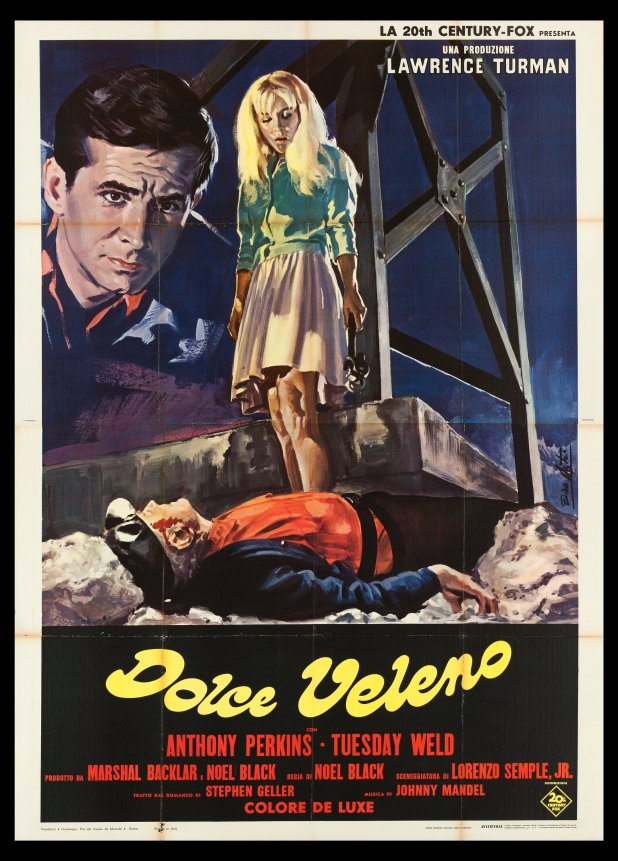
Dennis Pitt (Anthony Perkins) wants a life of adventure, and he gets it.
On parole from a mental institution — he set the fire that accidentally claimed the life of his aunt — he works a menial job watching bottles go through the line at Sausenfeld Chemical Company. So when he sees the gorgeous Sue Ellen Stepanek (Tuesday Weld) march across the field in her majorette uniform, he brings her along into the games in his head, pretending to be a CIA agent and having some fun with a young and innocent teenager.
Except that Dennis goes from being the antagonist to the protagonist.
Directed by Noel Black (Private School) and written by Lorenzo Semple Jr. (the TV Batman, Flash Gordon) from the book She Let Him Continue by Stephen Geller, Pretty Poison spends so much of the movie making us think that Dennis is the same kind of killer that Perkins played in Psycho — the last film he was in before going back to the stage — and he’s really just a scared little boy being shocked by the evil inside a gorgeous young lady.
Semple told Shock Magazine, “It was very hard to cast. Tuesday was excellent for it, but Tony was much too obvious for it. We really tried to find somebody young to do it. We never could find a new, young actor the studio would go with.”
Weld had tremendous issues with Black. She told Rex Reed it was “The least creative experience I ever had. Constant hate, turmoil and dissonance. Not a day went by without a fight. Noel Black, the director, would come up to me before a scene and say, ‘Think about Coca-Cola.’ I finally said, ‘Look, just give the directions to Tony Perkins, and he’ll interpret for me.” She further hated the movie, saying, “I don’t care if critics like it; I hated it. I can’t like or be objective about films I had a terrible time doing.”
The movie largely disappeared from theaters, and any reputation it had stemmed from critics like Pauline Kael, who vilified Fox for its failure to market PrettyPoison effectively. 1968 was a strange year. However, it was a time when the country felt like it was falling apart, and Robert Kennedy and Martin Luther King were both assassinated. A film that has a young woman gleefully accepting murder and even turning a gun on her mother (Beverly Garland) was going to have a hard time.
But wow — this movie. It really took me by surprise, and I loved the turn Perkins gives to his character; at the end, he is so frightened of Weld that he willingly goes to prison for her crimes. She’s learned nothing and is already moving on to her next victim, yet the end teases that parole officer Morton Azenauer (John Randolph) has figured her out. At one point, it seems like Dennis has all the answers, but when the world cracks on him, he becomes a child.
By the way, Dennis and Sue Ellen go to see The St. Valentine’s Day Massacre, directed by Roger Corman.
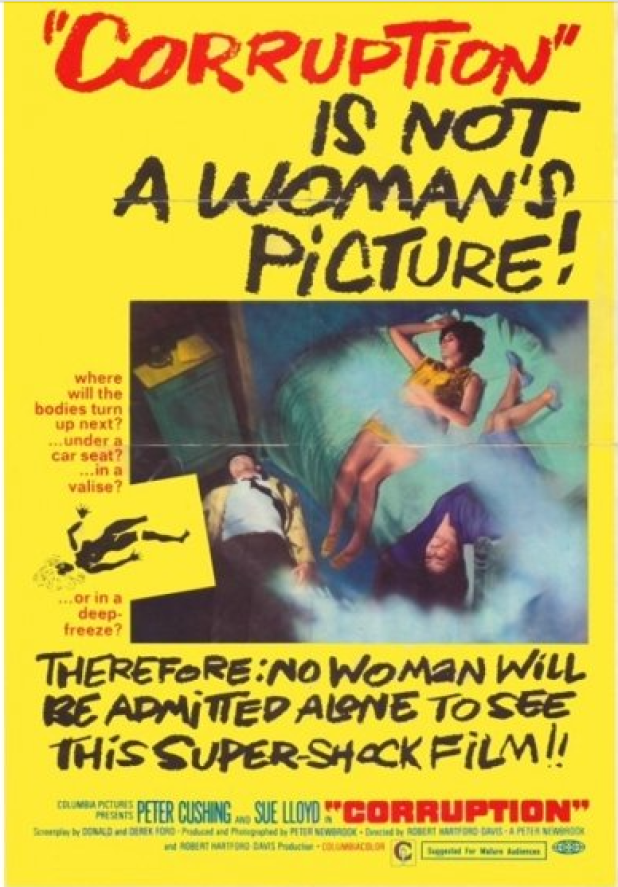
As the trailer will tell you, Corruption is not a woman’s picture.
That’s debatable.
What is not is that Corruption is a ripoff of Eyes without a Face.
But hey — some of my favorite movies are total rip-offs.
Renowned plastic surgeon Sir John Rowan (Peter Cushing) starts the movie at a swinging 60s party with his beautiful fiancée Lynn (Sue Lloyd, Hysteria). Sir John isn’t dealing well with all this counterculture excess, so when a pervy photographer makes a pass at his girl, he attacks the man, sending a hot light into Lynn’s face. This party may seem like a parody when seen today, but this is a serious scene, with Cushing facing the Summer of Love and not dealing so well with all of it.
Rowan pledges to fix Lynn’s scarred face through a combination of laser technology and a pituitary gland transplant. Sound good? Well, it’s fueled by murder, giving the fluids of young women to his wife, to keep her face from scarring and it needs to be repeated again and again to stop the scars from coming back. Everything goes well — as well as repeatedly killing people and basically feeding their skin to your wife can go– until Sir John and Lynn try to seduce a new victim who ends up being part of a gang of robbers.
Those criminals break into the home of Sir John and they soon learn his secret. However, no one profits from this knowledge, as everyone ends up getting killed by a surgical laser. And then, get this — it’s all a dream!
Cushing would say, “It was gratuitously violent, fearfully sick. But it was a good script, which just goes to show how important the presentation is.” You have to love a movie where Van Helsing flips out at a party that Austin Powers would say is way too mod. And wow, it’s pretty gory for a late sixties British movie!
Director Robert Hartford-Davis would also make Incense for the Damned, Gonks Go Beat and The Fiend.
Also, just to remind you one more time, Corruption is not a woman’s picture.
Bewitched aired throughout the most tumultuous time in modern history — hyperbole, that could also be today, but true, as rehearsals for this show’s first episode were on the day Kennedy was shot and the episode “I Confess” was interuppted by Martin Luther King Jr.’s death — from September 17, 1964, to March 25, 1972. The #2 show in the country for its first season and remaining in the top ten until its fifth season, it presents a sanitized and fictional world that at the time may have seemed contrary and fake to the simmering 60s, but today feels like the balm I need and an escape.
Within the home on 1164 Morning Glory Circle, Samantha (Elizabeth Montgomery) and Darrin Stephens (Dick York, later Dick Sargent) have just had a whirlwind romance and ended up as husband and wife. At some point, she had to tell him that she was a witch, a fact that he disapproved of, and that she should be a normal housewife instead of using her powers. Yet she often must solve their problems — usually caused by her family, such as her mother Endora (Agnes Moorehead) — with a twitch of her nose.
Creator Sol Saks was inspired by I Married a Witch and Bell, Book and Candle, which luckily were owned by Columbia, the same studio that owned Screen Gems, which produced this show. You could use either of those movies as a prologue for this, which starts in media res — I like that I can use such a highbrow term to talk of sitcoms — with our loving couple already settling into the suburbs.
Author Walter Metz claims in his book Bewitched that the first episode, narrated by José Ferrer, is about “the occult destabilization of the conformist life of an upwardly mobile advertising man.” As someone who has spent most of his life in marketing, maybe I should look deeply into the TV I watched as a child. Bewitched was there all the time in my life, wallpaper that I perhaps never considered.
Head writer Danny Arnold, who led the show for its first season, considered the show about a mixed marriage. Gradually, as director and producer William Asher (also Montgomery’s husband at the time) took more control of the show, the magical elements became more prevalent. What I also find intriguing is that with the length of this show’s run, it had to deal with the deaths of its actors and York’s increasing back issues, which finally forced him to leave the show and another Dick, Dick Sargent, stepping in as Darren, a fact that we were to just accept.
That long run, the end of Montgomery and Asher’s marriage and slipping ratings led to the end of the show, despite ABC saying they would do two more seasons. Instead, Asher produced The Paul Lynde Show, using the sets and much of the supporting cast of this show. He also produced Temperatures Rising, which was the last show on his ABC contract, which ended in 1974.
Feminist Betty Friedan’s two-part essay “Television and the Feminine Mystique” for TV Guide asked why so many sitcoms presented insecure women as the heads of households. None of this has changed much, as the majority of sitcoms typically feature attractive women and funny but large husbands, a theme created by The Honeymooners, and the battles between spouses. I always think of I Dream of Jeannie, a show where a powerful magical being is subservient to, well, a jerk. At least on Bewitched, Samantha is a powerful, in-control woman with a mother who critiques the housewife paradigm.
Plus, unlike so many other couples on TV at the time, they slept in the same bed.
Bewitched‘s influence stretched beyond the movie remake. The show has had local versions in Japan, Russia, India, Argentina and the UK, while daughter Tabitha had a spin-off. There was even a Flintstones crossover episode!
Plus, WandaVision takes its central conceit — a witch hiding in the suburbs — from this show. And Dr. Bombay was on Passions!
This is the kind of show that has always been — and will always be — in our lives. Despite my dislike of Darren’s wedding vows of no magic, there’s still, well, some magic in this show. Just look at how late in its run it went on location to Salem for a multi-episode arc, something unthought of in other sitcoms.
You can watch this just for the show itself, to see the differences between the two Darrens and when Dick York had to film episodes in special chairs because of his back pain, when the show did tricks like have Montgomery (using the name Pandora Spocks) playing Samantha’s cousin Serena to do episodes without York or just imagine that the world was changing outside. Yet, magic and laughter were always there on the show, throughout the lives, divorces and deaths of its principals and supporting cast.
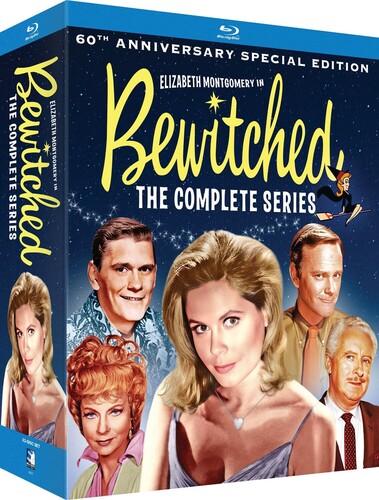
The Mill Creek box set is an excellent, high-quality way to just sit back, twitch your nose and get away from it all. This 22-disc set has everything you’d want on Bewitched, including extras like Bewitched: Behind the Magic, an all-new documentary about the making of Bewitched, featuring special guest appearances by actor David Mandel (Adam Stephens), Steve Olim (who worked in the make-up department at Columbia), Bewitched historian Herbie J Pilato, film and television historian Robert S. Ray, Bewitched guest star Eric Scott (later of The Waltons) and Chris York, son of D. York (the first Darrin). There are also sixteen new episodic audio commentaries, moderated by Herbie J Pilato that include behind-the-scenes conversations with Peter Ackerman (son of Bewitched executive producer Harry Ackerman), David Mandel, Bewitched guest star Janee Michelle (from “Sisters at Heart”), Steve Olim, Robert S. Ray, former child TV actors and Bewitched guest stars Ricky Powell (The Smith Family), Eric Scott (The Waltons), and Johnny Whitaker (Family Affair and Sigmund and the Sea Monsters) and Chris York (son of D. York). There’s also an exclusive 36-page booklet featuring pieces by Bewitched historian Herbie J. Pilato, as well as an episode guide. You can order it from Deep Discount.
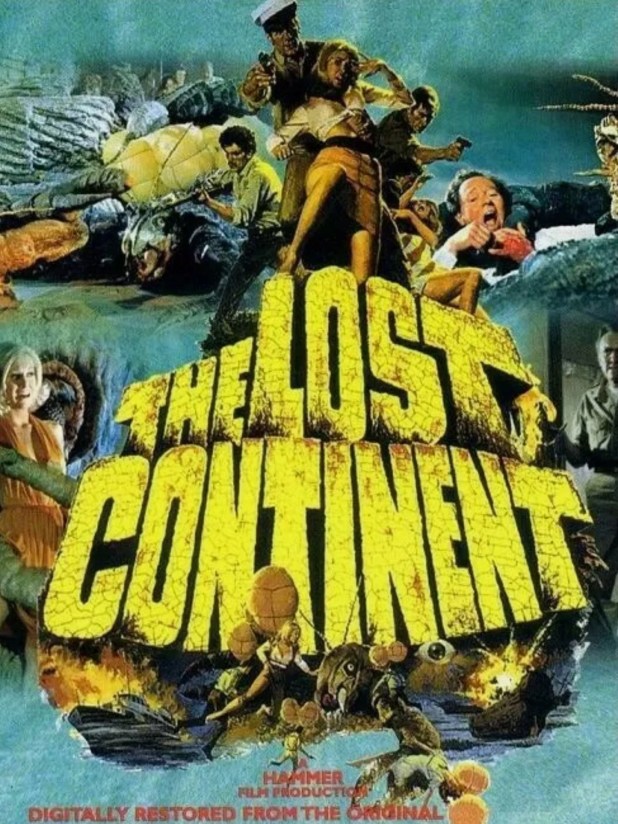
EDITOR’S NOTE: Lost Continent was on the CBS Late Movie on April 28 and October 25, 1972 and November 22, 1973.
Produced, directed and written by Michael Carreras — based on Dennis Wheatley’s novel Uncharted Seas — this is a rare Hammer that’s an adventure movie and not horror. It taught me if you’re taking a tramp steamer, make sure they’re not carrying white phosphorous to sell. Also: Check out the weather, because if a hurricane is coming, it’s not a good idea to be on a boat. The stolen stuff blows up, the hurricane hits, the boat crashes.
This will bring you to an island with a shipwrecked Spanish galleon and an island ran by the child descendent of Sanish conquistadors. That kid gets stabbed at one point — by a cleric — and a priest with the plague and all of his monks burn inside a church as pipe organ music plays. There’s also a shark attack, a flare gun accident, killer seaweed, weird monsters, barbarians, leprosy, a giant hermit crab, a big scorpion and so many ideas that you’ll wonder if you’re still watching the same movie.
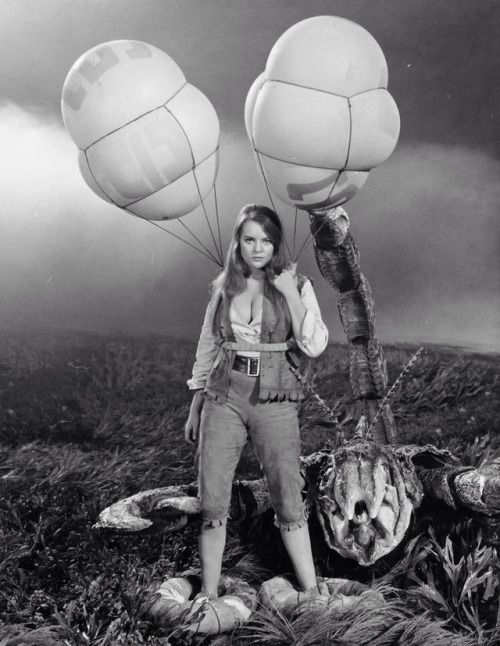
It has a theme song by The Peddlers, so it has that going for it. Hammer girls include Hildegard Knef (who would play the witch in Witchery), Suzanna Leigh (Lust for a Vampire) and Dana Gillespie (who dated Bowie when she was 14) — who plays a native girl named Sarah who uses balloons and snowshoes to walk through the deadly seaweed. Huh? Yeah!
EDITOR’S NOTE: Sol Madrid was on the CBS Late Movie on March 8 and November 9, 1972, September 26, 1973 and January 30, 1975.
Also known as The Heroin Gang and The Secret File of Sol Madrid, this is based on Fruit of the Poppy by Robert Wilder. Directed by Brian G. Hutton (Where Eagles Dare, Kelly’s Heroes) and written by David Karp, it stars Man from U.N.C.L.E.‘s David McCallum as the titular character.
Small-time crook Harry (Pat Hingle) is trying to escape with half a million dollars of stolen organized crime money, taking his girl, Stacey (Stella Stevens), to Madrid. Hitman Dano Villanova (Rip Torn, who replaced John Cassavetes, who was “sick” but really walked off the set; he would later say “Ricardo Montalban is to improvisational acting what Mount Rushmore is to animation.”) is hired to murder him, while drug dealer Emil Dietrich (Telly Savales) and a crooked cop named Jalisco (Ricardo Montalbán) are making a deal to move tons of heroin into the U.S. Sol Madrid must deal with all of them.
Anyway, this was supposed to be a Eurospy, but it doesn’t have the gadgets. It does have Stella Stevens.
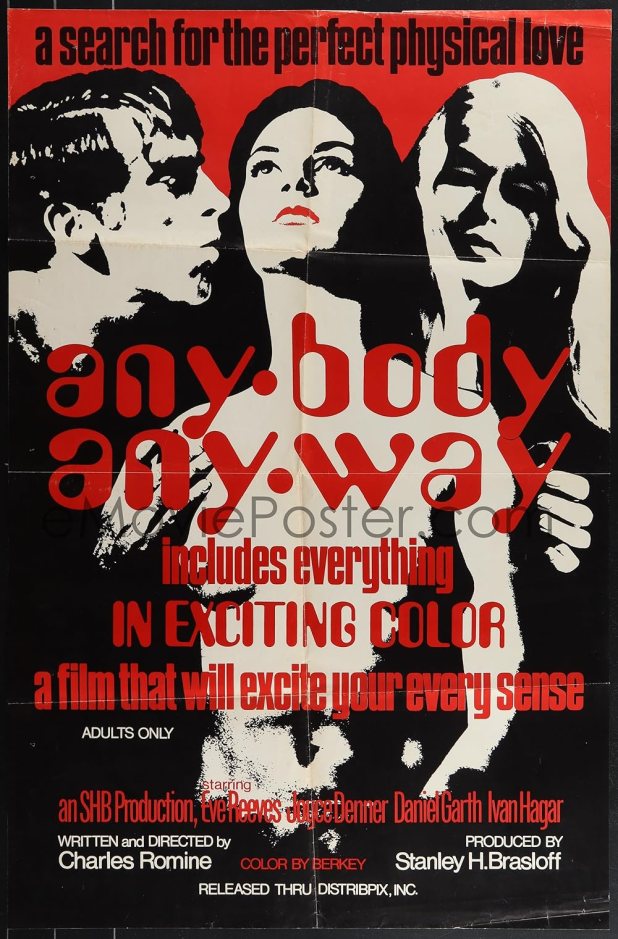
Also known as Any Body…Any Way, this movie was exactly what I wanted it to be: fucking weird.
When Terry Wilson (Joyce Danner) and Ann Henderson (Eve Reeves) go to the middle of nowhere for a barn party, Ann is nearly raped but saved by the middle-aged, British and oh-so-strange Mr. Bradley (Daniel Garth). They ditch the party and Ann’s man, but then run out of gas because otherwise we wouldn’t have a movie.
In the middle of nowhere, they walk up to a house — on the suggestion of a drifter (Ivan Agar, Laughing Crow from Shriek of the Mutilated) who is more than he seems — that just so happens to belong to Mr. Bradley and his sister Ida (Irene Lawrence). They have no phone and their car isn’t working either, so they stay for dinner and a bed for the evening. Ida needs the company. She’s been there for two years, ever since her mortician brother retired.
So why are there bars on the windows? Why did their door lock behind them? Why are the closest filled with women’s clothing of all sizes? Why would Terry pick this exact and terrifying time to finally get sapphic with her office buddy?
The Bradleys wake them up and let them know that they’re in control and must play their demented games with them or end up like all the embalmed bodies in the basement. Mr. Bradley just wants to discover the perfect way to make love, so if he has to tie up women and then kill them, that’s how his laboratory of libido operates.
I mean, this is a movie that starts with fifteen minutes of go go dancing in a barn — I played in a band that practiced in a barn and it’s hard to sing when all you can smell is shit, so I can’t even imagine go go dancing while smelling cow feces — and ends with that same barn and Ann going off with the guy who tried to rape her and Terry finding another young lady to enjoy a game of flats with. Yes, I used a 17th-century term — lesbian sex was thought to look like two playing cards rubbing together — in this article. I bring you quality euphemisms, my friend.
Did you not see Harry Novak’s signature hanging above this? Behind Locked Doors was directed and co-written by Charles Romine, who would go on to make Mysteries of the Gods. In contrast, producer and uncredited co-writer Stanley H. Brassloff made one of the most upsetting softcore movies, Toys Are Not for Children.
This movie looks way better than it should, with great lighting, bright colors, and a room full of gorgeous and dead women — or are they? — posed seductively, along with an off-the-rails room destroying catfight and an ending that blew my mind, as deceased denizens of the strange mansion come back for one last dance with brother and sister into the inferno. This is the kind of movie that makes you stay for all that barn dancing, and you wonder, “When does it get weird? Sam promised me it would get there,” and when it does, you’ll text me and say, “I can’t believe that this is a real movie.” Well, it is, pal. It sure is.
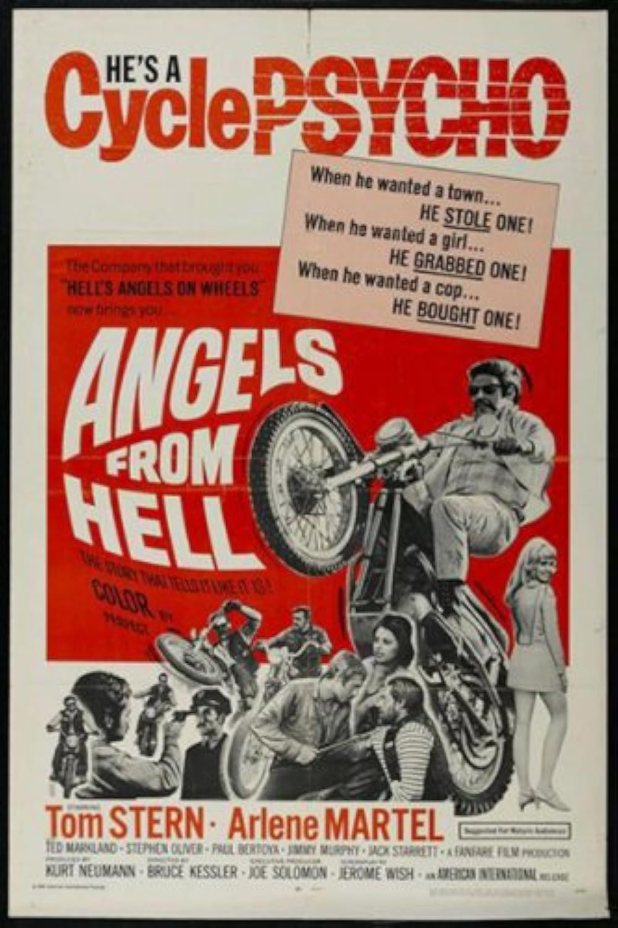
Bruce Kessler had a wild life. A race car driver, the last person to speak to James Dean, a survivor of a racing crash that put him into a coma, a world-class skeet and trap shooter, and the director of tons of TV shows and movies (Cruise Into Terror, Deathmoon) and movies (Simon King of the Witches, Killers Three, The Gay Deceivers), he led what we call a life.
Mike (Tom Stern) comes back from ‘Nam and back to leading his gang, the Madcaps. Unlike many of these biker movies, the main cop — Bingham (Jack Starrett) — is actually sympathetic to the motorcyclists.
But as great as the title is and as cool as biker movies can be—often hiring real gang members and having them do stunts—this just can’t decide whether the bikers should be heroic or scumbags, and it can’t have it both ways.
At least it has Arlene Martel in the cast. She was also Spock’s would-be wife, T’Pring, in the “Amok Time” episode. She also played a character named Adultress 58 in Battlestar Galactica, and if that’s not a great band name, I have no idea what is. She also shows up in Dracula’s Dog, Bunny Yeager’s Nude Camera and Chatterbox! And if you were a ’90s hipster, you should know Von Dutch did the opening titles and murals.
Joe (Joe Weldon) is the man who gets the girls for a Sunset Strip go-go club. He also gets those girls for his own pleasure, as he starts the movie by taking Colette (Mary Bauer, who may have been in Lady Godiva Rides, The Divorcee and Street of a Thousand Pleasures but was also a production assistant on Sesame Street) back home for some clumsy sixties exploitation movie aardvarking.
There’s also Sandra and Billie, two ladies who do a BDSM routine that had to be volcanic back in 1968, but when voiced over today with “wow, look how out there these chicks” are VO and some amazing fuzz guitar, it’s kind of quaint. Then the ladies go home and get a vibrator that is so unsexual that in no way can you be turned on by. It looks like…man, I don’t even know. It looks like something you’d buy at Home Depot.
The girls decide to skip work the next day, which means that Joe has to bring in a new lady: Cindy (Pat Barrington), who tends the bar. If you didn’t guess by the fact that Pat Barrington is playing Cindy, well, in little time she’s the most popular dancer there is. Barrington is the queen of movies like this, as well as a life that Ashley West of The Rialto Report said was “a wild tale of sexploitation films, a serial killer, go-go dancing, sexual assault, Hollywood, nude modeling, Sam Fuller, Lenny Bruce, Robert Mitchum, and much more.” Barrinton was also the gold girl in Orgy of the Dead and shows up in The Satanist, Mantis In Lace and Sisters In Leather.
Anyways, the rest of the girls get upset and try to forcibly make her a daughter of Sappho, which leads to the police arriving and the end of the gravy train for Joe.
Director Zoltan G. Spencer also made seven other movies: The Hand of Pleasure, Danish & Blue, The Screentest Girls, Sisters In Leather, Tropic of Scorpio, The Satanist and Terror At Orgy Castle. He’s the voice of Joe in this and sounds world-weary. Joseph A. Ziemba from AGFA said that he was “a mysterious sex-horror sorcerer who created happy un-worlds that writhed with sexual chaos, shabby sets, and baffling tangents.” I want to thank him for being part of my favorite genre: the sex movie that doesn’t have any intention of turning you on.
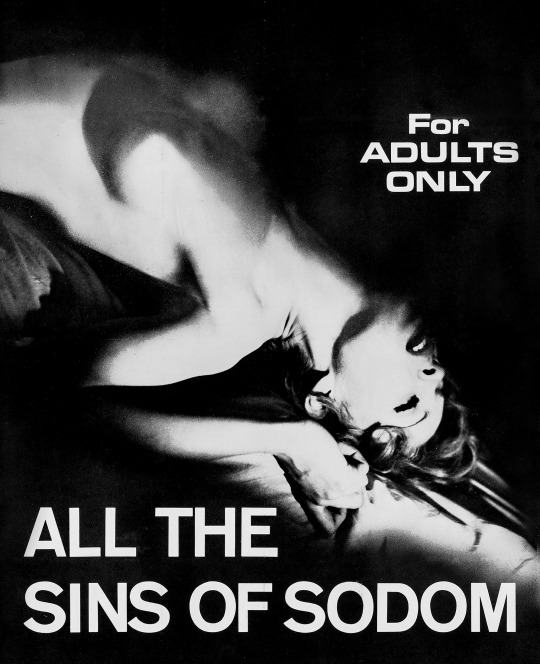
The title of this movie is awesome, but then I found out that it’s also called All The Evils Of Satan, and I don’t know if I could be more enthusiastic about a film.
New York City shutterbug Henning (Dan Machuen) is supposed to shoot some nudes for his agent Paula (Peggy Sarno), but is obsessed with shooting the evil that lives inside all women. To capture this, he takes images of Leslie (Maria Lease, who would go on to be a director of adult films, and Dolly Dearestand the script supervisor on Better Off Dead) as she hangs from the ceiling of his studio. After they make love, and while Henning usually never sees another of his conquests again, she feels different. She’s also mindblowingly gorgeous, which helps.
He also meets another model named Joyce (Marianne Prevost), for whom he feels sorry. She’s homeless and needs a hand up. He invites her to stay in his studio and assist him, but when he grows angry that he can’t capture with his camera what he sees with his eyes, he learns that she’s the perfect muse for his images of base morality. Paula even tells him she sent Joyce his way, claiming, “I sent her to you because she is what you’re looking for. If I ever I saw it, she’s the daughter of Satan.”
That means that things aren’t going to end well for anyone. Again, this is in stark black and white and while the lovemaking scenes are quite erotic, they’re mostly clothed. Then again, when they were made by Sarno, this burned the celluloid.
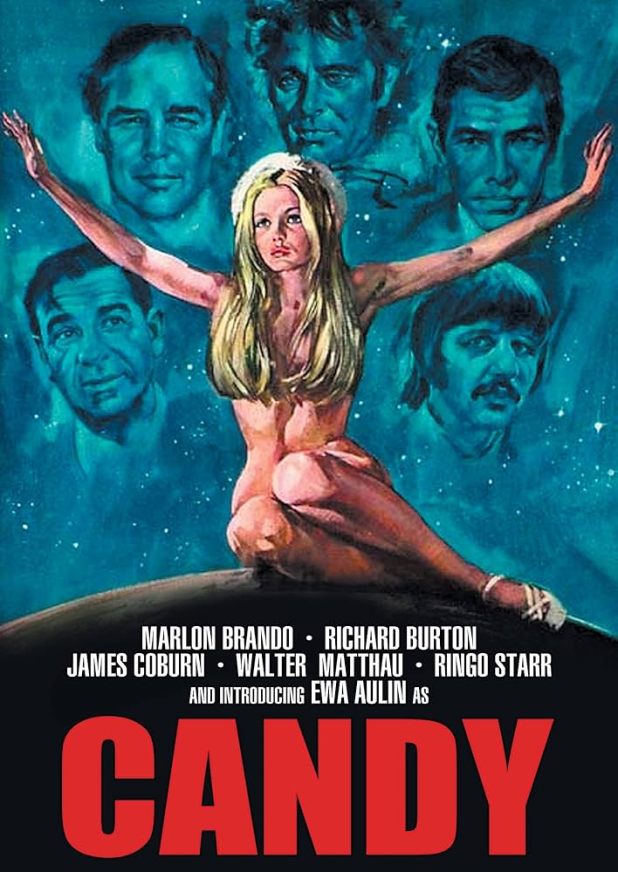
This felt like a can’t miss: the novel Candy by Terry Southern and Mason Hoffenberg using the name Maxwell Kenton. They got paid $500 by Olympia Press, the same people who printed the first edition of Lolita. They wrote it chapter by chapter, trading things back and forth. They were amazed that it became a big deal, as Hoffenberg said, “Do you remember what kind of shit people were saying? One guy wrote a review about how Candy was a satire on Candide. So, right away, I went back and reread Voltaire to see if he was right. That’s what happens to you. It’s as if you vomit in the gutter and everybody starts saying it’s the greatest new art form, so you go back to see it, and, by God, you have to agree.”
Candy Christian is a Midwestern girl who just wants to make people happy. Of course, being an eighteen-year-old and gorgeous blonde, most of them want to have sex with her, then own her. She wants to make love to the gardener, but that leads to her father nearly dying from a concussion and adventures that will take her around the world.
Originally, Frank Perry—who directed The Swimmer—was going to make this, and Hayley Mills would play Candy. Her father wouldn’t let her play the role, so Christian Macquand got the rights. He’d just helped Marlon Brando buy his island—Brando’s son was named for him—and that got the great actor on board, as well as other big-time box office names.
In Patrick McGilligan’s Backstory 3: Interviews with Screenwriters of the 60s, Southern said that the director “disappointed me by casting a Swedish for the lead role, which was uniquely American and midwestern. He thought this would make Candy’s appeal more universal. That’s when I withdrew from the film.”
That Swedish girl is Ewa Aulin, who is naturally attractive and had already been in the Tinto Brass giallo Col cuore in gola and Giulio Questi’s Death Laid an Egg. Aulin would only be in one other movie that U.S. audiences may see, Start the Revolution Without Me, before appearing in her husband John Shadow’s Microscopic Liquid Subway to Oblivion and Italian films including The Double, When Love Is Lust, Legend of Blood Castle, Death Smiles on a Murderer and Una vita lunga un giorno. By 23, she had tired of acting, divorced Shadow, and met real-estate developer Cesare Paladino. She had two daughters and became a schoolteacher.
Buck Henry took over the script, and the movie got made.
The film starts with Candy daydreaming in her father’s (John Astin) class; she soon falls for the charms of the poet MacPhisto (Richard Burton), who is too drunk to make love to her. The gardener, Emmanuelle (Ringo Starr), attacks her, and she gives in; when his family finds out — he was about to be a priest — they are attacked by his sisters Lolita (Florinda Bolkan in her first movie), Conchitya (Marilù Tolo!) and Marquita (Nicoletta Machiavelli!). Her father gets a brain injury and she goes off with his brother (also Astin) and his wife Livia (Elsa Martinelli), but not before she’s nearly impregnanted by Brigadier General Smight (Walter Matthau) and lusted after by the man who saves her father’s life, Dr. Abraham Krankheit (James Coburn), and filmed by Jonathan J. John (Enrico Maria Salerno). Oh yeah- the doctor’s nurse is Rolling Stones muse Anita Pallenberg.
She meets many men — a hunchback (Charles Aznavour), a guru (Brando, who its said tried to have sex with her for real on camera) and another guru who enlightens her before its revealed that it’s her father and yes, they have just had sex — and by the end, wanders through a field of hippies and flies into space.
Southern said, “The film version of Candy is proof positive of everything rotten you ever heard about major studio production. They are absolutely compelled to botch everything original to the extent that it is no longer even vaguely recognizable.”
Brando said that this was the worst movie he ever made. But man, this excerpt from Marlon: A Portrait Of The Rebel As An Artist by Bob Thomas is just insane: “Brando, of course, wanted his portion of the script rewritten. The screenwriter was Buck Henry, a gifted young comedy stylist who had written The Graduate for the screen. Brandovisitedt Henry at the Plaza Athenee Hotel in Paris accompanied by the French moneyman for Candy, Peter Zoref, a conspiratorial-looking man who wore dark glasses indoors and out. The two visitors found Henry suffering from food poisoning. Henry tried to defer the conference, but Brando insisted on continuing, even while the writer went to the bathroom. While Henry retched, Brando shouted comments about how the comedy elements of his sequence could be heightened. There was a brief silence from within, and Brando opened the bathroom door to find Henry nearly unconscious, hunched over the toilet. Brando lifted the slender writer into his arms, carried him into the bedroom, and laid him out on the bed. Brando sat beside him and continued reading from the script and making suggestions to increase the hilarity. Zoref remained stolid behind his dark glasses, occasionally puffing on a cigar. A knock came on the door, and a waiter entered to remove the dinner tray. He stopped and surveyed the scene with open mouth: an (alleged) American gangster sitting in a chair like a stuffed figure, a thin corpse stretched out on the bed, a famous movie star sitting on the bed and guffawing over pages he was reading. The waiter slowly turned and walked out the door, closing it quietly behind him.”
This is the kind of movie that today gets one-star hate reviews by hip kids on Letterboxd who can’t be bothered to write much more than a sentence. It didn’t fare that well when it was released, either. But man, it’s a mess, a glorious mess, but one that has Coburn being incredible, famous people acting like morons and Aulin being some kind of android angel who has floated into this movie and bewitched everyone. She married Shadow while making this, a rock star who would one day write the 3D Matt Cimber martial arts movie Tiger Man.
So yeah, it’s a mess, but I love it for that. This is from a time when people were not afraid to fail and would throw money at projects that made no sense. Hollywood emerged from years of musicals and Westerns to try and become cinema, only to fall into blockbusters. But this emerged, a movie shot in France and Italy that looks luscious and yet is dumb throughout, a perfect blend of overindulgence and underwatched.


 B&S About Movies
You must be logged in to post a comment.