WEIRD WEDNESDAY: All the Sins of Sodom (1968)

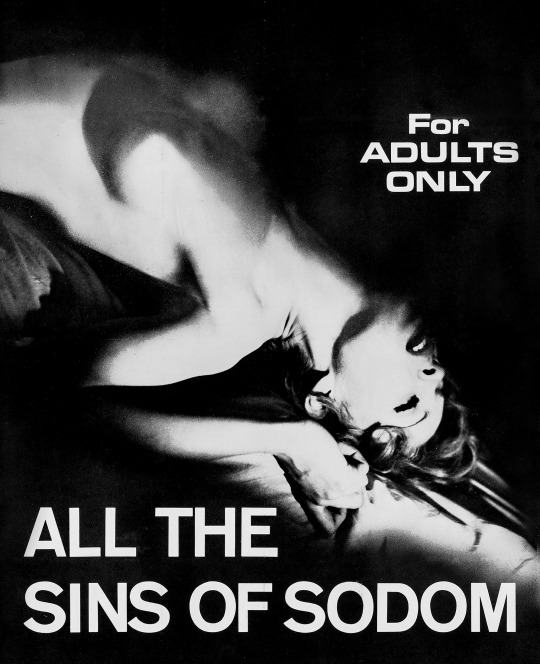
The title of this movie is awesome, but then I found out that it’s also called All The Evils Of Satan, and I don’t know if I could be more enthusiastic about a film.

New York City shutterbug Henning (Dan Machuen) is supposed to shoot some nudes for his agent Paula (Peggy Sarno), but is obsessed with shooting the evil that lives inside all women. To capture this, he takes images of Leslie (Maria Lease, who would go on to be a director of adult films, and Dolly Dearest and the script supervisor on Better Off Dead) as she hangs from the ceiling of his studio. After they make love, and while Henning usually never sees another of his conquests again, she feels different. She’s also mindblowingly gorgeous, which helps.

He also meets another model named Joyce (Marianne Prevost), for whom he feels sorry. She’s homeless and needs a hand up. He invites her to stay in his studio and assist him, but when he grows angry that he can’t capture with his camera what he sees with his eyes, he learns that she’s the perfect muse for his images of base morality. Paula even tells him she sent Joyce his way, claiming, “I sent her to you because she is what you’re looking for. If I ever I saw it, she’s the daughter of Satan.”

That means that things aren’t going to end well for anyone. Again, this is in stark black and white and while the lovemaking scenes are quite erotic, they’re mostly clothed. Then again, when they were made by Sarno, this burned the celluloid.

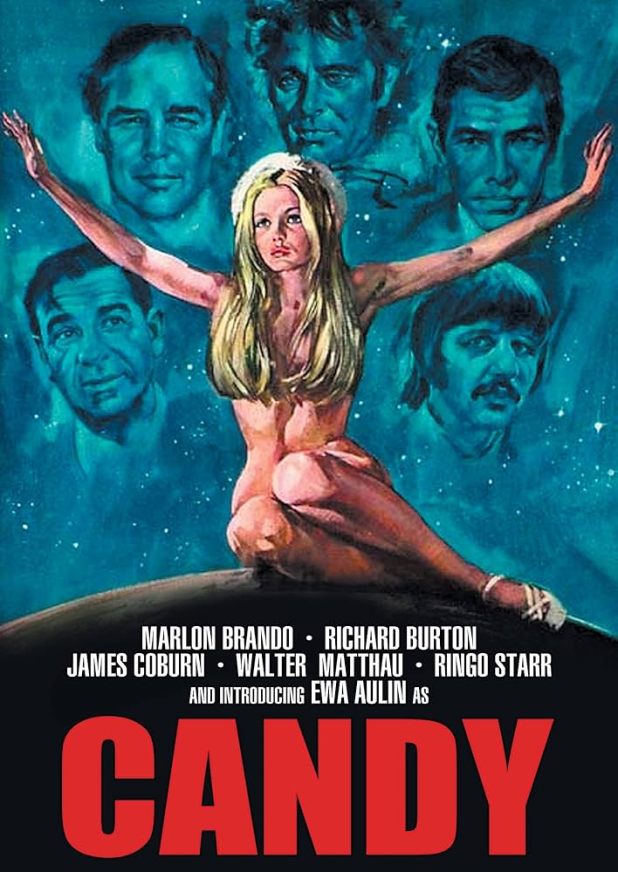
APRIL MOVIE THON 4: Candy (1968)

April 1: Drop A Bomb- Please share your favorite critical and financial flop with us!

I’m obsessed not just by flops but by the late 1960s and early 1970s, when Hollywood wanted to figure out how to get the kids into theaters. Easy Rider was a hit, so they financed movies like The Last MovieHeadBeyond the Valley of the DollsSkidooZabriskie Point and so many more.

This felt like a can’t miss: the novel Candy by Terry Southern and Mason Hoffenberg using the name Maxwell Kenton. They got paid $500 by Olympia Press, the same people who printed the first edition of Lolita. They wrote it chapter by chapter, trading things back and forth. They were amazed that it became a big deal, as Hoffenberg said, “Do you remember what kind of shit people were saying? One guy wrote a review about how Candy was a satire on Candide. So, right away, I went back and reread Voltaire to see if he was right. That’s what happens to you. It’s as if you vomit in the gutter and everybody starts saying it’s the greatest new art form, so you go back to see it, and, by God, you have to agree.”

Candy Christian is a Midwestern girl who just wants to make people happy. Of course, being an eighteen-year-old and gorgeous blonde, most of them want to have sex with her, then own her. She wants to make love to the gardener, but that leads to her father nearly dying from a concussion and adventures that will take her around the world.

Originally, Frank Perry—who directed The Swimmer—was going to make this, and Hayley Mills would play Candy. Her father wouldn’t let her play the role, so Christian Macquand got the rights. He’d just helped Marlon Brando buy his island—Brando’s son was named for him—and that got the great actor on board, as well as other big-time box office names.

In Patrick McGilligan’s Backstory 3: Interviews with Screenwriters of the 60s, Southern said that the director “disappointed me by casting a Swedish for the lead role, which was uniquely American and midwestern. He thought this would make Candy’s appeal more universal. That’s when I withdrew from the film.”

That Swedish girl is Ewa Aulin, who is naturally attractive and had already been in the Tinto Brass giallo Col cuore in gola and Giulio Questi’s Death Laid an Egg. Aulin would only be in one other movie that U.S. audiences may see, Start the Revolution Without Me, before appearing in her husband John Shadow’s Microscopic Liquid Subway to Oblivion and Italian films including The DoubleWhen Love Is Lust, Legend of Blood CastleDeath Smiles on a Murderer and Una vita lunga un giorno. By 23, she had tired of acting, divorced Shadow, and met real-estate developer Cesare Paladino. She had two daughters and became a schoolteacher.

Buck Henry took over the script, and the movie got made.

The film starts with Candy daydreaming in her father’s (John Astin) class; she soon falls for the charms of the poet MacPhisto (Richard Burton), who is too drunk to make love to her. The gardener, Emmanuelle (Ringo Starr), attacks her, and she gives in; when his family finds out — he was about to be a priest — they are attacked by his sisters Lolita (Florinda Bolkan in her first movie), Conchitya (Marilù Tolo!) and Marquita (Nicoletta Machiavelli!). Her father gets a brain injury and she goes off with his brother (also Astin) and his wife Livia (Elsa Martinelli), but not before she’s nearly impregnanted by Brigadier General Smight (Walter Matthau) and lusted after by the man who saves her father’s life, Dr. Abraham Krankheit (James Coburn), and filmed by Jonathan J. John (Enrico Maria Salerno). Oh yeah- the doctor’s nurse is Rolling Stones muse Anita Pallenberg.

She meets many men — a hunchback (Charles Aznavour), a guru (Brando, who its said tried to have sex with her for real on camera) and another guru who enlightens her before its revealed that it’s her father and yes, they have just had sex — and by the end, wanders through a field of hippies and flies into space.

Southern said, “The film version of Candy is proof positive of everything rotten you ever heard about major studio production. They are absolutely compelled to botch everything original to the extent that it is no longer even vaguely recognizable.”

Brando said that this was the worst movie he ever made. But man, this excerpt from Marlon: A Portrait Of The Rebel As An Artist by Bob Thomas is just insane: “Brando, of course, wanted his portion of the script rewritten. The screenwriter was Buck Henry, a gifted young comedy stylist who had written The Graduate for the screen. Brandovisitedt Henry at the Plaza Athenee Hotel in Paris accompanied by the French moneyman for Candy, Peter Zoref, a conspiratorial-looking man who wore dark glasses indoors and out. The two visitors found Henry suffering from food poisoning. Henry tried to defer the conference, but Brando insisted on continuing, even while the writer went to the bathroom. While Henry retched, Brando shouted comments about how the comedy elements of his sequence could be heightened. There was a brief silence from within, and Brando opened the bathroom door to find Henry nearly unconscious, hunched over the toilet. Brando lifted the slender writer into his arms, carried him into the bedroom, and laid him out on the bed. Brando sat beside him and continued reading from the script and making suggestions to increase the hilarity. Zoref remained stolid behind his dark glasses, occasionally puffing on a cigar. A knock came on the door, and a waiter entered to remove the dinner tray. He stopped and surveyed the scene with open mouth: an (alleged) American gangster sitting in a chair like a stuffed figure, a thin corpse stretched out on the bed, a famous movie star sitting on the bed and guffawing over pages he was reading. The waiter slowly turned and walked out the door, closing it quietly behind him.”

This is the kind of movie that today gets one-star hate reviews by hip kids on Letterboxd who can’t be bothered to write much more than a sentence. It didn’t fare that well when it was released, either. But man, it’s a mess, a glorious mess, but one that has Coburn being incredible, famous people acting like morons and Aulin being some kind of android angel who has floated into this movie and bewitched everyone. She married Shadow while making this, a rock star who would one day write the 3D Matt Cimber martial arts movie Tiger Man.

So yeah, it’s a mess, but I love it for that. This is from a time when people were not afraid to fail and would throw money at projects that made no sense. Hollywood emerged from years of musicals and Westerns to try and become cinema, only to fall into blockbusters. But this emerged, a movie shot in France and Italy that looks luscious and yet is dumb throughout, a perfect blend of overindulgence and underwatched.

You can watch this on Tubi.

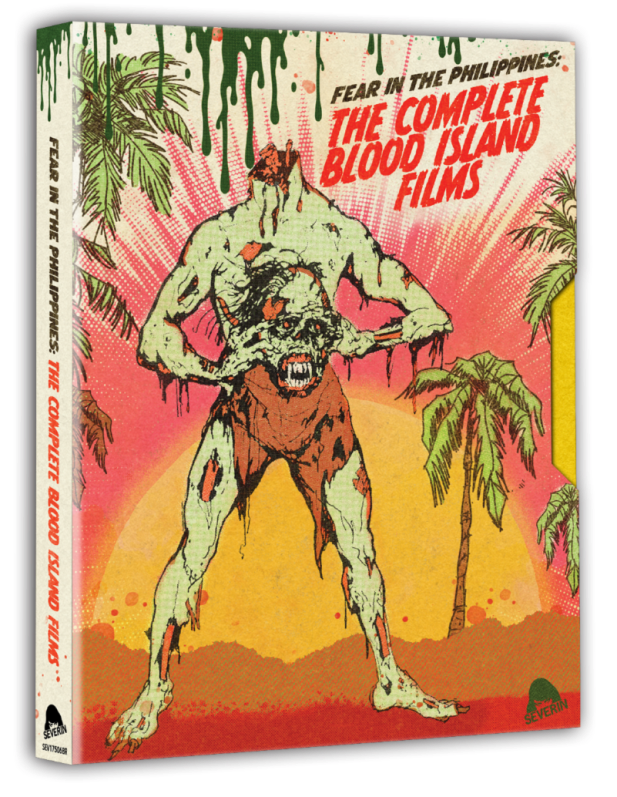
SEVERIN BOX SET RELEASE: Fear In the Philippines: The Complete Blood Island Films

From 1959 to 1971, Filipino filmmakers Eddie Romero and Gerry de León —along with Hemisphere Pictures marketing consultant Samuel M. Sherman—booked flights for drive-in audiences to Blood Island. This dark den of zombies, medical experiments, wanton women and terror would last four movies that fans of exploitation films have obsessed over ever since.

I’ve loved these movies ever since I first discovered them when Severin’s first re-releases came out a few years ago. I was so lucky to see many of them at the drive-in.

Now, Severin is re-releasing all of them – scanned uncut in 4K with improved color and audio plus over 8 combined hours of special features – in a new box set that you can get directly from the Severin Films Webstore.
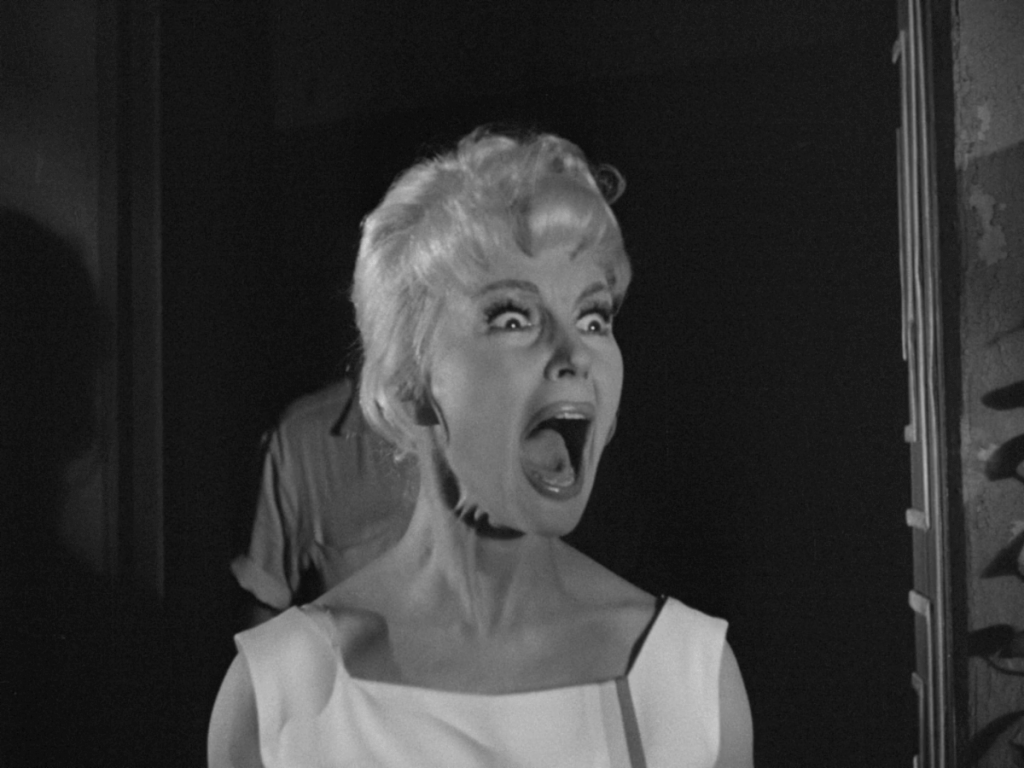
Terror Is a Man (1959): Call it Blood Creature, Creature from Blood Island, The Gory Creatures, Island of TerrorGore Creature, or its most well-known title, Terror Is a Man, but what you should really call it is the first of the Blood Island films. These movies, produced by Eddie Romero and Kane W. Lynn, include Brides of Blood, The Mad Doctor of Blood Island and Beast of Blood.  You can also consider The Blood Drinkers a Blood Island movie.

This movie was in theaters for nearly ten years—until 1969, when distributor Sam Sherman re-released it as Blood Creature with a warning bell that alerted the audience to impending gore.

William Fitzgerald (Richard Derr, who was almost The Shadow in a TV pilot that was turned into a movie called The Invisible Avenger) is the lone survivor of a ship that has crashed on Blood Island. Also, there are Dr. Girard (Francis Lederer, whose Simi Hills home is considered a landmark residence), his frustrated wife Frances (Greta Thyssen, who was in three of the Three Stooges shorts and Cottonpickin’ Chickenpickers) and his assistant Walter Perrera.

Much like The Island of Dr. Moreau, Girard is making half-man, half-animals like the panther he’s been experimenting on that tends to attack villagers. Of course, the doctor’s wife falls in love with the protagonist, and the beast gets loose and kills all sorts of people, including his creator. But hey — that mummy-like cat-eyed fiend seems to survive at the end, as a small island boy sends him away on a rowboat.

Gorgeous natives. Strong men. Crazy doctors. Werecats in bandages. Blood Island. Indeed, this one has it all.

The Severin release includes extras such as interviews with Samuel M. Sherman, co-director Eddie Romero, Pete Tombs (co-author of Of Immoral Tales), and critic Mark Holcomb, a trailer, and a poster and still gallery.

Brides of Blood (1968): This movie, which was originally known as Island of Living Horror, was rereleased with Count Dracula’s Great Love. The former was retitled Cemetery Girls and the latter was renamed Grave Desires.

Much like all of these Filipino horror films, it’s completely bonkers.

The tropics are the place for three Americans to find, well, complete insanity.

Dr. Paul Henderson, a nuclear scientist investigating nuclear bomb tests, is played by Kent Taylor. He was once a major star, playing the title role in fifty-eight Boston Blackie movies. His name is also half the inspiration for Superman’s alter ego (the other star is Clark Gable).

He’s married to the gorgeous but always ready-to-cuckold Carla, Beverly Powers. Beverly was once the highest-paid exotic dancer in the world before becoming an actress and starring with Elvis in SpeedwayKissin’ Cousins and Viva Las Vegas. She also pretty much played herself in Breakfast at Tiffany’s. After all that acting, she became a minister with The Living Ministry in Maui, Hawaii.

Then there’s Jim Farrell, a young Peace Corps member played by John Ashley. Ashley was an AIP star who appeared in Dragstrip Girl and sang his song “Let Yourself Go Go Go” in Zero Hour! He was also a regular in their beach movies, appearing at Beach PartyMuscle Beach PartyBikini BeachBeach Blanket Bingo, and How to Stuff a Wild Bikini.

After living in Oklahoma for a while, Ashley produced these movies with Hemisphere Pictures, living in the Philippines for part of the year and helping to create these little bits of madness.

Our protagonists soon learn that Blood Island is cursed. It’s now a place that has been irradiated by nuclear fallout from those bomb tests, with vines that attack people and butterflies that bite. There’s also a beast in the jungle that tears women apart to get off because, hey, why not?

Carla learns that the beast is one of the villagers, Esteban, but it comes at the price of her own life. She’s an early “sex and people who want sex must be destroyed” casualty decades before this type of destruction de rigeur.

Between carnivorous trees eating Carla’s remains and the movie ending in a vast orgy, this is probably unlike any other film you’ve seen before. You can say that about every single film from this studio.

The press book for the movie suggested that all female theatergoers would get the chance to become Brides of Blood and receive a free engagement ring. There was even the idea of giving away fake marriage certificates, but legal concerns prevented that.

Extras on the Severin release include commentary from  Samuel M. Sherman; interviews with co-director Eddie Romero, Sherman and Beverly Powers; the alternate Brides of Blood Island title sequence and a Jungle Fury title card; a teaser; a trailer and a poster and still gallery.
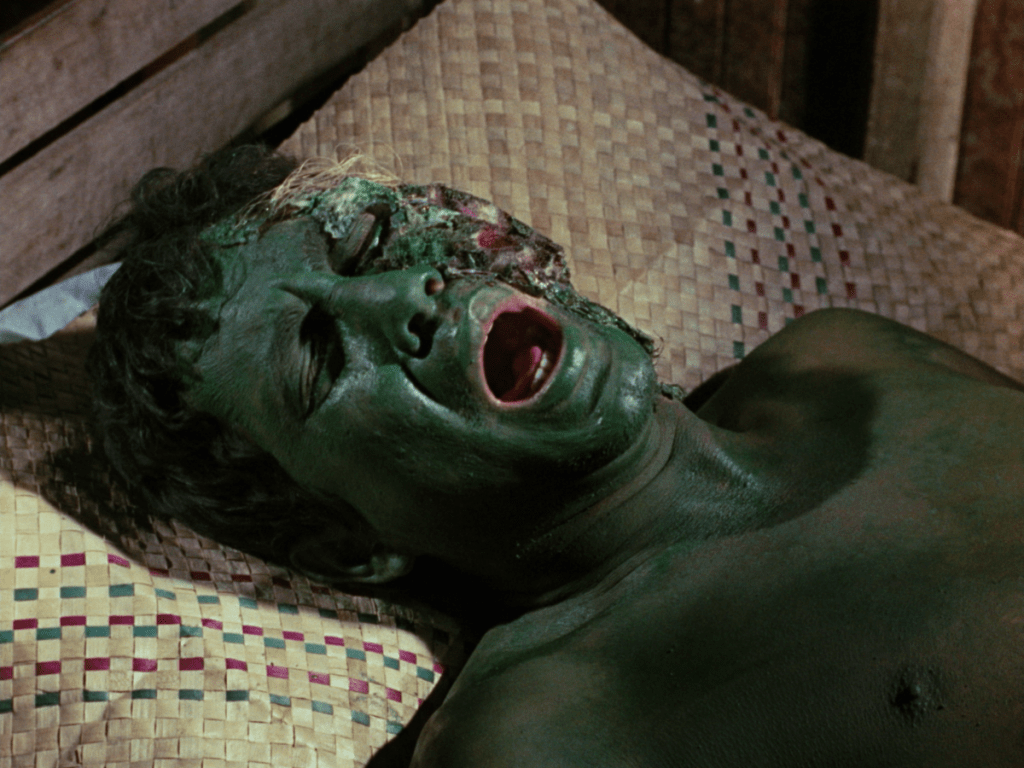
Mad Doctor of Blood Island (1969): We’re back ten years after we first got to Blood Island. Eddie Romero and Gerardo de Leon have returned in the directing chair, and this time, they’ve brought even more blood, beasts and boobs than they did in their last effort, Brides of Blood.

This film was syndicated to TV as Tomb of the Living Dead and is also known as The Mad Doctor of Crimson Island because, in some states, like Rhode Island, the word “blood” wasn’t allowed in movie advertising.

After Brides of Blood, John Ashley discovered that the film was so well-received that distributors asked him to make more. He moved to the Philippines and got to work.

The film starts with an initiation, as at some theaters, you are given a packet of green liquid and asked to recite the oath of green blood so that you can watch the unnatural green-blooded ones without fear of contamination. Years later, Sam Sherman said that he came up with this idea, and he got incredibly sick when he drank one of the packets. The film’s other gimmick is rapidly zoomed in and out, like Fulci on speed, whenever a monster appears. That was to cover the harmful special effects, but it made plenty of theatergoers sick. Man — destructive green liquid and frequent pans and zooms. It’s as if they wanted kids to puke!

A woman runs naked through a jungle before a green-skinned monster kills her. Yes, that’s how you start a movie!

Then we meet our heroes, like pathologist Dr. Bill Foster (Ashley), Sheila Willard (Angelique Pettyjohn, who was famously in the Star Trek episode “The Gamesters of Triskelion” and early 80s hardcore films like Titillation, Stalag 69 and Body Talk) and Carlos Lopez (Ronaldo Valdez, who would become the first Filipino Kentucky Fried Chicken Colonel).

The ship’s captain, who got them there, tells them how the island is cursed and how its people bleed green blood. Everything falls apart — Sheila’s dad, who she hoped to take home, is now a drunk. And Carlos’ mother refuses to leave, even after the mysterious death of her husband.

It turns out that Dr. Lorca has been experimenting on the natives, who just want to be healthy. Instead, they’re becoming green beasts that murder everything they can. Look out, everyone! I hope you’ve drunk your green blood before this all began!

Angelique Pettyjohn claimed that the love scene with John Ashley was not simulated. Seeing how Severin finally found the uncut film, and I haven’t seen any penetration, I think she’s full of it. But who am I to doubt her?

To make this even better, the American trailer of this is narrated by Brother Theodore!

Extras on the Severin release include commentary by Nathaniel Thompson and Howard S. Berger and a second commentary with Samuel M. Sherman; interviews with Pete Tombs, Mark Holcomb and Eddie Romero; a trailer and a poster and still gallery.

Beast of Blood (1970): All good things must end. This is the final of the Blood Island films and the last movie that Eddie Romero would make for Hemisphere Pictures.

As Dr. Bill Foster (John Ashley), Sheila Willard, her father and Carlos Lopez escape from Blood Island, this movie’s Beast gets on board and goes buck wild, killing everyone he can and blowing up the ship. He survives and heads back to the jungle while Dr. Foster spends months recovering. Everyone he knew or loved is now dead.

Of course, he’s going back to Blood Island.

Dr. Lorca (Eddie Garcia), who apparently died at the end of the last movie, is still alive but horribly scarred. He controls the beast, which can live without its head and even talk and control its own body from afar.

This is less of a narrative movie for me and more a collection of magical images, as bodies squirt blood and beasts have swampy faces and make strange noises while their heads rot inside beakers and lab equipment.

To promote this one, which played a double bill with Curse of the Vampires, the producers printed counterfeit 10 bills that folded in half, with the other side revealing a poster for the film. Those fake sawbucks were scattered all around the neighborhoods where this movie played.

Extras on the Severin release include commentary by Samuel M. Sherman, interviews with Celeste Yarnall and Eddie Garcia; a Super 8 digest version; a trailer; a radio spot and a poster and a still gallery.
Spy Shadow (1967-1968)

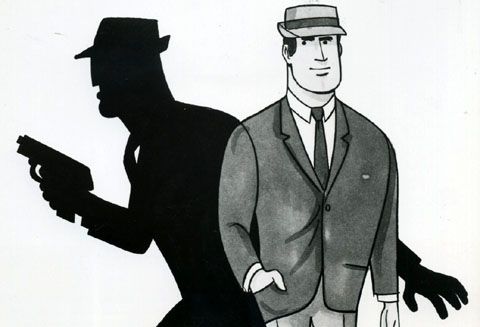
As part of the show Super President, which had two adventures per episode, one part of the show was where we learned of Spy Shadow, an agent of Interspy named Richard Vance (Ted Cassidy) who learned — somewhere in the mysterious Far East, just like Lamont Cranston, here said to be in Tibet with mystics who taught him the power of concentration — how to command his shadow to become another person. He’d need that power as he fought S.P.I.D.E.R. (Society for Plunder, International Disorder, Espionage and Racketeering) in Eurospy-style adventures.

Created by DePatie-Freleng Enterprises, formed by David H. DePatie and Friz Freleng, this is a footnote in TV superheroics, but may have been a bigger character had it not been placed with Super President, a show that people still seem to hate sixty years after it first aired.

I wonder if the makers of this show had been reading Doom Patrol, as Spy Shadow’s powers are a lot like Negative Man from that team. At least Spy Shadow doesn’t have to be wrapped up in bandages like Larry Trainor.

You can watch all of the episodes of this show on YouTube.

SEVERIN BLU RAY RELEASE: Russ Meyer’s Vixen (1968)

Give Russ Meyer $70,000 and he will give you everything.

Take it from Roger Ebert: “Meyer’s ability to keep his movies light and farcical took the edge off the sex for people seeing their first skin-flick. By the time he made Vixen, Meyer had developed a directing style so open, direct and good-humored that it dominated his material. He was willing to use dialogue so ridiculous… situations so obviously tongue-in-cheek, characters so incredibly stereotyped and larger than life, that even his most torrid scenes usually managed to get outside themselves. Vixen was not only a good skin-flick, but a merciless satire on the whole genre.”

It was also the first movie to get an X-rating for its sex scenes, which I’d consider a compliment because, after all, it’s softcore.

Vixen Palmer (Erica Gavin, who danced at The Losers, the same topless bar where Meyer women Haji and Tura Satana also once bewitched men; she’s also in Beyond the Valley of the Dolls, Caged HeatErika’s Hot Summer — a Gary Graver film which was once another movie and then edited around her after this movie became a box office success — and Godmonster of Indian Flats) lives with her husband Tom (Garth Pillsbury, who also shows up in If You Don’t Stop It… You’ll Go Blind!!!Can I Do It ‘Till I Need Glasses?Malibu High and The Loch Ness Horror) up in the woods of British Columbia, running a tourist resort.

She’s quite literally always on the make — the tagline “Is she woman…or animal?” is more than lived up to — as she seduces a Mountie (Peter Carpenter) the moment her husband flies out to pick up the next couple staying with them for a fishing vacation. Days — maybe hours — after they arrive, she sleeps with the husband, Dave (Robert Aiken, speaking of Gary Graver, Aiken wrote his movie Moon In Scorpio) and then his wife, Janet (Vincene Wallace, what does it say about me that I instantly knew she was in the Harry Novak produced The Secret Sex Lives of Romeo and Juliet?) just as quickly. Hell, give her time and she’ll even sleep with her brother Judd (Jon Evans), despite his protest “We decided to stop doing this when we were 12.”

The only man or woman she won’t touch seems to be Niles (Harrison Page, Beyond the Valley of the Dolls), an African American Vietnam War deserter who is friends with Judd. He’s in Canada hiding from the draft, as he sees the war as a racist endeavor. Mr. O’Bannion (Michael Donovan O’Donnell) wants to pay to fly him to back to America, but he soon tries to hijack the plane and force everyone to Cuba. Luckily, Tom and Niles stop this and get away from the authorities, too, which means that Vixen has to get over her racist feelings toward Niles.

Meyer started this without a leading lady, which some would think is a bad idea. He told Ebert in Film Comment, “Bravely I went up to the location for Vixen without a leading lady and left a couple of my henchmen to try to find somebody. It’s always difficult. But Erica had a curious quality about her. She didn’t have the greatest body, you know. She didn’t have the up-thrust breasts like the others.”

Side note: Of course Russ Meyer would think that such a gorgeous woman was lacking in the breast department. Then again, I’ve said for years that I never notice breasts and nearly every long term relationship I’ve had has been with women who were blessed with curves like a Russ actress, so maybe I have watched too many of his movies. I also don’t see that as a bad thing. I agree with Gavin as to why Meyer’s movies just work: “His films came from a different direction than porno. Basically he was not looking through a camera; he was looking through a peephole. I think that’s why his films were so good. He was a true voyeur.”

In the book that would be my early quite to psychotronic films, Incredibly Strange Films, Meyer was able to see that Gavin was one of the main reasons why this was a success. He thought that the scene between her and Judd was one of the best he ever shot, saying that it “…was the best of them all. She really displayed an animal quality that I’ve never been able to achieve before – the way she grunted and hung in there and did her lines. It was a really remarkable job… I’ve done a lot of jokey screwing but there’s something about Erica and her brother that was just remarkable… it really represents the way I like to screw.”

It had to terrify people upon watching this just how much Vixen is a non-stop engine of passion. I always laugh when people say that they want a woman like her yet they’d probably be mentally unable — not to mention physically challenged — to keep her. By the end, the title “The end?” suggests that she’ll never be able to stop seducing. And who would want her to?

Well…maybe some folks in Ohio.

Thanks to Charles Keating, who was busted in the savings and loan scandal of the late 1980s, this movie is still banned in Cincinnati. The financial expert obtained an injunction preventing it being shown on the grounds that it was obscene and the cops seized the print the first day itw as shown. It didn’t get to play in Ohio and cost Meyer $250,000 to defend the movie.

Keating said Meyer had done more to undermine morals in the nation than anyone else.

Meyer responded, “I was glad to do it.”

After watching this movie on VHS for years, the Severin blu ray is a revelation. The colors, muted in the past, are now a memory, replaced by a lush rainbow of joy. Things are sharper, no long fuzzy, looking as they would in my dreams. I don’t know how to say thank you enough to everyone who worked on this.

Extras including an archival audio commentary by director/co-writer/producer/cinematographer/co-Editor Russ Meyer; the Censor Prologue from the 1981 theatrical re-release); an audio commentary by Gavin; archival interviews with Gavin And Harrison Page; David Del Valle’s The Sinister Image with guests Russ Meyer and Yvette Vickers; Entertainment… Or Obscenity? – Marc Edward Heuck on the film’s historic Cincinnati censorship battles and a trailer.

You can get this from Severin.

Super President (1967-1968)

When this show aired, it upset so many people. The National Association of Broadcasters said: “An all-time low in bad taste, with the President of the United States in a Superman role. NBC was responsible for this direct ideological approach to totalitarianism. We fear that there may be other broadcasters who are irresponsible enough to keep it in circulation.”

The idea of a super-powered American President seems dumb, but four years after the death of Kennedy and as America seemed to be on the verge of falling apart, maybe it seemed like a great plot for a cartoon. At least the DePatie–Freleng studio, who also made The Pink Panther cartoons, were commissioned to make Warner Brothers specials and also animated the lightsabers for Star Wars, thought so.

The President of the United States, former astronaut James Norcross, is voiced by Paul Frees, whose voice has been in almost everything you’ve ever watched. Other voice talent included Ted Cassidy, June Foray and Don Messick, whose voices would be in the few things that Frees didn’t work on.

Super President got his powers from a cosmic storm, just like the Fantastic Four, giving him increased strength and the ability to change his molecular composition like Metamorpho, plus he has a cave and special vehicle called the Omnicar like Batman and his Batcave and Batmobile.

Perhaps this cartoon, while forgotten today, inspired Calvin Ellis, the Kryptonian President of the United States on Earth-23 who is also the Superman of that reality (and just happens to look like Barack Obama).

You can watch all of the episodes of this show on YouTube.

VIDEO ARCHIVES SEASON 2: The Thomas Crown Affair (1968)

VIDEO ARCHIVES NOTES: This movie was discussed on the December 10, 2024 episode of the Video Archives podcast. 

Millionaire Thomas Crown (Steve McQueen) needs a new fix. He’s moved on from fast cars and boardroom deals to putting together a bank robbery just because, well, he needs adrenaline.

Investigator Vicki Anderson (Faye Dunaway) is promised 10% of the stolen money by the bank if she can get it back and learn who stole it. She quickly decides that Crown is the only person who could have pulled off this job. Along with detective Eddy Malone (Paul Burke), she closes in, but starts to be enticed by the roguish Crown.

It’s literally — and in a scene, actually — a game of chess.

Sean Connery and Johnny Carson both turned down the lead but only McQueen could pull this off. I’m not certain that audiences today can estimate his level of cool or the breakthrough moments of this movie, like how Vicky drives one of ten Ferrari 275 GTB/4S NART Spiders ever made, has 29 costume changes or that director Norman Jewison made one of the first mainstream uses of Christopher Chapman’s multi-dynamic image technique to show multiple screens of the robbery happening all at once.

Still, Roger Ebert said that this movie was “possibly the most under-plotted, underwritten, over-photographed film of the year. Which is not to say it isn’t great to look at. It is.”

I love the poster line: “McQueen, together with this Bonnie and Clyde Gal…and the slickest gang that ever robbed a bank!”

You can watch this on Tubi.

VIDEO ARCHIVES SEASON 2: The Love Bug (1968)

VIDEO ARCHIVES NOTES: This movie was discussed on the November 12, 2024 episode of the Video Archives podcast. 

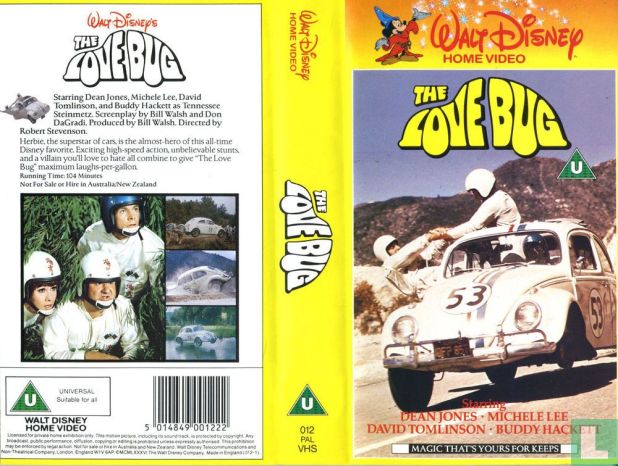
Based on the 1961 book Car, Boy, Girl by Gordon Buford, this was the first of many movies that would feature Herbie the Love Bug, who is driven by Jim Douglas (Dean Jones) and worked on by Tennessee Steinmetz (Buddy Hackett), a mechanic who transforms used car parts into art.

Jones claimed that this film was so good with the fact that it was made when Walt Disney was still invovled with his films. It was released just two years after Walt’s death. I would also say that having Robert Stevenson as director — he also made Mary PoppinsThat Darn Cat and Old Yeller — helped.

Douglas has big dreams of racing, but all he gets to do is compete in demolition derbies. After racing and crashing another car — an Edsel, no less — our protagonist comes across a car dealer named Peter Thorndyke (David Tomlinson, Mary Poppins) abusing a Volkswagen Beetle. The next morning, the car just so happens to show up at Douglas’ house and he’s nearly arrested until Thorndyke’s sales assistant and mechanic Carole Bennett (Michele Lee) convinces her boss to sell the car.

Herbie — so named by Tennessee — seems to have a mind of his own, but he’s able to help Douglas win several big races, to the continual chagrin of his former owner. Much like nearly every Dean Jones character, Douglas is a jerk and just wants a Lamborghini 400GT instead of the heroic little VW Bug. Herbie responds by running away, damaging big stretches of Chinatown and nearly driving himself off the Golden Gate Bridge in his depression. Yes, back in the day, live action Disney got dark.

Of course, not so dark that a small Volkswagen can’t win a race against cars with much more horsepower, like Thorndike’s Apollo GT (the avergae VW bug had 40 hp while the Apollo GT had 225 hp).

MOVIES THAT PLAYED SCALA: Witchfinder General (1968)

Thanks to the British Film Institute, there’s a list of films that played Scala. To celebrate the release of Severin’s new documentary, I’ll share a few of these movies every day. You can see the whole list on Letterboxd.

Based on Ronald Bassett’s — a man who was primarily known for his medical and pharmaceutical work — novel about Matthew Hopkins, a notorious 17th-century witch-hunter, this 1968 film was a co-production of Tigon British Film Productions and American-International Pictures (who retitled the film The Conqueror Worm to link it to their series of Edgar Allan Poe movies).

Movie posters used to be awesome.

Michael Reeves was 24 and only three films* into his career when he made this film, the tale of Hopkins (Price), a lawyer who has opportunistically become a witchhunter with no morality whatsoever, blackmailing and killing his way through the world. This film is pure nihilism and makes the statement that when the world goes to hell, there is no way to be an angel.

Reeves saw Donald Pleasence as Price, but AIP only saw Vincent Price as the lead. Reeves had refused the courtesy of meeting Price at Heathrow Airport which was a “deliberate snub calculated to offend both Price and AIP” according to Benjamin Halligan’s book Michael Reeves. When they met for the first time, Reeves said, “I didn’t want you, and I still don’t want you, but I’m stuck with you!”

According to Kim Newman in Nightmare Movies, Reeves and Price argued over the actor’s propensity to chew the scenery and Price supposedly said, “Young man, I have made eighty-four films. What have you done?”

Reeves replied, “I’ve made three good ones.”

And that’s how Reeves pushed Price into delivering the performance in this film. In the book Faster and Furiouser: The Revised and Fattened Fable of American International Pictures, Price said that he wrote the director a ten-page letter after he saw the film, praising the director’s work.

Reeves wrote back, “I knew you would think so.”

After Reeves’s death, Price would think back and say, “I realised what he wanted was a low-key, very laid-back, menacing performance. He did get it, but I was fighting him almost every step of the way. Had I known what he wanted, I would have cooperated.”

That said — Reeves was notoriously poor with actors, mainly concentrating on what the visual look of the film leaving the acting direction — outside of his playing with Price — to the actors.

The poster tagline — “Leave the realized at home…and if you are squeamish stay home with them!” — isn’t a lie. This is a film packed with some of the most intense torture and violence you’ll see. It was heavily censored in England** — yet still upset people — and played uncut in the U.S.

Hopkins is using the English Civil War and the destruction of social order to brutally abuse and torture those he deems witches throughout East Anglia. Then, he and his assistant John Stearne charge the local government for their work and move on.

Richard Marshall (Ian Ogilvy, who was in several of Reeves’ teenage short films and appeared in his movies The She Beast and The Sorcerers) is a young soldier returning home from the war, asking John Lowes (Rupert Davies) if he may marry his niece Sara (Hilary Dwyer, The Oblong Box, Scream of the Banshee). The old man confides that they are concerned for their safety and feel as if the village has turned on them as Marshall gives his word to protect them. As he leaves their town, he gives the witchfinder directions to get there.

Hopkins and Stearne enter town and instantly go to work taking out witches, including using rats and hot needles to find the Devil’s Mark inside Lowes. Sara offers sexual favors to protect her uncle and as soon as Hopkins leaves town, his partner assaults her.

When Marshall returns, he marries Sara in his own ceremony and vows to kill the two men, nearly beating Stearnes to death. Yet the tables are turned and the hero must watch as his love is tortured before him. That’s not the end, but I’d like you to see this for yourself.

AIP originally made this movie as a tax write-off, but was surprised by the quality of the film. Samuel Z. Arkoff said, “Michael Reeves brought out some elements in Vincent that hadn’t been seen in a long time. Vincent was more savage in the picture. Michael really brought out the balls in him. I was surprised how terrifying Vincent was in that. I hadn’t expected it.”

This film led to the second wave of AIP Poe films like The Oblong Box (originally scheduled to be directed by Reeves, but handed over to Hessler after Reeves fell ill during pre-production), Murders in the Rue Morgue and Cry of the Banshee, which reteamed Price and Dwyer.

It also inspired several inquisitonploitation*** films such as Mark of the Devil and The Bloody Judge, as well as leading the way for religious horror such as The Devils and the folk horror of The Blood on Satan’s Claw.

It also influenced metal, as the band Cathedral has a song “Hopkins (Witchfinder General)” and the band Witchfinder General outright took the name. Like all great NWOBHM bands, they have a self-titled song.

There was even a BBC4 radio play, Vincent Price and the Horror of the English Blood Beast, which tells the story of the relationship between Price and Reeves.

Sadly, a few months after this movie was released, director Reeves died in London at the age of 25 from an accidental alcohol and barbiturate overdose. What an incredible blow to the world of film, as obviously he was going to be a director whose work could only have gotten better.

*Castle of the Living DeadThe She Beast and The Sorcerers.

**Even the script provoked this reply from censors: “A study in sadism in which every detail of cruelty and suffering is lovingly dwelt on…a film which followed the script at all closely would run into endless censorship trouble.”

***Yes, an invented term.

SEVERIN BLU RAY RELEASE: Scala!!! shorts disc one (1968. 1971, 1978, 1984, 1986, 1989, 1991)

On the bonus discs of Severin’s new Scala!!! Or, the Incredibly Strange Rise and Fall of the World’s Wildest Cinema and How It Influenced a Mixed-up Generation of Weirdos and Misfits release, you’ll find examples of several shorts that played at the theater. You can buy this from Severin.

Divide and Rule – Never! (1978): Made for and by young people, this forty-minute or so film looks at race and how it is viewed in school, at work and by the law. There are also some historic sequences of British imperialism and a discussion of how Germany got to the point that it was pre-World War II, plus plenty of punk rock and reggae. This has many sides represented, from Black and Asian immigrants to ex-National Front members.

Divide and Rule — Never! was distributed by The Other Cinema, a non-profit-making, independent film distribution company in London.

Sadly, so much of this movie — made 45 years ago — are just as relevant today in America. This is movie that doesn’t shy away from incendiary material, but that’s what makes it so powerful. In addition to the interviews, it has some interesting animation and a soundtrack with Steel Pulse, TRB, X-Ray Specs and The Clash.

Dead Cat (1989): Directed and written by Davis Lewis, this has Genesis P-Orridge in the cast and a soundtrack by Psychic TV, which has been released as Kondole/Dead Cat.

A boy (Nick Patrick) has a cat that dies and his grief deposits him into a psychosexual nightmare, including a medicine man (Derek Jarman) and several unhoused people (P-Orridge, Andrew Tiernan).

This was shown at only a few theaters the year it was release — including Scala Cinema — before fading away and almost being lost before Lewis found it. In the program for this film, Scala said “The torture that occurs at the transition of sexuality.” If you liked videos for bands liek Skinny Puppy and Nine Inch Nails, this feels like the inspiration.

The Mark of Lilith (1986): Directed by Bruna Fionda, Polly Gladwin and Zachary Nataf as a project at The London College of Printing, this is all about Zena (Pamela Lofton), who is researching monstrous women. She meets Lillia (Susan Franklyn) a vampire, at a horror movie and the two start a relationship. 

Liliana, trapped with an abusive male partner by the name of Luke (Jeremy Peters) who is what vampires probably would be, scavengers who feed on the weak, dreams of movies in which she is the victim of just such a vampire. She’s often fed on human beings, but has been careful not to be caught or make a mess, unlike her partner. As for Zena, she’s been studying how female gods were once worshipped but now only appear in horror fiction as monstrous creatures.

So much of this movie is as right on now as when it was made, like the speech that Zena gives when Liliana tracks her down: “Have you noticed that horror can be the most progressive popular genre? It brings up everything that our society represses, how the oppressed are turned into a source of fear and anxiety. The horror genre dramatizes the repressed as “the other” in the figure of the monster and normal life is threatened by the monster, by the return of the repressed consciously perceived as ugly, terrible, obscene.”

Her argument is that we can subvert the very notions of horror, making the monsters into heroes that destroy the rules that hold us down.

However, this being a student film, it’s very overly earnest and instead of working these ideas into the narrative as subtext, they take over the entire movie. If you’re willing to overlook this, it’s a pretty fascinating effort.

Relax (1991):  Steve (Philip Rosch) lives with his lover Ned (Grant Oatley), but as he starts to engage in a more domestic relationship, he starts to worry about all of the partners he’s had. After all, the AIDS crisis is happening and he’s never been tested. Ned tells him to relax, but there’s no way that he can.

The wait for the test is just five days but it may as well be forever. This also makes a tie between sex and death, as Steve strips for both Ned and his doctor. And in the middle of this endless period of limbo, he dreams of death and fights with Ned, who just smiles and keeps telling him to relax. But how could anyone during the time of AIDS?

I remember my first blood test and the doctor lecturing me after he gave it, telling me that I should have been a virgin until I married and whatever happened, I brought it on myself. The funny thing was, I had been a virgin, I thought I was getting married and I had no knowledge that my fiance was unfaithful to a level you only see in films. That night, my parents came to visit, leaving their small town to come to the big city and my mother asked, “What is that bandage on your arm?” I could have lied, but I told her it was for a blood test, and I dealt with yet someone else upset with me. My problems were miniscule in the face of the recriminations that gay people had to deal with, a time of Silence=Death, a place seemingly forgotten today other than by the ones who fought the war.

Directed and written by Chris Newby, this is a stark reminder of that time.

Boobs a Lot (1968): Directed by Aggy Read, this is quite simple: many shots of female breasts, all set to The Fugs’ song of the same name. Banned in Australia, this has around three thousand sets of mammaries all in three minutes, the male gaze presented over and over and, yes, over again until it goes past just being sophomoric and becomes mesmerizing in the way that breasts are when you’re starting puberty. I’m ascribing artistic meaning to this but really, at the end of the day, it’s just a lot of sweater meat. Fun bags. Cans, dirty pillows, babylons, what have you. My wife is always amazed at how many dumb names I can come up with for anatomy and I blame years of John Waters and reading Hustler as a kid and yeah, I’m not as proud of the latter than the former. That said, there are a lot of headlights in this one.

Kama Sutra Rides Again (1971): Stanley (Bob Godfrey, who also directed and write this) and Ethel are a married couple looking to keep their love life interesting, so they have been trying out new positions. Things start somewhat simple, but by the end, Ethel is being dropped through trap doors and out of an airplane onto her husband. A trapeze love making attempt ends in injury, leading Ethel to chase Stanley while all wrapped up.

Stanley Kubrick personally selected this film to play before A Clockwork Orange in theaters in the UK. I wonder if this played at Scala before the screening that shut down the theater. More than just a dirty cartoon, this was nominated for an Oscar. Despite being about lovemaking, it’s all rather innocent and remains funny years after it was made.

Coping With Cupid (1991): Directed and co-written by former Slits guitarist Viv Albertine, this finds three blonde alien women — played by Yolande Brener, Fiona Dennison and Melissa Milo — who have come to Earth to learn what love is, under the command of Captain Trulove (the voice of Lorelei King). They meet a man named Peter (Sean Pertwee), who hasn’t found anyone, as well as interview people on the street to try and learn exactly how one person can become enamored of another.

Richard Jobson from Skids and Don Letts from Big Audio Dynamite appear, as does feminist sexologist Shere Hite, at least on a TV set. I love that the three aliens are the ideal of male perfection yet they are lonely, trying to figure out what it takes to make the heart beat. It’s kind of like so many other films that I adore where space women try to understand men, a genre that really needs a better title. See Cat-Women of the Moon, Missile to the Moon, Queen of Outer Space, Fire Maidens from Outer SpaceAmazon Women On the Moon, Abbott and Costello Go to Mars, El Planeta De Las Mujeres Invasoras and Uçan Daireler Istanbulda.

On Guard (1984): Sydney: Four women — Diana (Jan Cornall), Amelia (Liddy Clark),  Adrienne (Kerry Dwyer) and Georgia (Mystery Carnage) — juggle their lives, careers and even families to destroy the research of the company Utero, who are creating new ways of reproductive engineering. Or, as the sales material says, “Not only are the protagonists politically active women, but the frank depiction of their sexual and emotional lives and the complexity of their domestic responsibilities add new dimensions to the thriller format. The film also raises as a central issue the ethical debate over biotechnology as a potential threat to women and their rights to self-determination.”

One of the women loses the diary that has all of the information on their mission, which leads to everyone getting tense over what they’re about to do. Directed by Susan Lambert, who wrote it with Sarah Gibson, this allows the women to be heroes and not someone to be saved. I like that the advertising promised that this was “A Girls’ Own Adventure” and a heist film, hiding the fact that it has plenty of big ideas inside it.

Today, in vitro fertilisation (IVF) is an accepted way of having children, yet here, it’s presented as something that will take away one of the primary roles of women. Juxtapose that with IVF being one of the women-centric voting topics of the last U.S. election.