Sizzlin’ Summer of Side-Splitters 2025: The Green Fog (2017)

Sept 1-7 John Waters Best of the Year Week: To be fair, these movies aren’t ALL funny, but JOHN WATERS is funny. He’s become more of a writer and public commentator these days. Still, he helps keep the arthouse from taking itself too seriously with his annual top-ten lists, while celebrating the comically serious.

The Green Fog, directed by Guy Maddin, Evan Johnson and Galen Johnson, was commissioned by the San Francisco Film Society for the 60th San Francisco International Film Festival. Along with an original score by composer Jacob Garchik and Kronos Quartet, it retells Vertigo using a cut and paste from movies and TV shows made in San Francisco.

There’s one single image from Vertigo, a hand grasping a ladder. Other footage comes from the 1923 version of The Ten CommandmentsGreedOld San FranciscoFrisco JennyFog Over FriscoBarbary CoastSan FranciscoThe SistersFlame of Barbary CoastThe Falcon In San FranciscoNora Prentiss, A Bucket of Blood, A Night Full of Rain, A View to a Kill, An Eye for an Eye, Basic Instinct, Born to Be Bad, Born to Kill, Bullitt, Chan Is Missing, Confessions of an Opium Eater, Crackers, Daddy’s Gone A-Hunting, Dark Passage, Desperate Measures, Dirty Harry, Dogfight, Experiment in Terror, Fearless, Final Analysis, Flower Drum Song, Getting Even with Dad, Go Naked in the World, Godzilla, Hard to Hold, Herbie Rides Again, High Anxiety, Hotel, Impact, Incident in San Francisco, Innerspace, Invasion of the Body Snatchers, It Came from Beneath the Sea, Jade, Jagged Edge, Julie, Magnum Force, McMillan & Wife, Memoirs of an Invisible Man, Mission: Impossible, Monster in the Closet, Mr. Ricco, Mrs. Doubtfire, Murder, She Wrote, One on Top of the Other, Pacific Heights, Pal Joey, Patty Hearst, Petulia, Portrait in Black, San Andreas, Sans Soleil, Samurai, Sister Act, Sister Act 2: Back in the Habit, Sneakers, So I Married an Axe Murderer, Star Trek IV: The Voyage Home, Sudden Fear, Take Me Away!, Terminator Genisys, The Birds, The Conversation, The Dead Pool, The Fan, The Game, The Golden Gate Murders, The House on Telegraph Hill, The Killer Elite, The Lady from Shanghai, The Laughing Policeman, The Lineup, The Love Bug, The Man Who Cheated Himself, The Net, The Organization, The Presidio, The Rock, The Sniper, The Streets of San Francisco, The Towering Inferno, The Woman in Red, They Call Me Mister Tibbs!, Thundercrack!, Time After Time, When a Man Loves a Woman, Where Love Has Gone, Woman on the Run, Yellow-Faced Tiger and The Zodiac Killer.

This is an amazing film, one that works incredibly. You really need to find it and watch it, as this will never be released.

John Waters commented on this film, saying, “An avant-garde ode to San Francisco, the most cinematic of cities, told entirely through clips of films shot there but with all the dialogue cut out so the parts of the movies that originally didn’t matter now do. Abstractly clever, strangely compelling, and just about perfect.”

You can download this movie from the Internet Archive.

USA UP ALL NIGHT: Blind Date (1987)

EDITOR’S NOTE: Blind Date was on USA Up All Night on May 11 and 12 and July 27, 1990 and June 28 and September 14, 1996.

Years ago, when I first started the site, I wrote “Kim Basinger: Professional idiocy, circa 1987 and 1988.”

Here’s a quick summary:

In 1987, Kim Basinger appeared in Blake Edwards’ Blind Date with Bruce Willis.

In 1988, she appeared in Richard Benjamin’s My Stepmother is an Alien with Dan Aykroyd.

In both films, she plays nearly the same role: a woman so devastatingly gorgeous, she decimates the brains of weak-willed men everywhere before settling for a man who is obviously the worst possible mate for her — falling in the kind of love that transforms your life in under 24 hours.

However, she has one downside: she is an utter moron, almost incapable of comprehending how the most basic societal behaviors should be observed. In Blind Date, it’s alcohol that’s to blame. One drink and her character, Nadia, loses control. It’s as if no woman could be both gorgeous and competent, even if she was able to pilot a starship the whole way here.

Despite her foibles, she’s presented as an inherently good person in both films. But in no way do you watch and see her as a real person, someone who can be more than a sexual object, which is probably the whole point of 1980s comedy, one supposes.

Anyways…

Walter Davis (Bruce Willis in his first movie lead) is trying to make a deal with Japanese industrialist Mr. Yakamoto (Sab Shimono). He needs a date for the dinner where they’ll shake hands on it, so his brother Ted (John Larroquette) plans a blind date with his wife Susie’s (Stephanie Faracy) cousin Nadia (Basinger). Simple, right?

Ted and Susie warn Walter not to let Nadia drink alcohol. If he does, she will go crazy. Additionally, she has an ex named Ted (played by Phil Hartman), who is stalking her.

Walter tells Susie that he wanted to be a musician but ended up taking an office job. Oh, if only this movie would give Bruce Willis a chance to sing!

During the party, Nadia turns champagne into an insanity power-up, getting the Japanese mogul’s wife to leave him, abusing a co-worker of Walter for hitting on her and spraying champagne at Walter’s boss. The deal gets called off.. Walter gets fired. This gives Walter license to embarrass her once she sobers up, showing up at a party at her friend’s house acting like a crazy person and even pulling a gun on David, which gets him arrested.

Nadia bails him out and even agrees to marry David if he’ll represent Walter. David’s father, Judge Harold Bedford (William Daniels), basically agrees to letting Walter out if his son moves far away. Nadia leaves Walter a note telling him not to give up on playing the guitar. David replies by sending chocolates with alcohol in them; she goes wild at her wedding and says that she’s in love with someone else, then marries Walter.

This was supposed to star Madonna and Sean Penn.

Oh, Blake Edwards. I’m sure there was a time when I would have liked your movie,s but I grew up watching these ones. I haven’t changed my opinion. This movie makes everyone act like a moron, mostly Basinger, who deserves better. Why would this couple get married?

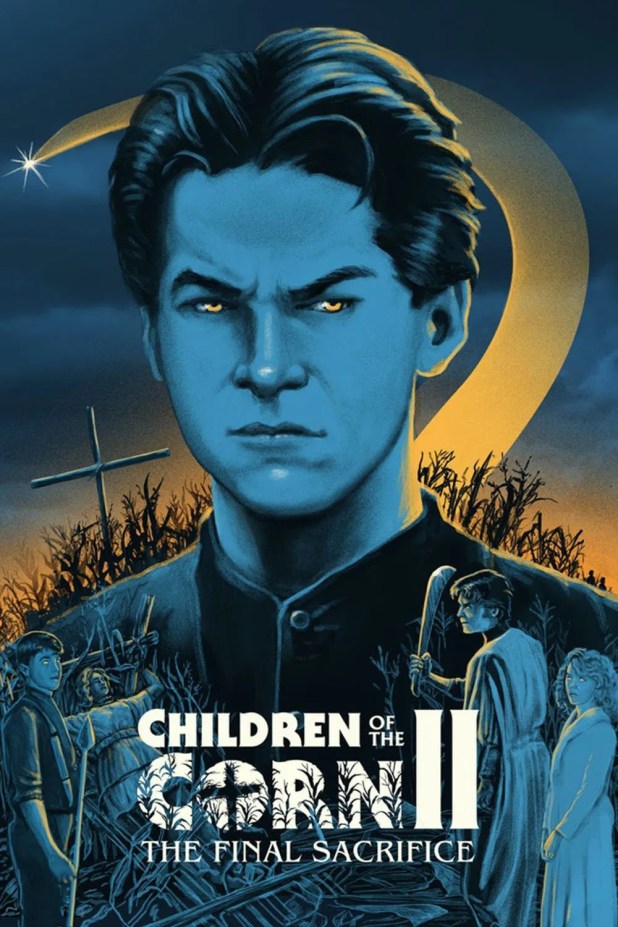
USA UP ALL NIGHT: Children of the Corn II: The Final Sacrifice (1992)

EDITOR’S NOTE: Children of the Corn II: The Final Sacrifice was on USA Up All Night on April 5, 1996.

Directed by David Price, the son of studio boss Frank Price, and written by A. L. Katz and Gilbert Adler (who also worked on Bordello of Blood), Children of the Corn II: The Final Sacrifice is anything but, as it’s the first of what would be nine sequels. Two of them were reboots.

Hemingford, Nebraska isn’t Gatlin, but it’s close enough. Two days after the events of Children of the Corn, the people of this town adopt the orphans of Gatlin and one of them, Micah (Ryan Bollman), starts talking to He Who Walks Behind the Rows and yes, the sequel is ready.

John Garrett (Terence Knox) is in town reporting on the children, and his son Danny (Terence Knox) has come along for the ride. John’s career is bad, but not as bad as his life, as he’s going through a divorce and Danny hates him for it, so he fits right into all these creepy children.

After some lighting wipes out some reporters John knew from back when life was better, he gets down to business and starts sleeping with bed-and-breakfast owner Angela Casual (Rosaline Allen), and no, I won’t go for the easy joke and say that she lives up to her name. Danny might, because he’s mad that his dad is getting it on so quickly, but he also meets the creeptastic Lacey Hellerstat (Christie Clark), who drops some knowledge on him about her hometown.

While all that drama is happening, Micah and his child gang get to work dropping houses on people and using voodoo dolls to kill people while they’re in church. They even throw an old woman and her mechanized wheelchair through a window. I am a strange person; I realize this, but I laughed like a lunatic during this.

Somewhere in all of this, there’s a Native American professor named Dr. Frank Red Bear (Ned Romero), who throws some exposition on this sequel fire and claims that this has happened before. However, there’s good news: a prophecy suggests that there’s a good spirit, not a bad one. Or maybe it’s people selling bad corn which has a green gas that comes out of it.

Dr. Frank Red Bear gets some great dialogue.

Dr. Frank Red Bear: Koyaanisqatsi. It means life is out of balance. My ancestors would have told you that man should be at one with the earth, the skies, and water. But the white man has never understood this. He only knows how to take. And after a while, there’s nothing left to take. So, everything’s out of balance. And we all fall down.

John Garrett: Wait a minute… so that’s what happened here in Gatlin?

Dr. Frank Red Bear: No… what happened in Gatlin was that those kids went ape-shit and killed everyone.

As if they’re been challenged to go as hard as they can, the children lock every adult in a building and set it on fire, killing almost every character in the movie before kidnapping Angela and Lacey, taking them into the cornfields and trying to get Danny to sacrifice them.

Now, as you sit there, you may ask yourself, “Do I want to watch a child get pulled into a harvester, but not before he has a demon face?”

Of course you do. This movie delivers.

He Who Walks Behind the Rows is now a benevolent spirit by the end, as Dr. Frank heals from being dead after being shot with an arrow, and his ghost paints some rocks.

The director claims that a local Christian group protested the movie and left a dead rodent as a warning, so they created their own church for the movie.

You can blame former New World exec Larry Kuppin for this. After there hadn’t been a sequel for years, he picked up the filming rights and formed Trans Atlantic Entertainment. This studio existed solely to produce sequels to several New World Pictures films, including this movie, Children of the Corn III: Urban HarvestHellraiser III, and Avenging Angel. They also announced sequels to Wanted Dead or Alive and Crimes of Passion, which didn’t get made.

Trans Atlantic also produced Female PerversionsDeath Ring, The VineyardRage and Honor IIPlughead Rewired: Circuitry Man IITollbooth, Cirio Santiago’s Vulcan’68I Shot a Man In Vegas and The Tale of Tillie’s Dragon.

In fact, the same crew shot this and Hellraiser III back-to-back to save money.

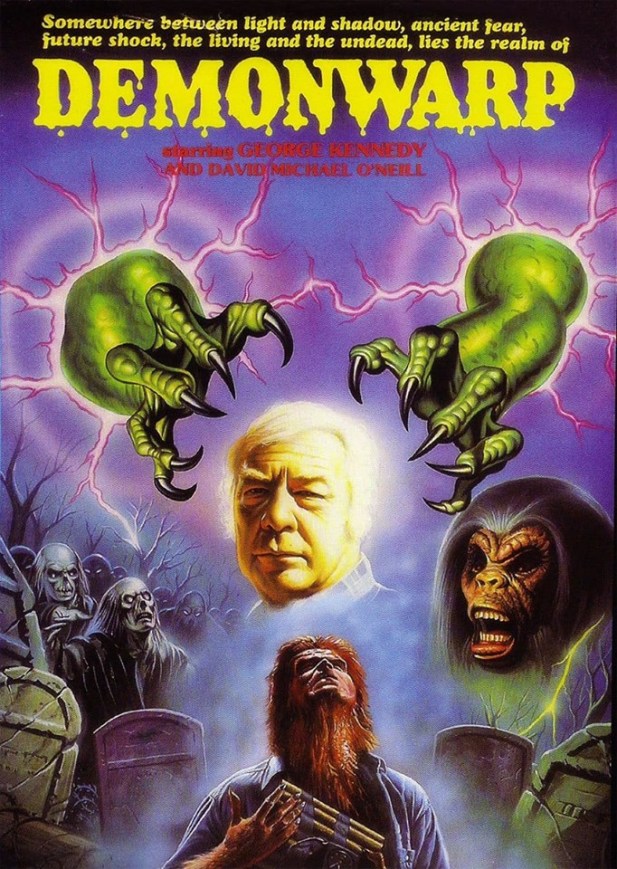
USA UP ALL NIGHT: Demonwarp (1988)

EDITOR’S NOTE: Demonwarp was on USA Up All Night, but I can’t find a date. Do you know?

Whoa, boy, Demonwarp.

Originally meant to be directed by John Carl Buechler and star Jack Palance, budget woes changed things up and this ended up being made by Emmett Alston (Nine Deaths of the NinjaNew Year’s Evil) on board and George Kennedy — who stipulated that his daughter Shannon must have a role, that he’d only be on set for three days and that he’d get $15,000 for his work.

Jack Bergman has led four of his friends — Fred Proctor, Carrie Austin, Cindy Ossman* and Tom Phillips (Billy Jacoby!) — to his uncle’s cabin for a weekend of booze, sex and hijinks.  That was the plan, but the truth is that his uncle was taken away by a sasquatch, and a woman was killed right in the place where they’re supposed to be hanging and banging.

Then there’s Bill Crafton (Kennedy), an angry older man who is both the crazy man warning them all to stay out of the woods and the tough elder seeking his missing daughter. After the girls get naked, the beast attacks and wipes out everyone but Jack, Carrie and Cindy, who survive the night only to have to wander a path back to civilization.

If you’re like, “Oh, cool, another Bigfoot slasher ala Night of the Demon,” just stay tuned.

That’s when they meet Tara (Kennedy’s daughter Shannon) and Betsy (Michelle Bauer!), who are seeking a field of marijuana, which leads to Bauer getting nude — shock of shocks! — and zombies showing up. That’s when this movie goes off the rails, seemingly throwing everything you’ve ever seen in ten horror movies, proving you a 5 for $5 for 5 nights rental experience all in one film.

Shot in the Bronson Cave section of Griffith Park — a setting for many a science fiction and horror film and TV show — Demonwarp then piles on everything it can, like space devil worshippers in a giant UFO experimenting on teenagers, zombies in The Residents t-shirts, George Kennedy running around and Bauer remaining naked for nearly the entire time she’s on screen, as well as a trick ending.

Have you ever put Chinese food on top of a pizza and then dunk it into a bowl of chili? This film Taco Towns that concept and throws you a crepe, some gruyere cheese, a layer of special guacomolito sauce, wraps it in a corn husk filled with pico de gallo and then layers it with zombies, a Bigfoot who looks more like a gorilla, shoots it all in broad daylight and serves it up in a commemorative tote bag filled with spicy vegetarian chili.

More movies should be this wild.

*Note that Bergman, Proctor, Ossman and Austin’s last names are all taken from members of the Firesign Theater.

USA UP ALL NIGHT: The Nest (1988)

EDITOR’S NOTE: The Nest was on USA Up All Night but I can’t find an air date. Do you know?

Directed by Terence H. Winkless and written by Robert King — and based on the novel by Eli Cantor — The Nest has a great poster going for it. I stared at it in the video store for the longest time and now, decades later, I’ve finally watched it.

Sheriff Frank Luz (Richard Tarbell) has a lot to deal with. Dead dogs are showing up all over town. Books are falling to pieces. And his ex-girlfriend Elizabeth Johnson (Lisa Langlois, Happy Birthday to MeDeadly Eyes) is back.

I dated a bug scientist — an entomologist — for a few months and I always told her that her experiments would lead to situations like this. She thought I was stupid and she was right, but I know that Dr. Morgan Hubbard (Terri Treas) is behind all of this, experimenting on cockroaches until they get cat sized and who needs that? How was that supposed to help?

This movie has human cockroaches and a cat cockroach, because it wants to make you puke. I mean, well done, you know?

Also: the studio this was made in dealt with cockroach infestations for years.

Also also: All of the explosions came from Humanoids from the Deep.

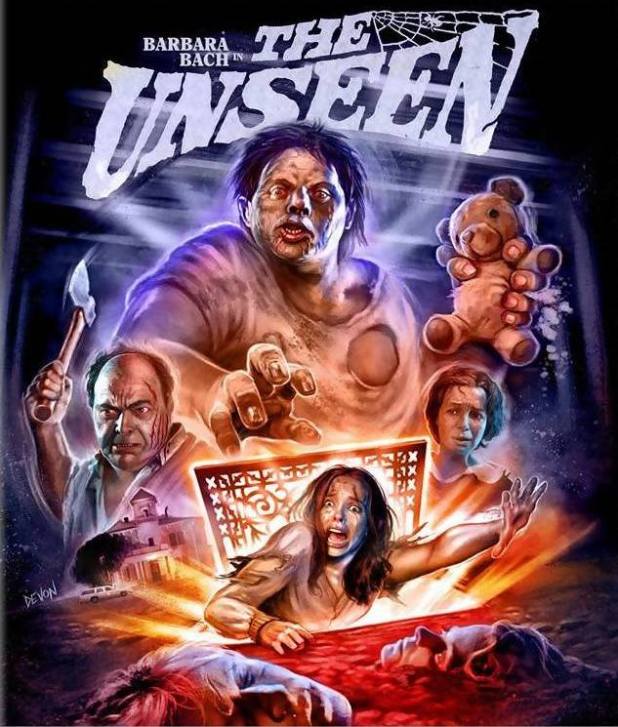
USA UP ALL NIGHT: The Unseen (1980)

EDITOR’S NOTE: The Unseen was on USA Up All Night, but I can’t find a date when it aired. Do you know?

Danny Steinmann started his directing career with the adult movie High Rise and worked on the films Savage Streets and Friday the 13th Part V: A New Beginning along the way. After that film, he was injured in a bicycle accident and was unable to return to directing. He also produced the Gene Roddenberry made-for-TV movie Spectre. Today, though, we’re here to discuss his 1980 effort The Unseen.

Keep in mind — Steinmann had his name removed from the movie as he was upset with the final cut. He’s credited as Peter Foleg.

Jennifer (Barbara Bach Lady Starkey, the wife of Ringo Starr who also was in The Spy Who Loved MeBlack Belly of the Tarantula and Short Night of Glass Dolls) and Karen (Karen Lamm, the wife of Beach Boy Dennis Wilson), along with their friend Vicki, are in Solvag, CA to cover a folk rock show and town festival. A mix-up over their reservations leads the girls to stay with Ernest Keller (Sydney LassickSkate Town U.S.A.Lady in White), the owner of a museum.

Jennifer is in town to report on the town’s parade and festival, but has to deal with her soon-to-be ex-boyfriend Tony (Douglas Barr, TV’s The Fall Guy‘s Howie, as well as Deadly Blessing), who wants to talk about their relationship. Ugh.

Meanwhile, Vicki just wants to get naked while creepy old men stare at her through vents. Sadly for her, The Unseen pulls her through one of those vents and slams it down on her neck, killing her. Soon after, Karen is also killed. Their bodies are discovered by Ernest’s wife, Virginia (Lelia Goldoni, who was in Cassavetes’ Shadows and the 1978 remake of Invasion of the Body Snatchers).

That’s when we learn the secret: Virginia and Ernest are husband and wife, as well as brother and sister. He killed their father two decades ago, and they’ve lived here ever since, along with Junior (Stephen Furst, the guy from Animal House in the role one wonders if he was born to play), their inbred son. Ernest is keeping up the cycle of abuse that his father started, beating his son and keeping his wife/sister in submission. Now, Jennifer must die to keep the secret.

Ernest lures her into the basement, where she finds her friends’ bodies. She panics and runs into Junior, who she discovers probably didn’t mean to kill anyone. Ernest tries to kill her, but Virginia tries to save her. This leads to a family fight, and Ernest kills his son with a board with a nail through it.

Just as Ernest is ready to off Jennifer with a hatchet, her stupid ex saves her. Well, he tries to, but an old leg injury flares up. Oh, you inept moron! It’s up to Virginia to save the day by shooting her husband/brother and going back into the house to hold her dead son.

The Unseen was initially written by Kim Henkel and Michael Viner. While Henkel is best known for The Texas Chainsaw Massacre, Viner was a producer and audiobook pioneer who also assembled the Incredible Bongo Band, whose song “Apache” is one of the most sampled songs ever. Their screenplay was adapted into the book Deadly Encounter by Richard Woodley.

Bluntly put, this movie is all over the place. The reveal of The Unseen stays on the monster so long that you wonder why this movie is called The Unseen. It starts with so much promise, but by the end, you may find yourself staring at the time left, hoping that it ends quickly.

Sizzlin’ Summer of Side-Splitters 2025: Nico, 1988 (2017)

Sept 1-7 John Waters Best of the Year Week: To be fair, these movies aren’t ALL funny, but JOHN WATERS is funny. He’s become more of a writer and public commentator these days. Still, he helps keep the arthouse from taking itself too seriously with his annual top-ten lists, while celebrating the comically serious.

In 49 years, Christa Päffgen — Nico — was born to a father who was a descendant of the wealthy Päffgen Kölsch master brewer family dynasty, a Catholic, and a conscript into the Nazi army, and a lower-class Protestant mother who took her away from the war to the Spreewald forest. Her father was either shot by a sniper and put out of his misery by a superior, went insane, died in a concentration camp or just faded away from combat shock.

Growing to be 5’10”, with strong features and pale skin, she was noticed as a teen as she sold lingerie by photographer Herbert Tobias, who named her after a man who had obsessed him, Nikos Papatakis. She dyed her hair blonde, later claiming she was inspired to do so by Ernest Hemingway. She then became a model in Paris before abandoning that life, running away to New York City.

After a small role in Mario Lanza’s For the First Time, she played herself in Fellini’s La Dolce Vita and was in the Jean Paul Belmondo film A Man Named Rocca and Jacques Poitrenaud’s Strip-Tease. At some point, she met Nikos Papatakis, and the two lived together between 1959 and 1961. He noticed her singing and paid for lessons. A few years later, she recorded her first single, “I’m Not Sayin'”, produced by Jimmy Page, for Andrew Loog Oldham’s Immediate label.

Brian Jones introduced her to Warhol and Paul Morrissey, which led to her appearing in Chelsea Girls, The Closet, Sunset and Imitation of Christ. Warhol suggested her to the Velvet Underground as their chanteuse, and she appeared on four songs on their first album: “Femme Fatale,” “All Tomorrow’s Parties,” “I’ll Be Your Mirror,” and “Sunday Mornings.g However, she never got along with many members of the band. That said, Velvet Underground members Lou Reed, John Cale and Sterling Morrison all played on her debut solo album, Chelsea Girl. By her second album, The Marble Index, she dyed her blonde hair red and started a style of dress that we’d call goth today*. She also made seven films with French director Philippe Garrel in the early 1970s, opened for Tangerine Dream — and later Siouxsie and the Banshees—and had a backing band on The End, which included John Cale and Brian Eno.

Somewhere in there, she had time to have a son with Christian Aaron Boulogne, whose father was either Papatakis or Alain Delon.

But her life was not all positive. After all, most of the last 15 years were spent on heroin; several claim she was misogynistic, anti-Semitic and said that black people had “features like animals,” while others say that she often made jokes in bad taste. Who knows? On vacation in Ibiza with her son, she fell off her bike, landed on her head and died a few hours later.

As you can tell, I’m a big fan of her music and the strange stories of her life. So, Nico, 1988 was perfect for me, as director and writer Susanna Nicchiarelli lets you know that Nico was more than the Velvet Underground. Images of Jonas Mekas’s films appear; the framing is meant to remind you of “the decadence and the quality of the VHS.” Actress Trine Dyrholm does more than an imitation; by singing and acting as the role, she becomes a version of Nico that imbues this movie and gives it a heart. The end, where she feels renewed, as well as the manic energy she feels playing the secret show in Czechoslovakia, is the most real feeling of being a singer that I have seen.

Even if you don’t know or like the music, I think you’ll find something here.

John Waters said of this movie, “A small, sad, fearless biopic that asks the question’ “Is junkie dignity possible?” The answer is no. Trine Dyrholm as our heroin-loving heroine plunges headfirst into the despair of showbiz with fierce determination.”

Waters also told Graham Russell: “She played at this disco, and I went. And people went, but not a lot. It wasn’t full. And she was heavy and dressed all in black with reddish dark hair, and she did her (makes guttural moaning noise). Afterwards, I said, “It’s nice to meet you, I wish you’d play at my funeral,” and she said (mimics doom-laden Germanic voice), “When are you going to die?” I told her, “You should have played at The People’s Temple; you would’ve been great when everyone was killing themselves!” Then she said, “Where can I get some heroin?” I said, “I don’t know.”. I don’t take heroin, so I don’t know. But even if I did, I wasn’t copping for Nico!”

*Indeed, in 1982, Nico and Bauhaus played “I’m Waiting for the Man” live, and her supporting acts included the Sisters of Mercy and Gene Loves Jezebel.

WEIRD WEDNESDAY: Darktown Strutters (1977)

George Armitage wrote Gas-s-s-sPrivate Duty NursesNight Call Nurses and Vigilante Force before scoring mainstream success with Miami Blues and Grosse Point Blank. He told Film Comment, “I wrote Darktown Strutters in three days, and the script form is all one sentence, the entire script is one sentence.”

While he had wanted to direct this, William Witney ended up making it. Witney was a Hollywood veteran, starting all the way back at Republic, where he worked on movie serials. He worked extensively with Roy Rogers and, at the end of his career, made a few movies with Gene Corman, including I Escaped from Devil’s Island and this movie.

This is less a narrative film and more a collection of hijinks as a gang of black bikers interacts with the police, all until Syreena starts to search for her missing mother, Cinderella. Turns out an evil barbecue chain — with an owner in full Klan regalia — has her.

Trina Parks from Beyond the Valley of the Dolls and Diamonds Are Forever is Syreena, backed up by a cast featuring former Ikette Edna Richardson, Roger E. Mosley (TC from Magnum, P.I.), Stan Shaw (Detective Sapir from The Monster Squad), Alvin Childress (Amos of the Amos ‘n Andy TV show), Zara Cully (Mother Jefferson!) and, this being a Corman family film, Dick Miller.

Get ready for a fairy tale mixed with blaxploitation, basically, with plenty of great tunes from The Dramatics, as well as John Gary Williams and The Newcomers.

And remember: “Any similarity between this true life adventure and the story Cinderella … is bullshit.”

Where Is Juan Moctezuma? (2025)

According to the filmmakers, “Legendary 1970s Mexican horror film auteur Juan F. Moctezuma II reportedly influenced the work of mega-directors Guillermo del Toro, Robert Rodriguez, Sam Raimi and more. But the last film Moctezuma made and his first in Hollywood, produced by Roger Corman, 1000 Paths of Death, was surrounded in mystery because it was shot in complete secrecy. And then he disappeared with the footage. Did his nemesis, the famous luchador Scorpion, sabotage his work yet again? Discover the truth in this fun film that delves into every level of the Mexican exploitation industry as it unfolds its obsessive tale.”

Obviously, Juan F. Moctezuma II doesn’t exist, even if someone went and made an IMDB page, adding credits for his films Una mujer sin precio 1961Las fieras 1969Demonoid 1971 and 1000 Paths of Death, films that he shares directing credits with the director of this film, Alaric S. Rocha. I appreciate this ruse, as they added him as a key grip on The Black Gestapo and Scream Bloody Murder, as well as an assistant art director credit for Sisters of Death.

There’s also a Fandom page, which goes into the story beats of the life of the director, such as his found footage — well, more to the point taking footage from other movies — film Tiempo de morir, which reads a lot like the plot of Cinema Paradiso, as well as working on a Cantinflas movie, losing the love of his life to luchador El Escorpión, working with Alejandro Jodorowsky on Fando y Lis, trying to win Lisa back on the set of Demonoid — not that Mexican Demonoid — and how his script for The Legend of Hell House (the movie claims Horror Express) was stolen by the real filmmakers. And hey — a Geocities-looking fansite, too!

It’s a cute idea, to be honest, in how it takes the world of Mexican cinema and American exploitation film through the years and weaves in this Zelig-like director, except that for all it gets right, there’s plenty that seems off. The movies that we’re shown pieces of appear to be modern-looking low-budget streaming cinema efforts, which ruins the illusion that the movie works so hard to craft that this is an actual documentary. And for all it gets right, claiming that Lloyd Kaufman, Yoram Globus or Roger Corman wanted to make Moctezuma’s last film, 1000 Paths of Death in 1977 rings hollow. Kaufman hadn’t even started to produce that much, Globus — with his cousin Menahem Golan — was still making films for AVCO-Embassy, and the two wouldn’t purchase Cannon until 197,8, and this movie claims that Corman was American-International Pictures when, in truth, he left AIP with his brother Gene to form New World Pictures in 1970. And as for AIP ripping off The Legend of Hell House, that was made by James H. Nicholson working out of 20th Century Fox as Academy Pictures Corporation. By 1977, AIP wasn’t even making the kind of movies that a Mexican horror director would come to the U.S. to make. Instead, they were putting out bigger budget films like C.H.O.M.P.S.MeteorThe Amityville Horror and Cooley High. As for Mexican horror cinema, movies as diverse as TintoreraThe BeesThe Bermuda TriangleMary Mary Bloody Mary, The Mansion of Madness (under the name Dr. Tarr’s Horror Dungeon) and Cyclone all played American grindhouses and drive-ins (and some multiplexes). Strange Mexican cinema could get played here.

I hate taking a movie to task like this — as well as showing off what a huge nerd I am — but I am the audience for this. If I can see through these moments, it makes me reconsider how much I like it. And that’s before the film explains to us that when El Escorpión and Moctezuma had their mascara contra mascara in Arena Mexico — in a year where Fishman, Mil Mascaras, Alfonso Dantes, Perro Aguayo, and El Faraón were the headliners — Moctezuma refused to shake hands… and then they show them shaking hands.

Also, while I’m being a geek, they mention selling a film to K. Gordon Murray by including full frontal nudity. That wouldn’t have gotten played on mainstream screens in the mid-60s, and other than Shanty Tramp, Murray was known as the King of the Kiddee Matinee. As for the Mexican films he did buy, he’d chop them up into one film and ensure they were sold to creature feature TV horror hosts. Full frontal would not have worked for him.

Getting a movie made is a miracle, much less one that has so many moving pieces and has to look and feel authentic. And many will look past that at this film, which gets Brian Yuzna, Isaac Ezban, Arturo Ripstein, Álvaro Rodríguez, John Penney, Paul London and others to speak at length about a filmmaker and where he fits in. It’s also a film that can’t decide if it’s subject was a maverick filmmaker who would go in debt to the cartels and destroy politicians all in the name of love, yet appear to be a slovenly rudo in the wrestling match at the end, almost a comedic figure (who would have instantly been DQ’d in the first fall for that low blow and why is a mask vs. mask match just one fall?) and not the heroic ideal we’ve been told that he was?

The ideas behind this are laudable, as is much of the execution. I just wish that it had gone all the way, because good is the enemy of great. Maybe I’m just upset that this isn’t about Juan Lopez Moctezuma, who made The Mansion of MadnessAlucarda and Mary Mary Bloody Mary. He also worked with Jodorowsky on Fando y Lis and El Topo, just like the director in this.

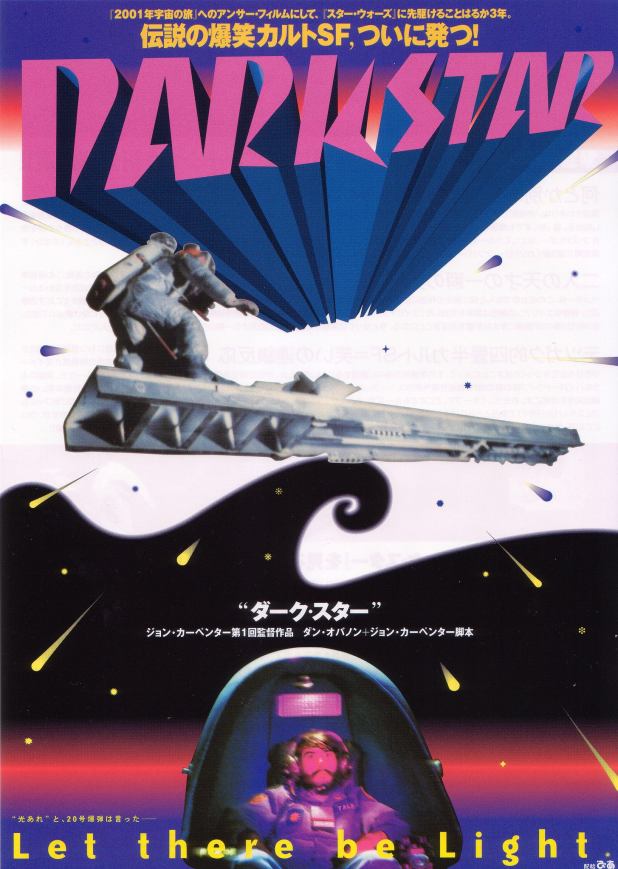
WEIRD WEDNESDAY: Dark Star (1974)

As a kid, I was obsessed with seeing Dark Star. This film, which combined the talents of John Carpenter, Dan O’Bannon, Ron Cobb, Greg Jein, and Bob Greenberg, was frequently featured in the pages of Starlog.

When I finally saw it — it played theaters until 1980, and then I was able to rent it when I got older — it didn’t live up to what I wanted it to be. Now, watching it as an old man instead of a kid just starting his life, I get it. It finally makes sense to me: even a job in space is totally going to suck, no matter how fantastic the worlds we get to travel to.

Twenty years into their mission to destroy unstable planets with Thermostellar Triggering Devices so that these worlds don’t threaten future colonization of other planets, the crew of the Dark Star has all gone insane. Or dead, as Commander Powell — voiced by Carpenter — is just a voice from cryostorage.

Lieutenant Doolittle dreams of surfing. Sergeant Pinback — O’Bannon — claims to be Bill Frug, a liquid fuel specialist, and says that the real Pinback is dead. Corporal Boiler has grown obsessed with his mustache. And Talby just watches the universe go by. None of them will be able to escape the crushing ennui of this voyage or a ship that is falling apart, filled with talking bombs that have learned Cartesian doubt.

In the end, all you can do is surf out into nothingness and burn out instead of fading away.

This started as a 45-minute 16mm student project with a $6,000 budget, but to get it into theaters, it needed more footage and to be pushed to 35mm to be shown in theaters. John Landis got the filmmakers in touch with Jack H. Harris, who padded the film some more. O’Bannon would later say that, somehow, “the world’s most impressive student film, ” it became the world’s least impressive professional film.”

Beyond writing and starring in the movie, O’Bannon also designed several of the film’s special effects, including one of the first usages of hyperspace in a movie. The influence of this movie goes beyond that, as O’Bannon would use the sequences with the evil ball to write Alien and the British show Red Dwarf would take the ball — pun unintended — and run with an entire series based on the themes of this movie.

As for influences on the movie, Phillip K. Dick’s idea of frozen dead people communicating from beyond definitely informs the commander. O’Bannon would later adapt We Can Remember It For You Wholesale and Second Variety as Total Recall and Screamers. Plus, while I don’t want to give away the ending, it’s the exact same way that Ray Bradbury’s Kaleidoscope wraps up.

You can watch this on Tubi.