THE FILMS OF WILLIAM GIRDLER: Grizzly (1976)

EDITOR’S NOTE: This was originally on the site on .

From 1972 to 1978, William Girder directed nine feature films and would have probably never stopped, were it not for the helicopter crash that took his life while scouting the Philippines filming locations. From Asylum of Satan and Three on a Meathook to The ManitouSheba Baby and Project: Kill, his films may have been derivative but they made money.

Here’s the best example. Around these parts, Girder is celebrated for Abby, a movie that was removed from theaters because of its similarity (let’s say total ripoff) of The ExorcistThat brings us to Grizzly, which is essentially Jaws on dry land. With a bear. A grizzly bear.

Grizzly found its inspiration when its producer and writer, Harvey Flaxman, came face to face with a bear during a camping trip. Co-producer and co-writer David Sheldon thought about how they could make a bear version of Jaws and they wrote a script that Girdler discovered and offered to finance, as long as he could direct.

Grizzly begins with military vet and helicopter pilot Don Stober (Andrew Prine, The Town that Dreaded SundownThe EliminatorsAmityville II: The Possession) flying over a national park and explaining how the woods remain untouched, much like they were in when Native Americans made their homes here.

The first two attacks happen quickly — in bear POV no less — when two female hikers are dismembered by the ursus arctos horribilis villain of this story. That brings in park ranger Michael Kelly (Christopher George, Gates of Hell/City of the Living DeadDay of the Animals, MortuaryPieces) and photographer Allison Corwin (Joan McCall, who besides being in Devil Times Five is also married to the film’s writer, Sheldon) in on the case.

At the hospital, a doctor tells the park ranger that a bear killed the girls, but the park’s supervisor blames the ranger and naturalist Arthur Scott (Richard Jaeckel, The DarkMako: The Jaws of Death and TV’s Salvage 1) for the girls’ deaths. And guess what? Just like Jaws, there’s no way the park is getting closed before tourist season.

The rangers all decide to search the mountain for the grizzly, which isn’t accounted for in their census of animals in the park. One of the rangers — of course — decides to get nude in a waterfall because that’s what you do when you’re hunting a killer bear and gets murked for her stupidity.

Kelly and Stober think they have found the bear from the air, yet it’s just naturalist Scott wearing an animal pelt and tracking the bear himself. Scott tells them that this bear is actually a prehistoric version of the grizzly that stands 15 feet tall and weighs at least 2,000 pounds.

No matter how many people the grizzly kills, no one will close the park. So when the story becomes national news, the owners of the park — a national park can have owners? — allow amateur hunters to shoot the shark (this has nothing to do with the very same thing happening in Jaws, right?). Those hunters are pretty much the worst people ever, as they use a bear cub as bait, thinking the grizzly will protect its young. Nope — it eats that baby bear and keeps on coming.

The grizzly literally shreds his way through the park and nobody closes it down until it murders a young mother and mutilates her child. And get this — the grizzly is so smart, it knows how to bury the naturalist in the ground and then waits for him to wake up so it can kill him. Can a bear be a slasher killer? Well, we already know that Bigfoot can be, thanks to Night of the Demon.

The grizzly kills every hero in this movie other than Kelly the photographer, who magically finds a bazooka in the wrecked helicopter and remembers the end of every shark movie: you must blow this beast up real good. She does and that’s the end of Grizzly.

An interesting personal note: I was telling my dad about this movie and he remembered that it has played on a bus that took he and my mother on a casino trip. That’s right — at 1 AM, pitch blackness, the TV on their bus blared this gorefest as loudly as possible. “I couldn’t wait for that movie to end,” was my mother’s review. My father’s was a bit kinder.

Warner Brothers originally wanted to finance Grizzly, but were furious that Edward L. Montoro and Film Ventures International (FVI) had taken the project. That’s because a year before, the studio sued both of these companies for copyright infringement when they released Beyond the Door in the US.

Sadly, while Grizzly was one of 1976’s best-performing films, earning $39 million worldwide (adjusted for inflation, that’s around $177 million in 2018 dollars), its distributor Edward L. Montoro and Film Ventures International kept all the profits. Girdler and Harvey Flaxman and David Sheldon (the film’s screenwriters/producers) had to sue to get their share.

Even after all that, Girdler still directed Day of the Animals, a spiritual sequel to Grizzly, for Montoro. While this film added Leslie Nielsen and Lynda Day George to the returning cast of Christopher George and Richard Jaeckel, it wasn’t as successful.

Grizzly just seems like a movie that’s buried in legal shenanigans. A sequel, Grizzly II: The Predator (also known as Grizzly II: The Concert, a title that would assuredly guarantee that I would buy this film) was made in 1983.

Filmed in Hungary by André Szöts and written by Sheldon, the co-producer and writer of the original, it was never released. The film had Louise Fletcher, John Rhys-Davies and unknowns but about to be big stars like Charlie Sheen (who took this movie over the lead in Karate Kid), George Clooney and Laura Dern in the cast, as well as live performances (hence Grizzly II: The Concert) by musicians like Toto Coelo (who had one song I can name, “I Eat Cannibals Part 1”) and Landscape III.

The movie was such a mess that the film’s caterer ended up rewriting it. And while the main filming was completed, special effects and all of the actual bear footage wasn’t. That’s because the film’s executive producer Joseph Proctor had disappeared with the money (and may have even been already jailed when filming began). While a mechanical bear was to be used, there was still footage shot of a live bear attacking concert-goers filmed (!). There’s a bootleg workprint, but the full film has ever emerged. This New York Post article has even more amazing info about Grizzly 2. Now that film has been released, if you’d like to see it.

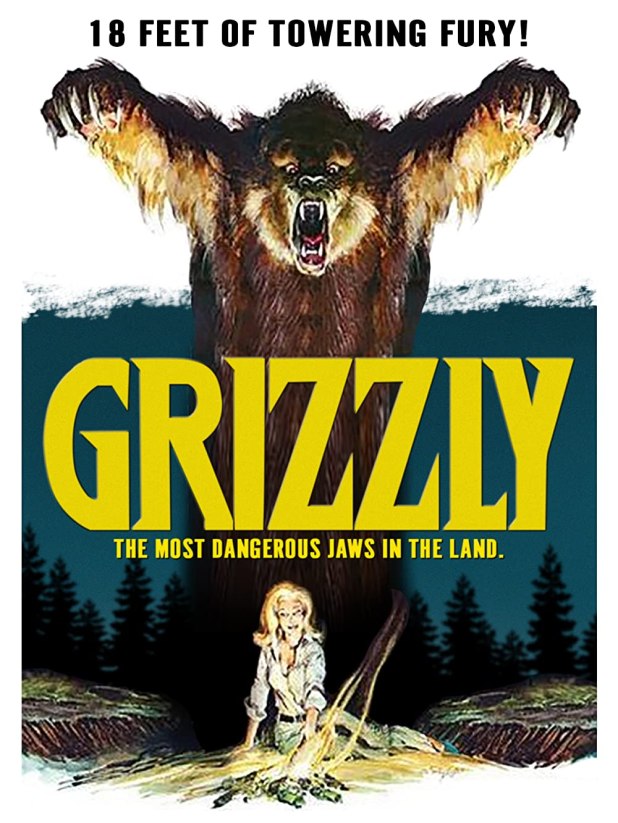
Finally, a trivia note for comic book fans. The amazing poster for this movie? Neal Adams did the art.

And in the universe of Tarantino, Don Stober was played by Rick Dalton, not Andrew Prine.
You can watch this on Tubi or get it from Severin.

THE FILMS OF WILLIAM GIRDLER: Project: Kill (1976)

William Girdler said that Project: Kill was “…the beginning of what I can do if I’m given the opportunity. Here I’m not pinned down by cliches or lousy material. It’s the only picture I’m really proud of.”

John Trevor (Leslie Nielsen) has spent six years as part of an MK-ULTRA experiment that gives American soldiers better killing abilities through training, drugs and hypnosis. It’s kind of like a cult for killers and now, he wants out. He even tells his second-in-command Frank Lassiter (Gary Lockwood) that he’s about to escape. It’d all be great if the withdrawal didn’t make John incredibly violent or that an Asian gang wasn’t looking for him in the hopes of taking the drugs from his system and using them for their own army.

Come for Nielsen dressed like a 70s dad despite being billed as an action star, stay for his romance with Nany Kwan and by all means, come back for his fight with Lockwood on a beach. It even ends a lot like Scorpio, where the older killer tells the younger one, “Now they’re going to come after you.”

On the William Girdler web site, Girdler’s insurance man Joe Schulten said, “Project Kill was supposed to be distributed in a lot of countries. Nancy Kwan was an international star at the time, and it was booked up all over the place. But the man who was going to distribute the movie was either killed or committed suicide right before the film was scheduled to come out. So the release was tied up in an estate dispute. I don’t think Project Kill was ever released to movie theaters. I think it only showed up on cable in the eighties.:

Producer David Sheldon had the answer: “Project Kill was released in the theaters, though not a very wide release. It has been on television quite a bit and there’s a home video in the stores. We pulled the picture from Arnold Kopelson (Inter-Ocean Films) who was supposed to distribute the film overseas, but was taking too long. A company called Sterling Gold tried to take it next, but the owner was found murdered organized crime style. Finally, I put it with Picturmedia who released it theatrically and sold the home video rights. The CEO of Picturmedia is Doro Vlado Hreljanovic. Picturmedia has done a poor job in releasing the picture. It deserves more.

That said, it does have Vic Diaz in it.

Writer Galen Thompson went on to script SuperstitionThe Evil and several Chuck Norris projects while David Sheldon was part of GrizzlyLovely but Deadly and Foxy Brown.

You can watch this on Tubi.

Junesploitation AND THE FILMS OF WILLIAM GIRDLER: Sheba, Baby (1975)

June 19: Junesploitation’s topic of the day — as suggested by F This Movie— is Blaxploitation! We’re excited to tackle a different genre every day, so check back and see what’s next.

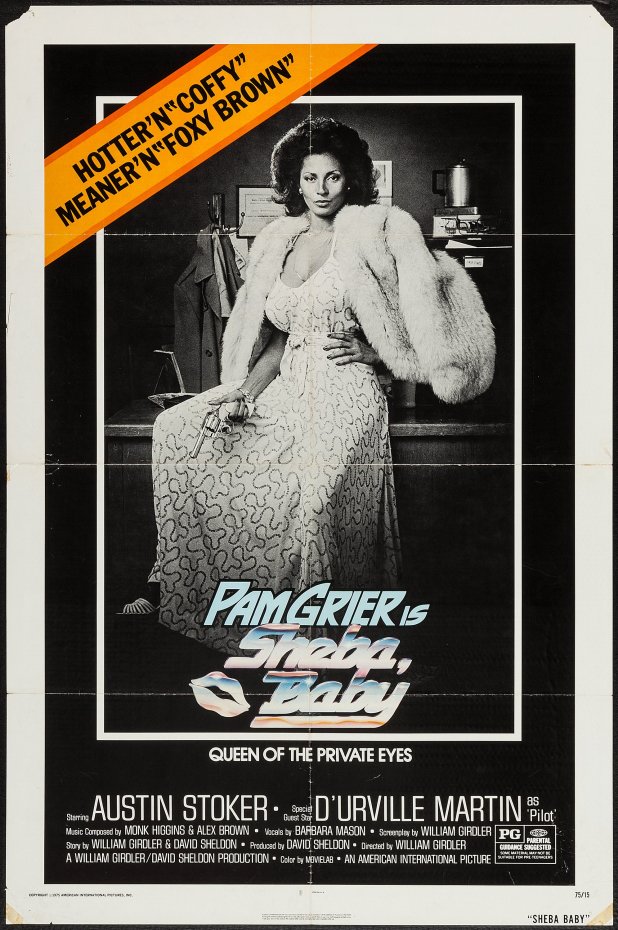
Private detective Sheba Shayne (Pam Grier) has come back home to Louisville from the big city of Chicago and she’s fighting back against the criminals out to ruin her father’s insurance business. Teaming up with her father’s partner — and her former lover — Brick Williams (Austin Stoker), she does exactly what she set out to do, even if the local cops warn her off and the thugs blow up her car.

They can kill her dad, they can drag her in a speedboat but they can’t make her give in. This is the kind of movie where Pam Grier effortlessly chases bad guys on a jet ski and dispenses them with a spear gun. In short, everything you want, including Pam kicking at least one of the bad guys directly in the balls.

David Sheldon and William Girdler sold this movie to Samuel Arkoff by telling him they already had a script done. Well, they didn’t. A day later, after selling the movie, they did.

This was also the last movie that Girdler would make in Kentucky, now ready to move onward.

As much as I like Girdler’s films, Jack Hill knew how to make Pam Grier movies. The Big Doll HouseThe Big Bird CageCoffy and Foxy Brown really are a high bar to achieve, if you think about it.

THE FILMS OF WILLIAM GIRDLER: Abby (1974)

EDITOR’S NOTE: This was first on the site on .

Warner Brothers’ lawyers must have had the best holiday season ever in 1974, thanks to all of the work they were getting shutting down ripoffs of The Exorcist. The success of Abby — $4 million in a month for its distributor, American International Pictures — led to the lawsuit that pulled all prints of the film. That’s probably why the copy I have has been battered to, well, hell and back.

From horrorpedia.com — Abby was a big success. Maybe too big for Warner Brothers’ comfort.

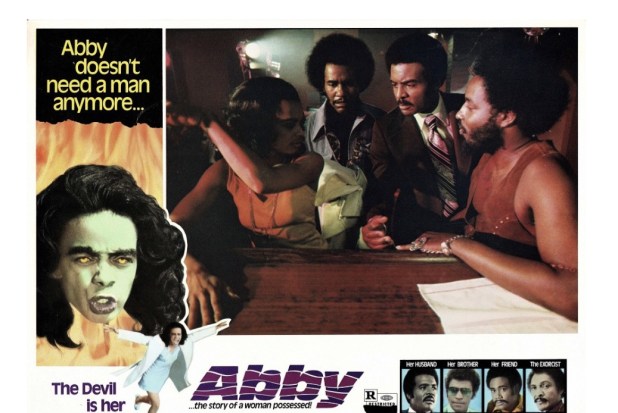
Directed by William Girder (Three on a MeathookJaws ripoff GrizzlyDay of the Animals and The Manitou), Abby is quite simply the African-American take on a possession film. Abby isn’t possessed by Satan, though. Nope, she is being taken over by Eshu, the West African trickster god, master of chaos and whirlwinds. Dr. Garrett Williams (William Marshall, not only Blacula but the King of Cartoons!) opens the film by explaining that Eshu is the most powerful of all earthly deities, the very embodiment of chaos. While on a Nigeria cave dig, he finds a puzzle box (I’d call it the Lamont Configuration, but would anyone get the Sanford and Son meets Hellraiser reference?) carved with phallic symbols. Once opened, a wind blows out that knocks the doctor and his men down, then travels the whole way to Louisville, Kentucky. There, it finds Abby, the wife of Dr. William’s son Emmett (Terry Cotter, Colonel Tighe from the original Battlestar Galactica).

Abby may have been a marriage counselor and a member of the church, but that’s all over. From cutting herself while making chicken to flipping out on anyone and everyone, Abby gets all the trademarks of possession, if those trademarks had the same voice as The Exorcist speaking in jive, calling people motherfuckers. When her husband tries to make love to her, she kicks him right in the balls. Also, Abby looks like a grey version of The Hulk when she is possessed. Basically, I just want you to know that everything Abby does is awesome and amazing and perfect.

Despite the efforts of white doctors and Dr. Williams, Abby escapes, sending a windstorm after everyone. Emmett runs after her, but since Abby has his car, he flags down a car. He then pulls a white woman out of the car and chases after her! Luckily, Abby’s brother, Cass, is a cop who is able to smooth all of this over. He’s played by Austin Stoker from the original Assault on Precinct 13 and Battle for the Planet of the Apes.

So where does Abby go? Why only to see some stock footage of Louisville’s finest clubs! Abby even tries to hook up with a bunch of guys who can’t satisfy her, so she kills them (but not before we get a dizzying POV shot of possessed Abby). The first dude literally gets killed when the car he was making out with Abby bounces up and down while smoke comes out of the windows.

Abby is on the make with a white guy who talks like WC Fields, but her husband and brother are on the hunt, searching through bars and b-roll footage!

They find her in a bar where she turns the entire bar against her husband before her brother starts shooting his gun up in the air. But oh shit — Dr. Williams shows up to battle it out with Abby!

Luckily, everything works out and Abby is saved. I mean, sure, a few people died along the way and some lady got carjacked and may never get over it. But people — Abby is fine and that’s all that matters.

Carol Speed is awesome in this film. And she wasn’t even the first choice for the title role! She won the role after the original actress was fired after demanding an on set masseuse! She even wrote her own song, “Is Your Soul a Witness?” that she sings in one of the church scenes. She also mentioned that the film was cursed, thanks to plenty of accidents, sickness and even tornadoes that tore through the set. Supposedly, generators would fail whenever she was in makeup, but I’d chalk these stories up as complete Hollywood carny bullshit. Which is to say, yes, totally, this movie was cursed and African penis gods rained insanity down on the set!

THE FILMS OF WILLIAM GIRDLER: The Zebra Killer (1974)

EDITOR’S NOTE: This was originally on the site on .

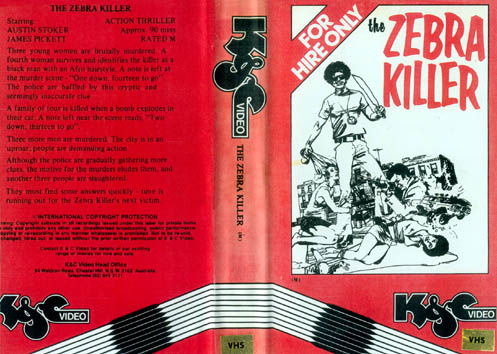
A police officer becomes obsessed with The Zebra Killer, who has kidnapped his girlfriend and has kept on murdering people. The Get-Man of the title refers to this cop, who goes by Lt. Frank Savage and is played by Austin Stoker.

In real life, the zebra murders — called that because of the police frequency used to communicate the crimes — were a string of racially motivated murders committed by a small group of Black Muslims in San Francisco Some think that the Death Angels, which is what the killers wanted to be known as, may have killed more people — up to 73 — than all other 1970s serial killers put together.

This movie, however, has the killer appear as a white man in blackface and afro wig, killing in random ways, much like the Zodiac Killer, who inspired Scorpio in Dirty Harry, which therefore is ripped off by this film.

If you’re making a blacksploitation version of a Hollywood film, go with the best. Go with William Girdler, who also made Abby, which is one of my favorite Xeroxorcist films. You can also find this movie as Combat Cops and The Get-Man, which are not anywhere near as good.

You can watch this on Tubi.

THE FILMS OF WILLIAM GIRDLER: Three on a Meathook (1972)

EDITOR’S NOTE: This was originally on the site on .

While the slasher genre really starts in 1978 (or 1979, when Halloween really took off), there are movies before that are nascent starting points. This was William Girdler’s second film after Asylum of Satan, made with money from his trust fund. It’s based on Ed Gein, as are PsychoDerangedThe Texas Chainsaw Massacre and many, many, many more.

Filmed in and around Louisville, Kentucky, the home of the director (whose also wrote and performed much of this film’s score), this is the tale of Billy Townsend (James Carroll Pickett), who seems like such a nice boy. He helps four girls who have gone to the lake for vacation when their car breaks down. But Billy has secrets and a father (Charles Kissinger, who also appears in Girdler’s films AbbyGrizzlyThe ManitouAsylum of Satan and Sheba, Baby) who loves his son so much that he’ll help him get out of any trouble.

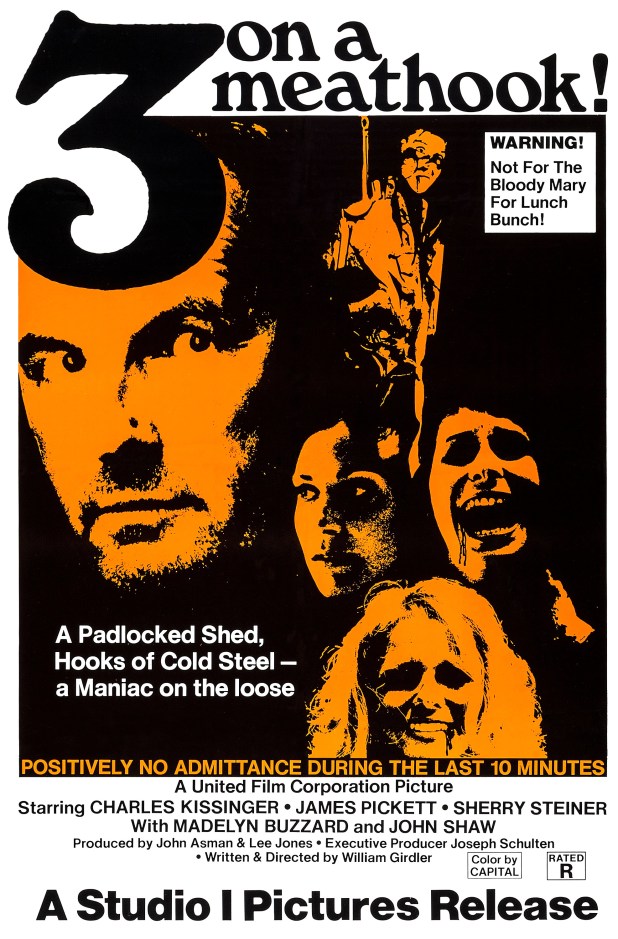
This has one of the best titles ever, as well as a great tagline — “WARNING: Not For The Bloody Mary For Lunch Bunch!” — and, as stated before, the notion of being an early slasher. It’s worth checking out to see where the form got its start. When I was a kid, this film’s cover freaked me out, as did the implications of its title. The actual film itself seems laid back and very 70’s, including an anti-Vietnam speech delivered directly to the camera.

You have to love a movie that is willing to totally forget any forward progress by having its antagonist decide to head downtown, watch some bands, see The Graduate and ponder life instead of continually killing people. You never see Michael Myers decide to take a break and grab a beer, you know?

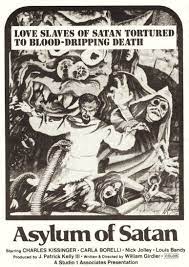
THE FILMS OF WILLIAM GIRDLER: Asylum of Satan (1972)

EDITOR’S NOTE: You can read another take on this movie here.

William Girdler was born on October 22, 1947 in Jefferson County, KY and this was his first of nine movies in six years, ending only when he died while scouting locations in the Philippines for his next film.

After he finished with the Air Force, Girlder formed Studio One with best friend and brother-in-law J. Patrick Kelly. Initially focused on TV commercials, Studio One eventually took on movies with this film. It later became Mid-America Pictures when Girdler’s films began making money.

According to the official William Girdler site, his “make ’em fast and cheap” directorial style was the result of a premonition that he’d die by the age of 30. Well, he made it to thirty, at least. Some say that Girdler was so obsessed with his own death that he said that he was in a race against time.

Filmed in Louisville in late 1971 for around $50,000, this is the story of concert pianist Lucina Martin (Carla Borelli) who has been abducted by Dr. Jason Specter (Charles Kissinger) and taken to his Pleasant Hill Hospital for treatment. It’s a sanitarium that she swears that she doesn’t belong in and who would want to be in a place where the doctor kills people to add to his Satanic majesty and immortality? And is Specter also the evil sorceress Martine? Because Kissinger is definitely playing both parts. He was also a horror host in Louisville known as the Fearmonger on WDRB.

It all leads up to a virgin sacrifice with our lovely piano player as the victim and Martine saying things like the fact that she “calls upon the gates of the dark realm to crash asunder” and invokes “blazing angles of the shining trapezoid.” What’s that? Oh, you know, the Order of the Trapezoid which later became the governing body of the Church of Satan.

More of that in a bit.

This being the early 70s, the ending is ambiguous, the rubber bugs and snakes countless and a Satan that looks like someone wearing a costume from a party store. You know, it might sound like I’m laughing at this movie, but I’m not. Asylum of Satan pleases me to an incredible degree, a movie made by someone who knew he was born to make movies and yet trying all he could to learn right there on the screen.

Girlder told the Louisville Times, “Other people learned how to make movies in film schools. I learned by doing it. Nobody saw Billy Friedkin’s or Steven Spielberg’s mistakes, but all my mistakes were right up there on the screen for everybody to see.”

The film was made with the assistance of local investors but the movie didn’t make enough to return their investment. Shortly before his too soon death, Girdler signed over the rights to this movie and Three On a Meathook to those original investors so that they could make back their money.

The Girdler site also has an amazing interview with Don Wrege, who clapped the clapboard for this movie. I loved every word, especially when he explains how the Church of Satan got involved being technical consultants.

“A bunch of high school girls (some daughters of investors) were dressed in virginal white, given candles and positioned in a circle around Borelli who was roped to the alter. A guy in a rubber suit. (Girdler said the suit/mask was from Rosemary’s Baby but wasn’t shown in the film, thus it was affordable and available and, of course, cool.)

There was a lot of motion involved. I think the guy in the rubber suit was on an apple box with wheels. The Asmans were on the largest crane we used the whole time, if I remember correctly. Multiple takes were done, all the time Kissinger (I think) was reciting the invocations that had been written by the satanic guy who was standing in the wings watching all of this take place. The incantation, if that’s the right word, was repeated any number of times with as much sincerity as Charlie Kissinger could muster, as multiple takes were filmed.

During one take, and at some very convenient point in the “prayer,” like “…if you’re present, show yourself…” or something like that, one of the white-draped high school daughters of an investor passed out and hit the floor. Everyone was horrified. The two people from the Black Church without hesitation ran to the girl’s limp body and began saying all sorts of weird shit, speaking in some unidentifiable tongue. The girl’s mother, who was there, TOTALLY freaked out, running to her daughter’s side screaming “You leave her alone…get away!” to the two Satanists.

The daughter came to in a few moments, and was excused for the day. Everything was really tense for a couple of hours after that. I think some folks started to wonder what the hell we were messing with. I made a mental note to try to keep track of that girl who fainted, but I haven’t had the nerve. I really don’t want to know.”

Well, that advisor was Michael Aquino, the actual writer of a lot of the rituals in the Satanic Bible and he told the Girdler site that he didn’t remember anyone passing out. Aquino later broke away from the Church of Satan and formed the Temple of Set.

After receiving his PhD in political science from the University of California, Santa Barbara, Aquino worked as an adjunct professor at Golden Gate University until 1986. The whole time, he was serving as an Active Guard Reserve officer of the United States Army stationed at the Presidio of San Francisco.

As the 80s went on, Aquino became intrigued by the connections between Nazis and the occult. At one point, he performed a solitary rite at Walhalla beneath the Wewelsburg castle which was an infamous ceremonial space used by the Schutzstaffel’s Ahnenerbe group.

He then formed the Order of the Trapezoid, which was a chivalric order influenced by a mix of Satanism, Pagan heathery and even the application of runes within magic. Aquino was often challenged in the Satanic Panic of many crimes, as well as in conspiracy circles for numerous acts of evil as he started his career in PsyOps. He even welcomed LaVey’s daughter Zeena and her husband Nikolas Schreck into the group before the inevitable break.

But I digress, as I always say.

Girdler would do so much more — again, in such a short time — but the basics of his career are here. The 70s were prime time for Satanic movies and he took advantage of it just as he would of all manner of subjects that he thought would make box office.

He was even kind of William Castle in a way here, as the press book mentions ordering “Sign of Satan Soul Protectors” to protect theatergoers from the “Evil Stare of the Devil.” That’s also Girdler’s Porsche in this and his sister Lynne Kelly in the pool with the snakes, because Sherry Steiner refused.

Here’s a drink for this movie.

Snake in the Swimming Pool

  • 2 oz. Southern Comfort
  • 4 oz. cranberry juice
  • 1 oz. lime juice
  1. Build over ice, starting with the SoCo, then followed by the cranberry and lemon.

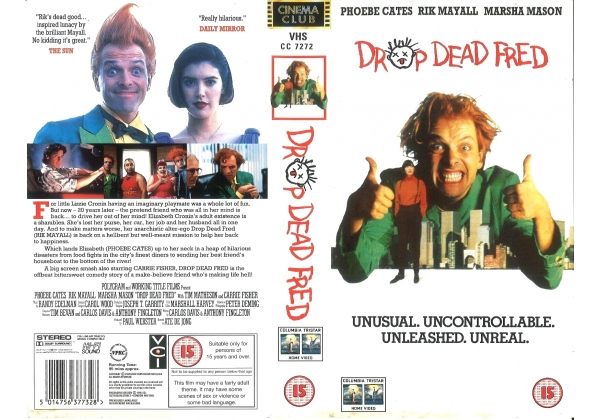
Junesploitation: Drop Dead Fred (1991)

June 18: Junesploitation’s topic of the day — as suggested by F This Movie— is 90s comedy! We’re excited to tackle a different genre every day, so check back and see what’s next.

I never saw Drop Dead Fred — I was 19 when it came out and despite my love of The Young Ones and everything Rik Mayall ever did, I somehow just never made time for it — when I was a kid, but man, this is one of those movies that’s at once perfect for children and also so anarchic and wild that their parents may never want to show it to them.

It also comes from a very, very dark place.

While originally intended for Tim Burton to direct and Robin Williams to play Drop Dead Fred, it ended up with Dutch director Ate de Jong and Mayall being involved. Yes, the director of Highway to Hell and the man known for abusing Adrian Edmondson on both The Young Ones and Bottom were selected to make a movie for children.

In 2021, The Telegraph published “Rik Mayall’s mental health misadventure: how Drop Dead Fred repelled America,” de Jong revealed that as he rewrote the script, he based much of it on his own life, saying “…the trauma of child abuse goes deep and its claws reach far in time. It was not something ever spoken about on the set, not with Rik or anyone, but for me it existed.”

This is the same movie that Rotten Tomatoes summarized as “Tackling mature themes with an infantile sensibility, Drop Dead Fred is an ill-conceived family comedy that is more likely to stir up a headache than the imagination.”

Gene Siskel said, “This is easily one of the worst films I’ve ever seen.”

Hmm. Maybe I saw a different cut.

Drop Dead Fred feels different in a world that understands childhood abuse and the ways that we cope with it. Elizabeth Cronin (Phoebe Cates, who the movie tries to make look like a woman who has never grown up and who is dowdy, but come on, it’s Phoebe Cates) grew up with a mother (Marsha Mason, absolutely perfect in this movie) who repeatedly emotionally abused her to the point that she found happiness with an imaginary friend named Drop Dead Fred (Mayall). After she caused too much chaos with Fred, her father forced her to symbolically — but totally not — duct tape Fred into a box and put him away forever.

This scene is also based in horrifying childhood memories. A friend of co-writer/executive producer Carlos Davis named Steve Burnette told the story that his mother had an imaginary friend as a girl which upset her mother so much that she demanded that she flush it down the toilet and kill it. This traumatized her for years.

When Elizabeth grows up, she remains the same unassertive and frightened little girl, just accepting her husband (Tim Matheson) leaving her for another woman (Bridget Fonda in an uncredited part), losing her job, getting her car stolen and having to move back home with her oppressive mother. Despite help from her friend Janie (Carrie Fisher), Elizabeth remains trapped, a victim of past abuse.

Then she unleashes Fred by opening the box and in a fit of pique, he responds to her growing up by smearing dog crap all over the carpet.

Drop Dead Fred has come back because his whole job is to figure out how to make Elizabeth — Snot Face, as. he calls her — happy again. But can she be happy? Her father abandoned her to a mother who, at best, used words to make her never feel like she was right or if she mattered. And then, when she tries to assert herself, her mother places all the blame on her, saying that she’s too emotional or being silly. Of course you’d invent — or be open to — an imaginary friend.

Seriously: I had an imaginary friend — in the form of a doll — named Freddy when I was 3 years old, a character well-known enough to my parents that my father made a book called Freddy Did It that recounted stories of where I broke things around the house for attention and blamed the doll.

At the end of all this, after enduring so much real life and even having her mother infantilize her by bringing her to a child psychologist to get pills that will make Fred go away, Elizabeth instead goes into a dream universe where she learns just how important that she is and that at least one person, Fred, truly loves her, values her and views her happiness as valid. She has learned from his dream world everything she needs.

The film originally ended with Elizabeth at Mickey’s house. After she reads his daughter Natalie a bedtime story, the little girl comes downstairs with her teddy bear torn apart and says that Drop Dead Fred did it. There’s a shot of a book with Fred in it and you hear his voice. Audiences hated this and wanted him brought back. The ending is so poignant and perfect to me, as Natalie now needs Fred. Elizabeth knows this and knows she can no longer see her best friend but now, someone who will be very important to her has needs just like she did. But unlike everyone else, she can believe in this little girl and support her and give her what she never did.

How dumb am I for ending this movie crying for ten minutes after it was over?

This is a movie for children where the main character and her childhood dream friend discuss eating her mother and pooping her all over the dining room table and here I am just overcome with emotion.

I have no idea why this movie was so hated when it came out and why no one isn’t talking more about it today. I also have no idea why I waited so long to see it, but it was exactly what I needed today.

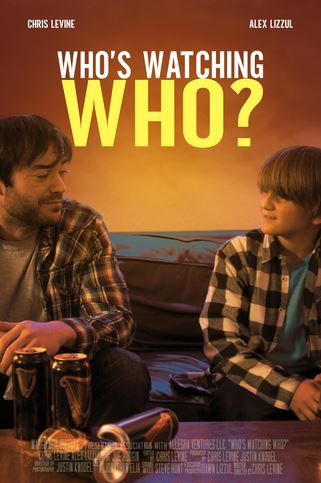
Who’s Watching Who? (2023)

“Uncle Nick, it’s gonna be okay, ya’ know? Love is complicated.”
— Trevor drops wisdom on Nick

As this review goes to press, we’ve learned that Who’s Watching Who? was named “Best Short Film” at The Percy Awards in Austin, Texas, as presented by The Academy of Independent Motion Pictures. In addition, the film has received screening invitations to the 15th Annual Burbank International Film and 26th Annual Dances with Films festivals.

A long-gestating passion project produced, written and directed by Chris Levine (most recently seen in Micheal Matteo Rossi’s 2023 actioner Murder Syndicate; he also starred Rossi’s 2021 offering, The Handler), he stars as Nick: the divorced, means-no-harm ne’er-do-well brother (sort of a grungy, more troubled Uncle Buck, if you will) reluctantly drafted to take care of Trevor, his 12-year-old nephew, for his working, single-mother sister. Will Nick rise to the challenge and be the adult for the weekend . . . or will Trevor (a really fine Alex Lizzul, in his debut) be in charge?

Produced and distribute by Margo Neil Pictures and Allegra Ventures, be sure to look for this delightful, family friendly comedy at a film festival near you. Also be sure to look for Chris Levine in the upcoming comedy, Cup of Roommate, as well as enjoy a few of his films now streaming on Tubi. We examined Chris’s career at length with the first effort of his that we reviewed, No Way Out.


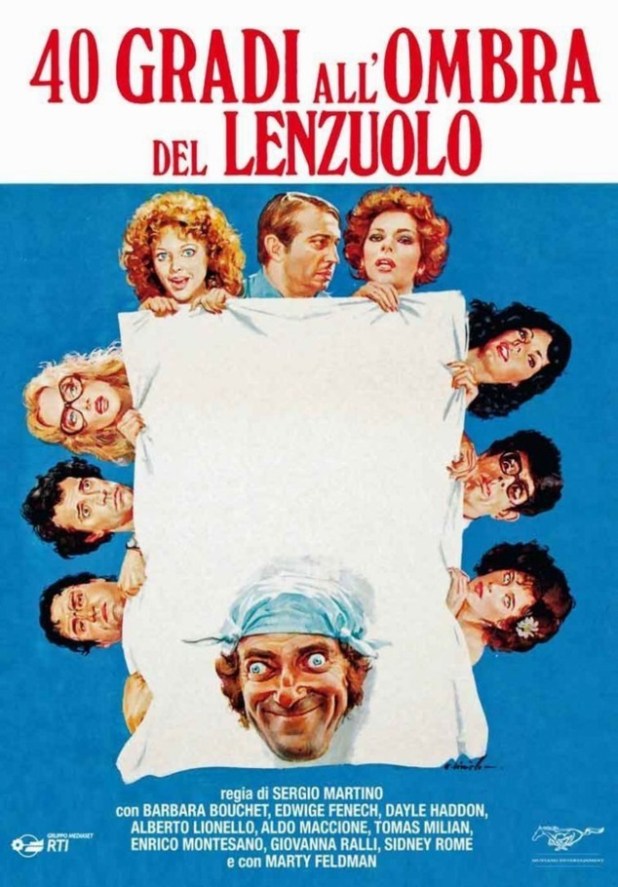
40 gradi all’ombra del lenzuolo (1976)

That title means 40 degrees in the shade of the sheet but you may know this Sergio Martino-directed. movie better as Sex With a Smile. In the U.S., all of those ads focused on Marty Feldman, who briefly shows up in one of the film’s five chapters. It’s American distributor Centaur/Surrogate even cut all of the credits and just have Feldman’s name in them along with changing the order of the stories.

“One for the Money” takes place in Switzerland as a rich Italian bride (Barbara Bouchet) meets a man (Enrico Montesano) who offers her 20 million lire (around $4.5 million dollars in 2023 U.S. cash) to make love. She blows him off but then starts to wonder “What if?”

“The Bodyguard” concerns a socialite (Dayle Haddon, who went from Disney movies like The World’s Greatest Athlete to movies like this and Just Jaeckin’s Madame Claude and The Last Romantic Lover) who hates how well her bodyguard (Feldman) keeps her secure. And then when she tries to escape him to met a new lover, she learns that maybe he was right to do his job so perfectly.

“Catch It While It’s Hot” is about a countess (Giovanna Ralli, What Have They Done to Your Daughters?) hooking up with her chauffeur (Alberto Lionello), while “Dream Girl” finds Edwige Fenech being so ravenous that she intrudes on the dreams of her neighbor (Tomas Milian), which he actually complains about. Come on, dude.

Finally, “A Dog’s Day” has a man save a woman (Sydne Rome, The Pumaman) from jumping off the ledge outside his apartment. They make a date and that’s when he meets her very jealous dog.

Martino’s sex comedies basically have the most attractive women ever dealing with men who look like buffoons. But I mean, would I fair any different upon trying to speak to Edwie Fenech or Barbara Bouchet? Also: Look for an appearance by Salvatore Baccaro, who played The Beast In Heat.

There’s also a sequel to this, Spogliamoci così, senza pudor, if you enjoy Italian sex comedies. In the same year that Martino made this, he also directed the poliziotteschi movies Gambling City and Silent Action as well as the giallo The Suspicious Death of a Minor. Few directors could hit so many genres with so much success.