MILL CREEK DRIVE-IN MOVIE CLASSICS: Savage Journey (1983)

EDITOR’S NOTE: This Night Train to Terror connected movie was part of another Mill Creek set, The Excellent Eighties. We reviewed this on February 27, 2021 but why not read it again?

This movie made this entire month worth it.

That’s because it unlocks another part of the saga that is my fascination with the utterly strange and mysterious Night Train to Terror, a movie that I have written about more than once.

While this movie is listed on IMDB as a 1983 made for TV movie, the truth is that this movie was originally released six years earlier as Brigham. I love this comment on the movie from Mormon Literature and Creative Arts, which stated that the film came about as David Yeaman wanted to “create a film billed as authentic and sympathetic to the LDS view. Top Hollywood brass was involved, primarily Oscar-winning screenwriter Philip Yordan, and the LDS public grew excited to finally see themselves depicted accurately on screen.”

Oh man. Let’s take a break from this quote just to remind everyone who Phillip Yordan was. In The Phillip Yordan Story, a Hollywood urban legend is just part of his legend. It was claimed that Yordan hired someone else to go through law school for him so that he could get a degree without doing the work.

While Yordan is the listed writer on nearly a hundred movies, including DillingerDetective Story and Broken Lance*, the jury is out on what films he actually wrote. Some believe that many of the movies he wrote were actually a front for blacklisted writers, who still wanted to make films, giving Yordan all the credit and half the paycheck.

In the late 1950s, Yordan finally got caught. He mixed up two scripts, delivering a Fox script to Warner Brothers and vice versa. Seeing as how he was under contract at Fox, Darryl F. Zanuck threatened to get him blackballed at all the major studios. A few years later, his secretary would claim that she was the real writer of The Rise and Fall of Legs Diamond and things got so bad that Columbia demanded that he have an office on their lot where they could watch him write, guaranteeing that he was the author. Despite this new contract, he was still hustling scripts at other studios and was fired and forced to return his paycheck. This time, he really was told you’ll never eat lunch in this town again.

Yordan then showed up in Spain, working for Samuel L. Bronston, using folks like Ray Bradbury, Ben Barzman Arnaud D’Usseau, Julian Halevy and Bernard Gordon, who really wrote The Day of the Triffids, not Yordan.

By the mid 60s, he was back in Hollywood, a survivor of everything from being blackballed to going bankrupt, working as a script doctor on movies like Horror Express — also a horror movie set on a train — and Psychomania.

At the end of his life, he worked as an adjunct screenwriting instructor at San Diego State University and was writing scripts for movies like The UnholyMarilyn Alive and Behind Bars (which is also part of Night Train to Terror), Cataclysm (ditto), Cry Wilderness and this movie.

Back to our friends at Mormon Literature and Creative Arts, who wrote that “Unfortunatley, when released, Brigham proved a critical fiasco. It was criticized for poor acting, incomprehensible chronology, sensationalized violence, incredibly poor casting, lack of dramatic focus, and even for recycling wagon train footage from earlier films like Brigham Young itself. The film was quickly withdrawn, reedited, and re-released early the following, billed as The New Brigham. Similar attempts at repackaging continued as it was apparently again revamped and christened Savage Journey a few years later (perhaps to parallel the 1983 handcart film Perilous Journey). Despite this, Brigham remained a critical flop, and modern Mormons, if they remember it all, do so with humor or derision.”

Yes, this was a movie that Yordan made specifically for the Mormon Chuch and along the way, he brought director Tom McGowan, who — yes, you got it — also directed Cataclysm, and Richard Moll, who would star in that film and Marilyn Behind Bars. Seeing as how both movies are segments in Night Train, it gets really disconcerting watching Moll have hair, not have hair and be played by a double with astoundingly hairy arms.

Other actors who appear in both films include Maurice Grandmaison, who plays Brigham Young himself and Papini, the homeless Catholic priest who attempts to help the heroine Claire Hansen; Stephen Cracroft, Phineas in this one and a first AD on Night Train; Lou Edwards, Brother Becker in Mormon times and a production manager on Night Train; Faith Clift, who was Claire Rudley in this movie and appears as Claire Hansen in Night Train (she was also Yordan’s wife, showing up in his movies Captain ApacheHorror Express and Cry Wilderness); an uncredited Marc Lawrence (yes, the very same man who made Pigs and appears in Night Train as Abraham Weiss) and most importantly, Yordan’s son Byron, who is the song and dance man doomed to die on Satan’s Cannonball, but not before he sings “dance with me, dance with me” more times than you can count.

I’m astounded that this film exists. Actually, I’m so into the fact that Yordan did, a flimflam man who claimed to have never read a newspaper before the age of fifty, yet somehow was a lawyer who became an Oscar-winning writer, a producer and the connection between so many movies that are just plain strange.

So how’s the movie?

Moll, who used the named Charles Moll for this film, sums up Savage Journey best in the movie The Work and the Story, saying “All independent films suck, all Mormon films suck, and, ergo, an independent Mormon film must royally suck.”

*A movie he won an Best Original Story Oscar for, despite it being a remake of 1949’s House of Strangers and the fact that he probably didn’t write a single word of the actual script.
MILL CREEK DRIVE-IN MOVIE CLASSICS: Murder Mansion (1972)

EDITOR’S NOTE: We covered this wild movie of many titles when it was part of the Mill Creek Chilling Classics box set on November 1, 2018.

I love Mill Creek multipacks. Sure, the quality is abysmal at times. Often, you get the same films on multiple sets. And you get bad dubs. But let’s face it — often you can find these sets used for $5 or less and you get up to 50 amazing films. That inspired me to spend the month of November gathering some of my favorite writers and fans of the site to tackle the Chilling Classics box set.

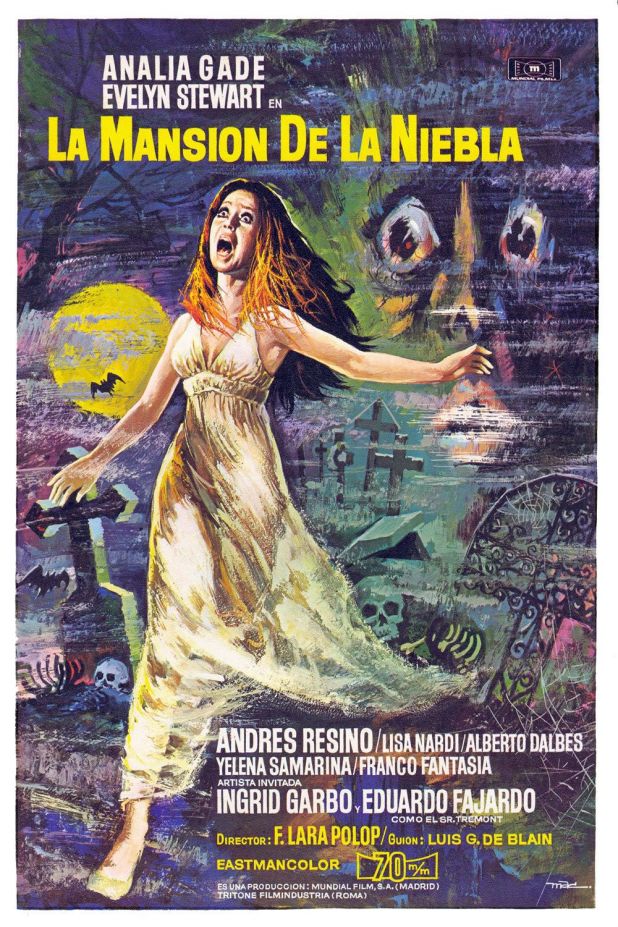
Originally released as La Mansion de la Niebla (The Mansion in the Fog) and also known as Murder Mansion, this Spanish/Italian film fuses old school haunted house horror with the then new school form of the giallo.

The plot concerns a variety of people drawn to a house in the fog, so the original title was pretty much correct. There are plenty of European stars to enjoy, like Ida Galli, who also uses the name Evelyn Stewart and appeared in Fulci’s The Psychic as well as The Sweet Body of Deborah. And hey, there’s Analía Gadé from The Fox with the Velvet Tail. Hello, George Rigaud, from All the Colors of the Dark and The Case of the Bloody Iris! They’re all here in a movie that seems to make little or no sense and then gets even more bonkers as time goes on.

This was one of the 13 titles included in Avco Embassy’s Nightmare Theater package syndicated in 1975 (the others were MartaDeath Smiles on a MurdererNight of the SorcerersFury of the Wolfman, Hatchet for the HoneymoonHorror Rises from the TombDear Dead DelilahDoomwatchBell from HellWitches MountainMummy’s Revenge and The Witch). How did these movies play on regular TV?

There’s a history of vampires in the house, the previous owner was a witch and hey — this is starting to feel like an adult version of Scooby Doo with better-looking ladies. That’s not a bad thing. But if you’ve never watched a badly dubbed giallo-esque film before, don’t expect any of this to make a lick of sense.

Don’t want to buy the whole box set? This is playing for free on Amazon Prime.

Mill Creek Drive-in Classics: This Island Monster (1954)

Well, for me, this tale of an Italian undercover treasury agent infiltrating an island-based drug smuggling ring that results in the kidnapping of his young daughter isn’t a drive-in classic: it’s a scratchy n’ snowy, UHF-TV classic (well, bore). Those UHF days were the days when a young kid was enamored with all things Boris Karloff. What did my snot-nosed little brat of yore know about Karloff being way past his prime at this point in his career?

Well, with a title like that, well, at least I can warn you this is not a horror film. Leave your memories of The Body Snatcher (1945) and Isle of the Dead (1945) at the porta. Oh, and Boris is barely in it: he shows up in the beginning, vanishes in the second act, then returns to finish off the flick. Plot spoiler: he’s the head clubbing and gun shooting mastermind behind the kidnapping to stop the investigation. His cover story is that he’s a kindly gent who runs a child’s hospice . . . and runs bootleg milk.

Ugh. This flick is cheap and clunky and that smokey ballroom scene looks like they were going for Casablanca — only Karloff is no Bogart — and the production is so cheap the American distributor didn’t make the effort to hire the ex-Frankenstein actor back to dub his own voice in this Italian thriller — a thriller with no action and too much talk (and the high-pitched dub on the kidnapped kid is beyond annoying; somebody gag her, already). Sure, everything you’d expect in a pre-Giallo Italian noir is here: We’ve got a government agent and drug smugglers, cops-in-the-pocket of a criminal mastermind (Karloff), a femme fatale, double-crosses, herrings of red, and chinzy car chases. But again: all done with a lack of action and too much chitty chat.

Director Roberto Bianchi Montero bounced around from genre to genre in the Italian film industry: spaghetti westerns, with Seven Pistols for a Gringo and The Last Tomahawk, to peblum, like Tharus Son of Attila, war movies, like 36 Hours to Hell (with Richard Harrison), Eye of the Spider (with Klaus Kinski), exploitative erotica, like Mondo Balordo (1964), and horror, like So Sweet, So Dead (1972).

Screenwriter Carlo Lombardo sounds like a familiar name with a long resume in many genres (you’re thinking of actor Carlo Lombardi, by the way), but he’s not: amid Lombardo’s work in operas — he’s regarded in Italy as the father of the late 19th and early 20th Century revival in operas — he wrote two more, Italian-only TV movies.

We never reviewed Frankenstein (1931) proper, but rest assure: we reviewed ALL of the knock-off flotsam amid our pages. You need more Giallo? Check out our “Exploring: Italian Giallo” featurette. “Film noir,” you ask? There’s our “Drive-In Friday: Black & White Nite” to ponder, along with our reviews of Rope, Spellbound, and Dead of Night (all 1945) to get you started.

You can watch a nice rip of This Island Monster on Tubi.

About the Author: You can learn more about the writings of R.D Francis on Facebook. He also writes for B&S About Movies and Medium.

Mill Creek Drive-In Classics: The Devil’s Hand (1961)

About the Author: Shannon Briggs has been a passionate fan of cinema ever since his grandmother recorded The Monster Squad on VHS through cable and gave it to him. You can see more of his musings on Twitter @MisterShannonB and read more his reviews at https://letterboxd.com/MisterShannonB/

Just a few seconds into the opening titles of “The Devil’s Hand”, the viewer isn’t greeted with the ominous score you expect from a horror film about a deadly cult. No, Baker Knight’s theme for the film is instead a surf-rock medley that would be a comfortable fit for a fun beach comedy with Frankie Avalon and Annette Funicello. It’s a head-scratching choice. This is indicative of the film’s overall out of touch nature with tone and how incredibly goofy it is when tackling the subject of cults.

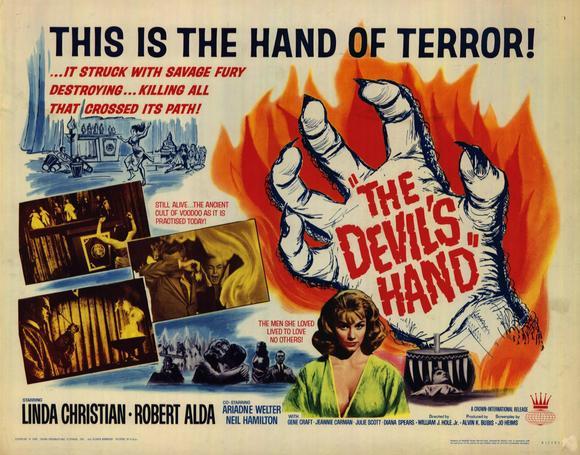
The plot of The Devil’s Hands consists of Rick (played by character actor Robert Alda, probably best known for his guest roles in a plethora of 1960s and 1970s television shows and was Alan Alda’s father.) haunted/mesmerized by vivid visions of a beautiful woman (Linda Christian, from the 1954 television adaptation of Casino Royale) and is shocked when he passes by a doll shop and sees a doll identical to this mystery woman. He brings his fiancé, Donna, (Ariadna Welter) to the shop and not only does the shop owner, Francis Lamont (Neil Hamilton, Commissioner Gordon from the 1960s Batman) recognize him, but states that it is of Bianca Milan and also declares that Rick ordered the doll. Rick has no memory of this, and things get even weirder when a doll that looks like Donna is discovered by the couple as well, but Francis refuses to sell it because it already belongs to someone else.

As soon as Rick and Donna leave, Lamont walks into a secret room in his shop and stabs the doll that looks like Donna with a pin. Donna collapses and is taken to a hospital for heart spasms. Rick has another vision of Bianca and tells Donna he wants to deliver the doll to Bianca but pledges his loyalty to Donna. However, minutes after meeting Bianca, Rick folds like a poker hand and is immediately DTF for Bianca. Turns out Bianca was using thought projections to appear to Rick and convinces him to join a cult meeting of the devil god, Gamba, led by Lamont. The meetings consist of bongo playing and interpretive dance around a statue of Buddha for some reason. Oh, and the occasional human sacrifice as well. Can Rick withstand Bianca’s charms enough to realize that joining a death cult probably wasn’t probably the best idea?

The Devil’s Hand attituded towards cults seems to mix fear of otherness pertaining to African/Asian iconography and huge smattering of voodoo. In fact, the most notable scene is when the worst undercover reporter is discovered, and Lamont stabs a pin through the head of the like-like doll of said reporter. The reporter is seen immediately clutching his forehead in pain and the car comically goes off the road and falls down a cliff where it immediately explodes. The voodoo stuff, while obviously ignorant, at least makes sense in the plot. When the film is trying to convey the evils of Eastern religion through bongos and sensual dancing, it’s just embarrassing.

As far as the cast, Christian’s Bianca is really the main focus as the story focuses on her allure and sensuality. However, the film cannot seem to make its mind on if she is a femme fatale or a more sympathetic character. Her scenes with Lamont seem to hint at a seething animosity but nothing really comes of it, and she mostly comes off as a loyal second in command. Alda’s Rick is the most frustrating because it never really confirms whether his initiation into the cult is due to brainwashing or lust. At times he seems to be under some sort of spell. For example, after joining the cult, it is revealed that Rick has done substantially well financially and has newfound luck. You think something may come of this revelation but…shrug. Most of the time, he seems to have all of his senses and eventually reconciles with Donna after basically gaslighting her for the second act of the film (our hero). Hamilton’s Lamont is by far the best performance even if saddled with some of the silliest dialogue in the film. Weltner’s Donna isn’t given much to do outside of advancing the finale and being a link to Rick’s humanity when the film decides to make him a loyal fiancé again. 

Directed by William J. Hole Jr., The Devil’s Hand (a.k.a. Witchcraft, The Naked Goddess, Devil’s Doll and Live to Love) was completed in 1959 but wasn’t distributed until 1961, when Crown International Pictures acquired it. Surprisingly, while mostly filmed in Los Angeles, some production was done in Mexico City, Mexico. Hence, the use of Mexican actresses Christian and Welter (whose stilted English is noticeable). Not surprisingly, the film seemed to made on cheap and quick and most of the cast wasn’t fond of it, specifically Christina and Alda. Screenwriter Jo Heims would go on to write the Elvis as twins’ vehicle, Double Trouble, and Clint Eastwood’s directorial debut, Play Misty for Me. Hole Jr., primarily a television director, would do a few more B-movies throughout the 1960s but finish out his career directing episodes of The Bionic Woman

The Devil’s Hand is a more of a curiosity than an enjoyable movie. It’s 50’s viewpoint of cults and primarily Satanism is so quaint that it would make 1975’s The Devil’s Rain chuckle. Like I said at the beginning, having a surf rock score for your Satanic horror film was a choice.

MILL CREEK DRIVE-IN CLASSICS: Jive Turkey (1974)

Man, Mill Creek box sets are beyond a learning experience, because you’ll get a Hammer movie, the story of a talking monster truck, an Israeli coming of age comedy, some giallo, Spanish horror, a Bigfoot doc and who knows what else. Let’s also include the blacksploitation film Jive Turkey, also known as Baby Needs a New Pair of Shoes.

Pasha (Paul Harris, Truck Turner) runs the numbers in the city. His childhood friend Big Tony (Frank DeKova, who had a long career of playing tough guys and died in his sleep) runs the drugs. But the narcotics are drying up and the mafia wants in on gambling and Pasha even has a traitor in his midst. It’s not going to be a good day.

This movie may not interest many but isn’t that what this site is all about? There are moments to savor here, like the closing Russian roulette scene between Pasha and Tony, as well as Serene, Pasha’s #1 hitman. Or hitwoman. You’ll figure it out and I love that the film didn’t make her into a caricature but instead the most cunning and deadly character in the entire movie.

This all was written by Howard (who produced) and Elizabeth Ransom with a script by Fredricka DeCosta, who all never did anything else. Director Bill Brame did a lot more, including The Cycle Savages, Miss Melody Jones and Scream Free! while editing eight episodes of the original Star Trek.

Of all the things to enjoy in this film, perhaps the best part is that it feels almost like a documentary of a day in Pasha’s life. You get to meet the low and medium-level people who keep the street moving and get the feel that you’re there. And if you’re the least bit offended by language (racist and profanity both), perhaps this isn’t the movie for you because even the soundtrack is filled with it.

MILL CREEK DRIVE-IN MOVIE CLASSICS: The Ghost Galleon (1974)

EDITOR’S NOTE: This voyage of the Blind Dead originally ran on our site on December 13, 2020.

What shall we call this movie? The Blind Dead 3Horror of the Zombies? Ship of Zombies? Or The Ghost Ship of the Swimming Corpses? Let’s just go with The Ghost Galleon and know that it’s the third Blind Dead movie after Tombs of the Blind Dead and Return of the Blind Dead.

Writer and director Amando de Ossorio is back, again pitting the former Knights Templar, now zombie horde against some swimsuit models and the rescue party that comes to get them. Now, they have the power to appear within the fog, taking over the ocean and killing all that they come near.

Jack Taylor, who worked with Jess Franco often, shows up here. He was in everything from Mexican films like Nostradamus and the Monster Demolisher to The Vampires Night Orgy and Pieces.

This movie is like being in a trance. A trance that has a flaming ship in a bathtub for a special effect, which is perhaps one of the finest trances to find oneself. The Blind Dead themselves are wonderful as always, but the idea that a sporting goods store owner could get publicity by stranding models and then somehow a galleon filled with the graves of Knights Templar who sacrificed women to Satan find them and take them inside their fog world and…ah, why am I complaining? That’s actually a perfectly logical plot.

MILL CREEK DRIVE-IN CLASSICS MONTH: Snowbeast (1977)

EDITOR’S NOTE: We did a Chilling Classics Mill Creek month three years ago and Bill Van Ryn wrote this on November 7, 2018. He loves this movie so much that we watched it on our live show and had a drink to celebrate it! For more of Bill’s writing, check out Groovy Doom and Drive-In Asylum

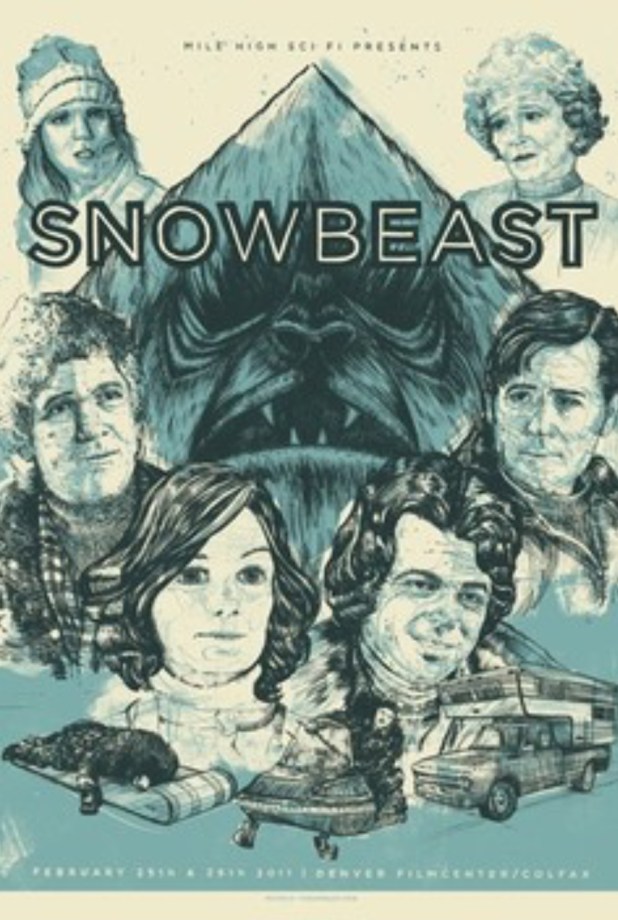
A popular vacation spot, desperate for tourist dollars, is suddenly beset by a beast that kills people. This coincides with the big breadwinning season of the vacation spot, leading the people in charge to hush up the deaths and avoid spooking the tourists into bolting. In the post-Jaws 1970s, there was no limit to the number of movies that came along with this exact same plot. One of the most successful imitators was William Girdler’s 1976 flick Grizzly, which placed the action in a park and substituted a bear for a shark. 1977 TV movies Snowbeast distills this formula even further, making the park a Colorado ski resort and changing the grizzly to a bigfoot monster.

Robert Logan and Sylvia Sidney play a grandson and grandmother who find their winter carnival interrupted by a monster that starts attacking and eating isolated people on the slopes — at one point, Logan says he can identify a victim’s body by looking at her face, and another character says “She doesn’t have it anymore.”  Sidney, of course, doesn’t want to admit that there is a problem at all, and advises Logan to keep it a secret. Bo Svenson is a former Olympic ski champion who has fallen on hard times and picks the wrong time to come to his old friend Logan for a job; I’m pretty sure entering into combat with a murderous bigfoot was not what he signed on for. Svenson’s wife, played by Yvette Mimieux, happens to be a former flame of Logan’s adding a love triangle to the story. Anyone who read the novel Jaws knows there was a love triangle in that story too, although it was not retained for the film version, so maybe nobody realized at the time just how deeply the screenwriter Joseph Stefano plunder the depths of Peter Benchley’s story.

Although the violence is subdued enough for a TV movie, there are some moments of dread to be found here, like when one character is trapped in a wrecked RV and can’t escape the oncoming monster, which just comes right for him and slaughters him immediately. There’s also a very silly moment when the creature shows up to interrupt a rehearsal for a pageant. It smashes a window, causes a little hysterical panic (including a hilarious reaction shot from Sylvia Sidney), and then proceeds back to where it came, stopping along the way to kill a helpless parent who was just waiting to pick up her daughter from the rehearsal.

Ultimately, camp is king in Snowbeast, and there is enough of that on hand to entertain this jaded viewer. Also, I enjoyed the outdoor photography, including some impressive tracking shots of characters skiing.

BONUS: Here’s the drink to go with it!

Snowballbeast

  • .25 oz. blue curaçao
  • 2 oz. vodka
  • 2 oz. vanilla rum
  • 2 oz. cream of coconut
  1. Shake with ice in your shaker, then pour into a chilled glass. Enjoy!

MILL CREEK DRIVE-IN MOVIE CLASSICS: Beast from Haunted Cave (1959)

EDITOR’S NOTE: It’s repeat time — Sam already watched this one on September 30, 2020, but it’s in this Mill Creek box set too.

Filmed at the same time as Ski Troop Attack and released on a double bill with The Wasp Woman, this Monte Hellman movie would mark the first of his many projects with Roger Corman.

Hellman would say, “What interested me about it was that it really wasn’t a monster movie. Roger liked Key Largo very much. I think that was one of his favorite movies. He kept making Key Largo just different versions of it. In this case he added a monster to it.

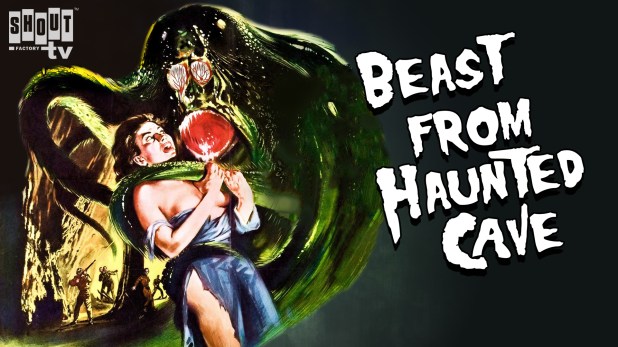
As for the titular beast, Hellman would say, “They literally spent two dollars at the dime store. It was mostly angel hair and paper mache monster.” The crew nicknamed the beast Humphrass. It was created and operated by Chris Robinson, who would go on to play the lead in William Grefé’s Stanley.

Basically, a gang gets together and tries to steal some gold, but ends up waking this monster and, well, bad things happen.

Linné Ahlstrand, who plays the doomed barmaid Natalie, was Playboy’s Playmate of the Month for July 1958 and Richard Sinatra, who plays Marty, was a cousin of Ol’ Blue Eyes. It’s things like that that sell a movie, you know.

There was a sequel planned — that’s why this ends like it does — but it never happened. However, Corman would pretty much make the movie all over again in 1961 and call it Creature from Haunted Sea.

You can watch this on Amazon Prime and Tubi.

MILL CREEK DRIVE-IN MOVIE CLASSICS: Legacy of Blood (1971)

EDITOR’S NOTE: We wrote about this moldy oldie (in the best of ways) back on March 4, 2020.

Will to DieBlood LegacyLegacy of Blood?

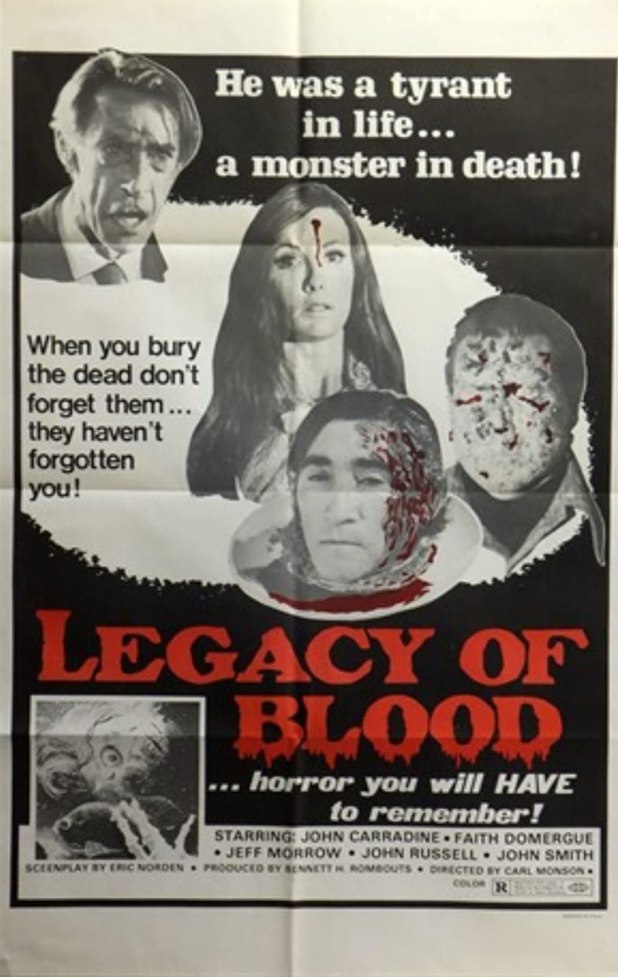
Whatever you call it, this 1971 film has a plot as old as movies themselves — a patriarch gathers his family to hear his will. Carl Monson, who wrote The Acid Eaters and also directed Please Don’t Eat My Mother was behind this.

This is the last movie for Rodolfo Acosta, who either played Mexicans or Native Americans in Westerns usually. John Carradine is also in this — of course, this movie was made for him — and Richard Davalos (Blind Dick from Cool Hand Luke and the cover image for The Smiths albums “Strangeways, Here We Come” and two of their greatest hits collections), Faith Domergue (Perversion Story), former pro wrestler Buck Kartalian, Jeff Morrow (The Creature Walks Among Us) and John Russell, who replaced James Doogan on the second season of Jason of Star Command.

Yes, the outside of the house is also the same mansion that was used for Wayne Manor. You haven’t gone completely bats yet.

You can watch this on Tubi with riffs from either Elvira or Cinematic Titanic.

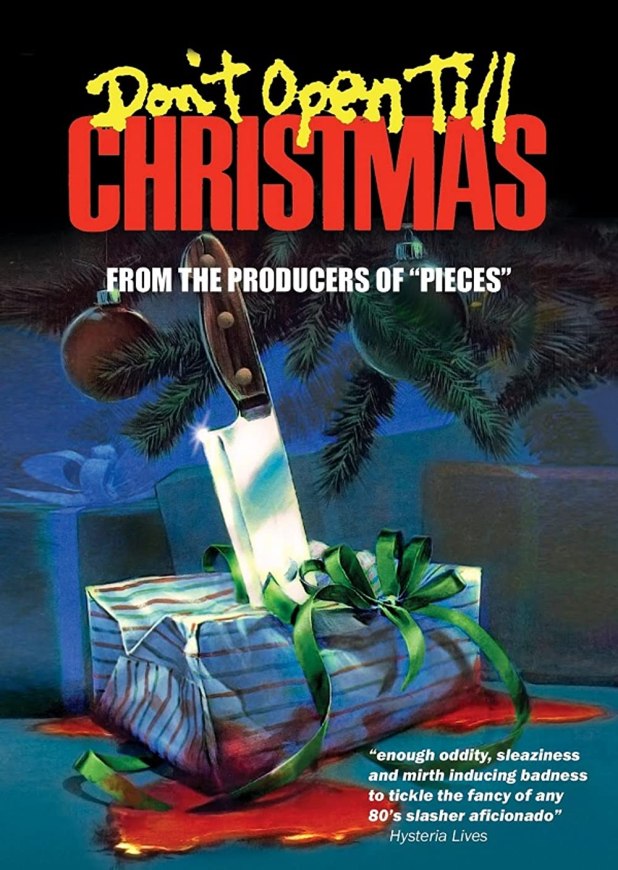
MILL CREEK DRIVE-IN MOVIE CLASSICS: Don’t Open Till Christmas (1984)

EDITOR’S NOTE: Ho ho no, we already wrote about this movie way back on December 18, 2017. It’s also part of our list of ten movies that ruin Christmas! Read on, little elf!

A guy in a Santa suit has sex with a woman in a filthy alley before they’re both killed by a man in a grinning see-through mask. Another Santa has his head impaled by a spear while his daughter watches. And yet another has his face grilled while roasted chestnuts on an open fire.

Scotland Yard inspector Ian Harris (Edmund Purdom, who wrote and directed this film as well as appearing in 2019: After the Fall of New York and Pieces) and detective Powell are perplexed. Plus, Harris just got a gift that says “Don’t Open Till Christmas.” They question Kate, whose father was a killed Santa, and her boyfriend, Cliff.

The next day, Cliff tricks Kate into coming to a porn studio. She storms off and he takes photos of a model dressed as Santa. A pair of police officers spot them shooting nudes in public, so he runs and the killer finds her, but lets her go. Oh yeah — and there’s a reporter named Giles digging around, too.

Things get worse. A strip club attending Santa gets knifed. The police think Cliff is the killer and the paper Giles says he works for has no idea who he is. And another Santa runs into the London Dungeon (yes, the place The Misfits sang about) and gets killed.

Even after undercover officers go after the Santa killer, they can’t find him and are killed themselves. The killer has a stripper who was there on the night he killed the Santa in her club and says that she will be the supreme sacrifice to Christmas evil. And Caroline Munro (!) is on stage in a nightclub when a Santa is chased on stage and stabbed in the face with a machete. Another Santa is castrated soon after.

It turns out that inspector Harris has no birth certificate and has gone on leave, disappearing to a mental asylum where Kate follows.

It turns out that Giles is Harris’ insane brother. Kate finds out first, but she is strangled and stabbed while detective Powell listens. Then, Giles lures him to his doom, as he electrocutes him in a junkyard.

Sherry escapes and Giles chases after her. She knocks him over a railing and he has a flashback of when he went insane: he caught his father, dressed as Santa, having sex with another woman. When his mother found out, Santa shoved her over a railing. But it’s too late for Sherry, as Giles has survived.

Finally, Harris wakes from a bad dream and unwraps his gift, complete with a card from his loving brother. It explodes, killing him and ending the film.

What I have just done is write about this film in a way that will probably make you want to watch it. It’s a slasher that even references Halloween in its opening credits. But it’s no Halloween.

According to tvtropes.com, “this utter sleazefest of a film is quite a jumbled and confused mess, and for good reason. While production began in 1982, the film remained in Development Hell for two years, due to the title of director continually changing hands; first up was Edmund Purdom (who also portrayed Inspector Harris) who walked off the set, prompting at least three or four others to fill in for him, with one only holding Purdom’s former position for a mere two days before being fired.”

Whew. You got better things to do this Christmas. Trust me.