At the end of the 70s, Marvel and Toei made a three-year licensing agreement. Each could use the other’s properties in any way they wanted.
Marvel would use the main robots from two of Toei’s anime, Wakusei Robo Danguard Ace and Chōdenji Robo Combattler V, as part of the Mattel licensed Shogun Warriors comic book and, sadly, not much else. That’s right, Marvel could have had a Kamen Rider comic.
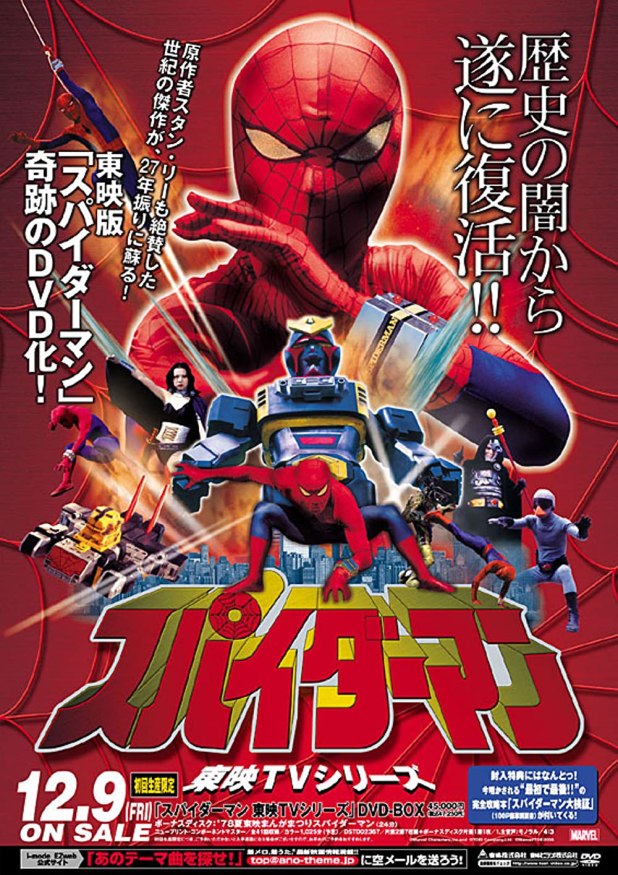
Across 41 episodes and one movie made for the Toei Manga Matsuri, this story took the costume of Spider-Man and then went absolutely insane.
Motorcycle racer Takuya Yamashiro sees the Marveller — a UFO — fall to Earth just as his father Dr. Hiroshi Yamashiro — a space archaeologist! — investigates. He’s killed by Professor Monster and his evil Iron Cross Army, who were being opposed by the alien Garia, the last surviving warrior of Planet Spider. He injects Takuya with his blood and gives him a car named the Spider Machine GP-7 as well as a bracelet that allows him to control the ship and the robot form — Leopardon — to protect Earth.
Obviously, this series is a blast. Of course Spider-Man needs a car and a giant robot and is bothered by cold. I might even prefer it to nearly every other live-action version of the character.
*The popularity of this show and Battle Fever J led to a new interest in sentai shows, which of course how we got Power Rangers here. Toei’s next two sentai series, Denshi Sentai Denziman and Taiyo Sentai Sun Vulcan featured Marvel Comics Group in the credits yet had no characters from the company.
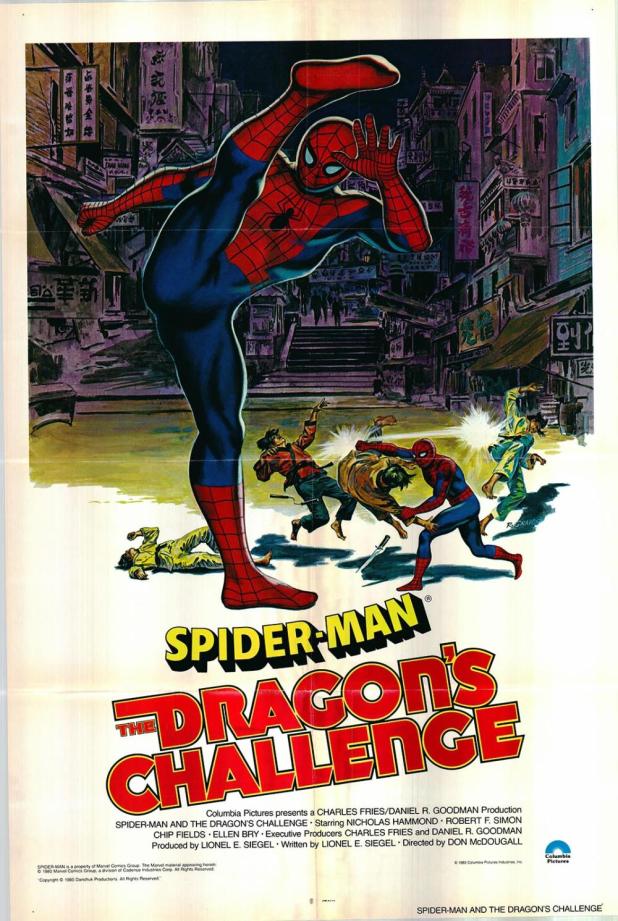
Min Lo Chan, who is the former Chinese Minister of Industrial Development, has defected to the U.S. under suspicion of being a spy. An old friend of J. Jonah Jameson, he is staying with his niece Emily while he tries to prove his innocence. Spider-Man comes in to the story when Jameson asks Peter Parker to help and the journey to save Min Lo Chan will take our friendly neighborhood web swinger all the way to Hong Kong.
While the costume looks great — except for the web shooter — the show as always drags. That said, I would have been excited by the show coming back for more, as Nicholas Hammond claimed that there were plans to do an Amazing Spider-Man/Incredible Hulk TV crossover/comeback movie. Even better — Spidey would have appeared in the new black costume. Supposedly, Universal canceled the film, saying that Lou Ferrigno wasn’t available as he was filming Hercules, a fact that Ferrigno says is not true.
I always felt that this show would have done better if CBS hadn’t aired it as a ratings spoiler throughout 1978 and 1979, programming it against other shows instead of airing it regularly.
This would be the final theatrical film of Spider-Man released until Columbia Pictures acquired the rights in 1999. That said, I would have loved to have seen whatever Cannon would have made.
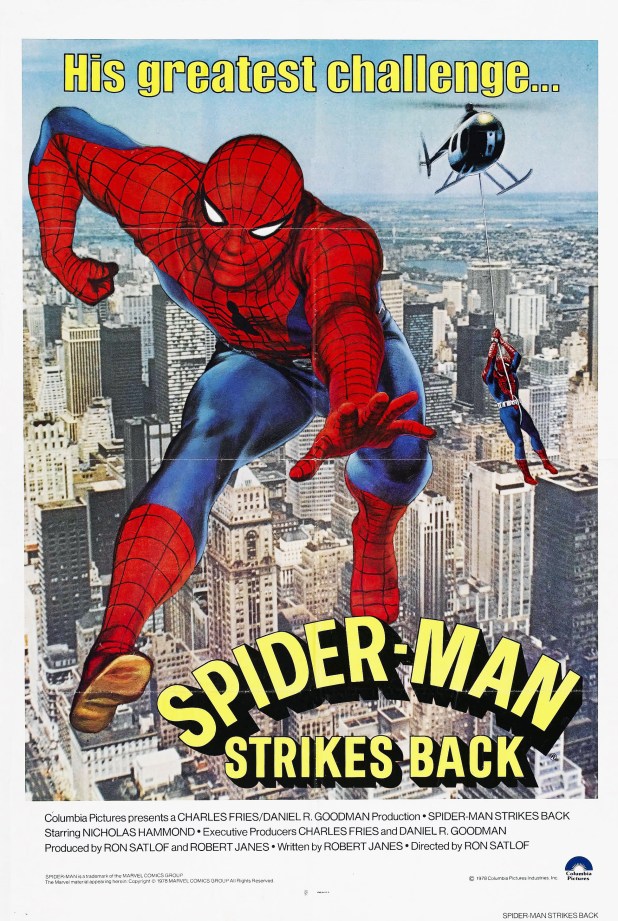
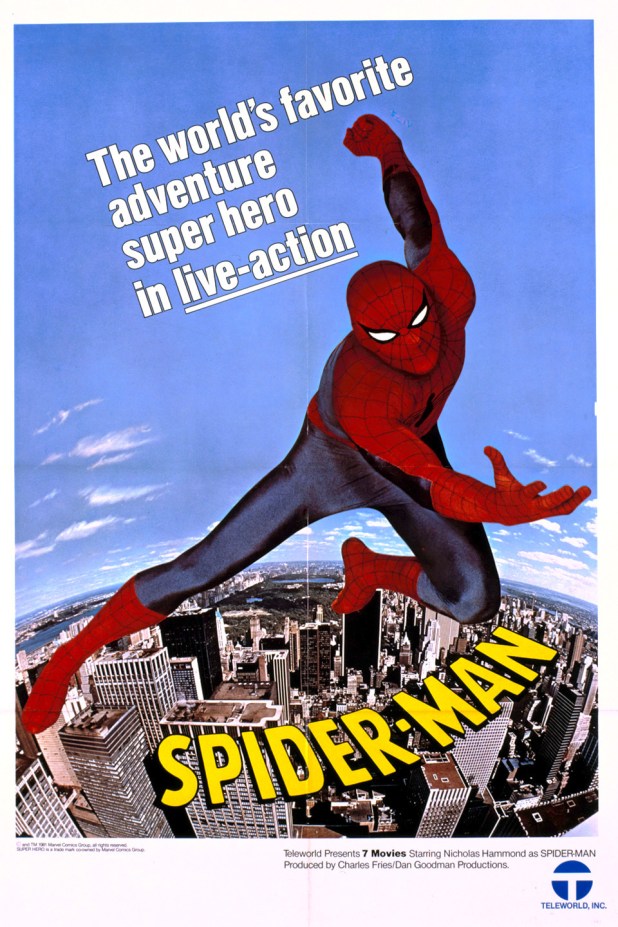
Despite its high ratings, the CBS Amazing Spider-Man series only lasted 13 episodes. There are a lot of reasons why it didn’t last — Marvel Comics publisher and co-creator of the character Stan Lee fought with producer Daniel R. Goodman (even telling Marvel house magazine Pizzazz that the show was “too juvenile”), it was expensive to make, it didn’t get the demographics that the network wanted and they no longer wanted to be the superhero network.
Columbia Pictures helped recoup those costs by releasing two movies in UK, Argentina, Australia and New Zealand, taking the “Deadly Dust” episodes — season 1, episodes 1 and 2 — and turning them into a feature-length movie.
Upset that their professor has brought a small amount of plutonium onto campus, three students decide to steal it and build a bomb in order to protest the dangers of nuclear power. They didn’t figure on international businessmen and arms dealer Mr. White (Robert Alda) taking their bomb and trying to detonate it in Los Angeles as an attempt to kill the President of the United States.
Meanwhile, Captain Barbera (Michael Pataki!) suspects Peter Parker (Nicholas Hammond) of the crime. He’s also pursued by Rita Conway (Chip Fields), a reporter who wants an interview with his alter ego, Spider-Man.
The great thing about the UK — well, maybe not great — is that nunchucks are illegal, so they get censored from every movie. Like this one. It played on U.S. broadcast TV but couldn’t play UK theaters.
I can tell you exactly where a five-year-old me was on the night of September 14, 1977.
Watching this movie on CBS.
I wasn’t alone, as it was the highest performing CBS production for the entire year and played as a theatrical movie in Europe, often in a double bill with Sinbad and the Eye of the Tiger.
Directed by E. W. Swackhamer (Vampire) and written by Alvin Boretz, this TV movie has Nicholas Hammond as Peter Parker, who becomes Spider-Man when he’s bitten by a radioactive spider.
His first villain isn’t Doctor Octopus or the Green Goblin, but instead The Guru (Thayer David), who is mind-controlling people to rob banks and threatens to cause ten people to commit suicide unless he’s paid $50 million. The real drama happens when Peter becomes one of the people under the villain’s thrall.
It’s just sort of like the comic and not really filled with action, but it does have the wild stunt of Spider-Man climbing an actual building in New York City and swinging on a web, which wasn’t CGI back in 1977 and blew all of our minds.
January 18, 1979: I was six years old and in pure comic book mania, as Superman had come out, there was a DC ski stunt show at Sea World, The Incredible Hulk was on CBS, the Captain America TV movie would be airing the very next day and there had already been a few Spider-Man TV movies. It was an amazing time to be a kid and get free superhero stuff sent over the airwaves and often, we’d have no idea what we were about to get other than what TV Guide told us.
The Justice League of America were all showing up on my TV! And not just Batman and Robin, played by Adam West and Burt Ward, but the deep cut heroes I loved, like Hawkman (Bill Nuckols, Wally from Supertrain), Captain Marvel (Garrett Craig, the third man to play the man who says “Shazam!” in the 70s after Jackson Bostwick and John Davey), Huntress (Barbara Joyce) and Black Canary (Danuta Wesley, who took over as the Tea Time Matinee Lady on The Tonight Show after the death of Carol Wayne), plus more well-known ones like Flash (Rod Haase, Candy Stripe Nurses, If You Don’t Stop It… You’ll Go Blind!!! and the sequel Can I Do It ‘Till I Need Glasses?) and Green Lantern (Howard Murphy, the gardener in Young Lady Chatterley II, which would become another important memory in my young life for different reasons).
A party for the retirement of Scarlet Cyclone (William Schallert from Inner Space and In the Heat of the Night) when the Legion of Doom spoils everyone’s fun by announcing they’ve hidden a bomb, so everyone must get de-powered, split into smaller teams and save the day. If that seems like a Gardner Fox story, it’s not a bad thing. The bad guys are Riddler (Frank Gorshin, who else?), Weather Wizard (Jeff Altman, who a year after this would star in one of the most baffling TV shows in broadcast history, The Pink Lady and Jeff), Sinestro (comedian Charlie Callas), Mordru (yes, a Legion of Superheroes villain! He’s played by Gabriel Dell, doubling down on oddball kids shows, as he had just been the voice of Boba Fett on The Star Wars Holiday Special), Doctor Sivana (Howard Morris, whose voice was all over the cartoons I grew up on), Giganta and Solomon Grundy (Mickey Morton, who was also in the aforementioned Star Wars nightmare, playing Chewbacca’s wife Malla).
While the show looked cheap and kind of silly, I was six. So I was beyond excited because there was another episode the very next week.
The next week is why I grew up to be the cynical person who will go on at length about why I hate Wed Craven or how no good slasher has been made with minor exceptions after 1984. All my pain came from this show, in which the adventure format was ditched to instead present a celebrity superhero roast of the superheroes hosted by Ed McMahon.
Now, I love celebrity seventies roasts.
I love Ed McMahon.
But I had been laughed at — and would be laughed at my entire life — for knowing too much about comic books.
Now, even comic books were abandoning me to the void of ennui. Yes, I was the kind of six year old that often asked for an Anacin because I claimed life was giving me a migraine.
Anyways…
New characters were added, including stand-up comic black hero Ghetto Man (Brad Sanders), Captain Marvel’s Aunt Minerva (Ruth Buzzi), Hawkman’s mother (Pat Carroll, the voice of Ursula in The Little Mermaid) and superhero reporter Rhoda Rooter (June Gable, Estelle on Friends) who lets the world know that Giganta (early trans actor Aleshia Brevard, who played one of the female creatures in Bigfoot) was marrying The Atom (Alfie Wise, who was Batman in Cannonball Run).
If it sounds horrible, well — it was. And it still is.
I mean, didn’t the producers realize that Captain Marvel lived on Earth-S, I wondered? Yet even I knew that this was above Wonder Woman, who had her own show, and Superman, who at one point eclipsed Batman, who bided his time and worked with the right directors obviously.
In his book Back to the Batcave, Adam West said that he regretted doing these shows. They couldn’t even get his Batman costume right.
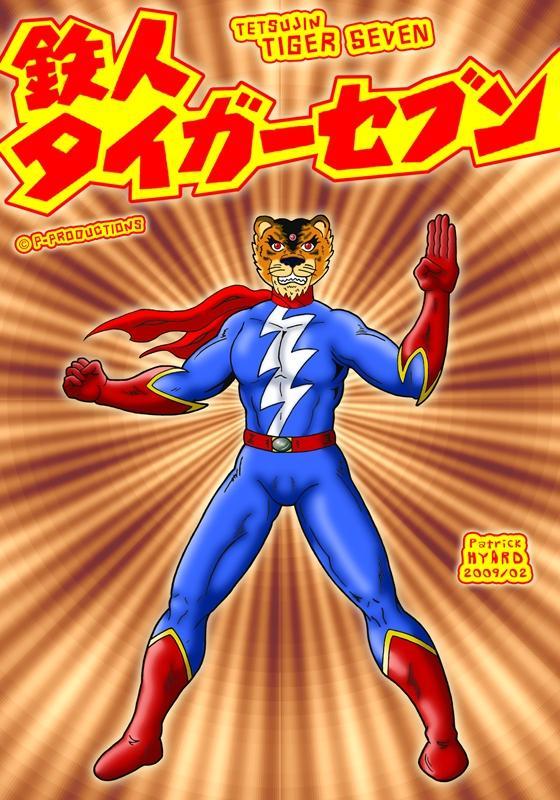
Iron Man Tiger Seven was a Japanese tokusatsu series that aired from October 6, 1973 to March 30, 1974 with a total of 26 episodes. It’s pretty much trying to be Kamen Rider without being Kamen Rider and has a hero born of tragedy, as several Mu monsters — yes, the same Mu that sung under the ocean and is also the home of the KLF — attack a dig that our hero’s human alter ego — Takigawa Go — is part of with his father, who is leading it. He’s stabbed in the heart and his father gives him an ancient heart that he has found in the ruins and a magic pendant that activates his powers when he says, “Tiger Spark.”
I say tragic because moments later, everyone but Takigawa Go gets killed and then a few episodes later, his girlfriend gets killed to, giving him the trademark scarf he wears when in Iron Man Tiger Seven mode.
Then again, he does get a somewhat intelligent motorcycle with rocket boosters and transformative powers that comes to his aid when he roars.
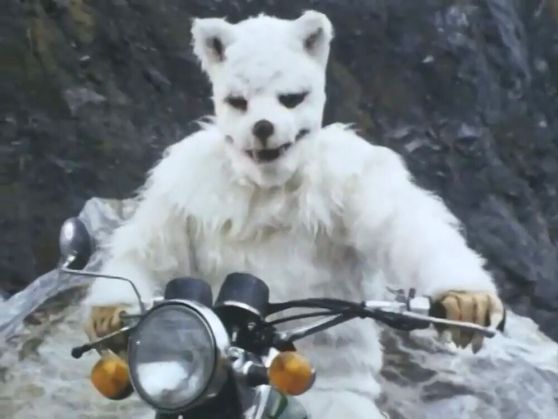
The bad guys in this are astounding with each monster of the week being called “something” Genjin, so we have Kappa Genjin, Merman Genjin, Flying Dragon Genjin, Rat Genjin and the incredible Wolf Genjin, who is a white wolf riding a motorcycle.
The same company that made this also created Kaiketsu Lion Maru, which has three kids in the samurai era who can transform into a human/lion hybrid.
You can watch the first episode on YouTube. There are also episodes with English subtitles on the Internet Archive.
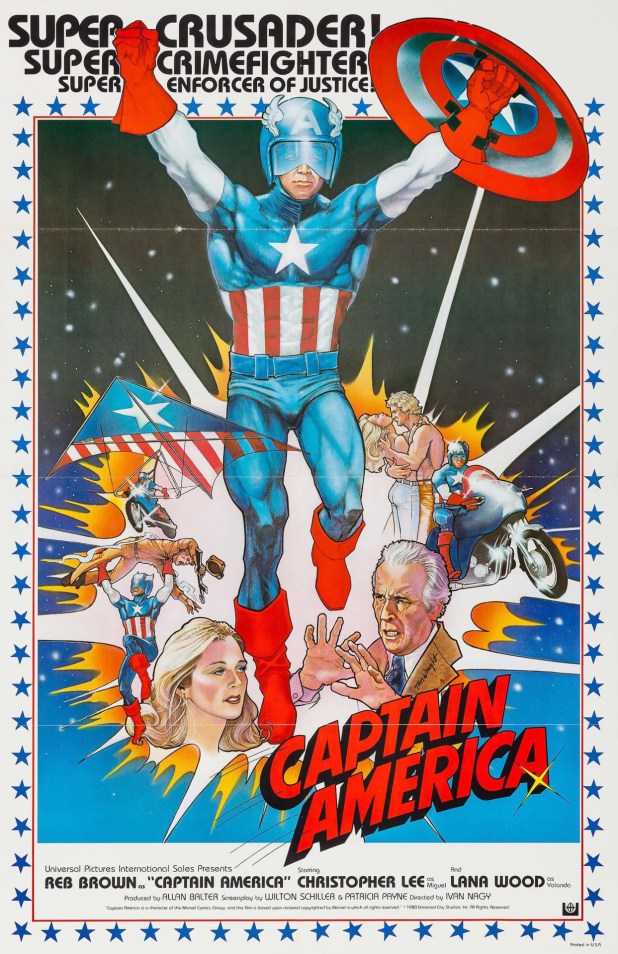
Airing on November 23 and 24, 1979 — the same nights that Salem’s Lot was also on CBS — with the new creative team of director Iván Nagy (perhaps better known as the boyfriend of Hollywood madam Heidi Fleiss) and Wilton Schiller (who produced the last season of The Fugitive and wrote this with his wife, former casting agent Patricia Payne).
According to star Reb Brown, Captain America wore a helmet in these movies because the California Highway Patrol — you know, CHiPs — said that he must have a helmet to ride a motorcycle on the freeway.
At least he gets to hang-glide this time. And get a decent villain, as Christopher Lee plays General Miguel, who is using an aging formula to hold Portland hostage. Cap has Connie Selleca on his side as a scientist, but this pitch for a series — the second if you count the other TV movie that aired four months before — didn’t get the ratings needed, what with those expensive stunts.
I kind of love reading reviews making light of Steve Rogers being a painter in these movies. That’s totally the character from the comics, one of the few things that made it into this film.
On Friday night, January 19, 1979, a seven-year-old me sat down to watch this and promptly lost his mind.
There was supposedly a directive from CBS to not follow the comics exactly, which makes no sense, because the comics sell the show which sell the comics, but for some reason, no one figured that out yet.
So that’s how this version of Captain America is a legacy hero, even if they get the part about Steve Rogers being a commercial artist right. He’s almost killed by some spies who are trying to get the F.L.A.G. serum that his father invented and gave to himself to become the first Captain America. But all Steve wants to do is roam in his cool van because it’s 1979 and this Earth-CBS version of Cap is Nomad before he’s Cap.
He ends up being saved by the aforementioned F.L.A.G. formula, gets super-strength, a special motorcycle, a clear shield, a motocross-centric costume and the actual job of being the Sentinel of Liberty.
According to star Reb Brown at Comic-Con, CBS planned crossing over his character with Spider-Man (Nicholas Hammond) and the Hulk (Lou Ferrigno/Bill Bixby). Seven-year-old me loves that.
Writer Don Ingalls once worked on the LAPD magazine The Beat, as well as scripting The Initiation of Sarah. Director Rod Holcomb has worked on all sorts of episodic TV, including The Six Million Dollar Man and The Greatest American Hero.
The reviews I’ve seen for this online are a mix of “look how far we’ve come” and “the idea of Captain America is capitalist nonsense.” First, this show is just fine. It’s strange to compare low budget TV movies made forty years ago to glossy multimillion films on so many levels. And Joe Simon and Jack Kirby created Captain America to represent the best of this country and what it could be, a character that two Jewish men created to make a stand for America entering World War II, that protest groups came to their offices to try and find them, that became a character of a man lost out of time and with no country, even fighting the Secret Empire the whole way to the White House, exposing Nixon as a supervillain — who killed himself off-panel! — and then traveled the nation as the aforementioned man with no country called Nomad. And this was no millenial story for social media clout. This was in 1974.
Freaky Friday started as a novel written by Mary Rodgers, based on Vice Versa: A Lesson to Fathers by F. Anstey, a story in which the protagonists are father and son. In Rodgers’ book, 13-year-old Annabel Andrews and her mother spend time in each other’s bodies. The novel was so popular that Disney as made it four times an Rodgers also mae several sequels herself, such as A Billion for Boris/ESPTV and Summer Switch (which ABC made into TV movies). The major difference between the novel and the films is that an outside influence switches the mother and daughter against their wills.
Freaky Friday (1976): “I wish I could switch places with her for just one day.” That’s all it takes to start off this crazy adventure for Ellen Harris (Barbara Harris) and her daughter Annabel (Jodie Foster).
Based on the 1972 novel by Mary Rodgers — who also wrote the screenplay — the magic that switches the mother and daughter in this movie is quite simple. In Friday the 13th, all you have to do is say, “I wish I could switch places with her for just one day” and it happens.
Actually, this whole thing reminds me of Goofy Minds the House, a 1977 Disney Wonderful World of Reading storybook that features the character Goofy and his wife switching jobs for one day and learning that they both have rough lives. That story was based on a Norwegian folktale and taught me that women were much stronger than men. Also — Goofy once had a wife named Mrs. Geef and Mrs. Goof, but now he’s thought to be dating Clarabelle the Cow, so something happened at some point. Perhaps even odder, Goofy was once called Dippy Dawg.
But I digress.
Just as much as that story is part of my childhood, so is Freaky Friday, a movie that I know for a fact that I saw at the Spotlite 88 Drive-In in Beaver Falls, PA.
Ellen Andrews and her daughter Annabel are constantly battling with one another until they switch places, which enables each of them to see life from the other side, connect better with other people and, of course, water ski.
The cast of this movie is made up of people that a five year old me would see as big stars, like John Astin, Dick Can Patten, Charlene Tilton, Marc McClure and, of course, Boss Hogg. Strangely enough, George Lucas wanted Foster for the role of Princess Leia, but her mother wanted her to complete her contract to Disney.
Disney can’t seem to stop remaking this movie. And really, no one else can either, because it’s the mother of body switch comedies, including 18 Again!, All of Me,Dream a Little Dream, Vice Versa and Freaky, a film which combines the Friday the 13th of this story with the slasher side of the holiday.
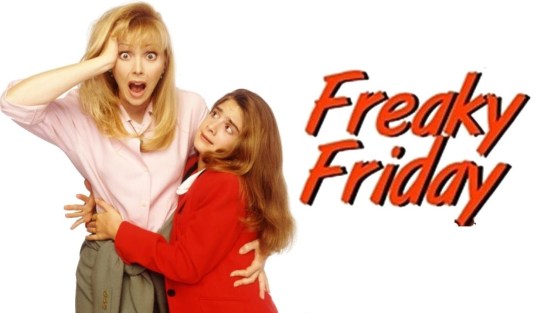
Freaky Friday (1995): This made-for-TV movie has Shelly Long as Ellen and Gaby Hoffman (the daughter of Warhol superstar Viva) as Annabelle. A pair of magical amulets causes the two of them to switch bodies in this version and waterskiing has been replaced with diving.
Ellen is also a single mother dating Bill (Alan Rosenberg) and designing clothing, which is the 90s version of being a housewife. What livens this up is a great cast with Drew Carey, Sandra Bernhard, Carol Kane and the much-missed Taylor Negron.
Writer Stu Krieger wrote The Parent Trap II, A Troll in Central Park, Zenon: Girlof the 21st Centuryand Phantom of the Megaplex while director Melanie Mayron is probably best known for playing Melissa Steadman on Thirtysomething even though she has more than sixty directing credits on her resume.
The other big change is that when Annabelle is in Ellen’s body, she tells Bill exactly how much she dislikes him, thinking it will push him away. Instead, he proposes.
Forgive me for being weird, but…do these characters ever have to make love in these bodies? Because, well, that could be awkward.
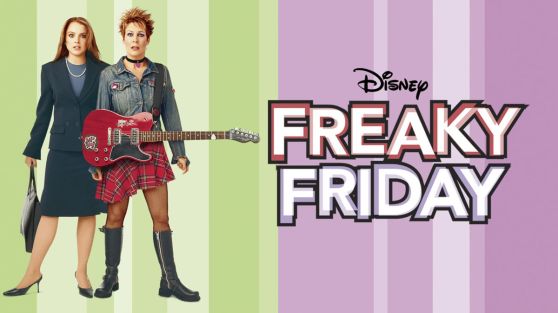
Freaky Friday (2003): I spoke too soon about the sexual side of Freaky Friday, as this movie, while chaste, does not shy away from the fact that Jake (Chad Michael Murray) has feelings for Anna (Lindsay Lohan) no matter if she’s in her body or the body of her mother, Tess (Jamie Lee Curtis). The attraction that Jake feels, while mental, is way hotter than the way Marc McClure reacted to Barbara Harris.
Written by Heather Hach (Legally Blonde: The Musical, What To Expect When You’re Expecting and a gym teacher in this movie) and Leslie Dixon (Overboard, Loverboy, the 2007 Hairspray) and directed by Mark Walters (who worked with Dixon again on Just Like Heaven; he also directed Mean Girls, Ghosts of Girlfriends Past, the gender-swapped He’s All That and Mr. Popper’s Penguins), this take on the story retains the single mother idea from the 1995 TV movie and has Mark Harmon play Ryan, the potential new father in Anna’s life.
Lohan’s character was originally written as a goth girl and she didn’t think anyone would relate to that, so she showed up dressed like a preppie. Somehow, she was convinced to play a grunge girl instead. I mean, she has a band called Pink Slip and plays guitar instead of water skiing or driving.
The McGuffin that drives this film is a pair of fortune cookies mixed with an earthquake switches bodies for Anna and Tess, which leads to Anna lecturing teachers and Tess being more loud and wild.
As for the casting, it really works. The original idea was for Jodie Foster to play Tess, but she didn’t like the stunt casting. Then, Annette Bening and Kelly Osbourne were going to be the leads — with Tom Selleck as Ryan — but Bening dropped out and Osbourne’s mother got cancer.
Probably the only downside is that this movie falls back on that Hollywood cliche of Asian people being able to magically change lives.
Is it weird that I know that the band Orgy taught Jamie Lee how to play guitar? Why do I have these facts inside my head? And how weird is it to hear “Flight Test” by the Flaming Lips in a Disney movie? Or Joey Ramone covering “What A Wonderful World?”
Freaky Friday (2018): It’s wild that Steve Carr made Next Friday and a Freaky Friday sequel. And this time, I had no idea I was getting into a musical. Cozi Zuehlsdorff from the Dolphin Tale movies is Ellie Blake and her mother Katherine is played by Heidi Blickenstaff, who played the role on stage. Seriously, this is a full-blown bing singing musical and also a version of the story that leans in on Ellie being a total slob with a filthy room, a girl who always wears the same clothes every day and who would totally be the kind of arty disaffected young girl who I’d be too shy to talk to and leave mixtapes in her locker. Or maybe text her Spotify links now, I guess, right?
A magical hourglass — given to Ellie by her late father, a Freaky Friday story beat retained from the last few versions — is the storytelling device that switches the daughter and mother. There’s also a scavenger hunt that an entire school is absolutely obsessed by, making this also an updating of Midnight Madness.
This was the first Disney movie made from one of their stage plays and it didn’t get great ratings. It’s fine — obviously there are a ton of different versions of Freaky Friday for you to watch. I’d place it slightly ahead of the Shelley Long version, but way behind everything else.
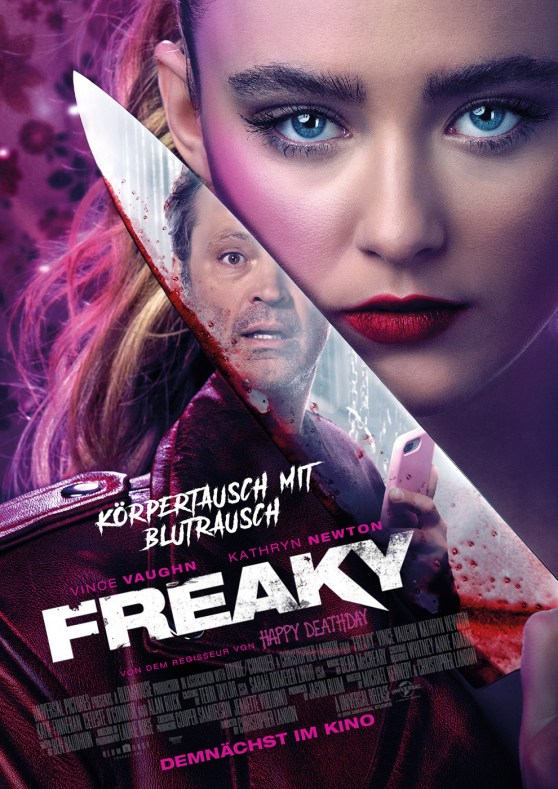
Freaky (2020): By all rights, I should hate this movie, a semi-remake of Freaky Friday that instead subverts the source material by turning it into a slasher. But you know, it ended up hitting me the right way and I was behind it pretty much all the way.
Directed by Christopher Beau Landon — yes, the son of Michael — who wrote Disturbia — that’s not even a word — and several of the Paranormal Activitymovies before directing the Happy Death Day films. If you liked those, well, this will definitely give you more of what those movies offered, this is set in the same universe — Landon said that, “They definitely share the same DNA and there’s a good chance Millie and Tree will bump into each other someday” — and was originally titled Freaky Friday the 13th.
Millie Kessler (Kathryn Newton, Big Little Lies) is a teenager who has been tormented by bullies, both of the teenager and teacher* varieties. Meanwhile, the urban legend of the Blissfield Butcher continues, as he keeps killing her classmates. Now that he possesses a McGuffin called La Dola — an ancient Mayan sacrificial dagger — he looks to gain even more power. But when he runs into our heroine — her mother (Katie Finneran, who is great in this) has left her behind at a football game where all she gets to do is wear a beaver mascot costume — she battles the Butcher and when he stabs her, they end up switching bodies.
So yeah — this turns into a body swap comedy and you’d think, after the gory as hell open, this is where they lose you. But no — if anything, this gets way more fun.
Millie’s friends make for some of the best scenes in the film. Nyla (Celeste O’Connor) and Josh (Misha Osherovich) have been with her through the worst parts of high school, so having their best friend in the body of a killing machine is just another trial to be endured.
Speaking of that killer, Vince Vaughn shines in this. There’s plenty of silly physical comedy, but also some really nice scenes like when he admits to the love interest that she left the note he treasures (body swap pronouns are a little hard) or when he has a moment with her mother while hiding in a changing room.
Landon — who wrote the movie along with Michael Kennedy — said that the film was influenced by the Screamseries, along with Cherry Falls, Fright Night, Jennifer’s Body, The Bloband Urban Legend. There’s also a fair bit of Halloween in here, particularly the opening series of murders, and references to Heathers, Child’s Play, Creepshow, Galaxy Quest, Carrie, The Faculty, The Craft and Supernatural. There’s also a bottle down the throat kill that came directly from the 2009 slasher remake Sorority Row.
I had fun with this. Here’s hoping you do the same.
*The funny thing is that the teacher that is the worst to her is Alan Ruck, who knows a thing about bring bullied, what with playing Cameron in Ferris Bueller’s Day Off.
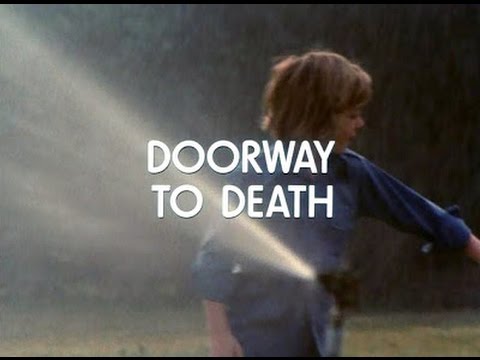
Directed by Daryl Duke and written by Richard Matheson and Jimmy Sangster, this episode is all about a family moving into a new apartment in San Francisco. When young Robert (Leif Garrett) starts to explore, he finds an empty apartment with a door into the woods inside. He also meets a man inside those woods who asks to meet his sisters Jane (Garrett’s sister Dawn Lyn, Walking Tall) and Peggy (Susan Dey). Yet when the girls visit the room themselves, they only find a closet.
And then she learns that the ghost — the man in the woods killed his wife with an axe and then was executed — wants her for his next wife.
“Doorway to Death” may not be the best episode of the show, but the scene where Peggy wakes up to find wet footprints around her bed, as if someone was walking her room and watching her all night? That’s the kind of weird I keep watching this show for.




 B&S About Movies
You must be logged in to post a comment.