DAY 12. THE FRACAS AND THE FUZZ: Something revolving around cops and criminals.
But what if the Maniac Cop found love?
This is the question we must answer.
Aren’t we all worthy of adoration?
Even those of us who have risen from the grave and killed numerous people in an obsessive quest for bloody revenge?
But first, the problem of bringing back the Maniac Cop, Officer Matthew Cordell, played once again by Robert Z’Dar. Leave that to Houngan Malfaiteur, played by Julius Harris from Hell Up In Harlem, Black Caesar and Superfly. I love the character names that Harris had in movies, like Tee Hee Johnson in Live and Let Die, Gravedigger in Darkman and Speedbagger in Prayer of the Rollerboys. He uses the dark powers of voodoo to bring our favorite boy in blue back from the beyond.
Meanwhile, there’s also another cop named Katie Sullivan (Gretchen Becker, who is also in Firehead and was Martin Landau’s partner until the end of his life) who gets shot in a convenience store holdup. Thanks to more police corruption, she’s painted as using excessive force and the man who shot her is due to go free, which upsets investigating officer Sean McKinney (the returning — and always awesome — Robert Davi).
It also upsets the Maniac Cop, who shows up to the hospital ready for mayhem. He kills one guy with defibrillator paddles and another with straight-up x-ray radiation. And the four reporters who joined in on Kate’s frameup? Toast.
McKinney joins up with Doctor Susan Fowler (Caitlin Dulany, who along with Jesica Barth, formed Voices in Action after the multiple accusations against Harvey Weinstein) to investigate the murders and Kate’s strange behavior, even though she’s braindead.
The Maniac Cop is interested in Kate, who Houngan claims refuses to return from the land of the dead. So he does what any of us would do. He sets everything — including himself — on fire.
Despite getting blown up real good, the body of the titular protagonist survives enough to hold Kate’s charred hand, even in the morgue.
This movie is packed with talent, including The Breakfast Club‘s Paul Gleason, one-time Freddy Krueger actor Jackie Earle Haley as holdup man Frank Jessup, and Doug Savant from Melrose Place and Robert Forster as doctors.
Maniac Cop III: Badge of Silence had a troubled production. Despite director William Lustig’s rough cut clocking in at just 51 minutes, he refused to shoot the additional scenes the producers wanted. That’s why the Blue Underground release has Alan Smithee listed as director. To fill in the gaps, there are several scenes that are obvious outtakes from Maniac Cop 2.
DAY 12. THE FRACAS AND THE FUZZ: Something revolving around cops and criminals.
Bill Lustig and Larry Cohen return to tell the next adventure of Maniac Cop Matthew Cordell, who somehow survived being skewered with a pole and a dunk in the rivers of New York City last time. Now, he’s got a junked out police car and is patrolling the city and killing past enemies like officers Jack Forrest and Theresa Mallory (Bruce Campbell and Laurene Landon).
Officer Susan Riley (Claudia Christian, Calendar Girl Murders) is now on the case of not only the Maniac Cop, but a killer named Steven Turkell (Leo Rossi, Bud from Halloween II) who has joined forces with the titular character. Turns out that for some reason, the Maniac Cop wants an entire army of criminals on his side. Look for Clarence Williams III from Mod Squad as one of those crooks named Joseph T. Blum.
Detective Lieutenant Sean McKinney (Robert Davi!) is also trying to stop the Maniac Cop, even promising him an honorable burial and exoneration for his crimes. For what it’s worth, our antagonist gets to kill the three inmates who scarred him and then takes our Turkell in a fiery explosion.
Of course, the credits roll with Maniac Cop’s hand bursting out of his coffin. You can’t keep a bad cop down.
Charles Napier, James Earl Jones, Danny Trejo and Hank Garrett, who once wrestled as The Minnesota Farmboy before going into comedy and appearing as Officer Nicholson on Car 54, Where Are You?
Sadly, Joe Spinell was to play Turkell the murderer, which would have united Maniac Cop with Maniac. However, Spinell died before filming began and the film is dedicated to him.
Although top billed in the credits and on the posters, Bruce Campbell is killed 17 minutes into the movie and has about 3 minutes of screen time. He also hates when people bring this movie up, as it reminds him of a painful time in his life. He always fires back — in a hilarious way — on hecklers who don’t follow this rule at conventions, which has led to goofballs purposefully asking queries about it just to get roasted by him.
DAY 12. THE FRACAS AND THE FUZZ: Something revolving around cops and criminals.
While he may be most famous for Cannibal Holocaust, a movie so controversial that he lost his license to make films and was arrested for the suspected murder of the film’s cast, Ruggero Deodato is no one-trick pony.
After growing up nearby Rome’s film studios and being friends with the son of director Roberto Rossellini, he worked his way up to being the assistant director on the film Django before helping Antonio Margheriti finish Hercules, Prisoner of Evil, a peplum that also has horror elements like a werewolf. He also directed the superhero film Phenomenal and the Treasure of Tutankhamen and Zenabel before taking time away to work in advertising.
He returned in 1976 for the film Waves of Pleasure and then made the film we’ll be discussing today. Later Deodato films of interest include Jungle Holocaust (which stars future cannibal icons Ivan Rassimov and Me Me Lai), Concorde Affaire ’79 (which has a veritable murderer’s row of junk cinema stars in it, like James Franciscus, Mimsy Farmer, Joseph Cotten and Edmund Purdom), The House On the Edge of the Park (which rips off The Last House On the Left so much that it even has Davis Hess in it), the slasher Body Count and late in the game giallo like Phantom of Death and The Washing Machine.
But Deodato will forever be known for his cannibal excesses, so much so that he was in Hostel II as a cannibal character.
When Edgar Wright was writing Hot Fuzz, Quentin Tarantino played him this film and Walter Matthau’s The Laughing Policeman for inspiration. On the commentary track for the movie, Tarantino says that it has “one of the greatest titles of all time, and it lives up to its name.”
Screenwriter Fernando Di Leo was behind several of the most well-regarded spaghetti westerns, like A Fistful of Dollars and Johnny Yuma before moving into the poliziotteschi genre. His Milieu Trilogy, which he both wrote and directed, includes Caliber 9, Manhunt and The Boss.
This movie, however, is all about the Fred (Marc Porel, Don’t Torture a Duckling) and Tony (Ray Lovelock, The Living Dead At Manchester Morgue), two members of the Special Squad. This secret arm of the Italian police seems to have complete impunity and grants their agents a license to kill.
Fred and Tony take full advantage of that. The film begins with them chasing purse snatchers — to be fair, the failed heist leads to them killing a woman directly in front of children waiting in line to meet Santa Claus — for nearly twelve minutes before impaling one and breaking the other’s neck before the normal cops arrive. As people wait for them to be arrested, they just casually walk away and ride their motorcycle together. Yet for all the killing, shooting and wanton seduction of women these two will accomplish in the next 100 minutes, they really have no issue holding one another.
Keep in mind that Deodato shot this epic sequence with no permits whatsoever and you may see that he saw these two as kindred spirits.
Their boss is played by Adolfo Celi, who you’ll probably recognize for playing Ralph Valmount, the villain in Mario Bava’s Danger Diabolik. They pretty much drive him crazy for most of the film, with him opining that they’re probably worse than the criminals that they go after.
Yes, this is probably the only cop movie you’re ever going to see where the good guys wait for the bank robbers to start their job, then just walk up and shoot them with silenced handguns with no due process. And then they go off and do target practice, which is pretty much them shooting at one another and dodging the bullets.
Silvia Dionisio plays Norma, the tough secretary for their boss. The film pretty much sets its tone when they have their conversation with her before seeing him. You expect the Bond/Moneypenny type flirting until she tells them that men often talk a great game, but she can go twenty times in a night while they’ll be sleeping after one orgasm. That’s why she keeps flirting with both of them, because they may have to team up to satisfy her. It’s disarming and shows that she’s no shrinking violet. Also, if anyone in this movie was smart, it’s Deodato, as he married Dionisio right around this time.
The boys’ big assignment is to stop crime boss Pasquini, which they start by visiting one of his finest clubs and setting all of the patrons’ cars on fire. He eventually comes after them, even slicing out the eye of one of their informants (and stepped on the eyeball, in a screen that Fulci must have been jealous he didn’t direct) to get them mad. This scene was censored from how it originally was intended, but the intent is there. There’s also a bonkers scene where the boys visit a relative of Pasquini and end up taking their turns with his needy niece.
Of course, everything works out for our heroes, thanks to their boss being a much better cop than both of them. But hey — they still get to blow up a boat.
If you ever watched a movie like Lethal Weapon or Cobra and thought, boy the captain is coming down pretty hard on this cop and he’s just doing his job, you should check this out. These supercops make Dirty Harry look like a third-grader with their near-limitless brutality.
Sadly, this was Ruggero Deodato’s only poliziotteschi film. But really, where do you go from here? A sequel was in the planning stages, but ended up being canceled due to Marc Porel and Ray Lovelock not getting along.
This is one of the most entertaining films I’ve ever seen, a cops with guns movies that rivals the excesses that Hong Kong cinema would achieve a decade later. It really has no story, just hijinks, but you won’t notice. You’ll be too busy trying to get your jar off the ground, trust me. If it didn’t come through in all these words, I love this movie.
DAY 12. THE FRACAS AND THE FUZZ: Something revolving around cops and criminals.
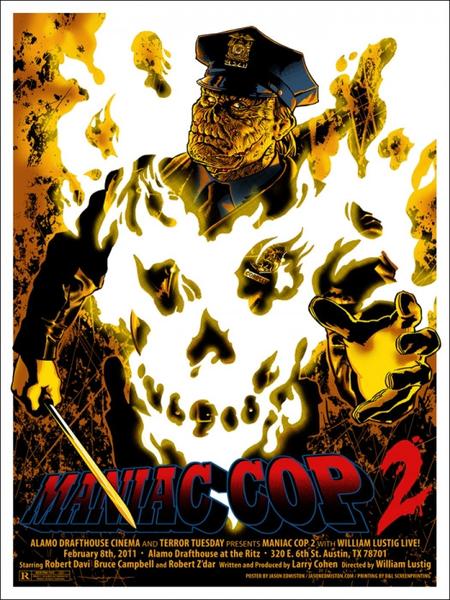
Beyond being the CEO of Blue Underground, Bill Lustig will get a forever pass just for making the films Maniac and the three movies in this series. I mean, Bruce Campbell, Tom Atkins and Robert Z’Dar in the same movie? And it’s written by Larry Cohen? Count me in.
There’s a series of murders going on in New York City, all being committed by someone in a police uniform, which leads to complete panic. However, that policeman is even more frightening than anyone dared dream. He’s not just a cop. He’s a…Maniac Cop.
Ellen Forrest thinks that her husband Officer Jack W. Forrest, Jr. (Campbell) is the Maniac Cop, following him to a hotel where she catches him in bed with fellow officer Theresa Mallory (Laurene Landon, Yellow Hair and the Fortress of Gold, Wicked Stepmother, your teenage dreams). She runs from the room right into Maniac Cop, who kills her, a murder for which Jack gets the blame.
Detective Lieutenant Frank McCrae (Atkins) believes that Jack was framed. He gets Jack to tell him about his fling with Mallory, who is currently undercover working as a prostitute. She and McCrae fight off the Maniac Cop, who is cold to the touch, doesn’t breathe and shrugs off several bullets.
The trail of the killer leads to Sally Nolland, a fellow female officer who Mallory confided in. She’s played by Sheree North, whose life was pretty interesting. In the mid-1950s, 20th Century-Fox groomed her as a replacement for the studio’s leading — and volatile — leading lady, Marilyn Monroe. They even had her test for two roles — The Girl in Pink Tights and There’s No Business Like Show Business — that Monroe was up for. To add insult to injury, the studio gave her Monroe’s wardrobe.
In March 1954, North dealt with a scandal when a stag loop of her in a bikini surfaced, but the studio capitalized on the bad press. Her next leading role was opposite Betty Grable in How to Be Very, Very Popular, a part Monroe had turned down. She was suspended by the studio as a result and this led to North getting into Life magazine with the headline “Sheree North Takes Over From Marilyn Monroe” emblazoned on the cover.
How to Be Very, Very Popular is a forgotten film today, but at the time, North’s “Shake, Rattle and Roll” dance proved memorable. The studio kept trying, casting her in two movies with Tom Ewell, Monroe’s co-star in The Seven Year Itch. While their second pairing, The Lieutenant Wore Skirts, was a success, the studio soon grew disinterested and began hyping a new blonde star — Jayne Mansfield.
Part of that reason may have been North standing up for herself. Her agent advised that she turn down a role that parodied Monroe in The Girl Upstairs and when Elvis dropped out of The Way to the Gold, North hated his replacement, Jeffrey Hunter.
After North’s contract with Fox ended in 1958, her career slowed. She did a series of TV shows, appeared in John Wayne’s last film The Shootist, was in Destination Inner Space and finally acted alongside Elvis in The Trouble With Girls. Ironically, she played Marilyn Monroe’s mother in the made-for-television film Marilyn: The Untold Story.
Today’s audiences would probably remember her best for two sitcom roles: Blanche’s sister Virginia on Golden Girls and as Cosmo Kramer’s mother Babs on Seinfeld.
But I digress…
McCrae follows Noland to a warehouse, where she meets with the Maniac Cop. She calls him by his real name, Matt, which leads McCrae to discover the history of Matthew Cordell (Z’Dar), a cop who was jailed for brutality before his fellow prisoners mutilated and murdered him. Of course, he was also set up after discovering corruption all the way up to the mayor’s office. It turns out that he survived — barely — and has been waiting to get his revenge ever since.
From here on, we get the shock and awe we were looking for, with Officer Cordell wiping out cops left and right. Yet even being impaled on a pipe at the end of the film can’t stop the rage of this now undead peace officer, who rises to murder the mayor as the film closes.
Look for Sam Raimi, Richard Roundtree and boxer Jake LaMotta, Lustig’s uncle, in cameos.
This is a fun movie that I have no complaints about at all. It’s fun, fast-moving and is filled with stunts and violence. If you’re expecting an Oscar-winning movie, well…
After years of rumors, a new Maniac Cop is on its way. According to Variety, the series will be the first production of Nicolas Winding Refn’s byNWR Originals, a part of his cultural site byNWR.com and will air on HBO.
Here’s the press release: “Set in Los Angeles, Maniac Cop is said to be told through a kaleidoscope of characters, from cop to common criminal. A killer in uniform has uncaged mayhem upon the streets. Paranoia leads to social disorder as a city wrestles with the mystery of the exterminator in blue. Is he mere mortal, or a supernatural force?”
Sounds interesting. Want to know about the other Maniac Cop films? Stay tuned — we’ll be covering them both today.
DAY 11. THE OLD WAY. Watch a classic from 1959 or before.
Herman Cohen started his climb up the show business ladder from the lowest rung, working as a gofer and usher at Detroit’s Dexter Theater at the tender age of 12. By 18, he’d be the manager. His career would take him from being the sales manager for Columbia’s Detroit region to their Hollywood publicity department and finally making his own films.
His greatest success came in the 1950’s with this film — which he wrote and produced for American International — which earned $2 million dollars on a $100,000 budget (approximately $18 million on a $900,000 budget when adjusted for today’s inflation). He was also behind the films Craze, Trog and Berserk!
Back in 1957, when this film was made, the idea of a teenager becoming a monster was shocking to audiences. Producer Samuel Z. Arkoff claimed that he received plenty of guff for exploiting this idea. In fact, this is the first of many I Was a Teenage movies, but it certainly wouldn’t be the last.
It’s also the first role for Michael Landon, who would go on to enjoy a long and fruitful Hollywood career with three landmark series on his resume: Bonanza, Little House on the Prarie and Highway to Heaven. When I was a kid, I was often afraid of the photo of the werewolf in this movie and my mother would say, “It’s just Michael Landon. You shouldn’t be afraid.” Also, as a youngster, if I ever went to another kid’s home and they were fans of Little House on the Prarie’s adventures of the Ingalls family, I’d instantly judge them as boring and want to go home.
Here he plays Tony Rivers, a troubled teenager to say the least. Unlike most 1950’s fare that portrays its protagonist as noble, we’re shown that Tony is a rough character right from the beginning. He doesn’t just rail against authority, he hates everyone. And he’s not all that forthright about it. In a fistfight with another classmate, he goes so far as to throw dirt in the man’s face and try to kill him with a shovel instead of just using his fists. His love of violence and hatred for his fellow man stands in dramatic contrast to his pretty boy looks.
Barney Phillips, who was also Sergeant Ed Jacobs on Dragnet, plays Detective Donovan, a cop who feels bad for Tony and tries to intervene on his behalf several times. After all, Tony grew up without a mom and his dad’s probably a drunk.
Yvonne Lime, who would move on from acting to becoming a noted philanthropist with her husband, plays his girlfriend Arlene. While her parents don’t seem to enjoy the cut of Tony’d jib, she’s in pure love with him, believing in him no matter what.
That said, the real horror starts at a haunted house party. After an extended dance sequence where Vic and his girl sing along to a record — amazingly, this is announced as a big deal and I can’t imagine attending a party where the highlight is some guy playing bongos and lipsynching to a 45 — Tony flips out and nearly kills the man for surprising him from behind. I mean, everyone was pranking one another to an inordinate degree and only Tony tried to outright murder Vic. Look — I hated Vic after a minute, so I get it, Tony. I can’t even imagine what it would be like to have to spend time with him on an extended basis.
Don’t believe me? Just watch these antics and tell me you don’t wish you could go full lycanthrope and strike them all down.
However, Tony’s rage ends up knocking down his girlfriend, so he volunteers to meet with hypnotist Dr. Alfred Brandon. He’s played by Whit Bissell, who would play a psychologist in not only this film, but in its follow-up, I Was a Teenage Frankenstein. He also had the same occupation in Invasion of the Body Snatchers.
This being the 50’s, the doctor has to be a quack. He’s really only interested in experimenting on Tony, regressing him to his most primal state.
After another party at the haunted house — this is made a major point yet we never see a single ghost — Tony drives Arlene home and Frank, one of their friends, is mauled and killed. As the cops debate the autopsy, Pepi the janitor (Vladimir Sokoloff, a Russian actor playing a Carpathian, so this isn’t whitewashing as much as its Hollywood not really even knowing at this point what ethnicity is. In fact, Sokoloff would play 35 different nationalities in his career, including people from Greece, China, Spain, Mexico and so many more) tells them all the truth: these are the marks of a werewolf!
Tony feels like there’s something wrong with himself, but the principal is so happy with his progress that she’s recommending him to State College. One would assume that the marks on his permanent record have been removed.
As he leaves her office, he notices Theresa practicing her gymnastics. This drives his teenage hormones into overdrive and he responds by going full werewolf and killing her, which is about the best translation for toxic masculinity that 1957 can muster. Just seeing the comely form of Dawn Richard (Playboy Playmate of the Month for May 1957) as she stretches out is all it takes. That said — her sexuality had to be somewhat shocking for the puritanical Baby Boom era. Therefore, she had to be destroyed.
Tony’s recognized by his jacket and goes on the run. He calls Arlene for help and she can only listen, unable to reply. And a visit to Dr. Brandon only leads to the man using our protagonist and filming his transformation, at which point Tony kills everyone. The cops are forced to gun him down — silver bullets are unnecessary when you have good old fashioned American steel — and that’s all she wrote.
One of those cops — they opine that man shouldn’t mess in the affairs of God — is Guy Williams, who would soon be swashbuckling in Zorro and sailing through the galaxy in Lost In Space.
Less than four months after the release of this film, AIP would release two movies that are pretty much the same story: I Was a Teenage Frankenstein and Blood of Dracula, which is even more of a remake, just with a female lead and doctor. It’s such a paint by numbers recreation that there’s even another dance number thrown in, references to Carpathia, dialogue lifted nearly line by line and an observer who knows that it’s a vampire when no one else will believe them.
I watched this movie on the very same day I rewatched An American Werewolf In London and it’s stunning to see the different ways that they interpret not only being a werewolf, but the transformation itself. Instead of the pain that 1981’s Rick Baker effects depict, all we see here is a slow dissolve of Tony getting a furry face. But it works — for so often, this was how American audiences saw werewolves.
DAY 11. THE OLD WAY. Watch a classic from 1959 or before.
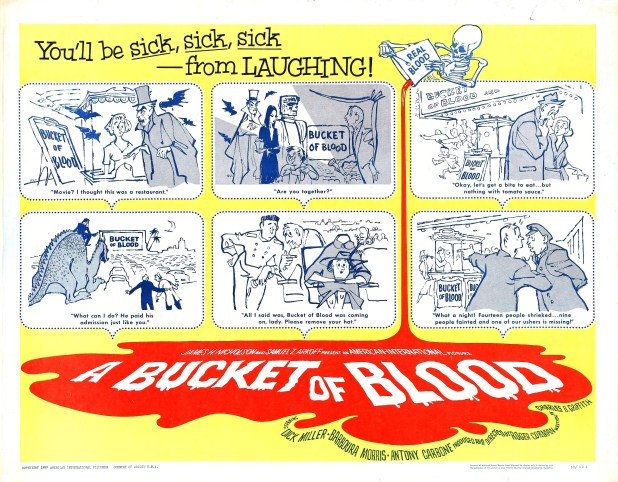
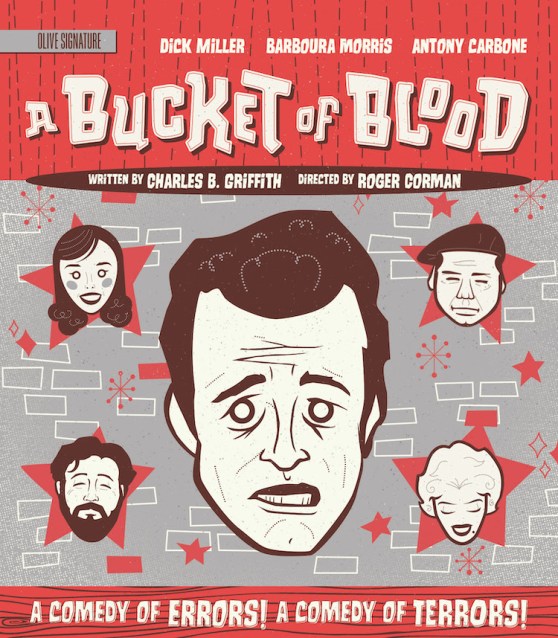
A Bucket of Blood aspires to art as much as it does junk. Written by Charles B. Griffith, whose name you can associate with films as disparate as Smokey Bites the Dust, Barbarella and Death Race 2000, it’s a tale of trying to figure out how to create art when all you can do is repeat words and images. Maybe that’s what art really is.
Roger Corman himself directed this one, shot in five days for $50,000. But hey — AIP wanted a horror film and had sets left over from Diary of a High School Bride. The same set would also be used for The Little Shop of Horrors.
We start by hearing the beat poetry of Maxwell H. Brock (Julian Burton, The Masque of the Red Death) at The Yellow Door cafe. People only know when to clap when they’re told, as the people he decries as sheep really live up to it. But it’s art, baby.
Busboy Walter Paisley (Dick Miller) yearns to be part of this hip crowd and wants to win the heart of Carla (Barboura Morris, The Trip), a friendly hostess at the club. As he fails to make her a sculpture, his landlady’s cat Frankie (Myrtle Vail plays the snooping older woman; she’s actually Griffith’s grandmother) gets stuck in the wall. He tries to cut it out of the wall, but ends up killing the cat. So he does what any of us would: he covers it in clay, sticks a knife in it and calls it art.
The next morning, Walter’s boss Leonard (Antony Carbone, Creature from the Haunted Sea) makes fun of the morbid art, but Carla loves it. So up it goes, on display, where the beatniks all fall in love with it. One of those crazy cats named Naolia gives him some heroin to remember her by, but Walter has no idea what it is.
As he’s followed home by undercover cop and total fink Lou Raby (Bert Convy!), he’s told he’s going to be arrested for possession. He panics and hits Lou with a frying pan, giving him another piece of art called “Murdered Man” for everyone to fall in love with. But the secret’s soon to get out, as Leonard sees fur sticking out of his “Dead Cat” piece.
Walter is now the king of the artistic set, except for Alice (Judy Bamber, Dragstrip Girl), a model who is pretty much disliked by everyone. Walter asks her to be in his model and she agrees, only to be strangled and turned into his next art object. The results so impress Brock that he throws a party for Walter, who drunkenly beheads someone directly after and shows the results to his boss.
This has to end like all wax-related films. Walter finally feels enough self-worth to propose to Carla, who rejects him and soon learns that the sculptures are really human bodies covered in wax. Everyone chases him home, where he makes his last piece of art from himself — the “Hanged Man.”
Dick Miller said of the film — in the book Roger Corman: Blood-Sucking Vampires, Flesh-Eating Cockroaches, and Driller Killers — “The story was good; the acting was good; the humor in it was good; the timing was right; everything about it was right. But they didn’t have any money for production values … and it suffered.”
Miller would go on to play a character named Walter Paisley in the films Hollywood Boulevard, The Howling, Twilight Zone: The Movie, Chopping Mall, Night of the Creeps, Shake, Rattle and Rock!, Rebel Highway, The Adventures of Biffle and Shoosterror and Schmo Boat.
The movie was remade in 1995 as part of the Roger Corman Presents series on Showtime. While never available on DVD, it was released as The Death Artist on VHS. It adds perhaps the one thing missing from the original: Paul Bartel. He and Mink Stole play a rich couple looking for new artists. Walter is played by Anthony Michael Hall, Carla by Justine Bateman, Shadoe Stevens is Maxwell and Sam Lloyd is Leonard. Taking place in a cappuccino bar, it also features Will Ferrell and David Cross in some of their first roles.
If you want to see this, I recommend the Olive Films Signature Edition, made to commemorate the film’s 60th anniversary. It comes complete with a new 4K scan of the film, short docs on Corman and Dick Miller, commentary by Elijah Drenner, director of the documentary That Guy Dick Miller as well as an interview with Griffith, a rare prologue from the German release and even a digest version of the film that was released on Super 8!
Much like their release of Invasion of the Body Snatchers that came out earlier this year, this is another great release from Olive.
DAY 10: ANALOGUE MANIPULATORS: Practical effects are the truth. No CGI will be tolerated.
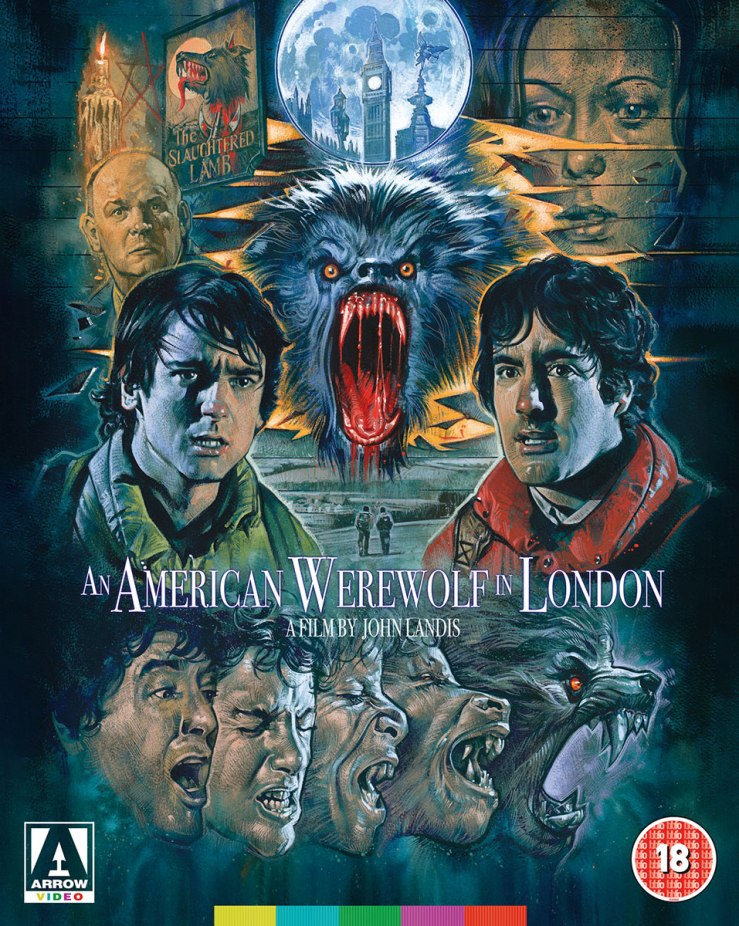
There must have been something in the waters of the Los Angeles River in 1981, as The Howling, Wolfen, Full Moon High and this film all came out in those same twelve months. While all three are interesting films for different reasons, An American Werewolf In London astounded audiences with its special effects.
Rick Baker’s vision was to have the main transformation — set to Sam Cookie’s “Blue Moon” — happen in real-time, with no cutaways or dissolves. Director John Landis compounded the difficulty of this sequence by insisting that it be shot in bright light. This all led to six ten-hour days of prosthetic make-up, but the results were an Oscar — the first of its kind — for special effects make-up and Baker became a household name. Well, in the house of kids who subscribed to Fangoria.
While he was a production assistant in Yugoslavia on the film Kelly’s Heroes, he witnessed an elaborate gypsy funeral where a criminal was wrapped in garlic and buried feet first in the middle of a crossroads so that he would never rise again. This moment of real-life horror stayed with him for over a decade as he built his career in Hollywood.
The money people thought that this movie was too funny to be scary and too frightening to be hilarious. Time has proven them wrong.
David Kessler and Jack Goodman (David Naughton from March Madness and Griffin Dunne from After Hours) are backpacking through Europe. As they make their way across the moors, they stop at a local club called the Slaughtered Lamb. In the midst of all the fun they’re having, they innocently inquire about the star on the wall and are asked to leave. Seriously — the bar just shuts down and forces them into the night, knowing that they’ll die out there.
Look for Rik Mayall in this scene, playing chess with former pro wrestler Brian Glover. Adrian Edmonson had been invited to be at the shoot but blew it off.
As they walk into the night, the pub owners can only say, “Keep to the road, stay clear of the moors and beware of the full moon.” Of course, that means that our heroes wander off the path and are surrounded by a creature that howls at the full moon. Jack is milled and David barely survives when the pub’s patrons come out to save him. As he passes out, he sees that it wasn’t an animal that attacked, but a nude man.
Three weeks later, David wakes up in a hospital where Inspector Villiers tells him that he and his friend were attacked by a lunatic, while our hero insists that it was a wolf. That’s when things get even weirder — Jack appears, even though he’s dead, and demands that David kill himself before the next full moon. As long as the bloodline of the werewolf continues, Jack will be undead, forced to haunt the world.
As David heals up, he moves in with Alex Price (Jenny Agutter, Logan’s Run), a nurse who helped him get back on his feet. Instead of being able to celebrate young love, Jack’s warnings — and decay — grow more insistent as we get closer to that epic transformation scene.
The rest of the film is a rollercoaster of werewolf attacks and David trying to reason with Jack, who is joined by all of David’s victims inside an adult movie theater. Finally, the police — and Alex — close in.
Today, Landis regrets some of his choices as he made the film, such as cutting certain sequences to earn an R rating. For example, the sex scene when Alex and David finally consummate their relationship was a lot more explicit and there was an action sequence where David as a werewolf would wipe out the homeless along the Thames. The director also felt that he spent too much time on the transformation scene sequence because he was so fascinated by Baker’s effects.
That said, Landis and Baker were never on the same terms after this film. It took eight years to make the movie and Baker decided to use all of the work he’d created so far for The Howling. Right around the same time, Landis finally got the movie greenlit and called Baker, who had to tell him he was already lining up a werewolf project. After getting screamed at over the phone, Baker left the project in the hands of his assistant Rob Bottin and only consulted on that film.
Special effects would never be the same after this film. Today, the entire transformation would be computer rendered, with those amazing monsters only truly existing on the screen. This film’s effects were so upsetting to even the actors that it caused depression when they first saw how damaged their faces were.
Arrow Video’s release of this film — which you can order from Diabolik DVD — is packed with everything you’ve come to expect from this label. There’s a new 2018 4K restoration from the original camera negative supervised by Landis, as well as two commentaries — one from filmmaker Paul Davis and another with actors David Naughton and Griffin Dunne. There’s also Mark of The Beast: The Legacy of the Universal Werewolf, a newly produced and feature-length documentary by filmmaker Daniel Griffith, Beware the Moon (Paul Davis’s feature-length exploration of the film complete with extensive cast and crew interviews), a new interview with Landis entitled An American Filmmaker in London, and a video essay by Jon Spira (who made Elstree 1976, a movie about ten extras who were in Star Wars) called I Think He’s a Jew: The Werewolf’s Secret. There are also discussions on how the movie impacted today’s filmmakers, special effects artists and archival making-of features. If it sounds like Arrow went above and beyond, well — they do this on just about every movie they release.
PS — Please, by all means, avoid An American Werewolf In Paris (starring Tom Everett Scott of Tom Hank’s That Thing You Do!), a movie made by none of these people that has extreme bungie jumping in it. That’s probably the only reason to watch it, actually.
DISCLAIMER: We were sent this movie by Arrow Video, but we’ve alreayd bought it several times and were planning on purchasing this new version anyway. This has no bearing on our review.
DAY 9. DIGITAL S(T)IMULATIONS: A pre-2000 movie using computer generated “special” effects.
As much as we decry practical effects over CGI — in the same way we demand physical media over streaming — there are times when it doesn’t have to be all that bad. I decided that instead of finding a poor example of computer generated animation, I’d share something that I love.
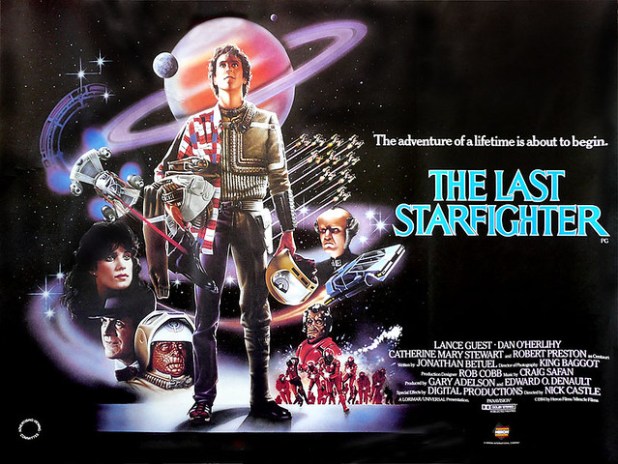
While the first CGI in mainstream film was probably 1976’s Futureworld (several modern techniques were innovated in this film, from an animated CGI hand that was taken from Edwin Catmull’s 1972 experimental short subject A Computer Animated Hand and an animated face from Fred Parke’s 1974 experimental short subject Faces & Body Parts to an early example of digital compositing to place live actors over a previously filmed background), the two movies that I can really remember to use extensive computer-generated imagery were Tron and The Last Starfighter.
In place of physical spaceships, 3D rendered models were used to depict this film’s Gunstar and spacecraft. Their designs came from artist Ron Cobb, who also worked on Dark Star, Alien, Star Wars, Conan the Barbarian and wrote the initial script for Dark Skies, which Steven Spielberg rewrote into the mich friendlier E.T. He’s also listed in the credits for Back to the Future as DeLorean Time Travel Consultant.
There are over 27 minutes of effects in this film, which was a tremendous amount of computer animation for its time. However, this animation required half the time of the traditional miniature special effects, allowed the film to be made for just $14 million dollars.
That said — there are still plenty of practical effects, like the creature and Beta Unit special makeup, as well as the Centauri’s Starcar, which was a real vehicle created by Gene Winfield, who also created the spinners for Blade Runner and the 6000 SUX for RoboCop. His car design for The Reactor was used in a variety of TV shows, including Catwoman’s Catmobile on the Batman TV show, the Jupiter 6 car in the “Bread and Circuses” episode of Star Trek, Bewitched and Mission: Impossible, where it was part of a scheme to make a bank robber believe that they’d been asleep for 14 years.
The idea that video games were recruiting players for some high end military service started as an urban legend that games like Missile Command were saving information on its players so that they’d be ready to defend America from the inevitable Russian ICBM strike that was coming in the 1980’s. There was also the There’s also the weird tale of Polybius, a video game that never existed — or did it? — that was an MK Ultra style experiment unleashed on Portland, Oregon arcades that led to addiction, hallucinations and visits by the Men in Black. Obviously, those legends led to this film or this is all an elaborate piece of disinformation to hide the truth in plain site. I leave your version of reality up to you, dear reader.
Alex Rogan (Lance Guest, Halloween 2) is going nowhere, stuck in a trailer park taking care of everyone else. His scholarship has been rejected and he has to keep fixing things and watching his little brother instead of getting to spend time with Maggie (Catherine Marie Stewart, The Apple).
The only fun he has is playing the Starfighter arcade game in the trailer park, which allows him to pretend that he’s defending the Frontier from Xur and his Ko-Dan Armada.
After Alex becomes the game’s highest-scoring player, the game’s inventor Centauri visits, offering him a ride in his fancy car as a prize. He’s played by Robert Preston, who is really just reprising his role as Harold Hill from The Music Man, which is an ingenious gambit.
The car is really a spaceship and Alex is taken to meet the Rylan Star League while a Beta Unit is used to replace him on Earth. That’s when he learns that the game is actually a training unit meant to find starfighters ready to battle very real Ko-Dan Empire.
Alex is expected to be the gunner for the Gunstar along with the reptilian navigator Grig (Dan O’Herlihy, who pretty much owned the 1980’s between this movie, playing Conal Cochran in Halloween 3: Season of the Witch and the Old Man in RoboCop). However, all our hero wants to do is go home.
It takes alien assassins attacking the trailer park and the death of all of the other starfighters and Centauri — who takes a laser blast meant for our hero — for Alex to join the cause. While he fights the Armada in space, Beta and Maggie battle the Zando-Zan killers back down on good old Mother Earth.
Of course, Alex has the gift that all great starfighters need and saves the day. He lands his ship on the trailer park and takes Maggie into space with him, while his brother starts playing the game in the hopes of joining his brother.
This is a film with real heart, beyond its aspirations of being a blockbuster. It’s directed by Nick Castle, who you probably already know played Michael Myers in the original Halloween. What you may not know is that he wrote the movie Skatetown U.S.A. or directed Tag: The Assassination Game, The Boy Who Could Fly and Dennis the Menace. Plus, he, John Carpenter and Tommy Lee Wallace all formed The Coup De Villes and played much of the music for Big Trouble In Little China.
Despite the film being based on the idea of an arcade game, there never really was one despite the promise in the closing credits of an Atari created edition. The game was actually started and would have been Atari’s first 3D polygonal arcade game to use a Motorola 68000 as the CPU. It would have used the Star Wars arcade controls and been much like the game Lance Guest plays in the film, but it was cancelled once Atari representatives saw the film in post-production and decided it was not going to be a financial success.That said there were Atari home versions in development and they were eventually released as Star Raiders II and Solaris.
There is an NES game — it’s a reskin of the computer game Uridium — and Rogue Synapse created a freeware PC game in 2007 that’s very close to the game in the film.
The themes of The Last Starfighter have been repeated in plenty of other stories, like Orson Scott Card’s Ender’s Game and Ernest Cline’s Armada, which is pretty much a note for note reboot of the same story. Of course, Cline wrote Ready: Player One and works in a reference to the original film, but he wears his influences on his sleeve. Interestingly enough, Wil Wheaton read the audio version of this book — which will be a movie soon enough that’ll cost a hundred times what The Last Starfighter did and have a sliver of the soul — and he appears in this film.
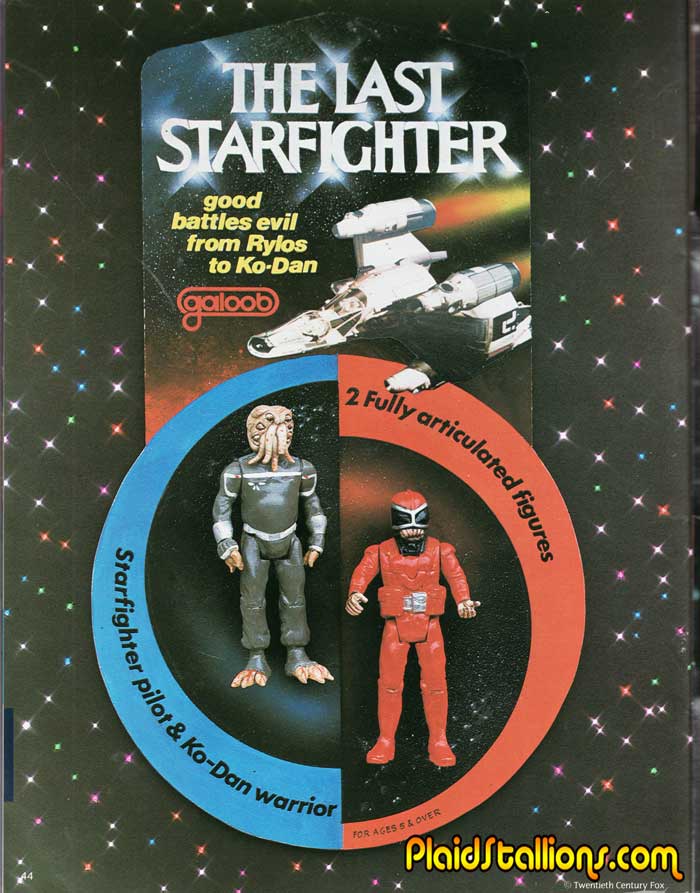
Galoob planned to create a toyline for this movie that sadly never came to be. You can see images of it and learn more about it at Plaid Stallions.
If you’re looking for a great slice of 1984, you can’t go wrong with this movie. I love that it has a lizard best friend, fun spaceship designs, the Music Man conning people for money in the midst of a galactic war and even the promise of a sequel which never came. It’s the kind of movie that would always be a rental that everyone could agree on or the perfect film to veg out whenever HBO showed it for the two hundredth time.
DAY 8. AFTER THE DISASTER: Will we rebuild, adapt or move on?
If there’s one thing this site has been about as of late, it’s been post-apocalyptic films. Just take a look at this Letterboxd list that keeps track of all of them — if a movie has been made about the end of the world, we’ve watched it, written about it and told way too many people about it.
So after watching more than a hundred post-End of All Things movies, where else do we have to go?
1985’s Roller Blade was directed by Donald Jackson, who was no stranger to end of the world movies. You’d probably know him best for the movie where Roddy Piper plays a male stud who knocks up fertile women and battles amphibians, Hell Comes to Frogtown.
He was also no stranger to post-nuke films that feature people on skates, for some reason. This very narrow genre of films is actually much wider than you think it is, thanks to movies like Solarbabies, Prayer of the Rollerboys and the many, many films that Jackson created, such as Roller Blade Warriors: Taken by Force, The Roller Blade Seven, The Legend of the Rollerblade Seven and Return of the Roller Blade Seven. He was also responsible for the 1996’s Rollergator, in which a purple jive-talking alligator escapes from Joe Estevez’s carnival and does battle with a skateboarding ninja.
Look — it’s 4 AM and I’m not certain that any of this is real. I’m just going to write what I know and hope that this record proves that I was here, alive on Planet Earth and trying to contribute something worthwhile before I become dust.
In the City of Lost Angels, Sister Speed leads a holy order of rollerskating nuns called the Bod Sisters that try to protect humanity from the fascist regime that seems to be holding sway over things. All of the nuns wear strange cult-like robes with iron crosses on them when they’re not nude and Sister Speed rolls around in a wheelchair, yet she still has her skates on, just in case her legs decide to start working again.
Perhaps the most telling thing I can say about this movie is that everyone is on old four-wheeled skates and not inline Rollerblades, so it’s basically lying to you with every single moment of screen time.
Then again, this is also a movie where switchblades are used to heal people.
The sisters also have this magic crystal that the bad guys want and they’ve possessed a young girl to infiltrate the skating nuns. Those bad guys are led by Dr. Santicoy, who has a leather dom mask and a hand puppet made from a silver-painted baby doll that he talks to. Also, for some reason, one of the head nuns is a dog named the Holy Hound Gideon. Yes, they put a dog in a colorful nun outfit that kind of makes that canine look like it joined some weird Satanic cult.
Nearly every single person in this movie has been dubbed, which makes it seem like you’re watching an episode of Power Rangers, but it’s an episode where everyone has naked rollerskate fights and has sapphic interludes in a hot tub.
There’s also a group of skating law enforcement officers led by Marshall Goodman, whose son Little Chris (played by Fred Olen Ray’s young son) runs away without his skates. Yes, he disobeyed the biggest rule in this wasteland. He took his skates off.
Unlike nearly every great end of the world movie, no effort has been made to explain how the world got this way. Who has time when there’s so much skating to do?
It also shouldn’t surprise you that a majority of the Bod Sisters — like Shaun Michelle, Melanie Scott, Crystal Breeze and Michelle Bauer (who was also in Dr. Alien and Sorority Babes in the Slimeball Bowl-O-Rama — are well-known adult actresses. The quality of a mid-1980’s VCA adult effort is completely apparent here, but just when you expect the performers to start getting down, they start skate fighting instead.
I’m not sure who this movie was made for, why it existed or how it found it’s way into my Plex stream at 4:49 AM, but it’s moments like these that make me realize that God doesn’t play dice and that there’s some kind of grand plan. Because otherwise, watching a cinema opus like Roller Blade would find me screaming into the void.
DAY 7. DAIKAIJU: The bigger the better. Who needs a city anyway?
We already did War of the Gargantuastoday, but you can never get enough giant monster movies, much less one that is endlessly self-referential!
Japan is in a mess to say the least. The weather is all screwed up, volcanoes have stopped erupting, there are too many virgins and that can only mean one thing — a giant monster named Mono is on the loose.
Disgraced scientist and Sailor Moon cosplayer Doctor Totaro Saigo has a special formula that can transform anyone — even the lowly assistant Nitta — to become a gigantic super soldier ready to take on even the largest of kaiju.
Syuusuke Saito plays Nitta before the transformation. He’s Kyoryu Black from Zyuden Sentai Kyoryuger, if you watch Japanese sentai shows (think Power Rangers). Once he transforms, he becomes Kota Ibushi, current New Japan Pro Wrestling star who started his career in the DDT promotion, or Dramatic Dream Team. If you like just plain strange things to happen in your pro wrestling, I’d advise you to check them out. For example, Ibushi once had a series of matches with Yoshihiko, an inflatable doll.
The movie begins as the SpiritSpots.com team visits Specter Pass, where eyewitnesses have reported strange lights. After urinating on a special idol, Professor Nindo Izumi appears to warn them of the danger that this area of Japan presents. They don’t listen and are all killed one by one, just like a slasher movie.
The next day, Nitta and Professor Saigo’s daughter Miwa discover the Juganda, a prehistoric flower that’s based on the Juran from Ultra Q and an egg that contains the key to Setupp X Cells, which Saigo believes are the key to jump-starting the next stage of human evolution.
Meanwhile, at Mount Myojin, the kaiju Mono emerges before a crowd of soldiers and monster rights protestors, who it promptly devours. That’s when Saigo uses Nitta’s love for his daughter to convince him to take the Steupp X Cells and put on a pair of magical briefs that change size as he grows. After nearly three minutes of pro wrestling mayhem, Mono retreats and Nitta retains his sexy new body.
Nitta becomes a big celebrity called “The Great Giant” and is chased by a mysterious girl named Lisa who only wants his magical size-changing underwear. Miwa grows depressed and Mono grows stronger thanks to a second egg and her newfound poison fog power. Luckily, Saigo has even better Setupp X Cells and Izumi has trained Nitta to even be able to stop the flow of waterfalls.
However, even Lisa coming back to the good side and Miwa getting back Nitta’s special briefs isn’t enough. Saigo must inject Nitta with evil cells that transform him into Japanese legend Minoru Suzuki, the most intimidating pro wrestler perhaps ever. He basically annihilates the monster, who it turns out is really an old woman.
Ibushi isn’t alone in having matches with strange opponents. Suzuki has had a several years-long feud with Mecha Mummy. One of their matches involved an extended sequence where they became friends and went fishing before hatred overcame their truce. The strange thing is, Suzuki was the co-founder of Pancrase, one of the first MMA groups in the world. Despite most of their matches not always being 100% real, he has the reputation of being one of the best fighters in all of Japan. He was also the motion actor for King in the video game Tekken.
Your sense of humor may vary, as this is very much in the vein of the Airplane movies, but all about Japanese monster movies, to the point that even scenes from Frankenstein Conquers the World get referenced. It also helps to know a little about Japanese pro wrestling, as Professor Saigo is so out of touch he only knows Giant Baba’s moves, which aren’t as dangerous as the modern powerbombs and top rope — err, top of the building — Phoenix Splashes that Nitta uses on Mono.
My subtitles and the English track on this film were absolutely different, which was kind of great, as they each added their own unique commentary to this completely out there movie. There’s even a scene that shows that training to battle a giant monster is just like getting ready for a boxing match like Rocky! Even the original Ultraman star Sandayu Dokumamushi shows up at the end to save the day!
There’s actually precedent for this movie, believe it or not. In 2004, The Calamari Wrestler featured Osamu Nishimura as a pro wrestler who becomes a giant squid and does battle with wrestlers Akira Nogami.







 B&S About Movies
You must be logged in to post a comment.