While this German rock flick is best remembered for featuring MTV video favorite Nena in her acting debut, the film takes its title from a hit song by her co-star Markus Mörl, which translates as “Step on the Gas – I Want Fun.”
The film was crafted as a multimedia showcase to launch the music careers of both singers in their native Germany. But after Nena’s “99 Luft Balloons” (which isn’t featured in the film) became a freak international hit (in both of its German and English versions) courtesy of its video, the film was quickly dubbed into English and retitled as Hangin’ Out — a title which also carried over into its Spanish and Japanese dubs.
The film, which featured six tunes from Nena’s eponymous band, became the 13th most successful film in Germany that year. However, to hear Nena — who has long since derided the film — tell it, the film had an opposite effect on her career: instead of the film launching her career, it was the MTV success of her career that made the film successful.
And while Nena, along with fellow Germans Falco (“Der Kommissar“) and Trio (“Da Da Da” and “Boom Boom“) where able to find international success beyond the Euroasia continent, Marcus failed to expand his career beyond Germany’s borders. He did, however, score a Top Five hit with “Kleine Taschenlampe brenn,” (“Small Flashlight Burning”), which is featured in the film and consider a German pop music classic. The film also features another one of his chart hits, “Feuerwehrmann,” which you can listen to in this clip from the film.
So, what’s the film about? It’s a simple love story.
Tina (Nena) is tired of school and life in her Barvarian village and won’t give fellow student Robby (Markus Mörl) the time of day. Instead she falls for Tino (Enny Gerber, in his only film role), a red silk jacket wearing, motor scooter riding ne’er do well who works at the local carnival. When Tino leaves town and breaks Tina’s heart, she convinces Robby to hit the road and track down Tino — which leads Tina and Robby to eventually fall in love.
While there’s several clips from the film available on You Tube (some blocked from U.S. playback), we found this English language vignette on You Tube — as you can see, the film awkwardly transitions from English language dialog to German language vocals (and here’s several trailers and clips to sample). There’s no online rips or VHS copies available online of the English language dub released under the Hangin’ Out title, but we located a copy of the German language version of the film on Russia’s version of You Tube, OK.ru.
Nena’s only acted in front of the camera two more times: the German films Tagediebe (Day Thieves; 1985) and Der Usichtbare (The Invisible; 1987). Curiosity seekers of all things Nena can watch Der Usichtbare and this promotional video of the song “Memorija” from Tagediebe, courtesy of You Tube.
About the Author: You can learn more about the writings of R.D Francis on Facebook.He also writes forB&S About Movies.
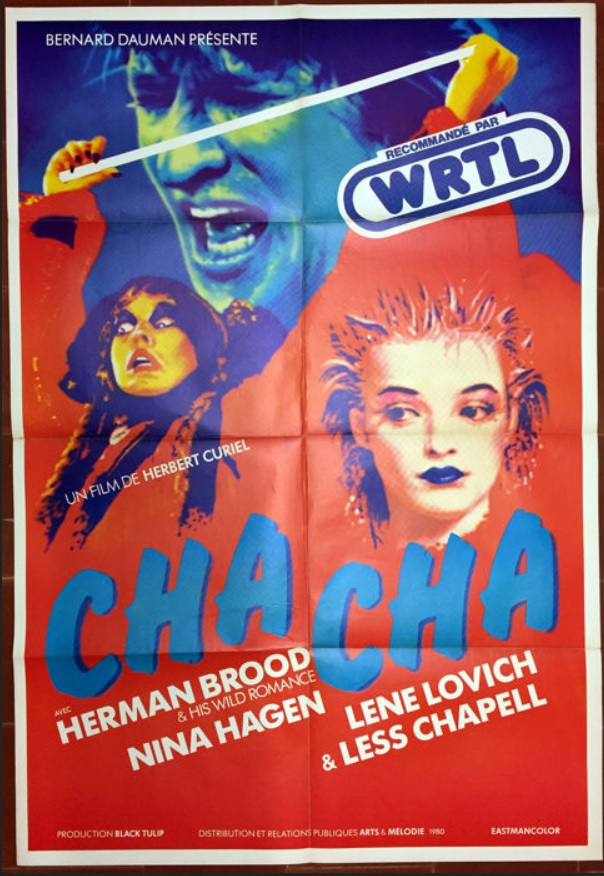
Cha Cha served as a multi-media film and soundtrack collaboration by the then romantically-linked couple of Dutch rocker Herman Brood (1979 U.K./U.S. Top 40 new wave hit with “Saturday Night” by his band Wild Romance) and East German musician-actress Nina Hagen (1982 new wave hit with “Smack Jack”), along with Detroit, Michigan-born and London-transplanted Lene Lovich (1979 U.K./U.S. new wave hits “Lucky Number” and “New Toy”).
Since each were at the top of their Euro-chart popularity, it lent to their ability to get their — what isn’t so much a fluid, narrative work, but an art film comprised of a series of vignettes strung together by a series of musical performances — passion project made. Think of 1975’s The Rocky Horror Picture Show crossed with the Richard Hell-starring Blank Generation from 1980 by Ulli Lommell (BrainWaves with Keir Dullea, The Boogey Man with Suzanna Love), and you have an idea of what you’re getting into.
Courtesy of catawiki.es (Spain)
Yes. The words “art film” should give you pause; this one is purely for the uber fans of the musician-stars of the film. You’ll also need additional patience as the film’s dialog bounces between English to Dutch to German; and its amateur student film vibe doesn’t help matters. The “plot,” such as it is, set against Amsterdam’s punk/new wave scene, is part documentary (voiceovers and interviews, natch) and part narrative film — with the cast starring as themselves; Brood is “the star” of the film: a bank robber who wants to “go straight” and believes the path to righteousness lies in his becoming a rock ‘n’ roll star.
Also featured in the film are the notable Dutch new wave bands Phoney & the Hardcore (“Suicide“), the Meteors (“Teenage Heart“), and White Honey (“Nothing Going On In the City“). (While not commercial radio hits on par with Brood’s, Hagen’s, and Lovich’s works, they were popular spinners on U.S. college radio stations and new wave clubs at the time.)
In the end, if you want to revisit the ’80s new wave era — or visit it for the very first time — Cha Cha serves as a fun time capsule of the lost MTV video era.
You can enjoy a pretty clean rip of the full movie on You Tube (it’s been there for 8 years, so it safe to say it’s not going away anytime soon). You can also listen to the full soundtrack on You Tube as well; you can access a detailed track listing at Discogs. You can learn more about Herman Brood in the 1994 Dutch rock documentary Rock ‘n’ Roll Junkie (you can watch the 15 minute television promotional video and 90-minute feature length theatrical on You Tube) and Nina Hagen in the 1994 English document (very arty and avant-garde, natch) Nina Hagen = Punk + Glory on You Tube.
About the Author: You can learn more about the writings of R.D Francis on Facebook. He also writes for B&S About Movies.
“Hey, just wait a minute there, you smug and pretentious, know-it-all pseudo-film critic . . . what’s this disaster-suspense drama doing in the middle of a “Rock ‘n’ Roll Week” of reviews? This is just a knockoff of Dirty Harry crossed with Earthquake, and instead of Clint Eastwood’s police inspector, we get an amusement park safety inspector. And while George Segal is pretty cool in the role, he’s no Dirty Harry Callahan.”
“Well, don’t forget that George is teamed with Richard Widmark as FBI Agent Hoyt.”
“Uh, no. Sorry. Still not Dirty Harry Callahan.”
“Well, do the factoids that Rollercoaster not only has a rock ‘n’ roll connection, but a connection to Pittsburgh and Star Trek as well, Mr. Critic of critics?”
“No, not really. But you’re going to ramble about it anyway. I’m going to go take a piss. Later, dude.”
Critics of critics. God, how we love ’em at B&S About Movies. . . .
So, the connection to Star Trek comes courtesy of director James Gladstone, who directed the classic September 1966 episode, “Where No Man Has Gone Before,” you know, third episode of the first season that served as the second series pilot when the first pilot, “The Cage” (starring Jeffrey Hunter as Kirk), failed . . . you know Gladstone’s episode: Gary Lockwood (2001: A Space Odyssey, Earth II) and Sally Kellerman (the original “Hot Lips Hoolihan” in the theatrical version of M.A.S.H) obtained psychic powers after the Enterprise crossed The Great Barrier. And, as we learned, courtesy of B&S’s Chief Cook and Bottle Washer, Sam, in his review of 1974’s Cry Panic, James Gladstone directed that John Forsythe-starring TV movie written by Jack B. Sowards who, in turn, came up with one of the greatest tales of Federation folklore: the Kobayashi Maru, a no-win scenario for new Starfleet captains that was first brought up in Star Trek II: The Wrath of Khan.
Gladstone also directed the ’70s duplex favorite, When Time Ran Out (1980), an Irwin Allen-produced disaster-suspense boondoggle about an island volcano. That film reteamed Paul Newman and William Holden from the disaster bonanza The Towering Inferno and Ernest Borgnine and Red Buttons from the water epic The Poseidon Adventure. And Gladstone, along with producer Jennings Lang (Airport ’75, Airport ’77, The Concorde : Airport ’79, as well as Play Misty for Me, Slaugtherhouse Five and The Nude Bomb!!), previously worked together on Swashbuckler (1976), Universal’s forgotten “pirate comedy” flop starring Robert Shaw from Jaws. (Yep, Lang also did the one that started it all: Earthquake.)
The plot of Rollercoaster was described by Gladstone as more of a Hitchcockian cat and mouse story than as the disaster movie it was marketed; Segal concurred: he saw it as a well-structured, Hitchcock-styled action-adventure, combined with Universal’s (“Sensurrond”) technology. And Rollercoaster was, in fact, the fourth film in the studio’s “Sensurrond” oeuvre: the aforementioned Earthquake, the WWII epic Midway (1976), and the theatrical version of Battlestar Galactica (1978).
The film stars Timothy Bottoms (Up From the Depths! Thank you, Charles B. Griffith for that duplex classic!) as a mad bomber blowing up the nation’s rollercoasters to extort a million dollars from a Chicago-based amusement amalgamate. Now, if you’re keeping track, that is pretty much the plot of Dirty Harry — only with the mad bomber replaced with an assassin, and Georgy-boy not slingin’ a .357 and quipin’ one-liners. And if it all sounds like Speed, with Dennis Hooper’s “mad bomber” blowing up a bus-for-bucks (which is just Die Hard on a bus), then it probably is.
“Hey, man. I’m back from my piss. And one hell of a loaf-pinch. You’re still rambling? Did you get to the rock ‘n’ roll part, yet? Time’s a-wastin’. I need to go do my yard work.”
Ugh. Critics of critics, again I say. . . .
Anyway, as for the Pittsburgh connection: Mine and Sam’s beloved Kennywood Park out in West Mifflin in Allegheny County was originally set as the location for the film’s opening “crash” segment. When the park got cold feet at the last minute, producer Jennings Lang reset the scene for “Wonder World” at Kings Dominion outside of Richmond, Virginia. (This extended interview, seen below, with King’s Park Manager, Dennis Speigel, who also starred in the film, tells it all.)
The Rock ‘n’ Roll Part!
So, do you remember during your MTV youth, the quirky “Cool Places” that featured the annoying and least-attractive member (well, opinions vary) of the then hot the Go-Go’s, Jan Wiedlin? Well, you might recall that wasn’t a Jan Wiedlin solo tune: it was the lone U.S. Top 50 radio hit by Sparks, which was featured on their twelfth studio album, In Outer Space (1983), issued by Atlantic Records.
Anyway, Spark’s previous label, Columbia (the band burnt through six deals over the years), decided a great way to promote their new signee was by casting them in movie and feature the planned singles of “Fill ‘Er Up” and “Big Boy“(the official single upload) from their mutual debut, Big Beat (1976; produced by Rupert Holmes . . . yes, the “Escape (The Piña Colada Song)” dude). Sadly, the genius of the Columbia promotions department didn’t work: after one more flop album, 1977’s Introducing Sparks, the label dropped the band. And here’s the big scene doing “Big Boy” from the film.
If you look closely at their “big scene,” you’ll notice that album’s ex-Tuff Dart Jeff Salen on guitar (“(Your Love Is Like) Nuclear Waste” and “All For The Love of Rock and Roll“), along with ex-Milk and Cookies (You Tube) bassist and drummer Sal Maida and Hilly Micheals. And since we’re talking MTV: You’ll recall Hilly Michaels had his own MTV video hit, “Calling All Girls,” from his solo debut, Calling All Girls (1980). As with Columbia pushing Sparks via film, Warners also failed to break Micheals to a mass audience by placing tunes from the album in the uber-obscure (flop) Robby Benson (The Death of Richie) rock flick, Die Laughing (“Shake It and Dance“), and Chevy Chase’s Caddyshack (“Something’s On Your Mind“).
Coco for Sparks!
Okay, so this is where Sam just says, “F it,” and lets me free range across The Point, gushing in gaiety over the quirky, they’ll-never-be-The Cars-no-matter-how-much-the-label-wishes-it-so Sparks. But I say “bollocks” to the industry: I love Sparks!
It all began for the Los Angeles Mael brothers with their ahead-of-its-time new wave precursor, Halfnelson (“half nelson,” get it?). The band featured the likes of Earle Mankey (later of the Pop and 20/20), his brother, Jim (later of the alt-rock chart-topping Concrete Blonde), along with Leslie Bohem and David Kendrick of L.A.’s Bates Motel. With fellow Bates Motel/Sparks’ members Jim Goodwin and Bob Haag, the quartet became the Gleaming Spires. Their new wave hit, championed by Rodney Bingenheimer (The Mayor of Sunset Strip), “Are You Ready for the Sex, Girls,” appeared on the soundtracks to The Last American Virgin and Revenge of the Nerds.
Halfnelson signed with Bearsville (home to Foghat, Todd Rundgren’s Utopia, R.E.M clones the dB’s, and NRBQ), with Rundgren producing. After one belly flop of an album, the label wanted a name change (their moniker was “dumb and confusing” per the label) and reissued the album. Three ignored albums later, Sparks were signed by “fan” Muff Winwood (Steve Winwood of Traffic and Blind Faith’s brother) to Island. So off to England Sparks went, to ride that country’s then hot “glam” wave, where they fit right in with the likes of David Bowie (his long time producer, Tony Visconti, produced them), T.Rex, Mud (Never Too Young to Rock), and Slade (Slade In Flame).
Then, when glam became passe in the U.K. under the rise of punk rock and the Maels didn’t fit in with that Sex Pistols-inspired scene, they returned to the U.S., where hard rock was on the rise in a post-Van Halen world. And Columbia’s brain trust had Sparks make a “big rock move” for two more albums. And that “move” led to Sparks’ appearance in Rollercoaster — a role that the Brothers Mael described in a September 2006 Mojo interview as “the biggest regret” in the career of Sparks.
Regret? I went screaming from the duplex to find used Sparks albums at the local used record store. Hey, at least Columbia converted one person into a “Sparkhead” via the film.
And how is this not on TubiTV, considering it’s been re-released on Blu by Shout Factory (Thank You!!!), who has their own Tubi channel? No online stream, either? Not even on Amazon Prime? What the hell! Well, we found this — as a commenter dubbed it — “Glaucomavision” copy (you’ll get the joke when you open the link) on You Tube, for those of you that have never experienced the wonder of the members of Sparks fleeing the shrapnel of a rollercoaster.
Yeah. I love this movie.
About the Author: You can learn more about the writings of R.D Francis on Facebook.He also writes forB&S About Movies.
If you’re a fan of the Who — and watched or listened to their 1973 rock opera Quadrophenia — you’re up to speed on the two warring British youth subcultures known as the Mods and the Rockers that came to worldwide notice courtesy their numerous, violent confrontations in mid-1960’s London. And you know about their roots in the frames of Marlon Brando’s The Wild One (1953) and the music of Eddie Cochran and Gene Vincent.
And Euro-cinema knew good fodder for a script when they seen one.
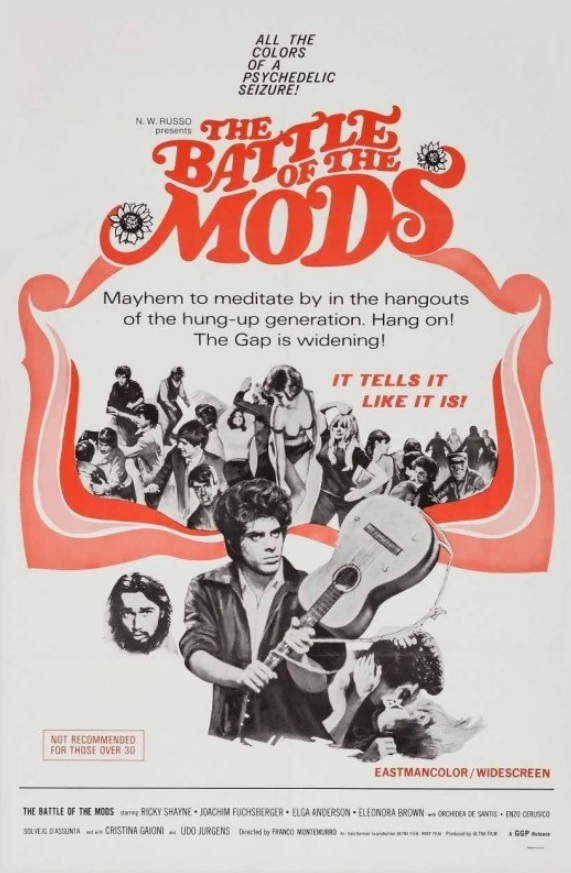
So Ennio De Concini, who wrote more than his fair share of sword n’ sandal and spaghetti westerns, and director Franco Montemurro (internationally known for 1962’s The Police Commissoner and 1964’s Divorce Italian Style), came up with a story about a Liverpool gang war between the Mods (who dress in the latest fashions and style ala Gene Vincent) and the Rockers (adorned in a ’50s greaser style ala Marlon Brando). Ricky Fuller (Euro musician Ricky Shayne), the son of a wealthy businessman, is a Mod musician who, after a bloody a gang fight that leaves his girlfriend dead, flees Liverpool for Rome — and he starts an affair with his father’s mistress.
La battaglia dei Mods
A 1970 Radio Luxemburg “Golden Lion” award-winning singer, Ricky Shayne (aka George Albert Tabet) was born to a Lebanese oilman and his mother, a French-born painter, in Beirut, Lebanon. After moving to Paris at the age of 15, he began his music studies; with a move to Italy at 17, he began his recording career and, courtesy of his cinematic good looks, quickly found acting work. In 1965, he co-starred in an Italian rock flick Altissima pressione (Highest Pressure). He quickly transitioned into leading man roles with the 1966 German rock film Siebzehn Jahr, blondes Haar (Seventeen Years, Blond Hair) and the 1967 Italian rock flick Una ragazza tutta d’oro (A Girl All In Gold). Of course, all of the films featured Ricky’s latest hits, with the The Battle of the Mods featuring his tunes “Uno dei Mods” (“One of the Mods”), along with “No No No No” and “Crazy Baby I Got You” (which also served as the film’s alternate title).
American classic rock aficionados came to know Ricky Shayne by way of the American pop band Stories, fronted by Ian Lloyd (1973 U.S. #1 “Brother Louie“). In lieu of importing Ricky Shayne to the States via his 1971 European smash hit single “Mammy Blue” (the German language version hit #7 in that country; the French language version hit #8 in France, the English language version hit #1 in Argentina and Brazil, and the Top 10 in Belgium and Japan), the song was re-recorded by Stories, who placed it in the American Top 50 — and proved to be the last hit by the band. Shayne, meanwhile, became a U.S citizen in 1975, but continued to hit the European charts with a variety of singles while starring in European film and television roles. Now, at the age of 76, he still performs in Eurasia as part of nostalgia package tours.
While a quick search of Ricky’s music on You Tube will turn up a wide array of his singles, here’s his original 1971 version of “Mammy Blue” to enjoy (alternately titled with one “m” or two, depending on country of release.)
This is purely a British film steeped in nostalgia for the short-lived British glam rock movement that spawned the likes of David Bowie, T. Rex (“Bang a Gong“), and Sweet (“Little Willie“), and to a lesser extent — at least for U.S. audiences — Mud (“Tiger Feet“), Slade (“Cum on Feel the Noise“), and Suzi Quatro (of the recent document retrospective, Suzi Q).
Like any Beatles flick or British Invasion film romp starring the likes of Cliff Richard and the Shadows (1966’s Finders Keepers), Herman’s Hermits (1966’s Hold On!), and Freddie and the Dreamers (1967’s The Cookoo Patrol), a rock band on tour finds itself in hijinks — with rock ‘n’ roll under attack by the establishment and a rock ‘n’ roll club in danger of being closed down.
To that end: In a “future” set in late 1970s, the establishment has banned rock ‘n roll from television. So a young rocker (British television acting mainstay Peter Denyer) leads the charge against the ban by organizing the biggest rock groups in England to perform at a benefit concert.
Of course, David Bowie, Marc Bolan (of T. Rex), Sweet, Slade, and Suzi Quatro will have none of this amateur cinematic foolishness, so we have to settle for the lesser “stars” of the glam era with the likes of Mud and the Glitter Band (Gary Glitter’s backing band, out on their own), along with the Rubettes — and guest appearances by Peter Noone of Herman’s Hermits (trying to eek a living in a post-British Invasion world) and Midge Ure (later of Ultra Vox) with his glam band, Slick.
This is the type of film with nary a plot, the “action” consists of the old slap stick standby of a food fight in a roadside diner, and lots — and LOTS — of musical numbers padding out the film for its whopping one hour fifty minute running time. The cast is rounded out by members of, get this, the prestigious Royal Shakespeare Company — and beware the bushy mutton chops and sharply-cut side burns — and of the outdated vaudevillian comedy groans presented by British comedians Freddie Jones and Max Wall (insert sad trombone “wah-wah-wah” sfx here.)
However, if you want to trip down the ’70s glam rock memory lane of your youth, or you if want to first educate yourself on the era with a glam primer, there’s not another film quite like this glittery mess of a train wreck of a film.
To say I love this movie is an understatement.
Overseas readers can stream this via Amazon Prime U.K., but we found you a free, three part upload on You Tube HERE, HERE, and HERE. Ha! It’s infectious! I got Sam the Bossman to watch: here’s his take. Yes, it depends which print you watched and where, back when: this came out in 1975 and 1976. Glam, of course, was out by 1976, and punk was on the rise. . . .
About the Author: You can learn more about the writings of R.D Francis on Facebook. He also writes for B&S About Movies.
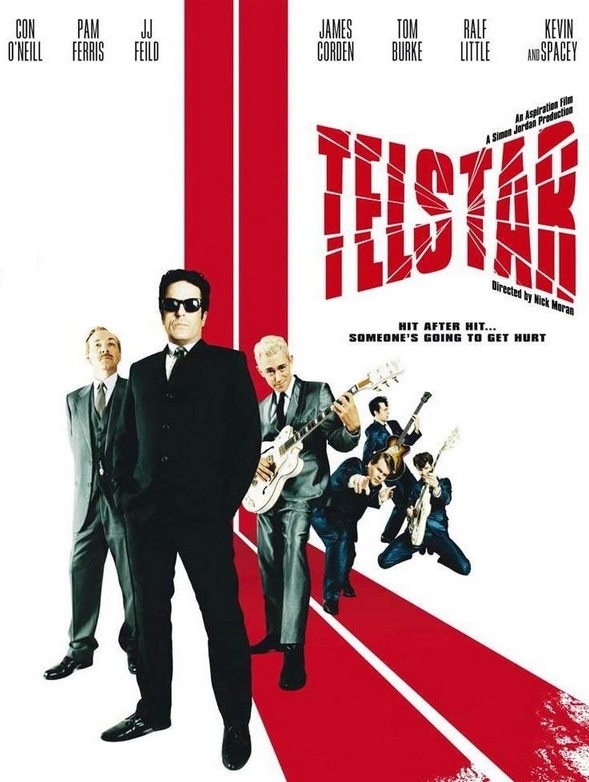
As with Clint Eastwood’s 2014 film adaptation of the 2005 Tony Award-winning Broadway musical Jersey Boys chronicling the career of Frankie Valli and the Four Seasons, I equally anticipated this rock bio concerned with British record producer Joe Meek. Sadly, as with Jersey Boys, I was left empty. Granted, the production designs of both films (as with Tom’s Hanks’s love letter to ’60s one-hit wonder pop-rock ditties, That Thing You Do!) are fantastic. However, the films underneath the period accurate sets and costumes are derivative raison d’être—despite their quality, one viewing is enough. And, for U.S. audiences, the thick British accents and harsh, Royal Shakespearean moments of actor-emoting can be a bit much to handle. Yes, this is purely meant for U.K. audiences, you yank rocker.
Joe Meek was an electronics-tinkering child prodigy who developed such sound engineering innovations as multi-tracking, overdubbing, sampling and reverb (with addition kudos to guitar and recording innovator Les Paul), and was the original trailblazer in viewing the recording studio itself as “a music instrument”—an instrument Meek skillfully mastered, regardless of his being tone deaf and lacking any playing or composition skills, into “Telstar,” the 1962 worldwide #1 instrumental hit by his assembled studio band, the Tornados.
Sadly, Meek was a tortured genius who suffered from bouts of depression and paranoia that led to fits of rage fueled by his closeted homosexuality (a punishable crime in the U.K. at the time) and his addiction to amphetamines and barbiturates (to fuel his maniacal quest for perfection). As result—even with the financial backing of ex-military officer and business entrepreneur Major Wilfred Alonzo Banks (Kevin Spacey nailing the demeanor and accent of an acidic, cultured British gentleman; but opinions on his performance vary)—Meek was never able to get out of his electrical hodgepodge of a studio on a cramped, second floor flat over a luggage store (and yes, he utilized the loo for recordings).
So acidic his personality, no labels, producers, or managers of note wanted to work with him; Meek was forced out of his business concerns with the U.K.’s pre-Beatles superstar, Billy Fury, (that the Tornados backed; by 1964, it was over for both artists); when Meek received offers to record bands from the likes of the burgeoning manager Brian Epstein, Meek dismissed the Beatles as “awful”; when fan Phil Spector reached out to work with him, Meek accused the “Wall of Sound” creator of plagiarism; Meek also turned away David Bowie and Rod Stewart (and told Rod’s then band, the Moontrekkers, to fire him); he also gave up developing a career for a Welsh lad by the name of Tom Jones—who soon became a star (“It’s Unusual,” “What’s New Pussycat,” “She’s a Lady”) after leaving Meek’s stable.
Outside of his own ego and arrogance, why did Meek turn away those future superstars: for love—the bleach blonde bassist of the Tornados, Heinz (Burt), in particular, with whom he became obsessed in transforming him into a solo artist that would crush the likes Billy Fury and Gene Vincent (who Meek admired-despised).
Sadly, in the end, Meek crushed himself.
When a copyright infringement lawsuit over “Telstar” held up 3 million pounds in royalties and his business partnership with the Major soured as result, Meek was drowning in debt. And because of his arrest for a homosexual-public toilet encounter, he was under suspicion in the 1967 Tattingstone Suitcase Murder.
Meek snapped.
He murdered his rent-griping landlady and turned the shotgun (that he used to threaten musicians into submission in the studio) on himself at the age of 37.
And now for the music trivia: The Tornados backbeat was handled by the portly Clem Cattini (portrayed by U.K. comedian James Cordon; of those annoying, faux-German dubbed coffee machine commercials and his NBC-TV late night gab fest). When it comes to drummers, no other (studio) drummer has appeared on more #1 chart-topping singles (42 in all) . . . and he was almost a member of the New Yardbirds. During his Joe Meek days, Cattini shared the studio/stages with a young Ritchie Blackmore (later of Deep Purple), along with Jimmy Page and John Paul Jones who, at the time, were backing several Meek protégés (Screaming Lord Such in particular; a precursor to the likes of Alice Cooper). When the Yardbirds fell apart, with Page obligated to fulfill touring contracts, the first call he made to reform the band was to Cattini. Telling the story years later, he didn’t think much of the offer and failed to call Page back. He also turned down Paul McCartney’s request to join Wings. After he was sacked/quit the Tornados, Meek replaced Cattini in the studio with future Jimi Hendrix skinsmeister, Mitch Mitchell. Catttini published his memoirs, My Life, Through The Eye of A Tornado, in July 2019.
You can stream this as a VOD on Amazon Prime, Vudu, and You Tube Movies, but we found you a freebie rip on You Tube to enjoy. If you’d prefer a more straight ahead telling of Meek’s life, then check out British sound engineer Beth McGowan’s hour-long TV documentary, The Strange Story of Joe Meek (1991), on her You Tube page.
About the Author: You can learn more about the writings of R.D Francis on Facebook.He also writes forB&S About Movies.
Ah . . . the ’90s . . . the era of the cheesy erotic thrillers inspired by the likes of Lawrence Kasdan’s far superior Body Heat (1981). And for every Paul Verhoeven noir-giallo Basic Instinct (1992) blockbuster . . . there was the great Willem Dafoe struggling to salvage Madonna in Body of Evidence (1992) . . . then there’s David Caruso bombing hard with William Friedkin’s Jade (1995). And let’s not forget Joe Eszterhas and Paul Verhoeven’s abysmal reteaming with Showgirls (1995). (Did you know there were sequels to both, Basic Instinct and Showgirls? True story. Sadly.)
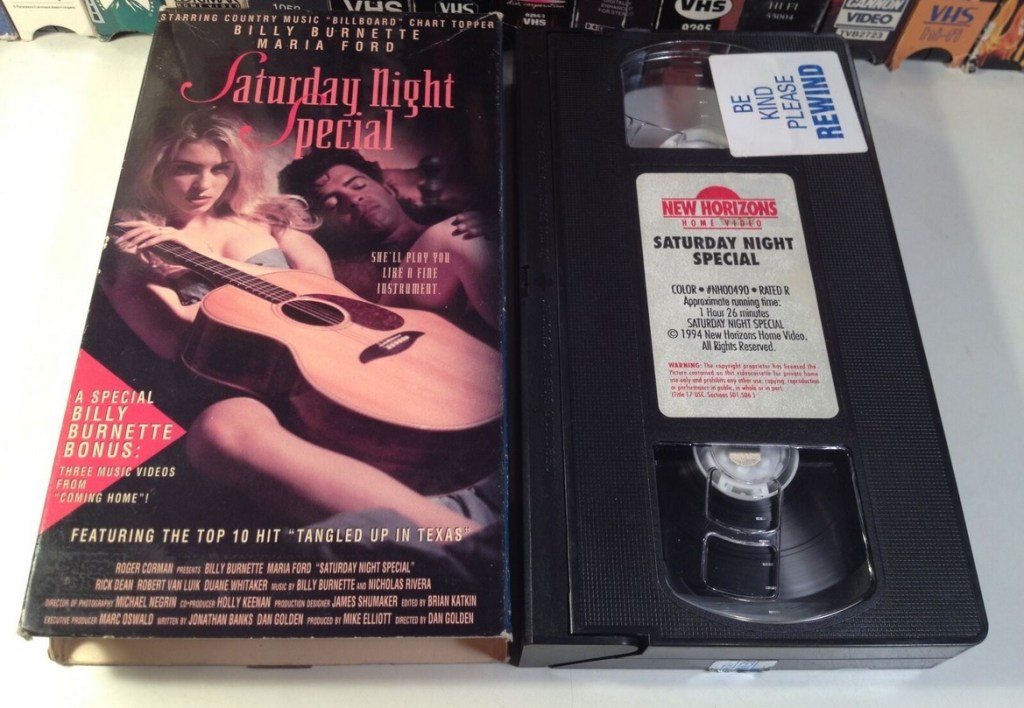
And then there’s Roger Corman’s take on the genre: Saturday Night Special.
Image courtesy of monsterlandmovies/eBay. Here’s the trailer.
And while Corman was never one to let a set or a special effects shot go to waste (see all of his ’80s Star Wars/Alien knock offs as examples*), he never let a script go to waste either. So he made the same movie . . . three times.
First, in 1991, the script was made as Kiss Me a Killer. If you’re a fan of Robert Beltran (Commander Chakotay on Star Trek: Voyager, Paul Bartel’s Eating Raoul, or 1984’s Night of the Comet), you’ll probably want to seek that one out concerning soft-core sexual hijinks in an L.A salsa club. Then Corman took the script and placed it into an Urban Cowboy-styled honky tonk as Saturday Night Special. Then, to capitalize on the media frenzy over Showgirls, he re-tweaked the script inside a Los Angeles strip club as 1996’s The Showgirl Murders. The upside to Saturday Night Special and The Showgirls Murders: both star Quentin Tarantino’s “favorite B actress,” Maria Ford. And of those two films, the one you want to watch is, you guess it, Saturday Night Special.
Yeah, but what does this all have to do with “Rock n’ Roll Week” at B&S About Movies? Well, this Corman noir stars country rocker Billy Burnette of Fleetwood Mac (formerly with Mick Fleeetwood’s side band, The Zoo; Burnette replaced Linsday Buckingham) in his acting debut . . . along with a cameo by Mick Fleetwood himself (remember when Mick showed up alongside Dweezil Zappa in The Running Man?).
Burnette is Travis, a ne’er-do-well drifter-cum-musician who gets a gig as the house musician at a local, dusty town honky tonky. And in typical film noir fashion, along comes Darlene (Maria Ford), the local femme fatale, who seduces Travis to kill her abusive, bar owner husband. Boobs, brawls, dead bodies, and to be honest, crappy country songs by Burnette, ensues. (Keep your eyes open for requisite low-budget screen heavy Duane Whitaker from Pulp Fiction, The Devil’s Rejects, Halloween II ’09 in an early role.)
In lieu of bogging this review with Billy Burnette career trivia, his Wikipedia page will give you all you need to know . . . and You Tube will give you all you need to hear. However, in short: Aerosmith fans know the music of Billy’s dad Dorsey and his Uncle Johnny from The Rock ‘n’ Roll Trio with their cover of “Train Kept-a Rollin’“; Billy had his own early ’80s new wave hit with a cover of his dad’s ’50s hit, “Honey Hush” (but you probably know that one better for its kick ass cover by Foghat). Oh, and Billy’s cousin, Rocky Burnette (son of Johnny), had his own 1980 U.S Top 10 hit with “Tired of Toein’ The Line.”
Anyway, back to the movie . . . we all know how the uploads come and go on You Tube. So we’re giving you three links to choose from to watch Saturday Night Special HERE, HERE, and HERE. Sadly, there are no VHS rips of Kiss Me a Killer or The Showgirl Murders online, but we found the trailers for each of them HERE and HERE.
One’s enjoyment of this movie hinges on your knowledge of and enjoyment of the music of Britain’s Status Quo, along with your retroism for the Beatles’ movies A Hard Day’s Night or, more accurately, Help! — you know, the one where the band’s on the run (sorry) when Ringo becomes of the target of a religious cult that covets his gaudy ruby ring.
With that being said, this movie isn’t intended for U.S. audiences who came to know the boogie-rock purveyors for their 1968 psychedelic-influenced hit “Pictures of Matchstick Men“; this movie is meant for the U.K. audiences — an audience that helped Status Quo outrank the Beatles, the Rolling Stones, and Queen by placing 61 of the band’s singles in the U.K. Top 40, with 22 of those singles reaching the Top 10 — more than any other U.K. band.
AKA, Guitars, Guns and Paradise
So, in commemoration of their upcoming 30th studio album, Bela Quo!, the band shot this movie in four weeks on a three million dollar shoestring while on vacation in Fiji — along with a corresponding double soundtrack album.
The story is a simple one: Francis Rossi and Rick Parfitt of Status Quo, playing themselves, while on tour with Status Quo on the Pacific Island country of Fiji, become involved in mafia intrique after witnessing a murder. The fact that SNL’s Jon Lovitz (of the later Almost Sharkproof) serves as Rossi and Parfitt’s co-star tells you this film wears its self-deprecating humor on its sleeves — and Rossi and Parfitt play the “aging rock stars” quite well.
Also known as Guitars, Guns and Paradise in other overseas markets (the band has a rabid fan base throughout Europe, Australia and the Pacific Rim counties), the Quo’s lone film isn’t a blockbuster and it’s certainly not an Oscar winner. But it’s a fun film with plenty of action, comedy, and great music by the kings of boogie rock (honorable mentions to Savoy Brown and Foghat, of course).
If you get a chance, do check out a few of my personal .mp3 player favorites from their early ’70’s catalog, such as “Caroline,” “Down Down,” “Down the Dust Pipe,” and “Paper Plane.” Yeah, when it came to down n’ dirty jeans n’ t-shirt (and leather vests) rock ‘n’ roll, Status Quo was the shite and a bag ‘o chips. You can get all the Status Quo you need, and more, over at their official You Tube page.
Now, if only Uriah Heep would make a movie . . . or how’s about Phil Mogg and UFO thwarting a Bond-like madman from stealing a cache of missiles to start WWIII (hey, it worked for Cliff Richard and the Shadows)?
The Quo’s 100th single release!
You have a couple of online choices to watch. Overseas readers can watch Bula Quo! on Rakuten TV. In the U.S. you can watch it on Amazon Prime and in the U.K. on Amazon Prime U.K.
About the Author: You can learn more about the writings of R.D Francis on Facebook. He also writes for B&S About Movies.
Update: Dark Force Entertainment made a February 2022 announcement regarding the Blu-ray reissue of this lost, Mark L. Lester film. You can learn more with their official Facebook post.
And the stars align at B&S Movies once again . . . courtesy of our proprietor, Sam, coming up with the idea of back-to-back “Mark L. Lester” and “Rock ‘n’ Roll”* tribute weeks. So this direct-to-video/streaming outing from the “director of Commando” . . . and our beloved redneck romps Steel Arena, Truck Stop Women, Bobbie Jo and the Outlaw . . . and Roller Boogie. . . and The Funhouse . . . and Class of 1984 . . . and 1999. . . and Firestarteris the prefect closing transition to our tribute week to all things Mark and our start of all things rock n’ punk! This time out, Lester only directs and leaves the writing to prolific SyFy and Lifetime Channel producer (Lester’s wife) Dana Dubovsky (Sand Sharks, Pterodactyl).
Taking its scripting cues from Great White’s tragic 2003 performance at The Station night club in Rhode Island** (which also served as fodder for “Blaze,” a 2003 “ripped from the headlines” episode of NBC-TV’s Law & Order: TOS that starred John Doe of X as “Teddy Connor,” the leader of the once great Wotan), Travis Bellamy (Hal Ozsan) and Dark Knights (think Buck Cherry’s “Lit Up” and “Crazy Bitch” colliding with Jet’s “Cold Hard Bitch“) love their pyrotechnics — and that love of the flame is what put them on top: Travis sets himself on fire amid a wall of sparks for the band’s encores. . . .
Oops. The club goes up in flames — and a 16-year-old (male) fan is trampled in the ensuing chaos.
Fast forward a year later: Dark Knights are cleared from any wrong doing and back on the road; but without the pyro-gimmicks, the ticket and albums sales are down and manager Eric Roberts (who produces; and is in this one a lot longer than most the films of his 500-plus resume) is urging Travis to “bring back the flames.”
. . . And in steps — instead of a Lifetime movie-inspired psycho babysitter or student or a long-lost “kidnapped” daughter or an orphaned niece infiltrating the family and tempting the emotionally flawed dad — an “innocent” groupie (Taryn Manning of Eminem’s 8 Mile and the Oscar nominated Cold Mountain) who begins to (bloodless and boringly) dispatch press agents, groupies, Eric Roberts (Lone Star Deception), and band members one by one.
Since this rock flick comes from the competent lens of Mark L. Lester, a man who’s blessed me with so many great films during my duplex-triplex theatre and video store youth, I really wanted to get lost in this horror-tinged murder mystery — in the same multiple-watches vein as Ash Avildsen’s intelligence rock n’ horror flick, American Satan (2017). And while Groupie isn’t utterly awful, this probably was going for the feel of Mark Wahlberg’s major studio rock romp, Rock Star (2001), as a slasher flick (with a crazy Jennifer Aniston performance), but it ends up being undone by its against-the-budget set and production design that leaves it meandering one step above a TV movie. (And if not for Lester and Roberts on the marquee — others have name-checked Taryn Manning — I wouldn’t have hit the big red streaming button at all.) I was hoping for some supernatural hocus pocus; e.g., the dead male fan returns as a female for revenge, ala The Wraith. Denied. We got a Hand that Rocks the Cradle twist instead.
Does Lester’s behind-the-camera’s eye and sense of tight pacing (this clocks in at a brisk 78-minutes) make for a more effectively-produced rock ‘n’ horror flick than say, Ferd and Beverly Sebastian’s Rocktober Blood (1984) — which, unlike Groupie, has no “second act” at all — absolutely. However, unlike Groupie, Rocktober Blood lends for repeat viewings because it gives us Billy Eye Harper in his face-painted and ghoul-masked glory, along with memorable, original tunes by Sorcery belted by Nigel Benjamin.
Perhaps if Groupie had the budgetary and creative confluence of American Satan and Rock Star — along with a few more boob shots, blood and, say, the retro-cum-modern rock sounds of Greta Van Fleet standing in for a Sammi Curr-styled rocker (Trick or Treat) fronting Dark Nights — we’d give Travis Bellamy some bow-to-the-alter-of Billy Eye worship. (Or even John Doe’s Teddy Connor and Wotan — who didn’t sing or play a note to achieve their faux band stardom.)
Oh, well. Another trailer embed bites the dust.
So while the film around him spins nothing we haven’t heard before from the rock n’ murder jukebox’s crackling speakers, Hal Ozsan (who you’ll recall in the early-2000’s final two seasons of Dawson’s Creek) shines (he’s the best part of the film) as trouble rocker Travis Bellamy — courtesy of his L.A. based band, Poets & Pornstars, providing the music for Dark Knights. You’ve probably seen Ozsan’s band live during their U.S opening slots for the revamped Alice In Chains (sans the late Layne Staley), the 21st century reinvigorated Bon Jovi, and modern rockers Muse. These days, Hal’s hung up his six strings to concentrate on his newly cast role as “Ryan Porter” on CBS-TV’s NCIS: New Orleans.
Groupie is readily available in the online marketplace as a DVD for your rock ‘n’ roll flick collection, but we found a free (with ads) copy over on Roku’s online streaming platform. There also a free (sign in) no-ads stream on Vudu and PPV streams on Amazon Prime, Google Play, and You Tube.
Attention Tayrn Manning fans: Ms. Manning stars in another indie rock flick with the always awesome Peter Fonda (the wise ex-rocker), along with Jason Ritter (the troubled rocker), and Lucas Haas (the intrepid journalist). A “road movie,” The Perfect Age of Rock ‘n’Roll(2010) travels the crossroads where the legends of the “27 Club” meets Eddie and the Cruisers — only with the dramatic arc and production quality of the rock flicks Almost Famous (based on the downfall of Humble Pie) and Still Crazy (based on the ’80s Animals reunion). Sorry, no freebies on this one, kids. You can check it out as a VOD on Amazon Prime (where it pulls 4 to 5 stars and a 91% approval), Apple iTunes, Google Play, Vudu, and You Tube Movies. (Never say never: we’ve since given the film a full review proper, so click that above link, wee rocker!)
Poets and Pornstars fans: Check out this playlist from their 2007 second album; you can learn more about their albums on Discogs.
* Don’t forget! July 19 to the 25 is “Rock ‘n’ Roll Week,” and we’ve got some great, deep obscurities to rock you all week long!
* Be sure to check out out review of the Providence, Rhode Island-shot rock-radio flick, A Matter of Degrees, which was part of last October’s Scarecrow Video’s “Psychotronic Challenge.”
About the Author: You can learn more about the writings of R.D Francis on Facebook.He also writes forB&S About Movies.
When making movies for the voracious appetite (sorry) of the streaming universe, it’s all about the Cormanesque approach: make ’em fast n’ make ’em cheap and always have a great pitch. In this case: replace the giant sand worms from Tremors (1990) with sharks. Oh, and the casting is important as well: so you book the daughters of Hulk Hogan and Greg Evigan, Brooke and Vanessa, to star alongside your ersatz-Kevin Bacon with the always likable Corin Nemec (who also starred in the Mark L. Lester-produced Dragon Wasps and Rise of the Dinosaurs; he was to also star in Poseidon Rex, but was injured-on set and replaced by the equally reliable Brian Krause).
Yep. Parker Lewis and Hulk Hogan’s kid.
Lester turned the director’s reins to the prolific Mark Atkins who, in his dual capacities as a cinematographer and director, has made every manner of mockbuster for Asylum Studios, along with an array of SyFy Channel potboilers title prefixed and suffixed with alien, android, dragon, Jurassic, and shark. Sitting in the co-producer’s chair alongside Mark L. Lester is Dana Dubvosky who’s produced most of the films in the Lester canons we’ve watched this week (and she’s written two of them: Stealing Candy and Groupie). Sand Sharks also serves as the producing debut for actor Eric Scott Woods (he’s the Sheriff Brody of these proceeding) who’s produced over eighty films for the Hallmark, Lifetime, and SyFy Channel shingles.
And how do the sharks end up swimming in the sand: cue the underwater earthquake that cracks open a deep ocean crater that unleashes a prehistoric predator. Add your faux-Amity Island with the sleep island community of White Sands, Corin Nemec as the spoil con-man son of the Mayor, mix with attractive spring breakers and generous helpings of CGI sharks (jumping out of the sand like dolphins on a blissful summer day, natch) and shake . . . and you’ve got yourself movie that, if not for Mark L. Lester’s name on the box, you’d probably pass it by. (If this was part of a weekly Drive-In Asylum Saturday Night watch party hosted by Bill Van Ryn, I shudder to think what “theme drink” co-host Sam Panico would cook up in the kitchen. I am sure banana liqueur, vodka, and boobie-shaped ice cube trays will be part of the “Sand Sharkamania Slice” recipe.)
But don’t pass this Cormanesque, 1950s sci-fi throwback: it’s a Mark L. Lester movie and there’s always fun to be had in a Mark L. Lester movie.
You’ve got two options to watch online: an ad-free rip on You Tube or an official with-ads upload on TubiTV.
Oh, and just so you know: Corin fully recovered from his boating accident on the Belize set of Poseidon Rex and currently has five films in various states of production. You can catch him on the recently released Lifetime Channel productions The Wrong Stepmother and The Wrong Stepfather. And yes, we watched them both because David DeCoteau directed them. And you know our love for Mark L. Lester is only matched by our love for David DeCoteau in these sticks of Allegheny County.
About the Author: You can learn more about the writings of R.D Francis on Facebook.He also writes forB&S About Movies.





 B&S About Movies
You must be logged in to post a comment.