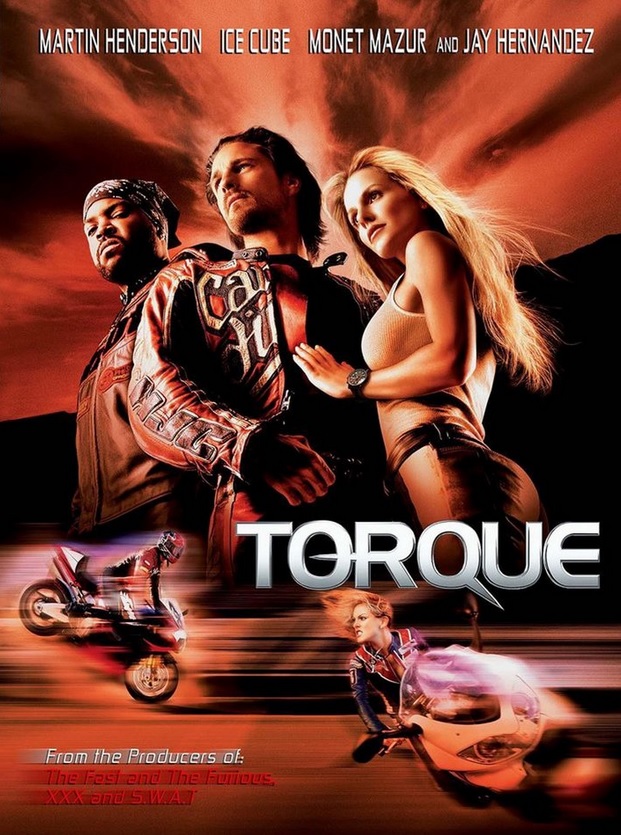
We gleaned over this biker flick as part of our “Exploring: The Clones of the Fast & the Furious” featurette during our first “Fast & Furious Week” back in August. And since John Doe shows up as tough-ass sheriff, we decided to bring it back with a review proper for our “John Doe Week.”
That’s right. If you have a hankering for a movie that stars one of the guys from N.W.A and one of the guys from the Los Angeles punk band X — then this is your movie.
That’s not your rods n’ cones, that’s the copy. The guys who made the Fast and the Furious, XXX, and S.W.A.T made this.
Now, if this Ice Cube-fronted two-wheeler sounds a lot like the Laurence Fishburne-fronted Biker Boyz, you’re probably right, as both films went into production at the same time. But the better known Ice Cube John Doe one was concocted by the production team of the Fast & Furious franchise. And Dreamworks wanted some of that Warners Bros. F&F stank on the screen, so they came up with their quickie mockbuster knockoff, got it? The trailer says it all, really.
So, is this The Fast and the Furious . . . only on motorcycles? Well, do you see any Torque sequels on your streaming service? No, you don’t. And that’s what happens when you get a $45 million box-office return on your $40 million investment: for Torque is one of those films where its performances, writing, and direction are slagged across the board . . . but everyone praises the stunts — so much so that it was nominated for several Taurus Awards.
Taking its cues from those juvenile delinquency films of the ‘50s and ’60s, the Sharks and the Jets the Hellions and the Reapers are illegal street racing-cum-biker gangs that compete on the two-lane blacktop and in the crystal meth business. And one of those members of makes the mistake of returning from Thailand to set things straight with his estranged girlfriend. Is any one woman worth it? Apparently so: for when she’s kidnapped for leverage, her ransom is the delivery of two bikes filled with crystal meth because, well, illegal racers always deal meth to finance their bike builds. Complicating problems is yet another gang member who wants our on-the-run biker wusspud from Thailand for the murder of his brother.
Damn right our favorite punk bassist steals his scene/courtesy of backgroundartist.tumblr.com.
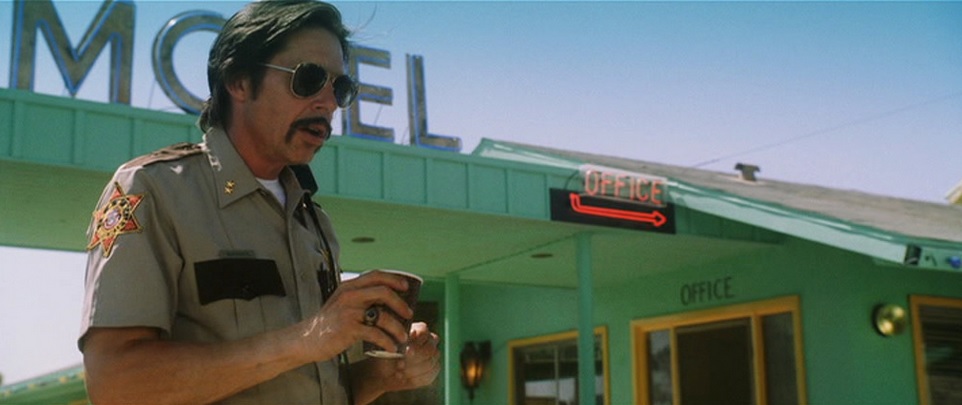
Along the way, Joe Doe shows up as the bad ass Sheriff Barner. Oh, and the always badass Dave Wyndorf and Monster Magnet appear in a club scene to perform “Monster of Light” from their sixth album Monolithic Baby! (2004) — which did nothing to place the song on Top 40 Active Rock charts. So, we’ll give Torque bonus points, not only for quenching our John Doe jonesin’, but for giving Wyndorf a line and letting him kick a little ass, and for ripping off George Romero’s Knightriderswith a sword-jousting scene that inspired us to watch Knightriders, again.
About the Author: You can learn more about the writings of R.D Francis on Facebook.He also writes for B&S About Movies.
Editor’s Desk: Upon the news of his medical hardships, we’ve seen an uptick in our reviews of Tom Sizemore films, which is no way for anyone to discover an actor’s films. Regrettably, Tom—whose credits included the major studio films Natural Born Killers, True Romance, and Black Hawk Down—has died at the age of 61 after having been been hospitalized in a coma for two weeks as result of a brain aneurysm brought on by a stroke.
If not mentioning Tom in passing another review, we’ve reviewed many of Tom’s films, which you can easily discover at B&S About Movies.
Tom Sizemore November 29, 1961 —March 3, 2023
A Little History of Grunge . . .
By 1988, underground “college rock” bands began to bubble under the mainstream and crossed over onto mainstream AOR stations still waste deep in the likes of the hair metal bands Winger, Slaughter, and Poison. And while the audio nimrods didn’t play the newly “major label signed” Husker Du (to Warner Bros.) and The Replacements (Sire), and gave record-industry guru David Geffen of Asylum Records (home of classic rock mainstays, the Eagles) the snub when his new label, DGC, signed New York noise-merchants, Sonic Youth, those spandex bastions did begin to “experiment” with the “more commercial” likes of the Cure, Jane’s Addiction, and Love and Rockets. Yeah, they spun Alice in Chains, but were still not quite ready to pluck Soundgarden from Seattledom.
Then, slowly, while those stations still bowed to the dynasties built by Led Zeppelin and Hendrix, you began to hear less Winger and more of the “false grunge” of Candlebox, Pearl Jam and Stone Temple Pilots, and (B&S Movies’ proprietor Sam’s favorite bands) Creed and Bush. Then, instead of Slaughter ad nauseam, you heard a little trio out of Seattle ad nauseam—and overnight America became a nation of coffee houses with hep-baristas adorned in $50 JC Penny designer flannel shirts and $150 Macy’s faux Doc Martins.
1991: The Year Punk Broke, indeed. Flux Capacitor me to 1985, Doc Brown. I need to be sedated, Joey.
Image created by R.D Francis.
A DJ’s Journey . . .
I started my radio career in the early breakers of the Seattle new-wave, working at a small, technically inept, stodgy and dying non-commercial FM that somehow, we, the staffers, convinced our clueless “L7” bosses to give an all-“alternative” format a try and dare rock ‘n’ roll lovers—not interested in blues babbling, folk hootenannies, jazz noodling, plunked banjos, and book reviews—to tune into our audio graveyard left of the dial. And it worked.
And thanks to an indifferent “voice of a generation” who blew his brains out a few years later, the two battling classic (ass-ic) rock stations in town became “rock alternative” outlets overnight and decided the alt-nation wanted to hear the (bane of my existence) Crash Test Dummies and Spin Doctors, and some chick named Torn Anus, I mean, Tori Amos, caterwauling like humping cats on a hot summer night about girls and corkflakes.
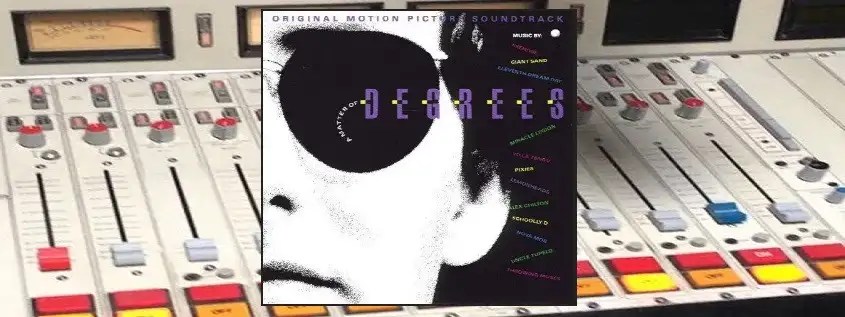
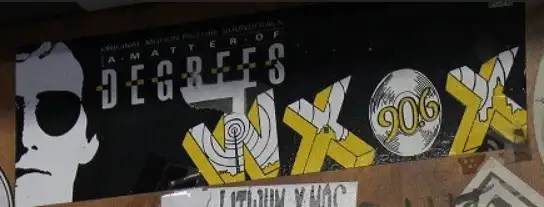
So, the tales of WXOX 90.6 Providence, Rhode Island, in the frames of A Matter of Degrees are near and dear to this DJ’s heart. The new film through 20th Century Fox’s specialty arm, Fox Lorber (Independent Magazinearticle), along with its accompanying soundtrack on Atlantic (the track-listing read like the playlist of one of my airshifts), was heavily promoted in all of the alt-rock mags of the day: Alternative Press, B-Side, CMJ, and Option (good reads!). It was probably even in the alt-section of the mainstream radio trades The Hard Report, FMQB, and Rockpool; it’s been so long, I can’t recall.
The staff of my radio station was stoked. The film was directed by W.T Morgan, who directed the alt-essential concert doc, X—The Unheard Music, and X’s John Doe was starring (later of the radio-connected The Red Right Hand). Fred Schneider and Kate Pierson from the B-52s had roles as DJs alongside Doe, and North Carolina’s hottest college-rock band, Fetchin’ Bones, who just got bumped up to Capitol Records, had a role.
And we were eventually crushed. What we thought was going to be a 1990 college rock radio version of the 1978 progressive rock radio chronicle FM—ended up being Friends: The College Campus Years. Then, we got alt-fucked again, by Cameron Crowe, with Friends: The First Year out of College, aka Singles (1993). Yeah, we got more “radio” with Airheads (1994)—but got more caterwauling cats in the “false grunge” screeches of 4 Non Blondes instead of Throwing Muses and the Breeders. At least Christian Slater’s alt-rock pirate in Pump Up the Volume (1990) cleaned out our Eustachian tubes. And I don’t need any Reality Bites (1994) from Lisa Loeb, either.
Well, at the time, courtesy of our Husker Du and Sonic Youth snobbishness, A Matter of Degrees seemed like a mainstream boondoggle produced by the same “suits” who decided to program songs about frolicking princes, chicks into cornflakes, and creepy, long-haired baritone Dean Martins humming stupid Canadian shite that was giving us A Flock of Seagulls when we wanted the Ramones. But as the VHS box patinas and the tape forecasts snow, I have come to love A Matter of Degrees—and its VHS and CD are a prized part of my collection because: it’s a time capsule that I wished never dissolved into the past.
A Matter of Degrees, written by Brown University alumni Jack Mason and Randall Poster, we come to find out, wasn’t about a radio station: the radio station served as a backdrop-linking device to a clever, ‘90s version The Graduate (1967), only with The Lemonheads (who ironically cut a cover of “Mrs. Robinson” for an early ‘90’s DVD reissue of the Dustin Hoffman hit) instead of Simon and Garfunkel backing the life-undecided, college campus hippiedom tales of Maxwell Glass (Ayre Gross; House II, Minority Report).
For Max, Providence, Rhode Island, isn’t a place: it’s a state of mind and that “mind” has been rattled by his being accepted into law school (he applied only to the hardest schools so he’d be rejected; he gets accepted to Columbia, the hardest of them all). Then he discovers his cherished campus radio station, which employs his friends Welles Dennard (the incredible Wendell Pierce; USA Network’s Suits, HBO’s The Wire, NBC’s Chicago P.D, Nicolas Cage’s It Could Happen to You) and Scuzz (the amazing-in-his-small-role Tom Gilroy; went onto work with R.E.M’s Michael Stipe and taught at Columbia University) is going to be torn down to make way for a research laboratory backed by a corporation that services the military. And when the station is rebuilt: the free-form format is out.
So, with an Abbie Hoffman-tenacity augmented with coursework titled “Interdisciplinary Approaches to Ethnicity,” Max is going to save the radio station—with arguments invoking the name of infamous ‘80s insider trader Ivan Boesky as a verb: Max speaks ill of the boyfriend of his feisty, Jerry and Elaine-styled best friend, Kate Blum (Judith Hoag; April O’Neill in Teenage Ninja Mutant Turtles, pick a U.S TV series), who runs the radio station: “[Roger] Ivan Boeskied it for them.” Not even their college-dropout/car mechanic roommate, Zeno Stefanos (Tom Sizemore, Zyzzyx Road), who has a propensity to lug car bumpers through the house and make sandwiches by slapping undiluted Campbell’s pea soup between two piece of white bread, can’t get Max off his disillusioned, high sparklehorse: “Remember, women and animals hold up two-thirds of the sky,” Zeno zens. (Now I had my share of Ramdan noodles and peanut butter sandwiches for dinner back in the day, but raw soup sandwiches? I’m glad I didn’t get accepted into Brown.)
“Hey, whatever happened to John Doe? I thought he was in the movie?”
Doe is Peter Downs, the founder of the station who “blew five years in San Francisco recycling the hits like a goddamned monkey” (been there, done that) and returned to his job as the program director of WXOX because, “this is paradise.” Oh, and Peter has a bitch-be-crazy girlfriend, Isabella Allen (Christina Haag), who has Max’s nose wide open. (See what I mean about the Friends-relationship dithering and not enough radio station? Get the Aniston out of here!) In the end, the station and sounds of “Peter Downs and WXOX 90.6 Providence” that Max man-love croons from a shark-toyed bubble bath to a toilet-perched Kate, serves as a plot-character linking device (just like Taj Mahal’s Dix Mayal on WKOK in Outside Ozona).
A Matter of Degrees is a case of “you had to be there.” If you never experienced college campus life and being enamored by the left-of-the-dial “hits” crackling over the airwaves of its tin-can station or a local non-com, you’ll have a lukewarm response to the film. The fun Mason and Poster-penned script reminds me of The Graduate; however, it won’t be in the same classic league as The Graduate when it bounces off your retinas. Your gray matter will populate it as a Singles rip-off—only this film came first. It is, in fact, the first Gen-X, well “grunge,” film in our $5.00 cup-of-coffee flannelled landscape (and you can visit with those films in our “Exploring: 50 Gen-X Grunge Films of the Alt-Rock ’90s” overview.).
Chalk it up to nostalgia fogging my sight; with eyes that see all of my friends from the grunge epoch as I flashback to my views from the glass booth (as I cracked open a new album called Bleach by some band called Nirvana) in the spot-on-miscreant Scuzz, the cucumber-cool Welles, and the rest of the WXOX satellites.
“Rock and roll can save you!” urges Peter Downs.
It did, Peter. More than you will ever know.
It smells like celluloid. Sounds like analog.
Where to get and how to hear the CD soundtrack and see the VHS movie:
While A Matter of Degrees tanked as a theatrical feature (the Sundance crowd shrugged), it blossomed on the international home video marketplace, carrying the titles of Louco Por Rock (Crazy for Rock, Brazil), A tutto rock (Too All, Rock Italy), and in Poland, Radio Maxa (Maximum Radio), or, more accurately, “Radio to the Max.”
As with most of the failed films in the pre-DVD era unceremoniously dumped to VHS, A Matter of Degrees has never been released on DVD—not officially nor as a grey market DVD-R—and there are no online VHS rips. There are no CD rips (of the non-vinyl) soundtrack, but you can listen to this re-creation of the soundtrack I patched together on You Tube. You can also see the soundtrack’s liner notes at Discogs. Multiple copies of the CD soundtrack, the even rarer cassette version, and the VHS can be found on numerous seller sites, eBay in particular. Not finding it won’t be a problem.
Caveat Emptor: John Doe’s incredible theme song for the film, “A Matter of Degrees,” which appears on his debut solo album, Meet Joe Doe (1990; DGC) and the promotional EP single, A Matter of Degrees, does not appear on the soundtrack, which is baffling, considering he’s one of the leads of the film. You can watch John Doe perform the single on the study-helper-for-the-late-night college crowd (good times): The Late Show with David Letterman (there is just something “off” seeing John Doe as a “traditional” lead singer clutching a mic-stand and not wearing a bass). Let the video play through to watch David Letterman’s 1983 clueless-awkward interview with X (really, Dave: alphabet jokes?) as they promote “Breathless,” the soundtrack single to the Richard Geer remake of Francois Truffaut’s film (1960) of the same name. X also covered the ‘60s hit “Wild Thing” for Major League (1989).
As with John Doe: Fetchin’ Bones are in the film—performing their MTV 120 Minutes hit, “Love Crushing,” for a “Save WXOX Benefit” (where John F. Kennedy, Jr. shows up and serenades a girl with an acoustic guitar)—but their song doesn’t appear on the soundtrack. Go figure. And the film is dedicated to D.Boon (backed by Doe’s title-cut song in the film only), the late guitarist-singer of the Minutemen. Why does the post-D.Boon outgrowth of the Minutemen, Firehose, appear on the CD soundtrack, and the Minutemen do not? Double go figure. And don’t bother (poi-dog) pondering how the B-52s got soundtrack skunked. Seriously, this film needed to pull a Dazed and Confused (1993) and release an “Even more . . .” Volume 2 to contain all the great “college rock” in the film. (Oh, hey Kris Erikson, Uncle Tupelo made it onto the soundtrack!)
You can also learn more about Randall Poster’s success as a music supervisor, the art behind movie soundtracks, and his longtime collaborations with director Wes Anderson (2014’s Grand Budapest Hotel) courtesy of these print interviews conducted by WIPO Radio, The AVClub and New Music Express. As it seems there will never be a DVD restoration replete with a commentary track, these interviews are the only way to gain insights on how A Matter of Degrees was and came to be made. (Jim Dunbar, who portrayed DJ Frank Dell, also amassed over 60 credits as a music supervisor, some in the company of Poster.)
In Poster’s post-1990 interview with the alternative music trade NME—New Music Express, he had this say on why he gave up on screenwriting and producing to work exclusively as a music supervisor on films (2012’s Skyfall, 2013’s The Wolf of Wall Street; he won a 2011 Grammy for “Best Compilation Soundtrack” for HBO’s Boardwalk Empire):
“I was always a big music lover, a record collector and an avid movie fan. I got through university studying English Literature, and I found myself without any professional direction. I wrote a screenplay with a friend of mine [Jack Mason] about a college radio station. We did a lot of new songs for it, and we did a record and I just felt that that was really what I wanted to focus on. I wanted to work with great directors, so I figured if I made music my focus, and that would enable me to do [work with great directors; like Wes Anderson].”
Poster also tells us that his college radio love letter was not only filmed in Providence: much of it was shot at Brown University. Poster and Mason were inspired by the college’s campus radio station, WBRU, changeover from a free-form to commercial format in 1985. They wrote the screenplay after graduation. It took them five years, but they got it made. And that’s awesome.
How beloved is A Matter of Degrees?
A post at the Radio Survivor blog, written by fellow AMOD fan, Jennifer Waits, proves this cherished time capsule of ‘80s college radio has fans that want, and need, a DVD release of the movie (hint to Kino Lorber!).
Then there’s new fans—of this almost 30 year old movie—like General Manager Sharon Scott of the streaming-community station Art x FM. When she put the new, low-powered community FM (LPFM) outlet in Louisville on the air, she was granted the WXOX-LP call letters. According to Sharon, she didn’t know about A Matter of Degrees or its fictional radio station until well after the station received the call letters. Then, she spotted the movie’s promotional sticker on the door at WRFL and was taken aback that it was the same call letters she had chosen.
It looks like Louisville has found its audio salvation! “WXOX Louisville can save you!”
You can learn more about the new WXOX and Sharon Scott’s fight to save WRVU-FM, Vanderbilt College’s radio station, after students lost access to its terrestrial signal. The Radio Survivor article also provides links to learn more about the history of Brown University’s WBRU.
Peter Downs was right: “Rock ‘n’ Roll Can Save You!” And don’t believe the hype the mainstream is selling.
Fool me once, trailer embed elves . . . you can watch the trailer for A Matter of Degrees on You Tube.
About the Author:You can read the music and film reviews of R.D Francis on Medium and learn more about his work on Facebook. He also writes for B&S Movies(the link populates a text-only listing of his reviews).
Image courtesy of photographer Allen J. Schaben for a May 2020 Los Angeles Times article by Randall Roberts/font overlay by PicFont.
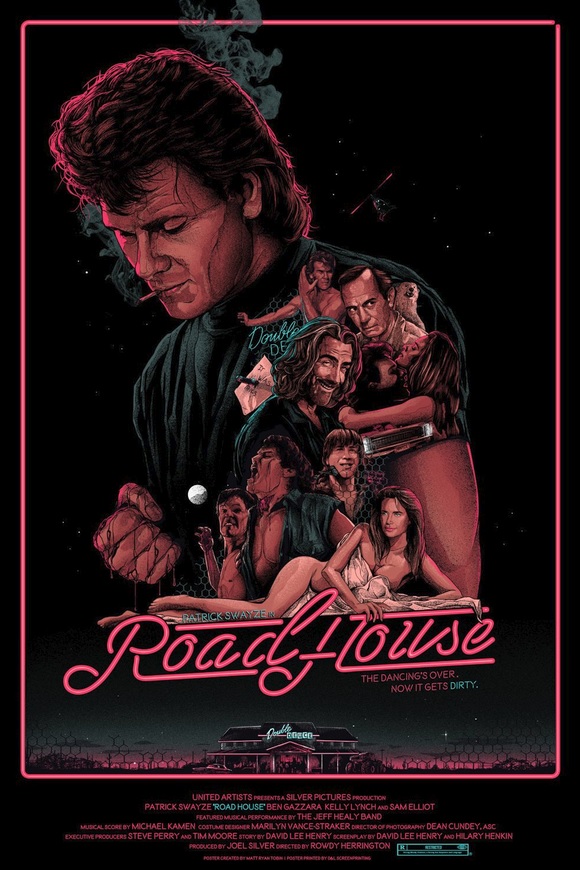
Variety hated it. Roger Ebert of the Chicago Sun-Times hated it. And it received five Golden Raspberry Awards nods for Worst Picture, Actor, Supporting Actor (Ben Gazzara? No, way, for he rocketh), Worst Director, and Worst Screenplay. Then John Wilson, the founder of the Golden Raspberries, listed it in his The Official Razzie Movie Guide as one of “The 100 Most Enjoyable Bad Movies Ever Made.”
Feldercarb, we say! For Pittsburgh born-and-bred director Rowdy Herrington* made this AND the Steel Town-set Striking Distance. And that’s the type of cinematic one-two punches we love ’round ‘ere in the B&S About Movies office cubicles, Big Hoss. Come on, now! A Doctor of Philosophy who travels the country as a bouncer kicking some town-psychopath ass and a Pittsburgh-bred, drunken river boat cop chasing down killers on the outskirts of Lawrenceville?
Seriously, what’s not to love here in this updated, glorified and horseless western (that takes place in Missouri, but was shot in California and Nevada)? And that’s what the mainstream critics who slagged Road House failed to see — and all of us lovers of all things “B-Movie” were able to see: Patrick Swayze’s Dalton is the new sheriff in a corrupt gold-mining town run by ex-Civil War hero-done-good, Brad Wesley. Only, this ain’t your granddad’s old n’ stuffy Cary Grant or Van Johnson western: this one’s modernized with a monster truck built specifically for the film**.
And Cary Grant or Van Johnson never delivered lines like this fan favorite:
Ah, but alas . . . for today, we came here not to bury Rowdy, but to praise John Doe, our favorite bassist from Los Angeles — this week of reviews is dedicated to him, after all — as the ne’er-do-well Pat McGurn, Brad Welsey’s favorite nephew with a weak constitution. As I look back on this film for “John Doe Week,” wow. Doe really shines in his role as Pat, whose loserville-status is what caused the whole dust-up between Sheriff Dalton and town “owner” Brad Wesley in the first place. Any other guy, after being fired — like myself, and Sam, B&S’s Chief Cook and Bottle Washer — would just find another job. But when you’re Pat McGurn: you run cryin’ to Uncle Brad who, in turn, gives you a couple of his guys to go kick some defenestration ass. Doc Clay, well, her stirrin’ up romance with the town’s new “bad boy,” that was just addin’ more tabasco to Brad’s breakfast Bloody Mary; lazy-ass Pat was the vodka, for you do not mess with the son of Brad’s only sister.
John, if you’re reading this: that’s sum mighty fine thepsin’, pardner!
About the Author: You can learn more about the writings of R.D Francis on Facebook.He also writes for B&S About Movies.
* Rowdy Herrington sat down with us for an extended interview back in November of last year. (Part 1, Part 2, Part 3, Part 4). He talks about Road House in the second part of the interview.
** In the movie, that truck, built in 1988 and known as Bigfoot 7, destroyed a new car showroom and crushed four new cars: a one-take shot that cost $500,000, a bill that could fund 10 of the low-budget flicks we normally review at B&S About Movies. And, yes, the truck did turn up again in Tango & Cash, another film that, like Road House, was slagged by critics across the board, but wow . . . we love that retro B-flick as well. The next time you’re in Kissimmee, Florida, for a Disney World romp, swing by Fun Spot America where Bigfoot 7 is currently displayed.
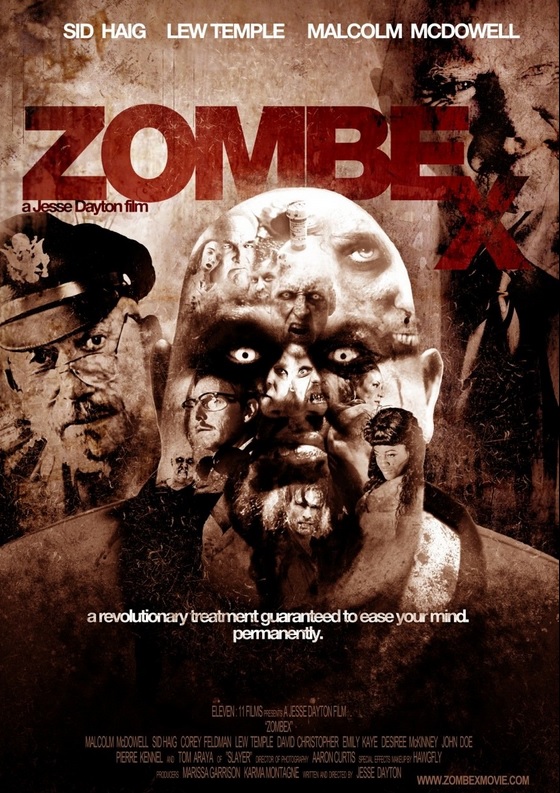
Look, we’re not going to sugar coat: the reviews on this one ain’t good. But when you have a film with a cast headlined by Malcolm McDowell and Sid Haig, with Corey Feldman along for the ride, and Slayer’s Tom Araya and X’s John Doe in tow, you cut generous amounts of CGI-slack for this, the writing and directing debut of musician Jesse Dayton. Dayton is a Texas musician best known for his soundtrack collaborations with Rob Zombie (Halloween II ’09 and The Haunted World of El Superbeasto).
How can you not want to at least try to watch a film with this cast—regardless of the fact that there’s no in-camera effects and all of the gun fire and headshots (to kill the zoms) are cheap CGI-boondoggles? Malcolm McDowell, as always, is good in his role and giving it his all, but we sure wish Zombex gave us more of him, Sid Haig, John Doe, and Tom Araya. Also stepping up to the plate is Lew Temple (the real star of these proceedings)—who we all know as Axl from The Walking Dead—as a conspiracy-spouting talk radio DJ out to expose the cover up.
Dayton gets bonus points for injecting a sense of reality into the undead tomfoolery with a zombie outbreak infecting a post-Karina Louisiana. Ol’ Mal is, of course, the greedy pharmaceutical boss distributing a new anti-stress drug that triggers the outbreak.
You can watch Zombex on Amazon Prime and Vudu as a VOD, but we found a free stream (without an account sign up) on Roku Online. The film’s Facebook page is still active, so you can check out stills from the film.
You can learn more about the life, career, and discography of Jesse Dayton at his official website. Fans of HBO’s True Blood also know Jesse for his songs “Coming Down” and “One of Them Days” appearing in the series. And I really dig Dayton’s countrified take on the Cars’ “Just Want I Needed,” complete with lap steels and mandolins. Give it a listen.
About the Author: You can learn more about the writings of R.D Francis on Facebook.He also writes for B&S About Movies.
Was it worth waiting a few years before finding a copy of this poorly-distributed VHS in a cut-out bin at an old Sound Warehouse?
Oh, yeah.
Fans of the cult film existentialism of Easy Rider, Vanishing Point, and Two-Lane Blacktop — or any art film that finds a reissue on the Criterion Collection — will enjoy this grim, black and white film noir homage (shot on Super 16mm) to the French new-wave films of old; to that end, the film employs a disjointed, non-linear narrative. Do you enjoy the films of Jim Jarmusch’s Stranger Than Paradise (1984), Down by Law (1986), and Mystery Train (1989)? Did you enjoy the later Clerks (1994) by Kevin Smith? Do the “mood pieces” of Italian filmmaker Michelangelo Antonioni — such as 1975’s The Passenger — appeal to you?
Then you’ll enjoy Border Radio — although this UCLA student film by Allison Anders and Kurt Voss (Down and Out with the Dolls) doesn’t possess the “slickness” of those films, as you can see from the trailer.
Border Radio is a noirish tale of three southern California punk rockers — two musicians and a roadie (Chris D. and John Doe) — who decided a club stiffed them on a gig, so they rob the club. Chris D. subsequently abandons his rock journalist wife and crosses the border into Mexico with his split of the caper, leaving her holding the bag in repaying the debt of their robbery; she sends John Doe into Mexico to find him.
The caveat of Border Radio: this is not a punk film.
U.S.-issued VHS by Michael Nesmith’s Pacific Arts Video courtesy of 112 Video/Paul Zamarelli of VHS Collector.com.
There are punk rockers cast in the film as actors, but the music and punk aesthetic is void from its frames. The film’s stars, Chris D. of the Flesh Eaters and the Divine Horsemen, and John Doe of X, do not perform any of their music in the film. At the time Allison Anders (1992’s Gas Food Lodging, 1999’s Sugar Town, 2001’s Things Behind the Sun) completed the four-years-shot film begun in 1983, L.A.’s punk scene — with the musicians she cast as actors — was over.
The Flesh Eaters disbanded and the Divine Horsemen (lead singer Julie Christensen stars in the film) were set to release their first recordings; Billy Zoom left X; Phil and Dave Alvin (Dave co-stars in the film) disbanded the Blasters, and Texacala Jones (who also appears in du-Beat-eo) split from Tex and the Horseheads. Green on Red (they appear on stage at the Hong Kong Cafe), who got their start on Slash Records with Gravity Talks (1983) and wrote the soundtrack for Anders’s Gas Food Lodging (1985), also folded up the tents after their three, pre-grunge albums for Mercury: The Killer Inside Me (1987), Here Come the Snakes (1988), and This Time Around (1989) failed to expand beyond college rock airplay and connect with the burgeoning, commercial alternative rock scene. The film’s theme song, “Border Radio,” is performed by The Tonys, aka L.A.’s the Dils, aka Rank n’ File, led by Chip and Tony Kinman; by the time of the film’s release, they formed the synth-based Blackbird project.
You can learn more about the out-of–print Enigma Records soundtrack — never released on compact disc — on Discogs.com. The film is not currently available on PPV and VOD platforms, but DVDs can be purchased direct from Criterion. Here’s the trailer and the full soundtrack to enjoy.
About the Author: You can learn more about the writings of R.D Francis on Facebook.He also writes for B&S About Movies.
John Doe made his first big screen appearances in the 1981 music documentaries The Decline of Western Civilization and Urgh! A Music War. While he made his big screen debut as an actor in Oliver Stone’s Salvador (1986; reviewed this week), he actually made his first foray into acting with Allison Anders’s Border Radio (1987), which began shooting in 1983. After scoring his first mainstream acting gig in Salvador, Doe found himself on another hot ticket, this time with much-ballyhooed Chinese director Wayne Wang.
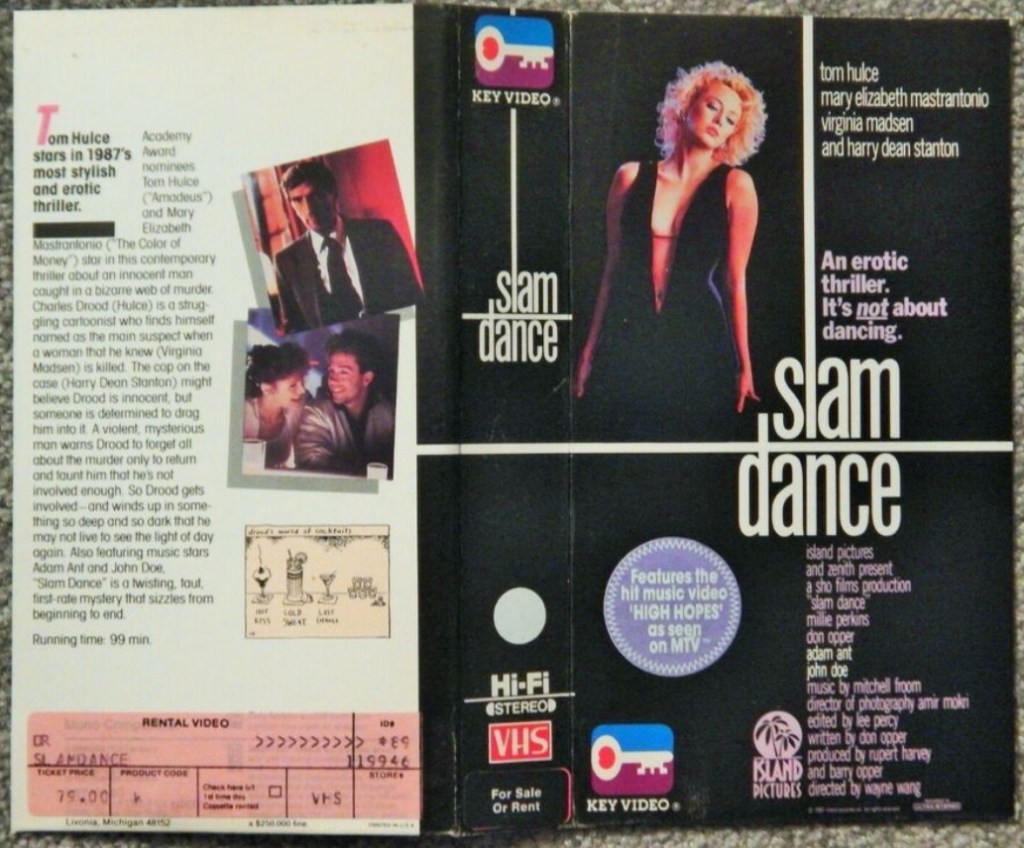
Ah, the VHS sleeve we remember/courtesy of rtsrarities/eBay via pinterest
Born in British Hong Kong and trained at California College of the Arts, Wang made his debut with the 1972-shot — for $16,000 — and released in 1975 gangster drama A Man, A Woman, and a Killer. The film was poorly reviewed and it wasn’t until his next film, Chan is Missing (1982), that Hollywood stood up and took notice; the film is recognized as the first Asian-American feature film to gain theatrical distribution and acclaim outside of the Asian marketplace place. Gene Siskel and Roger Ebert of PBS-TV’s Sneak Previews loved him. Courtesy of Wang’s choice to shoot in black & white to carry through the film’s mystery-noir narrative, he was hailed as the next “John Cassavetes.” Wang’s next feature, another Asian-centric narrative cast with Asian actors, Dim Sum: A Little Bit of Heart, repeated the box office and critical acclaim of Chan is Missing.
And, with that, Hollywood was ready for Wang to take on an American feature film. Island Pictures, a subsidiary of Island Music, fronted Wang the $4.5 million to shoot the Don Opper-penned (Android and City Limits; rewrites on Critters) film noir Slam Dance. The film was a critical and box office bomb that cleared less than a half million in American box office receipts. Wang himself was so displeased with the end product — which he blamed on producer interference — he tried to have his name removed from the film.
And since it was the first “mainstream movie” for both Opper and Wang, it killed off their mainstream hopes in Hollywood. Opper didn’t write another movie until the Hallmark Channel (!?) disaster film Supernova (2005), an Australian-produced feature film that starred Luke Perry, Peter Fonda, and Tia Carrere. While Wang directed three more indie, low-budget films, he returned to mainstream critical good graces with The Joy Luck Club (1993) and Miramax-distributed Smoke (1995).
Tom Hulce, who was never able to consolidate his Oscar tour de force in Amadeus (1984) into a leading-man career of distinction, stars as C.C. Drood. Drood is a married cartoonist involved noirish intrigue after his lover, Yolanda (a very hot Virginia Madsen), who makes her living as a call girl, is found murdered. In addition to having John Gilbert (John Doe), a corrupt cop looking to pin the murder on Drood, Yolanda’s lesbian lover, Bobby, has hired a hit man (Don Opper) to kill Drood. Of course, Gilbert and Bobby, were in on the murder all along. Another wrench in the noir works is new wave star Adam Ant as Drood’s agent. And the musician connections of the film carries through with keyboardist Mitchell Froom, who got his start with the bands Montrose and Gamma led by Ronnie Montrose, composing the film score.
As for the actor that led to us reviewing this film: John Doe followed up his smaller support role in Salvador with class and style; he should have made a much greater leap into feature films after turning in equally stellar (in larger roles) performances in the much-aired cable cult favorites of Road House (1989) and Great Balls of Fire (1989) (reviews for both this week!). Unfortunately, Doe’s next two films, Liquid Dreams and A Matter of Degrees (both 1991) failed at the box office. Doe fared better with his next work — going thes-for-thesp — as professional gambler Tommy “Behind-the-Deuce” O’Rourke in the Kevin Costner and Dennis Quaid-starring Wyatt Earp (1994; reviewed this week, look for it).
While it’s available as a rental on Vudu, we found a free-with-ads steam on TubiTV — denied! — it’s been pulled. But you can stream it over on Amazon Prime. Oh, and regardless of the pretense of Doe and Ant — and its title — this is not a “punk film.” You’ve been caveated. You can watch the trailer and opening seven minute from the VHS, via You Tube.
About the Author: You can learn more about the writings of R.D Francis on Facebook.He also writes for B&S About Movies.
Editor’s Desk: This is our first review in our week-long tribute to the acting career of John Doe from the Los Angeles punk band, X.
Before receiving wide-spread acclaim for the one-two punch of Platoon (1986) and Wall Street (1987), and after intriguing audience with his feature film debut Seizure (1974) and an adaptation of the novel The Lizard’s Tale, known as The Hand (1981) starring Sir Michael Caine, writer and director Oliver Stone arrived on A-List Hollywood’s doorstep with this, his third feature film. Sadly, while it received Oscar nods in the actor and screenplay categories for James Woods and Stone — and was loved by critics — it cleared less than $2 million in box office against its $5 million budget.
The film tells the story of an American photojournalist (Woods) who becomes involved with the left-wing liberation military during the Salvadorian Civil War that tore apart the Central American country from 1979 to 1992.
Also starring a great cast of Jim Belushi (as Wood’s out-of-work DJ friend), Micheal Murphy (as a U.S Ambassador), and John Savage (as a fellow, murdered photojournalist), John Doe lends his support as an American expatriate who owns a seedy bar.
While Doe made his acting debut in Border Radio, which was shot in 1983, it wasn’t released until 1987. So, outside of his uncredited, under-five bit-parts in Smithereens (1982; as a bouncer) and 3:15, the Moment of Truth (1986; as a club drunk), this Stone award-nominee served as John Doe’s big screen acting debut — a career that has since grown to a resume of 82 credits. We’ll soon see John in the lead of the indie-film noir D.O.A The Movie in 2021.
About the Author: You can learn more about the writings of R.D Francis on Facebook.He also writes for B&S About Movies.
Image courtesy of photographer Allen J. Schaben for the Los Angeles Times, May 2020/font overlay by PicFont.
Update, December 2022: Our thanks to Andrew Chen, this film’s writer and director, for contacting us to let us know that, as result of completing its festival run, you can now enjoy Ghost in the Gun on You Tube.
For you hard media and Blu-ray fans: Andrew Chen partnered with fellow filmmaker Thomas Crouser to bring Ghost in the Gun to Blu-ray alongside his feature film, Deadly Promises. You can learn more at the Ghost in the Gun Facebook page.
As a film critic fortunate enough to watch this film’s promotional festival screener, trust me: you will not be disappointed with this film. It’s perfect!
There’s nothing quite like a social media excursion into the realms of indie films and coming to discover an up-and-coming writer and director. To say this short is a great industry calling card is an understatement, as it’s won 83 film festival awards (IMDb list) across various disciplines.
And this homage that travels the dusty trails of the supernatural western that dates back to Sergio Leone’s “Dollars Trilogy” is certainly deserving — and it reminds us of the old west-meets-the supernatural majesty of Eyes of Fire (1983), a film so majestic, that we reviewed it, not once (for our “Movies Never Released to DVD” feature), but twice (for “Satan Week”). Can we plug our obsession with all things Amityville (see our “Exploring: Amityville” feature) as well, sure, why not? If you know that cinematic franchise of sequels, prequels, and sidequels, they’re usually stitched together via the possession of inanimate objects (clocks, lamps, toys, clown dolls, shiny trinkets, etc.).
Ghost in the Gun is Chen’s second writing effort that also serves as his directing debut: a supernatural journey of revenge concerned with a man left for dead. Upon discovering a possessed gun, he transforms into a gunslinger hellbent to revenge his wife’s murder — but unbeknownst to him, the “gun” has its own, hellbent agenda.
What makes this Twilight Zone-inspired tale work — besides Chen’s skills at the Final Draft and Canon Reds — is the fact that it stars ubiquitous TV actor Tim Russ (as the “Ghost in the Gun”); yes, Tuvok from the Star Trek-verse. But since this is B&S About Movies, we have to mention Tim’s work in Dead Silence, and for the younger, Nickelodeon crowd, you’ll remember him as Principal Franklin on iCarly. And you’ll recognize Ross Turner from the Netflix teen drama 13 Reasons Why, here as the dastardly Sheriff Hicks. The film’s under-the-radar lead, Darren Bridgett, a veteran of various shorts and indie productions (his most visible support role was in 2013’s critical and award-winning favorite Fruitvale Station), carries the film with the class of a major studio, A-List actor.
Ghost in the Gun isn’t just some film school short . . . where our auteur ends up with a career slingin’ hash at Chili’s, pardner: the quality here is of a major studio-level film (that reminds of Brando Benetton’s college thesis project, Nightfire). So you’ll be seeing bigger films and bigger roles from both Andrew Chen and Darren Bridgett.
From the Sci-Fi Nerds Department: If you’re a Lucas-head or a Trekkie, you’ve experienced writer-director Andrew Chen’s pen before, with his 2016 screenwriting debut, Where No Jedi Has Gone Before (that’d I love to see expanded into a feature), concerned with a die-hard Star Wars fan meeting his girlfriend’s Trekkie-obsessed parents.
And we’d love to see Ghost in the Gun as a feature-length film. Yes, it’s that good. You can learn more about the film and keep abreast of its eventual streaming release on its official Facebook and Twitter pages.
Oh, and by the way . . . we love our western spaghetti ’round these ‘ere parts of Allegheny County, pardner. So much so that we loaded up the pasta pots with a “Spaghetti Westerns Week” that ran this past Sunday, August 16 to Saturday, August 22 — and our “Drive-In Friday” tribute to the Spaghetti Westerns of Klaus Kinski will get you started.
Disclaimer: We did not receive a review request from the director or a P.R firm. We discovered this film on our own and requested a screener. And we truly enjoyed the film.
About the Author: You can learn more about the writings of R.D Francis on Facebook.He also writes for B&S About Movies (links to a text-only list of his reviews) and publish music reviews and short stories on Medium.
“This guy’s turning. You know that, right?” “Damn it, Vik, I was still drinking that.” — Jure to his sister Viktoria, after she cuts him off
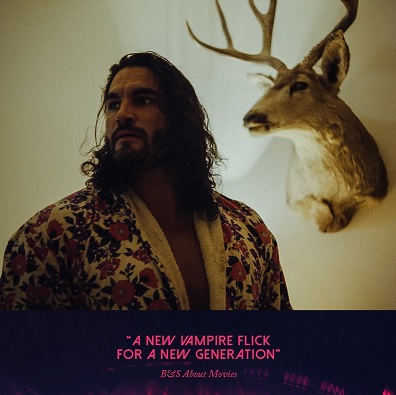
See. This isn’t another vampire movie. So drop that critical stake at the crypt’s threshold, Van Helsing. The caped debonair of Christopher Lee isn’t in there. And neither is the bad-boy dreaminess of Edward Cullen. Nor the anti-superhero backflipping antics of Blade. Or the Brat Packery of Near Dark. For this isn’t your grandfather’s Hammer atmosphere-over-gore vampire flick lurking in that web-strewn sarcophagus. And while it’s bloody, like your father’s CGI gore-over-atmosphere plasma soirées, this is a new vampire flick for a new generation. And this isn’t a horror film. This is a melancholy, neo-noir romantic thriller.
Blood from Stone is a new breed of undead chronicle: a philosophical vampire flick told from the perspective of the cursed ones who deal with the fact that they’re “living” forever. And that, in an ever-changing world, it’s become more difficult for them to exist in modern society. And as hard as they try, in spite of their soulless state, to love and be loved , they’ll never lead the ordinary, conventional lives of the mortals upon which they feed.
Faced with the hopelessness, the immortals in this flick do what mere mortals do in times of personal failures and emotional defeat: become empty vessels of drug and alcohol-induced self-destruction, seasoned with emotional and physical outbursts. And when you’re existing in a spiritual limbo, that self-destruction is even more deadly. Just like mortal junkies — even though you’re six-feet under and living above ground — your “life” also spirals out of control and takes you down, ever deeper: to rock bottom.
“Listen, it’s your choice. Destruction or creation. Vengeance or forgiveness.” — Viktoria giving Jure a heart-to-heart
So goes the lonely, emotionally-trapped existence of these existential, co-dependent and addiction-afflicted vampires that are never leaving Las Vegas. How sad is their existence? Darya (up-and-coming Hungarian actress Gabriella Toth), the vampire bride of Jure Alilovic (former Serbian MMA fighter Vanja Kapetanovic), hates who she is. The pain she suffers isn’t from her undead state — but the emotionally abusive relationship she endures at the hands of her reckless husband. It’s bad enough that he’s a vampire with a thirst for blood: he’s a vampire with an addiction to drugs and alcohol . . . and he satiates his dual-addiction by feeding on the chemically-altered blood of the drunk and the stoned. Mortals pass out amid empty bottles, dispensed needles, and the stench of bong water. Jure passes out amid blood-emptied bodies. His wealthy family, weary of his selfish co-dependence, threatens to cut him off.
In her quest for a life of normalcy, one of husbands and kids, Darya runs off to Sin City, gets a job in a Casino bar as “Nikko Dee,” and meets mortal men — with the hopes of a husband (which she finds in the arms of a surgeon at the hospital where she steals blood). She babysits for her co-workers and pines for her own children. And, as in any mortal obsessive-abusive relationship, Jure can’t let Darya go. And if he can’t have her, no one can. Now he’s on violent bender leaving a trail of dead bodies in his wake.
One may have a hard time with the thick, Eastern European accents of Vanja Kapetanovic and his co-star, Russian actress Nika Khitrova, who stars as his sister Viktoria. And your steaming-conditioning with most indie-horrors (of the sometimes direct-to-video variety) clocking in at the usual 80-minutes may be tried with this film’s almost-two hour run time. But those points aren’t deal breakers: Kapetanovic and Khitrova are very good here, as is Gabriella Toth (who speaks in non-accented English), and their accents lend to authenticity-acceptance in the central Euro-birthright of the characters.
“If I wasn’t in love with you, I would have killed you already.” — Nikko to Raymond, her surgeon-boyfriend
As I appreciated the against-the-low budget art design and cinematography of writer-director Geoff Ryan’s reimaging of the vampire myth, I recalled my appreciation of Blair Murphy’s indie-art house vamp romp Jugular Wine. That 1994 shot-on-video passion project, as with Ryan’s digitally-shot take on the genre, also aspired to create a tale that tore down the usual graveyard tropes and strip club clichés of most modern vampire flicks. The mileage of your own, modern vamp romp comparisons, however, may vary.
This isn’t the first time we’ve heard from writer-director Geoff Ryan. Blood from Stone is his third feature film. He made his debut with the war drama Fray (2014) and the online shopping-addiction comedy Haul Oh! (2016). Also a veteran of six shorts and seven film festival wins, he’s currently in production on his forth feature, the thriller-noir, Brother’s Keeper.
Disclaimer: We did not receive a review request for this film. We discovered the trailer on social media and requested a screener. And we truly enjoyed the film. Our thanks for the promotional images courtesy of Blood from Stone Facebook — many thanks for using quotes from our review for your campaign.
About the Author: You can learn more about the writings of R.D Francis on Facebook.He also writes for B&S About Moviesand publishes short stories and music reviews on Medium.
“Joe, why are you doing this?” — Christine’s enigmatic cries
In the year 1623, in his essay “Meditation 17,” English poet John Donne compared humans to countries and continents to God as an argument that man can not exist without a connection to each other and with God. No person ever suffers alone and, as we cope with our own pains and of others, we discover an inner strength that draws us closer to God. And a piece of God exists in each and everyone of us.
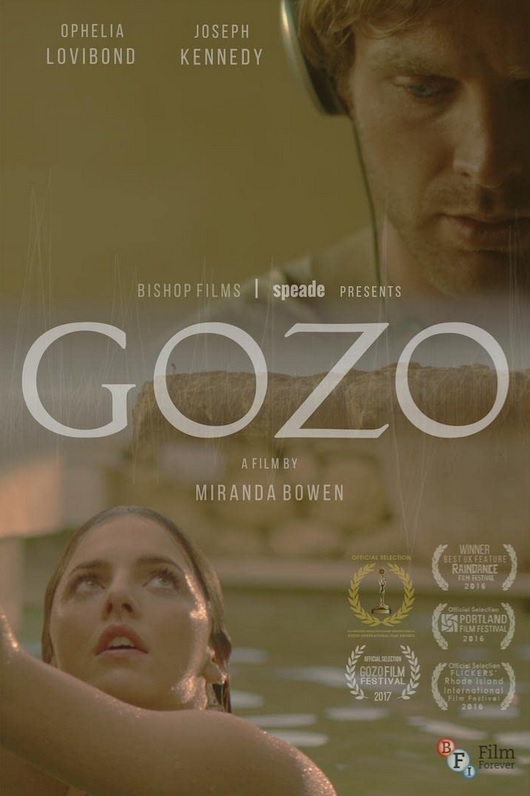
And on the Republic of Malta island of Gozo in the Mediterranean Sea, Joe (Joseph Kennedy, a British stage and TV vet; Sex & Drugs & Rock & Roll) and Lucille (Ophelia Lovibond, a 20-year vet of numerous British TV series; a co-starring role on CBS-TV’s Elementary) come to learn that you never disconnect yourself from past sufferings. You can runaway from the past, but the further you run, the more desperate your isolation becomes, for the “island” you seek is just an illusion. There is no escape. For no man is an island. As Glenn Fry warned us in his lyrical interpretation of John Fowles’s 1965 novel The Magus — itself set on Mediterranean Greek island — you can check out (from the mainland) anytime you like . . . but you can never leave.
For Londoners Joe and Lucille, their lazy-days dream is an old stone farm-house with a swimming pool and a breathtaking view. And while the real reason for their new island existence is Joe sweeping his past affair with Lucille, which lead to his ex-lover’s suicide, he’s convinced himself it’s for his job as a sound engineer, creating a catalog of the island’s unique environs for film soundtracks and commercial jingles. When a young tourist, a redhead resembling his dead ex-lover, Christine, goes missing, the island’s idyllic, open landscapes transform into a claustrophobic nightmare: Joe’s buried guilt and isolation manifests as a series of strange, recorded noises that descends him to a madness that Lucille must escape.
Now, while this sounds like a horror movie — filled with the (subtle) omnipresent hallucinations, spectres, and peripheral phantasms — this feature film writing and directing debut (based on an idea by Joseph Kennedy) by Miranda Bowen (BBC America’s Killing Eve), is anything but. For Gozo is an island where the Hitchcockian meets the Shakespearian; where Joe’s a doomed Prospero living a life of illusion — an illusion shattered by an Ariel that opens his eyes and ears to the tempest of his past.
And leave your A24 or Blumhouse expectations of the paranormal variety on the mainland.
About the Author: You can learn more about the writings of R.D Francis on Facebook.He also writes for B&S About Moviesand publishes short stories and music reviews on Medium.
Disclaimer: We did not receive a review request for this film. We discovered the trailer on social media, were intrigued by the film, and requested a screener. We truly enjoyed the film.






 B&S About Movies
You must be logged in to post a comment.