OVERLOOK FILM FESTIVAL 2025: The Spirit of Halloweentown (2024)

In 1998, the Disney Channel Original Movie Halloweentown was filmed in St. Helens, Oregon. Since then, it has seen 50,000 visitors every October, even 25 years later. Yet, just like the town in the series of Disney films—Halloweentown II: Kalabar’s RevengeHalloweentown High and Return to Halloweentown—the locals believe that there are real hauntings. And beyond that, like any small town, there’s plenty of gossip to listen to.

Directed by Bradford Thomason and Brett Whitcomb, this film feels like a real-life Waiting for Guffman. A zombie dance is choreographed by a girl who had to drop out of dance and wants to reconnect with her father. A newcomer to the town has bought a favorite restaurant, the Klondike Tavern, and his social media mistake causes his entire staff to mutiny. A woman claims to the town council that she is being attacked in her dreams and that the town is becoming possessed by demons. A team of paranormal investigators is also investigating the hauntings they claim are real.

This film never makes fun of its subjects, instead allowing them to tell their stories. I absolutely loved this and have been raving about it to everyone I can, as it’s a perfect non-spooky way to get yourself ready for the Halloween season. Here’s hoping it finds a streaming home soon so more people can enjoy this fun hangout in a town that has embraced its history as a spooky location.

The 2025 Overlook Film Festival takes place April 3 to 6. To learn more, click here.

APRIL MOVIE THON 4: I Know What You Did in English Class (2000)

April 5: Visual Vengeance Day — Write about a movie released by Visual Vengeance. Here’s a list to help you find a movie.

Directed and written by Les Sekely (Vampire Time Travelers), this is similar to that film and this quote that I used to describe that one is even more accurate: “This movie feels less like a narrative movie and more like someone made a Dark Brothers or Rinse Dream adult movie mainstream, giving it constant blasts of words and images…” If I say Party Doll-A-Go-Go and you get it, you’re a pervert, and we should be friends, and you’ll know exactly what kind of strange editing and barrage of sound effects and dumb jokes that entails.

Years ago, students destroyed the life of their teacher. Most of them got over it, but only one still feels some empathy and wonders what happened to her, perhaps because his girlfriend is also a teacher. Yes, you now get that this is not a rip-off of I Know What You Did Last Summerexcept for being close to the title.

I can see that as a movie that would anger many viewers, as it doesn’t even let up with being silly, even when it’s trying to be heartfelt. The sound effects, if anything, get louder and more repetitive, kind of like Max Headroom repeating himself. It was something in the way 90s and 00s movies could be edited and doesn’t seem to have survived until today. Yet here’s this film, rescued by Visual Vengeance, a little shot in Lakewood, OH effort about demons, classroom hijinks and the regret of growing up, mixed with male gaze rear-end shots and a Troma-like sensibility without nudity. I haven’t seen many movies like it, so you should try it at least.

You can watch this on Tubi.

GET SWAMPY WITH THE DIA DOUBLE FEATURE!

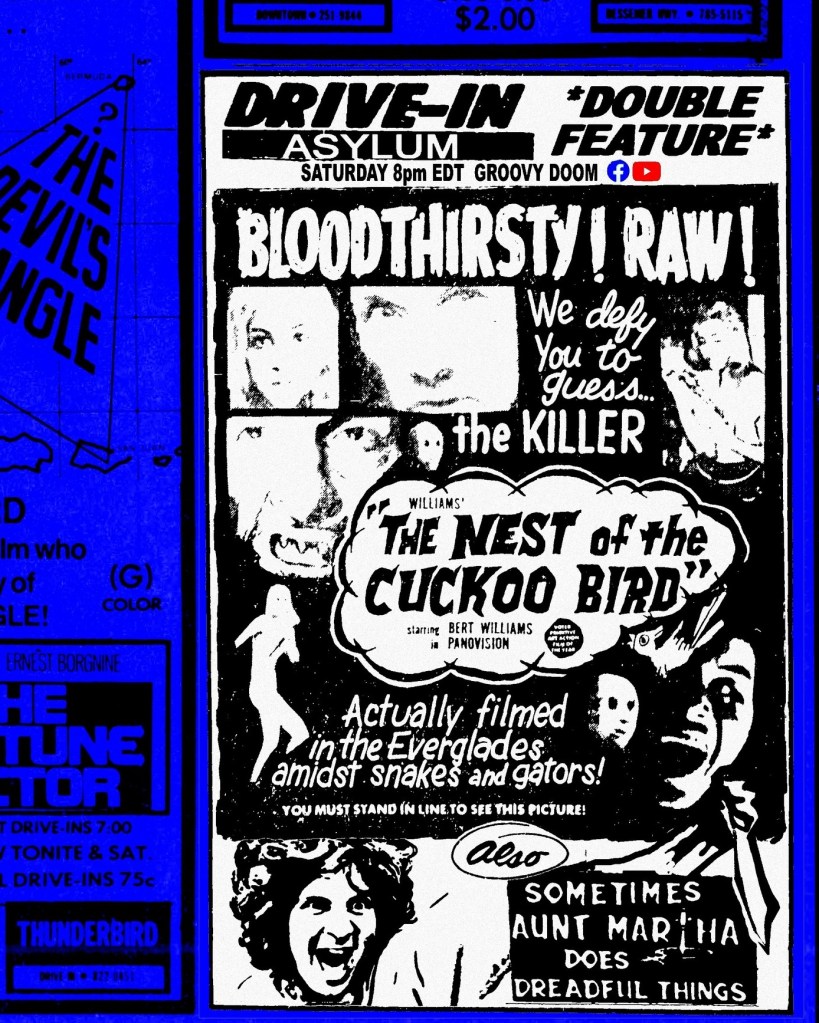
This Saturday at 8 PM EDT, we’re going deep into the swamps of Florida for two obscure yet wonderful movies. Brad Carter, author of several movie adaptations, will join us, including adaptions of Mardi Gras Massacre, Cruel JawsNight of the DemonRats Night of Terror and Hell of the Living Dead.

Join us on the Groovy Doom Facebook or YouTube channels.

Up first — The Nest of the Cuckoo Birds, a 1965 freak-out about liquor control board agents, swamps, showgirls, the Cuckoo Bird Inn, the Chapel of the Dead and so much more. You can find it at the Internet Archive.

Every show, we watch movies, discuss them, look at their ad campaigns, and also have two themed cocktails. Here’s the first recipe:

Cuckoo Birds

  • 2 oz. whiskey
  • 1 oz. cream de coconut
  • 3 oz. almond milk
  • 3 oz. pear juice
  • 1.5 tsp. turmeric powder
  1. Shake with ice in a cocktail shaker.
  2. Strain into a glass and enjoy.

Our second film may be even stranger. Maybe! It’s Sometimes Aunt Martha Does Dreadful Things, which you can find on Tubi. If you like it enough, you can buy it from AGFA!

Here’s the second recipe.

Orange Swamp Water

  • 2 oz. tequila
  • 2 oz. spiced rum
  • 1 oz. triple sec
  • 1 oz. Bailey’s Irish Cream
  • 4 oz. orange juice
  1. Build drink over ice in a large glass.
  2. Stir and get weird.

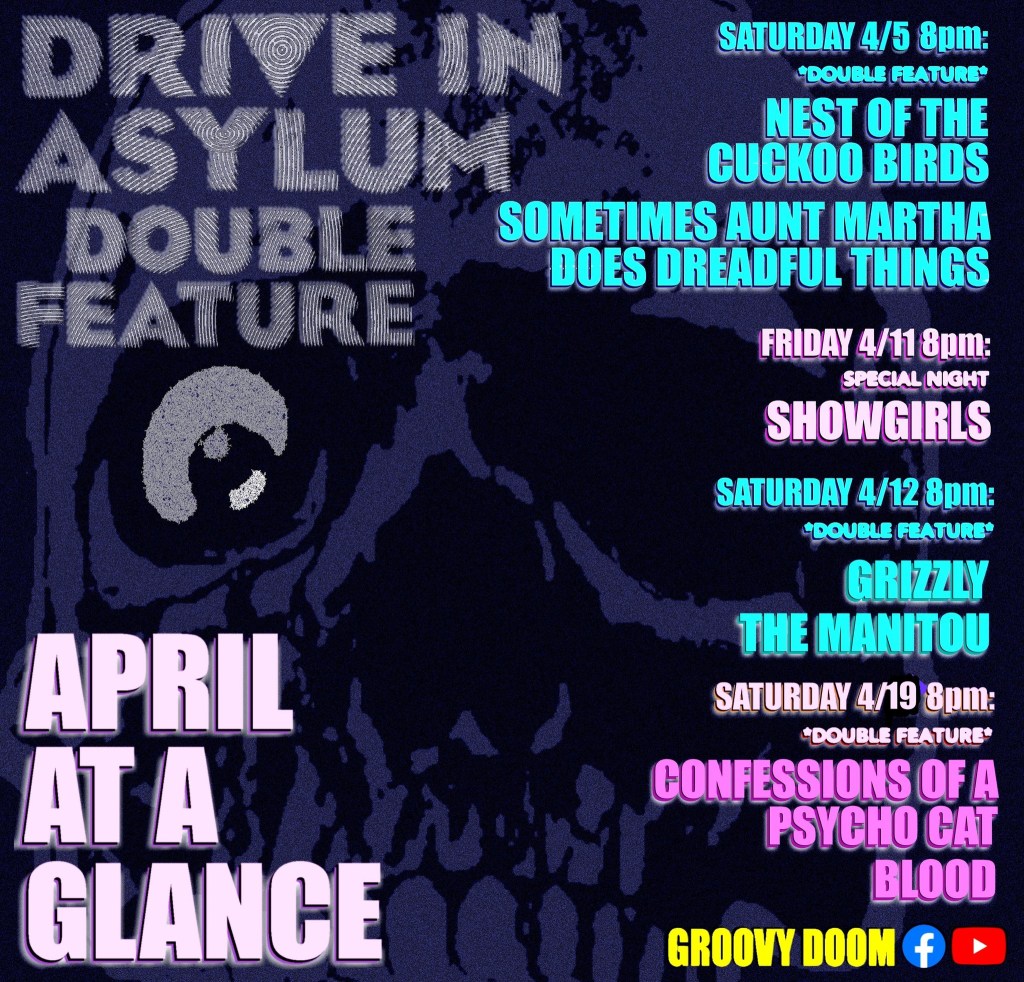
Here’s what’s playing for the rest of the month.

Want to know what we’ve shown before? Check out this list.

Have a request? Make it here.

Want to see one of the drink recipes from a past show? We have you covered.

B & S About Movies podcast Episode 77: Party Lines

Three movies that obsess me, from a time when we had no internet and had to use phones to connect and fall in lust — as well as a teen sex comedy that makes no sense — are on the show this week. Get ready to hear me go on and on about Lovelines, The Party Animal and Party Line.

You can listen to the show on Spotify.

The show is also available on Apple Podcasts, I Heart Radio, Amazon Podcasts, Podchaser and Google Podcasts.

Tales from the Crypt S6 E14: 99 and 44/100 Percent Pure Horror (1995)

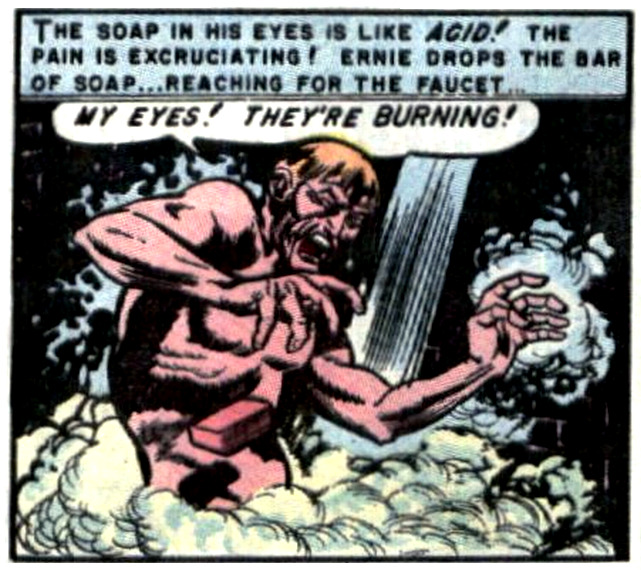
Luden Sandelton (Bruce Davison) makes soap for a living as the CEO of Dermasmooth. When the new campaign — created by his wife Willa (Cristi Conaway), who has also been cheating on him — fails, he has to fire her. That doesn’t go over well. Yet even after he’s killed, Luden has a way of coming back up the drain, so to speak.

“Greetings hack and field fans! I hope you’re in the mood for a little fiendly competition. It’s that time of fear again. The annual All Crypt Die Cathalon! I’ve been working out like crazy to get ready. This year I’m really going for the cold. Kind of like the woman in tonight’s tale. It’s a putrid portrait of an up-and-coming young artist that’s sure to leave a nasty taste on your palette. I call it “99 & 44/100% Pure Horror.””

The title for this one comes from the old Ivory Soap advertising slogan that their soap is 99 and 44/100 percent pure. In the 70s, Marilyn Chambers — before acting in Beyond the Green Door — was a model on a box of this soap, which was quite ironic once she became famous.

This was directed and written by Rodman Flenderm, who also made The UnbornLeprechaun 2 and Idle Hands. He also directed “Food for Thought” in season 5.

This episode is based on “99 44/100% Pure Horror!” from Vault of Horror #23. It was written by Al Feldstein and William Gaines and drawn by Jack Davis. In that story, a man kills his boss and takes over his job. He hides the body in the soap itself, which ends up causing his demise.

APRIL MOVIE THON 4: The Vanishing of S.S. Willie (2024)

April 4: World Rat Day — Celebrate this holiday by writing about a movie with a rat in it.

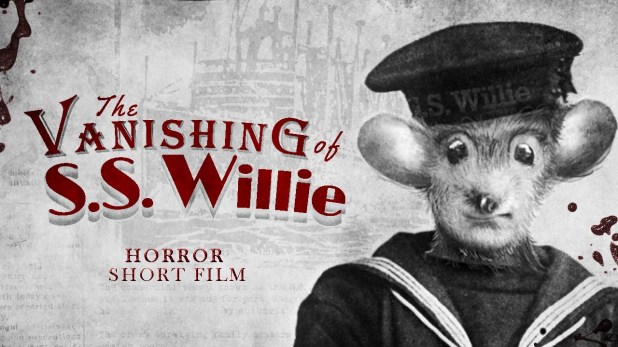
Directed and written by Nick Lives, this was the first of the many Steamboat Willie cash-ins after it went into the public domain. However, it’s way better than others like Mouse of Horrors and The Mouse Trap.

Instead of a slasher, this is a found-footage film, a lost 1928 documentary about the disappearance of the S.S. Willie in 1909. The claim is that all prints of this film were lost in a fire, but a man named Ben Collin is looking into what happened to the entire crew, who are unnamed but are anthropomorphic animals. The Cabin Boy was trying to make one last voyage and planning on being married. When the wreck of the ship is found, The Captain seems to have killed himself and The First Mate and Deckhands have all been transformed into skeletal instruments. The Cabin Boy and The Chambermaid were never found.

This has a creepy look to it, and unlike the inspiration, Pete isn’t the villain. Mickey—The Cabin Boy—and Minnie—The Chambermaid—are. The vacant stare of the mouse is just plain scary.

I get it — this is a mouse and not a rat. But how many times can I write about Rats: The Night of Terror?

This is one of the few Mickey projects with some originality and isn’t just using the character’s look to make a cheap horror movie.

You can watch this on YouTube.

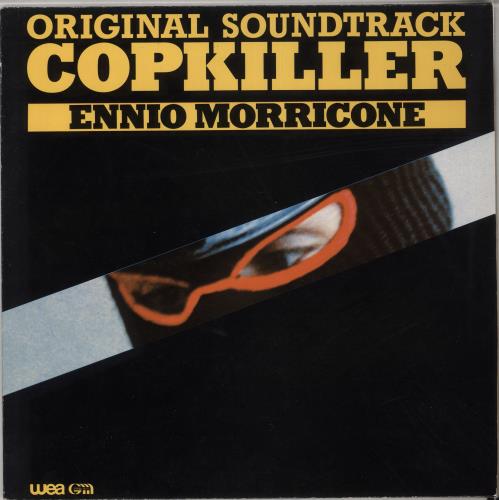
APRIL MOVIE THON 4: Copkiller (1983)

April 3: National Film Score Day — Write about a movie that has a great score.

L’assassino dei poliziotti is also known as Copkiller, Corrupt, Bad Cop Chronicles #2: Corrupt, Corrupt Lieutenant and The Order of Death. After making movies about the Italian Communist Party, director Roberto Faenza was considered so politically incorrect that he had to go outside Italy to find funding for movies like this one.

Filmed in New York City and at Cinecittà Studios in Rome, this film stars Harvey Keitel as corrupt cop Lt. Fred O’Connor and former Sex Pistol John Lydon as the criminal that obsesses him.

O’Connor has been making money off drugs with Sgt. Bob Carvo (Leonard Mann, Vengeance Is a Dish Best Served Cold), which they invest in a Park Avenue apartment. However, Carvo wants out, as his wife—and O’Connor’s ex-girlfriend—Lenore (Nicole Garcia)—suspects rightly that he’s on the take.

Then, O’Connor meets Fred Mason (Lydon), who is really Leo Smith. He keeps claiming that he’s the Copkiller, a man who has been murdering police officers. When O’Connor catches him in his apartment, he ties him up. He keeps him captive, even going to interview his wealthy grandmother, Margaret (Sylvia Sidney), who tells him that after the death of his parents, he swore off their wealth and compulsively confesses to crimes that he didn’t commit.

This film plays with who the guilty person is—either the seemingly mentally ill Smith or the manipulative O’Connor—before flipping the script right before the dark ending.

So much of who Lydon is in this movie is, well, post-Sex Pistols Lydon, given to rants. The song “The Order of Death” from the Public Image Ltd. album This Is What You Want… This Is What You Get refers to the film, with the line “This is what you want… This is what you get” coming from the Hugh Fleetwood novel Order of Death that this movie is based on. As for Keitel, he’s essaying an early version of his character from Bad Lieutenant.

Backing it all up is a solid score by Ennio Morricone, whose career of more than four hundred films goes from classy fare like Days of Heaven and Cinema Paradiso to scumtastic stuff such as Hitch-HikeLast Stop on the Night Train and What Have You Done With Solange?

You could also view this — instead of as a cop movie — as a film where two male closer than friends break up because of a woman, only for the jilted one to keep a young man captive and engaging in a BDSM relationship with him. That said, Keitel is, as always, great, and I wish Lydon was in more than just this one movie (and not just because the other film he had planned to act in was to be directed by Russ Meyer). He’s excellent in this.

You can watch this on YouTube.

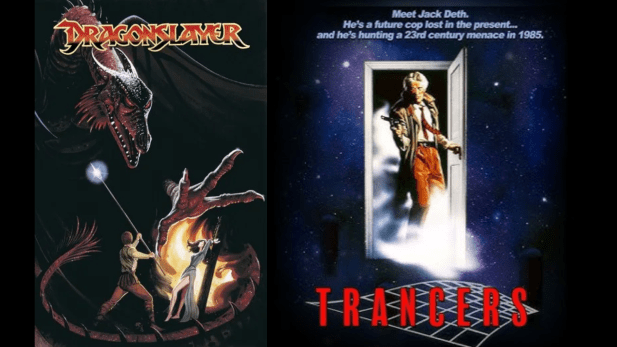
APRIL MOVIE THON 4: Dragonslayer (1981) and Trancers (1984): Two Great Film Scores but Only One in Service of Its Film

April 3: National Film Score Day- Write about a movie that has a great score.

ABOUT THE AUTHOR: Exploitation-film historian A.C. Nicholas, who has a sketchy background and hails from parts unknown in Western Pennsylvania, was once a drive-in theater projectionist and disk jockey. In addition to being a writer, editor, podcaster, and voice-over artist, he’s a regular guest co-host on the streaming Drive-In Asylum Double Feature and has been a guest on the Making Tarantino podcast. He also contributes to the Drive-In Asylum fanzine. His essay, “Of Punks and Stains and Student Films: A Tribute to Night Flight, the 80s Late-Night Cult Sensation,” appeared in Drive-In Asylum #26.

Dragonslayer (1981) and Trancers (1984): Two Great Film Scores but Only One in Service of Its Film

The mating of visuals to music can be transcendent. Think of how many movies, even stone-cold masterpieces, wouldn’t be as effective without their iconic scores by musical geniuses such as Max Steiner, Erich Korngold, Bernard Herrmann, John Williams, Miklos Rozsa, Henry Mancini, John Barry, Jerry Goldsmith, Vangelis, Danny Elfman, and, of course, the greatest film composer of all time, Ennio Morricone.* And we can’t forget groups who did scores, like Goblin, Tangerine Dream, The Beatles, Pink Floyd, The Who, Nine Inch Nails, and Queen. Music has always been a part of movies even in the silent era. 

A great score can elevate a movie or hurt it. My fundamental maxim for judging the effectiveness of a score is whether I’m paying more attention to the score than the film itself. During my prime theater-going days, I went to see Dragonslayer, a now-forgotten film from 1981, a year packed with classics like Raiders of the Lost Ark, The Empire Strikes Back, Superman II, Altered States, Flash Gordon,** The Evil Dead, An American Werewolf in London, The Howling, Ms. 45, and Possession. I’d read in reviews before buying my ticket that the score by legendary composer Alex North was exceptional. My expectations were high.

So there I sat on opening day in a Philadelphia grindhouse—not one of the scarier ones—enjoying Dragonslayer, a decent enough film. And the reviewers were right: Alex North’s score was fantastic. (It was later nominated for an Academy Award.***) The score was so good that it took me right out of the film’s universe. The music had transformed this urban shithole, with urine-stained floor, broken seats, and tattered velvet curtain, into Carnegie Hall. (If only it could have literally done that—and changed the wino snoring next to me into a tuxedoed high-society type offering me a single malt Scotch.)

It was then that I realized that this was not a good thing. All the effort that had gone into creating that awesome-looking dragon had been lost on me. I’d closed my eyes and was zoning out to the music. While it was a classic symphonic score, it wasn’t the usual rousing John Williams stuff. Instead, it was more brooding. North had incorporated complex lines with counterpoint and some atonality. It’s not that the score was inappropriate to the action. It’s just that it was so much better than the film itself that it became a distraction and put a damper on my viewing experience. Dragonslayer’s score, though outstanding, does no service to the film it supports.

But sometimes—more accurately, rarely—a film with a few good elements that would otherwise be forgotten is improved so much by an unexpectedly great score that both the film and its score live on, each beloved. Case in point: Trancers (1984) a film I first watched on home video. 

On paper, Trancers doesn’t look like much: a low-budget mash-up of Blade Runner and The Terminator that Charles Band and his Empire International Pictures dumped into Chicago and LA theaters to make a few bucks before the VHS cassettes hit the shelves at Blockbuster. But Empire made exploitation films that were a cut above the rest, so it looked good, courtesy ace cinematographer Mac Ahlberg. And it had some other good things going for it: stand-up comedian Tim Thomerson, perfectly cast as Jack Deth, the futuristic gumshoe; future Best Actress winner Helen Hunt as his juvenile love interest; and a funny, clever screenplay from Danny Bilson and Paul De Meo. That duo went on to write even more great stuff, including Zone Troopers (1985), Eliminators (1986), and The Wrong Guys (1988) for Empire; The Flash (1990) for television; The Rocketeer (1991) for Disney; and Da 5 Bloods (2020) for Spike Lee, which was released after De Meo’s death. These things make Trancers memorable, to be sure, but you’ll be blown away by the score by Phil Davies and Mark Ryder.

Like the score in many 80s films, the Trancers score used the premier electronic instrument of the day, the Fairlight synthesizer. The main theme, which serves as the musical motif throughout the film, is simplicity itself: an initial burst of synthesizer whine, followed by a slow, haunting melodic line in a minor key supported by swelling harmonies. It’s mournful mood music that stands in contrast to the film’s action scenes. The film may be part science fiction, part noir, but the music emphasizes the noir. Like the Dragonslayer score, it calls attention to itself, but does so in a way that doesn’t violate my rule. Instead of distracting, it engages.**** George Bernard Shaw once said, “Music washes away from the soul the dust of everyday life. To this day, I can’t listen to the Trancers soundtrack without being moved.

Trancers was so successful on home media that it became a franchise with seven installments.***** Charles Band’s brother Richard, Empire’s house composer, reworked Davies and Ryder’s compositions through Trancers III before the uneven series turned to other composers and music with lesser effect. Recently, there’s even been talk of a Trancers TV series. Jack Deth may live on, abetted, I hope, by the original Trancers score.

But, you ask, “Isn’t the Trancers soundtrack just a knock-off of Vangelis’s opening theme from Blade Runner?” It’s true that Trancers and Blade Runner are both science-fiction films with synthesizer scores. The difference is that the Trancers score, even if it was inspired by Blade Runner, is better. If you weren’t scorched by my hot take there, here’s a molten-lava take: The Trancers score is among the best movie scores of all time. If you don’t believe me, some kind soul has put together a 10-hour loop of the theme, which you can listen to on YouTube.

There you have it: two genre films, Dragonslayer, a big-budget studio film with high ambitions, and Trancers, a low-budget exploitation film with modest ambitions, both with excellent scores. But only one score does what it’s supposed to do, and it does so beautifully. I want the Trancers theme played at my funeral as I head down the line to the next life.

* For my money, the scene in The Good, the Bad and the Ugly with Eli Wallach as Tuco running through the cemetery to “Ecstasy of Gold” by Maestro Morricone is the greatest music cue in any movie ever. If perfection can exist in this world, this is it. 

** If you read any discussion of movie soundtracks mentioning the rock group Queen, you’ll always sing aloud “Flash! A-ah… Savior of the universe!” See? You did just now. It’s an immutable law of the universe.

*** North received 15 Academy Award nominations, including one for the American standard “Unchained Melody,” which he wrote early in his career for the film Unchained. If that was the only thing he’d ever written, I’d say he had an amazing life.

****  Just last month, Band released to YouTube a black-and-white remastering of Trancers. The noirish score complements the monochrome images even more brilliantly.

*****Six features and one 20-minute short. The short, originally intended as a segment of the Empire portmanteau film Pulse Pounders, was shot in 1988 but was unreleased until 2013. It fits between Trancers and Trancers II on the series’ timeline and is lovingly called “Trancers 1.5” by fans.


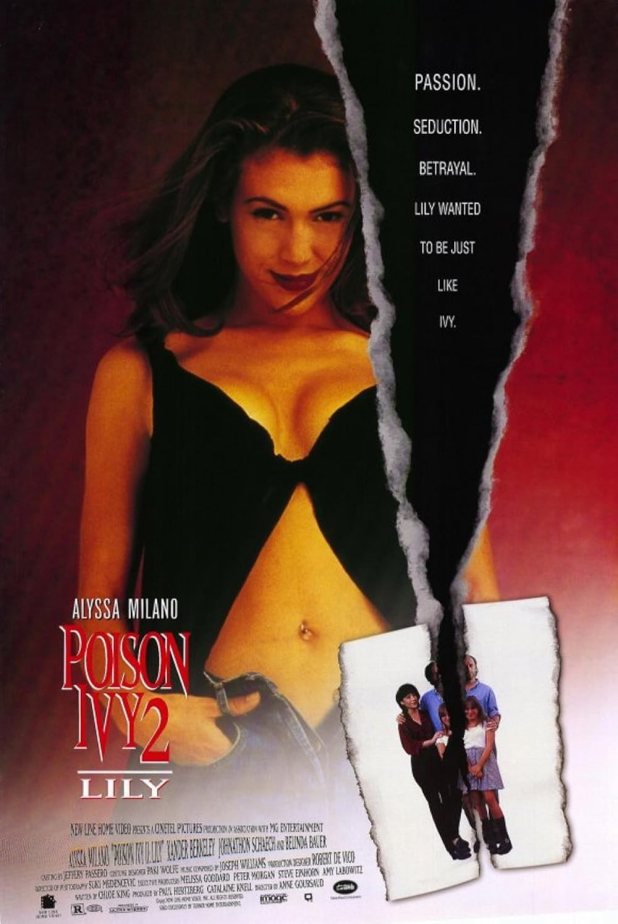
APRIL MOVIE THON 4: Poison Ivy II: Lily (1996)

April 2: Get Me Another- A sequel or a movie way too similar to another film.

Anne Goursaud may be known for editing Francis Ford Coppola’s films Bram Stoker’s Dracula, The Outsiders and One from the Heart, but she also had a run of directing in the 90s, working with Alyssa Milano to make this and another erotic film, Embrace of the Vampire, before also directing Love In Paris, which was released in the U.S. as Another 9 and 1/2 Weeks and brought back Mickey Rourke as John Gray and giving him a new love interest played by Angie Everhart. As you can imagine, it did not do well.

She also made this a sequel to Poison Ivy by name only. Milano is Lily Leonetti, a girl from Kalamazoo who has come to California to learn to be an artist. She moves in with Tanya (Kathryne Dora Brown), Bridgette (Victoria Haas) and Robert (Walter Kim), three fellow students who each have their own unique artistic skills. She soon finds a diary and nude photos of a girl named Ivy, who she becomes obsessed over, wishing that she could be as fearless as her.

Those photos: Jaime Pressly confirmed in 2008 that they are her, saying “Drew plays Ivy in the first Poison Ivy film, and in Poison Ivy II, Alyssa Milano plays the art student who moves into Ivy’s old room in a house with other students. She finds a diary and pictures of Drew’s character in a closet. The pictures are supposed to be of Drew, but they’re of me, though you never see my face.”

Pressly is the lead in the next movie, another unconnected effort, Poison Ivy: The New Seduction.

As she takes classes from Donald Falk (Xander Berkeley, Christopher in Mommie Dearest), he tries to seduce her, all while she’s babysitting his daughter Daphna (Camilla Belle), becoming friends with his wife Angela (Belinda Bauer) and falling in love with fellow student, the complicated sculptor Gredin (Johnathon Schaech). By the end of the movie, she’s changed so much that he’s fallen out of love with her, the teacher tries to assault her during Thanksgiving dinner, and his daughter runs into traffic.

This may be the most 90s movie to ever exist, feeling like Delia’s catalogue becoming a sentient being through Hot Topic. There’s one song that sounds so much like Portishead that I was convinced it was a remix I had never heard before. Monks chant over nearly every song, and I’m shocked that nobody shops at Wet Seal in this. This movie goes to the mall, right?

Anyway, the married art teacher gets so enraged over Alyssa Milano that he tries to shove her out the window. Her boyfriend—who came back to her—saves her at the last minute. She stays in California, but how can they return to art school?

This would be Milano’s last movie with nudity, but perhaps two was enough for most teenage 90s boys. Maybe the internet got in more homes and they learned that. they didn’t need to go to the video store to see nude women. Alyssa Milano had bigger and better things to do. As for the series — well, the title — there would be two more that I will get to.

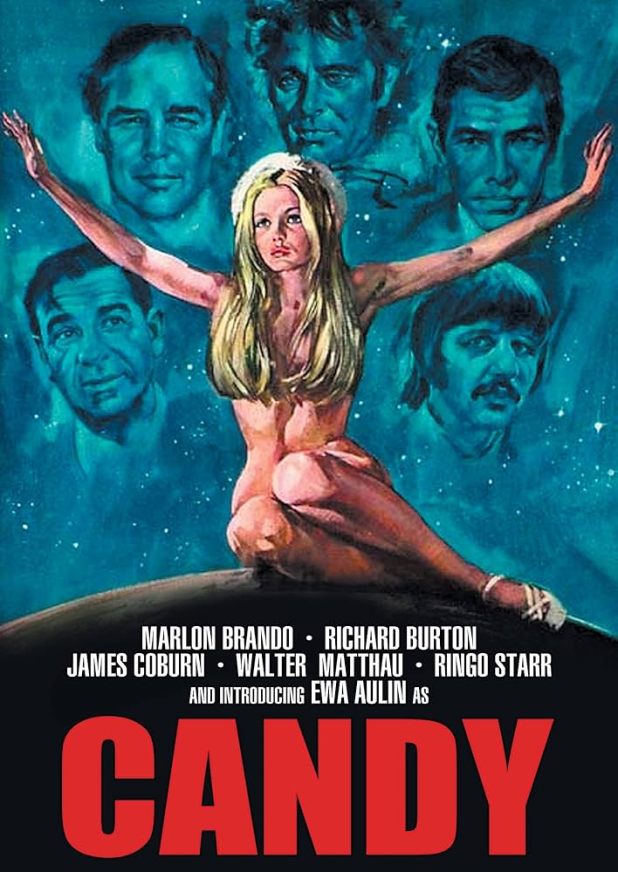
APRIL MOVIE THON 4: Candy (1968)

April 1: Drop A Bomb- Please share your favorite critical and financial flop with us!

I’m obsessed not just by flops but by the late 1960s and early 1970s, when Hollywood wanted to figure out how to get the kids into theaters. Easy Rider was a hit, so they financed movies like The Last MovieHeadBeyond the Valley of the DollsSkidooZabriskie Point and so many more.

This felt like a can’t miss: the novel Candy by Terry Southern and Mason Hoffenberg using the name Maxwell Kenton. They got paid $500 by Olympia Press, the same people who printed the first edition of Lolita. They wrote it chapter by chapter, trading things back and forth. They were amazed that it became a big deal, as Hoffenberg said, “Do you remember what kind of shit people were saying? One guy wrote a review about how Candy was a satire on Candide. So, right away, I went back and reread Voltaire to see if he was right. That’s what happens to you. It’s as if you vomit in the gutter and everybody starts saying it’s the greatest new art form, so you go back to see it, and, by God, you have to agree.”

Candy Christian is a Midwestern girl who just wants to make people happy. Of course, being an eighteen-year-old and gorgeous blonde, most of them want to have sex with her, then own her. She wants to make love to the gardener, but that leads to her father nearly dying from a concussion and adventures that will take her around the world.

Originally, Frank Perry—who directed The Swimmer—was going to make this, and Hayley Mills would play Candy. Her father wouldn’t let her play the role, so Christian Macquand got the rights. He’d just helped Marlon Brando buy his island—Brando’s son was named for him—and that got the great actor on board, as well as other big-time box office names.

In Patrick McGilligan’s Backstory 3: Interviews with Screenwriters of the 60s, Southern said that the director “disappointed me by casting a Swedish for the lead role, which was uniquely American and midwestern. He thought this would make Candy’s appeal more universal. That’s when I withdrew from the film.”

That Swedish girl is Ewa Aulin, who is naturally attractive and had already been in the Tinto Brass giallo Col cuore in gola and Giulio Questi’s Death Laid an Egg. Aulin would only be in one other movie that U.S. audiences may see, Start the Revolution Without Me, before appearing in her husband John Shadow’s Microscopic Liquid Subway to Oblivion and Italian films including The DoubleWhen Love Is Lust, Legend of Blood CastleDeath Smiles on a Murderer and Una vita lunga un giorno. By 23, she had tired of acting, divorced Shadow, and met real-estate developer Cesare Paladino. She had two daughters and became a schoolteacher.

Buck Henry took over the script, and the movie got made.

The film starts with Candy daydreaming in her father’s (John Astin) class; she soon falls for the charms of the poet MacPhisto (Richard Burton), who is too drunk to make love to her. The gardener, Emmanuelle (Ringo Starr), attacks her, and she gives in; when his family finds out — he was about to be a priest — they are attacked by his sisters Lolita (Florinda Bolkan in her first movie), Conchitya (Marilù Tolo!) and Marquita (Nicoletta Machiavelli!). Her father gets a brain injury and she goes off with his brother (also Astin) and his wife Livia (Elsa Martinelli), but not before she’s nearly impregnanted by Brigadier General Smight (Walter Matthau) and lusted after by the man who saves her father’s life, Dr. Abraham Krankheit (James Coburn), and filmed by Jonathan J. John (Enrico Maria Salerno). Oh yeah- the doctor’s nurse is Rolling Stones muse Anita Pallenberg.

She meets many men — a hunchback (Charles Aznavour), a guru (Brando, who its said tried to have sex with her for real on camera) and another guru who enlightens her before its revealed that it’s her father and yes, they have just had sex — and by the end, wanders through a field of hippies and flies into space.

Southern said, “The film version of Candy is proof positive of everything rotten you ever heard about major studio production. They are absolutely compelled to botch everything original to the extent that it is no longer even vaguely recognizable.”

Brando said that this was the worst movie he ever made. But man, this excerpt from Marlon: A Portrait Of The Rebel As An Artist by Bob Thomas is just insane: “Brando, of course, wanted his portion of the script rewritten. The screenwriter was Buck Henry, a gifted young comedy stylist who had written The Graduate for the screen. Brandovisitedt Henry at the Plaza Athenee Hotel in Paris accompanied by the French moneyman for Candy, Peter Zoref, a conspiratorial-looking man who wore dark glasses indoors and out. The two visitors found Henry suffering from food poisoning. Henry tried to defer the conference, but Brando insisted on continuing, even while the writer went to the bathroom. While Henry retched, Brando shouted comments about how the comedy elements of his sequence could be heightened. There was a brief silence from within, and Brando opened the bathroom door to find Henry nearly unconscious, hunched over the toilet. Brando lifted the slender writer into his arms, carried him into the bedroom, and laid him out on the bed. Brando sat beside him and continued reading from the script and making suggestions to increase the hilarity. Zoref remained stolid behind his dark glasses, occasionally puffing on a cigar. A knock came on the door, and a waiter entered to remove the dinner tray. He stopped and surveyed the scene with open mouth: an (alleged) American gangster sitting in a chair like a stuffed figure, a thin corpse stretched out on the bed, a famous movie star sitting on the bed and guffawing over pages he was reading. The waiter slowly turned and walked out the door, closing it quietly behind him.”

This is the kind of movie that today gets one-star hate reviews by hip kids on Letterboxd who can’t be bothered to write much more than a sentence. It didn’t fare that well when it was released, either. But man, it’s a mess, a glorious mess, but one that has Coburn being incredible, famous people acting like morons and Aulin being some kind of android angel who has floated into this movie and bewitched everyone. She married Shadow while making this, a rock star who would one day write the 3D Matt Cimber martial arts movie Tiger Man.

So yeah, it’s a mess, but I love it for that. This is from a time when people were not afraid to fail and would throw money at projects that made no sense. Hollywood emerged from years of musicals and Westerns to try and become cinema, only to fall into blockbusters. But this emerged, a movie shot in France and Italy that looks luscious and yet is dumb throughout, a perfect blend of overindulgence and underwatched.

You can watch this on Tubi.