CANNON MONTH 2: Mad Dog Coll (1992)

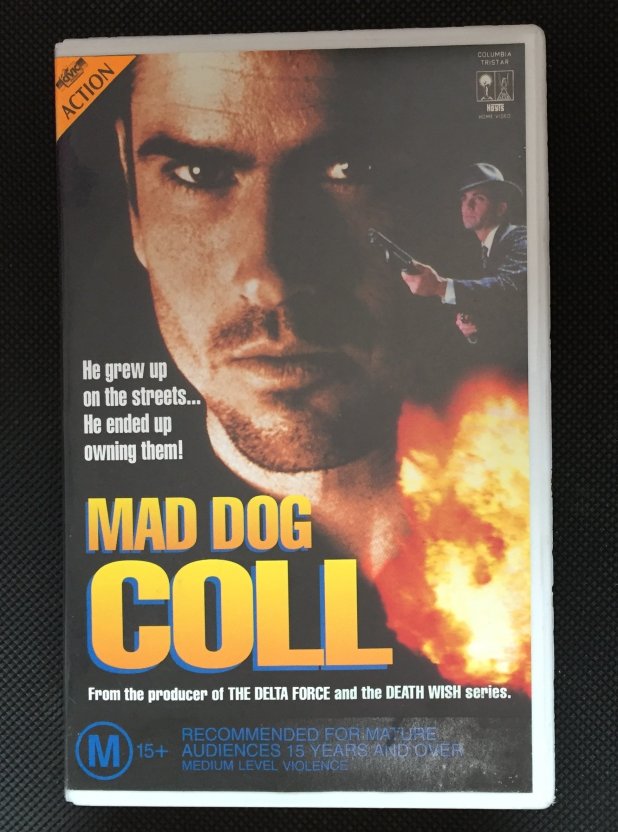
21st Century released Hit the Dutchman the same year as this movie, which concentrated on Dutch Schultz. This Greydon Clark and Ken Stein-directed film is about his nemesis, Vincent Coll, who started off as a street fighter and works his way up to becoming a crime boss.

Coll was called Mad Dog by the press after a five-year-old was caught in the crossfire in a gun battle. This movie claims that he was innocent of that and it was someone else who did the crime. It also presents Vincent (Christopher Bradley) and Peter (Jeff Griggs) as being sick of the low wages they received from Schultz (Bruce Nozick) and striking out on their own, which starts off the gang war.

Both this film and Hit the Dutchman were made by 21st Century in Russia, so the entire film has a very soundstage feel that also feels very Cannon, so you know that I loved it. It looks way better than it should, thanks to Janusz Kaminski, whose career would go way upward after working in the world of low budget films.

Released in the U.S. as Killer Instinct — to cash in on Basic Instinct but having nothing to do with that movie, God bless Menahem — this was intended to be part of a trilogy that only got two parts. Regardless, I love that Golan saw that more gangster movies were getting made, so he went to Russia to show America in the 1920s.

CANNON MONTH 2: The Image of Bruce Lee (1978)

EDITOR’S NOTE: Yes, this isn’t a Cannon. It’s 21st Century, which was later sold to Menahem Golan. But hey — it is a fake Bruce Lee movie too, so let’s get into it.

No less a luminary than Quentin Tarantino reviewed this movie, setting it up by saying that “Both Bruce Li and 21st Century kept kung fu flicks alive in the waning days of the genre before the emergence of Jackie Chan.”

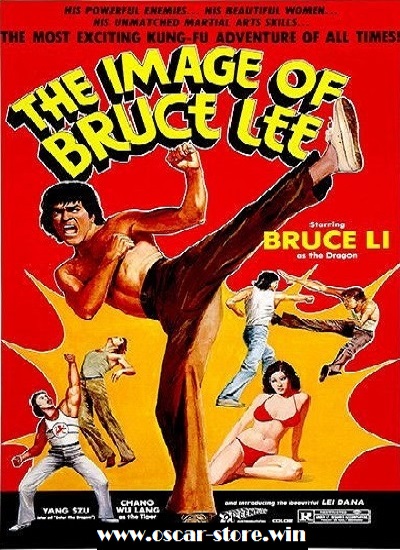
The Han Family and a Japanese gang led by The Hakido Bear (Bolo Yeung) are unleashing counterfeit U.S. dollars on Hong Kong. Hi Chi (Bruce Li) and his partner Lai (Chang Lei) must stop them, which seeing as how this is a kung fu movie means lots of fights. While that’s all going on, one of the Hans named Donna (Dana Lei) has the paper needed to print more money and starts playing the two crime families against one another. She’s incredible in this, beating every one of these men at their game.

How would we confuse this with a Bruce Lee movie? Is it the Game of Death tracksuit that Li wears in the first scene? Maybe it’s Li himself, who was billed as Li Hsiao Lung (Lee Little Dragon). Man, the titles of Li’s movies are practically begging you to pretend that he’s the real Bruce, like Bruce Lee, A Dragon StoryBruce Lee Against SupermanBruce Lee, We Miss You and Exit the Dragon, Enter the Tiger. But it really has nothing else to do with Bruce, instead a buddy cop movie with two of the worst cops this side of a giallo arguing over who is going to get Donna, who is really the villain of the movie, but who can blame them? Between the 70s fashion and her doing everything she can to bend every man to her will, she owns this movie, but we needed the Brucesploitation connection to get us to watch it in the first place.

You can watch this on Tubi.

CANNON MONTH 2: Stone (1974)

EDITOR’S NOTE: This isn’t a Cannon movie, but as I finish out the month, I’m posting the pre-Golan 21st Century movies. 

When Toad (Hugh Keays-Byrne, Immortan Joe!), a member of the GraveDiggers outlaw motorcycle club, watches an environmentalist get killed by a hitman and several of the members of the club get killed, Detective Stone (Ken Shorter, Dragonslayer) gets assigned to the case. The gang allows Stone to join them and as you can imagine, seeing as how this is a biker movie, he soon begins to leave behind the normal world with his high class girlfriend Amanda (Helen Morse, Picnic At Hanging Rock) and embrace the nomadic motorcycle lifestyle along with the leader of the GraveDiggers Undertaker (Sandy Harbutt, who directed and wrote this movie, which was a huge success and he never made another; he was also married to Morse at the time), Hooks (Roger Ward, Mad Max), Vanessa (Rebecca Gilling), Dr. Death (Vincent Gil, Nightrider from Mad Max!), Captain Midnight (Bindi Williams) and Septic (Dewey Hungerford).

Meanwhile, the GraveDiggers battle their rivals, The Blackhawks and their leader Birdman (Tony Allyn, The Stud). And that hitman has an idea: a mass murder of The GraveDiggers under the cover of intergang violence. Stone has to solve the case or all of the gang will be in coffins standing up, as that’s how they get buried because this gang rides for Satan.

If you couldn’t guess, I absolutely love this movie. It takes everything great about American biker movies and applies it to the wide-open country of Australia. Real life bikies and bikers were paid with beer for participation as actors and extras in this picture and four hundred of them are in the biker funeral scene. This movie seems as much a Western in theme as it is a biker film. Between that idea, the fuzzed guitars and the slow-motion scenes, there’s so much to love here.

Producer David Hannay said that the most “negative experience” he had as a filmmaker was not being able to get finance for Harbutt to make another film, stating: “Why have I failed? What is wrong with me? I have failed this person who is such an important part of my life, this person with enormous talent, this extraordinary human being, and I have failed him totally and absolutely. It really is the major low point in my life; if I really dwell on it, I get very angry. I should have made a difference. Because I should have been able to make it happen. He is far more talented than 999 of the 1000 other people I know.”

If you get the Severin blu ray, you also get Stone Forever, a doc made in 1999 and a soundtrack on CD. I mean, you should totally be buying that right now.

CANNON MONTH 2: The Phantom of Terror (1970)

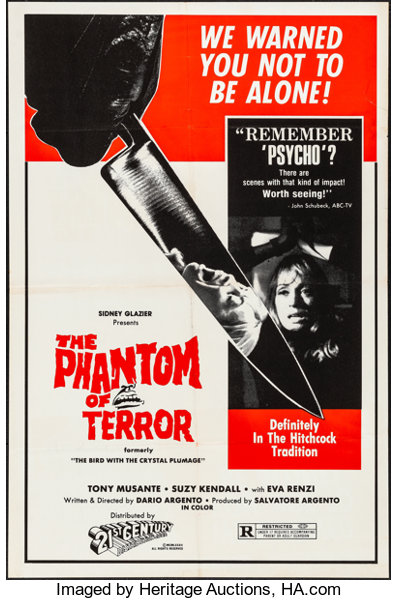
EDITOR’S NOTE: If you look at the poster for the 21st Century release of The Phantom of Terror and wonder where you’ve seen it before, well, it’s been on the site at least three times with the last appearance being September 16, 2021. That’s right — it’s The Bird with the Crystal Plumage. 21st Century re-released it in 1982 and you have to image that people had seen it before twelve years ago and didn’t think it was a new slasher, right?

Other than the films of Mario Bava (Blood and Black LaceThe Girl Who Knew Too Much), there’s no other film that has no influenced the giallo. In fact, the most well-known version of the form starts right here with Dario Argento’s 1970 directorial debut. Until this movie, he’d been a journalist and had helped write Leone’s Once Upon a Time in the West.

Sam Dalmas (Tony Musante) is an American writer suffering from an inability to write. He’s gone to Rome to recover, along with his British model girlfriend (yes, everyone in giallo can score a gorgeous girl like Suzy Kendall). Just as he decides to return home, he witnesses a black-gloved man attacking a girl inside an art gallery. Desperate to save her, he can only watch, helpless and trapped between two mechanical doors as she wordlessly begs for help.

The woman is Monica Ranier and she’s gallery owner’s wife. She survives the attack, but the police think Sam may have had something to do with the crime, so they keep his passport so he can’t leave the country. What they’re not letting on is that a serial killer has been wiping out young women for weeks and that Sam is the only witness. That said — he’s haunted by what he’s survived and his memory isn’t working well, meaning that he’s missing a vital clue that could solve the crime.

As you can see, the foreign stranger who must become a detective, the missing pieces of memory, the black-clad killer — it’s everything that every post-1970 giallo would pay tribute to (perhaps rip off is the better term).

Another Argento trope shows up here for the first time. It’s the idea that art itself can cause violence. In this film, it’s a painting that shows a raincoat-clad man murdering a woman.

Soon, Sam is getting menacing calls from the killer and Julia is attacked by the black-clad maniac. The police isolate a sound in the background of the killer’s conversations, the call of a rare Siberian “bird with the crystal plumage.” There’s only one in Rome, which gets the police closer to the identity of who is wearing those black gloves (in truth, it’s Argento’s hands). It’s worth noting that the species of bird the film refers to as “Hornitus Nevalis” doesn’t really exist. The bird in the film is actually a Grey Crowned Crane.

Alberto, Monica’s art gallery husband, tries to kill her, finally revealing that he has been behind the attacks. Ah — but this is a giallo. Mistaken identity is the main trick of its trade. And even though this film was made nearly fifty years ago, I’d rather you get the opportunity to learn for yourself who the killer really is.

I may have mentioned before that my parents saw this movie before I was born and hated it to a degree that any time a movie didn’t make any sense, they would always bring up “that weird movie with the bird that makes the noises.” Who knew I would grow up to love Argento so much? It’s one of those cruel ironies that would show up in his movies. I really wonder if my obsession with giallo and movies that are difficult to understand is really me just rebelling.

An uncredited adaptation of Fredric Brown’s novel The Screaming Mimi, this film was thought of as career suicide by actress Eva Renzi. And the producer of the film wanted to remove Argento as the director. However, when Argento’s father Salvatore Argento went to speak to the man, he noticed that the executive’s secretary was all shaken up. He asked her what was wrong and she mentioned that she was still terrified from watching the film. Salvatore asked her to tell her boss why she was so upset and that’s what convinced the man to keep Dario on board.

The results of all this toil and worry? A movie that played for three and a half years in one Milan theater and led to copycats (and lizards and spiders and flies and ducklings and butterflies and so on) for decades. Argento would go on to film the rest of his so-called Animal Trilogy with The Cat O’Nine Tails and Four Flies on Grey Velvet, then Deep Red before moving into more supernatural films like Suspiria and Inferno.

Tales from the Darkside episode 15: “Answer Me”

Directed by Richard Friedman (Scared StiffDoom Asylum, Phantom of the Mall) and written by Michael McDowell (Beetlejuice) and Dennis Schuetz, “Answer Me” is nearly a one room, one person episode, as Joan Matlin (Jean Marsh, Return to OzWillow) is an actress who is jet lagged by a London to New York City flight and trying to get sleep before an audition the next day. The phone never stops ringing in another apartment and she slowly goes insane from all of the noise.

Yet when she looks inside, no one is there. That’s pretty much the whole episode until the conclusion, which is how most episodes of this show work out, right? That said, this one has decent acting and when you only have a bit more than twenty minutes, it doesn’t wear out its welcome. I often wonder why so many of these episodes have unlikeable protagonists. I guess in the 80s, no one was all that likeable.

CANNON MONTH 2: Lunatic (1971)

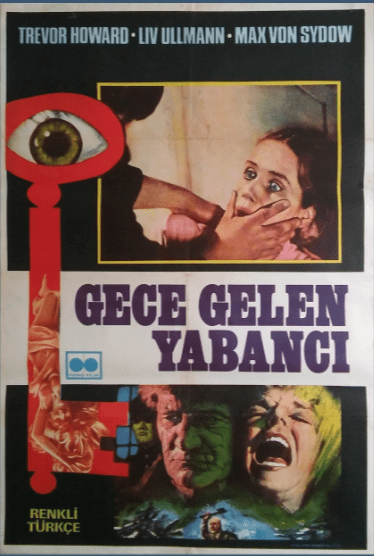
EDITOR’S NOTE: Although released by 21st Century as Lunatic in 1981, this is really a re-release of  The Night Visitor, which was on the site on April 10, 2022.

Salem (Max Von Sydow) has escaped a near-inescapable insane asylum, a place where he’s been trapped since being wrongly charged with killing a farmhand. Now he truly is deranged and is out for revenge on those he believes are guilty: his younger sisters Emma (Hanne Bork) and Ester (Liv Ullmann) and her husband Dr. Anton Jenks (Per Oscarsson), the man who accused Salem of the murder.

Beyond the fact that the villain is actually the hero of this, it has an incredible score by Henry Mancini that was made for synthesizer, 12 woodwinds, organ, two pianos and two harpsichords — with one tuned to be flat and add dissonance.

Originally entitled Salem Came to Supper and released again ten years later by 21st Century Film Corporation as Lunatic (before that company was bought and rebranded by Menahem Golan after the breakup of Cannon), this was directed by Laslo Benedek (who made the 1951 Death of a Salesman) and written by Guy Elmes, who adapted several Italian films for Western audiences.

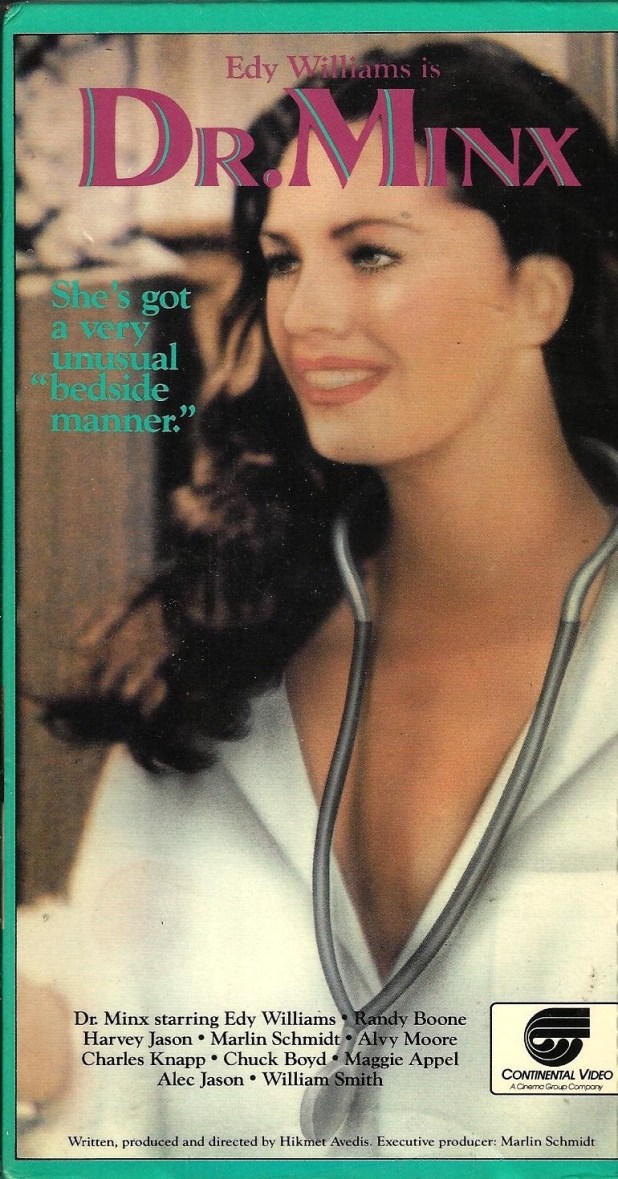
CANNON MONTH 2: Dr. Minx (1975)

EDITOR’S NOTE: I’m winding down Cannon Month 2 with the films of 21st Century before Menahem Golan got the company. This was originally on the site on May 26, 2021. 21st Century got this movie when they bought out the original Dimension Films and re-released it on a double bill with Cheering Section in 1981 and then on VHS under the Continental Video label. 

“She’s a vixen — watch her operate.”

Dr. Carol Evans (Edy Williams!) keeps having these short affairs but they leave her unsatisfied. She’s just dumped her latest boyfriend (William Smith!) but ends up injuring two kids — David (Harvey Jason) and Brian (Randy Boone) — who somehow end up falling for her. There’s also the bulldozer death of her husband to deal with and a blackmailer as well. And yeah, Smith is not pleased at all that she’s sleeping with a teenager.

But yeah. Most people just watched this to gawk at Edy Williams.

Director Howard Avedis loved making movies about older women deflowering teenage boys. This is also 1975, so get ready for a bleak ending! I think by the 80’s, Avedis figured out how to make thrillers that really thrilled. But here, he’s doing what he can to entertain the audience.

Dr. Minx was Avedis’s follow-up to The Teacher (1974), which starred Jay “Dennis the Menace” North. He also released the Adam West-starring The Specialist in 1975 and followed that with Connie Stevens in Scorchy (1976).

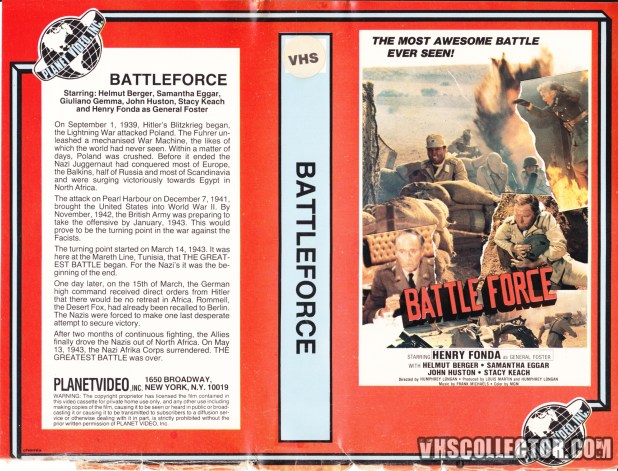
CANNON MONTH 2: Battle Force (1978)

EDITOR’S NOTE: 21st Century — pre-Menahem Golan — released this film originally known as The Biggest Battle on the Planet Video VHS label.

Just look at this cast: Giuliano Gemma, Edwige Fenech, Ida Galli, Helmut Berger, Michele Soavi, Stacy Keach, Ray Lovelock, Samantha Eggar, Henry Fonda, Evelyn Stewart, John Huston and Orson Welles as the narrator.

Yes, you read that right.

Directed and co-written — with Cesare Frugoni, who also was the writer for Cut and RunThe Spider LabyrinthSlave of the Cannibal GodWarriors of the Year 2072The Island of the Fishmen and many more — by Umberto Lenzi, this starts at the 1936 Berlin Olympics, as German officer Manfred Roland (Keach) has dinner with a group of friends including German actress Annelise Hackermann (Eggar), Canadian reporter Sean O’Hara (Huston) and American Brigadier General Harold Foster (Fonda). The two military men give one another matching medals that say “In God we trust” and promise that in four years, they will have another meal just like this.

Six years later, that dinner hasn’t happened and the world is quite different. Roland is married to Hackerman, who has gone into hiding due to her religion but soon has to give sexual favors to an SS officer just to live while her husband executes her people. Foster’s sons John and Ted (Lovelock and Soavi, I mean, what a great bunch of kids to have!) have joined him in the war effort.

Another soldier, Lt. Kurt Zimmer (Berger) may be dating a French sex worker (Fenech), but he’s still killing her people until John joins the resistance. Everyone ends up in Tunisia, where John meets British commando Captain Martin Scott (Gemma) and the fighting increases. While this is all happening, Annelise commits suicide.

In the big battle, Scott kills Zimmer and rips the medallion from the dead body of Zimmer. He gives it to John who notices that it looks just like his father’s but has no idea why.

Lenzi spent a ton of money on this movie and it was a ton of tanks in the big battle. Meanwhile, Huston and Fonda were shooting Tentacles at the same time as this movie. Somehow, this movie mixes newsreel footage and episodic war stories and does it all in under two hours with the kind of cast that should be in a miniseries. It’s not good, but it’s something.

You can watch this — complete with really rough video edit of the title — on Tubi.

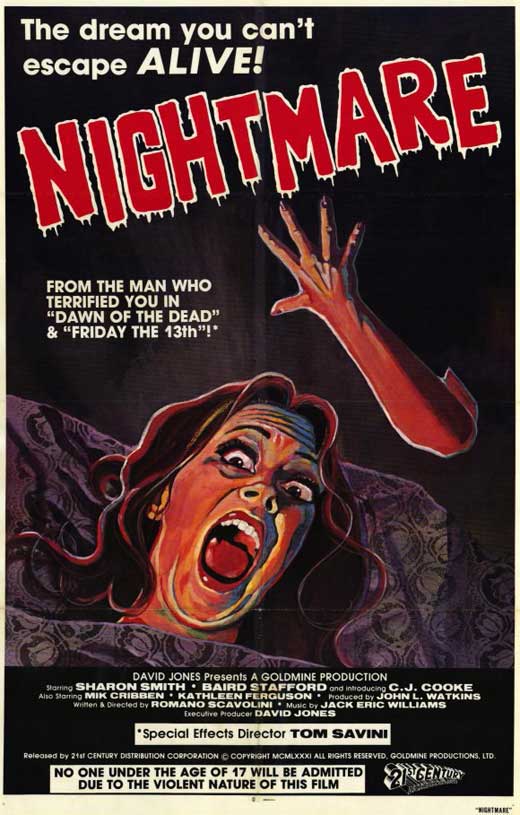
CANNON MONTH 2: Nightmare (1981)

EDITOR’S NOTE: As I close out the second Cannon Month, I’m looking into the films released by 21st Century. That would include this video nasty, which was first on the site on October 25, 2018Nightmare is one of the 72 films that violated the British Obscene Publications Act of 1959. In fact, its distributor was sentenced to 18 months in prison for refusing to edit the film. It also brags that Tom Savini created the film’s effects, a credit denied by the FX artist.

After mutilating and murdering a family, George Tatum has been jailed for years. Now, he has been given the opportunity to be reprogrammed and returned to society. That said — he still has nightmares of his childhood and a trip to a Times Square peep show unlock flashbacks that make him a killer all over again.

En route to Florida — where his ex-wife, daughters and son live, George follows a woman home and kills her. Meanwhile, his doctors have no clue that he’s left the city.

Imagine his wife’s surprise when she starts getting all manner of threats over the phone. All she wants to do is carry on with her new boyfriend, Bob. She has enough to deal with, as her son C.J. is the worst of all horror movie kids. He often plays pranks that go way past the line of good taste, like covering himself in ketchup and pretending to be dead. So when the kid says that a man is following him, everyone thinks he’s just up to his normal young serial killer in training mischief.

After killing some of C.J.’s fellow students, George breaks into their house and kills the babysitter while mom is at a party. But C.J. calmly and cooly deals with it — he shoots his father with a revolver while dad has a flashback of catching his dad engaging in BDSM games with his mistress before he decided to kill them both with an axe.

The movie closes with C.J. sitting in a police car, mugging for the camera, while his mother returns to see her ex-husband’s body being removed from the house. How does C.J. know the camera is there? Has he learned how to break the fourth wall? Will he soon be able to hear his own theme song, much like Michael Myers? And when I’m asking questions, isn’t the full title, Nightmares in a Damaged Brain, way better than just Nightmare?

Director Romano Scavolini started his career in porn, which might explain the incredibly casual nudity in the film and its devotion to giving the viewer exactly what they want from a slasher. It knows exactly why you’re here and gives you what you need. He stated about the film that he wanted to tell a story that has roots in reality and not just fantasy. A story of no hope, because mankind is at the mercy of its own demons. And, perhaps most importantly, a story where a young boy is unable to deal with the fact that his parents might just happen to be down with BDSM.

According to Matthew Edwards’ Twisted Visions: Interviews with Cult Horror Filmmakers, Scavolini claimed that prior to receiving distribution through 21st Century Film Corporation, Warner Bros. and Universal Pictures had both wanted to buy the film, but only if the gore was cut down. Scavonli refused, feeling that “the strongest scenes had to remain uncut because the film should be a scandalous event.” Yeah, I’m gonna call bullshit.

This is a scummy, down and dirty affair. C.J. is an annoying kid, but who can blame him, He has the worst parents possible — one’s a serial killer and the other would rather party on down with Bob than deal with the wretched fruits of her ex-husband’s loins. Remember thiose 20/20 exposes on how horrible slasher movies were? This is one that lives up to those warnings.

CANNON MONTH 2: Cathy’s Curse (1977)

EDITOR’S NOTE: I love this movie so much that I have a full-sized painting of Cathy’s face that lights up — thanks Mark Dockum — and it’s been on the site three times: once all the way back on October 24, 2017, another time when John S. Barry wrote about it on November 15, 2018 and a reprint of when I wrote about it for Drive-In Asylum #12, which you can buy right here, and which follows: 

There has never before or since been a movie where pure evil finds its origin in a rabbit crossing the road that’s narrowly missed by a misogynistic father, who then smashes his car into a ditch where it goes up like a tinderbox. It’s movies like this that made me run on foot from my first fender bender, diving into a snowbank, waiting for my car to blow up real good. Spoiler warning: It sure didn’t.

Cathy’s Curse finds its true origins in many places. First, the Canadian Film Development Corporation was formed to encourage more movie-making north of the border. According to Canuxploitation.com, “thanks to $10 million dollars of allocated funds in 1971 and the added incentive of tax shelter laws that increased the Capital Cost Allowance (CCA) for money used in the production of a Canadian feature film from 30% to 100%, Canada experienced an unprecedented explosion of moviemaking.” That money gave birth to filmmakers like Bob Clark and David Cronenberg, as well as the maniacs behind this film.

Secondly, Canadian horror is strange to American eyes. Again, Canuxploitation.com claims that’s because these films “are distinctive in the way they present concepts of individuality, community, and even morality. Our films tend to be more story and character-focused than their American counterparts, and when at all possible, the “wild” Canadian landscape is used to full effect.” In particular, films from Quebec stand out as even stranger than the rest of the country, with Possession of Virginia and The Pyx coming immediately to mind.

Finally, the third father (I should set them up with Argento’s Three Mothers) to Cathy’s Curse is a preponderance of occult-based films in the mid-1970s. Thanks to the one-two Satanic punch of The Omen and The Exorcist, filmmakers saw child possession as a rich source of appropriation.

So why do I love this movie so much? Because I believe that it was made by aliens who have no understanding of how human beings truly behave or act. It’s like John Keel’s stories of how the Men in Black were often confused by everyday objects like pens and had no idea how to eat food properly. Characters make asides that seem to be important plot points that ultimately go nowhere while glossing over things that end up being essential.

In my exhaustive research of Canadian possession movies, which was done with several cans of Molson as a control group, I have learned that when kids get taken over in a Canadian film, instead of the pure bile and meanness of say, Regan MacNeil, they just end up becoming impolite and swearing a lot more. Cathy Gimble, our heroine in this film, immediately picks this up. From forcing a group of children to repeat that all women are bitches to stabbing kids with needles, she goes from polite North of the Border pre-teen to Rhoda Penmark in no time flat.

Why else do I love Cathy and her film so very much? Because there are so many lessons to be learned. For example, if your daughter finds a frightening-looking doll in the attic — much less an attic that has a giant cast iron frog that no one ever comments on in the film — don’t let her keep it. And if you want to make sure your psychokinetic problem child is being properly taken care of, don’t entrust her daycare to a handyman that’s had lifelong issues with the sauce.

I adore Cathy’s Curse for its inconsistencies. Cathy’s powers are never really explained. They can do everything from blow-up knick-knacks to making snakes and rats appear out of nowhere to pulling maids out of windows like a Helen Reddy loving Damien Thorn, Cathy has the power she needs when she needs that power. How does one use the power to make food rot and get covered with bugs properly? You can’t very well join Alpha Flight (Canada’s Avengers) with that one.

I celebrate this movie for its actors, blessed with limited abilities, hilarious pronunciations and magical leather coats complete with wooly fur. A scream or an overreaction happens in nearly every scene.

You know how most horror movies start with an opening sequence showing how nice and happy everyone’s life is to juxtapose how horrible everything gets when the supernatural invades the real world? This movie will have none of that. Every single frame is packed with goofball weirdness. People wear dresses in the coldest of snow. Every wall is covered with pictures of animals. Next door neighbors just happen to be mediums connected to the spirit world. Strange music cues and cuts in the middle of dialogue happen for no reason whatsoever.

Unlike draconian films that have a point of view or an actual plot, this is a movie with no real point of view. Instead, it’s less a narrative and more scenes of Cathy destroying lives. You won’t learn a pesky moral or meaningless lesson. Instead, you will watch a young girl repeatedly tell off old women, including the immortal line where she refers to a medium as an “extra large piece of shit.”

In short, Cathy’s Curse is the kind of film that I put on and people say to me. “Why would you show me that?” and I never invite them to my house ever again. It’s a good litmus test to weed out boring people who have no idea how to enjoy the magic of film. You didn’t need them anyways! You have Cathy!

You can watch Cathy’s Curse on Tubi or get it from Severin.