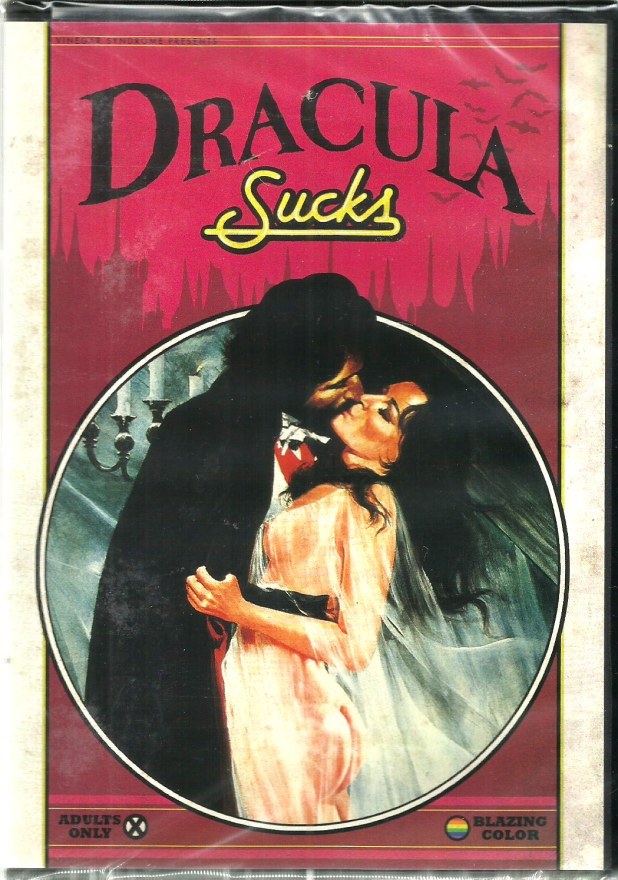
Reggie Nalder played perhaps the best vampire of all time, Barlow in Tobe Hooper’s Salem’s Lot, but in this pornographic version of the Dracula story, he’s Van Helsing.
So who, in 1978, should play Dracula? C’mon. Jamie Gilils*.
Who else could be credited, somewhat, for gonzo, which destroyed the narrative nature of adult, but could also be in two of the best Golden Age movies, The Opening of Misty Beethoven and Barbara Broadcast?
Shot in the same Lancaster, California castle as Al Adamson’s Blood of Dracula’s Castle, this movie has an all-star cast for people who may blush when they mentioned their names, like Seka (her first role), John Leslie, Serena, John Holmes (I mean, he’s a household name, right?) Annette Haven and Kay Parker.
It’s way better than an adult Dracula should be, but you may wonder, “Why is this on the site? I know this is Not So Classic Monsters Week, but what gives?”
Well, item one: Norman Thaddeus Vane, who made The Black Room, was second unit director. And who was the director? Phillip Marshak. Yes, the man who made Cataclysm AKA The Nightmare Never Ends AKA The Case of Claire Hansen” in Night Train to Terror. And as you know, everything in my movie life revolves around that movie. I mean, everybody’s got something to do, everybody but you, you know?
There’s a softcore cut of this, which makes sense, but also Lust At First Bite, an even more hardcore cut with forty more minutes. You can get it all from Vinegar Syndrome and really, who else would put this out?
*Gillis also played Dracula in Dracula Exotico. Later, he’d be attacked by a werepanther played by Raven with Rocco Siffredi in tow in a movie co-star John Leslie directed, Curse of the Catwoman, and yes, that was totally not from research.
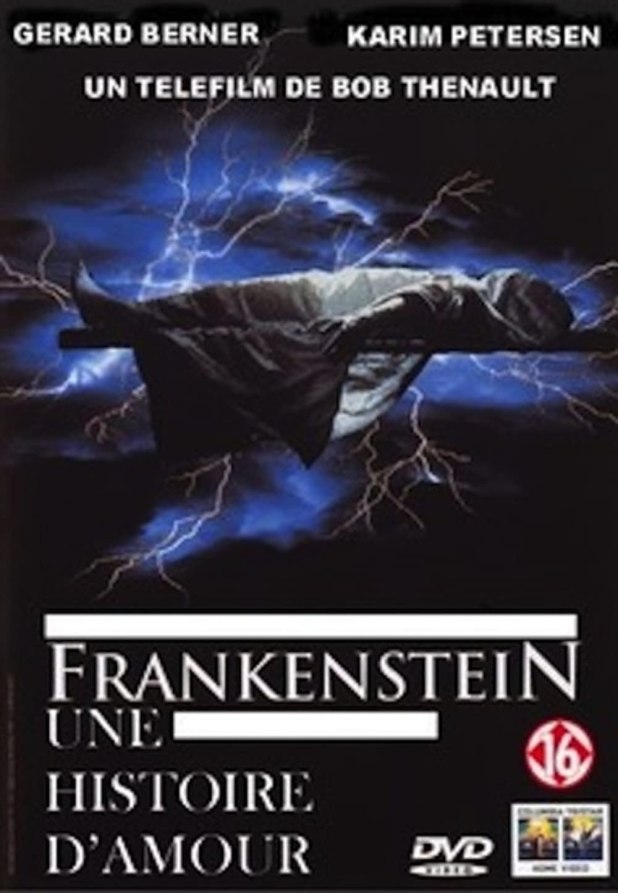
AKA Frankenstein 95 and why does Frankenstein have so many movies with years after its name?
Obsessed with creating life, Count Victor Frankenstein starts on animals, moves up to cadavers and freaks everyone out around him — his teachers, the lcoal government and even his own family — as he dreams of getting a real person to try out his experiments on.
Man, this movie is just plain weird and nobody is talking about it, but then I realize that it’s a made for TV French movie from 1974 so adjust your perceptions, Sam.
Also, besides morally disgusting everyone he meets, the other people that Victor knows — his foster sister, a village fool — want to have steamy, sweaty and probably chemically smelling sex with him. He’s also mentally bonded with the creature, giving everyone else in town psychic visions.
Sometimes, a movie connects stars on the rise and stars on the fall and other times, it captures stars that continue to burn no matter their trajectory.
So consider this six-day wonder, this public domain piece of nothing, as both the most important movie some people ever made, a forgotten piece of nothing made for money on hard times or as another fast film to get through and on to the next one.
Or, as Mitch Hedberg would say, “People either love me or hate me, or they think I’m just okay.”
“This is the jungle. The vast wilderness of giant lush foliage of tropical birds and fierce animal life, the killer tiger, the cunning hyena, the deadly python that can crush a giant elk, the proud lion, a fierce lioness, stalking a prey to feed her young. and the buzzards, the scavengers of the jungle soaring lower, ever lower eager to devour the dead or the dying. Kill or be killed, this is the law of the jungle — and here — what have we here? Who are these men? What can they possibly be doing in this cruel tropical wilderness?”
Tim Ryan, who wrote the screenplay along with dialogue by Leo “Ukie” Sherin and Edmond G. Seward, must have been shooting for the moon here and trying to get in a little bit of poetry before the eventual fall. Sherman was a radio comic who wrote for Crosby and Hope, who was now dead center in the ten-year break between the famous duo’s Road to movies (Road to Bali in 1952 and The Road to Hong Kong in 1962; Road to the Fountain of Youthwas planned in 1977 with the two playing older versions and new actors coming in when they found Ponce de Leon’s goal, but Crosby’s death that year canceled this movie) and would have been the right guy to write buddy dialogue. Seward made this his last script after a stint that didn’t go well in Australia (Throughbred, for example, has an ending taken from the film Broadway Bill) and time writing for the Bowery Boys. As for Ryan, he also wrote plenty of Bowery Boys films — and other ones at Monogram and Colombia — while adding up 157 acting credits. If his last name sounds familiar, well, his ex-wife and one-time comedy partner Irene kept it and ended up being an overnight success (actually, she’d been working in vaudeville, movies, radio and TV since she was 11 years old) as Granny on The Beverly Hillbillies.
So, basically, their stars were not on the rise.
Nor was Bela Lugosi’s. Despite the Universal films becoming famous again as they were reissued in theaters and began playing TV, Lugosi wasn’t seeing much personal success, traveling the U.S. — and even England — playing summer stock, spook shows and live appearances. He was nearing the end of his fourth marriage — to 29 years his junior Lillian Arch, who would leave him for the man Bela was sure she was making time with, her boss and film noir actor Brian Donlevy — and addicted to doctor-prescribed morphine and methadone, as well as alcohol.
One of those traveling shows took to the UK, playing Dracula on stage for six months (ironic, as the British ban on horror movies in the 30s is what started his career decline at Universal), a time in which he made a comedy called Mother Riley Meets the Vampire. Despite sadly remarking in an interview that he was condemned to always be the boogie man, he yearned for more comedy.
Producer Jack Broder was listening. His Realart Pictures Inc. had re-released the Universal horror — gaining a ten-year lease on these movies — and theaters across the country enjoyed making great money on these reissues, which often brought in more crowds than newly released movies.
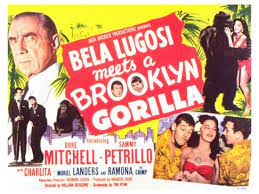
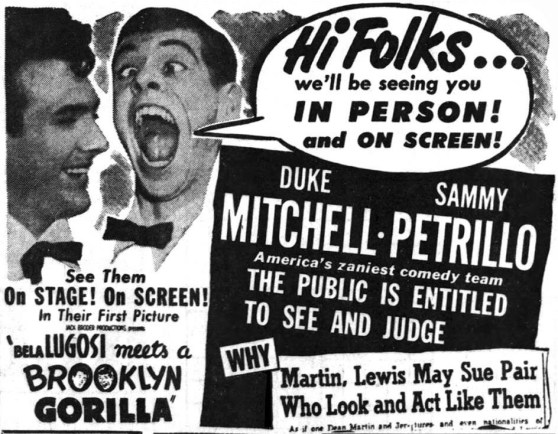
Broder had a relationship now with theater owners and saw an opportunity. Why not make new movies? He hired Herman Cohen as a new vice-president and formed Jack Broder Productions and made movies like, well, Bela Lugosi Meets a Brooklyn Gorilla (the title comes from Broder’s ten-year-old son and the fact that Cohen thought that it was dumb to not put Bela’s name right up in front; its a much better title than White Woman of the Lost Jungle).
But who to star with Bela?
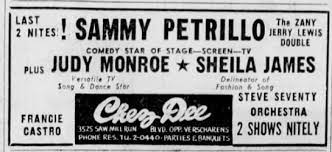
Comedian Sammy Petrillo had made a career out of imitating America’s hottest comic, Jerry Lewis. They looked alike and hey, even sounded the same. Petrillo even worked for Lewis once on The Colgate Comedy Hour and got signed to the same talent agency as Lewis, even as a minor, but was released from his contract when he believed that Lewis was intentionally holding him back.
He would later tell Before the Big Break, “Jerry said a couple of derogatory things to me. He said something to the effect of, “Don’t sign any checks and tell people you’re Jerry Lewis!” He wasn’t being funny. He was being serious.”
A few years later, Petrillo went on to form a musical comedy team with singer Duke Mitchell. With Mitchell as Dean and Sammy as Jerry, the duo played big stages, like the Paramount Theatre and the Copacabana in New York, as well as the Flamingo Hotel in Las Vegas. You have to imagine the Rat Pack was not pleased to have the two doing this act on their turf.
In fact, Lewis threatened to boycott anyone who booked them. One such instance was on another The Colgate Comedy Hour appearance, hosted by Abbott and Costello (who should have been just as peeved as Lewis, if you think about it, as this movie apes — sorry for the pun — their more successful Abbott and Costello Meet Frankenstein).
Petrillo told Psychotronic Video, “There was one of Jerry’s cronies — one of the guys that worked for him — at the rehearsal. And he looked at us, and he walked out of the room. I turned to Duke and I said, “That guy just went to call Jerry. We’re off the show.” And then Lou Costello walked over to us and he says, “Fellas, I hate to tell you this: NBC will not allow us to put you on the show, but we’re gonna pay you anyway.” He said Jerry Lewis did it. That really happened, and then it happened in nightclubs. We were blackballed here and there.”
The hate was so intense that the man who would make The Day the Clown Cried and his son would remember Sammy until he died, even telling The New York Times on the day of his death, “When Sammy and the other guy played in that gorilla movie, I remember my dad and Dean saying, “We got to sue these guys — this is no good.” Whenever there was any mention of Sammy Petrillo, it was a tense moment.”
As for that gorilla movie…
Maurice Duke, who managed the team, had been pitching a movie starring them to several studios. Jack Broder thought they were hilarious. Cohen thought they stunk. But Realart was ready to go into the business of making Mitchell and Petrillo films.
Re-enter The King of Comedy.
Lewis, who knew Broder through the Friars Club of Beverly Hills, showed up at the Realart offices, starting a screaming match with the producer. So Paramount Pictures producer Hal B. Wallis, who then had Martin and Lewis under contract and also was acquainted with Broder through the Friars Club, stepped in.
He threatened to sue Broder for releasing a film that featured a duo that closely resembled Martin and Lewis. There was also a backdoor deal with he’d pay Broder to destroy the film for a fee, but since they couldn’t agree on a price, Broder put the movie out and the two never spoke again.
We begin in the jungles of Kola Kola, a place where two long-haired and bearded men dressed in frayed tuxedos are found after months — years? — of living off wild berries and raw fish. Rescued by the tribe of Chief Rakos (Al Kikume in his last role; a Hawaiian actor who often appeared in jungle movies) and his daughter Nona (Charlita, which sounds way more exotic than Clara DeFreitas from Massachusetts).
This being a Martin and Lewis remake, remix and ripoff, Duke and Sammy go by their real names and before you know it, Duke’s making eyes at Nona and singing “Deed I Do” while Sammy is running from the amorous aims of Nona’s sister Saloma (Muriel Landers, whose career is filled with big girl roles; she even played Curly Joe Besser’s sister Tiny in a 1953 Three Stooges short). It turns out that Nona is college educated, as she’s going to be queen, and that she knows a man who can get them off the island, Dr. Zabor (Lugosi).
As soon as Sammy sees the mad scientist, he makes a judgment call, as he brays, “Ain’t this the fellow that goes around with the hand and the faces, biting people on the neck and wearing capes?”
Speaking of the Stooges, Dr. Zabor’s assistant Chula is played by former boxer Mickey Simpson, who was pro wrestler Rocky Dugan in their short Gents in a Jam, as well as a frequent actor in John Ford films. He would play Sarge, the diner owner in Giant, a year after this movie, which goes back to my earlier thoughts of how movies can have stars on the rise and fall.
Anyways, this movie…
Before you know it, the doctor is turning Duke into a gorilla because he wants the girl for himself and Sammy spending lots of quality time with Ramona, who was the latest Cheetah in the Tarzan movies or so the urban legend goes. Also, Pancho from the early Cisco Kid movies, Martin Garralaga, shows up as Pepe Bordo, the only man on the island with a radio.
Spoiler warning for a near-seventy-year-old movie: this all ends like The Wizard of Oz.
After Sammy dies protecting the gorilla who was once Duke from the rifle of Dr. Zabor, everyone wakes up in the dressing room of The Jungle Hut nightclub in Passaic, New Jersey.
Nona is really a gorilla trainer working with her dad in a fur suit, while Bordo is a waiter, Chula is working backstage, Saloma is a dancer and Dr. Zabor runs the club.
Hey, it cost $12,000.
Petrillo and Mitchell broke up — on a much friendlier basis — around the same time as Martin and Lewis. Sammy worked for Randall’s Network Film Corporation, recorded novelty records, working with Doris Wishman on Keyholes Are for Peeping(Sammy and Chesty Morgan had the same agent) and eventually settled down in — of all places — Pittsburgh, where he had a dual life of running The Nut House comedy club, did a couples act with his girlfriend Suzie Fiore and was an MC at local gentlemen’s clubs.
Duke Mitchell, well…
The King of Palm Springs invented brunches in that town, was the singing voice of Fred Flintstone and made two auteur projects, Massacre Mafia Style and Gone with the Pope that Grindhouse Releasing helped find an audience years after his death.
As for Bela, his career sadly continued its decline. While Boris Karloff would make films — of varying quality, but he could command his own TV show and worked everywhere — Lugosi made films for Ed Wood (I’m not looking down on this, but in the grand scheme of career success, the rest of the world would) and had to take jobs like standing in front of the Paramount Theatre before the midnight premiere of House of Wax, holding a man dressed as an ape on a leash while people who were once his peers like Broderick Crawford, Gracie Allen and Judy Garland walked the red carpet.
Two moments at the end of Bela’s life strike me as poignant.
After making Bride of the Monster for Wood, he went to rehab — something few did in 1955 — and the premiere of the movie paid for his medical bills. When Frank Sinatra heard of his issues, he sent a $100 check to help pay for it or around $1,000 in today’s money. He even visited Lugosi, who had never met him before. Keep in mind that Sinatra was beyond A-list at this point. And when Bela died, he paid for his funeral in full, despite not knowing him.
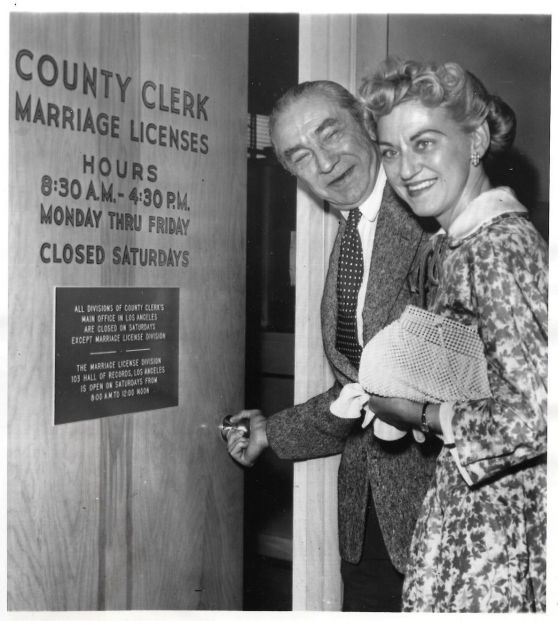
Second, he met his final wife Hope Lininger after rehab. She wrote him letters, signed “with a dash of Hope” and may have been 37 years younger than him, but she was with him for the last year of his life. After his death, she never remarried and left for Hawaii where she worked as a nurse for a leper’s colony.
Finally, the son of Bela, Bela Lugosi Jr. may have believed that Wood was taking advantage of his father’s fame, despite evidence that Wood was there for Bela in his darkest moments. That said, Lugosi’s son became an executive at Comedy III Productions, which helped heirs of celebrities to license and control likenesses.
He told the Mansfield News Journal, “It all started in law school in 1963 when someone brought to my attention that all this movie merchandise was coming onto the market with dad’s name and likeness on the products. I had never authorized Universal to use his name and likeness, so when they refused to stop using it, I filed a lawsuit claiming that the right to the commercial use and likeness survives the death of a celebrity. That ultimately went to the California legislature and the Celebrity Rights Act became law.”
By all means, watch Bela Lugosi Meets a Brooklyn Gorilla and imagine. You are at the nexus of a series of stars, of lives, of history.
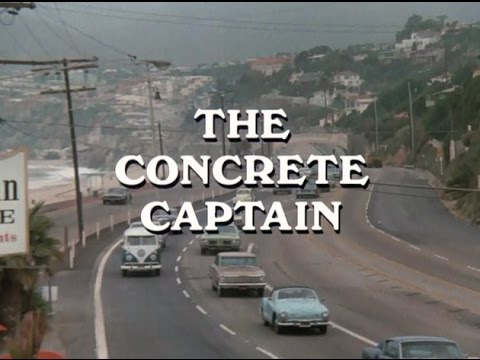
Ed Lucas (Stuart Whitman) has found his wife Kate (Gena Rowlands) the perfect souvenir. The Concrete Captain is a small chunk of concrete with a miniature harpoon in it. Lucky for him — and maybe not so good, really, when you see how it all happens — she loves it.
She’s actually obsessed with it.
The Concrete Captain ends up being real and his ghost thinks that Kate is his long-lost love Katharine. And he’s coming back for her.
This episode of Ghost Story was based on a short story by Elizabeth Walter, whose story “The Spider” was an episode of NightGallery, “Fear of Spiders.” Three more of her stories would end up in this series: “The New House,” “Pendergast” (which was called “Elegy for a Vampire”) and “Travelling Companion” (which was called “Time of Terror). The story was adapted by JImmy Sangster and Richard Matheson, which if you think about it, is pretty much as good as it gets.
This was made four years — and plenty of TV work — before Richard Donner would make The Omen and show the world just how good he was. Anyone who watched this episode would already know that, as this gothic ghost story wanders the silent and gray shores of a coastal town that’s been shut down.
José Ramón Larraz went to school for philosophy, became a comic book writer and then made some wild movies, like Whirlpool, which Roger Ebert negatively reviewed — I mean, it sounds great to me — by saying that it was genuinely sickening film. It has to do with various varieties of sex, yes, but its main appeal seems to be its violence… The violence is not, however, the cathartic sort to be found in The Wild Bunch or the comic strip spaghetti Westerns. It’s a particularly grisly sort of violence, photographed for its own sake and deliberately relishing in its ugliness. It made me awfully uneasy.” He also directed the Spanish Western Watch Out Gringo! Sabata Will Return, The House That Vanished(which had so many titles, including Scream…And Die! and Please! Don’t Go in the Bedroom, as well as a campaign that made it look like Last House on the Left), Symptoms, Stigma, Black Candles (AKA Sex Rites of the Devil) and three American co-productions before the end of his career, the underrated Edge of the Axe, Rest in Pieces and Deadly Manor.
The film starts with its leads, Fran (Marianne Morris) and Miriam (Anulka Dziubinska, billed here as Anulka; a former Page 3 girl who was the Playboy Playmate of the Month for May 1973, she was once married to Soupy Sales’ son Tony, who was in Tin Machine with David Bowie, Reeves Gabriels and his brother Hunt Sales) in bed together, which was probably quite shocking in 1974, but perhaps even more shocking is when they’re machine gunned before the credits.
They’re brought back as vampires that roam the British countryside and take in wayward male motorists, draining them of more than blood before disposing of these conquests. They have a different form of vampirism than you may have seen before, making grisly arm wounds that they continually feed from, closer to cannibals than bloodsuckers.
Beyond the gorgeous leads, the scenery is just as inviting, as this was not around Oakley Court, which Hammer used for The Man in Black, The Lady Craved Excitement, The Brides of Dracula, The Reptile and The Plague of the Zombies. William Castle shot The Old Dark House there and you’ll also see it in films like Mumsy, Nanny, Sonny, and Girly; And Now the Screaming Starts! and perhaps most famously, it was the home of Dr. Frank N. Furter in The Rocky Horror Picture Show. While it had no heat or running water when that movie was filmed, it’s now a luxury hotel.
This played double features with The Devil’s Rain! in England, which is my kind of night.
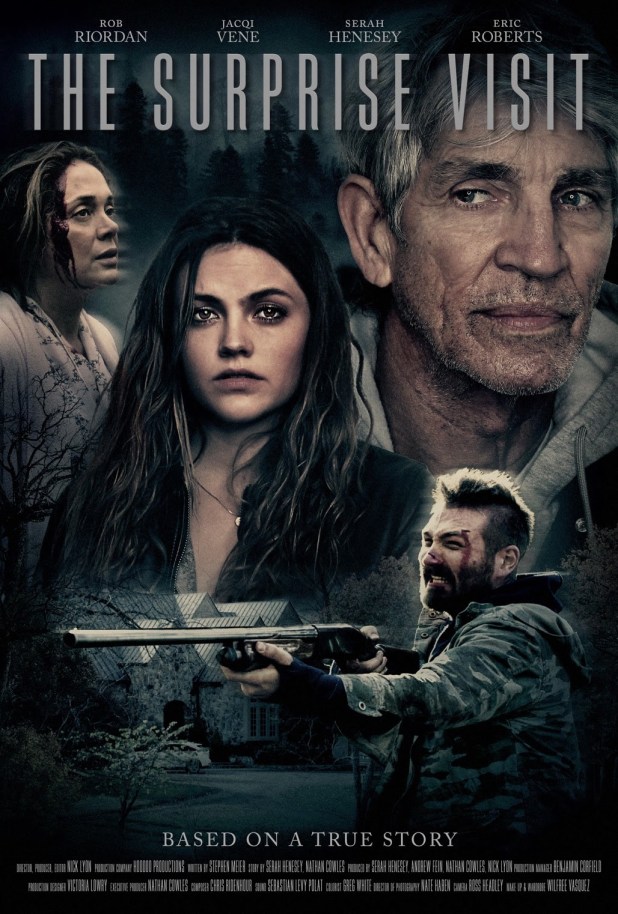
Juliette and her husband plan on surprising her mother, who ends up being out of town, which is what her gardener (Eric Roberts, who in the mid 1990s was present for a deal I made with several demons to secure the future release of several Italian and American exploitation films on a format that would come to be known as 4K; you’re welcome and I’m cursed to watch every movie Mr. Roberts makes) tells them. At the same time, his junkie son and his pregnant wife are planning on stealing from the same mansion.
Director Nick Lyon has made quite a few movies like Isle of the Dead, Rise of the Zombie and Species: The Awakening, which gives him the experience to make this movie filled with nail-biting moments. It’s an interesting idea to pit two couples against one another from different castes and at different moments in their lives.
This movie claims to be based on a true story. You know that as soon as I saw that, I was going to watch this.
The Surprise Visit is playing in theaters and is also available on demand.
EDITOR’S NOTE: We originally wrote about this movie back on September 15, 2021. Now, Kino Lorber has released it on blu ray, along with audio commentary by Troy Howarth and Nathaniel Thompson, interviews with director Dario Argento, set designer Antonello Geleng and actress Fiore Argento. There are also trailers and your choice of watching this in English or Italian with English subtitles. The slipcase release and blu ray itself are both gorgeous and I’m so excited to have this in my collection. You can get it yourself from Kino Lorber.
Look, I’ll come clean. I’ve outright written off Argento’s post-Opera work without putting the work in, but that’s because the films I have seen have upset me so greatly — and in no way a good way — that it felt like putting in the work to watch another one after Sleepless felt like, well, work.
This was originally going to be a sequel to The Stendhal Syndrome and titled In the Dark, but everything changed when Asia Argento declined to be involved.
The biggest issue is that the story is intriguing but as you wait for the visuals, nothing much happens. If this were any other director, I’d be fine with this movie. But with Argento, perhaps unfairly, I want more. I want bullets tearing through keyholes and eyeballs, bodies crashing through windows, menacing forests and colors that burn their way into my ventral occipital lobe. Instead, this looks no better than a TV procedural.
The Card Player is a masked and black gloved killer who kidnaps women in Rome, then challenges the police to play internet poker with him for their lives. If the police lose, they get to watch someone get tortured and killed Red Room-style online.
There’s a great close with a train bearing down on the killer and a victim who play poker right up to the end. Sure, the effect that follows is poor, but getting there isn’t horrible.
What is bad is that this entire movie is based around watching people play video poker. While we can argue whether or not Argento was inventing Twitch, the fact is that 1972 Dario would shoot a poker game like cards were flying at us filled with mystery and menace. Instead, we simply watch cards slowly get dealt out.
Man, Dario. I really want to see you do something great. And I get it. You already did. Maybe I should take it easier on you. But we always want more from the ones we love.
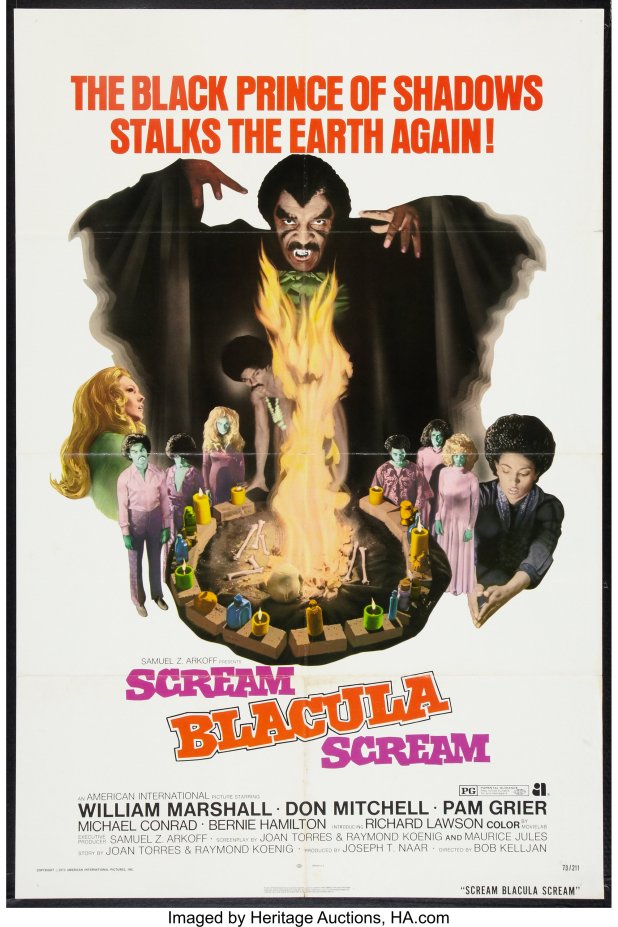
If you’re trying to be the king of voodoo, don’t bring the bones of Prince Mamuwalde back to life. Maybe voodoo queen Mama Loa knew what she was doing when she chose Lisa Fortier (Pam Grier) as her successor instead of her son Willis (Richard Lawson, Poltergeist).
Sadly, this movie has murky lighting, bad direction and a dumb story, but no matter what, William H. Marshall gives Blacula a dignity beyond this movie and Pam Grier is, well, Pam Grier. So if we just go with the magical power of this movie’s two main actors, it’s a success in spite of itself.
That said, I fully do not believe in the ending that has Lisa get upset when she sees Blacula take out some policemen.
The Medveds claimed that this was the Worst Blaxploitation Movie of All Time. Come on. In a perfect world, we also would have seen Taste the Blood of Blacula, Blacula On Sugar Hill and Blacula Sunday.
William Crane mostly worked in TV, but we always will have him to thank for directing the first African-American vampire movie (and the first Jekyll and Hyde movie for a black audience, Dr. Black and Mr. Hyde).
Prince Mamuwalde (William Marshall) represents the Nigerian Ibani African nation as they ask Count Dracula (Charles Macaulay) to help stop slavery. Instead, Dracula laughs in his face and tells him he’s going to enslave the proud black man’s wife Luva (Vonetta McGee, The Great Silence). Mamuwalde is bitten, turned into a vampire, cursed with the name Blacula and imprisoned in a coffin as his wife dies beside him.
Two centuries or so in the future, interior decorators Bobby McCoy (Ted Harris) and Billy Schaffer (Rick Metzler) buy Blacula’s coffin at an auction, opening it and unleashing his thirst on the world.
At Bobby’s funeral, Blacula finds Tina Williams (McGee), who looks exactly like his dead wife. As the vampire kills and turns people, he also begins to convince his wife’s reincarnation that they must spend the rest of eternity together. Blacula is a romantic and that — along with his dignity — makes him a vampire who stands the test of time.
Crane worked hard to keep the movie as authentic to the black experience as possible, changing Blacula’s name from Andrew Brown to Mamuwalde and the unique concept of him being an African prince before he got his fangs.
I’m all for this movie. They should have made ten sequels.
Look, this movie is horrible, but when I’m happy that it exists. That sentence could pretty much sum up nearly every movie that I write about on this site, right?
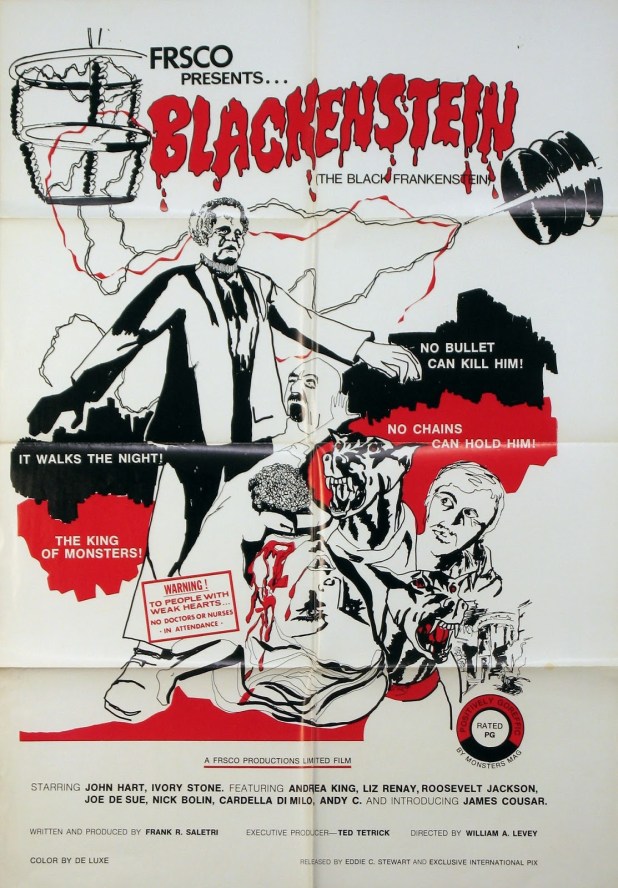
Writer and producer Frank R. Saletri had also planned Black the Ripper and while I’m confessing, I will say that I would totally watch that movie and probably love it. He also wrote Sherlock Holmes in the Adventures of the Werewolf of the Baskervilles and Sherlock Holmes in the Adventures of the Golden Vampire, movies that were supposed to star Alice Cooper as the man who lives at 221B Baker Street. However, he was killed gangland style in his home, a place where Bela Lugosi once slept. Probably in a coffin.
Doctor Stein (John Hart, who replaced Clayton Moore for one season in a Coy and Vance trick and we all know that that never works) has recently won a Nobel Prize for solving the DNA genetic code, which means that he can put body parts back on someone or make people look young. These things will come in handy, as Eddie Turner stepped on a land min back in the rice paddies of Da Nang and ended up coming back a torso.
Things go well, but Stein’s assistant Malcomb falls for Eddie’s woman Dr. Winifred Walker and so he sabotages the surgery, turning our hero into a cannibal Frankenstein with a huge afro. So how do you stop an out of control black Frankenstein’s monster? You just have some police dogs tear him apart.
At least they used the original Universal lab equipment.







 B&S About Movies
You must be logged in to post a comment.