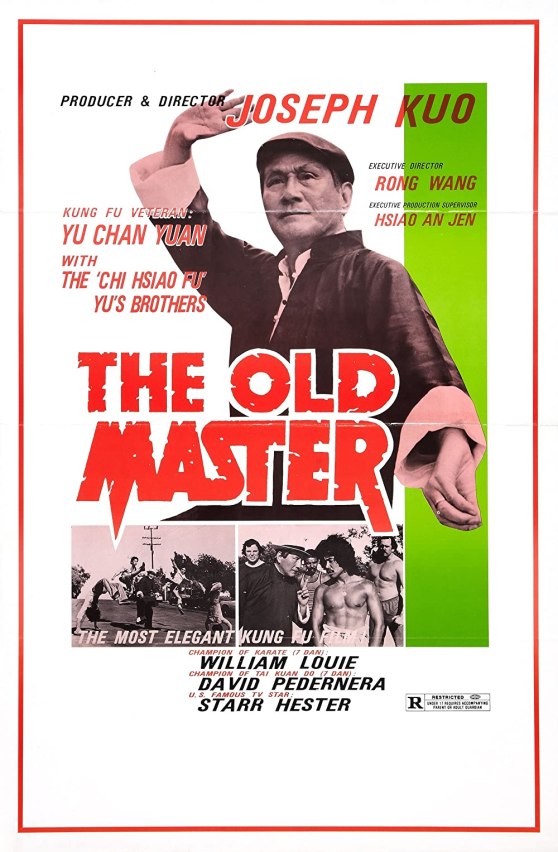
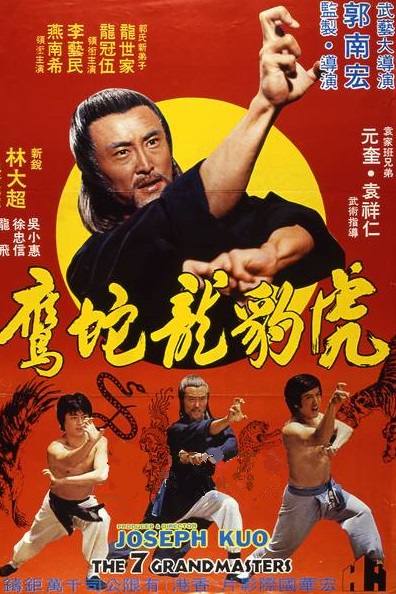
9th Old School Kung Fu Fest: The Old Master (1979)

The Old School Kung Fu Fest is back and the Museum of the Moving Image and Subway Cinema will co-present eight newly restored films and one fan favorite classic by Kuo on glorious 35mm. Four titles will be available exclusively online, December 6–13, and another five films for in-person big-screen viewing at MoMI, December 10–12. 

To see any of these shows, visit the Museum of the Moving Image online or Subway Cinema.

The Three Dragons — Sammo Hung, Jackie Chan and Yuen Biao — remain enshrined in the stars of Hong Kong — and even world — cinema. They all were trained by Yu Jim-yuen, who also taught Corey Yuen, Yuen Wah, Yuen Tai, Yuen Miu and Yuen Bun. All of these men honored him by taking on his name as their own.

Chan spent ten years studying under Yuen and was even adopted as his godson when his parents left the country. In his book I Am Jackie Chan, he described Yuen as a brutal taskmaster: “Master believed in just three things: discipline, hard work and order. Discipline came quickly and painfully, measured in strokes of the cane. Hard work was the rule of the day – a few minutes of stolen rest often meant an hour of extra practice for any unlucky students caught slacking off.”

Chan may have thought of running away every single day, but he credited Yuen as being just as much a father as his biological one, saying “Charles Chan was the father of Chan Kong-sang*, Yu Jim-yuen was the father of Jackie Chan.”

Yuen moved to America, teaching martial arts and appearing in this one and only film which is worth tracking down just to see him in action. You have to understand that he’s 74 years old here.

He plays Grandmaster Wan, who has come to America to help one of his students who now has a school of his own. He’s under attack by other schools and in debt to gangsters, so Wan helps him by defeating each of the rival dojos. However, his student has been betting on the fights and hasn’t been honest, so Wan disowns him and takes up with Bill, an honest student who wants to learn kung fu from the source.


Man, between the Yellow Magic Orchestra cover of “Firecracker,” a discofied “I’m Popeye the Sailor Man” and Patrick Hernandez’s “Born to Be Alive” this movie is nearly a disco film as much as it is martial arts. It has plenty of fights though, with Bill (Bill Louie, who was in Death Promise) taking most of the hard work on when it comes to chops, kicks and throws.

The best part of this movie is that Bill has learned his moves from a toy robot. No, I’m not making that up.

It’s also totally a travelogue movie and I’ve read a lot of reviews that say that this movie is a disjointed mess. It also has lots of corny jokes about how The Old Master doesn’t speak much English and how a larger woman is in love with him. You know, perhaps my brain is pickled from the many movies I’ve made it live through, but I found all of the incongruous moments of this movie made it that much more charming.

*Jackie Chan’s real name.

9th Old School Kung Fu Fest: Interview with OSKFF 2021 Programmer Grady Hendrix

Old School Kung Fu Fest 2021 Programmer Grady Hendrix is no stranger to this site. After all, we just covered his book These Fists Break Bricks and did an entire week around his Paperbacks from Hell and interviewed him about the influence of paperbacks on the movies that we adore so much.

We had the chance to speak with him this week to discuss the Old School Kung Fu Fest, which is being co-presented by the Museum of the Moving Image and Subway Cinema.

This is your opportunity to see eight newly restored films and one fan favorite classic by Joseph Kuo on glorious 35mm. Four titles will be available exclusively online, December 6–13, and another five films for in-person big-screen viewing at MoMI, December 10–12. 

To see any of these shows, visit the Museum of the Moving Image online or Subway Cinema.

B&S ABOUT MOVIES: This is the ninth Old School Kung Fu festival. How did you get involved?

GRADY HENDRIX: We did the first one in 2000 and people seemed to like it, so we’ve done a bunch of them. And now, we’re back again after some time off because of the pandemic.

When we first started doing Subway Cinema back in 1999 or 2000, not all of us were huge old school kung fu fans. But then, after we did the first Old School, I discovered that there’s really something about these movies on a big screen with an audience. It changes your entire relationship with it. Suddenly, it feels not like some janky panned and scanned VHS tape, but a real movie. And that made us reconsider these movies.

The more we’ve done them, the more we’ve loved them. This is our ninth year doing it, so it’s something we’ve fallen in love with by doing them.

B&S: It’s like seeing a giallo on the big screen. It makes you more forgiving of the wooden dummy at the end of Don’t Torture a Duckling.

GRADY: There’s stuff in these movies that you only realize with an audience. There’s a gap when you watch them alone and you wonder why it’s there and you realize that with an audience, you’re like, oh that was there to give everyone a minute to react before they go on to the next thing.

It’s interesting that you mention giallo, because when you watch those at home, you think it’s a little sleepy here. It’s a little slow. Watching with an audience, you’re actively watching, like what’s at the end of this hall that she’s walking down? It’s a more participatory experience.
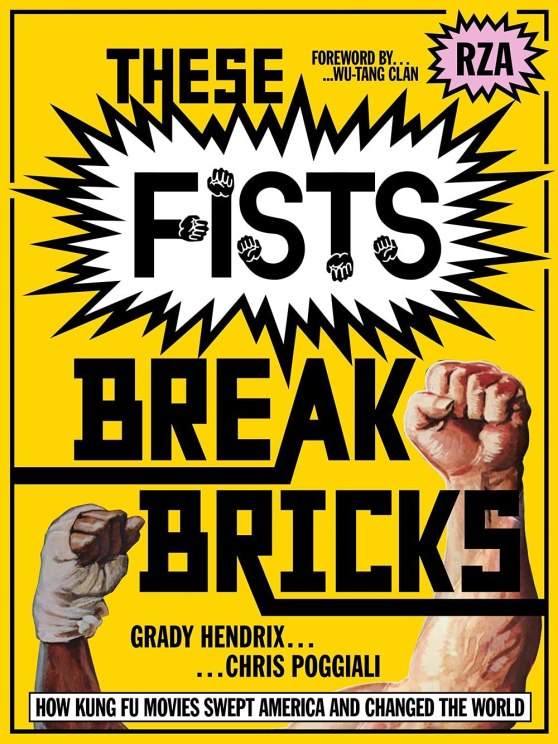
B&S: Like giallo, kung fu movies came to America and played the same grindhouses and drive-ins and found their audiences. Kung fu movies found an entirely different audience than they were intended for.

GRADY:  They speak in such a different way to different audiences. It wasn’t just that these movies had nonwhite stars, which is why black and Latin audiences love them in the States. They really work for working class audiences.

The plot of so many of these movies were about kids standing up to these forces of oppression — the emperor, the corrupt politicians, the gangsters, the local thugs who ruled their town and fighting them with nothing and you can imagine that as a 16-year-old black kid living in New York City in 1974, it can be really appealing. Most of their audiences felt like they had no power and that the entire structure of the city was designed to keep them down. It makes sense that these movies speak to them.
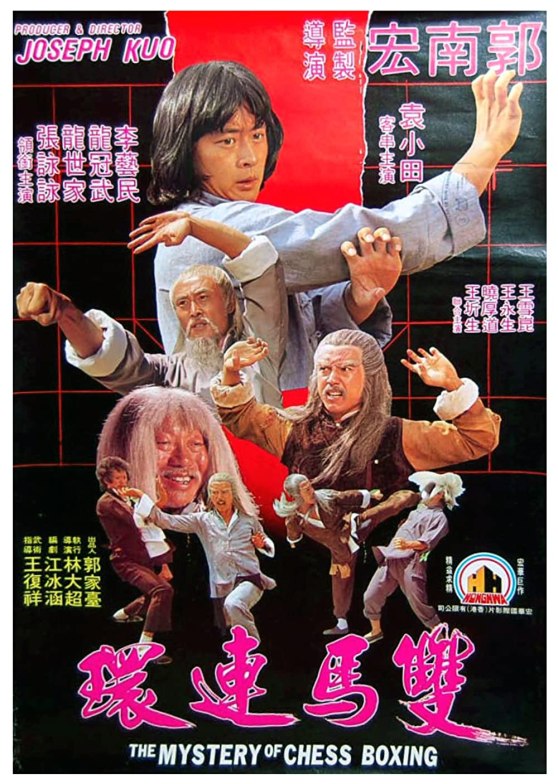
B&S: I can only imagine what it was like to be in one of those grindhouses and experience what it was like. In your book, the RZA says, “I’ll never forget the first time I watched The Mystery of Chess Boxing and hearing the entire cinema roar each time Ghost Face Killer (played by Mark Long) appeared on the screen. He was a villain killing off his enemies — in some cases in front of their wives and children — yet we walked out the theater wanting to be him, the baddest motherfucker on the screen.”

GRADY: I think that’s so important with these movies. One of the things that’s nice about screening them is you watch people after it’s over and they may have not known each other going in, but as they walk out the doors, they can’t stop talking about it. It’s not just going to see these movies to watch them on the big screen. It’s to see them with people.

B&S: Especially now.

GRADY: The movie-watching experience is at a premium now.

B&S: A few years ago, Drive-In Asylum showed three films and ended with Alice, Sweet Alice and that kind of blew everyone’s mind. They weren’t ready for the ending and you don’t get that emotional reaction watching it at home alone.

GRADY: That movie is also very grungy and bleak and just feels like New Jersey. Very 70s bleak, New Jersey, urban. l admire the commitment to doing Alice last! That last scene just gets you.

B&S: Between years of doing this festival and your book, I assume you consider yourself a martial arts fan now.

GRADY:  I started getting these movies in the 90s. Mostly Hong Kong movies and I love martial arts and I was loving some from the 80s and the 90s. Mostly the stuff that a little more wirework, a little more surreal beyond just Jackie Chan and Sammo Hung.

Going back to that older 70s aesthetic and late 60s aesthetic just wasn’t so much on my radar really until much much later. And it was a lot of it was economic snobbery. I just had a hard time watching a movie where it didn’t look a little polished.

It’s never going to be the budget of a Hollywood movie, but I felt like I couldn’t quite enjoy the budget level of an independent Taiwanese movie from the 70s or independent Hong Kong 80s movies. It took me a while to get past my own snobbery and see what’s really there.

I developed a real love of it. I mean, watching Joseph Kuo bringing out the simplest changes out of the simplest set-ups like two guys in a field kicking each other…when you watch what he’s done with that, it’s like watching a really good punk band just blast through a set. It’s simple but it’s powerful. They’re doing complex stuff within the simplicity.

B&S: I loved that These Fists Break Bricks leaves no stone unturned. Everything from the expected like the Shaw Brothers and Bruce Lee, but also Count Dante, the martial arts in comics, Godfrey Ho, even deep cut Shaw Brothers movies like The Boxer’s Omen and Black Magic.

GRADY: And there’s so much stuff we missed. I mean, there was so much more we wanted to write about. Martial arts on TV because it really had a presence in the 60s. Its influence on more music. I mean, there was just so much more. We just couldn’t fit in. We ran out of room. But it’s amazing to me how it went from zero to 60 so fast in the States and when everywhere.

B&S: I loved how you bookend everything by starting with how Asian actors could barely get work in Hollywood and end the story with just how powerful Sho Kosugi became.

GRADY: What was so weird to us was to find out that Japanese guys basically only played houseboys in movies before they started getting sent to the internment camps. And then to end with the biggest action star of the 80s, one of them being Sho Kosugi and the way he really would not let people take advantage of him. He really drove his own ship. It was really kind of breathtaking to see that.

B&S: While Chuck Norris was white, he also followed his own path.

GRADY: And that’s one of the things with Chuck Norris. And I know it comes off like we’re very down on Chuck Norris. And I’m not! One of the things I really admire is how hard he works because acting does not come easy to him.

He’s gone on record saying that it took him a really long time to get it. But he keeps doing the physical stuff on screen, even though he had a hard time. And you know, his first movie, no one wanted to make a movie with him. But he did it and he hit the road for almost a year and made it a big movie. Second movie, the exact same issue and the exact same hard work. Third movie and so on, until he gets the big studio contract and he walked out because he didn’t want to do the really violent stuff. He wanted young kids to see his movies because he feels like it’s good for them.

I really admire a lot of choices he made. I like that in some of his movies, he plays a karate instructor and you can see him teaching a class and he seems so much looser. And when he’s fighting in those scenes, he’s so limber and ferocious and you’re like, whoa. This is where Chuck is most comfortable.

I went back and watched some of the old footage of him in tournaments and he was a real bad ass. I mean, he was the real deal. It’s just that the cameras started rolling and he stiffened up and had to really fight to overcome the stage fright.

B&S: My favorite Chuck Norris quote is “David Carradine is as good a martial artist as I am an actor.”

GRADY: He was always super self-aware. One of the things I always think is interesting is that he developed this obsession with Vietnam and a lot of it was about his younger brother dying so young in Vietnam.

One of the things that was really interesting is that everyone took potshots at Chuck Norris all the way back to the beginning. Even critics who liked him would be like, well, it’s like watching an English muffin act on screen. And everyone was just so mean to Chuck Norris from the beginning. And you know, he had the last laugh, but man, he worked hard.

He was the opposite of somebody like Jim Kelly. Jim Kelly had some screen presence. If his career had been a little different, he could have been a huge movie star. He was also his own worst enemy. A lot of times he was really arrogant and didn’t do the work the way Chuck Norris did. He thought it was going to come to him.

It’s really interesting to look at the two of them and just sort of contrast them because they weren’t contemporaries. Kelly was going down when Norris was coming up, but I just always find that really interesting. Those two were on such radically different paths.
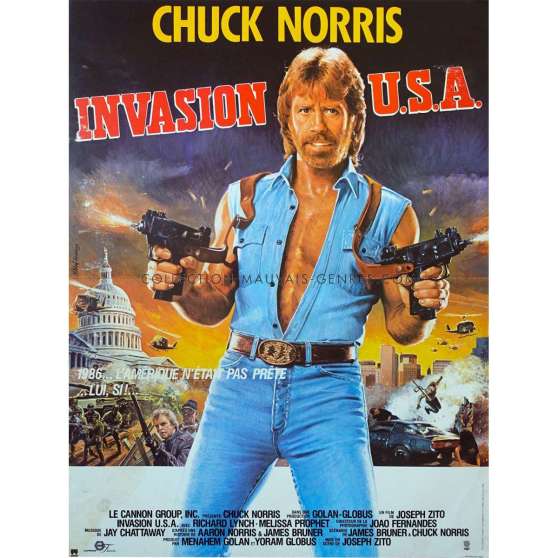
B&S: He’s still doing things. Like, he shows up for a few seconds in The Expendables 2 as the Lone Wolf and people lost their minds.

GRADY: I don’t really like his movies that much and I still have a tremendous amount of affection for his movies and nostalgia for them. (laughs)

B&S: His Cannon Films are interesting because the politics are so opposite of what I believe in, but I love those movies. Like Invasion U.S.A. is a great action movie.

GRADY: It’s the movie version of an old man reading Reader’s Digest while yelling at kids to get off his lawn.

B&S: I mean, that’s how he came up with Invasion U.S.A.!

GRADY: It’s the right wing uncle at Thanksgiving.

B&S: You did a great job on the commentary on the Trailer Trauma blu ray. Any plans for recording more commentary tracks?

GRADY: I’ve been asked a few times and one of the things I find really difficult is I really take commentary super seriously. It takes me a lot of prep work. I just got asked to do one and I turned it down because it was a movie I didn’t love enough to put in all the work. I liked it but I didn’t love it. But I’m just waiting. If someone asked me for the right movie, I am so there. I think it’s really fun to have the privilege of yammering about something I love as someone’s watching.

Want to learn more about Grady Hendrix and his work? Check out his web site to read about his books like Horrorstör (“the only novel about a haunted Scandinavian furniture store you’ll ever need”) and My Best Friend’s Exorcism (“basically Beaches meets The Exorcist). There’s also the amazing Paperbacks from Hell, which you can purchase at Quirk Books or Amazon, and These Fists Break Bricks, which you can learn more about at the official site or order this great book from Mondo.

Don’t forget! The 9th Old School Kung Fu fest has four titles available exclusively online, December 6–13, and another five films for in-person big-screen viewing at MoMI, December 10–12. Check out the Museum of the Moving Image online or Subway Cinema to learn more.

Thanks to Grady Hendrix for his time and Emma Griffiths for coordinating this interview.

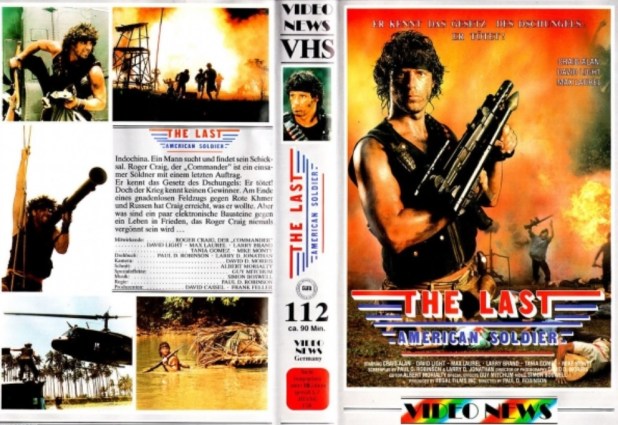
Philippine War Week II: The Last American Soldier (1988)

Directed and written by the Italian director Ignazio Dolce, who went from being an actor to directing six films of his own (the others are L’ammazzatinaLast PlatoonLeathernecksLast Flight to Hell and La Spina del Papavero), this movie finds its hero Sgt. Roger “Commander” Craig — yes, the guy’s name is is a rank higher than his actual rank — putting together his own army that stays around at the end of Vietnam and makes things so rough that the Russians need to come and help.

Now, Commando wants to bring his pregnant wife back to the United States and makes a deal with his old commanding officer to steal some important Russian electronics for two passports and a safe trip home. This leads to a Russian soldier named Vlassov blowing our hero’s adopted village up real good — many bamboo huts gave their all for this movie — and killing his wife’s entire family before taking her captive.

There are two insane things in this movie: special pills that simulate death and a water torture scene with a plastic bag that looks way too uncomfortable not to be fake. That’s the struggle that Americans in Vietnam movies set in the Philippines are willing to take for you. They will look death right in the face.

Bonus: A Simon Boswell score!

You can watch this on YouTube.

Philippine War Week II: No Dead Heroes (1986)

The most comforting aspect of these Philippine First Blood and Commando inversions is that you can always count on Mike Monty, Nick Nicholson, and Paul Vance to show up as the ubiquitously evil CIA, KGB, or General (from either the Ruskie or Yank side) with one hand over their heart — and the other in the war-profiteering honeypot.

The truth is, for as awful as these Southeast Asian namsploitation’ers can get, they are sociopolitical eye openers. Here, in the U.S., we safely experienced the Vietnam War that raged between November 1, 1955 – April 30, 1975, as “Big Three” network evening news broadcasts; the peoples of Vietnam, Laos, Cambodia lived it — in real time. And those horrors spilled into the islands of Indonesia. So, while hokey, these films do you give an understanding of how Indonesians viewed the western outsiders: as plutocrats. For the Americans, and even the Russians, not only screw each other, but themselves — with the “freedom” of the region on the bottom of the political agendas.

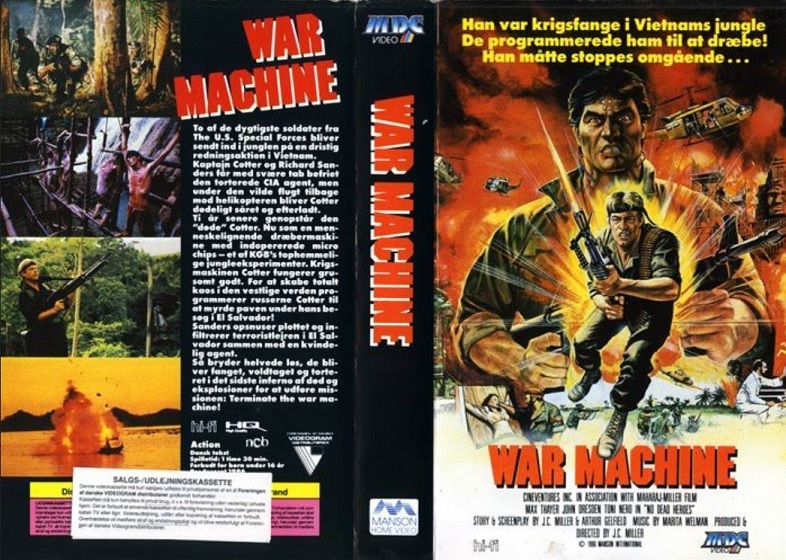
However . . . you think us Yanks get it bad in these movies: the Russians get it worse. According to No Dead Heroes, aka War Machine and Commando Massacre, the Russians have complete and total control of Central America, as they make their way up through Mexico and, eventually, into Texas (Chuck Norris’s Invasion, U.S.A ripping). All Russians hate god. All Russian men perpetually rape women. Russians will kill anyone and everyone, the young and the infirm be damned. Do they love their children too, Sting? Eh, maybe. But they do hate all the non-Russian kiddies.

“Ack. What are you doing? Political insights in a review of a Philippine war flick?”

Yeah, you’re right. Back to the mindless drivel.

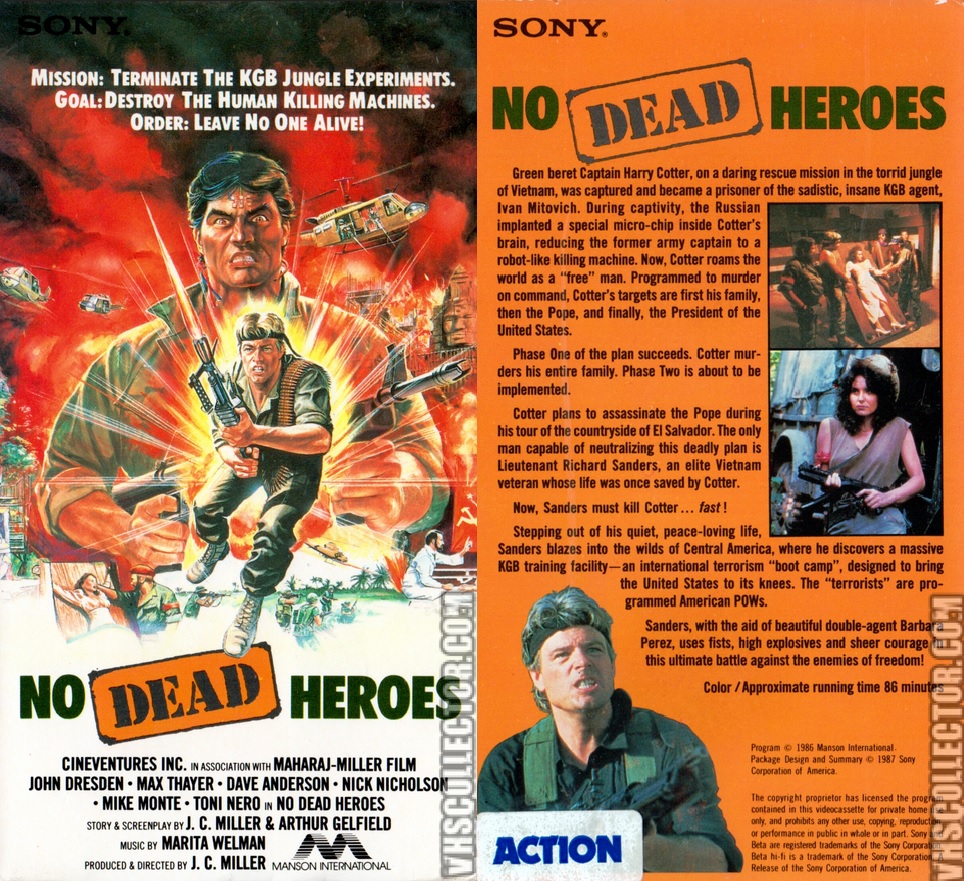
First off: I am burnt out on my PWF binge this week. You know the “plot” of these films, by now, right? And Sony did a pretty decent job in the art and copywriting departments with the VHS marketing: so read the sleeve for the plot.

No, I can’t be that remiss in my reviewing duties. Besides, that copy could use some simplification.

Paul at VHS Collector with the clean jpeg assist!

So, we have an over-the-top Russian General conducting KGB experiments at a Vietnam prison camp. And we send in Richard Sanders and Harry Cotter (Max Thayer and John Dresden) to save the prisoners from the insane experiments. What’s “insane” about them: VC operatives are supplying Americans for the Russians to stick microchips into their brains (Hey, it’s the Apple-DOS ’80s*) to turn them into “robot assassins” via a Russian agent’s wristwatch controller.

Natch, Cotter’s not very good at his black-ops missions and wet work assignments, since he — as do all of our heroes in these Philippine war flicks, for we’d have no “plot” to speak of — is captured. Of course, he’s implanted with a chip.

Flash forward ten years . . .

Cotter — after “a command” to kill his family — is sent out on assassination missions, such as to kill the Pope and, eventually, the President of the United States. Of course, we don’t have the budget for anything to be shot in the U.S. or at the Vatican, so his Holiness conveniently tours the oppressed believers of El Salvador, aka the jungles on the outskirts of Milan. When the plan is discovered, the only man for the job is the only man who “thinks” like Cotter, which is his old friend and fellow soldier, Richard Sanders, from that botched mission from ten yahrens ago.

So, in addition to First Blood, Commando, Missing in Action, and Platoon, we’re in a pinch of Jean-Claude Van Damme and Dolph Lundgren’s Universal Soldier, along with a dash of the political thriller The Manchurian Candidate — which you most likely know for the 2004 remake with Denzel Washington, but this one pinches from the John Frankenheimer version made in 1962 with Frank Sinatra.

So, all of the expected spliced-in-clips from other films, awful dubbing, poor editing, distorted music, out-of-place sound effects that sound nothing like the actual weapon portrayed, dialog that cuts off cold before an actor can finish a sentence, ensues. It’s like a mixed-up baffle-job of the Alfonzo Brescia Italian Space Opera variety: only we are not in space and Uncle Al didn’t make it (we love ol’ Al’s Star Wars rips!).

On the upside: this one does bring on the blood. There’s so many bodies dropping, you start to lose count. Which is why we’re here in the first place: the blood and hut explosions. Get the hell out of here with that “plot” and “acting” nonsense.

Now, lets get down to what’s under the VHS sleeve.

A hero under any other name.

Our director, Junn P. Cabreira, aka the Americanized J.C Miller, amassed 42 directing and 10 writing credits in a career that stretched back to 1974. But none of those mostly Filipino/Tagalog-titled films — even in the product-rabid VHS ’80s — received widespread distribution beyond their Indonesian homelands. Sure, there’s a few English-titled films that might have hit the Western drive-in circuits, possibly even home video shelves, with titles such as The Deadly Rookies (1978; starring Willy Milan!), The Tiger and the Lady (1979; starring 380-credits strong Romy Diaz), Cover Girls and Hotel House Detective (both 1981; with 600-credits Indonesian leading man Eddie Garcia), and Dope Godfather (1983, 200-credits Vic Vargas). Then there’s something called Eastwood and Bronson (1989) that, based on the title — and the fact that Indonesia “matinee idols” Richard Gomez and Joey Marquez channel Clint Eastwood and Charles Bronson in a rip of an U.S. “buddy cop” film — I want to see it even more (Magsalita tungkol sa demonyo! As of October 2021 — several months after writing this — there’s a non-dubbed copy on You Tube! Mahusay!).

What helps this Rambo-rip entry is that it was made specifically for distribution outside of Indonesia with English-speaking audiences — especially the Rambo-swamped U.S. — in mind. While they were not “stars,” well, they are at B&S About Movies, we have Max Thayer (Planet of Dinosaurs, No Retreat, No Surrender 2) and John Dresden (Big Bad Mama II) as our John Rambo and John Matrix stand-ins. Both actors struggled for a foothold in American TV and films, only managing bit parts, but forged a fruitful co-starring and leading man career in Indonesian cinema with roles in Cirio H. Santiago’s Final Mission (coming this week, search for it), Teddy Page’s Phantom Soldiers (coming this week, look for it; we are writing ahead, here), and the Cameron Mitchell-starring Raw Force (nope, you’re on your own, we can’t watch them all).

But thanks to Sly Stallone, Arnold Schwarzenegger, and Chuck Norris — and to a lesser extent, Oliver Stone with Platoon — igniting a cottage industry in Indonesia, we will remember Junn P. Cabreira the best — well, the only film, really — for his Rambo Namsplotation entry.

Ugh. Not again. We had freebie ready to go and now it’s gone. Thank goodness for watching early and taking notes in my ol’ spiral notebook. Yeah, there’s a couple other free streams out there, but the links are iffy: just don’t do it. And that’s too bad, as I like this one and I think you will to, as it is one of the better Rambo clones, courtesy of Max Thayer and John Dresden, along with the familiar faces of Mike Monty, Nick Nicholson, and Paul Vance. Eh, give this 7 minute clip a spin to see if you want to go the full (Mike) monty.

*More A.I tomfoolery with these features!

About the Author: You can learn more about the writings of R.D Francis on Facebook. He also writes for B&S About Movies.

Philippine War Week II: Mission Terminate (1987)

We come here, not to bury Philippine Namsplotation films, but to praise Richard Norton. That’s right, kids: it’s another B&S About Movies film-geek fandom joint.

Aussie actor Richard Norton got his start in Chuck Norris’s The Octagon (1980) and Forced Vengeance (1982), contributing to multiple episodes of CBS-TV’s Walker, Texas Ranger, starring in Robert Clouse’s Force: Five (1981) and Gymkata (1985), and with Michael Dudikoff in American Ninja (1985). And do we really have to remind you that Richard Norton starred as Slade in the great Cirio H. Santiago’s Philippine post-apoc’er Equalizer 2000 (1987)? Well, now you know: Richard Norton is right up there with Mark Gregory, Michael Sopkiw, and Daniel Greene on the B&S About Movies A-Team.

While we haven’t seen all of Richard’s almost 70-and-climbing credits, we’ve seen most of them. And some are great — like the films we’ve mentioned — while others are not so great. There’s not another actor that’s more hard working, who was stuck in some questionable projects over the years, who started out as a bodyguard to the Rolling Stones and personal trainer to Mick Jagger. We reviewed his most recent effort, if you’re interested: the 2021 Australian crime-thriller, Rage.

See. The fanboy section of the review has ended. That didn’t hurt. Back to the movie . . . and to hell.

Also known as Return of the Kickfighter, the plot concerns, you guessed it: more corrupt American soldiers on a war-profiteering tear, democratic freedom on the Indonesia mainlands, be damned.

So, to the chagrin of their Vietnamese guide (Asian Martial Arts mainstay and Brucesploitation star Bruce Le), a U.S. marine unit raids a Vietnam village — for a gold stash — and they kill the villagers.

Yes. Of course, we “flash forward” ten years. Haven’t you been paying attention at all this week? That “flashback” set up is how all of that old ’70s war footage is clipped into the film, so as to up the production values.

Well, eh, actually . . . this time, it’s 15 years. And someone is murdering the members of the unit — one by one. And the chicken shit leader of that raid, now a high-ranking officer with a cushy government desk job with the Pentagon, needs to clean up the mess. So, with a little lie there and half-truth there, he sends in the only man for the job (again?): Pentagon black-ops agent Major Brad Cooper, aka the man we came to see, Richard Norton. But Cooper gets wise pretty quick and figures his Pentagon boss, Col. Ryan, committed the atrocity all those years ago. So Cooper is sidelined from the mission. But Cooper goes rogue. And his “mission” objective changes.

He meets Quan Niehn, the Vietnamese guide from 15 years ago. Turns out, Quan and his brother nursed an injured Ninja Master hurt in that raid back to health and, in payment, the Master taught the brothers the ways of the Ninja. Then the brothers went “Cain and Able,” with Quan to the good Vietnamese side and his brother to the evil Viet Cong side. And the plot twist is that we think Quan is killing the members of the unit, but it’s really his evil brother — the leader of a secret, Mountain stronghold terrorist boot camp. So, once Quan and Cooper make nice, Coop calls in his old Queen’s Cobras unit to kick the evil brother’s ass. The firefights and explosions and bodies plowed down by more bullets than John Rambo and John Matrix can handle, ensues.

What makes this work is the martial arts, something Sly and Arnie couldn’t bring to the table. The Return of the Kickfigther handle is clearly the more effectively, descriptive title, with Bruce Le (1978’s Return of the Red Tiger and Enter the Game of Death) and Hong Kong action star Dick Wei (1978’s Five Deadly Venoms and 1980’s Claws of the Eagle) mixing it up with Richard Norton — who keeps his Australian accent on-camera (a HUGE difference in quality for this film against most we’ve reviewed this week), which is explained away as being an “All American” since he was trained by the American military.

Ugh. The full movie was uploaded when we made the schedule — now it’s gone. Well, you can at least watch this “Kill Count” montage and eight minute fight scene (embedded above) between Richard Norton and Bruce Le on You Tube. Director Anthony Maharaj, here in his debut, got his start as a screenwriter with the Philippine war flick Final Mission (reviewed this week; look for it) and the post-apoc’er Future Hunters for Cirio H. Santiago. Maharaj and Norton worked on a second Indonesian war flick, Not Another Mistake (1989) — no, we didn’t review that one, this week. You can’t do ’em all.

About the Author: You can learn more about the writings of R.D Francis on Facebook. He also writes for B&S About Movies.

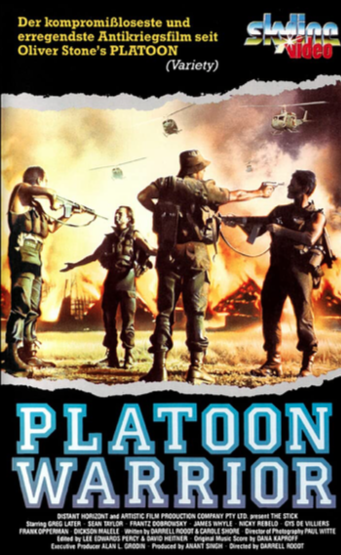
Philippine War Week II: Platoon the Warriors (1987)

Take the 1984 Filipino movie Diegong Bayong, get some footage from Hong Kong, throw it in a blender and boom, you have Platoon Warrior or Platoon the Warriors and yes, if you’re wondering if this has something to do with Godfrey Ho of course it does.

Jack Barlow (Anthony Alonzo) has lost his son, father and mother to a gang who puts the cherry on the top of the Death Wish cosplay sundae by assaulting his daughter.  And that would be the Diegong Bayong parts, as he gets one gang to kill another gang which seems, well, nothing like either PlatoonThe Warriors or anything Death Wish.

There’s also a two and a half minute love scene from that movie repurposed, remixed and reused here and — of all things — set to Kraftwerk.

Somehow, this trailer is a billion times better than the actual movie.

This movie is also not the Michael Dudikoff vehicle Platoon Leader.

It’s…man Godfrey Ho and his crew are wild because this is such a puzzle of so many things jammed together that I have no idea what I’m to get out of it. I was expecting an 80s jungle film and I got something else but then it went back to the jungle.

Look, in the Philippines, they make spaghetti with banana ketchup and cut up hot dogs and that makes more sense than what I just watched.

You can watch this on Tubi.

Achoura (2021)

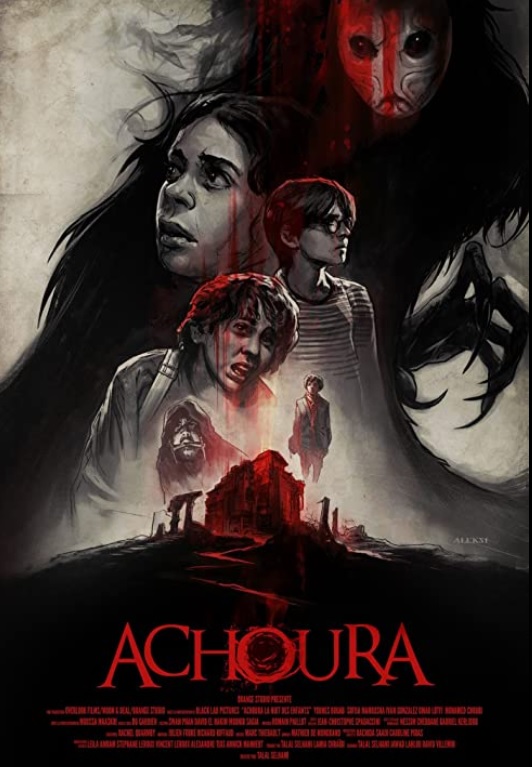
If you enjoy the cultural horror twists of Mexican filmmaker Guillermo del Toro — not so much the U.S. studio tentpoles of Mimic and Hellboy, but of Pan’s Laybrinth, The Devil’s Backbone, and Cronos — you’ll enjoy this France-Morocco co-production that first appeared in the overseas theatrical marketplace in 2018.

Described by its studio as the recent reboot of Stephen King’s IT: Chapter One meets the 2014 Australian box office hit, The Babadook, Achoura, aka Children’s Night, concerns four reunited childhood friends — one that disappeared 25 years earlier — celebrating “Achoura,” a Moroccan religious celebration. As with the Stephen King tale: a creature from their past returns and forces them to confront the errs of their youth.

Is it all too reminiscent of King? Maybe. Is that a bad thing? Not in the least, as the film is effectively well-made. The truth is: if we’ve learned anything from international films: no matter how different the cultures, our ancestral folklore — and the fears of them — are all the same.

Achoura makes its domestic debut on U.S. shores on December 14 through Dark Star Pictures on all streaming platforms and DVD. We’ve also recently reviewed the studio’s newest November and December releases of Ankle Biters, Beyto, (search for both, this week) and That Cold Dead Look in Your Eyes. You can view more of the studio’s trailers on their You Tube page.

88 FILMS BLU RAY RELEASE: Disciples of Shaolin (1975)

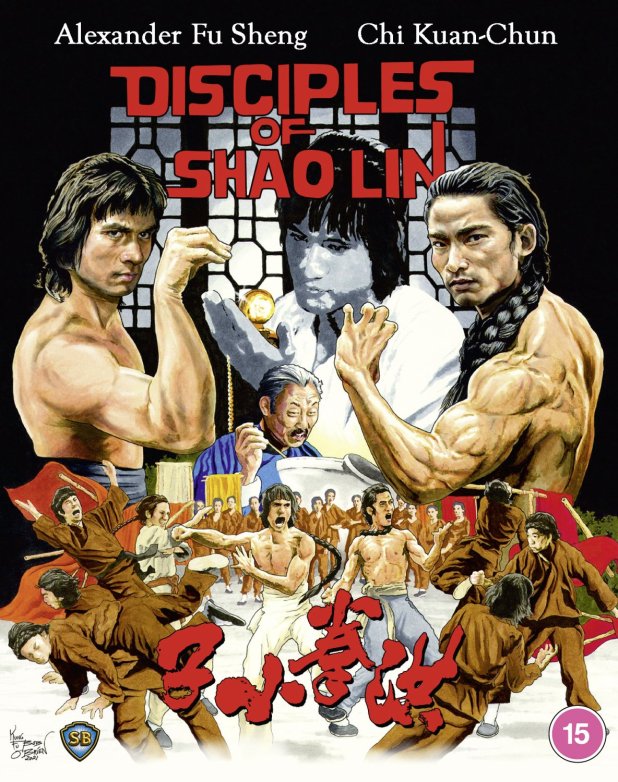
Guan Feng-yi (Alexander Fu Sheng) and Huang Han (Chi Kuan-chun) are a yin-yang of heroes. Where Guan Feng-yi is an impulsive young man ready to fight at any time, Huang Han is dignified and given to deep thought. The Chinese title — The Hung Boxing Kid — makes more sense as this isn’t really a shaolin movie. It really resembles two other movies that Chang Cheh directed for Shaw Brothers, The Boxer from Shantung and The Chinatown Kid.

Together, the heroes protect a textile mill from a rival mill owned by a ruthless Manchurian lord. However, the lure of money and power may be too much for one of our leads. While Guan Feng-yi once only wanted shoes for his feet, he soon learns that the world can pay him so much more.

The really crazy thing about this movie is how many Italian movies it takes its soundtrack from. There’s Gianni Ferrio’s “Crescendo Trionfale,” “Step by Step,” “Anonima Assassini” from La Poliziotta; Claudio Mattone’s “Celio in Amore,” “Tema di Nico, pt. 4,” “Arioso,” “Cugini Carnali” and “Tema di Nico” from Cugini Carnali; and Ennio Morricone’s “Alone in the Night” and “Anger and Sorrow” from Death Rides a Horse.

The 88 Films release of Disciples of Shaolin has two sets of audio commentary, one by critic and author Samm Deighan and the other by Mike Leeder and Arne Venema. There’s also an interview with Jamie Luk, a trailer and the first run will have a slipcase, booklet and poster. It’s a gorgeous package and release. You can get a copy from MVD or Diabolik DVD.

ARROW VIDEO SHAW SCOPE BOX SET: Shaolin Temple (1976)

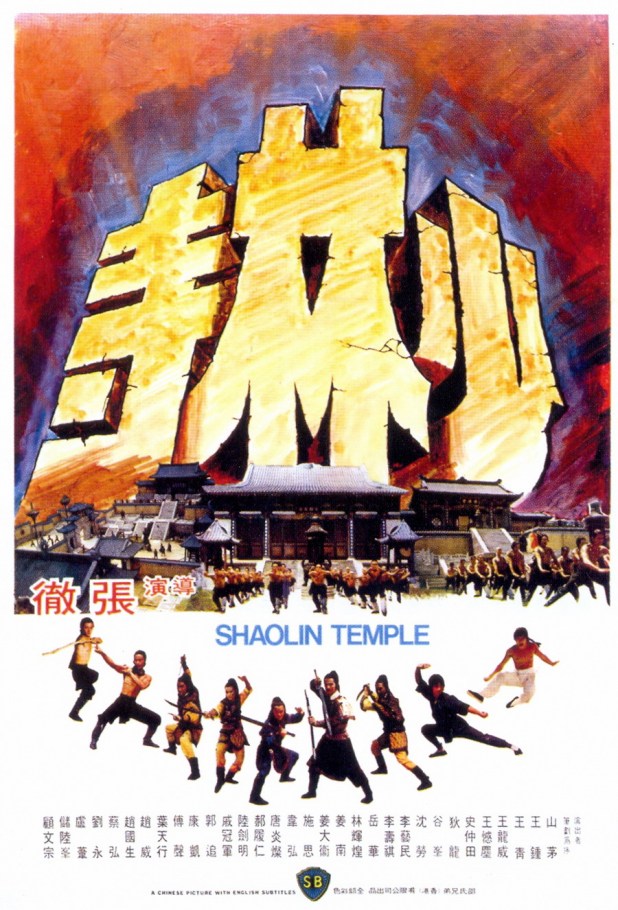
Filled with the stars of the second and third generations of director Chang Cheh’s stable of actors such as Alexander Fu Sheng, David Chiang, Ti Lung and Chi Kuan-Chun, as well as several of the actors that would later become collectively known as the Venoms Mob, Shaolin Temple — also known as Death Chambers — is so much more than just the prequel* to Five Shaolin Masters.

The leaders of the Shaolin Monks have started to come to the conclusion that time is running out and they must train more fighters to fight the Qings, yet they’re still forcing fighters to sleep outside the temple for weeks at a time to test their resolve.

Two of those fighters — Fang Shih Yu and Ma Chao-hsing — are accepted and must survive the even harsher world that is inside the temple. Fang Shih Yu struggles to learn tiger boxing and keeps failing until a mysterious person begins teaching him the tiger-crane style, which makes him a much stronger fighter.

Yet will all the training — and new monks — be enough when the Qing army attacks and attempts to burn the temple down?

This movie has an amazing training sequence that lasts ten minutes within the maze inside the temple. You have to respect people that only are concerned with fighting and meditation when they’re not building thrill rides that beat people into submission. And the last half an hour is one gigantic fight as the monks use all the skills that they’ve learned in the film.

*Actually, it’s the fifth part of the Shaolin Cycle, following Heroes Two, Men from the Monastery, Shaolin Martial Arts, Five Shaolin Masters and The Shaolin Avengers.

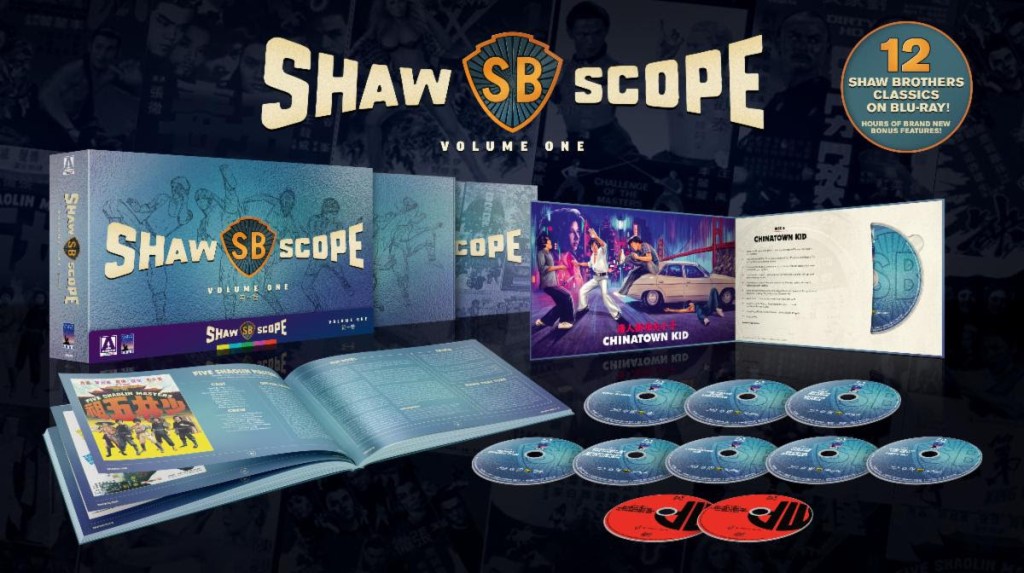
The Arrow Video Shaw Scope Volume One box set has Shaolin Temple with uncompressed Mandarin and English original mono audio, as well as newly translated English subtitles and English hard-of-hearing subtitles for the English dubs.

It also has an alternate standard-definition version and opening credits, as well as Hong Kong and German trailers.

You can get this set from MVD.

You can also stream this movie on the Arrow player. Visit ARROW to start your 30-day free trial. Subscriptions are available for $4.99 monthly or $49.99 yearly. ARROW is available in the US, Canada, the UK and Ireland on the following Apps/devices: Roku (all Roku sticks, boxes, devices, etc), Apple TV & iOS devices, Android TV and mobile devices, Fire TV (all Amazon Fire TV Sticks, boxes, etc), and on all web browsers at https://www.arrow-player.com.

9th Old School Kung Fu Fest: 7 Grandmasters (1977)

The Old School Kung Fu Fest is back and the Museum of the Moving Image and Subway Cinema will co-present eight newly restored films and one fan favorite classic by Kuo on glorious 35mm. Four titles will be available exclusively online, December 6–13, and another five films for in-person big-screen viewing at MoMI, December 10–12. 

To see any of these shows, visit the Museum of the Moving Image online or Subway Cinema.

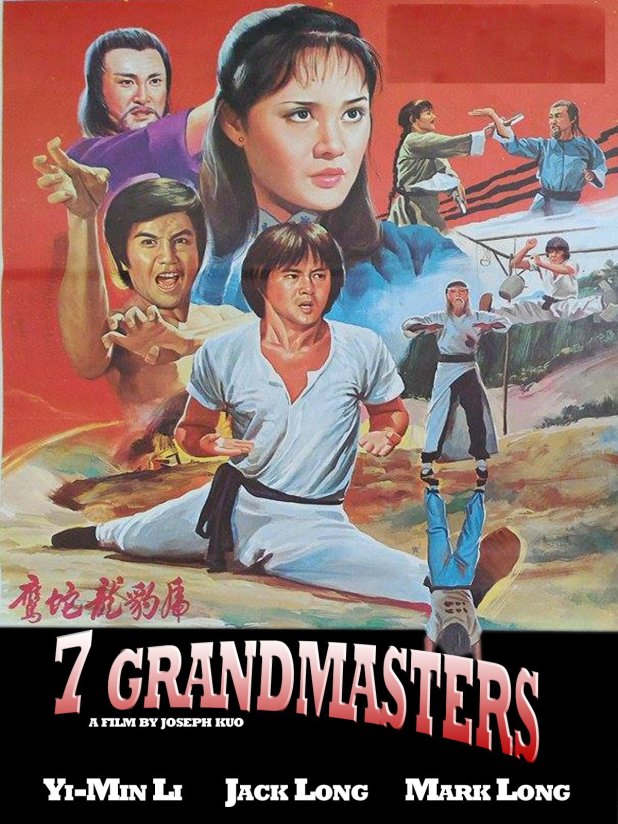
Sang Kuan Chun is ready to retire. After all, he’s done it all and has nothing to prove until he gets a note that says that he’s not the best and must challenge the seven grandmasters to prove that he — and his style — are the best. Sang Kuan Chun goes on a journey with his four best students — and soon picks up Siu Ying who wants revenge — to challenge each of the schools. And let me tell you, this is not bs, as I once was part of a small martial arts group that would go school to school and challenge their students to prove that we had the best fighting style. Look — I’m no master of chess boxing and am just one of those gotta be dumb, gotta be tough fighters. So just imagine walking into a martial arts school in the suburbs and being like, “We want to fight your best guy.” I felt like Yoji Anjo challenging Rickson Gracie a lot of the time.

Before Sang Kuan Chun’s teacher died, he gave him a book of the Pai Mei Twelve Strikes. There was a masked man who stole three of those strikes — and also set up Sang Kuan Chun to kill Siu Ying’s father — and who is mathematically the better fighter because he knows all twelve of the deadly strikes. That man teaches Siu Ying the final strikes and leads him to nearly kill the teacher until he remembers the rule of never killing anyone if it can be avoided.

Once the masked man is revealed, there’s still one final battle.

Look, 7 Grandmasters isn’t the best martial arts movie ever, but it’s got a story that breaks from the norm and the idea that there’s always one more strike and always someone better than you rings true. It’s definitely a blast to watch.