Lt. Colonel Glenn Manning (Glenn Langan) has been given orders to keep his men safe from a nuclear blast, but when a civilian glider crashes close to the area, he races out to save the day. He ends up getting blown up real good — one would argue exactly like Dr. Bruce Banner five years later — and has third-degree burns all over his body. Then, the bad news. The plutonium blast has caused his old cells to stop dying while the new ones multiply at an accelerated rate. That means that he’s growing ten feet a day and there’s no sign of it stopping.
Before long, his heart and brain can no longer support him and he’s running wild, decimating the olf Vegas strip and throwing giant syringes at scientists before taking a tumble off the Hoover Dam directly into next year’s War of the Colossal Beast.
Jim Nicholson of American International Pictures made this movie because The Incredible Shrinking Man was a success and he had the rights to Homer Eon Flint’s The Nth Man, which is about a man ten miles tall. Charles B. Griffith was hired for the script ad Roger Corman was brought on board to direct but soon dropped out. You know, if you’re going to make a movie with way too big or way too small people, get the man whose very name says BIG: Bert I. Gordon.
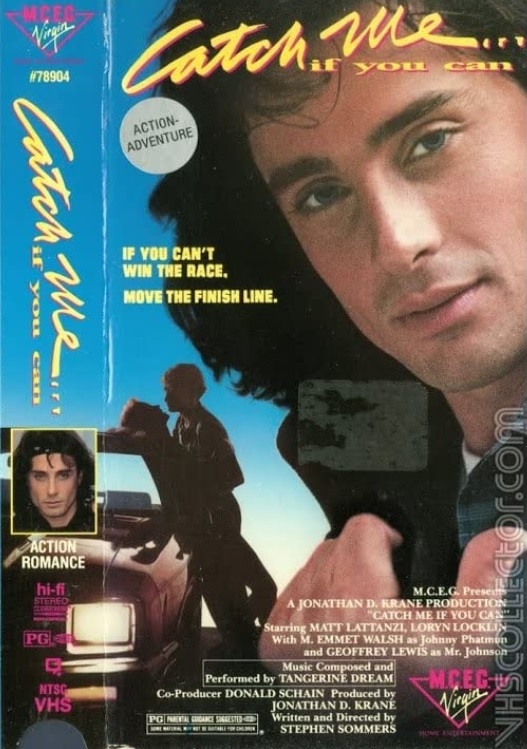
Well, as with the previously-reviewed-this-week Corey Feldman-fronted Round Trip to Heaven, this Down Under car flick is a doublesploitation whammy: we all know what makes a carsploitation movie . . . but what makes a teensploitation movie, now that’s the question.
Well, for me, it’s when your film has 30-year-old teenagers — in this case, our stars of Matt Lattanzi, Loryn Locklin, Grant Heslov, and Billy Morrissette (Severed Ties!), who were 30 and 21, 26, 27, respectively — and no matter the filmmaker’s intentions — you’ve made a teensplotation movie. Yes, even when your film is loaded with classic cars, hot-rods, and muscle cars and qualifies it as a carsploitation movie.
The filmmaker in this case . . . isn’t the usual, expected filmmaker. No, it’s not Albert Pyun. It’s not David DeCoteau. It’s not Fred Olen Ray.
It’s Stephens Sommers.
Yes. The same Stephen Sommers — in his writing and directing debut — known as the writer, director, and producer behind The Mummy, The Scorpion King, and G.I Joe franchises. Meanwhile, actor Grant Heslov became a producing partner with George Clooney and received four Oscar nods and one win (2012’s Argo).
As with the countless teen movies dating back to the ’50s, we have a gaggle of teens who — in addition to not being teenagers and are far more intelligent and resourceful than your typical, goofy teenagers (at least when I was in school) — work together in the ‘ol “Let’s save the teen center, gang!” plot of old. Only this time: it’s the ol’ “save the school” plot.
Of course, the school will be saved by resident “bad boy” Dylan (Matt Lattanzi of Xanadu and My Tutor) who sidelines between the reading, writing, and arithmetic as an illegal street racer. Dylan convinces the school’s resident goody two-shoes (Loryn Locklin, in her acting debut; her next was the inane Jim Belushi comedy Taking Care of Business) to bet the $3000 already raised on an illegal race he knows he can win — and turn that 3-grand into the needed 200-grand to save the school.
That’s right. He doesn’t win.
Explore the soundtracks of Tangerine Dream!Catch Me If You Can is one of their many scores.
Now, the adults — school board administrators, mind you — are sanctioning an illegal, winner-take-all road race, with Dylan against the town legend. You know, just like any school board would handle a funding crunch that’s closing a school.
Look, the proceedings are cliched and utterly unbelievable. The teens don’t behave like teens (as in my Bruno Kirby guilty pleasure with the high school politics comedy, 1978’s Almost Summer) and the adults don’t carry themselves as roll models (of which Almost Summer had none, well, except for the adult-as-teens actors). But we have M. Emmett Walsh (who runs the local gambling syndicate backing the races) and Geoffrey Lewis (our principal) as the “responsible” adults, Loryn Locklin looks great in saddle shoes, there’s no cheese in thespin’ department, the driving and stunts (an old Chevy jumps through the school’s football field goalposts in a highlight) are top notch, and the ’50s and ’60s tunes (Elvis, Del Shannon, the Platters, Danny and the Juniors; but Tangerine Dream scores) give this homage to Sommers’s old hometown days of growing up in St. Cloud, Minnesota (where this was shot), a nice retro-juvenile delinquency flick of the ’50s feel — which is the whole point of the movie. And a fun movie to watch.
Sure, even at a production budget at $800,000, this car flick still bombed in the U.S., but cleaned up in the overseas markets — especially in Australia — where it made $7 million, courtesy of Matt Lattanzi then being the first husband of singer-actress Olivia Newton John. Meanwhile, in the U.S., it was HBO and Cinemax to the rescue, turning it into a cult classic.
Oh, and by the way, don’t confuse Catch Me If You Can with the other Aussie car flick we’ve reviewed, Freedom, which stars Matt Lattazni lookalike Jon Blake. That’s a whole other, carsploitation movie (and carries the soundalike “grab it while you can” tagline on its one-sheets).
Need more car flicks? Check out two-part Fast and Furious tribute weeks!
We had this writing and directing debut by Stephen Sommers on our review backburners for quite a while (sorry, Steve) and never managed to fit it into our two “Fast and Furious” weeks of reviews (HERE and HERE) of, well, Carsploitation films. We’re also guilty of passing over Catch Me If You Can (again, sorry, Steve) as part of our “Exploring” tribute to the film soundtracks of Tangerine Dream. So, we do get them, eventually.
You can stream this really great car flick on Vudu without commercials. But we found a copy on You Tube — here’s the trailer. As you can read from the You Tube upload comments, everyone loves this movie. Why it didn’t click with theater audiences and turn Matt into the next Tom Cruise is anyone’s guess. So goes the power of HBO and Cinemax endlessly replaying movies back in the ’80s.
About the Author: You can learn more about the writings of R.D Francis on Facebook.He also writes for B&S About Movies.
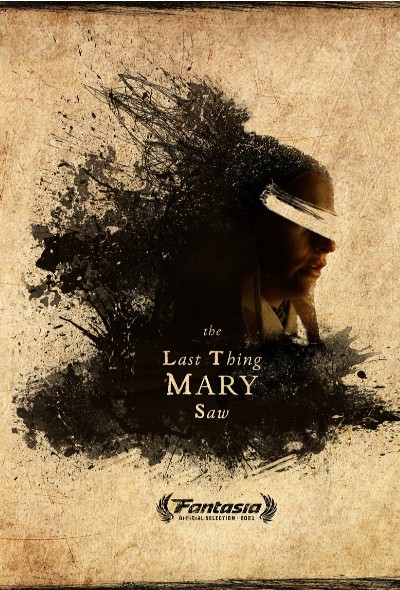
In 1893 Southhold, New York, dark doings are afoot.
Mary (Stefanie Scott, Insidious: Chapter 3) starts this film blindfolded with blood pouring out of her face, being interrogated in the wake of the death of her grandmother (Judith Roberts from Dead Silence and Eraserhead, known as The Matriarch). There’s also the matter of Mary’s relationship with Eleanor (Isabelle Fuhrman, Esther from Orphan), the family’s maid.
The family has the Word of God on their side and takes the relationship between the two girls as a sin against the Lord, so they’ve been dealt with incredibly harshly. But when The Intruder (Rory Culkin) arrives, things suddenly take a turn down the Left Hand Path.
First-time feature writer/director Edoardo Vitaletti takes viewers to a time and place they may have visited before, but that doesn’t mean that there’s any less opressive dread in this dark tale of religion taken too far, where being unable to say the Lord’s Prayer can get you killed.
By the way, have you noticed how many movies feel the need to break down their narrative into chapters these days? I’d opine that it’s more due to the influence of cable narrative than books, but it really does feel like this technique is being used in nearly every modern horror film I’ve watched as of late.
A dark film that values look and feel over a story that really comes together, this is at the very least a strong vision from a first-time filmmaker that will definitely win over some fans and point to a strong career taking what one hopes are its first steps toward greatness. This has been picked up by Shudder and will debut their in early 2022.
This week, we’re joined by Ben Raphael Sher, the producer of Eli Roth’s History of Horror, for a night of movies that we’ll figure out how they fit together when we get to it. We’ll be starting at 8 PM EST on the Groovy Doom Facebook page where we’ll talk about the movies, see the ad campaigns, make two cocktails and more.
Up first is 1984’s honor student by day, hooker by night Angel! Man, if you were in a video store in the 80s, you saw this one and you probably brought it home. You can watch it on Tubi.
While you don’t need to drink during these movies, we do love to make mixed drinks. Please, as always, enjoy them responsibly.
Hollywood Hooker
2 oz. vanilla rum
2 oz. coconut rum
1 oz. cranberry juice
1 oz. pineapple juice
Pour all of the ingredients into a shaker and mix until its as cold as possible. Seriously, shake it up like your name is Razzle Dazzle.
Serve over ice and stay off the boulevard!
Our second movie is one that I can’t wait to watch with our audience. 1988’s Pin is one of the strangest ones we’ve shown and just imagine what that entails. You can watch it on YouTube.
Here’s the beverage for our second feature.
Sex in the Doctor’s Office
1 oz. triple sec
1 oz. peach schnapps
1 oz. Chambord
1 oz. Midori
2 oz. grapefruit juice
Pour all the ingredients into a shaker, grapefruit juice last.
Edward L. Cahn was a director who got work done. There’s his work on American-International Pictures, his Our Gang comedies and a movie that inspired Alien — which inspired a lot of movies in its wake — called It! The Terror from Beyond Space. He also made Invisible Invaders which has pretty much the same plot as this film.
A killer with the fingerprints of a dead man that leaves radiation behind? Yeah, that’s the kind of mystery that we can get into. Mob boss Frank Buchanan (Michael Granger, who was the original Lazar Wolf in Fiddler on the Roof) was kicked out of our country by his own gang, but found a German scientist and Operation:Paperclip’d him into his service. Now, when he needs revenge or someone killed, he uses his atomic powered brained zombies to do his wetwork.
Luckily, perennial scientist hero Richard Denning is here to save the day. He’s Dr. Chet Walker here, but he also played Dr. Mark Williams in Creature from the Black Lagoon, geologist Dr. Hank Scott in The Black Scorpion and another geologist named Dr. Rick in Day the World Ended. He was also the radio husband to Lucille Ball before I Love Lucy made it to TV. He was also married to Evelyn Ankers, who was menaced by Universal Monsters in The Wolf Man, Ghost of Frankenstein and Son of Dracula.
The love interest in this one — Joyce Walker — is played by Angela Stevens, who appeared in several Three Stooges shorts and nearly had her career ended by the attack of an ocelot at a dress shop. This really happened.
Creature with the Atom Brain inspired a song by Roxy Erickson, which is pretty great as well. It even has voiceover samples from this movie. It comes from his album The Evil One, which has the songs “If You Have Ghosts,” “I Think of Demons,” “I Walked with a Zombie” and “Night of the Vampire.”
You have to love any movie with the tagline “Terror true to science, based on laboratory experiments described in national magazines!” What magazines? True Detective?
While this may have been the first movie to use squibs for bullet wounds, it was also an incredibly low budget film. How low? So low that Can shot it with as few breaks and edits as possible, which means that characters are constantly sitting, standing, pacing and doing anything to keep the long shots from seeming like lengthy shots, even going to other rooms with no cuts whatsoever.
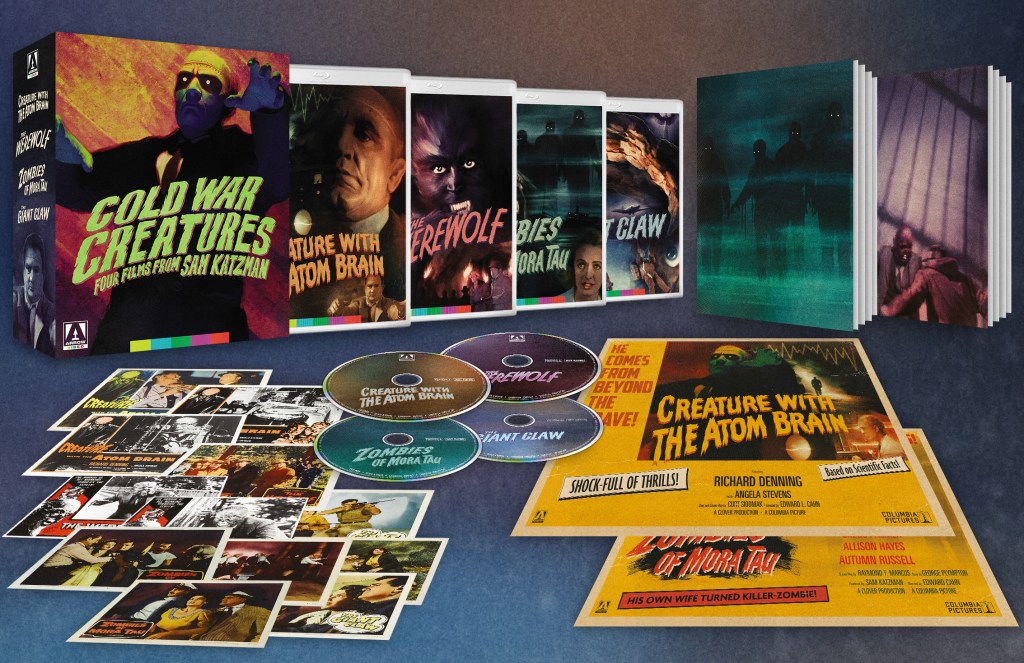
Creature with the Atom Brain is one of four movies on Arrow Video’s new Cold War Creatures: Four Films From Sam Katzman set along with The Werewolf, The Zombies of Mora Tau and The Giant Claw. Each film has a 1080p blu ray presentation, along with a fully illustrated 60-page collector’s book featuring extensive new writing by Laura Drazin Boyes, Neil Mitchell, Barry Forshaw, Jon Towlson and Jackson Cooper, as well as 80-page collector’s art book featuring reproduction stills and artwork from each film and new writing by historian and critic Stephen R. Bissette, the former artist of Swamp Thing. Plus, you get two double-sided posters featuring newly commissioned artwork by Matt Griffin and reversible sleeves for each movie with original and newly commissioned artwork for each film by Matt Griffin.
Creature with the Atom Brain has extras like an introduction by historian and critic Kim Newman, audio commentary by critic Russell Dyball; Sam Katzman: Before and Beyond the Cold War Creatures, a brand-new feature-length illustrated presentation on the life, career and films of Sam Katzman by Bissette; a condensed Super 8mm version of Creature with the Atom Brain, a trailer and an image gallery.
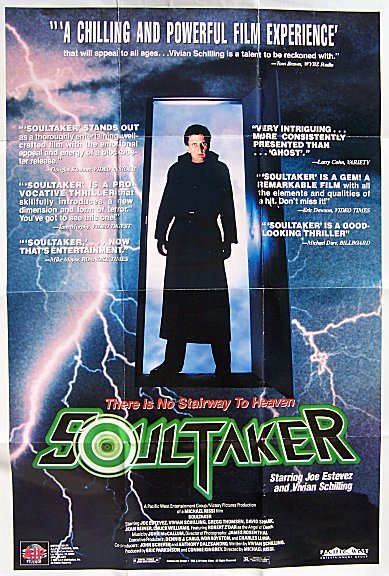
Writer Vivian Schilling told Fangoria about this movie: “When I was 18, just out of high school, I went to a party with a girlfriend. A guy offered us a ride home, someone we thought we knew pretty well. He didn’t look wasted or anything, but when we got in the car he started driving really crazy. We were going very fast and hit a tree; I was in the front seat and was literally buried in the dashboard. It was bad. For a moment as I was sitting there. I thought I was going to die. I always felt lucky to have lived through that, but it also made me wonder. What if I was supposed to die and didn’t know it?”
So they made a movie where Robert Z’Dar played the Angel of Death and Joe Estevez was his Soultaker, years before Final Destination, and Schilling even appears in the movie as one of the souls chased by death itself.
After the surprising success of this low budget film, a sequel was planned with James Earl Jones, Faye Dunaway, Donald Sutherland and William Shatner discussed as being in the cast and director Tibor Takács being picked to helm the picture. Funding was never found and Schilling eventually turned that script into her book Quietus.
Director Michael Rissi also made Terror Eyes, which also starred Schilling.
Editor’s Note: This review is a perfect example of when our readers contact us in the positive to uplift our efforts to discuss film with a like-minded kindness. In this case: this review began with a reader inquiry (which we get into detail within the review) and said reader contributed materials, providing us with production information. This same reader-synergy resulted in our recent reviews of Robo Warriors and Future-Kill — not to mention the endless “pingbacks” or cites we receive from other film blogs.
Also, this is NOT a political dissertation intended to incense any reader. This is a film review on the craft of filmmaking, only. Thanks for your understanding.
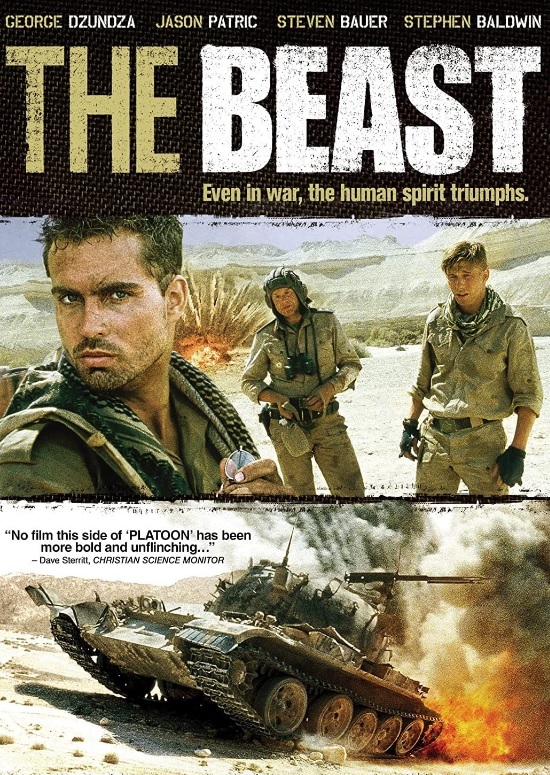
Oliver Stone’s Platoon meets Wolfgang Petersen’s Das Boot is not a critical understatement.
“Not foreseeing where we were going to be 20 years on, at the time I saw the Soviets’ situation in Afghanistan as something akin to their Vietnam.” — Director Kevin Reynolds, The Austin Chronicle
We’ve had this war flick (working as a deeper character study and war treatise) on our backburners since January, when one of our loyal readers, Nick Paticchio, discovered this lost Kevin Reynolds film for the first time. He reached out, urging B&S About Movies to review and, in his words: “drag it out of complete obscurity.”
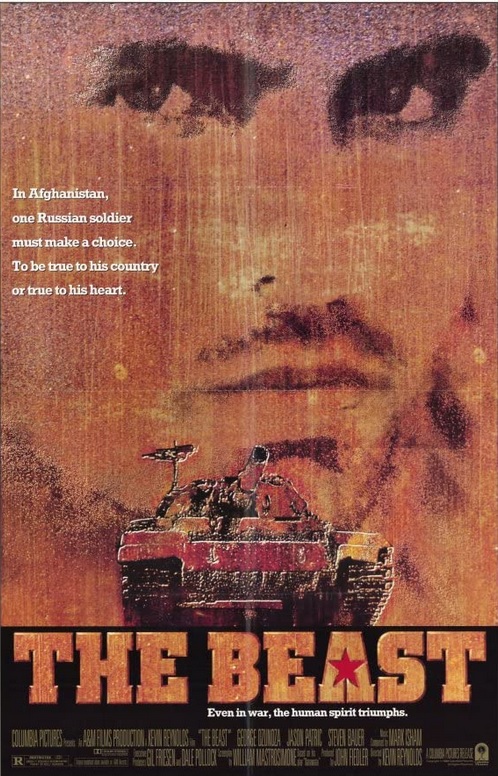
Nick schooled us that the film, originally known as The Beast of War, was directed by ex-Kevin Costner associate Kevin Reynolds and it stars George Dzundza, Jason Patric and Steven Bauer. A box office flop, it was released on only two screens in the U.S. by Columbia Pictures. Nick also told us that Roger Avery, Quentin Tarantino’s old writing partner, has The Beast listed as “The Best Movie of 1988” on his personal Letterboxd page, as well as one of his “20 Desert Island Films” — with Apocalypse Now as the only other war film on the list.
You’ll recall that Kevin Reynolds made his bones with his feature film debut script for the “brat pack” apocalypse flick, Red Dawn (1984), a film that he envisioned as a modernized take on William Golding’s 1954 novel, Lord of the Flies; understandably, he wasn’t happy with the John Milius-directed end product.
Then, with his second script (and one of my “desert island” movies since discovering it as a UHF-TV re-run and taping it), which caught the eye of producer Steven Spielberg, Reynolds first worked with Kevin Costner and made his directing debut with the coming-of-age road comedy, Fandango (1985). Then the two Kevins collaborated on four more films: the Kostner-directed Dances with Wolves (1990; but as second unit director), Robin Hood: Prince of Thieves (1991), Rapa-Nui (1994; with Costner as producer), and Waterworld (1995).
In between Fandango and Robin Hood sits this second Reynolds directing effort — a film originally conceived as Nanawatai (sanctuary), a stage production by Trenton, New Jersey-born playwright William Mastrosimone. The playwright made his debut mark in Hollywood by giving Farrah Fawcett the best role of her career with the rape thriller, Extremities (1986) (if you’ve seen Somebody Killed Her Husband (1978) and Sunburn (1979), you know what we mean).
Why Columbia Pictures released The Beast in only two theaters (for a $160,000 take against $8 million), then both mothballed it — even with rave reviews from the Lost Angeles Times, PBS-TV Sneak Previews, The Christian Science Monitor, and the Lost Angeles Daily News is anyone’s guess. The film, however — based on its many Euro IMDb reviews — received a wider, as most failed U.S. theatricals do, overseas theatrical release.
Some say it was the changing of the guard at Columbia Pictures: The film began production when David Puttnam (produced one of our favorites, Foxes) was head of the studio. By the time of release, Puttman was replaced by Dawn Steel (made her producing debut with Honey, I Blew Up the Kid). It’s opined that Steel didn’t think audiences would relate to Afghan characters played by Steven Bauer, who is of Cuban/German-Jewish descent, while Erick Avari is an Indian Parsi, Kabir Bedi is an Indian Sikh — and the rest are played by Israeli Jews (with the deserts of Israel doubling for Afghanistan). Others believe, even thought the film is effectively subtitled and the Russian language is minimal, large portions of the Afghan dialog is spoken in native Pashto.
Well, courtesy of a 2014 interview with Rutgers graduate playwright William Mastrosimone, on the digital pages of Matthew Gault’s War is Boring blog (a newly discovered and incredible blog; thanks, Nick), we know the reasons why The Beast failed: Sylvester Stallone.
Mastrosimone tells us that the new executives at Columbia weren’t interested in his take on Afghanistan. Sly had approached them with an idea for Rambo III (1988) around the same time — another film set in Afghanistan that the suits at Columbia thought had a better chance of making money.
The Beast was buried.
As we discussed during our “Box Office Failures Week” in the context of our reviews for Zyzzyx Road (2006) and the Christian Slater-starrer Playback (2012), The Beast did, in fact, suffer its unjustified fate as result of a contractual obligation. Troubled productions or films that lose a studio’s faith, to fulfill a clause in a SAG or IATSE agreement regarding release-distribution regulations (among other clauses only lawyers can dream up), Columbia held up their end of the contract by releasing the film in two theaters in New York City and Los Angeles. The movie ran a few weeks — and vanished.
That’s until filmmakers like Roger Avery and fans like B&S About Movies’ reader Nick Paticchio discovered the film. Nick, in fact, came to have a discussion about the film with Roger Avery.
Avery, along with Quentin Tarantino*, came to see the film in Westwood, California, on the opening weekend . . . and no one was there; they had the theater to themselves. In speaking with the owner, they learned it was in the theater for one day, for “awards qualifications.” As Nick and Roger continued their discussion, Roger astutely analogized the similarities between The Beast — its release suppressed for reasons of political agenda — to Mike Judge’s (brilliant, IMO) Idiocracy (2006): too intelligent for its own good.
There’s no room in a tank for a conscious.
“It’s my best work. I don’t care if it’s an Academy Award [winner]. I just want the movie to get its due some day.” — Screenwriter William Mastrosimone, War is Boring
The Beast follows the exploits of a Soviet tank crew that becomes lost in the desert during the 1981 invasion of Afghanistan** (the invasion began December 24, 1979, ended on February 15, 1989, the U.S.S.R fell on December 26, 1991). Following the heartless assault of a Pashtun village and the resulting slaughter of mujahidin freedom fighters by a tank unit, that lone tank commanded by Daskai (an incredible, Oscar-level turn by George Dzundza; he campaigned hard for the role and went on a heavy diet and workout routine prior to filming, losing over 50 pounds) becomes lost in a mountain pass.
That wrong turn becomes the catalyst for the tribe’s new khan, Taj (a really incredible Steven Bauer of Scarface fame; later of TV’s Breaking Bad and Better Call Saul), to ban with Moustafa, his warring, desert scavenger cousin (a fine Chaim Jeraffi; sorry Sam, he was the Jiffy Dump Guy / Jiffy Park Guy in two Seinfeld episodes). Together, reluctantly, they gather up the survivors and, manned with a captured RPG anti-tank weapon, seek bloody revenge. The same stress and betrayals also plague the Soviet tank crew, jeopardizing their escape (the crew stars India-born Erick Avari of Stargate (1994) and The Mummy (1999) fame as the crew’s Afghani guide).
A battle of wills between a rogue commander and a solider with a conscious.
“The Beast was written by a great playwright by the name of Bill Mastrosimone. It was sent to me in a 50-page outline, I read it and thought, ‘Wow, this is cool,’ and then I found out it was a play. So I went to see the play . . . and I thought, this isn’t a play, this is a movie.” — Director Kevin Reynolds, “The Constancy of Sorrow” by Marc Savlov of The Austin Chronicle
To say anymore would be plot spoiling: this is a film to be experienced and not by a review read. Everything works in this second, overly ambitious film by Kevin Reynolds — and foretells his directorial skills in pulling off the “Mad Max on the Water” effort of Waterworld, itself a film that languished in development hell since 1986 because no one knew how, or was confident enough, to make that liquid apoc’er, work. The Beast truly is a tour de force masterpiece in writing and directing, acting, set design and costuming. I loved Waterworld . . . but I love The Beast, even more. This is a repeat-viewing movie.
Nick — who inspired this review — is right: Criterion or Shout Factory! — or Arrow or Severin — need to reissue this on a DVD and Blu-ray proper, complete with commentary tracks from all concerned. For now, we did find one production insight from the film’s art director, Richard James, courtesy of his recent, July 2021 comment on the You Tube channel VOD upload of the film. Here’s his insights from July 2021:
“I was the art director on this movie. My focus was to build the interior of the [Israeli] T-55 [Tiran] Russian Tank. The goal was to make the interior so it could be filmed and to look like the real thing. The interior set had to function to meet requirements in the script, such as loading and firing the gun. The turret had to revolve 360 degrees. I was able to locate a shop manual of the tank. The tank interior set was suspended by metal framing, all sitting on a turn table; port holes allowed the camera to position itself perched also on turntable. The whole contraption had to be dismantled and shipped to Israel for the shooting location. The set was reassembled in a warehouse in Old Haifa, as [we] filmed in the desert. Even the studio suits didn’t know how [Kevin Reynolds] was able to accomplish his interior shots.”
In addition to Richard James, actor Jason Patric provides his insights on the production as part of the June 9, 2021, podcast of Ty & That Guy, hosted by producer Ty Franck and actor Wes Chatham of SyFy/Amazon’s The Expanse. The timestamp where you need to start to learn more about The Beast begins around the 39 minutes and 40 seconds mark and runs to the 51:00 minute mark. (Great find, Nick!)
You can stream The Beast on Tubi and the trailer on You Tube. For an ad-free experience, you can rent it from You Tube Movies. As a testament to the love of the film’s effectively shot action sequences: you can find several fan-cut clips on You Tube. (You’ve seen the film’s opening tank assault of the village in the 2001, better-distributed film, Megiddo: The Omega Code.)
** To learn more about the politics behind the invasion, you can read an overview at The History Channel.com.
Again: Positive reader input also resulted in our recent reviews of Peter Carpenter’s Vixen! (1968) and Love Me Like I Do (1970), as well as the aforementioned Future-Kill (1985), and Robo Warriors (1996). God bless their VHS-pack rattin’ brains! Surf ’em up, if you can.
A very special thanks to Nick Paticchio for his collaborative efforts in our exposing this incredible film to a wider audience. We got you, Mr. Mastrosimone. We got you.
About the Authors: You can learn more about the writings of R.D Francis on Facebook.He also writes for B&S About Movies.
“People always ask me if it’s difficult for me at my age to keep up with trends. What they don’t understand is that I’m not older today. I was already older before,” said Samuel Arkoff, formerly of American-International Pictures and now the head of Arkoff International Pictures. After selling AIP to Filmways and seeing them pretty much immediately screw it up, he started making the kinds of movies he made all along like Q The Winged Serpent, The Final Terror and this film.
Susan’s (Judy Landers) mom gets killed and she forgets who she is after the murderer pushes her through a window, which means she gets sent to the Hellhole, which does not sound like the kind of hospital that someone goes to when they’re mentally ill, but who are we to place out 2021 values on to an exploitation movie from 1985?
Actually, it’s the Ashland Sanitarium for Women and the killer — Silk (Ray Sharkey) — now works there, watching over Susan in case she gets her memory back. He’s not the worst maniac in this movie. That would be Dr. Fletcher (Mary Woronov forever!), who loves performing lobotomy experiments.
Talk about a cast! This has Marjoe Gortner, Edy Williams, Robert Z’Dar, Frogs star Lynn Borden, Mighty Joe Young actress Terry Moore, Carol Ita White from Savage Streets and Dyanne Thorne in it and you know, that’s way more star power than several movies usually get. Aaron Butler, who was one of the writers of this, also wrote Chained Heat, so that should tell you what you’re getting into.
Pierre De Moro only made two other movies, Savannah Smiles and Christmas Mountain, and this feels like the kind of work made by a man who is sick of making children and families happy.
We love movies — did you know that? — and just as equally, we love having toys that are based on the movies that we adore so much. Back when Sam first started collecting toys, way back around 1977 or so, his first superhero toy was a Mego Pocket Heroes Aquaman. After a few years, he had just about every Mego he could get his hands on, including that amazing Thing figure that had a fabric rock costume!
Starting this week, those Mego dolls are now available for the first time through Topps, the folks who sold you baseball cards and cool stuff like Dinosaurs Attack!
Topps.com will feature the most iconic action figures throughout the decades, from every genre imaginable. The exclusive Mego figures, including new characters and reimagined classics — we can spy Chucky, the Rocketeer and Hannibal Lecter in the photos they sent us — will be available to purchase only through the Topps website, with new action figures releasing every Monday!
These exclusive Mego figures will be available in a variety of sizes, including a combination of 8-inch and 14-inch versions.
The first two exclusive figures are Shazam! and Black Adam, who is due for a new movie starring the Rock soon. To learn more — and get a 10% offer — just visit the Topps site today!
DISCLAIMER: This is no ad. We were asked to share this out and thought it was pretty cool. I mean, don’t you want a Cliff Secord Mego figure on your desk? How about that General Ursus figure?!?
A hollow earth movie that posits an underground civilization created by Sumerian descendants who worship Ishtar. Never mind that Sumerians and Ishtar have no connection and the true symbol of Ishtar is an eight-pointed star, not to mention that all of the gods in this movie are really Egyptian. But hey — it does have the great flood symbolizing the journey to the underworld and was probably influenced somewhat by the Shaver Mysteries that dominated Amazing Stories from 1945 to 1948 (see Beyond Lemuria and Encounters with the Unknown for more film evidence of the Shavers, the hole to hell and Lemuria itself).
I absolutely love that this movie starts with an introduction from University of Southern California English professor Dr. Frank Baxter, who explains the premise of the film and how it may have some basis in reality. How many movies take the time to discusses the hollow earth theories of John Symmes — whose Hollow Earth theory taught that our world is mae up of five concentric spheres, with the outer earth and its atmosphere as the largest — and Cyrus Teed — a physician and alchemist who became a self-proclaimed messiah, taking on the name Koresh and proposing a new set of scientific and religious ideas he called Koreshanity, which taught that our planet and sky exist inside the surface of a larger sphere.
Archaeologists Dr. Roger Bentley (John Agar) and Dr. Jud Bellamin (Hugh Beaumont, Beaver’s dad) have found the hollow earth and meet the Sumerian albinos and their mutant mole man slaves*, who all eat mushrooms because why not? Whenever they start having too many people, they stop overcrowding by sacrificing women to the Eye of Ishtar. But everyone — other than a girl named Adad — is so sensitive to light that the fact that the scientists have a flashlight must mean that they are gods. Oh yeah — Ellnu, the High Priest, is played by Alan Napier, who would soon enough be Batman’s faithful butler Alfred.
This was Virgil Vogel’s first film, which he would follow up with The Kettles on Old MacDonald’s Farm and Invasion of the Animal People before a career mostly spent in television.
For some reason, Adad is unceremoniously crushed before the end of the movie, just when she gets near the surface and nearly escapes. Supposedly, Universal thought that Bentley’s romance with Adad would promote interracial relationships. Never mind that John Agar and Cynthia Patrick were both white. They reshot the new ending where she gets smashed and that was that.









 B&S About Movies
You must be logged in to post a comment.