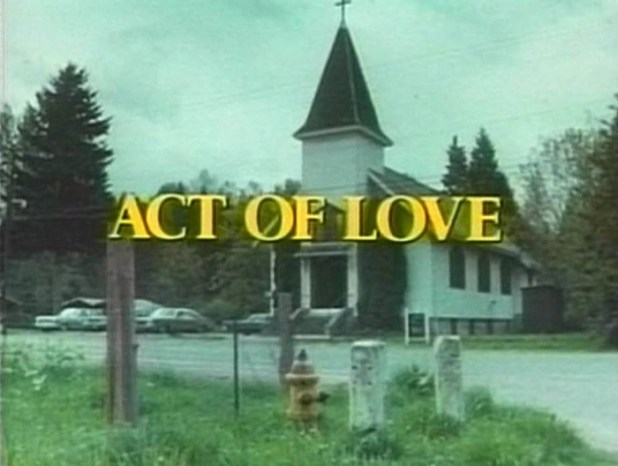
In between playing one of America’s most beloved teenagers and directing its favorite movies, Ron Howard took several against type roles. This is one such example, as he plays Leon Cybulkowski, who puts his brother Joseph (Mickey Rourke!) out of his misery as he asks to be killed instead of living out his life as a quadriplegic.
Director Jud Taylor started his career as an actor before becoming an in-demand director of TV movies. Some of his best-remembered films include Revenge!, The Disappearance of Flight 412, Search for the Gods (which has Kurt Russell and Stephen McHattie seeking ancient astronauts), Out of the Darkness and The Great Escape II: The Untold Story (he was an actor in the original).
Based on the book Act of Love: The Killing of George Zygmanik by Judith Paige Mitchell, this NBC TV movie originally aired on September 24, 1980. It’s an emotional watch and Howard is pretty decent in it. It also has Robert Foxworth (the voice of Ratchet in the Transformers movies), Jacqueline Brookes (The Good Son), David Spielberg (Christine), Mary Kay Place (Mary Hartman, Mary Hartman), Chris Mulkey (Hank Jennings from Twin Peaks; The Killing of Randy Webster), Pat Gorley (Kiss My Grits) and David Faustino in his first acting role.
Ah, Sam knows my Bigas Luna fandom*, as I gushed my philosophical wax over the majesty of Luna in our review of Anguish. Gracias, mi amigo: your X-Mas gift of film is enjoyed.
What saddens me: that this, Bigas’s fourth directing effort — and his first English-language film (the second was Anguish) — ends up on a Mill Creek box set. No offense to the executives of Mill Creek, as we devour your box sets like a serial killer with a chest ripped-out heart on a Valentine’s Day murder spree . . . but wow, you’d think, with Dennis Hopper (Easy Rider) and Micheal Moriatry (The Stuff) on the marquee, Reborn would have not fallen into the public domain and received a proper digital reissue. Sadly, a deserved John Carpenter, Sean S. Cunningham, or Wes Craven-like success was not in the cards for Luna. As with Anguish, Reborn bombed at the U.S. box-office (as result of a poorly-received limited release) for which it was intended. What we really need is a double disc restore with Reborn packed with Anguish in honor of Bigas Luna. Now.
Okay. Enough with the ranting. Let me a have nice, warm cup of Ovaltine (Well, Roundtine, because, as Jerry Seinfeld pointed out: the cup is round and the jar is round. . . .) and finish this review. (Sorry, Sam. It can’t be done.)
It’s no mystery that Reborn, like Anguish before it, is beyond the bizarre — even for Satan’s tomfoolery — only this first English-language film for Luna is a bit more low-key than the eye-ball carving and snail fetishisms of Anguish. Luna’s eye for set design is on fire, natch, oozing with style and substance that’s punctuated by his usual taste for the erotic mixed with the spiritual: it’s a religious fantasy piece that questions faith, explores Luna’s Catholicism, and the mysteries of one’s acquiring healing powers. And, if those powers are real (they are, in this case), how does the one blessed (or cursed) used them? And, if that person is with child (she is, here), then will that child inherit the mother’s powers of stigmata and healing?
The story concerns Giacomo (Francesco Rabal, the real “leading man,” here), who discovers his Holy Ghost-hearing girlfriend (Antonella Murgia, the real “leading lady,” here) is a “stigmata”: someone whose hands and feet mysteriously bleed in the same places where Jesus Christ was crucified. (At the risk of getting into a religious debate: It is said Christ was crucified through his achilles (the back of the foot, above the heel) and his wrists; anyone “bleeding” from their palms and insteps are phonies, because, there’s no way nails can be driven through those parts of the body without shattering bones . . . then hang from those wound-points without ripping through the flesh and shattered bones, and falling off the crucifix. So read your Roman history before committing religious fraud, preacher man.) Of course, no surprise, Dennis Hooper is the maniacal Rev. Tom Hartley, an American televangelist-head of a racketeering “revivalist” church** — and he exploits the situation for his own, greedy purposes. Moriarty is Mark, Hopper’s kidnapping sidekick, sent to Italy to “recruit” the girl — they fall in love; he impregnates her — is his usual, off-the-chain self in a role that rises to his work in Q: The Winged Serpent.
The reason why we are here: Mill Creek Entertainment features this Bigas Luna classic on their Excellent Eighties 50-Movie Pack. There’s (awful, with muddy images and distorted audio) steaming copies at Amazon Prime and You Tube, but emptor those caveats, ye streamer: both platforms stream the 92-minute, shorter U.S.-version — when, what wereally want, is the extra 13 minutes of the 105-minute original version. And trust me: those lost minutes are why so many detract this Luna masterpiece as “confusing junk.” And these bad prints aren’t helping matters, leaving you think you’re watching a knockoff of Giulio Paradisi’s confusing mess-of-a-mess The Exorcist knockoff that is the The Visitor — and Reborn is not that bad, for it is so, so much better. And it has nothing to do with exorcism.
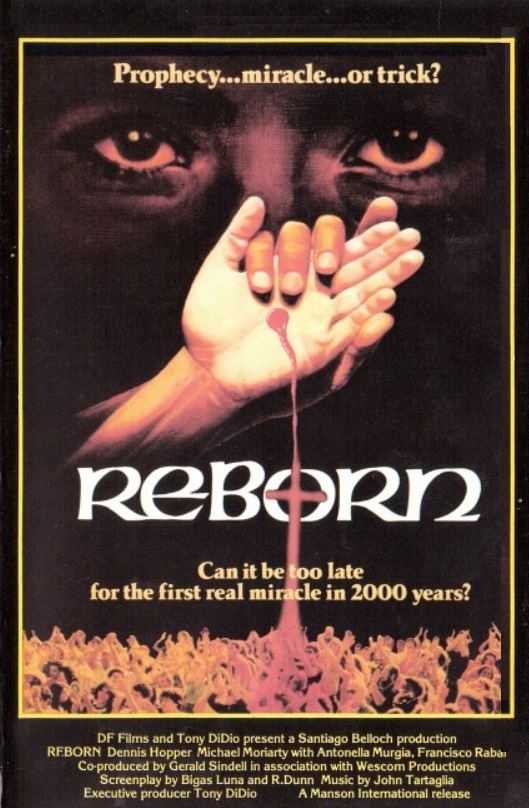
The Exorcist-inspired theatrical one-sheet that hurt the film more than helped.
MGM currently holds the copyright on Reborn, with Park Circus/Arts Alliance as its TV/Home Video distributor. Again, we need a restore on this one, so help us out MGM and Park Circus! We found two trailer-clips on You Tube HERE and HERE to enjoy.
* You can learn more about Bigas Luna with his 2013 obituary at Variety. ** Beth B’s dark comedy, Salvation!, starring Exene Cervenka, tackles the same material.
About the Author: You can learn more about the writings of R.D Francis on Facebook.He also writes for B&S About Movies.
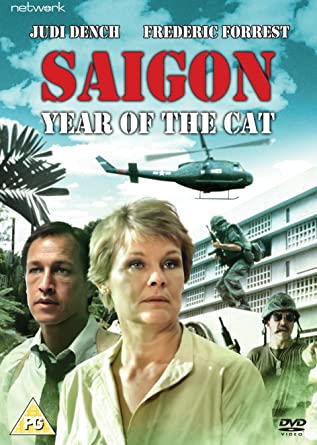
At the end of 1974, as American forces withdraw from Saigon, only a few CIA advisors remain. In this strange end of the war era, one of those advisors named Bob Chesneau (Frederic Forrest, who was in another better known Vietnam movie, Apocalypse Now) is having an affair with a bank analyst, Barbara Dean (Dame Judi Dench).
Written by David Hare (The Hours) and directed by Stephen Frears (Dangerous Liaisons, High Fidelity), this Thames Television film also has a strong cast with E.G. Marshall (Creepshow), Wallace Shawn (The Princess Bride), British comedian Chic Murray, Manning Redwood (The Shining, Shock Treatment) and Josef Sommer (Witness).
It’s pretty amazing the places that Hare and Frears went after this movie, which doesn’t show much of the promise that they would later display. But here it is, one of the many British made for TV movies that are all over this giant brick of a Mill Creek collection.
The joy of enjoying Robert Conrad as an actor is a case of you had to be there: if you weren’t, you missed out. Back in the day: we went gold, red and black because Conrad told us so. And we can remember those days thanks to Mill Creek rescuing this lost and forgotten TV Movie adrift in the public domain.
If you’re a younger surfer amid the digital pages of B&S About Movies, Conrad is just that old guy from The Wild Wild West (1965 – 1969) adapted into that utterly awful Will Smith movie Wild Wild West (1999) where Smith portrayed Conrad’s Jim West: no, there was never any giant, Civil War-era mechanical spiders in the series. If you’re a wee-bit older and go back to the pre-cable days of local UHF-TV, you remember coming home from school and watching Conrad as Tom Lopaka on the early ’60s series 77 Sunset Strip, a character which grew into its own four-years series, Hawaiian Eye. And the not-so-old and the not-so-young remember Conrad as Pappy Boyington on Black Sheep Squadron in the ’80s.
Before there was a Tom Selleck, there was Robert Conrad: he was the “he man” of the ’70s, rife with the “sex” for the women and the “brawn” for the men. From Murph the Surf (1975), Sudden Death (1977), and The Lady in Red (1979), he packed the duplexes and the Drive-Ins. From Smash-Up on Interstate 5 (1976), Coach of the Year (1980), and Two Father’s Justice (1994), we turned his TV movies into ratings winners. If Conrad was still active and relevant as an actor in the 21st Century, Sylvester Stallone would have cast him in The Expendables, because, for his fans (moi): Action equals Conrad and vise versa.
However, Conrad, even when playing off his tough guy image, isn’t comedy. And that led to his decision, which he later regretted, in turning down the role of Cmndt. Lassard in the first Police Academy film. Conrad tried to correct that career misstep with a role in Neal Isreal and Pat Profts’s next film, Moving Violations (1985) and this military comedy. With his two comedic bids failing at the box office, he went back to the action genre with the TV movies The Fifth Missile (1986) and Assassin (1986; which we reviewed as part of our last Mill Creek blowout with their Sci-Fi Invasion set).
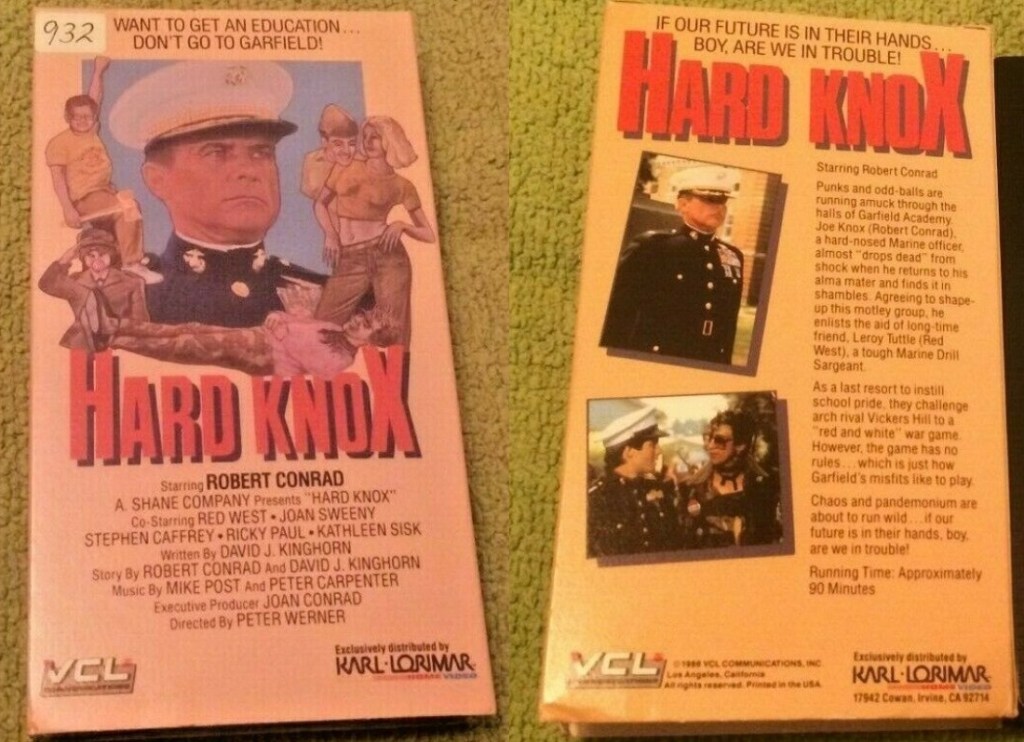
Image courtesy of terriers4u/eBay.
In a story idea conjured by Conrad, and in an obvious bid to correct the wrong of turning down Police Academy, he’s Joe Knox: a hard-nosed, retired Air Force Colonel who takes over the leadership of a co-ed military academy from his mentor, General Garfield (Bill Erwin; Across 240-plus credits: Plains, Trains & Automobiles, Home Alone . . . and too many TV series to mention, yes, Samuel, even Seinfeld: “My Teeth, My Teeth, you moron!”). Helping Col. Knox whip the Porky’s-cum-Animal House bumbling cadets (including Alan Ruck of Ferris Bueller’s Day Off fame) into shape is Thomas “Top” Tuttle (ex-Elvis body guard Red West of Road House).
Since this is an ’80s TV movie, the shenanigans are innocuous and not as racy as the Police Academy films it apes, and it’s not as funny as No Time for Sergeants (the military comedy gold standard, so what film is), but it doesn’t fail as badly as Mad Magazine‘s (really awful) military school romp Up the Academy (1980). Also keep your eyes open for Reb Brown (TV’s original Captain America, Space Mutiny) and Dennis Farina (in an early role; on his way to TV’s Law & Order as Det. Fontana).
Sam? Notice how I got a plug for both Law & Order and Seinfeld into one review? Sweet!
Check out the trailer-clip then get your own copy of Hard Knox as part of Mill Creek’s Excellent Eighties box set and watch it on You Tube.
About the Author: You can learn more about the writings of R.D Francis on Facebook.He also writes for B&S About Movies.
Across three decades, Donna (Kate Amundsen) is trying to live up to the traditions and expectations of her Italian family while striving for the American Dream.
Directed by Jaret Martino, who co-wrote along with DonnaMarie Martino and Pat Branch, this is the story of a woman escaping domestic violence and discovering the inner strength to start her life over again.
Yes, DonnaMarie is Jaret’s mother and this is her story. Co-writer Branch said, “My first words to Donna were, “I’m not here to judge your choices. I just want to tell your story as authentically as I can.” She allowed me into the deepest, darkest, most intimate corners of her psyche and I tried to exploit that privilege without sensationalizing it.”
This is not always an easy watch, but a sober reminder of what life is like for so many women. It took a lot of bravery — and no small amount of talent — to bring it to the screen.
Donna: Stronger Than Pretty premieres on all major streaming platforms February 23 from Gravitas Ventures. You can learn more at the official site.
Editor’s Note: This is the first time Shaker Run has been issued on a Mill Creek set, in this case, as part of their B-Movie Blast 50-Film Pack (Amazon) that we’re reviewing this month. But guess what? We were already all over this Smokey dopey Bandit boo-boo on December 7, 2020, as part of our second, month-long tribute to the Fast and the Furious film franchise (you can find all of those review links with our recap). See, Mill Creek? You inspired us to make up our own box sets! So, how’s about a B&S About Movies 50-Film Pack?
To be honest, this movie is really dumb. Fun. But dumb, in a Lee Majors The Last Chase kinda-way. Take one part Mad Rockatansky and one part Burt Reynolds. Strip away the story and characters — and just focus on the cars. Vroom-vroom: yer git yerselves a movie, Hoss.
So, “The Bandit,” aka Cliff Roberston (yep, Grand-pa Ben Parker from the Spider-Man franchise), is Judd Pierson, a down-and-out stock racer slummin’ on the carnival circuit-for-a-buck as a daredevil driver with his sidekick, The Snowman, aka Casey Lee (yep, ex-teen idol Leif Garrett of Thunder Alley, who’s actually very good here) at his side.
Then they meet their “Frog” in the form of Dr. Christine Ruben: she decides to double-cross the New Zealand government and smuggle a lethal bio-agent out of a military-backed research facility — and she needs The Bandit and The Snowman. And when you’re hard up for cash, and a hot doctor bats her eyelash-sob story, you take the hook. Sucker. Then nice, loooong car chases — and the ensuing crashes — takes us eastbound and down.
Unfortunately, there’s no freebie uploads on any streaming platforms. So, beside the clip above, you can check out these extended 8:00 and 20:00 You Tube clips that distill the film down into what we came for: the car chases. And since this was a New Zealand-shot film, that country’s NZ On Screen website offers up an 10:00 excerpt from the film. If you like what you see, you can stream over on Amazon Prime.
Editor’s Note: Sam took a swat at this best-forgotten ’80s comedy back on February 2, 2021, as part of its inclusion on Mill Creek’s B-Movie Blast 50-film pack. If there’s a film that doesn’t deserve as a second, fresh take, it’s Cavegirl. But here we are, as the film is also part of Mill Creek’s The Excellent Eighties 50-film pack.
Update: Cavegirl will be re-issued on hard media by Dark Force Entertainment. Learn more with their Facebook announcement.
I’ve been a fan of Daniel Roebuck ever since his chilling portrayal of Sampson Tollet in the juvenile delinquent classic River’s Edge. But in proof that all actors must start somewhere on their journey to becoming a stock player in Rob Zombie’s retro-celluloid house of horrors or picking up work in cool Don Coscarelli flicks, Roebuck made his feature film debut with this caveman-cum-jungle girl comedy. And at the risk of offending an actor I respect: this movie is as stone cold dumb as it looks. Can we blame this film’s inspiration on Ringo Starr’s Caveman? Eh, probably: In Europe, where everything is a sequel to something (the Houseand Demons “franchises” come to mind), distributors tried passing this off as a sequel to that Ringo joint.
In one of the most-unlikely “high school students” committed to film, Roebuck stars as the way-too-old and oafy-dopey Rex, the type of guy that loves bones — as well as boners for unattainable girls — who gets a shot at the (cave) babe of his dreams. However, unlike Pauly Shore’s Encino Man from 1992, where the hot cave person comes to the present, Rex transports back to The Stone Age.
But how?
Ugh. Don’t you know your innocuous and implausible comedies, such as 1976’s Freaky Friday or 1988’s Vice Versa? A magic trinket does the job. In this case: Rex discoveres a cave wall-encrusted magic crystal. There he meets a cavebabe, Eba (Cynthia Thompson, who made her debut in Tomboy and ended up, in all places, a Ruggero Deodato flick, Body Count). And while Rex tries to get under her skimpy animal skins, he helps her tribe fend off a warring cannibal tribe. The end.
Now, if the character of “Brenda” looks familiar to you — but the actress name Stacey Swain does not — that’s because it’s Stacey Q! Yes, she the ’80s pop queen who made it into the U.S. Top Ten with “Two of Hearts” in 1986. Her song “Synthicide,” which was the debut single by SSQ, which cracked the U.S. Top Fifty back in 1983, appears on the soundtrack. That song, along with “Big Electronic Beat” and “Clockwork,” from SSQ’s lone album on Enigma Records (also home to the very-similar Berlin lead by ’70s actress Terry Nunn), also appears on the soundtrack to 1984’s Hardbodies (that, shockingly, hasn’t been “Mill Creek’d,” at least not yet). If you’re a punker and you love your zombies, you’ve heard Stacey’s soundtrack work before, on, of all places, The Return of the the Living Dead. Remember when Linnea Quigley stripped for Trash in the graveyard? Well, the song “Tonight (We’ll Make Love Until We Die)” blaring over the boombox is Stacey fronting SSQ.
Yeah, when the backstory on the soundtrack is more interesting than the movie, you know you’ve got narrative issues with your film.
This ended up being the only feature film writing and directing debut for rock video director David Oliver Pfeil, in which he also served as his own producer and cinematographer. It’s certain he had higher hopes for his passion project. But when you’re backed by Crown International, boobs rule over one’s artistic passions. But no worries: Pfeil went onto become a prolific opening credits designer for features films and television series. One his many credits was the opening titles for the film and series Buck Rogers in the 25th Century — which is the best part of that decrepit, plastic Star Wars knockoff.
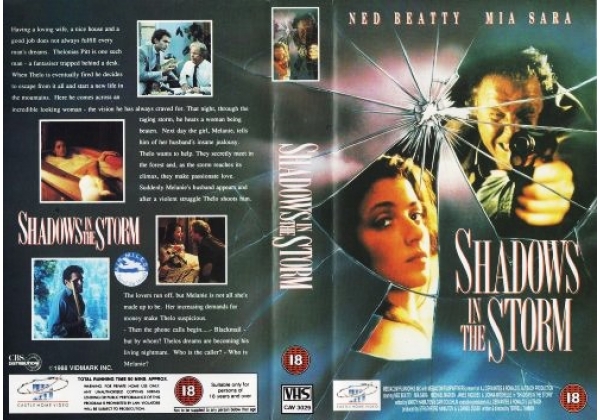
This is a movie that posits that Ned Beatty could win over Mia Sara and killer her husband for that love. Of course, seeing that she looks exactly like the girl in his dreams could mean that this is all in his head, right?
I’m really obsessed by how a Mill Creek box set comes together, because this was directed by Terrell Tannen, who also made A Minor Miracle, which is on the same The Excellent Eighties set. Did he just sell his rights to them and they decided to toss them in on this? Was it part of an even bigger package deal? These are the things I keep myself up at nights wondering.
Also: Beatty’s character is named Thelonius Pitt, a name that could only exist in a movie.
This strange little noir film also has Michael Madsen in it and Troy Davis, who was Illinois State Police Trooper Charlie Bloch in Halloween 5and the principal on Twin Peaks.
Now I’m in suspense over what madness awaits in the rest of this box set. Show me your wonders, Mill Creek!
Here’s another Mill Creeker that Sam, the boss at B&S, and myself never heard of and would have passed on — if not for it being on a Mill Creek box set. And you probably never heard of it either, as it is a British TV movie, part of the 165-episode run of BBC-TV’s 1985 – 2002 series Screen Two. According to the digital content managers at the IMDb, the Screen Two project was the brainchild of producer Kenith Trodd, who headed a team to create a programming block for the BBC to compete with Channel Four’s efforts in making movies for television and theatrical release. The series plan was to break the BBC away from their studio-made stage play format (know your old PBS-TV rebroadcasts of Doctor Who) to create “live,” non-stage programming. Known as The Fourth Man during its TV run, it carried the title of Blunt for its VHS and overseas theatrical releases.
Of course, it helps that we have Sir Anthony Hopkins heading the cast to inspire us to sit down and review the title for our Mill Creek blowout of their 50-film Excellent Eighties box set.
So, what’s it all about?
VHS image courtesy of ijcm3/eBay.
The story concerns Blunt, Anthony Blunt (a bad Bond joke on my part), a British art historian and professor who became the infamous “fourth man” in the Cambridge Five, a notorious group of spies comprised of rogue MI5 agents (Britain’s CIA equivalent) working for the Soviet Union from the 1930s up through the early 1950s. Once a Sir of the Royal Victorian Knighthood, Blunt was stripped of the honor in 1979 when his activities came to public light.
While the production values exceed the TV stage play-style they were attempting to update, this is — even with Hopkins to hold our interest — still pretty dry and pretty boring and the production values really haven’t improved much: this isn’t an action drama, but (still) a stagey, psychological drama that attempts to get inside the heads of the men and asks “why” Blunt did it. While Blunt and the Cambridge Five’s exploits are certainly intriguing and appealing to spy aficionados, the way this story is told, it just isn’t as engaging as the exploits of Ashaf Marwan, an Egyptian billionaire who worked for Mossad, the State of Israel’s intelligence agency to became the world’s first true “super spy” during the 1973 Yom Kippur War/Arab-Israeli War. His exploits are chronicled in the much better spy film The Angel (2018) and its accompanying documentary, The Spy Who Fell to Earth (2018).
You can watch Blunt: The Fourth Man on Tubi as a free-with-ads stream.
About the Author: You can learn more about the writings of R.D Francis on Facebook.He also writes for B&S About Movies.
Author’s Note: Due to the somewhat controversial subject matter of this film — political intrigue in a West Africa country by white businessmen — please note this is a film review that addresses the creative art of filmmaking only. This review is not a political dissertation in support of or in contradiction of any sociopolitical belief system and is not intended to incense any reader regarding race, social or free speech/opinion issues. This review was written to expose a film that attempts to help the viewer reach an understanding regarding the universal ills of corruption in our world.
“Mama never thought you were a bad person. She just thought you brought bad luck.” — Ada to Carlos
Carlos and Susan (real life acting couple Raúl Arévalo and Melina Matthews) reside in Brussels, Belgium, where Carlos is an expectant father — his wife is eight months pregnant — and a corporate lawyer for the Euro-division of a U.S. oil company. His mother, Elena, works as a diplomat at the United Nations (when we first meet the couple, Carlos’s mother is the guest of honor at — an exquisitely-shot — U.N. award dinner). Both live with the hopes that their current, upper-class life of luxury will only grow as Carlos vies for a full-associates position with the corporation and relocate his soon-to-be-expanded family to New York City.
Of course, the catch, i.e, blackmail, to securing the promotion is for Carlos to travel to a remote, West African island country off the coast of the Republic of Ghana. His “mission” is to negotiate the release of Steve Campbell, an American oil engineer, who’s been kidnapped by a rebel insurgent, Calixto Batete (Madrid, Spain-born and New York-trained Jimmy Castro) — who’s a former friend of Carlos.
Forced into using an old friend against the island nation’s democratically-corrupt government? To save a deal for drilling rights on a newly discovered, large oil deposit? Yeah, this isn’t going to go all to film noir hell-in-a-hand-basket.
To earn the release of Campbell, Carlos enlists another old friend and colleague, Alejandra, and her girlfriend Eva. Through them he discovers that Calixto married Carlos’s ex-girlfriend, Ada, and their son, Cal Jr., is the thought-to-be-aborted son of Carlos. Amidst Carlos’s skeletons falling out of the closet, he comes to discover the kidnapping plot is a scam designed to retrieve damning documents regarding the oil company’s clandestine operations with the county’s corrupt president, who’s aligned with the terrorist organization MIA, which lead to a genocide of the island’s citizens, the Zandes.
Complicating matters is that he must travel to Black Beach, where the rebels are holding the kidnapped Ada. (The film’s title is a reference to the volcanic-deposited black sand beaches along the African coast; however, here, it is a reference to the prison where Ada is being held; think U.S. unacknowledged “black site/black operation.”) And once Carlos discovers the critical documents (at about the one hour fifteen minute mark), the film goes dark, as Carlos is on the run across Zandes’ lands and the government’s armies callously mow down citizens with a machine-gunned equipped helicopter; the Zandees fight back with machetes and rocket launchers — and it’s bloody and gruesome.
Black Beach is a world where everyone is corrupt: the oil company, the African government, and the United Nations . . . and everyone’s souls. And you feel the poverty and fears faced by the West African peoples.
As with any James M. Cain or Dashiell Hammett tale of yore, all of the noir (yes, intricate) plot corkscrew markers of blackmail, greed, moral corruption, love, lust, and violence are in check. And the exotic, unfamiliar West African locations raise the proceedings above the noir ante norms. I was almost worried we were going to be racing around the streets of Brussels (been there, done that) or New York (not again). So it was nice that the narrative shifted to West Africa for a nice, visual (and very well-shot) change of pace.
These qualities, however, are overlooked as result of many critics-in-the-negative perturbed over the “white savior” aspect of the narrative (?), and reading-in a now de rigueur “white privilege” sub-plot argument where none is needed nor the point of the film; it’s just a retro-film noir piece. Another issue reviewers have is that a black child comes into the care of a white-Hispanic family. Perhaps if a better-known star, like Liam Neeson (Raúl Arévalo reminds me of Sean Penn, but no one is casting Sean in films anytime soon), would make things more palpable, as the familiar allows for an easier digestion of a film.
Others, if not put off by the race-bend of the material, find the plot “confusing” and “long.” Well, again . . . Black Beach, while more-akin to Neeson’s aging-action star films — only with less blow-up, bullet-holed action — is actually a more-twisty noir. But I don’t blame those detractors, I get it. I know, from my own fandom experiences of attempting to expose friends to the film noir genre (I’ve had them tell me, flat out, Double Indemnity, “sucks,” for example), a twist of Cain sours most cups of green tea. (Yes, and I’ve had friends squish their faces when they see me drink green tea . . . “Eww, it’s so bitter, etc.” And so it goes.)
The only downside (for moi) is the film’s length pushing just 10-minutes short of the two-hour mark — thus this film is a takes-it-time slow burn (as a good noir should; if you want quick and easy, watch a U.S. soap opera or cop procedural drama). But Black Beach is, while a Spanish-Belgium made film, no different than any U.S. major studio film that deals in political intrigue. Streaming commenters have taken the film’s subtitles on the Spanish/Euro prints and English dub on the U.S. prints to task as being “out-of-sync,” which made the film a wee difficult to follow. I watched the subtitled version — and skimmed the English dub — and I found no issues in those areas: I followed the film quite clearly.
However, those qualms in no way detract from the quality brought to the screen by Estaban Crespo and his cast of actors (I really like Jimmy Castro in this; his Calixto honestly communicates a loyalty to his country and people). Its multiple award nods in cinematography, editing, and sound are well-warranted. And the acting’s fine, too.
After writing and directing seven shorts, Crespo made his feature film debut with the romantic drama Amar (2017), based on his 2005 short of the same name. Black Beach is his first, widest-exposure and internationally-distributed feature, which shot in Madrid, Spain, Gran Canaria, Canary Islands, Spain (The Clash of the Titans and Jesús Franco’s Mansion of the Living Dead were shot there), Brussels, Belgium, and the West African Republic of Ghana.
Disclaimer: We did not receive a screener or review request. We discovered the trailer and streamed it from Netflix on our own. That has no bearing on our review. And we truly enjoyed the movie, film noir detractors, be damned.
About the Author: You can learn more about the writings of R.D Francis on Facebook.He also writes for B&S About Moviesand publishes short stories and music reviews on Medium.






 B&S About Movies
You must be logged in to post a comment.