Ghoul Scout Zombie Massacre (2020)

So, after stream-stumbling into Omar Jacobo’s enjoyable, Mexican-made horror FUBAR that is Blood Freaks, I began picking through distributor Rising Sun Media’s Facebook page — and this feature film debut from writer/director Eric Eichelberger caught my eye (and dislodged from its socket). And from what I can see, while GSZM was released to VOD streaming in 2018; it’s now offered as a new, free-with-ads stream on Tubi in 2021 (or at least the tail end of 2020): I should know, as I am constantly farming the Tubi platform for films to watch — especially new and off-the-reservation flicks — and this film never populated on my previous digital excavations. Ah, wait . . . the film, in fact, hit the festival circuit in 2018 and debuted on streaming platforms in October 2020. So there you go. Roll ’em, Dano!

Here’s the plot synopsis from the Rising Sun Media marketing department:

Four girls find themselves in a reform school run by an evil woman that joins forces with her equally demented scientist brother who creates a serum to turn attractive rocker guys into lobotomized slaves for his underground movie business. The scientist brother laces Girl Scout cookies with the serum while his sister offers full pardons to the girls to sell them. They are aware that they aren’t your average cookies and agree. The evil plan backfires and the rocker guys turn into flesh-eating zombies and terrorize the town. It’s up to the girls to clean up the mess and restore peace before it’s too late!

Now, with a synopsis like that, what’s not to watch? Plus, more drug-laced cookies and zombies, like in Blood Freaks? And reform school girls in girl scout uniforms. Lobotomized sex slaves. A scientist running an underground porn business. A zombified rock band. This sounds like a John Waters Pink Flamingos joint.

Of course, I’m all in. And it’s the latest film from the guy who rebooted Death Race back to its campy-beginnings with Death Race 2050! Oops, wait. That’s G.J. Echternkamp who wrote and directed that cheezy-campy-crazy fest. This cheezy-campy-crazy fest is the feature film debut by Eric Eichelberger. (Hey, I’m the guy, despite how much how I adore them both, perpetually confuses the German bombshellness and Swedish schwingness of Elke Sommer and Brit Elkland in reviews, so cut me a break!)

Eichelberger’s debut feature film (he’s worked primarily as a reality television editor; he was an art director on Stuart Gordon’s King of the Ants (2003), if that’s a film you’ve seen; I haven’t) is all about perspective: If you’re a 20-something digital streamer that never experienced the analog SOV-VHS ’80s (e.g, pick up a Don Dohler flick, watch films like Spine; or, in a horror perspective, Curse of the Blue Lights) and the celluloid La Brea tar pits’ ass jawbone-dislodging of ’70s grindhouse and exploitation flicks onto brick-and-mortar home video rental shelves (check out Bloodsucking Freaks), or woke up late-nites on Fridays and Saturdays to watch Cinemax’s “After Dark” programming blocks rife with sexed-up Basic Instinct-clones (Harry Tampa’s Fleshtone is an example) and X’d-up T&A comedies of the Porky’s variety (we did a “Drive-In Friday” tribute to those ’80s teen-sex comedies), then of course — you’ll hit your favorite streaming platform or review site and christen GSZM as the “worst movie you’ve ever seen.”
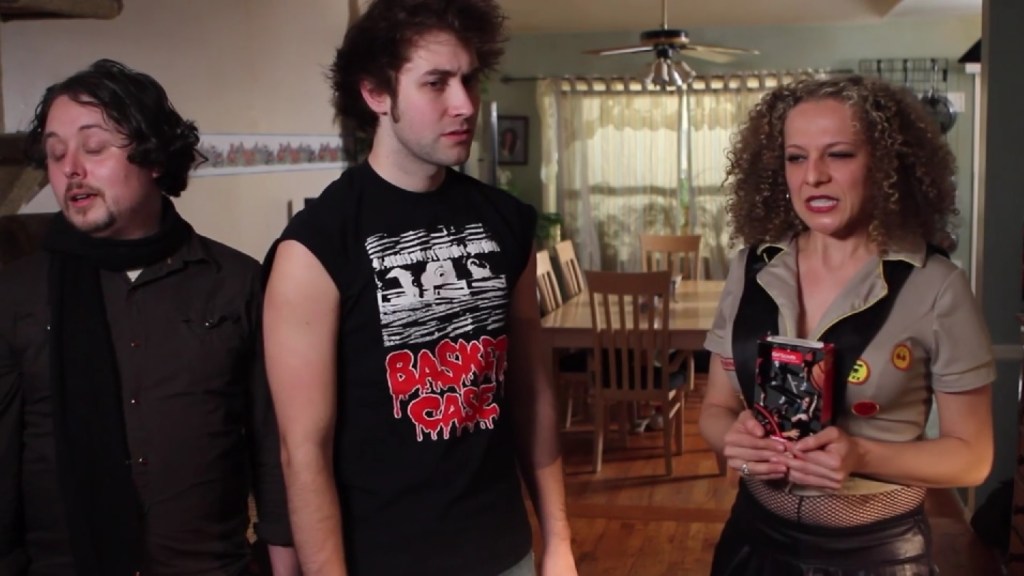
If the tee-shirt of Frank Henenlotter’s Basket Case doesn’t clue you in, all hope is lost.

Ha! Then ye digital reviewer, thou has never tossed back a sour ale of the Eddie Romero or Godfrey Ho variety, or noshed on Hard Rock Zombies (which is GSZM’s closest celluloid relative for this reviewer) and other (awful) ’80s heavy metal horror ditties of the Blood Tracks variety.

Eichelberger is one of us: he’s watched way to many Italian zombie movies (your poor mom!). He’s probably watched Lucio Fulci’s Zombie (1979) more than myself and Sam the Boss, combined. And it’s a foregone conclusion the ‘Eich also partakes of the zombie cheap-slop, such as Jess Franco’s Oasis of the Zombie (1981), Jean Rollin’s guacamole-smeared living-dead romp Zombie Lake (1981), and (ugh) Bruno Mattei’s Hell of the Living Dead (please, Bruno, just stop it already). Did the ‘Eich watch Wendy O. Williams in Reform School Girls (1986)? You bet he did.

All of those film come to play in the frames of GSZM. And like those films, this one is also strictly for adults only: it’s lewd, it’s lascivious, it’s gratuitous, and nudity is at forefront (and back!) for extended periods. (You’ve been warned.) However, unlike most of those films, which were not homages to anything other than cinematic ineptitude-by-low budget, Eichelberger’s debut, while admittedly production-bad with tragic thespin’, is supposed to be “bad” to mimic the bad films in which it’s tipping its hat. (And a couple truths: This is actually a well-shot film, void of any of that annoying, fish-eyed handheld lensing of the i-Phone variety cloggin’ up Amazon and Tubi. And that Eric Eichelberger is on his way to being the new David DeCoteau (who we worship at B&S, so know your Ellen Cabot, ye reader). And that the most experienced actors on board, leads Vance Clemente (makes me think he’s Crispin Clover’s brother) and Jessica Mazo, are actually quite skilled; here’s to hoping they move onto larger roles or nail a guest-starring network series gig. Oh, and adding to the meta: GSZM features the last ever screen performance from the late Bloodsucking Freaks director, Joel M. Reed, who we lost this past April.)

No, Girls Scout Zombie Massacre is not a 10-star film by any means. It’s also not a 1-star film, either, you IMDb’ing Amazon scamps. It’s also not Shaun of the Dead or Return of the Living Death nor Re-Animator or Severed Ties, either (and what films are, as they’re zombie-horror-comedy gold standards). GSZM is what it is: an intentionally bad, campy-comedy-horror movie — and it’s inherently preposterous to give Eichelberger’s film a bad review. Look, if you’ve sat through any Troma Team film (shite, don’t get Sam started on a Troma tear) and you’re into Charles Band’s direct to video oeuvres, with their soupçons of gore, a dashes of comedy, and smidgens of T&A, then there’s something for you to watch. The only thing that’s missing is Eddie Deezen (Beverly Hills Vamp) as our mad scientist and, along with Michelle Bauer, Linnea Quigley (The Good Things Devils Do), and Brinke Stevens co-starring, we’d have ourselves another USA’s Up All Night romp with back-to-back showings of Hollywood Chainsaw Hookers, Sorority Babes in the Slime-Bowl-O-Rama, and Nightmare Sisters.

The only downside to the film — IMO, so take it as you may — is that the film is a bit too long and would have been better served by a cut to a more first-time-director-streaming-friendly 80-minutes. But this is a self-financed and produced film with none of those “no, thou can not do that on film” pesky studio suits or distributors to rein it all in. But that’s par for the streaming course in the digital lawless wastelands of the 21st Century VOD-tundras. A couple reviewers mentioned a 70-minute running time, which would be one hour eleven minutes. So, we’re assuming, what we are able to currently free-stream on Tubi must be a “director’s cut,” because that cut runs 111-minutes, that is, a one hour fifty-one minute running time. But it’s the steaming verse, so we give the widest of wide berths to the new kids sailing the seven seas of the Amazon-fed oceans.

All in all: A job well done, Eric, we look forward to your next film; definitely make another one. And you’ve inspired us to watch — finally, the one Gordon film I haven’t watched — King of the Ants, on Tubi. Of course, the whole reason for this review is for you, dear B&S reader, to check out Ghoul Scout Zombie Massacre on Tubi courtesy of Rising Sun Media. You can learn more about the film on GSZM’s official website.

And be sure to check out our recent interview with director Eric Eichelberger.

Disclaimer: No, we do not know the filmmaker. And we didn’t receive a review request, either. We discovered this film on our own and genuinely enjoyed the film.

About the Author: You can read the music and film reviews of R.D Francis on Medium and learn more about his work on Facebook.
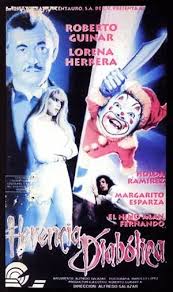
Herencia Diabólica (1993)

Alfredo Salazar wrote some pretty great movies, like Las Mujeres PanterasThe Batwoman, the Aztec Mummy films and some Santo movies. He only directed ten movies, with this one being his last. And oh man, what a way to go out.

Tony (Roberto Guinar, who must have a thing for weird dolls, because he also directed the absolutely nightmarish Muerte Infernal) and his wife Annie (Holda Ramírez) have returned to Mexico due to Tony’s aunt dying and giving him her mansion. While he’s working, Annie finds plenty of black magic implements and a clown doll. He explains it like, “Yeah of course she did a lot of witchcraft. No big deal.” And Annie is fine with it. So fine that they cerdo hormiguero and nine months later Tony’s a dad. Well…not before the clown kills his wife and his son Roy is safely born in the hospital.

Fast forward a few years and Roy (Alan Fernando) has become obsessed with the clown, whose name is Payasito. He then gets a new mommy — Tony’s secretary Doris (Lorena Herrera) — who soon realizes that the doll is evil and has to go.

There are long stretches of this movie where nothing happens. These are important because they will make you forget the little person named Margarito Esparza Nevare playing Payasito. He is absolutely terrifying every single moment that he appears in this movie, whether he’s stabbing someone, lynching the maid, assaulting someone and sometimes just standing there. He’s one of the most frightening visuals I have ever seen in any movie I’ve ever seen. Just imagine how bad that gets.

You can watch this on YouTube.

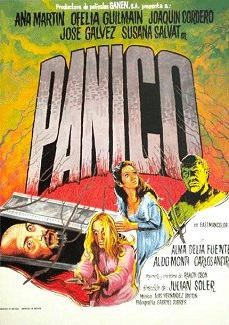
Pánico (1966)

With a name like this, I just had to review this one.

It’s directed by Julián Soler, who also made Santo vs. Blue Demon in AtlantisEl Castillo de Los Monstruos and El Hombre y La Bestia, this is a three-part horror anthology.

The first story — Pánico — has nearly no dialogue, just a young girl (Ana Martin, who is in a movie I just have to track down — La Mujer del Diablo, as its a Mexican gothic occult movie directed by Alfredo B. Crevenna) being hunted as she runs through the woods, followed by a witch (Ofelia Guilmáin, The Exterminating Angel) with a knife. She keeps seeing the same three boys over and over again, as well as the doll of a child. At the end, she ends up strangling the witch and then dying within the real world, as she had been trapped in a mental institution after the three men we keep seeing had assaulted her, which cost her her unborn child.

In Soledad, Joaquín Cordero (Dr. Satan!) and José Gálvez (the devil in Macario) have just buried the body of a girl during a plague. They soon turn against one another and the hallucinations both suffer leave them — and you — wonder who is alive and who is dead.

Finally, the last story is Angustia, which is a cover version of Poe’s The Premature Burial with some comedic elements, as a scientist and his cat both ingest chemicals that make them seem dead. He’s played by Aldo Monti, who would go on to direct the giallo-esque Santo en Anónimo Mortal and an occult thriller called Seducción Sangrienta that I also need to track down. He spends much of this story trapped in his coffin, trying to get anyone to notice that he is still alive, including his wife (Alma Delia Fuentes, Blue Demon Destructor of Spies and Peligro…! Mujeres en Acción). By the end, he of course gets buried alive and then reincarnated as a catterpillar that his grieving wife steps on.

This was written by Ramón Obón, who has over a hundred script to his credit, including Las SicodélicasThe Empire of DraculaLa Señora MuerteSanto vs. Los LobasEl Látigo contra SatanásLa Furia de Los Karatecas and Terror y Encajes Negros.

Plenty of weird fun here and it feels really experimental. The short running time really helps, as unlike modern portmanteaus, it never drags.

Blue Demon: El Demonio Azul (1965)

Alejandro Muñoz Moreno became better known as Blue Demon, a Mexican luchador and film actor who was the contemporary, teammate and often rival of El Santo. From 1948 to 1989, he never lost his trademark mask in a series of mask vs. mask and mask vs. hair challenges, winning the hoods of Espectro II, Matemático, Rayo de Jalisco and Moloch and shaved the heads of Baby Olson, Tony Borne and Cavernario Galindo. He held the NWA World Welterweight Championship twice, the Mexican National Welterweight Championship three times and the Mexican National Tag Team Championship. He was such a big deal that each year or so, CMLL holds the Leyenda de Azul tournament in his name and he was buried in his trademark outfit.

Along the way, he found the time and energy to appear in 28 movies.

After La Furia del Ring and Asesinos de la Lucha Libre, this was the third film that Blue Demon would appear in. Directed by Chano Urueta, this is a great introduction to the hero, who battles werewolves and mad scientists. Whereas El Santo at least had a silver mask that you’d figure would give him the edge against el hombre lobos, Demon has no such extra advantage. Instead, he’s going to battle them with just the gifts that God gave him, which is mostly body slams, which somehow do end up curing the world of lycanthropes in this entry.

One of the wrestlers that Blue Demon is in the ring with in this, Ray Mendoza, may not be known as much to American audiences, but his sons became Los Villanos and two of them — Villano 4 and Villano 5 — wrestled for WCW.

Plus, the man who played El Sanguinario in this — Fernando Osés — would go on to write ten of the Santo films and nearly all of Blue Demon’s movies, including this one. He even directed three movies — El Chicano JusticieroLa Hija del Contrabando and Gente Violenta.

You can watch this on YouTube.

Agent Revelation (2021)

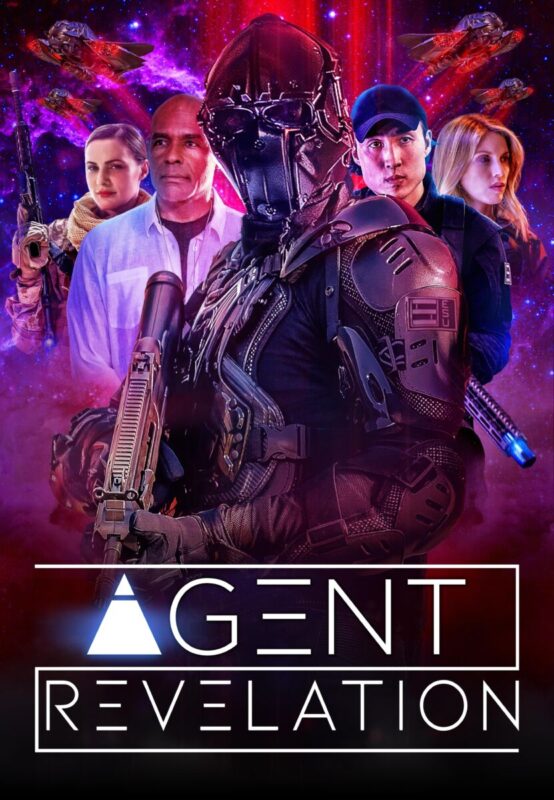
Also known as Agent II, this is the story of an ancient dust that controls humans getting unleashed. However, Jim Yung (writer, director, producer and star Derek Ting, who also made the 2017 film Agent that this is the sequel to) gains superpowers from the red dust, which will come in handy, as Earth is currently in a secret war against the  Kinians, a race of evil aliens.

That’s when he meets Alastair (Michael Dorn, Worf from Star Trek: The Next Generation), an AI firm owning billionaire who has created his own private army to fight the aliens that we’ve already seen stop a guy named John (also from Agent) and killing the farmers that he’s controlling. He plans on training Jim to be his greatest soldier.

This movie gets a ton out of its budget, with scenes that look like first person shooters, massive use of bullet time and some good fight scenes. I kind of dug that the aliens are here for the mana that humans use to power their fighting skills. It’s a metaphysical lizard alien fistfight movie and you don’t get too many of those.

This is available on demand from Quiver Distribution. You can learn more at the official website and Facebook page.

ANOTHER TAKE ON: Southland Tales (2006)

AUTHOR’S NOTE: We originally covered this movie all the way back on February 28, 2020, which feels like a million years ago. With the new Arrow Video release of this movie, it feels only right to watch it one more time.

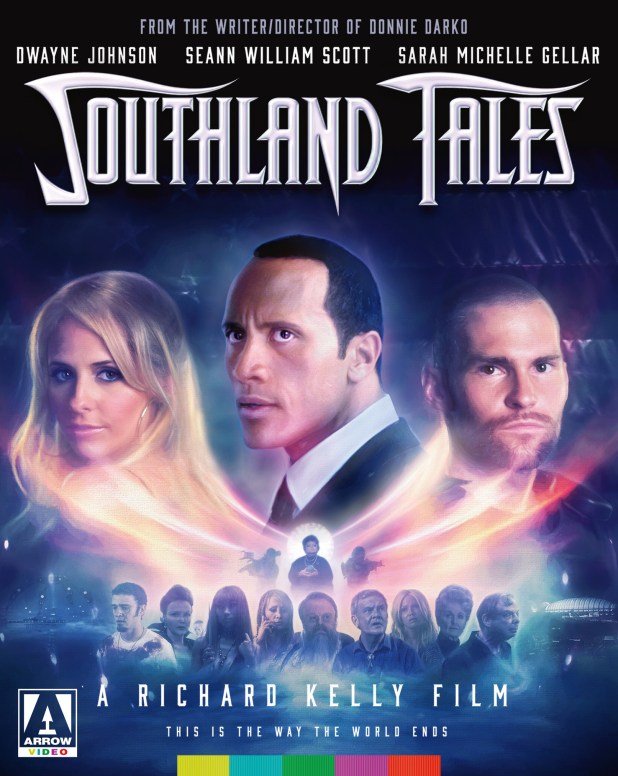
Richard Kelly made Donnie Darko, a film that had a cult that is still obsessed with it, and then followed that movie with Southland Tales, which has, well, probably me still trying to figure it out.

Luckily, the new Arrow release has the 160-minute Cannes cut, which has about 15 minutes more footage than the original, which was one of my holy grails. Between that and a new documentary, It’s a Madcap World: The Making of an Unfinished Film, which has new interviews with Kelly and the crew of this movie, plus everything else in this set, I’d like to say that I’ve figured out more of this movie and have an answer as to what it all means, but let’s be honest. I’m not even sure Kelly is completely sure what this is all about.

Much like Boxer Santaros/Jericho Cane, the character played by Dwayne Johnson/The Rock, who has a script to a new movie The Power basically downloaded directly into his brain that isn’t just the best movie he’s ever considered, but also the way that the world will end, I think that either Kelly had his soul split in two by Fluid Karma or — most likely — had access to the best in drugs after the success of his first film.

The thing is, while so many people dismissed this movie as five years dated in the wake of 9/11, which inspired Kelly to rewrite his story in light of “some of the biggest issues that I think we’re facing right now …the increasing obsession with celebrity and how celebrity now intertwines with politics,” the fact that we are still in the end stage of having a celebrity in the White House who created a cult — not just a cult of personality — makes this film even more relevant in the last twelve months than it was for the past fifteen years.

Somehow, this film — which made $374,743 worldwide against a production budget of $17 million — still obsesses and confuses me long after I forget the latest movie that everyone can’t stop chatting about.

In our world of influencers and bubbles and a public who doesn’t understand the meanings of words like socialism and fascism — while at the same time our leaders on one side misrepresent what defunding means and the other side knows exactly the talking points to speak most directly to the blood and circuses heard of the easily swayed — Southland Tales feels like it really could be the world outside my door. Is it because it was so prescient? Or has life over the COVID-19 confined and protest filled year of 2020 moved reality to science fiction?

I don’t really recommend this movie to many people, because ten minutes in they’re going to realize that it feels like chapter four of a narrative that has already been going on without them — this is exactly what is happening, there were three graphic novels that begin the movie’s story that no one would ever know about or should have to read, but there you go — which never works for any movie other than the ones that I get all mental over.

Therefore, instead of a traditional narrative review — the one we did last year does that and you can refer to it right here if you’d like — I’m going to instead list off some of the questions in my head in the hopes that they will get answered by the universe (or Kelly is Google searching for himself, manages to make his way here and decides to bless me with whatever passes for answers).

Why is the neo-marxist porn-based conspiracy army — as well as USIDeath — staffed by nearly all actors with Saturday Night Live origins, like Amy Poehler, Jon Lovitz, Nora Dunn and Cheri Oteri?

How did the overdubs of Justin Timberlake, who plays Private Pilot Abilene, change the story that Kelly intended? Adam Lorincz, who commented on the original review, said that Kelly redubbed “only the parts when he doesn’t speak on-screen, we just hear his inner monologue, and keep the parts where he is actually speaking, resulting in a character that’s sometimes almost sage-like in it’s wisdom, other times an absolute douchebag.” What’s going on there?

Did Kelly just want to work with a collection of his favorite actors from movies? Like how do you get Wallace Shawn, Zelda Rubenstein and MIranda Richardson and throw them in a film with people like Christopher Lambert and Bai Ling? Building off the SNL question, why are there so many comedic actors — John Larroquette, Curtis Armstrong, Janeane Garofalo, Will Sasso — in this movie? Sure, Kelly has said that he “sought out actors that he felt had been pigeonholed and wanted to showcase their undiscovered talents,” but is there a deeper message to their casting?

What is the point of Kevin Smith’s legless veteran, Simon Theory?

Come to think of it, what is the point of why the zeppelin needs to be shot down and why Boxer has to be there and what the point of the dance number is, other than to entrance the audience of USIdent people so that they all stay and die?

Why is the soundtrack so stuck in mid-90’s — Jane’s Addiction, The Killers and Moby figure prominently — yet the rest of the movie not feel lost in time? I mean, even the chapters take their titles from songs from that time period: “Temptation Waits” is a Garbage song, “Memory Gospel” is a Moby song in the movie and “Wave of Mutilation” is by the Pixies.

Did he pay any of the artists or credit them for taking lyrics as words that the characters say? For example, the line “We saw the shadows of the morning light, the shadows of the evening sun until the shadows and light were one,” comes directly from Jane’s Addiction.

Does it make the movie make more or less sense when you know that The Power was not written whole-cloth by Boxer, but was written by Krysta and given to him after he’s found with his memory wiped away in the desert? Oh yeah — this is another fact that you’d only know if you read the comic books.

Why is Boxer’s other name — Jericho Cane — the same name as Arnold Schwarzenegger’s character in End of Days?

I don’t have the answers. I do have the new blu ray set, which you can get from Arrow Video.

El Cuarto Chine (1968)

The independently wealthy Albert Zugsmith made millions selling ads. So he did what you or I would probably want to do if we had that much money. He started producing his own movies, starting with his American Pictures Corporation, which made Captive Women, Sword of Venus and Port Sinister all for under $100,000 each.

His first big success was Invasion U.S.A., which he followed with Paris Model and Top Banana before making a deal with Universal. There, he produced Female on the Beach with Joan Crawford, The Incredible Shrinking Man, Written on the Wing and Touch of Evil before moving to MGM, where he got High School Confidential!, which was part of a series of films he worked on with Mamie Van Doren, including The Beat GenerationThe Big OperatorGirls Town and the first movie he directed, The Private Lives of Adam and Eve.

The movies that he directed definitely start moving in an exploitation direction from here on out, like the Vincent Price movie Confessions of an Opium EaterSex Kittens Go to College, the notorious bomb DondiPsychedelic SexualisSappho Darling and Movie Star American Style or LSD I Hate You. He also produced Russ Meyer’s Fanny Hill.

That brings us to this burst of insanity.

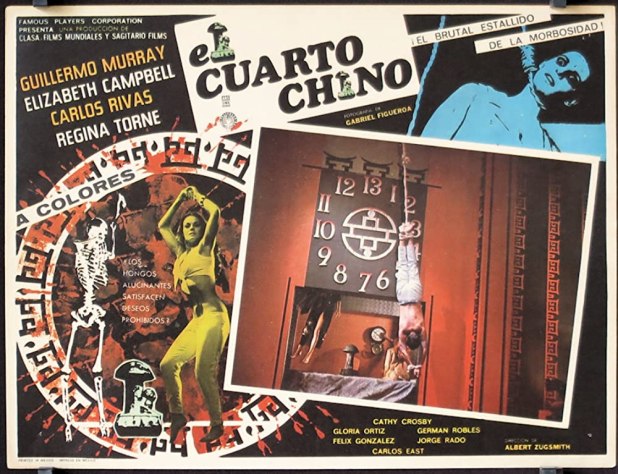
Nick Vidal (Carlos Rivas) owns the bank his father stole from the Cervantes family, with Juan Cervantes (Ivan J. Rado, The Wild Bunch) still working there. For some reason, Juan has no worries at all, while Nick can barely sleep and is obsessed with the shady deal. He’s also sleeping with his secretary, Sidonia (Regina Torné, La Senora Muerte).

Meanwhile, Consuelo the maid (Gloria Leticia Ortiz, Santo in the Hotel of Death) tries to hang herself and is stopped by her father Pedro (Germán Robles, who played Nostradamus the vampire in that series of films). It turns out that she too had an affair with Nick and can’t live without him. And while all that’s happening, Dr. Saluby (Guillermo Murray, El Mundo de Los Vampiros) has come to check on the injured maid and ends up sleeping with Nick’s wife Muriel (Elizabeth Campbell, Golden Rubi from the Wrestling Women movies).

To make this even more convoluted, Nick has been getting threats on bank stationary. He’s sure it’s Juan, so when he goes to the man’s house, instead of a fight, he’s warmly greeted and taken to the Chinese room that gives this movie its title. There, he sees a woman in a mask who is in a drug haze, which helps her get over the pain she feels from her deformed foot.

Nick’s nightmares kick into high gear, filled with gory dismemberments, dancing skeletons and him being bound to a giant clock.

Then, somehow, this becomes a murder mystery, as the maid is found hung again, but the real cause of death is choking by human hands. And anyone — everyone — has a reason for why she had to die, because it turns out that she’s pregnant with Nick’s child.

I have no idea how this film ended up made in Mexico with a mostly Mexican cast. That said, it’s really something. How many mushroom taking murder mysteries with dream sequences have you seen?

El Hombre y El Monstruo (1959)

If I’ve learned anything from watching Mexican films, it’s that you should never make a deal with el diablo.

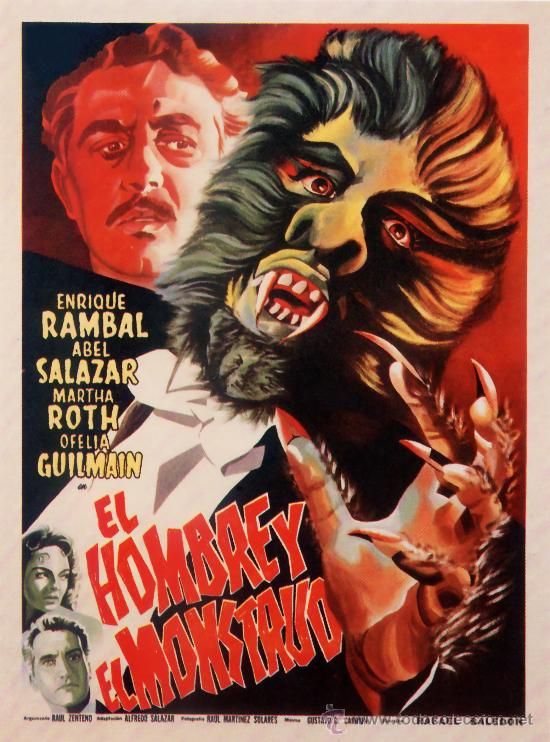
If you’re like Samuel Magno (Enrique Rambal, The Exterminating Angel), you finally get your dream of being a concert pianist to come true. Then every time you play Tchaikovsky’s Piano Concerto No. 1, you turn into a monster.

Directed by Rafael Baledón, who acted from 1938 to 1994 as well as directing La Muñeca Perversa, Muñecas Peligrosas and Orlak, El Infierno de Frankenstein, this is 78-minutes of Mexican gothic horror, with the curse only stopped by the protagonist’s demanding mother.

It’s literally FaustDr. Jekyll and Mr. Hyde and The Werewolf all in one movie, with special effects on par with El Baron del Terror. If you aren’t rushing to find this movie right now, what’s wrong with you?

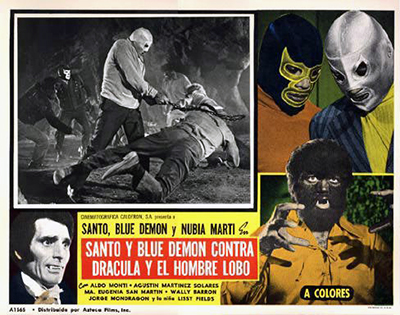
Santo y Blue Demon contra Dracula y el Hombre Lobo (1973)

Santo made eight movies in 1973 and I can honestly recommend every single one of them to you.

That’s because in the world of Santo, anything can happen. Sometimes, Santo movies are just about wrestling. Other times, they are take on whatever trends are hot, like Eurospy films, Hammer movies or even karate films.

For example, this one starts with Santo and his girlfriend Lina (Nubia Marti, Santo vs. the She Wolves) go to visit her uncle, Professor Cristaldi. It turns out that 400 years ago, their family killed Dracula and the Wolfman, who are back for revenge from the grave.

Santo gets Blue Demon on board for help, while the monsters plan on turning Lina and her family into monsters. He even turns Lina’s mom into a vampire and kidnaps her, which is a really devious move.

The werewolf’s name is Rufus Rex. Do you need a better reason to watch this movie? How about Santo and Blue Demon defeat evil by throwing both of them into a put of spikes?

Aldo Monti — as Dracula — menaced Santo before in Santo in the Treasure of Dracula, which was recut and re-released with full color (and full frontal nudity) — to the chagrin of the Santo family — as El Vampiro y El Sexo. 

You can watch this on YouTube.

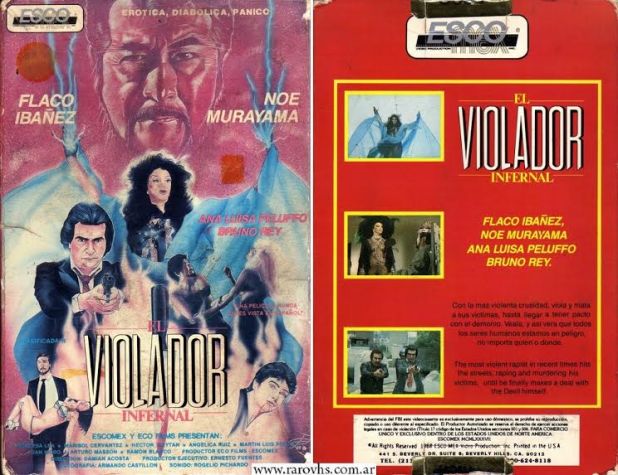
ANOTHER TAKE ON: El Violador Infernal (1988)

ABOUT THE AUTHOR: Herbert P. Caine is the pseudonym of a frustrated academic and genre movie fan in Pennsylvania. You can read his blog at https://imaginaryuniverseshpc.blogspot.com.

This film’s title translates to “The Infernal Rapist.” Yep, you read that right, “The Infernal Rapist.” Why did they think this was a good title? Were “The Obviously Evil Rapist” and “The Man with Consent Issues” taken? Were the producers afraid that we’d confuse this film with some obscure franchise called “The Gentle Rapist”? We know that rapists are evil!

I watched this film largely based on curiosity rooted in its garish title. Unfortunately, I could not find a subtitled or dubbed version of it. (I don’t think it has ever received an official release here.) Consequently, I was left with a Spanish language only version on YouTube. Fortunately, the plot is not difficult to follow.

El Violador Infernal follows the adventures of Carlos “El Gato,” a serial killer and rapist who is about to die in the electric chair. After being unconvincingly electrocuted, Carlos receives a vision of the devil, who bears an odd resemblance to Cher. SatanCher offers Carlos a deal: in exchange for renouncing his religion and carrying out regular human sacrifices, Carlos will be given a new lease on life as a wealthy drug dealer. Carlos jumps at the chance, as a rapist isn’t all that faithful a Christian anyway.

If nothing else, the film realizes that its mission is to shock, as it immediately moves on to our protagonist sexually assaulting another man. Although this probably constitutes the most “transgressive” scene in the movie – keep in mind that homosexuality was far less accepted in the 1980s – it is probably the least graphic rape scene in the film, with a fully-clothed Carlos humping the also-clothed victim. Never mind Deliverance, this scene won’t even make you forget the scene from Kingpin where Woody Harrelson fantasizes about pimping out Randy Quaid. Subsequent scenes are far more explicit.

There’s no getting around the fact that the rape scenes in El Violador Infernal are disturbing to watch. Although the acting in this film is not great, the women involved make a convincing show of being terrified and disgusted by what is happening to them. The film rather sleazily draws out these sequences, making them all the more disgusting and uncomfortable. The director failed to comprehend that a rape scene does not need to be drawn out to be shocking. Consider, for example, the rape in Abel Ferrara’s Ms. .45, which lasts for a minute at most but takes the viewer completely off guard.

The film also suffers from terrible special effects. Although there are not many effects scenes in the film, the few included are laughably bad. As part of his deal with SatanCher, Carlos gains the ability to shoot lasers out of his eyes. The “lasers” are obviously just red lines drawn on to the film. In some scenes, they don’t even connect to his eyes. In another scene where Carlos levitates one of his victims, you can just make out the harness holding her in the air.

Given the sleaziness and low budget of the film, you would assume it was populated with unknowns, but that is not the case. Carlos is portrayed by Noé Murayama, a Japanese-Mexican actor who appeared in over 150 films and numerous television shows. Princesa Lea, who plays one of the objects of Carlos’s affections, was a popular vedette, or cabaret entertainer.

In the end, this film is not worth the time it takes to watch, let alone without subtitles. If you’re determined to see it, it is available on YouTube without subtitles.