2020 Scarecrow Psychotronic Challenge Day 22: Jaws 3D (1983)

DAY 22. MURKIN: Something underwater or ocean related. It sure is dark down there, what was that?

If you are a regular visitor to our site, you may realize that we love shark movies. We have a whole Letterboxd list devoted to them. While Sam’s taste may veer toward the ripoff side of the Jaws equation, Becca’s heart is with the sequels, even Jaws: The Revenge.

After a career as a production designer — he built the awesome New York City model in Escape from New York — Joe Alves took his experience on Jaws 2 to make this one. Earning the 1983 Golden Raspberry for Worst Director, he went back to production design for movies like Starman and Freejack.

But this wasn’t even the movie the producers wanted to make.

David Brown and Richard Zanuck, the producers for the first Jaws films, brought in Matty Simmons, who produced National Lampoon’s Animal House, and Lampoon writers John Hughes and Todd Carroll to write a script called Jaws 3, People 0. With Joe Dante directing, it would have started with author Peter Benchley being devoured in his swimming pool. The studio didn’t want to turn what was fast becoming a joke into a joke and demanded another legitimate film. Brown and Zanuck responded by quitting the studio.

Richard Matheson was brought on to write this script, which was filled with studio demands, including needing to have Brody’s sons in the movie and a part for Mickey Rooney. The studio heads had never checked to see if Rooney was available so that shoehorning was all for naught. As for anyone from the previous films, Roy Schnieder said, “Mephistopheles couldn’t talk me into doing it. They knew better than to even ask.” He specifically took the movie Blue Thunder so that he would be unavailable.

“The third dimension is terror.”

Yes, in 1983, 3D was back, thanks to movies like Comin’ At Ya! Any movie in its third iteration — I’m looking at you Friday the 13th Part 3 and Amityville 3-D — were made ala Dr. Tongue, with things coming directly at your face.

Back in the days before Blackfish, Seaworld was a big name. Somehow, the producers were able to talk the brand — specifically SeaWorld Orlando — into being the location for this movie. I remember as an 11-year-old seeing ads all over the Cleveland park for this movie and wondering, “Why are they advertising something that scares everyone inside a place that is supposed to be making us happy?”

Young Mike Brody has grown up to be Dennis Quaid, who told Watch What Happens Live that this movie had the biggest cocaine budget of any film that he worked on. He told Andy Cohen that he was on cocaine in every frame of the movie. He and Kathryn Morgan (Bess Armstrong) are in charge of the park, which has somehow allowed a great white shark to swim on in and kill people, including some dudes who are there to steal some coral.

Louis Gossett Jr. is also here as Calvin Bouchard, the park manager, who for some reason is best friends with a hunter played by Simon MacCorkindale, which feels counter-intuitive to running a park that is all about the love of animals. Then again, knowing what we know about SeaWorld today, it all makes sense.

There are also two dolphin stars, Cindy and Sandy, who were not on blow but have a bigger role than many of the humans, including Kelly Ann Bukowski (Lea Thompson) and Sean Brody (John Putch). You have to admire the stupidity of someone who wants to ride in bumper boats when the deadliest predator known to man is on the loose.

Somehow, the stupidity continues to the point where a second and much larger shark gets in the park, which seems like the kind of thing that should get everyone fired and the park closed. There’s only one way to deal with this kind of thing: we gotta blow another shark up real good*. Luckily, the 3-D effect is here to show us this in graphic — and below-average even in 1983 — detail. You know how some effects look bad years afterward and you attribute them to the fact that the movie has aged? This looked bad in the time it took from filming to playing in theaters.

Ironically, this movie has a lot in common with Halloween III: Season of the Witch. Both of their original films were big successes in the 70’s that made their directors big names. Those directors didn’t come back for the sequels (well, Carpenter did reshoot plenty) and both were directed by the production designers of the original movies. They also moved the location and tried to do something different. While the Silver Shamrock caper is today much more well-regarded, Jaws 3D is still a joke to many.

By the way, for all the scorn through at Bruno Mattei for outright ripping off shark footage for Cruel Jaws, this movie had to pay a lawsuit to National Geographic for taking scenes from its 1983 documentary film The Sharks without authorization. Strangely, that makes me love this movie even more.

*Some of the entrails that fly out of the screen in 3-D are actually a brown leather ET doll.
SLASHER MONTH: Witchboard III: The Possession (1995)

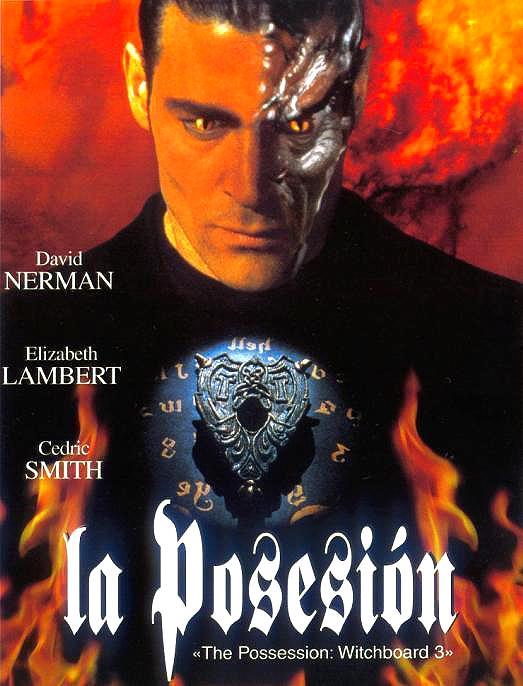
Written by Jon Ezrine and the writer and director of the first two films, Kevin S. Tenney, this entry in the Witchboard films was directed by Peter Svatek (Bleeders). It’s all about Brian (David Nerman), a man who finds out his landlord (Cedric Smith, the voice of Professor X on the 90’s X-Men the Animated Series) is really a demon named Kral. How does a demon learn the ways of Canadian real estate, one wonders? The film never really gets into that, but these are the facts that I really want to learn.

Kral takes over Brian’s body — as demonic landlords are wont to do, basically subletting his soul, so yeah maybe demons are good at real estate — and decides that he’s going to knock up our protagonist’s wife Julie (Elizabeth Lambert).

There are some good KNB effects on display — a man gets attacked by his own butterfly collection — and it’s pretty much the Red Shoe Diaries if that Showtime show also had gore and demons, which sounds like a great idea for a movie if you ask me. This one is kind of like Wall Street with, you know, demons.

Speaking of sex, this movie remembers that it is angry that the second one didn’t get Ami Dolenz as nude as Tawny Kitaen and goes all in on the softcore aardvarking. It’s couples gore, I guess.

While this is the last Witchboard film, A Nightmare On Elm Street 3: The Dream Warriors and The Blob director Chuck Russell is planning on a remake, as of 2017. I’m all for that.

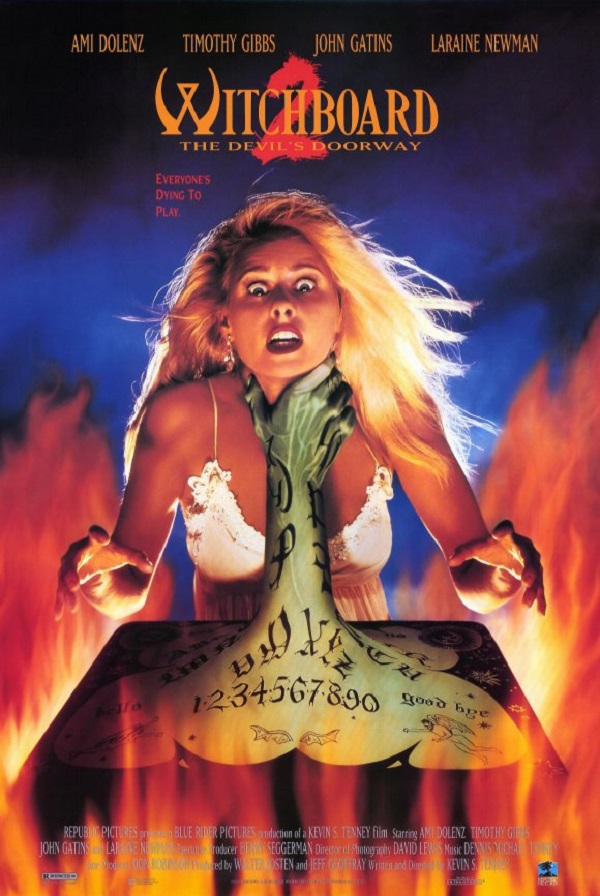
SLASHER MONTH: Witchboard 2: The Devils Doorway (1993)

Ami Dolenz — yes, the daughter of Mickey — takes over for Tawney Kitaen here as the Ouija-based mayhem continues. Writer/director Kevin Tenney is also back to tell the tale of Paige, who is becoming possessed through the board, discovering the spirit of the woman who once lived in her new apartment.

Who was Susan Sidney, the woman obsessing her heroine, keeping her locked inside to paint numerous images of her? An innocent? An exotic dancer prostituting herself? And what happened to her? Well, it’s a good thing Mickey dates a cop!

Tenney actually did research into progressive entrapment, where the spirits contacted by the Ouija board would slowly take over the lives of those who came in contact with them. While he didn’t believe in the veracity of the occult, he did say that the whole thing seemed creepy.

It was pretty cool seeing horror fan and SNL alumnus Laraine Newman show up in this.

This is the only Witchboard movie to not be packed with nudity. That’s because Dolenz had a no-nudity clause. However, Republic Pictures’ foreign sales department — yep, that old excuse that international markets need nudity — pressures Tenney into pushing for her to disrobe. The director and thinks this is why they tried to keep him out of the third movie in the series.

Hey — a dude gets killed by a boiler room. That’s worth your time, right?

Words

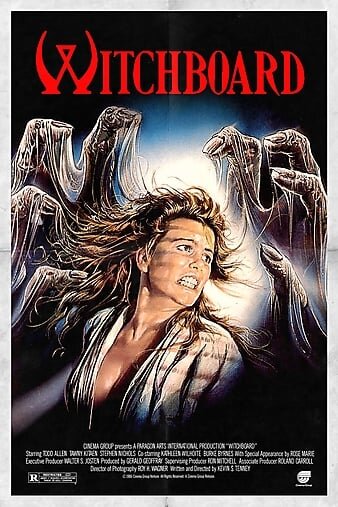
SLASHER MONTH: Witchboard (1986)

Back before Hasbro — who now owns Parker Brothers — bought the rights to Ouija and turned it into a movie, it was the kind of game that inspired the possession in The Exorcist as well as turning up in films like Don’t Panic and Spookies. I was warned often as a kid to never play with it as it would unleash demons within me.

My mother would have been better off warning me about redheads — I’ve married two of them — like Tawny Kitaen, who dominated the late 80’s after her appearances in several Whitesnake videos. Those of us who stayed up way too late watching Cinemax also knew her from movies like Bachelor PartyCrystal Heart and, well, this movie.

Written and directed by Kevin S. Tenney, who also made the similar Witchtrap, this is a movie just as much about Ouija* as it is about the friendship — and enemyship — of Brandon Sincalir (Stephen Nichols, who your mom weak in the knees for when he played Patch on Days of Our Lives) and Jim Morar and their dual love for Linda Brewster (Kitaen) as it is about witchboards.

One night at a party, Brandon shows everyone how he has a friendship with a dead ten-year-old boy — not creepy at all, right? — through the divining board, which really seems to get to Linda, whose hair goes from severe to gorgeously windswept, as if she were dancing on the roof of a car*, as the movie goes on.

This movie really does have it all, and by everything I mean a punk rock psychic named Sarah “Zarabeth” Crawford (Kathleen Wilhoite, Private School) who gets her throat slashed by the real ghost Linda is talking to, who is named Carlos Malfeitor, and then tossed out a window on to a sundial.

Watching this movie through the lens of someone 34 years older than when I first saw it, I can tell you that Brandon and Jim really were the ones in love with each other and Linda is just the beard for them both. But it’s hard to quibble with a movie that comes up with the conclusion that the only way to destroy a haunted Ouija board is to shoot it as many times as possible.

You can watch this on Tubi.

*Before lawyers got involved, it was called Ouija. Despite Parker Brothers — the owners at the time — not having the rights to that name, they decided to reshoot any scenes that mentioned it by name or used one of their boards.

**Kitaen did have experience with this look, after all.

Join us as we pay tribute to the late Tawny Kitaen’s career with our exploration of her films.

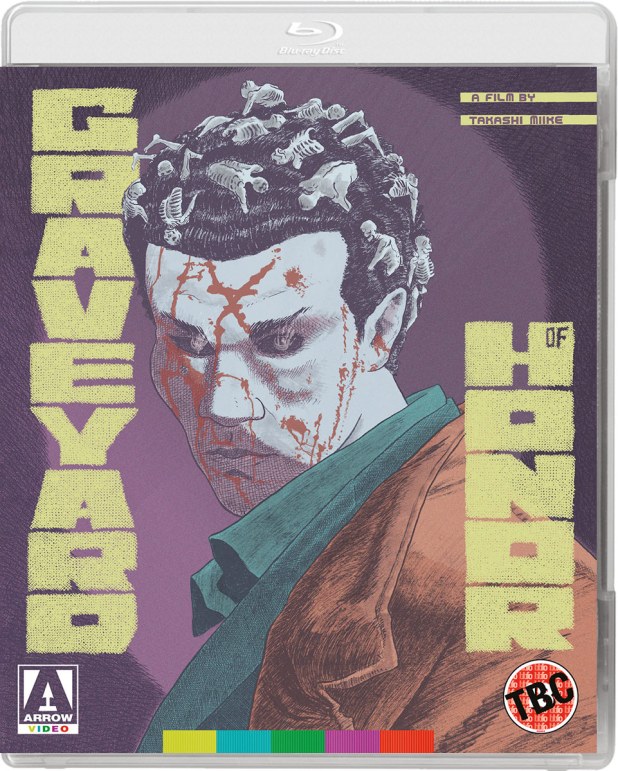
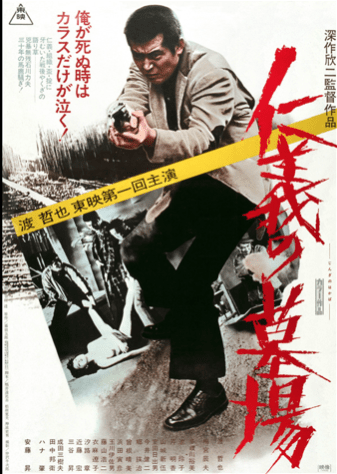
Graveyard of Honor (2002)

There are decades between the worlds of Kinji Fukasaku and Takeshi Miike, but this is the movie that unites both of their lengthy resumes. They’re very different filmmakers, so seeing them both tell the story of Goro Fujita’s book and the life of Rikio Ishikawa.

The original film takes place in the years following World War II, but this version takes place in a very different time, as the late 80’s economic boom is about to give way to the depression of the 90’s. It also changes how its protagonist enters the world of crime. Here, he bluntly — literally — saves the life of a boss when an assassin (Miike) comes in like he’s in a completely different film, double guns blazing, only to be knocked down with a chair.

But just like in the previous version of this story, Rikuo cannot be tamed. Or reasoned with. Or expected to act like a normal human being. He drags down everyone he comes near and turns on anyone close to him. He is a force of horrible nature and corrupts everything he touches.

This is perhaps the most restrained movie you’ll see Miike. Don’t take that as boring. Even a more dramatic version of the director is still more whiplash than three lesser talents put together.

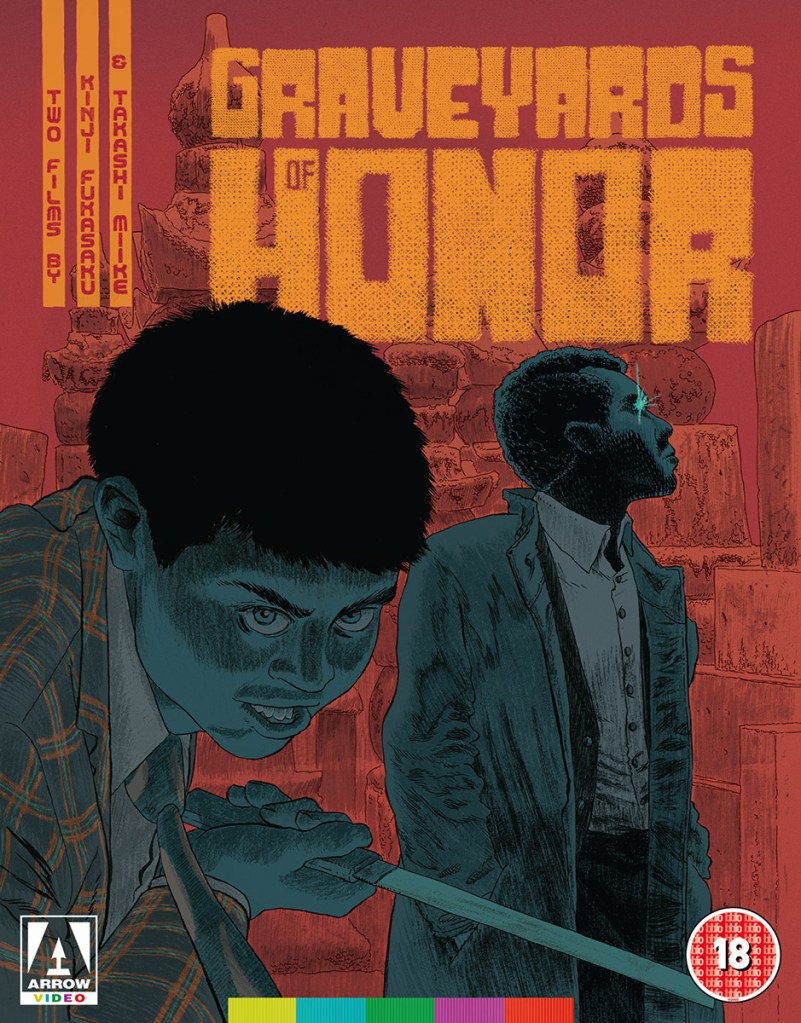
You can get this movie as part of the Graveyards of Honor set recently released by Arrow Video. It comes with Kinji Fukasaku’s 1975 version, as well as audio commentary by Miike biographer Tom Mes, a visual essay by author and critic Kat Ellinger and archival features like interviews with Miike and the cast, making-of features, press release interviews and a premiere special.

Graveyard Of Honor (1975)

Kinji Fukasaku (Battles without Honor and Humanity, Battle Royale) adapted Goro Fujita’s gangster novel of the rise and fall of real-life gangster Rikio Ishikawa, a man who lives up to the lack of honor or humanity references by Fukasaku’s other film.

How horrible of a person is Ishikawa? Within minutes of the opening credits, he steals money from the Aoki gang, robs a Sangokujin gambling den with Imai, stashes his gun with a geisha named Cheiko, gets arrested and returns for his gun and to assault the girl.

Meanwhile, the leader of his gang is running for Japanese parliament and the out of control antics of the film’s protagonist are too much for them. Despite a talking to by the family boss, he blows up the leader’s car. This unpardonable crime leads to the gang telling him to slice his fingers off in the ritual of yubitsume. He refuses and goes to the cops before leaving Tokyo for 18 months, drifting to Osaka and a drug-filled haze.

Of course, the first thing he does when he heads back to Japan — ten-year exile or not — he comes back for a whole other round of mayhem, which includes battling two Yazuka families and the police all at the same time, followed by driving Cheiko to suicide and, inevitably, cannibalism, a sword battle in a graveyard and suicide.

Noboru Ando, who appears in this movie, was an actual mob figure for some time, saying “In Japanese, the only difference between yakuza and yakusha (actor) is one hiragana character.” Very noticeable by the knife scar on his cheek, he appeared in plenty of mob-related movies, including movies directly based on his life, such as his sexual experiences while hiding from the police (Ando Noboru no Waga Tobou to Sex no Kiroku) and life of crime in Takashi Miike’s Deadly Outlaw: Rekka.

You can get this movie as part of the Graveyards of Honor set recently released by Arrow Video. It comes with Takeshi Miike’s 2002 version of the movie, as well as new audio commentary by author and critic Mark Schilling, a new visual essay by critic and Projection Booth podcast host Mike White and an appreciation of the director. Like everything Arrow releases, this is a great set.

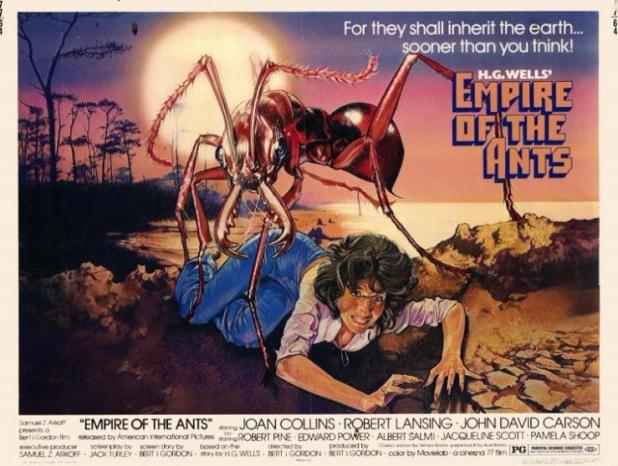
2020 Scarecrow Psychotronic Challenge Day 21: Empire of the Ants (1977)

DAY 21: MURDER SHE ROACH: One about pesky varmints, pests or creepy crawlies.

If you love Joan Collins, you have to get used to her being abused. She gets a demonic baby that doesn’t want to be born, she’s choked out by Santa after getting that blood out of that nice white fur carpet and then, she gets gassed by a queen aunt. It’s not easy being Joan.

This American-International Picture says that it was inspired by H.G. Wells short story of the same name, but it’s really just a nature gone wild thanks to man movie, but I’m not saying that like it’s a bad thing. I mean, how many movies have giant ants that blast humans with clouds of fog that take over their minds?

We watch as polluted materials get loose in the swamp, just as land developer Marilyn Fryser (Joan Collins) brings a bunch of new clients to see her beachfront property. The land is worthless, of course, but then an army of giant ants busts in on the scene and everyone flees for their lives.

As if that wasn’t bad enough, it turns out that the ants use pheromones from the queen to take over an entire town and the sugar factory there, as they prepare to do the same to the world.

Beyond Ms. Collins, this movie also has Pamela Shoop (Nurse Karen!), Robert Pine (who was in The Day of the Locust, a movie that disappointed me as a kid because there were no giant locusts), Jacqueline Scott (William Castle’s Macabre), Albert Salmi (Superstition), Robert Lansing (who should know all about nature on the loose, thanks to being in Day of the Dolphin and Creature from Black Lake) and Robert Lansing (who was in a ton of TV, including playing Control on The Equalizer).

This was directed by Bert I. Gordon, the master of process shots to achieve giant creatures menacing actors. That said, he also used large rubber ant parts, which Joan Collins hated, as she said that they scratched her.

You can watch this on Daily Motion.

SLASHER MONTH: The Freeway Maniac (1989)

There’s no way that the Gahan Wilson that wrote this movie is the Gahan Wilson who drew all those cartoons for Playboy, right?

Because if he is, then this is a comedy and this movie makes a lot more sense.

And if not, then I have no idea what the filmmakers were going for in this one.

So after this movie completely rips off the open of Pieces and Nightmare, we move to an asylum where the inmates are being given cigarettes as some form of therapy. One of them escapes and kills everyone in his way and that’s Arthur (James Jude Courtney, who would go on to be The Shape in the 2018 Halloween). He nearly kills an actress named Linda (Loren Winters, who was a one and done actress in this, along with producing the film), whose experience ends up getting her cast in a cheesy science fiction movie called Astronette that will use her notoriety for publicity.

There’s no way Arthur would hunt her down, right?

I have so many questions for this movie. How did they get Robbie Krieger from The Doors to write the theme song? Why did they have Linda’s boyfriend cheat on her and suddenly become a sympathetic hero in the last act? Why is there no real freeway in this movie? Why does Arthur howl at the moon? Why is some of this movie well-shot with decent stunts and other portions have the worst acting you’ve ever seen? Are you surprised that this was released by Cannon — well, released on VHS in the Netherlands by Cannon Screen Entertainment, so not really produced by Cannon.

There’s not really another slasher like The Freeway Maniac. It’s…something else.

You can watch this on YouTube.

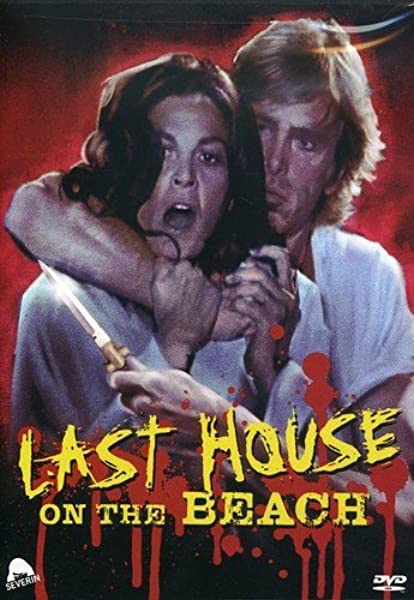
SLASHER MONTH: The Last House on the Beach (1978)

Also known as La Settima DonnaTerror and Terror and The Seventh Woman, this is what happens when filmmakers dare ask, “What would happen if we mixed up The Last House on the Left with nunsploitation?”

In Roberto Curti’s Italian Crime Filmography, 1968-1980, he writes that this film was filled with “a succession of grim, misogynist and exploitative scenes: adolescent nudes, slow-motion sodomizations, vicious wounds, assorted killings.” I list this in case you are wondering why I decided to watch it.

Sister Cristina (Florinda Balkan, A Lizard in a Woman’s SkinDon’t Torture a Duckling) and the girls in her care (Sherry Buchanan from Tentacles and What Have They Done to Your Daughters?, Laura Tanziani, Laura Trotter from Nightmare City, Karina Verlier from Emanuelle In America, Luisa Maneri from Demons 6) are rehearsing A Midsummer Night’s Dream when three thugs, led by Ray Lovelock, show up to hide out from the cops. Of course, they also decide to terrorize everyone and probably kill several of the girls along the way. Can Sister Cristina renounce her Holy Vows and help the girls to escape?

Of course she can.

A movie that takes a disco scene from Eyes Behind the Wall and has a brutal murder occur in full view of a Scrooge McDuck poster, this is the Italian exploitation film in its most undiluted form. Lovelock is a complete scumbag — and sings on the soundtrack — while there’s no way that Tarantino didn’t rip off the ending of this movie for Death Proof.

Francesco Prosperi — who wrote Hercules In the Haunted World — would go on to the next big craze, barbarian movies, making one of the better ones, The Throne of Fire. He also had his hand in a few cannibal films, like The Green Inferno and White Cannibal Queen. He should also not be confused with Mondo Cane director Franco Prosperi.

You can watch this on YouTube or you can try and hunt down the out of print Severin DVD.

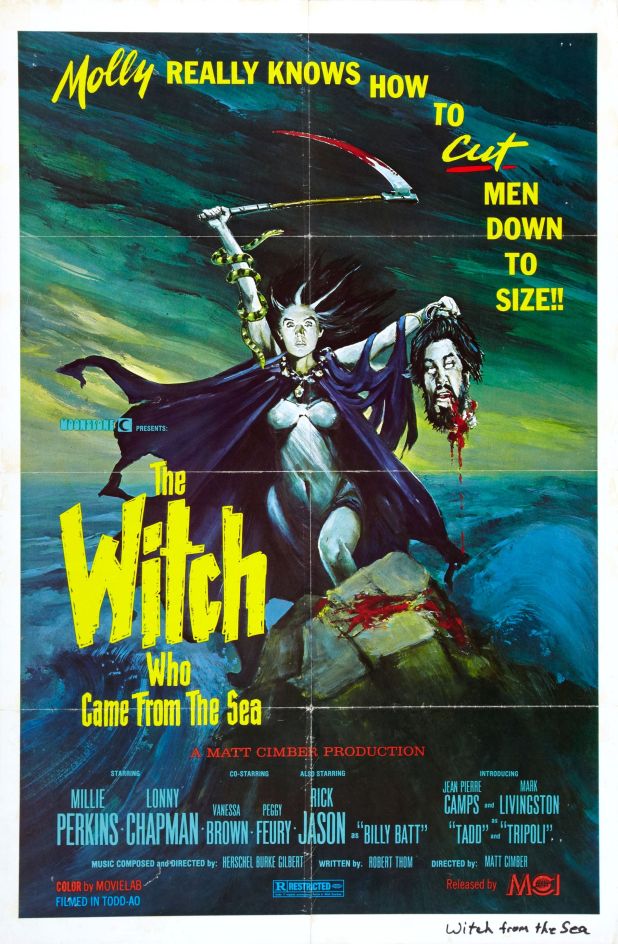
SLASHER MONTH: The Witch Who Came from the Sea (1976)

We’ve talked about the charmed life of Matt Cimber before. This is perhaps the best movie he made that doesn’t have Pia Zadora in it. It was written by Robert Thom (who also wrote Wild in the Streets), husband of star Millie Perkins, and supposedly based on elements from both of their lives. If that’s true, they led some really wild lives.

Helping this movie look way better than it deserves? Director of photography Dean Cundey.

Perkins, whose debut was Anne Frank in The Diary of Anne Frank, is a revelation in this movie as Molly, a woman for whom television has created a fantasy world that reality can never match. She was assaulted by her father at a young age and the impact of that horrific act ripples across every terrifying decision she makes in this film. She still worships the man, claiming that he died for love while her sister Cathy (Vanessa Brown) detests his memory and will only say that he was lost at sea.

Molly leads a double life, as when she isn’t working at the bar owned by her lover Long John (Lonny Chapman, When Time Ran Out), she’s using her feminine wiles to lure men to their doom, much like the sirens did to sailors. Of course, they didn’t castrate them with straight razors, but let’s not quibble.

Her orbit leads her into a world of football players and aging actors who only work in commercials now. Despite brawling with one of the latter, Billy Batt (Rick Jason of TV’s Combat!) at a party after discussing Boticelli’s The Birth of Venus — and showing a high faluting sensibility that gave this movie its title — she’s able to bed and destroy a series of lovers while getting her body inked by Jack Dracula (Stan Ross) to resemble the tattoo her incestual father once had.

She also falls for handsome Alexander McPeak, who already has his own issues with his strange girlfriend Clarissa Jenks (Roberta Collins, who made everything from Death Race 2000 and Unholy Rollers to The Big Dollhouse, both Hardbodies movies and Eaten Alive better).

There’s no way that Molly can find love or a place to belong in this world. She’s a constant storm destroying and snuffing out lives, unable to find peace or even a place to be. Her story will not end well (not when George ‘Buck’ Flower — who also cast the film and put his own daughter Verkina into the disturbing father/daughter love scene flashback — is on her case).

Every setting in this film feels rotten and everyone in it feels diseased as if the end of the 20th century is a rotting piece of carrion left out at the furthest edge of the surf, unable to wash back into the tide. That said, I want to drink in the bar where most of this is set, as I can imagine the rum was high proof and the conversation was minimal.

While this was a section 2 video nasty, don’t come expecting gore. Do expect to be upset by its unrelenting dread and evil-minded script, however. Also, if the poster looks familiar, it’s a direct ripoff of Frank Frazetta’s cover for Vampirella #11.

You can watch this on Arrow’s American Horror Project. It’s also available as a single blu ray. It’s also streaming on Amazon Prime and Tubi.