Author’s Note: Yeah, we know you’ve seen them before and know them well. But we’ve got some movie “Easter Eggs” in these reviews. Thanks for revisitingthe classics with the B&S gang, where we coddle the obscure and the forgotten films of the VHS, UHF, and Drive-In yesteryears.
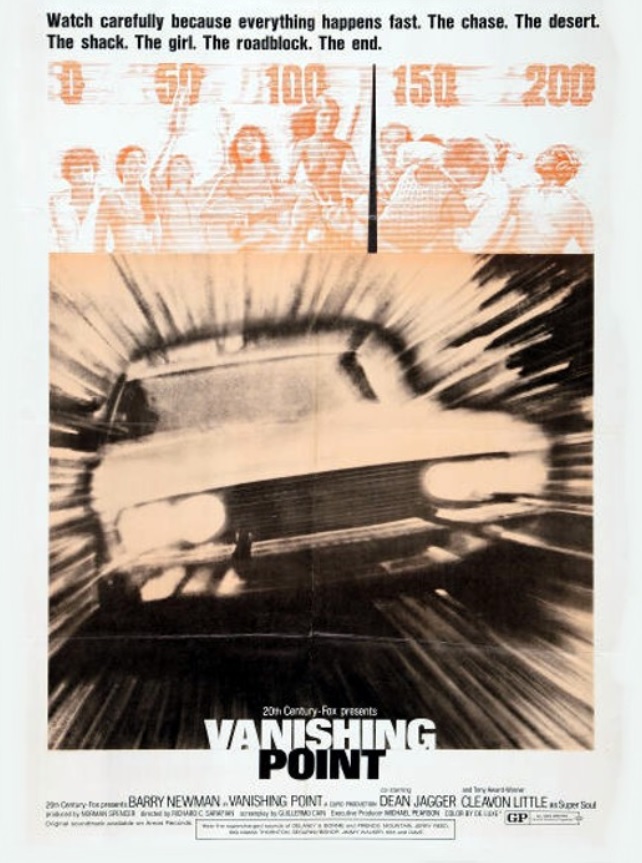
This 20th Century Fox tale reminds a lot of Elektra Glide in Blue, United Artists’ 1973 existential road flick entry about a disgraced biker-cop (Robert Blake) produced-directed by James William Guercio, who managed and performed with the Beach Boys and produced several albums for ’70s pop-meisters Chicago (who appear in the film). We also had Vanishing Point on the short list for “Radio Week,”* thanks to Cleavon Little’s blind DJ. While it was bumped for that week—but it’s prime fodder for “Fast and Furious Week.” Thank god for Dodge Chargers. . . .
Kowalski (Barry Newman) is a Vietnam veteran, disgraced ex-cop and former professional road racer of motorcycles and stock cars. To cope with his personal demons, he lives on the open road as a driver for a car delivery service. Before heading out on his next assignment—transporting a supercharged 1970 Dodge Challenger from Denver to San Francisco—he scores a hit of speed and makes a bet with his drug-pusher that he can make the trip in 15 hours.
As the police follow in hot pursuit, Kowalski becomes a folk hero to the roadside eccentrics and Vietnam-war worn masses, thanks to the on-air updates of the cross country chase by a blind DJ “Supersoul” (Cleavon “The Prince of Darkness” Little of FM) on KOW, an 50,000-watt R&B/Soul station broadcasting across Nevada, Utah and parts of Colorado and California. (Little’s engineer—an unaccredited role—is John Amos of TVs Good Times, but youngins know him for his work in Die Hard 2: Die Harder and Coming to America.) (And, is it just me, or is Outside Ozona a slasher version of Vanishing Point? That’s not critical insult, but a kudos.)
Yeah, we love this movie, but this movie also really wants to be the next Easy Rider, with its replacement of Steppenwolf by way of the equally biker-acceptable Mountain with “Mississippi Queen,” along with the counterculture band Delaney, Bonnie & Friends (see the history of Eric Clapton and Fleetwood Mac), who also appear in the film as a singing group at a religious revival caravan.
There’s no online streams, but Blus, DVDs, and used VHS-tapes are available on Amazon to watch Vanishing Point. . . .
So, we teased you about the two “sequels” to Easy Rider . . . but did you know their was a remake to Vanishing Point? It’s okay. No one does. Join us tomorrow, August 7 at 6 pm, for more tales of the fast and the furious . . . and the vanishing . . . with Vanishing Point ’97.
How much is this film loved? It has die-cast cars!
Author’s Note: Yeah, we know you’ve seen them before and know them well. But we’ve got some movie “Easter Eggs” in these reviews. Thanks for revisitingthe classics with the B&S gang, where we coddle the obscure and the forgotten films of the VHS, UHF, and Drive-In yesteryears.
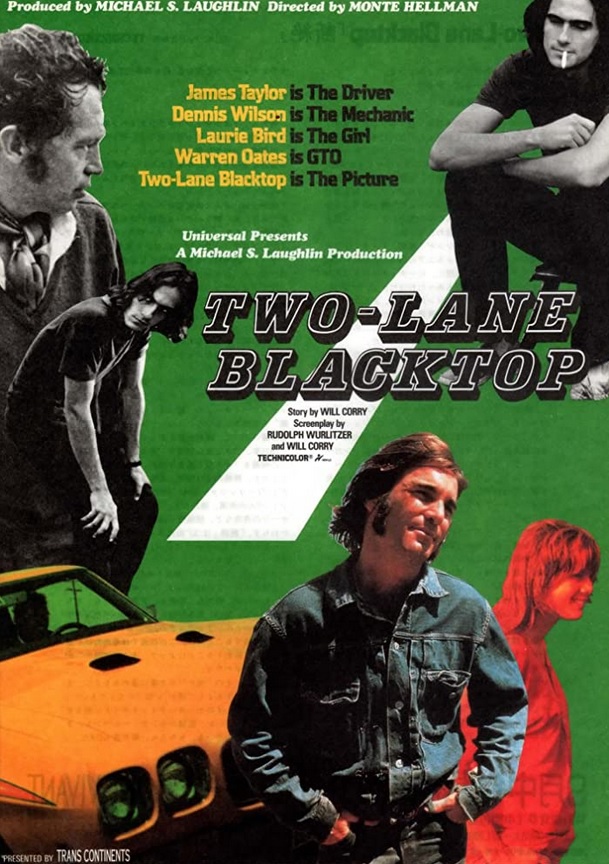
This Universal Studios tale in which the bikes of Easy Rider meet the Dodge Challenger of Vanishing Point was on the short-list for our “Rock ‘n’ Roll Week” tribute (ran Sunday, July 19 to Saturday, July 25) of films as result of ex-Beach Boys drummer Dennis Wilson starring as the “Mechanic” and ‘70s soft rocker James Taylor as the “Driver.”
But wait! There’s those celluloid bonus points, since this is directed by Monte Hellman, who made his directorial debut with Roger Corman’s Beast from Haunted Cave (1959)—a relationship that lasted for several films over fifteen years. And Hellman gave us Silent Night, Deadly Night III: Better Watch Out (another “unwanted sequel,” ala Phil Pitzer’s Easy Rider: The Ride Back, that’s actually better than you think, as result of the Hellman touch), and he executive-produced Reservoir Dogs. So, courtesy of that Corman lineage, Hellman’s not giving you a typical Universal picture. This is an A.I.P-styled romp that’s not for the mainstream cinema folks.
As with Wyatt and Billy’s biker travels, Two-Lane Blacktop is an existential road trip into metaphorical ambiguity—only from inside the cockpit of a Black 1955 Chevy 150. Unlike most major studio buddy-road adventures, this one’s void of exposition to the point of silence: the Chevy’s passengers are perfunctory to the story, operating more like “parts” to the car than actual people.
As the stoic duo travels across country entering impromptu and legalized dragstrip races, they pick up the hitchhiking “Girl” (Laurie Bird, who became Hellman’s girlfriend), meet a homosexual hitchhiker (Harry Dean Stanton, later of Alienand Repo Man), and a New Mexico to Washington D.C. “pink slip” challenge is made by “GTO” (Warren Oates), an insecure braggart who discover a vicarious purpose through the freedom-lives of the Chevy’s “internal parts.”
Regardless of its rock-star casting, neither Wilson nor Taylor provide music to the film and no Easy Rider-styled soundtrack was ever released. The film does, however, features songs by the Doors, Arlo Guthrie, and Kris Kristofferson. Lori Bird, in a James Dean-tragic life, only made three films: two with Hellman, the other being Roger Corman’s Cockfighter (1974; also with Warren Oates), and in Woody Allen’s Annie Hall (1977; as the girlfriend to Paul Simon’s character). Coming to live with Simon’s musical partner, Art Garfunkel, she committing suicide-by-pills in his apartment at the age of 26.
There’s no online streams, but Blus and DVDs (co-issued by Universal through Criterion Collection and Anchor Bay) and used VHS-tapes are to be found on Amazon.
My buddy Eric, as with Easy Rider, takes me to task with this movie as well: “Duke, your idea of “classics” sucks ass,” he tells me. According to him—a car nut, mind you—”nothing happens.” “It’s like watching a stoner version of Seinsuck.” (Sorry, Sam!)
Friends and film, huh? It’s not so bad: chicks and film is worse.
About the Author: You can learn more about the writings of R.D Francis on Facebook. He also writes for B&S About Movies.
UPDATE: Out in the social media ethers, reader Jake Garrett schooled us on this fun car flick fact: The ’55 Chevy in Two-Lane Blacktop is the same car as Bob Falfa’s in American Graffiti. Did you know that? We didn’t. Hey, we’re big enough to admit that we don’t know all of the film trivia out there. Thanks, Jake! See, positive, kind comments on our reviews and messages via our “contact” page, work — and get you plugged in reviews (if you want to be “famous,” that is!).
Author’s Note: Yeah, we know you’ve seen them before and know them well. But we’ve got some movie “Easter Eggs” in these reviews. Thanks for revisiting the classics with the B&S gang, where we coddle the obscure and the forgotten films of the VHS, UHF, and Drive-In yesteryears.
While The Fast and the Furious franchise began as crime caper flicks that transitioned into spy flicks of the xXx variety, there’s no denying Universal Studios’ “big engine” is rooted in the rock ‘n’ hot-roddin’ juvenile delinquency flicks of the ’50 (we have a “Drive-In Friday” night this week covering a few of those films), the biker-centric counterculture flicks of the ’60s, and revin’-car flicks from the ’70s (reviews for a whole bunch o’ them this week!).
For long before the good intentions of Paul Walker’s LAPD officer Brian O’Conner’s law-enforcement soul was drugged with the scent well-weathered leather, hot metal and oil, and the scent of a Mitsubishi’s exhaust (R.I.P., Mr. Peart), Easy Rider was the godfather of them all—and that celluloid patriarch brought forth two sons. . . . And those sons were fruitful and multiplied with the ’70s “big engines” of Dirty Mary, Crazy Larry (also starring Peter Fonda) and Gone in 60 Seconds (no, not that one, the 1974 one!).
In between, there was this cop movie called Bullit that starred some guy named Steve McQueen toolin’ around in a 1968 Mustang Fastback going head-to-head with a 1968 440 Magnum Dodge Charger. And they slipped “The Duke” (of all people) into the cockpit of a souped-up 1973 Pontiac Firebird Trans Am “Green Hornet” in McQ. But we were diggin’ Roy Scheider in his 1973 Pontiac Ventura Sprint in The Seven-Ups. And let us not forget: Producer Philip D’Antoni is the guru of rubber who gave us memorable car chase sequences in not only The Seven-Ups and Bullit, but The French Connection, as well. Then, for a twist, instead of a souped-up muscle car, Robert Blake slipped onto a 1970 Harley touring cycle for the “motorcycle cop” version of Easy Rider: 1973’s Electra Glide in Blue.
Released in 1969, Easy Rider became a counterculture epic that set the pace for the early ‘70s car chase classics to come: Two-Lane Blacktop and Vanishing Point (as well as Electra Glide in Blue)—regardless of the transportation and “mission” of their protagonists’ “trips,” each film equated the open road with freedom of the soul.
Wyatt and Billy (Peter Fonda, who became a biker icon courtesy of Roger Corman’s 1966 biker epic, The Wild Angels, and Dennis Hopper, who was able to get financing for his 1971 ego-boondoggle The Last Movie as result of Columbia Studios raking in $60 million worldwide on a $400,000 budget) embark on a western-without-horses motorcycle trip across America from California to New Orleans for a drug deal (instead of gold prospecting or stage coach robbing). Along the way to make their “big score” they meet up with communal hippies (in lieu of Indians), partake of drugs and sex, and frolic about New Orleans (in lieu of say, Dodge City, Kansas, or Virginia City, Nevada) in a Seinfeldian “a movie about nothing” existence (sorry, Sam; quoting my buddy Eric’s take on the movie)—and it all comes to an end by way of the ubiquitous, hippy-hatin’ rednecks (the Indians got ’em).
Jack Nicholson stars as Wyatt and Billy’s gold-football helmeted sidekick: ACLU lawyer and jail cellmate, George Hanson (the trio first collaborated on The Trip, Roger Corman’s 1967 stoner flick written by Nicholson; who did his own biker flick, 1967’s Rebel Rousers, which was released post-Easy Rider fame, in 1970), music Svengali Phil Spector (The Big T.N.T Show) stars as “The Connection,” and future MTV video queen Toni Basil (“Hey, Mickey!”) also appears in a minor role (she worked with Nicholson on the Monkees’ Head). The soundtrack—inspired by the successful use of pop and rock music for 1967’s The Graduate— features music by Steppenwolf (who also provided music to another psychedelic film, 1969’s Candy), the Band, the Byrds, and Jimi Hendrix.
You can watch this everywhere, pretty much, but it streams on Amazon Prime.
Ah, Easter Eggs: So, did you know Easy Rider was followed forty years later by an unofficial sequel? Two, in fact. It’s okay. No one does. Join us tomorrow at 12 noon and 3 pm for more tales of the fast and the furious . . . with Easy Rider: The Ride Back and Me & Will.
About the Author: You can learn more about the writings of R.D Francis on Facebook. He also writes for B&S About Movies.
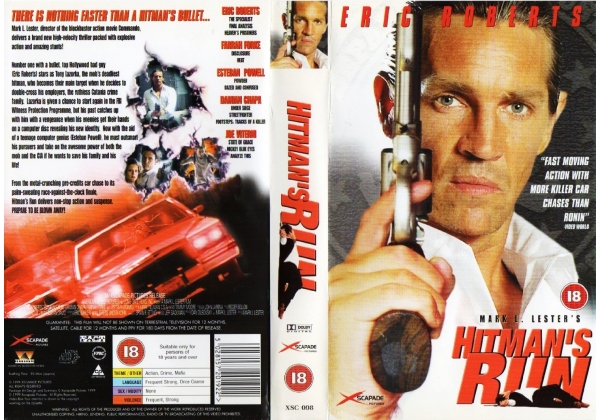
Sooner or later, Mark Lester and Eric Roberts would have to unite and bring their dual direct to video magic to bear. This would be one of those times and it would not be the last.
Here, Eric is former mob hitman Tony Lazorka, who has become John Dugan in witness protection after he refuses to kill someone. He’s in witness protection which is more like witless protection. And the mob is back on his trail, which is how these things always go. Where’s Arnold ready to erase people these days?
Roberts gets screwed over by a hacker, who we know is a computer wizard because he rides a skateboard and is a general malcontent. He’s played by Esteban Powell, who was in Dazed and Confused and Powder before this. He cannot have been more annoying than he was in this movie and I didn’t want his poor father (Eric Poppick, who always plays nosy neighbors and put-upon doctors; witness Single White Female and Problem Child) to ever find him again. Having the mob kill you would be a better fate than enduring one day with this keyboard kid.
C. Thomas Howell plays a fed, Farrah Forke makes an appearance and plenty of people only I would get excited about are in this, like Damian Chapa (dude, the guys IMDB bio is bonkers; he name drops growing up in a bar across from Larry Flynt’s first Hustler club, then talks about how The James Dean Foundation picked him over Leo for a biopic before they were all murdered, yet he neglects to mention that he played Ken in Street Fighter), Pittsburgh native Lindsay Taylor and Joe Viterelli, who was in the aforementioned Eraser and was a dependable mob character actor, appearing as Jelly in the two Analyze This movies, as well as Mobsters, Bullets Over Broadway and Mafia!
And you thought Mark L. Lester and Eric Roberts was a Reese’s chocolate-in-the-peanut butter match in our VHS celluloid heaven? The ‘Les also worked with Mark Dacascos — a man only matched by actor-martial artist Oliver Gruner in direct-to-video action bad assery. Yeah, you heard me right: Mark friggin’ Dacascos: Jimmy Lee in Double Dragon, Zero in John Wick: Chapter 3 – Parabellum, Eric Draven in the The Crow: Stairway to Heaven series, and the Netflix series Wu Assassins. Ah, but the direct-to-video oeuvre: American Samurai, China Strike Force, and The Redemption: Kickboxer 5. Yeah, you’re damn right we watched the mockbusters I Am Omega and Solar Attack for our Dacascos fix.
My only grip with you, Dacascos: Why you haven’t done a movie with Eric Roberts?
“Better research before you pop your lip at me, Mr. Francis.”
“Mark Dacascos?”
“It’s cool, R.D. I did three projects with Eric, in fact. I can’t remember if we had scenes together, and if we are in it that long, you know how that goes in these low-budgeters, but our names are on the boxes. We did Beyond the Game, with Oliver Gruner, by the way, along with Final Approach, and Maximum Impact, with Danny Trejo. And I know you dig Danny over at B&S.”
See. Even the uber fans like Sam and myself can’t see ’em all.
So . . . with Arnie’s Commandofront and center on the ‘ol DVD box and Paula Trickey from TV’s Pacific Blue and The O.C as the only other named commodity in the military tomfoolery: Dacascos is Major John Murphy, a U.S. Army Investigator, teamed with Lt. Kelly Andrews (Trickey) to shut down Sgt. Gammon’s cocaine smuggling operation (at the former Victorville Air Force Base in California).
Are the clichés and stereotypes afoot? Of course they are. But aren’t they also stumbling about in the A-List Summer Tentpoles? You get what you paid for with The Base: it’s not exactly Rambo, but you gets lots of Commando-styled action and violence on a well-stretched budget. And thanks to Dacascos’s agility, we get — unlike with Arnie’s bulk and Sly’s grunt — lots of martial arts action that rivals the celluloid hijinks of Chuck Norris. And ex-75th Ranger Regiment U.S. Army Ranger Tim Abell — still building on his 112-plus resume, including the cable mockbuster Battle of Los Angeles — is pure pisser as the psycho-drug dealing Sgt. Gammon.
“Hey, R.D. Don’t forget to mention that ‘Dacas and I also did Instinct to Kill.”
“You got it, Mr. Abell!”
“Hey, you forgot about the sequel I wrote and Mark Lester produced.”
“C. Courtney Joyner?”
“It was called The Base 2: Guilty as Charged and it starred Antonio Sabato, Jr. in the Major John Murphy role and, this time, James Remar, you know, Ajax from The Warriors, is the corrupt military psycho.”
“Yeah, I know. Sam and I never saw it and we can’t find any online streams.”
“Yeah, that’s how it is with most of my and Mark’s later films. But here’s the trailer. Happy hunting. Oh, thanks for reviewing Public Enemies, by the way.”
“Hey, remind everyone that I made three flicks for Mark Lester.”
“James Remar? Yeah, we’re reviewing Betrayalwith Erika Eleniak. But we can’t find a streaming copy of Blowback with Mario Van Peebles to review. Sorry, James. But we’ve never seen it.”
“Eh, that’s cool. I know how it is with these low-budgeters and their shoddy distribution.”
So, in the words of Sgt. Gammon: “It’s time to lock, cock, and rock” . . . and hit that big read streaming button. You can watch a freebie rip of The Base on You Tube. We also found this very cool interview with Mark L. Lester chatting about his early films on You Tube.
It’s been one hell of a week paying tribute to Mark L. Lester at B&S About Movies. Damn fun.
About the Author: You can learn more about the writings of R.D Francis on Facebook. He also writes for B&S About Movies.
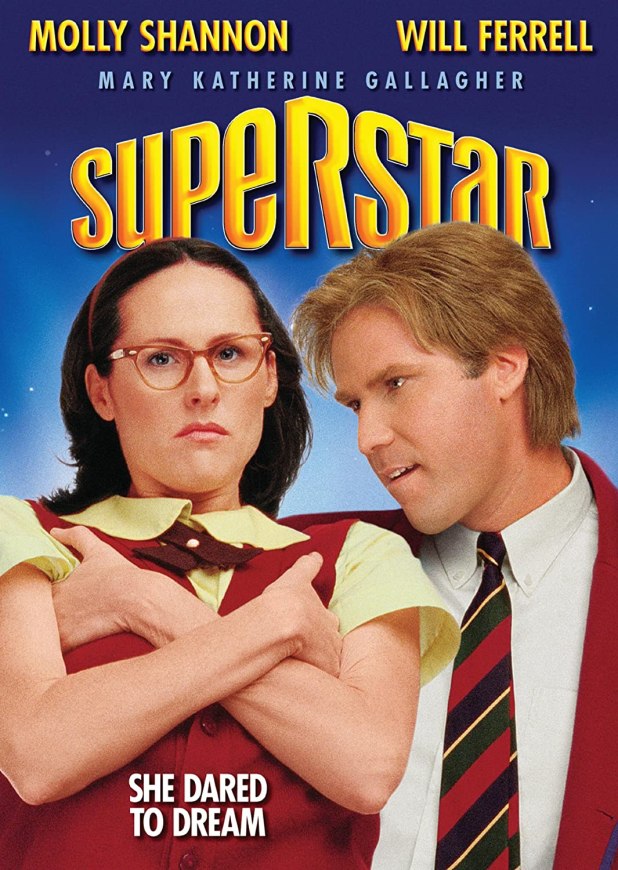
Kids in the Hall member Bruce McCulloch directed this, another example of trying to turn a sketch into an entire long form story. In this case, Catholic high school student Mary Katherine Gallagher finally grows beyond five-minutes of jokes to tell you more of her life. Does it work?
Steve Koren wrote this, as well as Click and Jack and Jill for Adam Sandler. Oh yeah — he also did A Night at the Roxbury. That’s some SNL cast service, let me tell you.
Mary Katherine dreams of kissing cool kid Sky Corrigan (Will Ferrell) and being a superstar. This leads to a moment right out of Carrie and her falling for bad boy Eric Slater (Harland Williams). And oh yes, Jesus (also Ferrell) shows up.
Did you enjoy this sketch? Would you enjoy it for more than an hour? This will determine whether you like this or honestly, any Saturday Night Live movie.
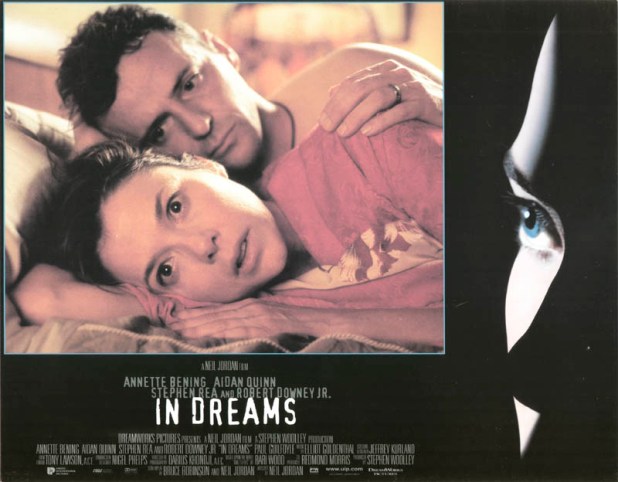
Neil Jordan has flirted with horror throughout his career, with movies like High Spirits, Interview With a Vampire and The Company of Wolves. This film is closer to psychological horror, with a mother feeling a psychic connection to a serial killer of young children. If it had more fashion in it, it could very nearly be a giallo.
Claire Cooper (Annette Benning) is an illustrator and mother who keeps dreaming if an underwater city and the murder of a young girl, which just might be a premonition of the sudden disappearance and death of her daughter Rebecca. The police won’t listen when she starts to grow mentally closer to the man she believes has killer her girl, Vivian Thompson (Robert Downey Jr.).
This movie is based on the book Doll’s Eyes by Bari Wood. The same author also wrote Twins, the book that David Cronenberg adapted as Dead Ringers.
I love the underwater city parts of this movie — shot in the same tank as Titanic — and the total downer of an ending. The difference between an artist like Jordan or a maniac like Martino or Lenzi means that I would love if this movie had been shot in 1975 with Mimsy Farmer in it way more than the actual movie, but that’s my “in dreams.”
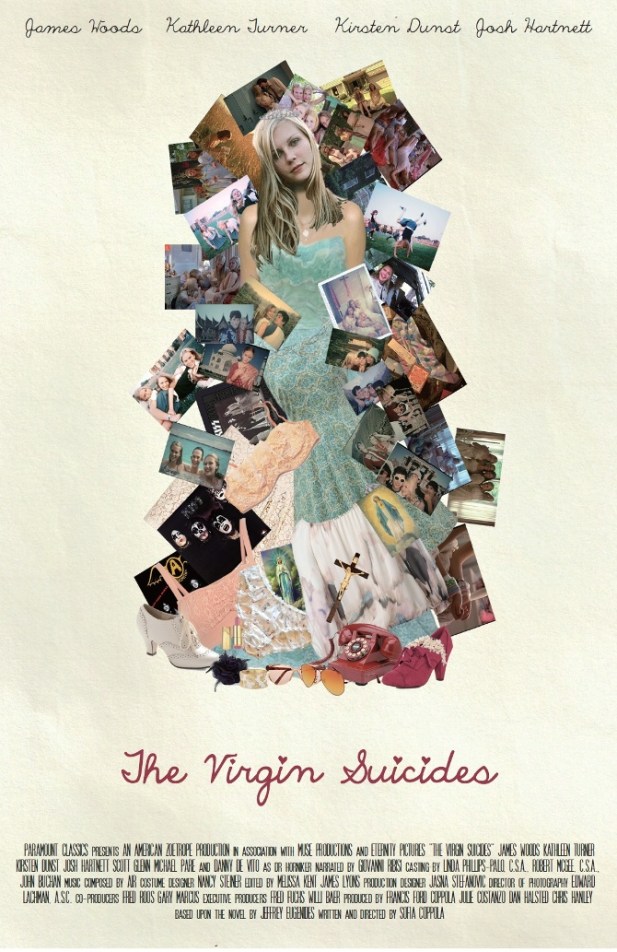
This was the directing debut of Sofia Coppola, who also wrote the script, which was based on the novel by Jeffrey Eugenides. It’s also the start of the creative relationship between Coppola and Kirsten Dunst.
I’d listened to the Air soundtrack numerous times, but never watched the movie. Thanks to quarantine, I’ve given in to my wife’s movie picks, which is how just about every movie this week has ended up on the site.
In the late 70’s, specifically in Grosse Pointe, Michigan, the Lisbon sisters rules the hearts and minds of teenage boys. These unapproachable goddesses — Therese, Mary, Bonnie, Lux and Cecilia — won’t survive the summer.
I really wanted to like this more than I did. I often fight the urge to tell my wife how much I dislike the films she picks. However, if given my choice, she’d be stuck watching something like Starcrash. Despite the sheer despair of this film — not what I really wanted to see while dealing with a plague just outside our door — it also made me realize how lucky I am to have such a wonderful person in my life.
“Once more unto the “Police Academy Week” breach, dear friends! Once more, Sam; for we jam up our VCRs with the VHS dead.“
A film such as Golfballs! solidifies the B&S About Movies celluloid theory: All of the Police Academy ripoffs (reviewed this week) are basically ‘60s beach movies, which are the same thing as Porky’s movies, which are the same thing asMeatballs ripoffs, which are really just Animal House ripoffs. And we’ll multiple that equation with Harold Ramis’s Caddyshack and Robert Zemeckis’s incredibly underrated Used Cars.
VHS image courtesy of eBay/ds2p1s
However, if we go back a bit further into the pre-VHS Drive-In epoch, there was 1979’s Gas Pump Girlsand 1981’s Lunch Wagon and, if we delve into the direct-to-DVD epoch, 1990’s Zoo Radio and 1992’s The Bikini Car Wash Company (did you ever hear of 1984’s The Malibu Bikini Shop 1995’s Bikini Drive-In: you just did). Yeah, you know the T&A drill: It’s all familiar in terms of plot and characters; it’s raunchy, it’s moronic, and it’s all innocent soft-core shenanigans. And, as is the case with most of these films, there isn’t so much a plot as it is a series of comedic skits and vignettes with the thinnest of through lines. The premise of each of these films is somewhat the same: slobs vs. the snobs. And the slobs with the once glorious business that’s now a shell of its former self is being squeezed out of business by the snobs who want to plow down the landscape or city block for condos or push through a highway overpass to benefit their business.
Such is the tale of Golfballs!, which takes a little bit from each of those films and a blatantly steals a whole lot from Caddyshack (right down to a camouflaged Bill Murray clone) and Used Cars—only adding boobs. Lots of gratuitous boobs from the likes of Playboy and Howard Stern’s perpetual radio guest Amy Lynn Baxter and adult film star Jennifer Steele (and a few others X-stars). And there’s jokes about blue (golf) balls and bent “wood,” a farting Chihuahua, cussing grannies, and more golf double entendres about “sticks” and “balls,” vaudevillian spit-takes, shower scenes, and public urination. Oh, and let’s not forget Golfballs!—as well as Porky’s and Caddyshack from which it pinches—was also shot in South Florida . . . and so was 1989’s Summer Job, which, come to think of it, is sort of like, well, Golfballs!, in the ugh-ack-groan comedy department.
Anyway . . . instead of the competing gas stations from Gas Pump Girls, car lots from Used Cars, and radio stations Zoo Radio, we have competing golf courses, with the once glorious and now decrepit Pennytree Country Club run by a kindly old dude and the upscale Bentwood (yuk, yuk!) run by an old bastard. And the old bastard wants to level Pennytree to make way for condos.
Ah, but when the daisy-duke wearing granddaughter (Christy Tummond) of Pennytree’s owner caddies for a heavy-tipping rich creepy guy—and he keels from a heart attack as she picks up a golfball—she knows how to save the club!
So, with her boyfriend (Todd Allen Durkin)—her grandfather’s right hand man at the club—they hit the nightclubs and strip clubs recruiting hot bodies—both male and female—as scantily clad (the women even more so) caddies and the operators of a Topless (Golf) Cart Wash. And it all culminates with the Greasers and the Socs (Where are you, Ponyboy?) having a “winner take all” golf tournament. It’s no plot spoiler to telling you “The Outsiders” win this one.
And you know what? While not original in the slightest, for a low-budget shot-in-Fort Lauderdale indie with a group of amateur theatre actors, this good vs. evil romp isn’t that bad and has some actual laugh-out-loud moments. It’s not great. But it’s not awful. Too bad Golfballs! wasn’t made during the Drive-In heyday of the ‘70s; it would have cleaned up at the box office right alongside the likes of The Pom Pom Girls, The Van, Malibu Beach, H.O.T.S., and Van Nuys Blvd.
Golfballs! is a competently-shot and acted film; it’s unfortunate this ended up being the only feature film by South Floridian commercial director-cinematographer Steve Procko. It’s also the lone screenplay of Robert Small who, regardless of what the IMDb tells us, isn’t the same Robert Small who worked as a writer, director, and producer for A&E’s Biography, Comedy Central’s Pulp Comics and MTV’s Unplugged (once again burned by the IMDb’s digital content managers with their bad film Intel).
All of the local South Florida community theater actors are good in their roles—especially the leads of Christy Tummond and Todd Allen Durkin. While the affable Tummond dropped off the celluloid landscape, Durkin has since built up an impressive resume with recurring roles on the TV and cable series Magic City, Nashville, Drop Dead Diva, Wrecked, and I Am Frankie. He most recently guest-appeared on FOX-TV’s The Resident, as well as making a three-episode arc on ABC-TV’s January 2023 series, Will Trent. Elizabeth Rodriguez, who appears here as one of the “Bentwood Girls,” later appeared in recurring roles in Fear of the Walking Dead (Liza Ortiz) and Orange is the New Black (Aleda Diaz). As we like to say here at B&S About Movies: Everyone in Hollywood has to start somewhere . . . and Durkin and Rodriquez did alright for themselves. And we dig it.
Golfballs! received worldwide distribution on VHS and DVD and has been reviewed on French, German, and Japanese film sites (see? it pays to cast blonde adult film stars). Sadly, because of its content, it has never appeared on any VOD, PPV, or U.S. Cable TV platforms. Used out-of-print DVDs and VHS tapes are out there in the marketplace, but go for between $30 to $40 dollars. Luckily, we found a free copy to watch on You Tube.
Need another South Florida-shot Police Academy-inspired bit o’ hyjinks (aka policesploitation) with another South Florida-bred actor in his feature film-leading man debut? Check out Private Resort. Wanna rock SoFlo style? Check out Incident at Channel Q.
Update: In June 2022, film journalist David Wain caught up with director Steve Procko for some behind-the-scenes production stories on The Schlock Pit.
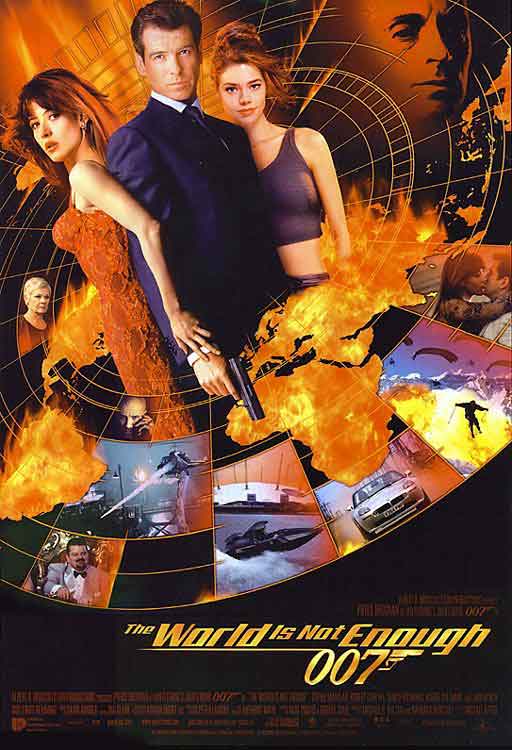
The first Eon Bond film to be released by MGM, this is the third Pierce Brosnan outing, with Bond dealing with the murder of billionaire Sir Robert King by the terrorist who cannot feel pain, Victor “Renard” Zokas (Robert Carlyle, whose cameo as John Lennon makes Yesterday). Soon, Bond must protect King’s daughter Elektra (Sophie Marceau, Braveheart) as well as learn why a nuclear meltdown could increase worldwide petrol prices. And oh yeah — deal with Dr. Christmas Jones (Denise Richards).
This was a Bond movie with many potential titles, such as Bond 2000, Death Waits for No Man, Fire and Ice, Pressure Point and Dangerously Yours. The final title is based on Alexander the Great’s epitaph “Orbis non sufficit,” which is the Bond family motto.
Robbie Coltrane returns from GoldenEye — his office is covered with cheesecake photos of former Bond girls — and Desmond Llewelyn, who died in a car accident not long after the film’s premiere, appears for the last time as Q. He’s shown training his successor, who is jokingly referred to as R and played by John Cleese.
Joe Dante and Peter Jackson, were initially offered the opportunity to direct this one. The producers eventually hired Michael Apted (Coal Miner’s Daughter, Enough).
This one feels like a misstep after two solid Brosnan entries. Alas — there are good moments, but just not enough. Man, I feel bad even ending that sentence that way.






 B&S About Movies
You must be logged in to post a comment.