2020 Scarecrow Psychotronic Challenge Day 14: Safari 3000 (1982)

Day 14. The Monster Mile: One about cars or racing.

Blame this review solely on the staff of Scarecrow Video of Seattle. The B&S staff had this on our shortlists for our “Fast and Furious Week I” and our upcoming-December “Fast and Furious Week II” tribute weeks to the well-weathered leather, hot metal, and oily rubber burners of the home video-era. Well . . . we lie. This one was on our long-list actually, as we kept avoiding this used celluloid clunker. Then the Scarecrow gang had to come up with theme day #15 for the 2020 Psychotronic Challenge. So let’s just yank this one off like the icky-sticky, puss-soaked band-aid that it is and get it over and done with. . . .

How did Roger Corman NOT make this?

So you’re Harry Hurwitz, aka Harry Tampa, and your genre-meshing of disco and vampires with Nocturna, Granddaughter of Dracula was a critical and box office failure. So, what do you do for your next picture? You team up with ’50s television producer Jules V. Levy (The Rifleman, The Big Valley), who was one of the (of the many) co-producers on Smokey and the Bandit (as well as John Wayne’s McQ and Brannigan, and Burt Reynolds’s White Lightning and Gator), to mesh the ol’ the Bandit with The Cannonball Run (1981). And, what the hell: while we’re at it, we’ll clip from The Gumball Rally (1976), because, why not? The Cannonball Run clipped ’em.

As you can see: there’s not an original part under this hood.

Okay, so the “script” is locked (we think), but who do you get to star in your road racing rip-off? Well, John Wayne and ol’ Burt aren’t signing up for this non-sense, especially after you unleashed Nocturna on the masses. Well, what the hell, Christopher Lee — who’s always grateful to get out of the horror genre — is game for a villainous role.

But who do you get for the lead: the guy who starred in Death Race 2000 (1975) and Cannonball (1976), of course, because, well, this Harry Tampa gas-guzzler isn’t that far removed from those films.

And who will be our Sally “Frog” Field to get our Bandit into a mess: Stockard Channing, aka Rizzo, from Grease.

Okay, now we need a “Sheriff Burford  T. Justice” for this rubber-burning tomfoolery, only he needs to be a bit more regal . . . and he needs to be a “Count,” but who . . . yes, Mr. Lee, of course! He’s Count Lorenzo Borgia, an African horse rancher who’s also a racing fetishist. But wait . . . are they . . . ripping off Star Wars . . . and foreshadowing Lee’s work as Count Dooku/Darth Tyranus? Alright, Harry! You ripped off Paul Hogan and George Lucas films that weren’t even made yet. Way to go, Mr. Tampa! This movie is going to . . . crash and burn.

Because I am Harry Tampa and I just can.

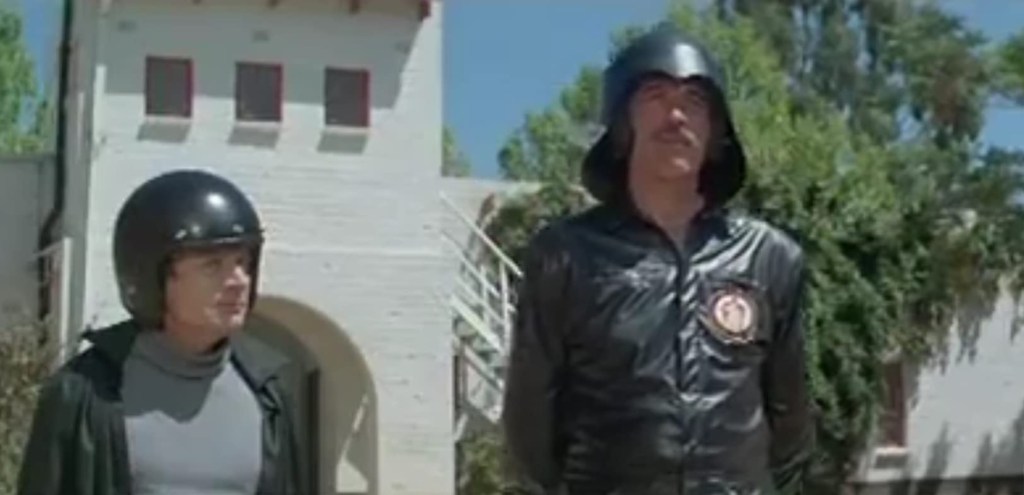
“Hey, R.D! Is that Rick Moranis, who played Dark Helmet in Spaceballs, standing next to Christopher Lee — wearing a “dark helmet” on his head?”

Nope. That’s Hamilton Camp . . . yes, he was in Smokey and the Bandit. And Starcrash. And Evilspeak. . . . Anywhoo, back to the plot.

There really isn’t one. At least one you haven’t already seen before. But the real “plot twist” is that this rips off Crocodile Dundee — which wasn’t even made yet! But since Linda Kozlowski wasn’t up for a Sue Charlton sidequal, well, prequel, we got Rizzo.

J.J Dalton (Channing) is your obligatory, ambitious richy-bitchy photojournalist (where’s Kay Lenz when you need her) for Playboy Magazine (she the type who, when doing an expose on prostitution, ends up arrested for prostitution). And she concocts a new story pitch: she’ll be a navigator for a race car in the 5th African International Road Rally. And she hires movie stunt driver Carradine as her driver. And Carradine’s ex-boss? The good ol’ Count. Yep, another “Frog” screws over another good ol’ boy.

What’s amazing about this auto-salvaged mess is that it isn’t just some low-budget schlock studio production. No. This isn’t a Roger Corman Eat My Dust-cum-Grand Theft Auto-cum-Smokey Bites the Dust stock footage recycler: MGM/United Artists — obviously hoping for some Smokey stank on the ol’ celluloid — ended up with a knock off Disney’s The Love Bug. But not all is lost: Christopher Lee is wonderfully deadpan and is adept at comedy. Who knew?! And Stockard Channing is quite the champ dealing with all of the baboons. And ol’ David is Dave: he never disappoints. But he was probably pissed he starred into two “3000 movies” — and they both sucked tailpipe (Deathsport, aka Death Race 3000). But hey, at least he didn’t star in America 3000 . . . but David A. Prior sucked Dave into Future Force (1989) and Future Zone (1990), so, Dave still got slammed in the ol’ celluloid hoosegow.

The VHS tapes on this, released between 1984 to 1987, are bountiful in the online marketplace, while DVDs were issued in 2011 by both MGM and 20th Century Fox Home Video. You can watch a pretty clean rip on You Tube and you can stream it Amazon Prime. Our advice: watch the You Tube one for free, as the Amazon print is of a pretty low quality.

Hey, be sure to check out our “Drive-In Friday” tribute to five of good ol’ Uncle Harry’s films! And thanks to the individual who pull-quoted our review in their update of this film’s Wikipedia entry because: all of Harry’s films deserve the Wiki-love!

About the Author: You can learn more about the writings of R.D Francis on Facebook. He also writes for B&S About Movies.

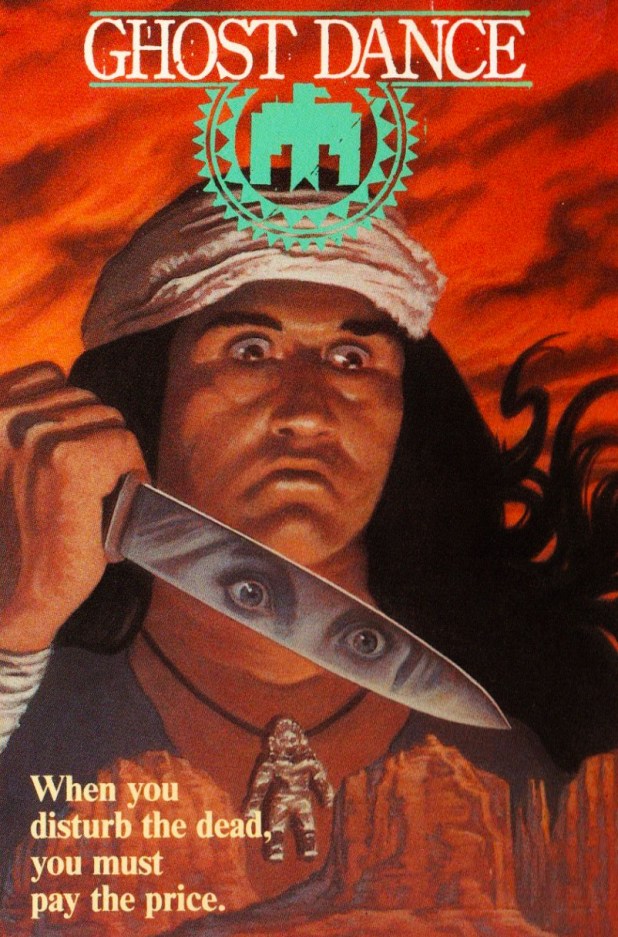
SLASHER MONTH: The Ghost Dance (1982)

The makers of 1982’s The Ghost Dance — don’t stop, don’t stop the Ghost Dance — deserve credit for their bold decision to create the first Native American slasher. The film tells the compelling story of a medicine man named Aranjo, who becomes possessed by the spirit of Nahalla, a warrior with a deep-seated hatred for the white man.

This being 1982, one of the Native Americans — Tom Eagle — is played by Victor Mohica, a Puerto Rican actor. I was stunned to learn that Chief Jay Strongbow was really an Italian named Joe Scarpa.

Frank Salsedo is in this and was the hereditary chief of the Mishewal Wappo Tribe. He also shows up in Creepshow 2 as Ben Whitemoon.

Written and directed by Peter F. Buffa, who has a TV documentary series to his credit, this film is a thought-provoking slasher. It delves into the rich history of Native American tribes, sparking discussions about their past and their representation in cinema.

This was shot in Tucson, Arizona’s Colossal Cave, the same setting for Night of the LepusFrankenstein IslandThe Trial of Billy JackThe Incredible Petrified World and the Suzanne Somers against Satan made-for-TV movie Seduced By Evil.

While there is potential for a compelling narrative, it’s unfortunate that this film falls short of expectations.

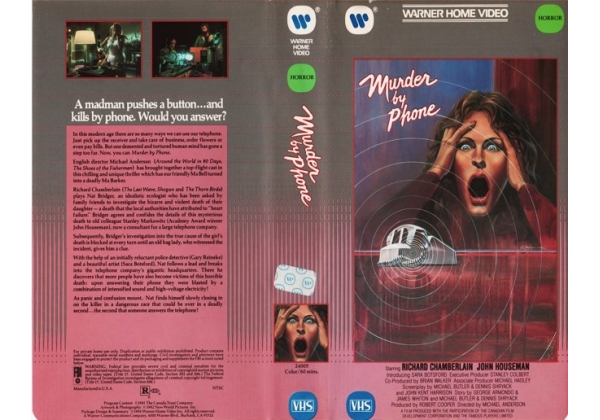
SLASHER MONTH: Bells (1982)

Also known as Murder by Phone, this Canadian slasher — of sorts — boasts an interesting pedigree, as it features actors like John Houseman and Richard Chamberlain, as well as a score by James Bond series composer John Barry.

The U.S. print of this — Murder by Phone — is 17 minutes shorter than the Canadian and international The Calling cuts. You’ll miss out on so much of a disgruntled phone employee using the phone lines — is he using a Captain Crunch whistle? Any phone phreaks reading this? — to kill people.

This will be part of my telephone-based drive-in horror night that I am curating, so…I guess stay tuned for that. These are the movies you never knew you wanted but here they are, calling and calling until you pick up. Consider this a not-as-good Scanners with Chamberlain looking very Gibb brother who is way too invested in solving this case. Gotta love the end freeze frame as he just has to answer that phone.

You can watch this on YouTube.

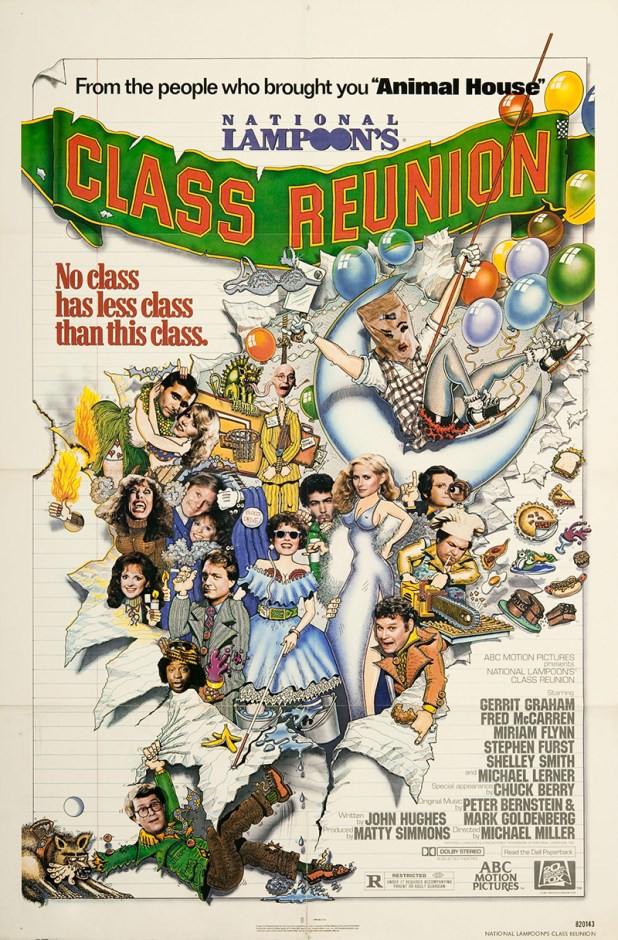
SLASHER MONTH: National Lampoon’s Class Reunion (1982)

The third National Lampoon movie* to reach theaters — it was filmed after National Lampoon Goes To The Movies — this was written by John Hughes, who was pretty unhappy with the final product. He’d tell the Chicago Tribune, “They didn’t even want me around, and I was shocked when I saw the movie”. My screenplay had been completely butchered, and my name will nevertheless be on the credits forever.” That said, I think no one but me remembers this movie and Hughes ended up doing just fine.

The film failed at the box office and the Lampoon name would end up being hit and miss, with films like National Lampoon’s Animal House and National Lampoon’s Vacation being all time comedy classics and others like National Lampoon’s Loaded Weapon 1National Lampoon’s Barely Legal and National Lampoon Presents Surf Party (amongst many, many others) became a series of dwindling returns, much like the magazine would be after most of its talent left.

If you’re hoping for the wit of the infamous National Lampoon 1964 High School Yearbook Parody, know that P.J. O’Rourke and Doug Kenney had nothing to do with this film. No, instead this is the tenth reunion of the class of Lizzie Borden High School and they’re being haunted by Walter Baylor, a student who had a prank played on him, ala Terror Train and Slaughter High.

The film certainly has a great cast. I’m always pleased to see Gerrit Graham (Phantom of Paradise,TerrorVision) on my screen. Plus, there’s Michael Lerner (Barton Fink), Misty Rowe (Hee-HawSST Death Flight), Blackie Dammett (the father of Anthony Kiedis, who is awesome in Nine Deaths of the Ninja), Miriam Flynn (Cousin Catherine from the Vacation movies), Stephen Furst (Flounder from Animal House), Mews Small (who was in the original Broadway production of Grease) and Anne Ramsey (Mama Fratelli from The Goonies).

It also has an on-screen performance by Chuck Berry performing a medley of his songs (“It Wasn’t Me”, “My Dingaling”, and “Festival”) and a theme song by Gary U.S. Bonds.

In a world of slasher silliness — I’m looking at you, Wacko, Pandemonium, Student Bodies and Saturday the 14th — this one isn’t all that good. It does, however, posit something that no other slasher in my memory really has done before. It redeems its killer.

In the very same year of this film’s release, director Michael Miller would make another strange slasher hybrid, Silent Rage, which features Chuck Norris against an unstoppable killer. MIller would use most of the crew from this movie and Stephen Furst for that one, too.

*I’m not counting TV movie Disco Beaver from Outer Space in the list of National Lampoon films.

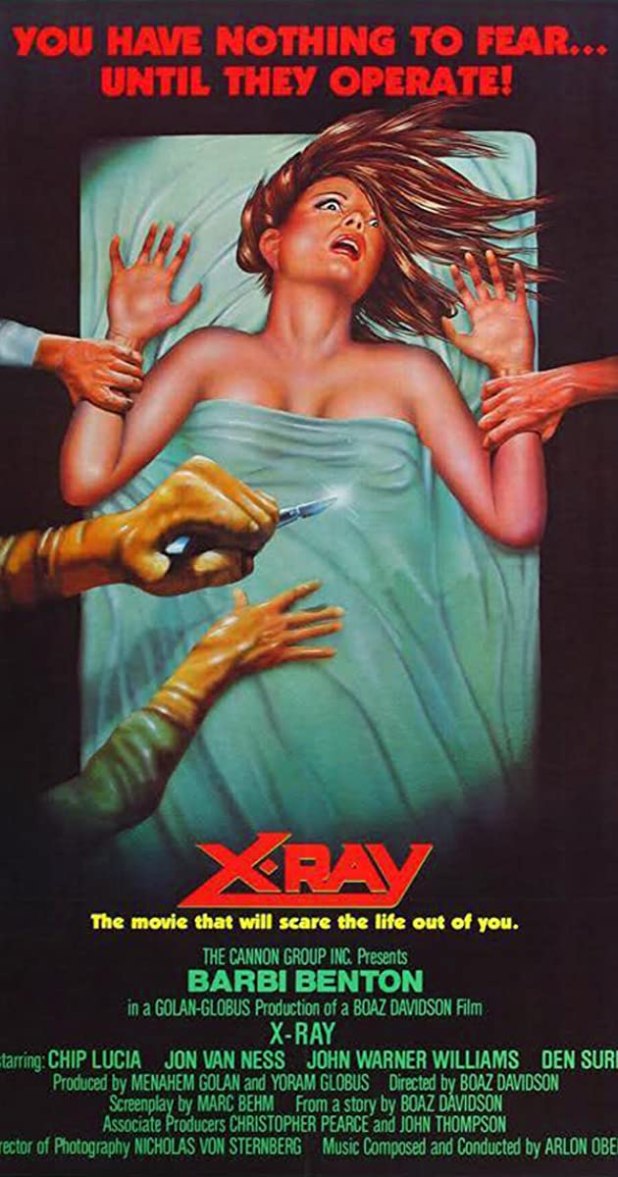
SLASHER MONTH: Hospital Massacre (1982)

How many names can one movie have? A bunch, because this is also known as X-Ray, Be My Valentine Or Else and Ward 13. It’s directed by Boaz Davidson, the man who was behind Lemon Popsicle and its depressing as anything American version The Last American Virgin. That name brought me joy when it was on screen, just as much as seeing the Cannon name before the credits sent me into paroxysms of joy.

Back in 1961, a boy named Harold gave Susan Jeremy a valentine and when she made fun of it with her friend David, he breaks in and hangs her friend from a hatstand.

Susan grew up to be four-time Playboy covergirl Barbi Benton (Deathstalker). Well, that’s who is playing her. She’s just gotten divorced and has to head in for some routine tests at a hospital. Literally, the minute she walks in, an evil doctor laughs while looking at pictures of her as a kid.

Better slashers have started with less.

This is the kind of movie that really uses its environment in the best way possible, as orthopedic saws send heads flying and sinks filled with acid melt faces.

If you recognize the kids from the beginning, they’re Billy Jacoby and Elizabeth Hoy who were the murderous children in Bloody Birthday, which came out the same year as this one.

You can watch this on Amazon Prime.

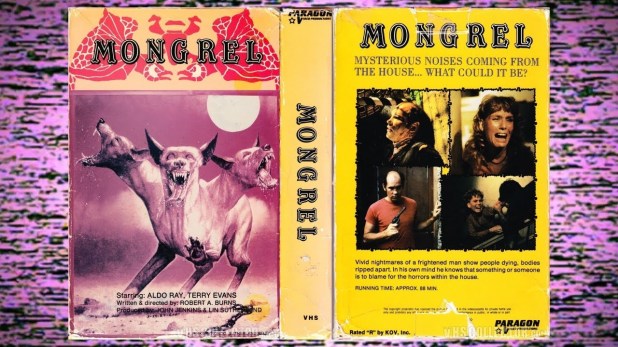
SLASHER MONTH: Mongrel (1982)

Robert A. Burns was the art director* of films like The Texas Chainsaw Massacre, The Hills Have Eyes, Don’t Go Near the Park and The Howling, all movies that feature grimy and cluttered near-chattel houses filled with carnage. Just think of Eddie Quist’s apartment or the home of the Sawyer family. Burns’ artistic eye made all that happen and this is the one and only film he’d direct** (he also wrote the script).

This film takes place inside a Texas boardinghouse that has the spirit of S.F. Brownrigg hanging heavy over the place. When one of the tenants decides to tease the dog that lives in the basement, he ends up getting bit and the dog is put down. This upsets the quiet editor named Jerry (Terry Evans) who tries to keep his life orderly but keeps getting beaten on by nearly every scumbag that lives in this fleabag rattrap. His only good connections are Sharon, who he shares books with, and the latest renter, a handsome man named Ken. He’s attracted to both of them for different reasons, but it seems like Ken is the one who has his heart. However, Jerry isn’t fully human — more on that in a bit — and even the slightest attention from people sends him spiraling out of control. It doesn’t help that every single other person in this movie is vile, with the worst being Woody (a young Mitch Pileggi).

Jerry was also connected to that dog who died after Toad, one of the more insipid residents, teased its owner Ian about it until the dog gets loose. Jerry also had a major incident where a dog attacked him as a child, so he loses it and Woody guns the mutt down. Our protagonist starts to take on the characteristics of the dog — is he possessed by it? Does he see that he needs its feral nature to augment his shy demeanor? — which gets even worse when a prank goes wrong.

The men are jealous that Ken has just come in and ended up getting the girl of their dreams. So they send him a note that Sharon is waiting for him in bed. He runs to her room, strips and discovers the body of the dead dog dressed in lingerie. Shocked, he falls backward and is electrocuted.

This sends Jerry beyond the edge, his ideal man and the third and perhaps most crucial part of his mental menage a trois relationship deceased, he succumbs to the call of the wild and begins killing everyone one by one, his voice replaced by the raspy, growling sounds of the werewolf (while remaining totally human).

If you’re not excited yet, how about the fact that Aldo Ray runs this whole place?

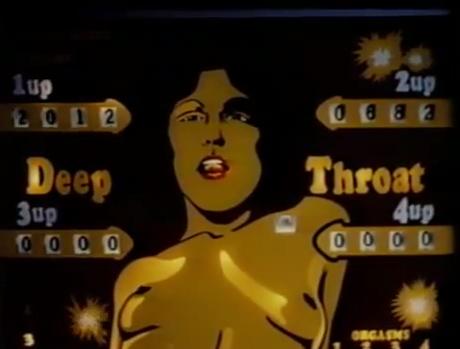
Thanks to Ryan Clark, I can also discuss that this movie features a Deep Throat pinball machine that was custom made by Burns. This message board had the maker of the Rondo and Bob discussing owning the machine, which also shows up in Future Kill

This is a slasher by the end — albeit most of the kills coming off camera, but it has plenty of stalking — but almost seems like a stage play concerning the plight of the human condition within this Texas boardinghouse. It takes a long time to get to where it wants to go, but that doesn’t mean it’s bad. Quite the contrary, it’s a strange piece of filmmaking that would easily find a home in the Vinegar Syndrome re-release catalog.

*Burns also worked on Re-AnimatorMausoleumTourist Trap, Play Dead and plenty more movies. It’s astounding how many movies he worked on are held in such high regard by me. He was also a noted genealogist and the world’s foremost expert on Rondo Hatton. Sadly, he killed himself after finding out he had cancer.

**Burns also made an early found footage movie called Scream Test that remains unreleased.

You can watch this on YouTube.

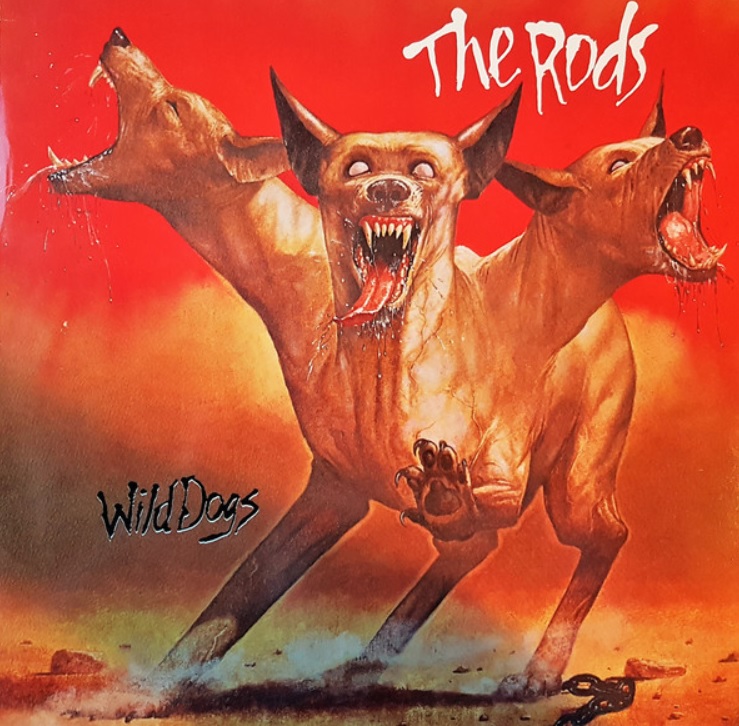
Is that VHS artwork familiar? It should be, if you’re a metal head from the ’80s. It also served as the cover for the Arista Records debut of Ronnie James Dio’s cousin, David Feinstein, who was in The Elves/The Electric Elves with Dio.

SLASHER MONTH: The Forest (1982)

The Forest is unlike any other slasher you’ve ever seen. Sure, it has murders in the woods, campers and stalking scenes. But it gets weirder than almost any other slasher would dare, pushing itself to the edge of absurdity while subverting anything you’d expect.

The killer — John — is played by Gary Kent, a stuntman whose work extends from his debut in Battle Flame through the films of Al Adamson and Roger Corman, emerging as the inspiration for Cliff Booth in Once…Upon A Time In Hollywood and the subject of the documentary Danger God. He’s not just a killer in this. He’s not just a cannibal. He’s a killer cannibal haunted by the wife and children that he murdered in a fit of rage.

Two couples — Steve and Sharon plus Charlie and Teddi — have decided to go into the woods for a vacation. The girls meet the ghosts the first evening, as they first meet the kids and then are confronted by their mother. If a ghost can be insane, hers definitely is.

When they were all still alive, the woman slept around on her husband to the point that he killed her, took off for the woods with his kids and watched them commit suicide, which was finally made him lose his mind and became the hermit human flesheater we meet in this film, the kind of maniac who’d feed a man his girlfriend.

The craziest thing about this movie is that Sharon ends up being the real hero — not just a final girl — and the two men are shown to be, at best, victims and at worst, total morons. Only she is capable, strong and able to survive, perhaps because she has connected to the dead children of the killer.

Even stranger, she was played by Tomi Barrett, who was the wife of Kent.

Shot in 13 days, this movie doesn’t get mentioned enough. Don Jones, the writer and director, would also Who Killed Cock Robin?The Love Butcher, Schoolgirls In Chains and Sweater Girls — all quality films.

You can watch this on YouTube.

SLASHER MONTH: Girls Nite Out (1982)

First off, the fact that one of the posters for this film rips off Night School‘s art makes me love it before I’ve even seen one second of footage.

Second, when I did watch it, it so shamelessly takes from other slashers that you’d very nearly be convinced that it was made in Italy.

Originally released as The Scaremaker, this was shot over the weekend at New Jersey’s Upsala College. That means that most of the scenes were shot in two takes or less.

After Dickie Cavanaugh kills his girlfriend in a jealous rage, gets committed and then hangs himself, all hell breaks loose. The men trying to bury him are killed and the school’s all-night scavenger hunt could not come at a worse time. Yes, I had no idea that when your college basketball team wins the big game that everyone has to engage in just such a contest.

There’s a killer on the loose wearing the school’s bear costume, using serrated knives as if they were bear claws. There are lots of POV shots as if you’re being attacked by the bear and I always enjoy being the participant in a bear battle.

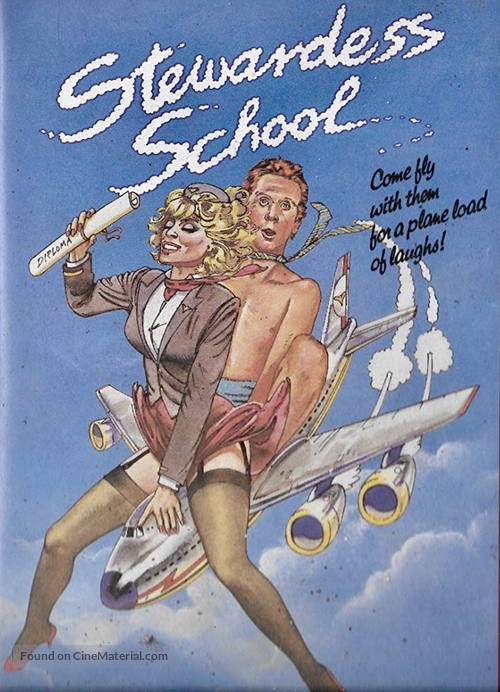
For a movie made on a shoestring, they got some big names. Hal Holbrook is on hand! Julia Montgomery from Revenge of the Nerds and Stewardess School (yes, she’s a star in my world)! Lauren-Marie Taylor (Vickie from the second Friday the 13th)! Page Mosely (who is something of a scream queen, with appearances in Open HouseEdge of the Axe and this movie)! And most importantly Rutanya Alda, who makes this film all hers in the last few minutes, despite the fact that this movie rips off Mrs. Vorhees’ motivation, as all lower level slashers must. I love Rutanya, who claims that she still hasn’t been paid her $5,000 fee for this movie.She should get way more than that, as the close is literally made so much better because of her commitment to more than one role.

If you’ve seen the trailers or poster for this, you may wonder, “Where are the girls in the artwork? Who is this girl in the trailer?” You are right to question these things, as the sales material was made reverse-Corman, in that it was created years after the film was complete.

La Noche del Ejecutor (1992)

Dr. Hugo Arranz (Paul Naschy!) celebrates his fiftieth anniversary with his wife and daughter before he finds himself cosplaying as Paul Kersey from Death Wish after they are both assaulted and killed while his tongue is cut from his mouth.

He survives. And he learns to work out. No, really.

Within minutes of running time, Hugo has emerged as a force of death, ready to wipe out everyone in his path. Despite this being shot in 1989, it didn’t get released until some time between 1992 and 1999. And to tell the truth, it may as well have been made in 1974.

This is one of the few times you’ll hear Naschy’s real voice in a film and the only time you’ll see him battle a final boss in an S&M mask. So there’s that, right? Right!

Monkey Grip (1982)

“Songs about sadomasochism and masturbation can’t be on the radio. The children! Protect the children!”
— the battle cry of the PMRC’s  membership

Courtesy of the Divinyls’ MTV’s patronage—and the conservative right’s “outrage” over the songs “Pleasure and Pain” from their second album, What a Life! (1983), and “I Touch Myself” from their fourth album, Divinyls (1991)—Sydney, Australia’s doppelganger to Akron, Ohio-by-way-of-London the Pretenders (with a little AC/DC raunch and punky Blondie in the woofers), rose up the U.S. charts.

There’s nothing quite like a little Tipper Gore-mock controversy to inject a floundering career. . . .

I remember my ex-Operations Director, with her endless stream of inane memos and made-up-week-by-week-as-you-go-along “station policies” that she’d spring on us; she loved her “write-ups” and warnings. The memo I especially remember—in the context of this film review—is the one advising us that, while it’s a “real toe-tapper” (Her words, I kid you not. Who works in radio and vocabulary-holsters “toe tapper”?), “I Touch Myself” by the Divinyls will not be added to our rotation. Forget the fact we were an alt-rock station that specialized in indie-artists and unsigned locals in the midst of a grunge wave and if a mainstream Madonna-lite copy was put into rotation, it would have be accidently-on-purpose scratched-beyond-airplay or “misfiled” into the 40-pound hallway receptacle—then buried under more trash. “Toe tapper,” indeed. But, once again, I digress. . . .

Watch the trailer.

Anywhoo . . . we say “floundering” because, unlike MTV turning around the then floundering career of Duran Duran (with those bane-of-my-existence Sonny Crockett-on-a-yacht videos), the audience response (due to MTV’s low rotation) to the Divinyl’s debut American single-video “Boys in Town”—was indifference. (That song, in addition to “Elsie” and “Only Lonely” from the soundtrack, were reissued on their international debut, Desperate.) But the late Christina Amphlett had black bangs (!), looked cute on the album cover, and she’d swing a neon-bluelight mic-stand like no other. And the song was like a chick-fronted version of AC/DC; even Blondie-heavy (before that band started meandering with disco-rap hybrids and faux-reggae tunes like a pre-Crash Test Dummies annoyance). So I bought the album. It was a hell of a lot better than Men at Work. And that Men Without Hats cacophony. Oh, wait. They’re from Canada. Never mind.

And if you’re creating a Divinyls-list for the .mp3 files: don’t forget their (minor) hit cover of the Syndicate of Sounds’ ‘60s garage classic “Hey Little Girl” (changed to boy, natch) on their third Chrysalis album, 1988’s Temperamental (which my old station did play, because it fit the format). And it if all sounds like Blondie, that’s because that band’s producer, Mike Chapman (Suzi Q), is behind the boards. And if you hear of a dash of Madonna erotica in the grooves, that’s because “I Touch Myself” was written by the team of Billy Steinberg and Tom Kelly, who wrote “Like a Virgin.”

Ack! Get back to the movie!

Anyway, before the bogusversy and before MTV, there was Christina Amphlett’s AACTA nomination for Best Supporting Actress in Monkey Grip (and she never acted again). Amphlett got her part by way of the Divinyls’ rise on the Melbourne local scene—and the film called for a band whose female lead singer is the gal-pal for the film’s domestically-troubled lead character. And instead of casting actors in a lip-sync faux-band, the producers cast a real band—in a rock flick doppelganger to Nina Hagen’s Cha-Cha and Nena’s Hangin’ Out (and, in a male perspective: Michael Hutchence of INXS co-starring in the punk chronicle Dogs in Space)—the Divinyls.

Based on the best-selling Australian cult novel by Helen Graham and fueled by a six-song EP soundtrack by the Divinyls, the story follows Nora, a single-mother in her thirties scratching out a living on the outskirts of Melbourne’s alternative music scene-business. In addition to struggling to raise her thirteen year-old daughter, she has to deal with her own mental and physical abuse at the hands of her heroin-addicted lover, Javo, a mostly-unemployed theatre actor. As result of the financial and domestic instability, she squats in a number of households with other single parents in Melbourne’s local art community (the suburbs of Calton and Fitzroy; think of New York’s Greenwich Village and Los Angeles’ Silver Lake communities) of musicians, actors, and writers. Nora, as with her likeminded contemporaries, refuses to play by the rules of conventionality, torn by their competing desires for freedom and stability that’s exacerbated by their artistic endeavors.

There’s no freebie online rips. But we found this 10-minute clip of scenes to sample and a VOD stream on Vimeo. You can learn more about the influential novel behind the film with its extensive Wikipage.

About the Author: You can learn more about the writings of R.D Francis on Facebook. He also writes for B&S About Movies.