The Second Coming (1980)

Editor’s Note: On June 26, 2021, we had a “Ron Ormond Day” in tribute to his films. You’ll find the links to the reviews from that day of films — and others — within this review.


This is the one Ron Ormond film that eludes the staff of B&S About Movies. Sure, Sam and I are familiar with the film, as our religious schooling and church youth group years exposed us to all of Ron Ormond’s films — including this lost, final film of the Ormond’s from, as we like to call it, their “Damascus Years.”

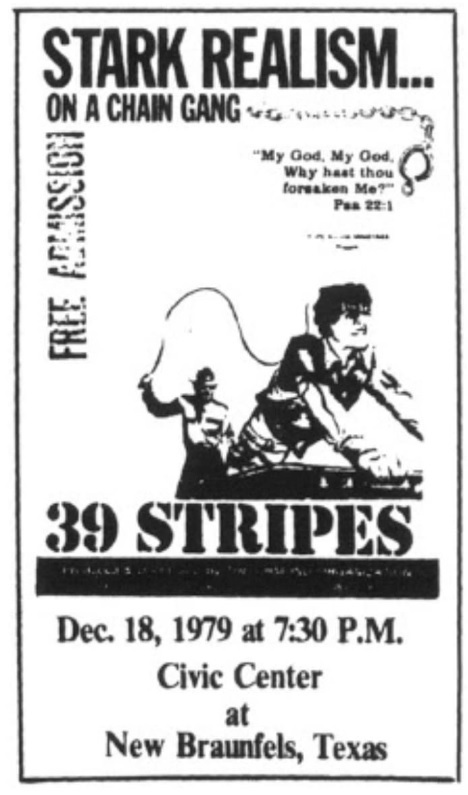
Out of the Ormond’s six Fundamentalist films — seven, if one includes their also-lost, hour-long “travelogue/documentary” feature, The Land Where Jesus Walked (1975) — this is the one film (two, including Land) that is not available as a vintage-resale VHS or reissues DVD. As with all of Ron Ormond’s post-salvation catalogue, The Second Coming did not play in rural Drive-Ins or indoor theaters: it was “rented out” (in this case: $100 a showing, as per the one-sheet) as a “roadshow feature” in churches and tent revivals.
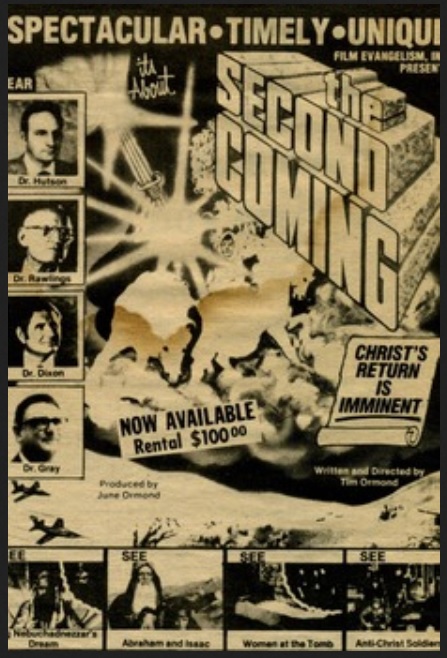
Courtesy of Letterboxd; the only online copy.

The Second Coming served as the directing debut of Ron’s son, Tim. Starting out as an actor in his father’s films: he starred in the family’s secular works Girl from Tobacco Row, White Lightin’ Road, and The Exotic Ones, then the Christian films If Footmen Tire You, The Burning Hell, The Grim Reaper, The Believer’s Heaven, and 39 Stripes. Tim matured to serve as an editor, cinematographer, writer (39 Stripes, The Second Coming), and director (the lost The Second Coming) on several Ormond family productions, which also included wife and mom, June Carr, on the production staff. Tim came to his directing debut through sadness: Ron Ormond died during the pre-production of The Second Coming — in 1981 at the age of 70s — leaving Tim and Ron’s widow to finish the film. June’s other films — under her maiden, professional name in the producer’s chair and as a Second Unit or Assistant Director include not only the above films, but Forty Acre Feud, The Monster and the Stripper, Please Don’t Touch Me, and the lost “jukebox musicals” Square Dance Jubilee and Kentucky Jubilee.

During our analog excavations to find an online stream or trailer to share (we were unsuccessful), we discovered an extensive, November 2007 interview with Tim Ormond, courtesy of Mondo Stumpo: an interview that assisted us in our additional documentation of The Second Coming. (We enjoyed the staff of Mondo Stumpo referring to the genre as “Christian Gore”; if you’re familiar with the Ormond’s “Pirkle” years, you know that’s a perfect analysis.)

We’d also extend our thanks to B. Earl Sink, Jr. — the son of Earl “Snake” Richards — in assisting us in our preserving of The Second Coming. As we’ve discussed in our previous reviews, Richards starred in two of Ron Ormond’s secular films: Girl From Tobacco Row (1966) and White Lightin’ Road (1967). Richards also starred in the non-Ormond “Jukebox Musical,” That Tennessee Beat (1966), by way of producer Robert L. Lippert, who produced many of the Ormond family’s works. It was during the course of that third film review, in which we came to speak with Earl Jr., who tipped us that he (regardless of the IMBb’s incomplete credits; they also have his mother’s credits split as “Carr” and “Ormond”) also acted in The Second Coming. And, as you read on, you’ll come to learn that four generations of the Sinks appeared in or crewed on Ormond productions.

If you’re familiar with the contemporary, Christian-apocalyptic oeuvre of Cloud Ten Pictures, with their B-star-studded Apocalypse series and their better known Left Behind series, as well as the films of David A.R. White’s PureFlix shingle (Jerusalem Countdown), or the ’70s Bible-apoc progenitors of Donald W. Thompson (A Thief in the Night), then you’re up-to-speed on the end-times tale in the frames of The Second Coming. But this is an Ormond film. And it is so much better for it: for Christian-based Ormond films come from the heart and, ironically, none are the least bit exploitative, although they appear on critical lists, i.e., “Christploitation,” as such.

As in the Ormond’s previous Estus Pirkle production, The Burning Hell: we have a similar, wayward youth in love with the world coming to find salvation through dreams, i.e., visions. This time, our scoffing youth, who dismisses his God-fearing mother and the family’s pastor, dreams of missing out on The Rapture. As with any Fundamentalist Ormond production — even the ones void of the crazed “Christian Gore” tutelage of Estus Pirkle — the imaginative creativity of the images presented in the frames is the always thing: God smites a Babylonian statue with a mighty rock (in repetitive, slow motion), dead saints of the past rise up out of their earthen graves, and new saints — the proclaimed 144,000 — vanish on the spot in an eye’s twinkle; then, in a grand, stunning piece of against-the-budget filmmaking (which we’ll get into detail, later): Jesus Christ returns with a phalanx of saints on white horses in the clouds.

Of course, our wayward lad returns to Jesus. As he should: Remember, Estus Pirkle warned us that communist invaders from Cuba would ram sharpened bamboo shoots through our brains via the ear canal, then dump our bodies in freshly bulldozed mass graves. Why would anyone want to stick around for those horrors?

As with the Pirkle trilogy — and the non-Pirkle The Grim Reaper — pastors show up, of course — six, in fact — amid the narrative with words of wisdom. Of course, while guys like Jack Van Impe and Jerry Falwell are committed and honorable in the word, it’s just not the same as having Estus ranting with his statistical analysis on the exact percentages of how many people end up in Hell, daily.

Hey, we can joke about the Pirkle trilogy, but the pastor, however off-putting he may be to secularists, he was committed to the cause. The Ormond family, on the other hand, created honorable, truthful films with a lighter touch. Fans of the Ormond’s Pirkle years may miss the “craze” of those films, here, and dismiss The Second Coming as less effective. We, the cubicle warriors of the B&S About Movies digital divide, do not: we adore all of Ron Ormond’s films.

Tim Ormond with mother June at a post-2000 convention signing/image courtesy of Dennis Dermody of Original Cinemanaic.

The Insights of Tim Ormond on the Making of The Second Coming

“After my dad died, I came to the final scene, which was the — and the way we got around things in general — was, someone would say, ‘That’s not the way it’s gonna be,’ and I’d say, ‘Well, this happened as kind of the way this person imagined it or dreamed it: like Daniel would have this dream.’ So that’s the way we would alibi things, [just] in case a theologian would say ‘Well that’s not the way it’s supposed to happen.’

“Anyway, this particular character in The Second Coming was visualizing Christ returning on white horses; wielding the sword, His face aglow. Well, I had to stage this scene. This was, of course, before computer graphics were like they are today. And even so, the cost would be prohibitive. So, I went to Hollywood, along with my Mom, and we looked up old friends; we found the wrangler who did Little House on the Prairie [for NBC-TV], as well as some old friends of my dad who’d worked on the Westerns [with Lash LaRue and Tex Ritter]. And I began to put together a crew and a shoot in Hollywood for staging this last [Christ in the clouds] scene.

“[While this was going on], I made a phone call to my friend in Nashville, Eddie King, who had played my brother in The Grim Reaper, and asked him if he could try to put together the same shoot in Nashville, because it would be much less expensive. So, I guess, just a few days before we were ready to go into production in Hollywood — and I’m just talking about on that one scene — I talked to Eddie, and he had put it together in Nashville. So we came back to Nashville to shoot it, merely from a cost standpoint.

“So, on that particular night, we gathered at the Riverwood Riding Academy, which was a great big field out near a park, not too far from my house, and people began to gather with the horses. We had a searchlight come in from Huntsville, which could basically shine this very bright, illuminating beam of light on Christ’s face: He was wearing a reflective surface so it would reflect the light back as bright as possible. He was dressed in the red robe, all the horses were white and groomed, all of his angels were riding alongside of him wearing white robes, we had fog on the ground, we had lights, we had big blowers running to move the fog. . . .

“And the funniest thing is, right exactly next door — I’m talking about a hundred yards away, but across a fence — was the park patrol. Just sitting there in the dark watching what was going on. And we didn’t know this. They didn’t bother us, but they were talking on their scanner. And one of my crew — actually the wife of the director of photography — was listening to them, and one guy said, ‘Come on, you’ve got to come over and see this! They’re doing a commercial for the Ku Klux Klan!’ So that was kind of a funny incident. But when it was done, it turned out very well. Of course, the ground was fairly dark on purpose, and there was a layer of fog. We superimposed that over the clouds, and it does appear like Christ returning triumphantly in the clouds. Which is a pretty graphical representation of the way it reads in the Bible. So that’s that one little scene.”

Earl and Rita Faye Sinks/courtesy of B. Earl Sinks, Jr. Facebook.

The Insights of B. Earl Sinks, Jr. on the Making of The Second Coming

“Ron [Ormond] wanted me to be in the film, as he wanted a 4th generation of our family to be in the film. Of course, my mother and grandparents were in Ormond films from back in California during the Lash LaRue days, as well as Square Dance Jubilee. My mom and grandparents also appeared in Girl From Tobacco Row, while my mom also did makeups for a few of the movies, like Burning Hell, and so on.

“So, Ron had my part written for me prior to his passing. Then Tim took over [as director]. I remember staying with Tim and June, his mom, rehearsing for the role along with Rev. Martin; he was in the movie 39 Stripes, which, as you know, was the story of his life. The reverend was such a Christ-like man that, to this day, I still think of him as such a sweet soul. When we finally got to the day of shooting, I recall when a cloud would pass over, or something wasn’t right, I would hear Tim call ‘CUT’ to end the scene. So, when we were shooting another scene, and I saw a cloud passing, I shouted, ‘CUT!’ like he did. Tim was tickled by that and let me know, jokingly, that he was the only one to say ‘CUT’ to end a scene. We all laughed.

“At the debut of the opening of the film, there was a man who thought my role, my acting, was good enough, so he asked me to read for a stage [production] of On Golden Pond. However, since it conflicted with school, my parents said ‘no’ to my audition. I also has a walk-on part in Tim’s Blood, Friends and Money with Jim Varney [but not as his character Ernest P. Worrell]; as I recall, my scene ended up on the cutting room floor.”

Bottom Right: Earl Sinks — aka Earl “Snake” Richards, the star of the Ormond’s Girl from Tobacco Row and White Lightin’ Road, as well as That Tennessee Beat — with the Crickets.


When you follow the links to our other Ron and Tim Ormond film reviews, you’ll understand the staff of B&S About Movies are fans, not only of the Ormonds’ secular films, but their Christian films, as well. We are doing our part to expose their films to our readers and preserve the Ormonds’ films for others to discover and enjoy — many for the first time.

To that end: We extend our thanks to Letterbox’d — and the anonymous uploader — who discovered a copy of the theatrical one-sheet of The Second Coming (the only copy of the theatrical one-sheet online). We also appreciate the film journalism efforts of Mondo Stumpo (still active, but ceased publishing in June 2012) and Original Cinemaniac for their previous efforts in preserving this lost Ron Ormond film.

And a special thanks to B. Earl Sinks, Jr. for taking the time to speak with B&S About Movies.

The Ormond’s Christian Films

If Footmen Tire You, What Will Horses Do? (1971)
The Burning Hell (1974)
The Land Where Jesus Walked (1975)
The Grim Reaper (1976)
The Believer’s Heaven (1977)
39 Stripes (1979)
The Second Coming (1980)
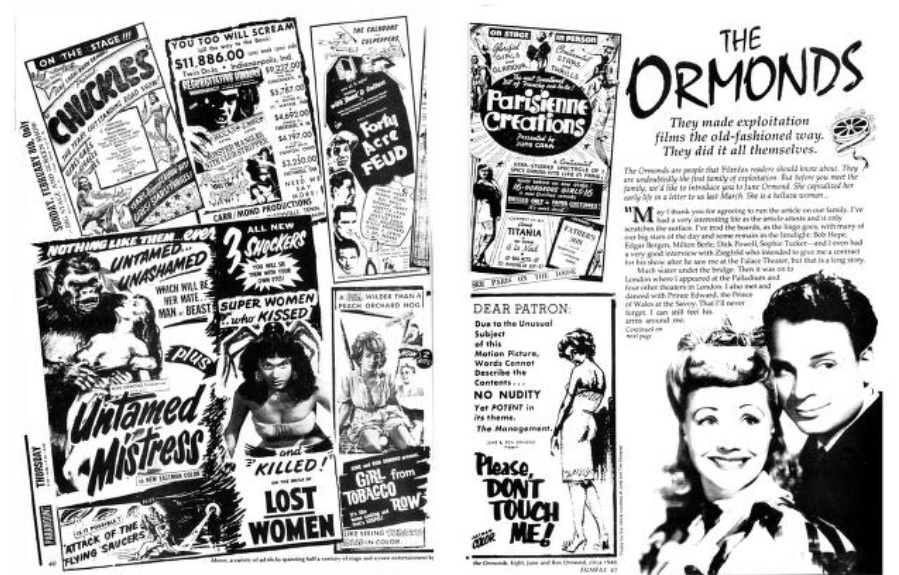
Learn more about the Ormonds in the pages of Filmfax, Issue 27 (1991), preserved on The Internet Archive. (The extensive article begins on Page 40.)

Update: July 14. 2021: Courtesy of film documentarian Brian Rosenquist — who’s currently working on a feature documentary concerning the joint exploitation films of Ron Ormond and Estus Pirkle, and who was involved in securing the original camera elements for Estus Pirkle’s three films, for Nicolas Winding Refn (Only God Forgives, The Neon Demon) to complete restorations — we’ve since learned The Second Coming was, in fact, released to DVD ten years ago on a double-DVD with The Grim Reaper. You can watch an online streaming version of The Second Coming on a Ron Ormond tribute page located at the Internet Archive.

In addition to streaming the only online copy of The Second Coming, the page also offers a copy of The Burning Hell, as well as the once lost “Jukebox Musical” Kentucky Jubilee, and Ormond’s pre-Christian film, Mesa of Lost Women.

You can learn more about the restorations of the Ormond-Pirkle trilogy with the Radio NWR podcast Estus Pirkle: A Celebration.

A cinematic search of Man’s higher purpose and meaning.

About the Author: You can learn more about the writings of R.D Francis on Facebook. He also writes for B&S About Movies.
Pinball Summer (1980)

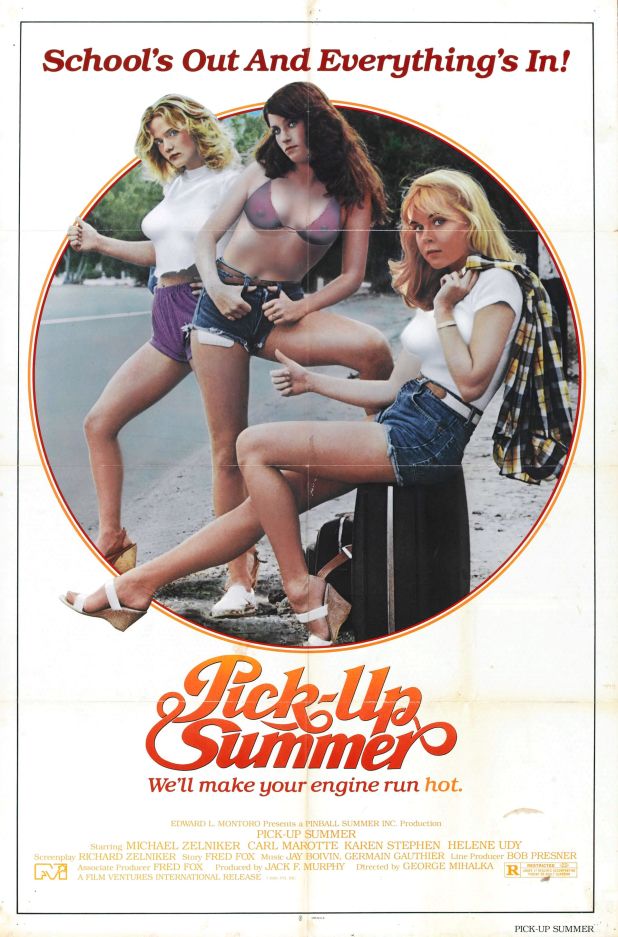
Also known as Pick-Up Summer and Flipper Girls in Germany, this Canadian film comes after the Crown International beach movies and before Porky’s. Most of the action revolves around a place called Pete’s, an arcade that is hosting a pinball competition, which also has a Miss Pinball pageant, which I really hope was a thing at some point.

Speaking of movies leading to something more, director George Mihalka and cinematographer Rodney Gibbons would make My Bloody Valentine* after this, a movie that is much better remembered than this teen summer comedy that revolves around disco, burger joints, amusement parks and hijinks between a biker gang and our heroes over the pinball trophy.

Film Ventures International bought this for America and changed the name, thinking pinball was dead. It did pretty well and people didn’t even notice that it was made in Quebec and not California. It’s a pretty innocent movie when it comes to teen comedies.

*Helene Udy, who played Sylvia in that classic slasher, Thomas Kovacs, who played Mike, and Carl Malotte, who played Dave, are all in Pinball Summer as well.

Foxes (1980)

Gerald Ayers had a vision: What would happen if you dropped Louisa May Alcott into the San Fernando Valley today? She would have a different story to tell.” I doubt the author of Little Women would write about the glam band Angel, who figues prominently in this movie.

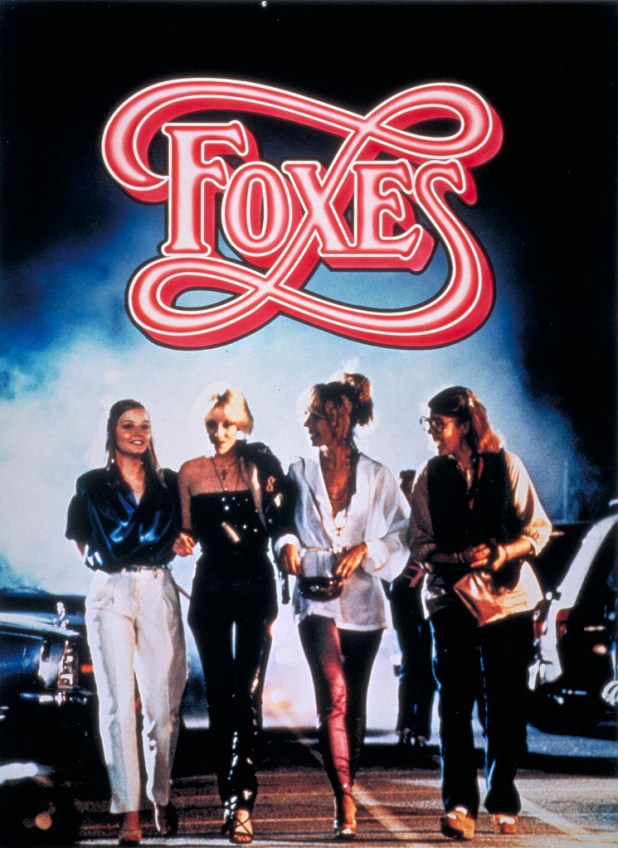
Nonetheless, Foxes is really the story of four girls:

Deirdre (Kandice Stroh, who didn’t act against for 21 years after this movie) is discovering her sexuality and the issues that brings with boys. Madge (Marilyn Kagan), on the other hand, is a virgin and hates her body as well as her younger sister Anne (Cherie Currie in her acting debut), who uses drink and drugs to escape their abusive home life. And the motherly friend who takes care of all of them is Jeanie (Jodie Foster), who is also raising her mother (Sally Kellerman) while yearning for a closer bond with her father, the tour manager for Angel.

Alright, let’s talk Angel.

Formed in mid-1970s Washington, DC by Punky Meadows and Mickie Jones (who rumor has it were asked to join the New York Dolls), Angel was signed to Casablanca Records by Gene Simmons and presented at the anti-KISS, as they wore all white to the all black Knights In Satan’s Service. Their classic line-up — Meadows, Jones, Frank DiMino, Gregg Giuffria and Barry Brandt — recorded the albums Helluva Band and On Earth as It Is in Heaven before Jones left and was replaced by Felix Robinson.

By 1981, DiMino and Meadows left and now the band had Fergie Frederiksen (Toto) and Ricky Phillips (The Babys, Bad English, Styx) before they broke up for good.

Over the next few years, Frank DiMino joined UFO guitarist Paul Raymond in the Paul Raymond Project; Felix Robinson played with White Lion; and Gregg Giuffria started the band Giuffria and recorded with House of Lords.

Like most rock and roll bands, Angel got back together. The 90s saw a new Angel made up of DiMino, Barry Brandt, Randy Gregg, Steve Blaze from Lillian Axe and Gordon G.G. Gebert, who was replaced by Michael T. Ross. Punky played on their album In the Beginning and there was a greatest hits release Angel: The Collection.

Mickie Jones died in 2009. Meadows and Dimino toured together as Punky Meadows and Frank Dimino of Angel, performing a set of classic Angel songs and solo cuts before just deciding to call themselves Angel.

Now, back to the movie.

By the end of the film, the girl’s life — which was once drinking, drugs and disco, has changed. Annie is dead and buried. Madge marries the guy who takes her virginity (Randy Quaid). Deidre is over boys. Jeanie is leaving for college. It’s a sobering realitization that the four friends may not see one another or be as close as they once were.

Foxes was the first film that Adrian Lynn would direct. The dude pretty much ran the 80s and 90s with movies like  Flashdance, 9½ WeeksJacob’s Ladder and Indecent Proposal.

Speaking of the 80s, the soundtrack to this movie is pretty great. Other than two songs by Angel, it was entirely produced and composed by Moroder and recorded by the same musicians — Keith Forsey and Harold Faltermeyer — that he worked with on songs by Donna Summer, the Three Degrees and Sparks. “On the Radio” by Summer is probably the bets-known song on from Foxes. It was the second movie Moroder scored in 1980 after American Gigolo.

Supposedly, Foster and co-star Scott Baio dated during the this time. That may or may not be true, as Foster came out right around this time. Maybe this is where Baio got his right wing rage from. Whatever the story is, this is my second favorite movie that they’re in together.

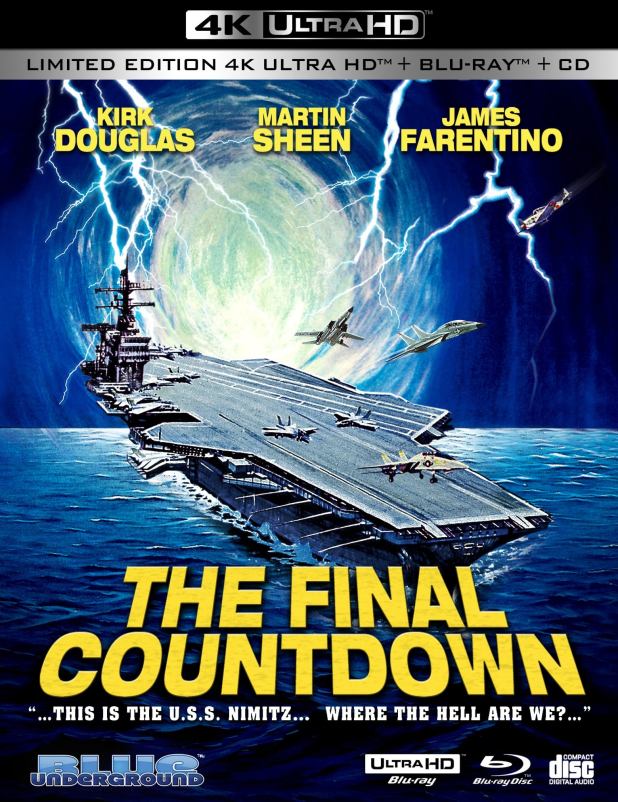
The Final Countdown (1980)

Produced with the full cooperation of the United States Navy’s naval aviation branch and the United States Department of Defense, The Final Countdown was set and filmed on board the USS Nimitz, capturing actual operations of the then-modern nuclear warship, which had been launched in the late 1970s. The Final Countdown was a moderate success at the box office.

Despite the films meager budget, producer Peter Vincent Douglas was able to get it made and get the military on board. While director Don Taylor turned in a workmanlike film — some claim this as to many of his movies, but hey, I love Damian: The Omen II and Escape from the Planet of the Ape— the second unit was able to work with the Navy to mount cameras directly onto the planes and get some astounding footage.

The SS Nimitz is departing Pearl Harbor for naval exercises in the mid-Pacific Ocean along with civilian observer Warren Lasky (Martin Sheen). He’s working for the Defense Department as an efficiency expert, as well as for the man who built the ship, the mysterious Mr. Tideman. However, the ship soon goes through an electrical vortex and finds itself on the eve of Pearl Harbor, leaving the crew — under the command of Captain Yelland (Kirk Douglas) — unsure of what to do next. Do they stop one of World War II’s most crippling defeats or allow history to proceed?

Things become more complicated when the Nimitz rescues survivors from a yacht under attack by two Japanese planes: U.S. Senator Samuel Chapman (Charles Durning) and his aide Laurel Scott (Katherine Ross), along with her dog Charlie and one of the Japanese pilots. One of the crew, Commander Owens (James Farentino), recognizes Chapman as a politician who would have been Franklin D. Roosevelt’s running mate during his final re-election campaign had he not disappeared shortly before the attack on Pearl Harbor.

I love the central issue of this film and have no idea what choice I would have made and equally adore the time travel twist at the end. I’d always pegged this as a lesser version of The Philadelphia Experiment, but now I realize that they tell a similar story from two very different angles (and vice versa in what direction they go in time).

There are some great small roles here as well, like Superfly actor Ron O’Neal as Cmdr. Dan Thurman, Soon-Tek Oh from Missing In Action 2: The Beginning as one of the Japanese pilots and Richard Liberty (Dr. Logan from Day of the Dead) as Lt. Cmdr. Moss. Plus, a total of forty-eight real life US Navy personnel from the actual USS Nimitz were involved with this movie as extras, background artists or actors, with some having speaking parts. I also learned that each ship in the Navy has something called breakway music that is played at the close of underway replenishment to motivate their crews. The Nimitz uses the music that was written for her in this film, John Scott’s “Theme from The Final Countdown.”

As for how the picture got the scenes of Pearl Harbor under budget, they’re tinted scenes from Tora! Tora! Tora!

I wondered why this movie was getting such a royal treatment before I watched it, but after viewing it and seeing the astounding job that Blue Underground put together, I have to admit that they’ve made a believer out of me.

You can get The Final Countdown from Blue Underground. It has a new 4K Restoration from the original 35mm camera negative on Ultra HD and HD blu ray. It also has audio commentary with Director of Photography Victor J. Kemper , a feature on Lloyd Kaufman being the executive producer and interviews with The Jolly Rogers F-14 Fighter Squadron. Plus, you get trailers, TV ads, poster and still galleries, a collectible booklet and a soundtrack, all inside an amazing lenticular animated slipcover.

BRUNO MATTEI WEEK: Virus – l’inferno dei morti viventi (1980)

EDITOR’S NOTE: Frederick Burdsall didn’t like this movie as much as I did. Because I don’t like this movie. I love it. 

Bruno Mattei got hired to make this, being asked by Spanish producers to make something like Dawn of the Dead but happier, if that was possible. He made this under the name Vincent Dawn, which the producers requested. Two scripts were written by Claudio Fragasso* and Rossella Drudi, with the one being picked not being the script Mattei preferred.

I wish I could have seen that script** because what got made is absolutely insane.

The movie starts in a top-secret chemical research facility called Hope Center #1. There, the male workers talk non-stop about sex like this:

Technician #1: She may not know much about chemistry, but in bed, her reactions are terrific.

Technician #2: I’m not surprised with that cute little ass.

Technician #1: I’m a tit man, myself.

In the middle of this locker room talk, a rat causes a chemical leak and comes back to life as a zombified rat*** that eats the face of a worker, turning every single person there — eventually — into the living dead.

Meanwhile, four commandos — Lt. Mike London (José Gras, billed as Robert O’Neal), Osborne (Josep Lluís Fonoll, Wheels on Meals), Zantoro (Franco Garafalo, The Other Hell, billed as Frank Garfield) and Vincent (Selan Karay) — wipe out some eco-terrorists who are demanding that the Hope Centers be revealed to the public.

Now that the Hope Center we’ve seen at the beginning of the movie has lost contact with the world, the commandos go to New Guinea to find out why. There, they encounter journalist Lia Rousseau (Margit Evelyn Newton, The Adventures of Hercules) and her cameraman Max (Gabriel Renom), along with a fighting husband and wife who are soon dispatched by a zombie doctor and their dead son.

Their fight dialogue really needs to be shared:

Josie’s husband: These bright ideas you get… bringing a 7-year-old child through this filth! Only YOU could have thought of it!

Josie: There was absolutely no way of knowing the trouble we’d run into.

Josie’s husband: Dumb broad! The living image of a modern mother! You couldn’t be so mean to leave our boy at a nice safe school for a couple weeks! Not her! “Oh, no! Not to bring our boy along with us would be cruel!” Doesn’t matter if he’s eaten by mosquitoes… or wounded by a native lunatic!

Lia Rousseau: Oh, please! You’re not gonna begin that again!

Josie’s husband: Oh, no! I’m sorry! Naturally, the great Lia Rousseau can’t possibly be disturbed listening to the complaints of a man who’s upset about his boy! No, she’s on a special mission. The idol of a TV audience who doesn’t get enough violence and BLOODSHED!

In case you’re wondering, “Is this a Bruno Mattei movie?” Let me satisfy you: when they go to a native village, footage from the documentary New Guinea, Island of Cannibals gets added into the movie and Rousseau having to strip down and get her body painted up. Of course, the mirth of the native village ends up with a zombie attack and the commandos — and journalists — make their way to the overrun hope center, where they learn that Operation: Sweet Death was made to destroy the world’s population so that overcrowding could be stopped, starting with the poor people, of course.

I love the ending of this, as politicians throw paper at one another while zombies have spread into the major cities.

In case you watch this and think, “This music sounds familiar,” I have the answer. It’s all Goblin, which was licensed instead of getting an original score made. It has songs from their album Roller, as well as their songs for Dawn of the Dead, Beyond the Darkness and Contamination.

Alternate titles include Hell of the Living DeadZombie Creeping FleshNight of the ZombiesVirus CannibaleOs Predadores da Noite (The Night Predators) and Zombie Inferno.

I absolutely love the absurd dialogue in this! There’s so much, but this is my favorite back and forth:

Vincent: Patience is the chief virtue for those who have faith. Mahatma Gandhi, New Delhi, 1946.

Lt. Mike London: Up your ass. Lieutenant Mike London, Shit Creek, the year is now.

Also, it has the strange air that the terrorists are right, despite their actions being wrong. Pretty much humanity is doomed in the world of Mattei. Really, for all the bad I’ve heard about this movie, it’s a total success in my eyes.

I mean, it has a scene where a commando puts on a dress, sings a song from Singin’ in the Rain, causes a zombie kitten to leap out of a dead woman’s stomach and then dies while everyone yells, “Bastards! Filthy jackals! Look at them, look at THAT! They’re eatin’ him like PIGS! Goddamned rotten ghouls!”

You can watch this on Tubi.

*In an interview in GoreZone, Fragrasso said this movie was, “designed with lots of love, but in the end it came out a test tube baby, a kind of abortion. But I’m satisfied with the end results.”

**In that script, Fragasso wrote of “an entire Third World made up of an army of zombies, who the armed forces of the industrialized nations would have had to fight.”

**Spoiler warning! I wonder if this rat is the father of the rats we meet at the end of Rats: The Night of Terror?

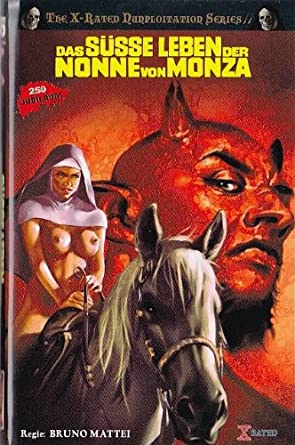
BRUNO MATTEI WEEK: The True Story of the Nun of Monza (1980)

Marianna de Leyva y Marino was born on December 4, 1575 in Milan. While she was from a noble family, there were numerous disputes over money after the death of her mother. At the age of 13, her father forced her to become a nun in the Monastery of Saint Margaret and despite claims that she would receive an inheritance, that never happened.

By all accounts, she was a friendly and modest woman, who was praised by community members and even recieved a letter congratulating her choice to go into the sisterhood from writer and historian Bartolomeo Zucchi.

Then, there things got scandalous.

In 1597, while working as a teacher at the convent’s school for girls, Marianna met Count Giovanni Paolo Osio, who had previously been accused of murder.

It’s important to realize just how rich, powerful and influential the nuns of this time were. Sure, they had entered the vow of poverty, but the truth was that Marianne was still wealthy, despite never recieving the money her mother left her. In addition to teaching, her duties included administering the property revenues and justice in Monza, so she was able to freely move through the society of the elite.

Her affair with the count began with letters, but soon grew physical, thanks to  the complicity of the other nuns and even the priest Paolo Arrigone. After two children were born to the couple — one stillborn and the other adopted as an illegitimate child by the count — Virginia went so far as to murder one of the nuns who threatened to expose her. She did this with the full complicity of the other sisters and the count also killed the blacksmith who had made keys to the convent for him.

However, the governor of Milan eventually arrested Oslo for the murder. He escaped and was later killed by a friend, while Archbishop Federico Borromeo ordered a trial of Marianne, whose defense was that she had lost her free will due to the diabolical force of lust. After a lengthy trial that even featured torture, she pleaded guilty and was sentenced to be walled-in for 13 years in the Home of Santa Valeria. She survived this sentence and lived there for nearly three decades before she died in 1650.

The Nun of Monza has been the subject of at least five other movies — including Sergio Corbucci’s Il Monaco di Monza — but never before with the sense of crazy mayhem like Bruno Mattei would bring to the table.

Using his Stefan Oblowsky alter ego and working with a script from Claudio Fragasso, Mattei seems committed to giving those with no attention span exactly what they come to a nunspolitation movie for as much as he possibly can. One wonders if these sisters even went to church what with all the arrdvarkery going on.

Zora Kerova stars as Sister Virginia de Leyva. You may remember her as the tarot card reader in Anthropophagus or as the sex show worker in The New York Ripper or getting hung by hooks in Cannibal Ferox. Her father has sent her to be a bride of Christ to remove her from the temptations of this world, but as we soon learn, all the whippings and ecstatic devotions simply lead to her fantasizing that Christ himself has come off the cross to get her on her knees. Yes, Mattei is never subtle, is he?

That said, she’s not alone in her carnal state. The nuns can’t stop aggressively cuddling and even a priest tries to assault our protagonist inside the confessional. To make matters even weirder, he’s dressed as Satan at the time.

Giampaolo Osio (Mario Cutini, Play Motel) soon falls for Virginia. He’s friends with the evil priest and has been shown killing numerous oppoennts in duels. But before they can get to know one another biblically, Virgina’s father dies, making her the new Lady of Monza. This also allows her to become the new Mother Superior, which worries the evil priest and his lover Benedetta (Paolo Montenero, A Bay of Blood). They set up Virginia by having Osio assault her, but this being a Bruno Mattei movie, she soon falls in love and bears him a child. That stillborn baby is summarily tossed out a window.

Look, if you’re coming to 1980 Italian exploitation cinema for even the slightest hint of good taste, you are not going to find it. Mattei’s other nun movie, The Other Hell, is perhaps even more obsessed with daring the Catholic Church to be upset.

Margherita (Leda Simoneti, Adam and Eve vs. the Cannibals) theatens to exposes the entire sordid mess before she’s killed, which brings in the Inquisitor which ends with our heroine walled up, just like in real life.

While this movie is set in the 1600s, that doesn’t mean that it can’t have a funky soundtrack by Gianni Marchetti, who also scored SS Girls and Emanuelle’s Revenge. There are also appearances by Paola Corazzi (SS Experiment Love CampSS Camp 5: Women’s Hell), Annie Carol Edel (Almost Human), Franca Stoppi (Iris from D’Amato’s Beyond the Darkness, as well as appearances in Mattei’s The Other HellViolence in a Women’s Prison and Women’s Prison Massacre) and Mario Novelli, who was the engineer in Amok Train/Beyond the Door III, as well as showing up in Eyes Behind the StarsThe Scorpion with Two Tails and Warriors of the Year 2072.

Despite stealing the horses in love opening from The Beast, this is probably as restrained as you’ll get Mattei. That said, this is also a movie about nuns whipping each other, evil priests and infants being launched from windows, so don’t go in expecting Godard.

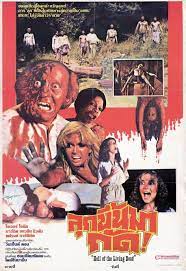
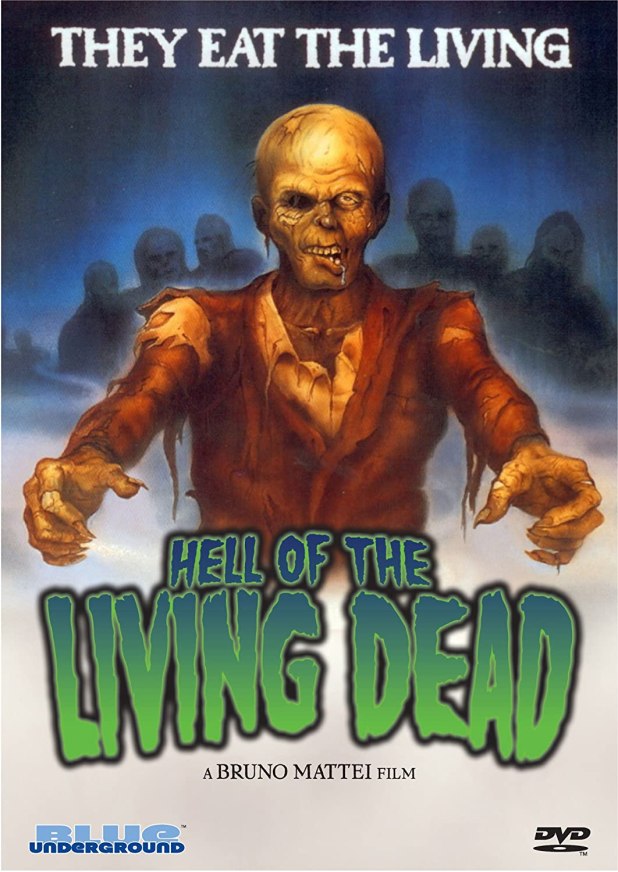
BRUNO MATTEI WEEK: Hell of the Living Dead (1980)

ABOUT THE AUTHOR: When Frederick Burdsall isn’t at work or watching movies while covered in cats, you can find Fred in the front seat of Knoebels’ Phoenix. 

Way back when in the time of the dinosaurs there were these places called Drive-Ins. You can pretty much count on both hands how many still exist today but they were magical and I consider myself fortunate to grow up in a time when they were prolific. The one near me was the Tacony-Palmyra and it boasted 2 huge screens with 3 films every night. One side was your standard movie fare but the other….oh, the other screen was heaven to a guy like me. 3 horror movies every weekend and for 10 straight weeks my friend and I would get some beer and head over to see Maniac, Zombie and whatever third feature had been added for that weekend. Most were forgettable but one in particular remained in my memory and that was the Bruno Mattei film Hell of the Living Dead.      

 Under the pseudonym Vincent Dawn and assisted by Claudio Fragassi ( who gave us the sensationally awful Troll 2) we start in New Guinea at a chemical research facility named Hope Center 1 where they are working on a project called Operation Sweet Death, a gas which will turn those it comes into contact with into zombies. Unfortunately, a rat in the works has created a leak and now the lab techs are turning on each other.

After the 4 commandos are introduced in a hostage rescue scene (which would have surely resulted in dead hostages in real life) we jump to New Guinea where they are investigating why contact with Hope1 has ceased. Believing it to be just another eco-terrorist takeover they set out in their jeep and cross paths with Rousseau and Max, a journalist and her cameraman already being stalked by the dead.

The group suffers several more attacks, one in a nearby village and another in a seemingly abandoned plantation that is anything BUT abandoned before finally reaching the river and their raft, with the dead hot on their heels. Once across, they finally reach the facility where they discover the grisly truth. Will anyone make it out alive to warn the world of what’s to come? 

There is certainly no end of things you could crap on this movie about. The dubbing is comical in a few scenes and Goblin is credited with scoring the movie but in reality they just used Goblin music lifted from Dawn of the Dead. Footage from the film La Vallee was also incorporated into the movie. Shot in Rome and Barcelona it was originally scripted to take place in Africa but was considered too costly.  So by all means watch and enjoy Hell of the Living Dead in all of its eye-popping, maggot eating, head crushing glory and I’ll see you at Knoebels.  

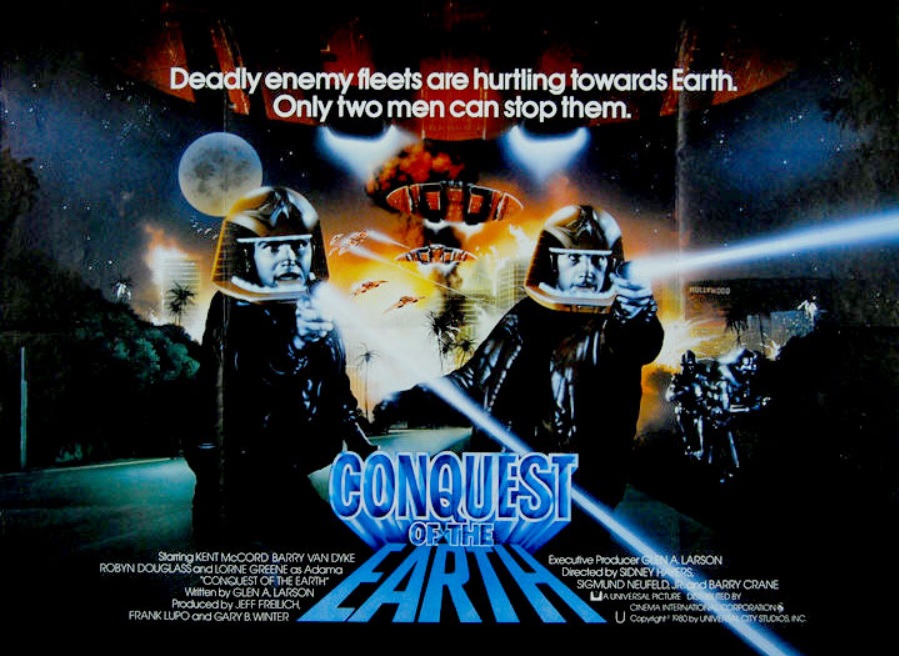
Conquest of the Earth (1980)

Editor’s Note: To commemorate the 42nd anniversary of the cancellation of the original Battlestar Galactica TV series in April 1978, we’re taking a look back at the two telefilms culled from the series — Mission Galactica: The Cylon Attack and Conquest of the Earth — for our “Space Week” tribute this week.


As I revisited my used VHS tape of this third Battlestar Galactica feature film cobbling from the TV series — after Mission Galactica: The Cylon Attack — my analog-kid memories time tripped to spending summers with my crazy Uncle Al (Bradley), the king of Italian schlock cinema; he who ripped the space opera torch from the hand of George Lucas and stumbled across the finish line to give us not one — but five (Yes, Sam, five. Not four. End of story!) — Star Wars ripoffs, faux flicks that we love so much amid the B&S worker bee cubicles, we dedicated one of our “Drive-In Friday” featurettes to Alfonso Brescia’s Pasta Wars oeuvre.

For if David Winter’s Space Mutiny is the South African equivalent of Turkey’s Dünyayi Kurtaran Adam, then Conquest of the Earth is Star Odyssey, Uncle Al’s response to George Lucas’s The Empire Strikes Back. For Glen Larson, with his Roger Cormanesque cheap ‘n shamless footage, prop, and costume recycling from his own BSG television franchise — as well as his Buck Rogers in the 25th Century axis (and Universal’s Earthquake and The Six Million Dollar Man*˟, and Irwin Allen’s The Towering Inferno, to boot!) — is a graduate of the Pasta Wars School of Science Fiction Film. (Hey, that prop from Quantum Leap looks like . . . oh, never mind.) Do you remember the time when Adalberto “Bitto” Albertini, he of the 1975 Italian soft-core sexploitation “classic” Black Emanuelle, pilfered Luigi Cozzi’s Starcrash to create Escape from Galaxy 3? Remember how Roger Corman endlessly recycled Battle Beyond the Stars to make the Star Wars droppings* that are Galaxy of Terror, Space Raiders, and Forbidden World (which also pillaged Galaxy)?

Yeah, it’s like that — and more. So much for TV network executives giving credence to viewer write-in campaigns.

Foreign theatrical one-sheet/various sites.

Set 30 years after the initial series’ final, 24th episode, “The Hand of God,” in the spinoff series, Galactica: 1980, the famed Battlestar finally reaches Earth — only to discover the planet’s technology is unable to defend itself against the Cylons. Centered around the characters of Commander Adama, the now “Colonel” Boomer (replacing Tigh), Apollo, Starbuck and Baltar, the new series would be concerned with Baltar (atoned and now serving as the President of the Council of the Twelve) stealing a time travel ship to altar Earth’s history, so its technology would advance in the present day to the Colonial-Cylon level. At that point, the series would have a weekly “Time Mission,” with Apollo and Starbuck sent into the past to bring back Baltar — who would always, somehow, slip their grasp — and undo his changes to history.

Now, if you know your Glen A. Larson productions, you’ll recognize this time travel concept — slightly tweaked — also served as plot fodder for his more successful, later series Quantum Leap, which ran for five seasons from 1989 to 1993.

But I digress.

The VHS version/multiple sites.

So, as the new spinoff series developed during pre-production, Richard Hatch and Dirk Benedict were soon out — and replaced by TV actors Kent McCord (TV’s Adam-12; you youngins may have seen it on Cozi-TV) and Barry Van Dyke (Diagnosis: Murder on the old n’ stuffy Hallmark Channel alongside those The Golden Girls reruns). They would star as Galactician descendants Troy (Boxey all grown up!) and Dillon: the new (and not improved) Apollo and Starbuck (or Luke Skywalker and Han Solo, if you will). Ann Lockhart’s character of Sheba was also out (who, in turn, was the replacement for Jane Seymour who departed her role as Apollo’s love interest and fellow warrior, Serena); she was replaced by Robyn Douglass (the 10-speed racing romance Breaking Away) as earthling Jamie Hamilton, a network news reporter, who assists the Colonials. Also out was the great John Colicos as Baltar; now the “evil” of the show would be portrayed by the equally awesome Richard Lynch (Ground Rules) as Xavier, a high-ranking Colonial officer who defies Adama’s orders to send the fleet into deep space, away from Earth, and steals the time ship.

Of course, Xavier chose to time trip to 1940’s Nazi Germany, since the German wehrmacht was the “most technologically advanced society” in the world at the time. (Ugh, more costume department pillaging-on-the-cheap with the space Nazis from BSG: TOS‘s “Experiment in Terra”). However, after the airing of the three-part pilot “Galactica Discovers Earth,” the network deemed the time travel aspect too expensive to maintain on a weekly basis; it was nixed to concentrate on a more cost-effective “present-day Earth” setting — complete with Troy and Dillon on new mission: integrating a gaggle of (annoying) Colonial children who, courtesy of their being born in space, have developed superpowers in Earth’s gravity. (By the Lords of Kobol, noooo!) And . . . did you know that, when you time travel, your clothing turns snow white? Well, it does when you need to reuse those all-white Colonial Warrior suits from “War of the Gods,” themselves reused in “Experiment in Terra,” collecting dust in the bowels of Universal’s wardrobe department**.

Upon the 10-episode failure of the rebooted series, Universal, to maximize the profits on their investment (the initial Battlestar Galactica pilot cost $20 million to produce; another $20-plus million was spent on the series episodes at one million each), requested Glen Larson recut the series as 14 feature films that would play as theatrical features, TV movies, and home video rentals in the overseas marketplace. The first was Mission Galactica: The Cylon Attack, which was cobbled, in part, from the original series’ “The Living Legend” story arc starring Lloyd Bridges as Commander Cain. The second film (know as Galactica III in some quarters) is the subject of this review: Conquest of the Earth, which was cobbled together from the three-part pilot “Galactica Discovers Earth,” along with footage from the season’s two-parter “The Night the Cylons Landed,” and (to work Baltar and Lucifer into the plot) the old BSG: TOS episode, “The Young Lords.”

Needless to say, there’s a lot of dialog looping afoot, with Lorne Greene, John Colicos, and Jonathan Harris helping stitch together the new, alternate timeline of this theatrical release. And the Dr. Zee character is dubbed as well, so as to explain away why two actors — Robbie Rist (yes, little Cousin Oliver from The Brady Bunch) and James Patrick Stuart (a pisser as failed rocker Perry on CBS-TVs Still Standing; yes he was on Supernatural) — portrayed Doctor Zee; turns out, they’re genetic brothers: Dr. Zee and Dr. Zen! And, thanks to creative editing and (bad) dubbing . . . we have a budding romance between earthling Jamie Hamilton and her space prince, Dillon — a romance absent from the U.S. series.

Just wow. The U.S. series installments were bad enough. But this? Cousin Oliver, flying bikes, humanoid Cylons! Oh, my!

At least the faux sequel Mission Galactica: The Cylon Attack has Lloyd Bridges to distract us from the mismatched scenes and dubbing (most noticeably by on-the-cheap union-rate voice actors and not the original stars). But this overcooked Pasta pot mess . . . not even the presence of requisite baddy Richard Lynch (but a good guy in Steel*˟ ) — against the dry-as-toast thespin’ from our heroes Troy and Dillon — can save it. No, not even those flying Colonial motorbikes! Frack, forget the bikes. For when you have Cousin Oliver bossing Commander Adama, you’re waist-deep in gooey feldercarb.

Starlog #34 (May 1980) that broke the news. Notice, they didn’t push the bikes, but Robyn Douglass, to perk up us young lads/group photo Amazon.

Oh, yeah. The humanoid Cylons.

So, the Cylons were busy on the Base Stars those past 30-years. Not only have they developed a new and improved Raider — with glowing red wings and an expanded, five-manned cockpit — they’ve developed human-looking counterparts! And Andromus, the main Cylon-human hybrid baddie that Troy and Dillion must contend with on Earth, is portrayed by Roger Davis, who you know for his two year, 120-plus episode run as Charles Delaware Tate on TV’s Dark Shadows, as Jeff Clark in the House of Dark Shadows theatrical film, the scuzzy redneck romp, Nashville Girl, and pre-Smokey and the Bandit romp, Flash and the Firecat. It’s bad enough John Colicos was stuck wearing a Cylon Warrior headpiece, like an errant Darth Vader, in “Fire In Space” (” . . . burn, Galactica, burn. You’re finished Adama!”), but wow, sticking Roger in that ridiculous Ed Woodian pointed-silver headgear. There’s got to be a better way to make buck as an actor.

But, hey, at least it gave Ronald D. Moore plenty of fodder to reboot BSG 2004, with his human-Cyclons and glowing-eye Raiders, so ABC-TV greenlighting Galactica: 1980 wasn’t a total loss. And for ditching the space scouts, we thank you, Ron.

Kumbaya, Oh, Lords of Kobol. Kumbaya.

But I digress.

In today’s digital realms, when you access Galactica: 1980 (which was a spinoff series) episodes at NBC.com, it’s cobbled under the Battlestar Galactica banner as “Season 2,” which is now 8 episodes, instead of its original 10 installments. And what we knew as the three-part Galactica Discovers Earth” story arc is now the extended (53 minutes vs. the usual 45 to 47 minutes) single-episode “Conquest of the Earth,” with all of the time travel plotting, the Nazis, the all-white time travel suits, and earthling Jamie Hamilton’s integration into the Colonial society, excised. But, what the frack . . . the bikes . . . and those damn kids . . . are still with us. And the now, second online episode is actually the old, first installment the abysmal two-parter, “The Super Scouts,” which was actually the fourth and fifth episodes . . . oh, never mind, it’s all just feldercarb at this point.

May the Lords of Kobol be with you.

What the frack? Cancel this crap.

* There’s more Star Wars droppings and clones to be enjoyed with our “Exploring: After Star Wars” and “Attack of the Clones” featurettes.

** There’s more recycling from the Universal-Glen A. Larson universe to be had in the frames of Harry “Tampa” Hurwitz’s The Rosebud Beach Hotel. The Currie sisters, Cherie and Marie (know your Joan Jett and the Runaways history), rock out wearing the same jumpsuits Markie Post (NBC-TV’s Night Court) wore during her season one guest stint as Joella Cameron on Buck Rogers in the 25th Century (the 1979 two-parter “The Plot to Kill a City” if you’re interested). As it turns out, the Universal Studios’ wardrobe department made two suits for the episode — and were shocked to re-discover the matching wares, when fitting the Currie sisters for the film. For nothing goes to waste in the Larson-verse. In fact . . . I recall seeing the all-white Colonial, angel-cum-time travels uniforms in another, non-Larson movie. Or was it a TV series? Ugh. By the Lords! What was it?

*˟ Look for our “Lee Majors Week” tribute where we reviewed The Six Million Dollar Man and Steel.

About the Author: You can learn more about the writings of R.D Francis on Facebook. He also writes for B&S About Movies.
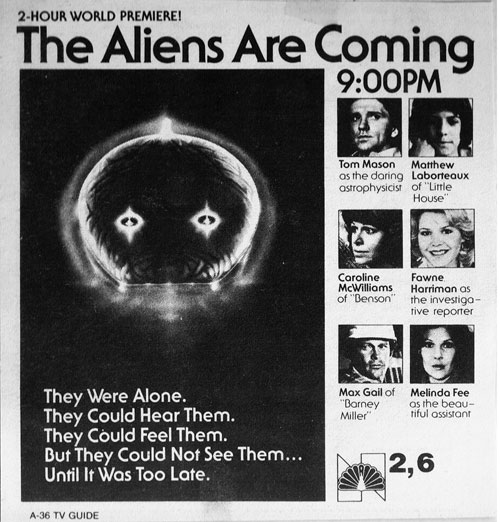
The Aliens Are Coming (1980)

Quinn Martin was the king of TV for two decades. His QM productions produced a string of successful television series — he had at least one television series running in prime time every year for 21 straight years — that includes Twelve O’Clock High, Dan August, Tales of the UnexpectedThe F.B.I.The InvadersThe FugutiveThe Streets of San Francisco, Cannon and Barnaby Jones. He also produced sixteen TV movies, The Force of EvilCode Name: Diamond HeadAttack on Terror: The FBI vs. the Ku Klux Klan and his lone theatrical movie, The Mephisto Waltz.

This was one of his last productions, other than four Dan August TV movies. This movie has a great pedigree, however, as it’s directed by Harvey Hart, who also directed The Pyx, and was written by Robert W. Lenski, who wrote Who is the Black Dahlia?Mafia Princess and Farewell to the Planet of the Apes.

The Aliens are Coming was obviously a pilot that never got picked up. It’s a lot like The Invaders, as aliens are looking to possess humans. Sadly, the budget isn’t what it should be, so a lot of the inside of their ships just look like light shows.

I was quite possibly the only eight-year-old Max Gail fan when this came out, so I know we definitely watched the premiere on NBC. I would have had no idea who Matthew Labyorteaux was at this point in my life because I hated going to anyone’s house who had the gall to make me watch Little House on the Prarie.

You can watch this on YouTube.

Return to the 36th Chamber (1980)

Shimmy shimmy ya, indeed. If there’s one thing Hong Kong movies have in store, it’s always plenty of sequels. And yet, we welcome those here with open arms.

Directed by Lau Kar-leung, this is the spiritual second film in a trilogy. Unlike the first and last movie in said triad, Gordon Liu does not play San Te, but instead an imposter monk Chu Jen-chieh, who just so happens to look like the master of the 36th chamber.

After using his likeness to the famed warrior to help his friends — a scheme that doesn’t last all that long — Jen-chieh runs to the temple, where he’s soon kicked out. Only when he meets San Te is he given the opportunity to build scaffolds all around the temple and renovate the entire complex.

From high above the school, Jen-Chieh is able to watch all of the forms of the monks. Finally, when asked to dismantle his work, he rebels and runs through the chambers with ease. That’s because he changed his work to practice each of the forms, which was exactly the plan of the smiling San Te.

In spite of himself, our hero has become an expert at kung fu. Another lesson from San Te. Jen-Chieh saves his village and continues his training.