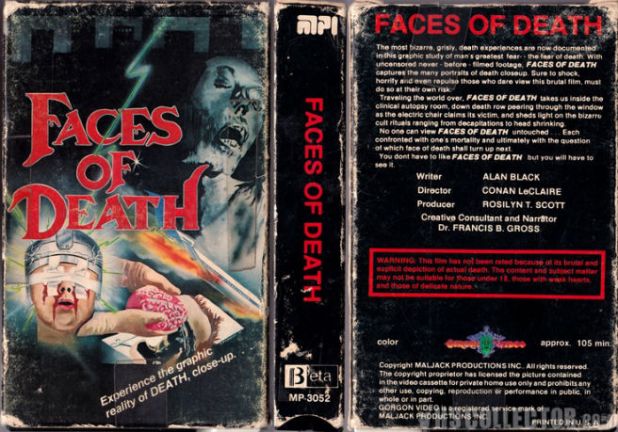
I’ve discussed the video store of my youth often, but no movie in Prime Time Video inspired such dread as Faces of Death, its gigantic clamshell package covered with a note scrawled in sharpie: YOU MUST BE 18 TO RENT.
This feels like a movie made from VHS, as where were people going to see this in 1978?
Written and directed by John Alan Schwartz (using the name Alan Black for the screenplay and Conan LeCilaire for directing, as well as Johnny Getyerkokov for second unit and appearing with no screen name for his role as the leader of the cannibal cult), this film made $35 million at the box office, despite being outlawed in the UK and made a video nasty. It was not banned in forty countries, no matter what the box art may scream at you, and it really doesn’t contain all that much real death either.
Try telling that to the kids in my hometown in the mid-80s.
They believed that pathologist Francis B. Gröss — actually portrayed by Michael Carr — was a real doctor who was using video to explore the phenomena of death itself. They spoke breathlessly of the moments in this movie and it was another torture test film, one people bragged about surviving.
As this was a non-union film, there weren’t many credits, so it could have seemed real. But today, so many people have come forward discussing how they were involved in the movie. Estimates are that 40% of the film is fake, but the death scene of the female cyclist is real and the alligator scene also shows up in Naked and Cruel.
In today’s world, we have the internet, which has non-stop access to the kind of footage that Faces of Death could only dream of having access to getting. As such, we are numb to the kind of panic and worry that one would have with this movie staring back at them from the shelves of a mom and pop video store.
Is it any wonder that Legendary is rebooting this film series but making it friendlier? Here’s the logline for the film: “A female moderator of a YouTube-like website whose job is to weed out offensive and violent content and who herself is recovering from a serious trauma, who stumbles across a group that is re-creating the murders from the original film. But in the story primed for the digital age of online misinformation, the question is: Are the murders real or fake?”
Nobody is going to have nightmares about that movie.
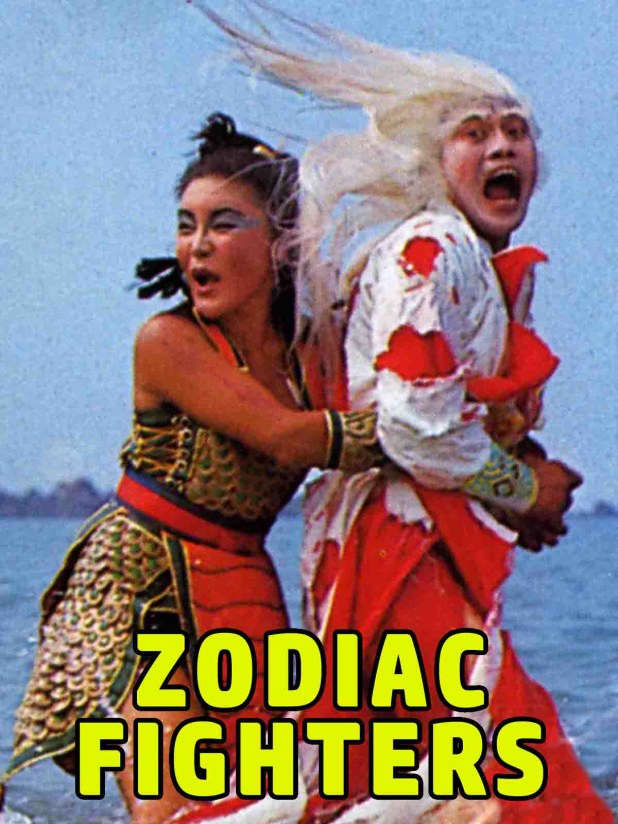
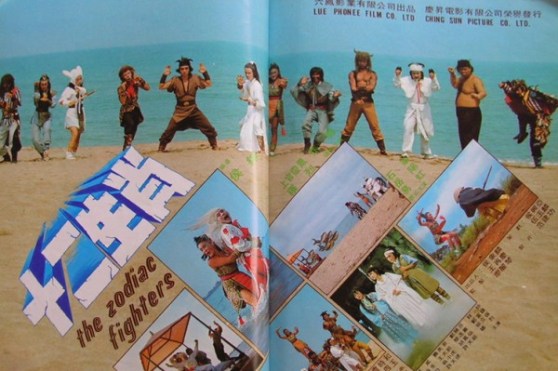
Known as Dragon Zombies Return, this movie is the kind of movie I just let wash over me.
Polly Shang Kuan Ling-Feng plays East Sea Dragon, a woman who has spent a year in a cave to study her fighting style and now is searching for the other, well, zodiac fighters like Rooster, Rat, Ox, Snake, Horse, Ram, Monkey, Dog, Pig, Tiger and Rabbit. Everyone has a costume that ties into their sign and martial arts to match.
Their enemy? Tiger Shark, played by Lo Lieh, who has an army of crab men, a boat that launches rubber sharks and the Five Elements, Fire, Wood, Water, Air and Gold. You thought there were only four elements? You aren’t ready for this.
This is the story of a professional mourner who finds a magic cave and unites all of the animal forms of combat to battle rubber sharks. I have no other way to explain it. It’s one of the oddest movies I’ve seen — and just think about that and all that I have watched — and it’s so blobby and grainy and a bad transfer and you know, I kind of want it that way.
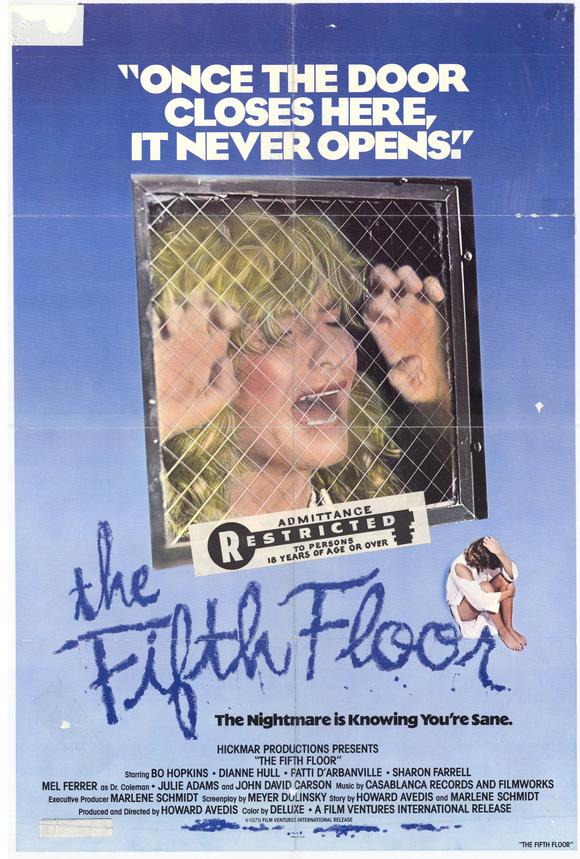
Growing up, the Saint Francis Hospital would always send people with mental issues to the fifth floor. I’ve had certain family members who would have semi-regular vacations to the fifth floor. It got to the point that whenever someone would discuss whether or not someone was acting strangely, they’d say, “Well, they’re on the fifth floor.”
This was going to be part of slasher month, except that it’s in no way a slasher. Of course, the poster work and other marketing makes it seem that way. It’s not. It’s much stranger.
Kelly McIntyre (Dianne Hull, cryonics enthusiast and an actress in Christmas Evil) is a disco dancer who gets dosed, probably by her boyfriend. This brings her to the fifth floor fo Cedar Springs Hospital, where her boyfriend refuses to help her, accusing her of being suicidal.
Kelly’s attractive, which means that she soon becomes the target of Carl the orderly. He’s played by Bo Hopkins, who I have had the fortune of watching several films with him in them of late. Here he’s out of control, a non-stop erection determined to ruin everyone’s life.
This movie is packed with faces you’ll remember, like Don Johnson’s ex-girlfriend and Warhol movie star Patti D’Arbanville, Cathey Paine (Helter Skelter), horror icons Michael Berryman and Robert Englund, Sharon Farrell (It’s Alive), Anthony James (the chauffeur from Burnt Offerings), Julie Adams Dennis Hopper’s The Last Movie and The Creature From the Black Lagoon), Mel Ferrer, John David Carson (Creature from Black Lake), Earl Boen (the only actor other than Arnold Schwarzenegger to appear in the first three Terminator films), Alice Nunn (Large Marge!), rock and roll photographer Chuck Boyd (who is also in the sexploitation film Dr. Minx and The Specialist, both from the same director of this movie), Machine Gun Kelly (who was the announcer in UHF), disco singer Patti Brooks (whose song “After Dark” was on the soundtrack of Thank God It’s Friday! and recorded two duets with Dan Aykroyd for Dr. Detroit), Milt Kogan (Barney Miller), 1961 Miss Universe Marlene Schmidt (who is in nearly every movie this director did) and Tracey Walter. Yes, Bob the Goon from Batman.
This star-studded journey into mental illness comes straight out of the mind of Howard Avedis, who brought us all manner of literally insane movies like Mortuary and They’re Playing with Fire, two movies that I recommend highly. He knows how to take a salacious topic and make it even smuttier, which I always adore. Well done, Howard (or Hikmet).
It might seem like a TV movie for a bit, then there’s full frontal nudity and you’ll feel safe, like a warm straitjacket has been put on you, allowing you to just lie back and enjoy the magical exploitation within.
“It’s super human, super music, super magic and super amazing! You’ll be compelled over the edge of sight and sound and under the spell of mind-boggling action and music! Pushed to the danger zone! It’s a death wish at 120 decibels! Stunt Rock! The ultimate rush!”
If there was ever a movie that can’t live up to its trailer, it’s Stunt Rock. Upon witnessing it on the Alamo Drafthouse’s Trailer War compilation, I fell in love with whatever this movie could be. I even ordered the official DVD of the film but never unwrapped it. Why? Because nothing could be as great as this trailer.
I’m so happy to have been proven wrong.
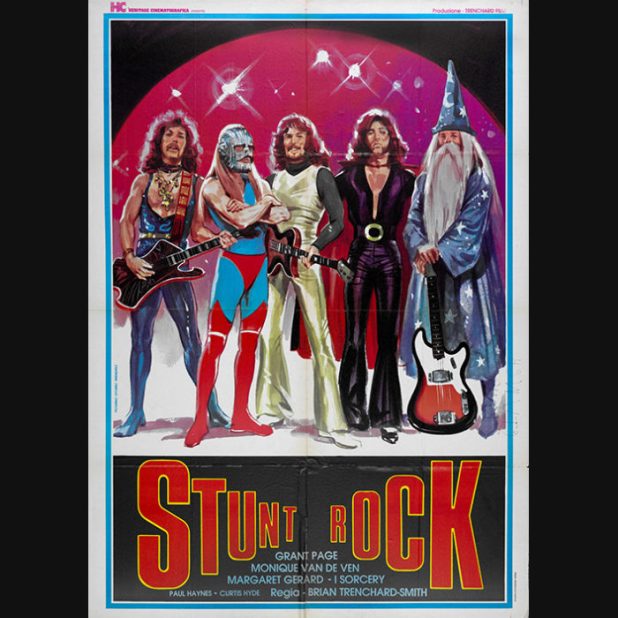
Stunt Rock — directed by Brian Trenchard-Smith (Dead-End Drive-In, Night of the Demons 2, Turkey Shootand so many more) — is exactly the type of movie I love: Take a basic concept and let hijinks ensue.
As Trenchard-Smith sais himself, the concept was “Famous stuntman meets famous rock group. Much stunt, much rock. The kids will go bananas.” He’s also referred to it as “a largely plotless, pseudo-documentary, rocumentary and basically a 90-minute trailer for Grant Page.”
Grant Page is an Australian stuntman who pretty much defied death on a daily basis throughout the 70’s and 80’s, transforming his weekend hobby into a career that would give him international exposure thanks to films like The Man From Hong Kong, Mad Max, Death Cheaters, Mad Dog Morgan, Death Ship and so many more, as well as starring in Road Games and having his own TV series, Danger Freaks.
Basically, Grant comes to America, talks about stunts, does stunts, gets the girl — Trenchard-Smith’s future wife Margaret Gerard — and hangs out with a band that combines rock and roll and magic. Monique van den Ven (Amsterdamned, the 1982 version of Breathless, Paul Verhoeven’s Turkish Delight) also shows up.
There’s also the subplot of a movie being filmed and the ways directors and agents treat their talent. The agent in this film is played by Richard Blackburn, whose career is the kind that draws the laser focus of this website. Would it just be enough if he played Dr. Zaius on the Return to the Planet of the Apes cartoon series? Let me add that he also co-wrote Eating Raoul and appears in that film as James from the Valley. But perhaps what he’s most celebrated for — at least around these parts — are for writing, directing and appearing as the Reverend in the absolutely transcendent 1973 film Lemora: A Child’s Tale of the Supernatural.
This is less of a film and more of a movie that you can shut off your brain and just savor the stuntwork while hearing Page discuss how and why he did it, interlayed with Sorcery in concert.
While Trenchard-Smith wanted Foreigner for the film, they were on tour and wouldn’t be back in time. That’s fortunate — no band other than Sorcery could have been in this movie.
A theatrical metal band formed in Los Angeles in 1976, Sorcery’s gimmick was that two master magicians would dress as Merlin (Paul Haynes) and Satan (Curtis James Hyde), join them on stage and battle one another in what their press bio referred to as “The King of the Wizards against the Prince of Darkness.”
The band was made up of Richard “Smokey” Taylor on guitar, Richie King on bass, Greg MaGie on vocals, Perry Morris on drums and the masked Doug Loch on keys. They’d later play Dick Clark’s 1982 A Rockin Halloween and 1983 A Magical Musical Halloween.
But if you really love metal, you probably know them best for a completely different film.
In 1984, Morris, Taylor and King became Headmistress, the band for the seminal metal/horror film Rocktober Blood, a film in which Billy “Eye” Harper wipes out most of his band before they reform a year after his killing spree has been halted.
That’s pretty much the movie. It doesn’t demand that you invest much more of your brain into it, instead relying on a magical blend of 1978 L.A., behind the scenes movie-making and wizards launching fire across a stage while a masked dude plays keyboards and dudes wail and shred. If this doesn’t sound like the most amazing film ever committed to celluloid to you, you’re invited to leave this site now and never come back.
The frequent use of split-screen seen in this movie was a necessary editing tool. That’s because many of the stunts from Australian films like The Dragon Files, Mad Dog Morgan and Death Cheaters was filmed on 16 mm and needed to be fixed to fit the wide frame. That said, I love how each frame has a different angle. It’s MTV three years before that little moon man ever launched.
I’m not the only lover of this film. Quentin Tarantino’s Death Proof owes the way it presents stunts — much less a New Zealand stunt icon in Zoe Bell in a starring role — to this film. And Eli Roth wore a shirt of the film while filing Hostel 2 and has featured the Sorcery songs “Talking to the Devil” in Knock Knock and “Sacrifice” in his remake of Death Wish.
Perhaps Stunt Rock has even greater cultural significance. After all, it’s Phil Hartman’s first movie. And editor Robert Leighton — who was billed as Robery Money as this was a non-union film — would go on to be the supervising editor of This Is Spinal Tap. Hmm — now it’s all making sense.
While Trenchard-Smith would at one point state that this was the worst movie he ever made, he’s softened on the film in later years. What do you expect from a movie that went from an idea in the shower to in theaters in under 5 months?
Sadly, three months prior to Allied Artists distributing the film, they went bankrupt. The film was sold to Film Ventures International. And then…the movie disappeared for decades until it was rediscovered.
You can order this movie — and lots of other amazing stuff — from the band Kino Lorber. Do so right now. This is a movie begging to be experienced.
BONUS: The amazing Trailers from Hell has posted Trenchard-Smith discussing the film over the trailer and it’s everything you want it to be.
The Weekly World News was launched in 1979 by The National Enquirer publisher Generoso Pope, Jr. as a means to keep using the black-and-white press that when that higher profile tabloid went to full color. Unlike any of the other rags you’d get at the supermarket, The Weekly World News was unafraid to wildly speculate on aliens, monsters and Elvis. It also introduced Batboy to the world and has been sadly lamented since it ceased publication in 2007 (although you can still read it online).
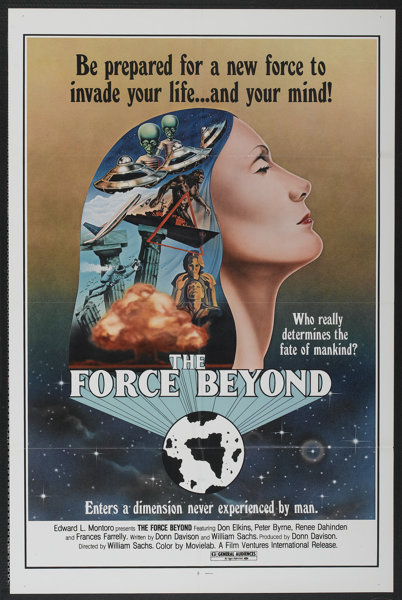
The Force Beyond is like watching an issue of that long lost tabloid without the smell of the pulp or getting black ink all over your fingers.
Producer Donn Davison did it all. He was a yo-yo master and a professional magician, while also a producer for Film Ventures International. He was a huckster who voiced the pitch to buy how-to sex manuals in roadshows and he ran the Dragon Art Theater in California, all before he did the voiceovers for The Crawling Thing and Creature Of Evil. Now, he’s our host, presenting the words of his wife, Barbara Morris Davison, who also was behind the movie Honey Britches. Whew!
Guess who else brought this movie your way? William Sachs, who also directed The Incredible Melting Man. Strap in. This movie is a non-stop deluge of info, where things are just thrown at you with no set order or reason. Grown men trying to make their own UFOs? Yeah, but did I tell you about the barn in Bangor that just suddenly disappeared?
Meanwhile, the soundtrack is a combination of Moog and chopped and screwed interpretations of Christian music made years before anyone knew who DJ Screw was.
My favorite part of this movie is that it’s voiced by Emperor Rosko, the son of Hollywood mogul Joe Pasternak. He started his career in 1964 on Radio Caroline, a pirate radio station broadcasting from a ship off the coast of Britain. He was joined on the air by his pet bird Alfie and would nearly rap his American-style music intros. He was also the inspiration for the character that Philip Seymour Hoffman played in Pirate Radio. He sounds like a verifiable maniac in this movie.
Honestly: this movie is one of the most ridiculous films I’ve ever witnessed, a whiplash tour through everything from Cayce to Bigfoot, Atlantis and MUFON. It’s the visual version of open calls back when Art Bell was still alive and people would call from Area 51 or the Antichrist would call in. Say it with me: “West of the Rockies, you’re now on Coast to Coast AM with Art Bell!”
You should read the above paragraph as me jumping up and down telling you that you should call off work, cancel any plans and watch this as soon as possible.
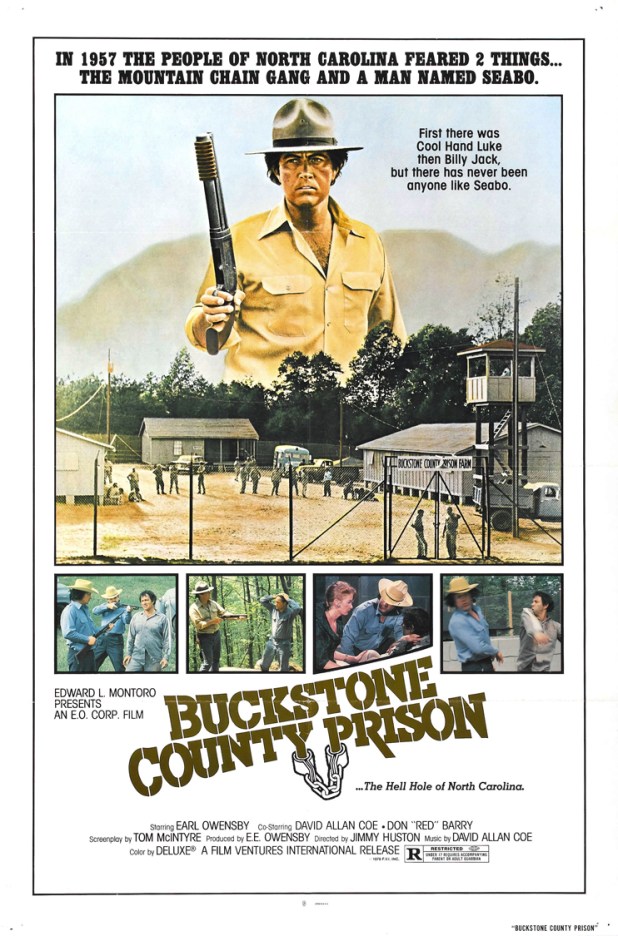
“In 1957 The People of North Carolina Feared Two Things…The Mountain Chain Gang And A Man Named Seabo.”
If that doesn’t work for you, how about “First there was Cool Hand Luke then Billy Jack, but there has never been anyone like Seabo.”
Earl Owensby had already made four movies — Challenge, The Brass Rings, Dark Sunday and Death Driver — before making this, a movie he’d pretty much remake six years later with Chain Gang.
Starring in this and producing it, Owensby knew the kind of movies that people in Southern drive-ins wanted to see because he was one of them. His E.O. Studios was run smartly: he’d star in these movies, they’d hire local semi-pro actors and shoot most of the movies off the soundstages.
Seabo (Owensby) — get used to that name — is a half-Native American, half-white bounty hunter who is set up for a murder he didn’t commit and faces off with prison guard Jimbo (Ed Parker). He eventually gets freed if he hunts down some escaped prisoners and joins forces with another bounty hunter named Red (David Allan Coe, who also recorded some of the songs on the soundtrack including one song, “Bounty Hunter,” that sounds a lot like “A Boy Named Sue”).
This movie feels made to order for what people were looking for at a drive-in with Owensby as a star that doesn’t look all that much different from the people sitting in the cars drinking beer and flashing their headlights at the screen.
There’s a copy of To Be Twenty that’s on Films & Clips, a YouTube channel that has lots of hard to find Italian movies. And if you watch that one, well, you may think that this is a fun loving comedy. And I’m here to sadly inform you that while that’s the movie I wish this was, it is certainly not the movie that it is.
That’s because the original version — the one that the director, Fernando Di Leo preferred — is 98 minutes long and the first 90 minutes will not prepare you for the last eight. The version that was cut and played in theaters after that one failed — and was dubbed for America — is 85 minutes and all sexual hijinks and fun.
Lia (Gloria Guida, who went from Miss Teenage Italia 1974 to starring in commedia sexy all’italiana films like Monika and La minorenne; she’s also in Bollenti spiriti and La casa stregata) and Tina (Lilli Carati, the runner-up of Miss Italia 1975; she’s in four Joe D’Amato movies — La Alcova, Christina, The Pleasure and A Lustful Mind — and acted in adult films in the late 80s and was also addicted to cocaine and heroin. She retired from public life in 1990 but returned to acting to play an occultist in Violent Shit: The Movie, which was dedicated to her as she died before it was released). They’re two young and, frankly, gorgeous women who decide to hitchhike to Rome and experience the world of free love.
As the girls say, We’re young, we’re beautiful, and we’re pissed off.” That takes them to a commune where they hope to find the pleasure that they’ve heard of and the leader, Nazariota (Vittorio Caprioli), allows them to stay as long as they sleep with the members. It sounds exactly like what they want, but every man in the place is either asleep, high, smells or a combination thereof. Tina does finally find Rico (Ray Lovelock) while we get to know the other members, who include a clown called Arguinas (Leopoldo Mastelloni) who has been meditating for three months and a single mother of three named Patrizia (Daniela Doria).
This episodic movie finds our two heroines taking part in a documentary where Lia shares how she grew up in a church orphanage and Tina reveals that her rich parents only cared about keeping her pure, which caused her to rebel. They also sell encyclopedias which leads them to meet all manner or strange people, all before the cops bust the commune — Arguinas is even accused of being in the CIA — and the ladies are told if they don’t go back home by dark, they will be arrested.
Now, depending on the cut you watch, that’s the movie. Unless you want to see the director’s cut. And if you care about the girls, you won’t.
On their way home, they stop to eat and dance while a jukebox plays. Several men take notice and follow them outside and take their turns assaulting them, beating them and leaving them for dead. The movie closes on their nude and destroyed bodies.
I mean, this is a sex comedy that also has readings from the Skum Manifesto and hippies portrayed as morons around ten years after their shelf date. But Di Leo drops the floor out from under you as until now, this has all been played as a humorous sex film. You are unprepared for what happens and I don’t think he was trying to make a point about the way men treat women. It feels like he’s punishing Lia and Tina for using their bodies and enjoy all the sex they’ve had.
At once, it’s a movie with goofy dialogue like “As you already know, all the ideologies and religions man has invented over the centuries have all failed. But it finally reached this unbearable level when Christianity, Marxism and psychoanalysis created general and personal conditions that are conducive to schizophrenia” and an ending that feels like a snuff film.
The director also made Blood And Diamonds, Naked Violence, Slaughter Hotel, Caliber 9, Madness — it’s all making sense now — and Naked Violence. I wish that I had just stuck to the America cut, but sometime we need to expose ourself to things and learn from them. I wish this was a message movie, like I said, but I think it’s a message I don’t agree with.
CEO Sir Ronald Selmer‘s plane has blown up in flight, which brings together the Vice Presidents of his company — Sir Arthur Dundee (Joseph Cotten), Paul De Revere (Leonard Mann) and Sir Harold Boyd (Adolfo Celi) — to discuss who will take over the company. The company pretty much runs the world, so each of them wants to be in charge, which means that anything can happen. And by anything I mean murder.
The smart money is on Selmer’s racecar driving nephew Paul — who even has a Keane painting in his office! — but someone sends his car off a cliff which brings in another family member, Superintendent Jeff Hawks (Anthony Steel), to solve the murders — yes, many murders — at the behest of Lady Clementine (Alida Valli, Suspiria).
There’s all sorts of wild moments along the way, like Sir Harold’s wife Gloria (Janet Agren) leaving a snooty fox hunt to be the roast beef in a man man sandwich in the stables, Sir Arthur trying to seduce and kill Sir Harold with one of his ladies — Polly (Gloria Guida) — and Sir Arthur’s pacemaker being short-circuited with a magnetic murder device.
Director and writer Giuseppe Rosati has a big cast and instead of making this an upper crust Agatha Christie thriller — she does get name-dropped — remembers that he’s Italian and that this whole movie should be sleazy. Well done! He directed this movie using the name Aaron Leviathan which is the best Italian Americanized name of all time. Giuseppe Rosati also made Those Dirty Dogs, Silence the Witness and The Left Hand of the Law.
The amazing Italo-Cinema points out that while this is set in London, it’s filmed in Italy, so if you see the graveyard from Antropophagus — which is set in Greece, I feel like I’m a world traveler — and some of the buildings from Suspiria.
The killer gets away with it! Come on! How many times have you seen that in a giallo? I kind of loved this but any time I see Joseph Cotten and Adolfo Celli in a movie, much less Janet Agren and Gloria Guida, well — I’m pleased.
EDITOR’S NOTE: Cinematic Void will be playing this movie on January 20 at 7:00 PM MT at Sie FilmCenter in Denver, CO. For more information, visit Cinematic Void.
Never say never, but I think this will be the only movie we ever feature on this site that has a love theme by Barbara Streisand in it. I could be wrong, but I just get the feeling that there aren’t going to be many more crossovers quite like this one.
Eyes of Laura Mars was adapted from a spec script titled Eyes, written by John Carpenter; making this Carpenter’s first major studio film. Producer Jon Peters, the beau of Barbra Streisand in this era, bought the screenplay as a vehicle for her, but Babs felt that it was too “kinky” and passed. However, she felt that “Prisoner,” the song that she lent to the film, would be a great single. She wasn’t wrong — it peaked at #21 on the Billboard Hot 100.
Instead of Ms. Streisand, we get Faye Dunaway, who had just won an Oscar for Network and had not yet become Mommie Dearest. She plays Laura Mars, a fashion photographer whose Chris Von Wangenheim by way of Helmut Newton-style photos (Newton and Rebecca Blake supplied the actual photos for the film) glamorize violence. As she’s due to release the first coffee table collection of her work, she begins seeing the murders of her friends and co-workers through the eyes of the killer. I love how until now, she’s only been detached and seen things through the eye of a camera.
John Neville (Tommy Lee Jones) is the cop in charge. After she rushes to a murder scene exclaiming that she saw who did it blocks away, the cops keep her in custody, showing her numerous unpublished crime scene photos that match her new fashion photos perfectly. Throughout the film, Larua and Neville fall in love as her visions — and the murders — increase in intensity and violence.
This is a great example of an American giallo filled with the twists, turns and red herrings of the genre. It’s done with a much higher budget and way better locations than you’re used to. And it gets closer to the psychosexual elements, but as great a director as Irvin Kershner is, he isn’t a maniac like Argento and his ilk. It’s also packed with talent, like Raul Julia, Battle Beyond the Stars‘ Darlanne Fluegel, Rene Auberjonois and Chucky himself, Brad Dourif.
The Eyes of Laura Mars would be parodied as The Eyes of Lurid Mess in MAD Magazine #206, with art by Angelo Torres. As was often the case with R rated movies when I was six years old, I first experienced this movie through the black and white ink lens of MAD.
When seen through the lens of the giallo form, The Eyes of Laura Mars reminds me of post-Deep Red era Argento — taking the basics of the detective form and grafting on one supernatural element. Here, it’s the fact that Laura Mars (Faye Dunaway), a high glam fashion photographer, can see the violent deaths of people as she takes photos. The images that they inspire lead her to great success and controversy, creating an intriguing narrative of the violent and at times bloody battle of inspiration for artists. I’m also struck by how detached Mars is from the art and fashion world in which she lives, until she’s in the midst of shooting. Then, she finally opens not just herself up, but her posture. She spreads low to the ground, sexualizing herself when she’s often covered by clothing throughout the film that hides her body from the world.
Going from an independent picture produced by Jack H. Harris to big studio affair by Jon Peters (who dreamed of then-girlfriend Barbara Streisand in the lead), The Eyes of Laura Mars struggled with a new writer being brought in to adjust John Carpenter’s script (the auteur said “The original script was very good, I thought. But it got shat upon.”) and the production lasted 7 long months, including a 4 day shoot in the middle of New York City to capture a major fashion shoot with models, wrecked cars and fire everywhere.
It has assured direction by Irvin Kershner, which led to him being hired for The Empire Strikes Back. After watching so much giallo, I’ve noticed that the America versions of the form are very much like Laura Mars herself: detached, cold and not all that interested in the murder as art that native Italian creators like the aforementioned Argento immerse themselves in. This film is made in hues of black and white when their world is neon and always the most red possible.
Upon a new view of this film, I was also struck by just how great the cast is. Tommy Lee Jones is perfectly cast, with his final speech near-perfect. In truth, he wrote that ending monologue, but credited it to Tommy Lee Jones actually wrote his own monologue, crediting it to Kershner, unbeknownst to the Writers’ Guild. Brad Dourif is routinely amazing in movies and his small role here is still a stand-out, as is the acting of Rene Auberjonois and Raul Julia.
This movie also features one of my favorite settings: New York City at the end of the 1970’s, which I feel is the closest place to Hell on Earth that has ever existed. As a child, I watched WOR Channel 9 news from the safety of being a few hundred miles away in Pittsburgh and wondered who would ever want to live in this city. You can almost smell the garbage and desperation in the air here, which is in sharp contrast to the cold, metallic and not so real world of fashion and art.
Death Carries a Cane (1973): If death carries a cane, isn’t it weak? With that thinking, aren’t the alternate titles — Dance Steps on the Edge of a Razor, Maniac At Large, The Night of the Rolling Heads and Devil Blade — so much cooler?
Well, that’s because whoever the killer is, he or she has a limp. That’s what Kitty (Nieves Navarro, billed here under her boring Americanized nom de plume Susan Scott) sees when she watches a murder through a coin-operated telescope. That’s just the first of many killings and it just might be her boyfriend Alberto, who has the misfortune of having a limp and a cane when that’s what’s being profiled. I’ve said it before and I’ve said it again, defund the giallo police.
Director Maurizio Pradeaux also made another Grim Reaper referencing giallo, Death Steps in the Dark, which has a scene where the protagonist has to wear drag to escape the police.
Naked You Die (1968): Naked…You Die (AKA The Young, the Evil and the Savage) is a pretty fun early giallo with good direction by Antonio Margheriti.
Yet it was very nearly was a Mario Bava movie.
According to Tim Lucas’ Mario Bava: All the Colors of the Dark, Bava was hired by Lawrence Woolner — the distributor of Hercules in the Haunted World and Blood and Black Lace in America — to direct a movie about a killer stalking a school. Cry Nightmare was going to be the title and Bava wrote the script with Brian Degas and Tudor Gates (Barbarella, Danger: Diabolik).
Lamberto Bava told Lucas that “Just a short time before the filming was to begin, Mario Bava had an argument with the producers and he abandoned the film.” As for Margheriti, who met Woolner when he distributed Castle of Blood, he said “I think Mario was busy at that time, working on Diabolik or something.”
Either way, locations were already secured, cast and crew had been hired and a theme song had already been recorded.
The drowned body of a woman is placed in a truck going to St. Hilda College. There, only seven students, two teachers — Mrs. Clay (Ludmilla Lvova) and Mr. Barrett (Mark Damon — Headmistress Transfield (Vivian Stapleton) and gardener La Foret (Luciano Pigozzi) are present.
Soon, the killing begins with Betty Ann being strangled and found by Lucille (Eleonora Brown in her last film until coming out of retirement in 2018), who is having an affair with Barrett. When she tells him to come see the body, it’s already gone, so they decide to leave the school.
The killings kick into gear with Cynthia (Malisa Longo, Ricco the Mean Machine) being killed in front of the gardener, who is soon killed as well and Denise (Patrizia Valturri) too. There’s also amateur detective Gillie (Sally Smith) on the case and Inspector Durand (Michael Renne from The Day the Earth Stood Still) trying to stop the killings.
All the girls wear similar uniforms — and outfits that change scene by scene — and nobody wonders why an older teacher can play Big Bad Wolf with Little Red Riding Hood and get away with it.
The aforementioned theme song “Nightmare” by Powell and Savina (Don Powell, who played Emanuelle’s father in Black Emanuelle 2 and did that film’s soundtrack, along with Carlo Savina, who composed the music for The Killer Reserved Nine Seats, Lisa and the Devil, Fangs of the Living Dead and so many more) and performed by Rose Brennan owes royalties to Neal Hefti.
Perhaps even wilder is the fact that the movie informs us that Gillie may be the daughter of James Bond.
Giallo would change in a few years to be bloody, sleazier and stranger. That said, this is a great example of an early version of this style of movie.
The Bloodstained Shadow (1978): One of my favorite things about giallo are the alternate titles. As if The Bloodstained Shadow isn’t a great name, this movie also goes by Solamente Nero (Only Blackness), which is a way better title. The other thing I love about this genre is that just when I think I’ve seen every good one, I find another to enjoy.
This is the kind of movie that tells you exactly where it stands in the first minutes, as a killer strangles a girl in a field before the credits even start. That murder has never been solved. Years later, a college professor named Stefano has a nervous breakdown. To recover, he comes home to visit his brother Don Paolo, who has become a priest that hates all of the immorality in their small town.
Oh what immorality — there’s a gambler, a psychic, a combination atheist/pedophile and an illegal abortionist with a mentally challenged son who lives in a shack top the list, along with your typical sex and drinking that happens in any town.
Meanwhile, murders have been piling up and whoever is behind it, they’re leaving notes to the priest, warning him that if he reveals who the killer is, he’ll be next. That’s because on Stefano’s first night back home, Don Paolo saw the killer murder the town psychic in the courtyard.
Stefania Casini (Suspiria) also appears as the love interest, Sandra, who helps Stefano come back to normalcy. Well, as normal as a town filled with murder can be. I’m kind of amazed that she wears a belly chain all day. When you get to the love scene, you’ll know what I mean.
There’s also some amazing religious imagery in this one, like a skinned and bloody animal that has been placed in the sacristy to warn the priest that he’s getting too close, or the communion scene that reveals who the real killer is.
Finally, Goblin plays some great music in here, created by composer Stelvio Cipriani. It’s really a great package, thanks to director Antonio Bido, who directed one other giallo, Watch Me When I Kill. I love how the past childhood trauma that the brothers endured continues to permeate their lives as they try to grow up. This is a very adult giallo and by that, I mean that it doesn’t need nudity and gore to tell its tale.
You must be logged in to post a comment.