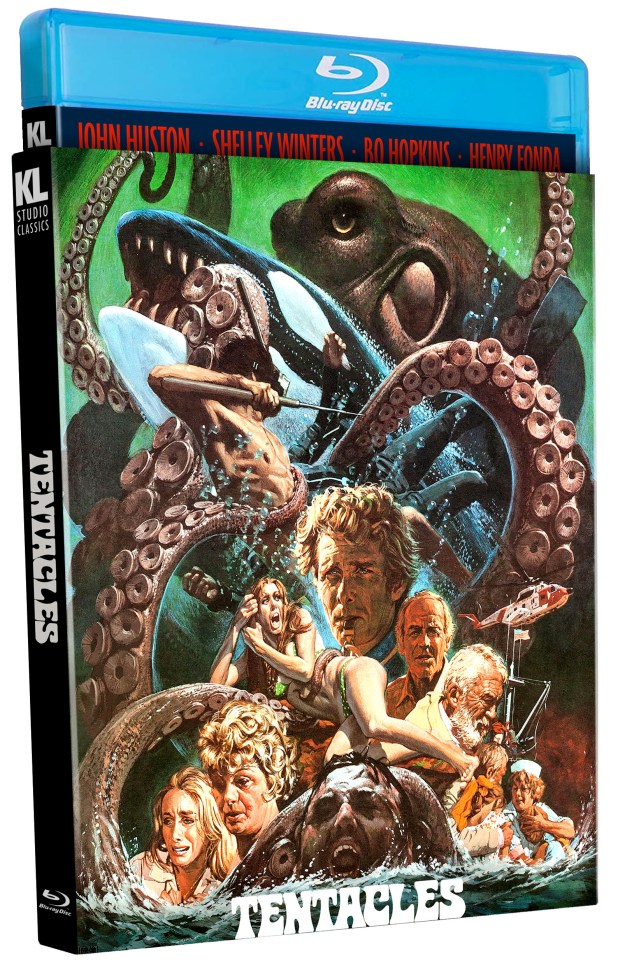
KINO LORBER BLU RAY RELEASE: Tentacles (1977)

EDITOR’S NOTE: You can check out my first take on this movie — posted December 20, 2018 — but I got so excited about watching it that I wrote something new.

Ovidio G. Assonitis just wants to entertain you. Starting in the 60s, when he brought Shaw Brothers movies to the west and started producing his own movies like The Labyrinth of SexWho Saw Her Die? and Man from Deep River, his films were lean, mean and audience pleasers, too. Supposedly, he tried to buy the rights to The Exorcist, which sounds kayfabe, because his Beyond the Door is literally the same movie.

So he already had some experience taking a blockbuster and making his own version. Therefore, when a great white shark took over the movie world, he made this one. He went so far to have Percy Rodrigues, who announced the trailers for all of the Jaws movies, read his sell copy.

Before we get to the movie, I really need to do a month of Assonitis produced and directed movies. Between this, the supposedly Emmanuelle Arsan-directed LaureThe VisitorMadhousePiranha II: The SpawningIron WarriorThe CurseCurse II: The BiteBeyond the Door IIIAmerican Ninja 4: The AnnihilationLambada and being the chairman of the newly relaunched Cannon Pictures Inc. after the departure of Menahem Golan and the restructuring of The Cannon Group.

Solana Beach is a seaside tourist resort dealing with undersea terror. And it’s not a shark. No, the title spoils it by revealing that a giant octopus in in town.

Science fact: According to America’s Oceans, “Giant Pacific Octopuses are creatures of high intelligence and high amicability. While they have the ability to inflict harm on humans if they wanted to, no attacks thus far have been fatal or even harmful.”

Also, I doubt if an octopus has foresight.

Unlike messy eaters like Orca — who didn’t even finish his meal of Bo Derek — or Piranha, this cephalopod leaves behind skeletons totally bereft of flesh, muscles and organs.

Assonitis spent nearly $1 million on a life-sized replica of the giant octopus, which promptly sank the exact second that it was put in the water. So the octopus that dies at the end? That’s a real one. An already dead one. But it’s getting torn up — spoiler — by killer whales, so the fact that a dead octopus is defiled should remind you that this is a movie made by Italians.

But hey –even though this movie is named Tentacles, octopuses don’t have tentacles. Instead, they have arms. Squid have tentacles. Again, an octopus have none. They also don’t roar, but then again, neither do sharks and that didn’t stop the creators of Jaws: The Revenge.

Back to the movie. The Trojan company has been building an underwater tunnels that uses radio signals that have driven the octopus insane. Blame Mr. Whitehead (Henry Fonda, who had a pacemaker put in right before this started filming, which is why he shot all his scenes in one day and barely moves in those scenes).

Marine expert Will Gleason (Bo Hopkins), Sheriff Robards (Claude Akins) and newspaper reporter Ned Turner (John Huston) are there to save the town, a pair of killer whales named Summer and Winter, who get a pep talk from Hopkins that makes me laugh every time I watch this.

“I guess you know now why I brought you here. I wanted to tell ya more about it, but there’ve been many people that died. I’ve lost a loved one. I need your help more now than ever. I remember the times when I was training you. People used to call you killers. They used to call me that on the streets. It doesn’t mean nothing. You have more love in your heart, more affection than any human being I ever met. But now, I can’t ask anybody else, so I’m asking you to help me kill this octopus. I hope you understand that. I know I’m in your environment. I don’t want it this way, but if I release you and you go away, I want ya to know I’ll understand. All right, enough said. I gotta go now. If you feel anything, you talk to me. Make some noises. I know people’ll think we’re crazy. Maybe we are. Maybe we are.”

Robert Shaw got the Indianapolis speech.

Bo Hopkins got talking to killer whales.
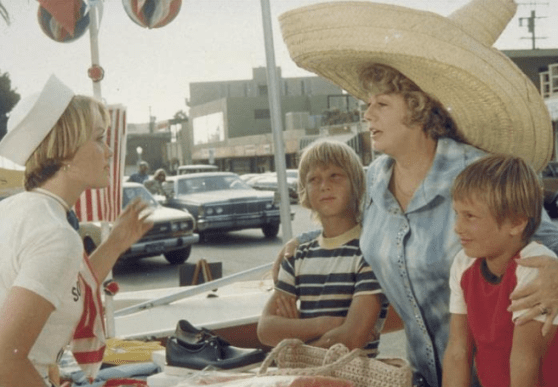
There’s a town festival scene right out of Spielberg and Shelley Winters is dressed like a child instead of a 57 year old woman. Also, she and John Huston literally disappear from the movie. Why were they in it? So that Shelley could have a kid talk to her this way?

Little boy: Mommy, you’re plump. There’s more to love.

Tillie Turner: Oh, sweet-talk me like your father.

If you like Italian casts, well, this movie is for you. Hey — there’s Cesare Danova from CleopatraThe Astral Factor and Mean Streets. Here’s Biloxi, Mississippi born Sherry Buchanan who replaced a production secretary during the shooting of My Name Is Nobody in Louisiana and ended up moving to Italy where she was in What Have They Done to Your Daughters?Eyes Behind the Stars, The Last House On the Beach and the movie that could be Starcrash 3, Escape from Galaxy 3. And take a look! It’s Delia Boccardo, Athena in Luigi Cozzi’s Hercules. Franco Diogene from Strip Nude for Your Killer!

It was written by Jerome Max (who only wrote six episodes of a soap opera otherwise), Tito Carpi (where to begin? MartaEscape from the BronxHoly God, Here Comes the Passatore!?) and Steven W. Carabatsos, who wrote episodes of Ben Casey and The Big Valley.

Bringing all the Italian madness together is a score by Stelvio Cipirani, which uses the theme from another movie he worked on, La Polizia Sta a guarde, multiple times. Cipirani scored lots more jawsploitation movies like The Bermuda TriangleEncounters in the DeepNight of the SharksBermuda: Cave of the Sharks and Piranha II: The Spawning.

Obviously, I must love this movie if I spent around a thousand words making fun of it.

The Kino Lorber blu ray comes with a trailer and a radio ad. You need this movie.
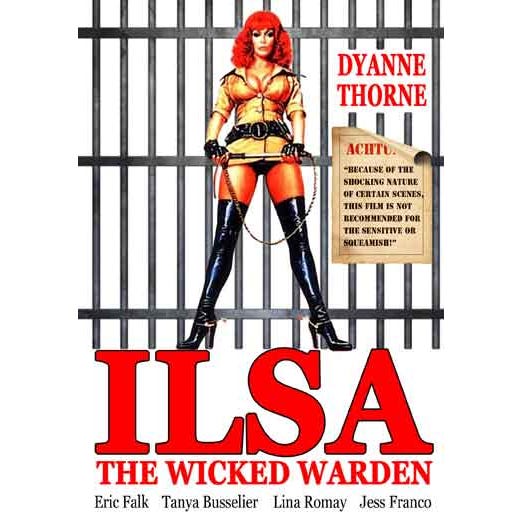
JESS FRANCO MONTH: Ilsa, the Wicked Warden (1977)

If you thought that Ilsa, She-Wolf of the SS was the limit, this movie makes it feel as if Jess Franco tool that movie as a personal challenge to somehow create something innumerable times sleazier.

Considered the third movie in the series — even if it wasn’t filmed as a sequel — and also known as Greta, the Mad Butcher, Ilsa: Absolute Power and Wanda, the Wicked Warden, this stars the women who is Ilsa, Dyanne Thorne, as Greta. She’s running a psychiatric hospital for young women, which gives her plenty of opportunities to indulge her more, shall we say, psychosexual side.

Probably shot at the same time — who knows, maybe even the same place — as Barbed Wire Dolls, the heroine of this story is Abbie Phillips, whose sister died inside the walls of Greta’s hospital, and now must infiltrate the hospital and find out why.

The amazing thing about this movie is that as wild as Ilsa has been in the past, she’s now entering the ninth circle of voyeur hell where director Jess Franco and his muse, Lina Romay, reside. Lina plays a prisoner named Juana who keeps the other female prisoners in line as well as lined up for prostitution and pornography. Also, in one scene that might break your mind, she follows a prison toilet BM by forcing Abbie to be human toilet paper. Yes, this happens and yes, this movie played American theaters and I have no idea how.

Snuff movies, acupuncture gone wrong, scarred women being used by cruel men, Lina Romay no doubt looking as perfect as she ever will or ever did and being the meanest woman in the world in a manner so brutal that she can only devour — literally — the previous champion in an ending that is either going to flip your stomach, raise your fist in triumph or both and Franco pretty much running through the motions he did in so many other women in prison movies, except Franco through the motions is still way more magical and insane and upsetting and sleazy and can you endure this than anyone perhaps ever.

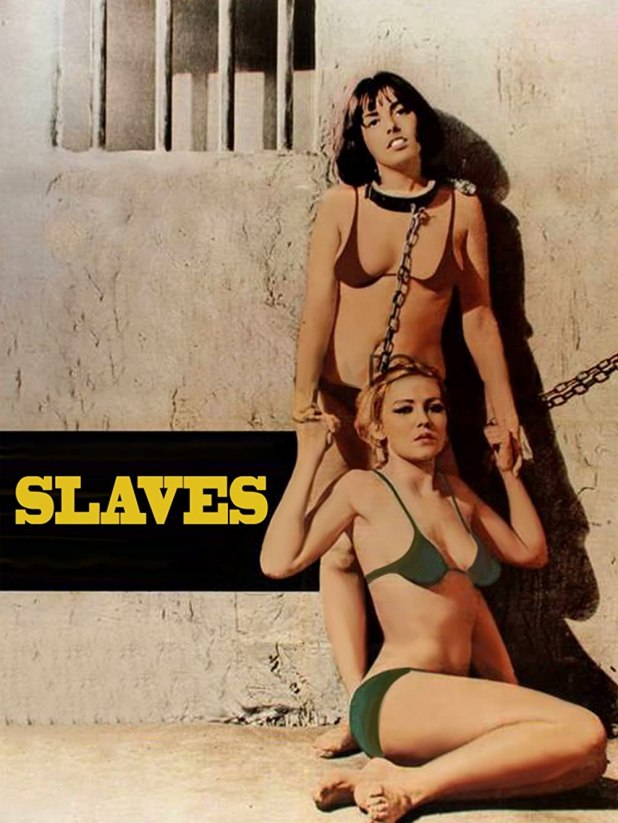
JESS FRANCO MONTH: Die Sklavinnen (1977)

At this point, Jess Franco was making movies like Women in Prison, Barbed Wire Dolls and Ilsa the Wicked Warden that have a similar story and interchangeable actresses and acts of depravity.

This time, Madame Arminda (Lina Romay) has been sent to prison but is broken out by the rich businessman Radeck (Vítor Mendes), awhose daughter Martine (Martine Stedil) has been kidnapped. Radeck thinks Arminda is behind it all, so his assistant (Franco) tries to kink the truth out of her, but she won’t crack.

This time around, things take on an almost noir feel as the truth is that Arminda and Martine were lovers until drugs made her forget her past and work in the brother, thinking that she’s a slave, and then a rival gang kidnaps her, so Radeck kidnaps their leader Ebenholz and gets Arminda to torture him and then, well…look, it’s like Shakespeare. Everyone dies.

There was no money anyways. And Radeck didn’t even love his daughter. So why were we even here?

Another Franco movie made for Swiss producer Erwin C. Dietrich, this is also known as Swedish Nympho Slaves, which is a title that demands that you watch this movie. I really wonder about this period in Franco’s filmmaking, because so many of these movies feel like they’re stitced together from other movies and shoots that had no purpose. That’s because that’s totally how they were made.

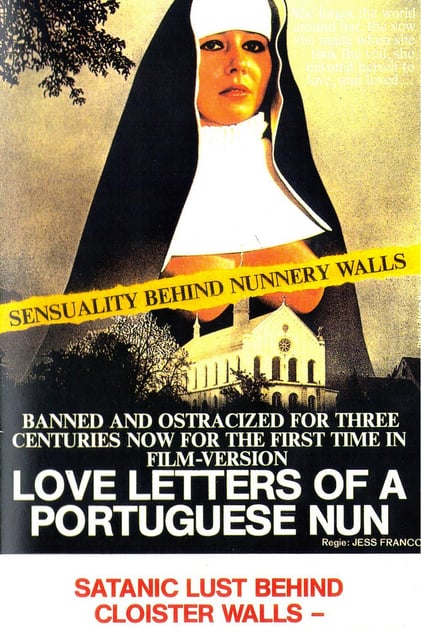
JESS FRANCO MONTH: Love Letters of a Portuguese Nun (1977)

It really says something about Jess Franco when the censored poster for one of his movies is filthier than the actual poster with nudity. I mean, red type that literally shouts, “Satanic lust behind cloister walls?” That’s how you get me to watch.

Who am I kidding? I watch anything and everything Jess Franco made.

Loosely based on the Letters of a Portuguese Nun attributed to Mariana Alcoforado, a Portuguese nun living in a convent named Convento de Nossa Senhora da Conceição, Convent of Our Lady of the Conception. There’s some debate over whether se was the real author of these letters, which tell the story of her affair with French officer Noël Bouton, Marquis de Chamilly and later Marshal of France. Some scholars think that the letters are fiction and were written by Gabriel-Joseph de Lavergne, although the actual Mariana did exist.

But this is a Jess Franco movie, so let’s prepare ourselves.

So while the basic theme of Maria (Susan Hemingway, born Maria Rosalia Coutinho) being in a convent stays the same, the convent is run by Satanists and our heroine is forced to make love to men women and even Satan himself. She writes a letter to God, which gets answered by a brave knight but ends up being taken by the inquisition and then tortured and burned at the stake.

So yeah, exactly like the book.

I mean, Jess Franco is the kind of storyteller that has Father Vicente (Wiliam Berger) bashing the bishop while Maria confesses that she wants to get biblical with her cousin. And she’s then forced to wear a crown of thorn over her privates because, well, I don’t know, it’s a Jess Franco movie. That’s usually my answer.

This is a filmed nightmare and also a dream, a time when Franco seemed to still take his time while never forgetting that it’s committing so many carnal and venal sins.

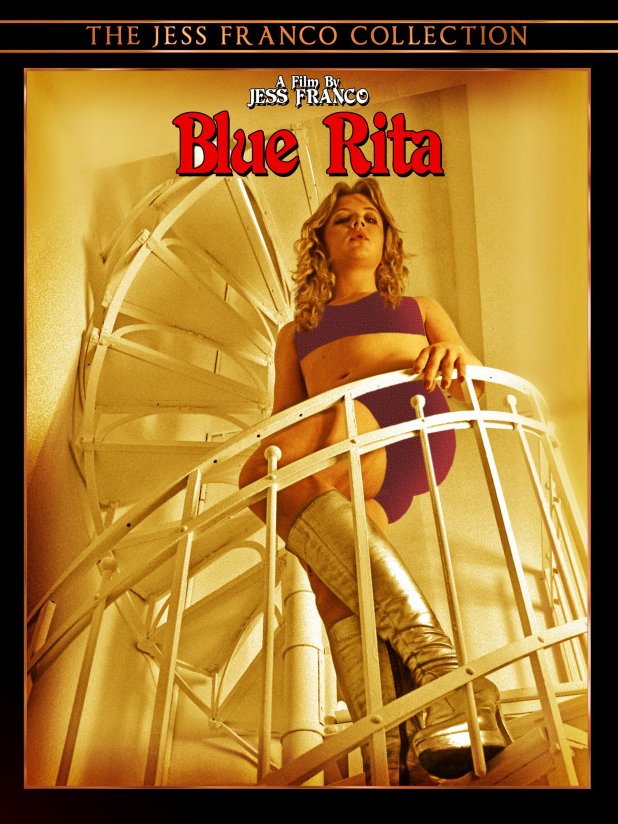
JESS FRANCO MONTH: Blue Rita (1977)

In the Jess Franco Cinematic Universe, which may have not been a thing but let’s believe that it could be, heroines/villains like Rita Blue (Martine Fléty) can be all at once a nightclub owner, an erotic dancer, a spy and a survivor of abuse that uses her abject disdain for men to torture them as a means of not only getting the information governments all over the world crave, but also to gain vast fortunes from rich men only too happy to be menaced by knives and handcuffs and — as Russ Meyer taught us — violence that cloaks itself in a plethora of disguises, with its favorite mantle still remaining sex.

Also known as Das Frauenhaus (The House of Women), this is another Franco riff on a cadre of man-hating women unleashed upon victims willing and unwilling, just like The Girl from Rio. The major difference is that Rita Blue’s female forces have synthesized a Spanish Fly of green ooze that drives men wild with desire — if their bodies didn’t already do the job for them — as they’re denied access to the folds of the flesh they want so much.

Now, set all of this in a world five minutes into the future that we’ll never live in, filled with go go boots, smoke both from machines and cigarettes, furniture not made for sitting on, jazz, nightclubs that define seedy, neon colors and all metallic everywhere.

Pure movie drugs, a film that you should only watch in a basement or somewhere hidden, maybe under the covers, perhaps keeping it to yourself, so that you can drink deep and inhale and live inside this world, a place that could never be but obviously should, a world dangerous to every man dumb enough to fall in lust.

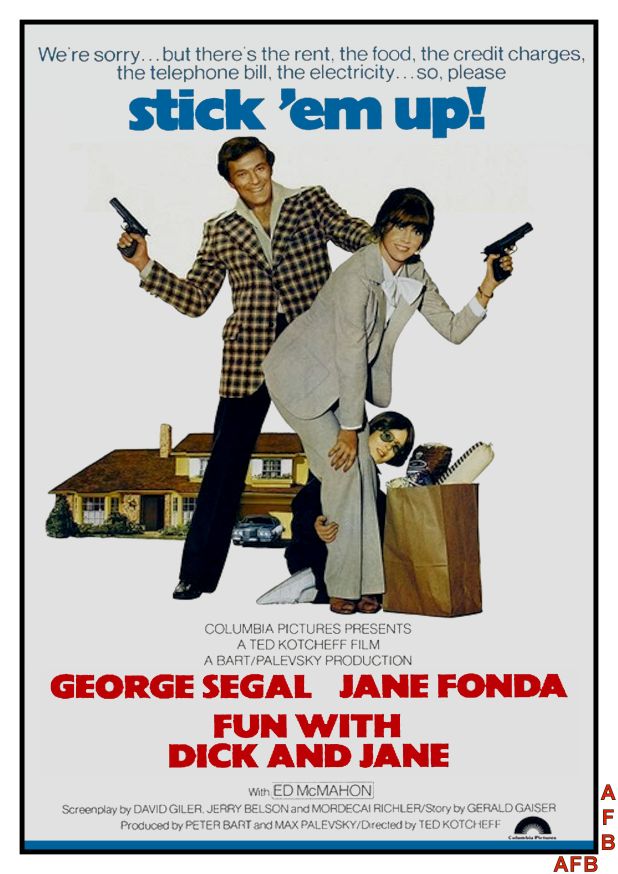
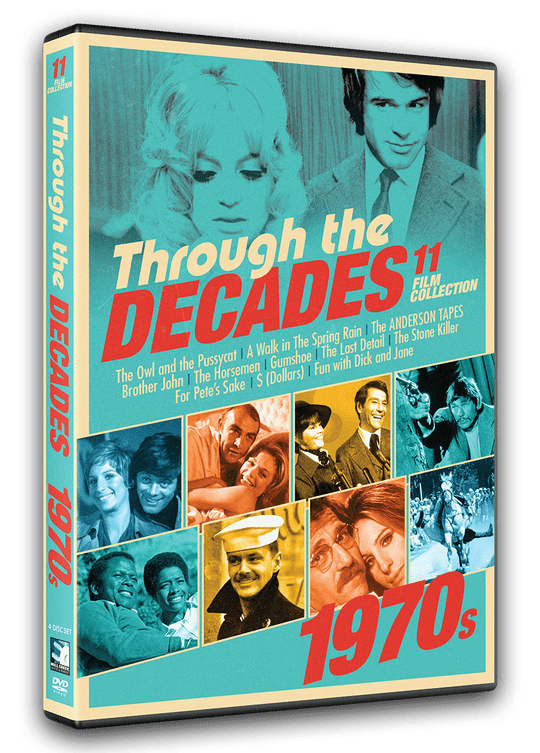
Mill Creek Through the Decades: 1970s Collection: Fun With Dick and Jane (1977)

Dick and Jane Harper (George Segal and Jane Fonda) were living the American dream, but when Dick’s aerospace job got liquidated due to the fuzzy accounting of his boss Charlie Blanchard (Ed McMahon, and if you think I’m not doing a week of movies that Ed was in, you don’t know me) and have to suddenly figure out how to save everything they have, even if Jane’s parents believe that poverty is going to be the best lesson they can ever receive.

The best answer to their problems? A life of crime. While Dick and Jane try to keep the people they’re stealing from to be those even more on the wrong side of the law than them, they still worry that they’re getting too used to being criminals. Can they give it up? Or is the lure of easy money just too much?

This movie was based on a story by Gerard Gaiser, which was scripted by David Giler (who wrote Myra Breckinridge and The Parallax View, as well as serving as the producer and rewriter of Alien as part of his partnership with Walter Hill), Jerry Belson (who popularized the line, “When you assume…” in a script he wrote for The Odd Couple) and Mordecai Richler. It’s directed by Ted Kotcheff, whose career is all over every genre, from the scares of Wake In Fright to the sports film North Dallas Forty, the original Rambo movie First Blood and Weekend at Bernie’s.

That said — this has a homophobic scene followed by George Segal in blackface, so…1977 everybody. A year I was alive in, can remember and yes, it’s even more racist today, so we’ve made progress. Not enough progress, but some.

Through the Decades: 1970s Collection is new from Mill Creek. It also has A Walk In the Spring Rain, DollarsThe Owl and PussycatFor Pete’s Sake, The Anderson TapesThe HorsemenThe Stone Killer, Brother John, Gumshoe and The Last Detail. You can learn more on their site and order it from Deep Discount.

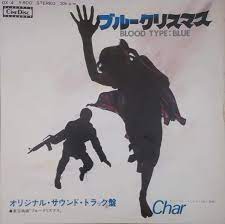
Blood Type: Blue (1977)

Also known as Blue Christmas, this movie is somehow way ahead of its time, as UFO abductees return to Japan with blue blood, which upsets everyone else because, well, do racist people really need a reason? And this also has a deeper story inside it, a remembrance of at least 17 Japanese citizens that were taken by the North Korean government.

Maybe it’s the time I’m watching this in — then again, you could have felt the same way at the start of AIDS or in how Japan and Korea view one another — but this is hitting too close to home. Reporters struggling to reveal the truth, lovers on opposite sides of a conflict united only by their hearts, human lives reduced to blood and organs under the scalpel, prejudice and feelings presiding over facts.

Director Kihachi Okamoto was drafted during the last years of World War II, into the very worst fighting, and was alone among his friends in that he survived. Most of his films have a very cynical edge, even his gangster films and it’s wild that this movie is from Toho.

There’s also the professor who broke this story, why he disappeared and where all the blue blood people are going. As for the UFOs, unlike most other Toho science fiction, they’re never seen.

Sure, this is long at 133 minutes, but it’s so strange, nearly shot like a parody yet dark in its tone. The closest thing I can compare it to is either Eyes Behind the Stars or Footprints on the Moon, but neither is anything like this. To be honest, the end of this has stuck with me for some time and this feels like another strange film that I’ll have to go back and watch several times.

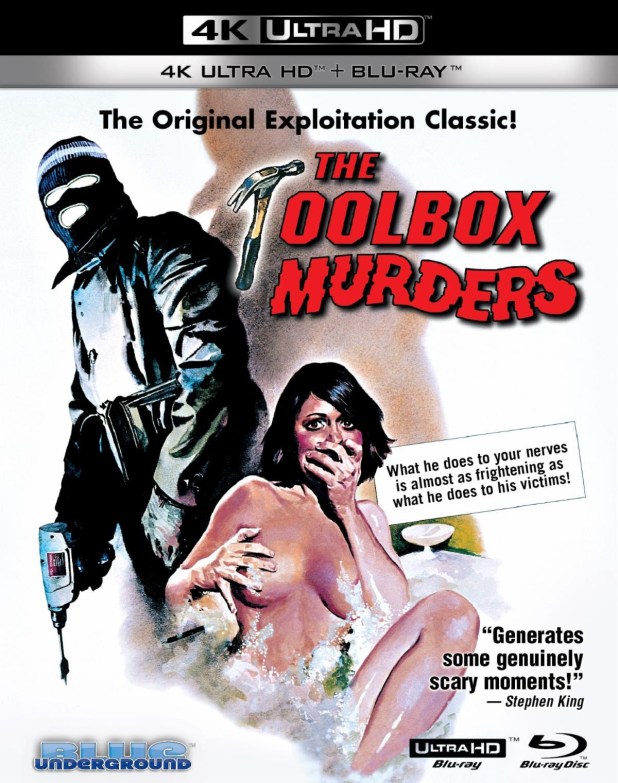
BLUE UNDERGROUND 4K UHD & BLU RAY RELEASE: The Toolbox Murders (1977)

EDITOR’S NOTE: We originally covered this movie back on October 22, 2020, but the new Blur Underground 4K UHD and blu ray release is a reason to celebrate. You can get it right here from MVD and it comes with so much! You get bith an ultra HD blu ray (2160p) and HD blu ray (1080p) widescreen version of the movie, plus two audio commentaries — producer Tony DiDio, director of photography Gary Graver and star Pamelyn Ferdin or Troy Howarth and Nathaniel Thompson, as well as new interviews with director Dennis Donnelly, acor Wesley Eure, acress Kelly Nichols, as well as an interview with actress Marianne Walter and two new features, Slashback Memories – David Del Valle Remembers Cameron Mitchell and “They Know I Have Been Sad,” a video essay by Amanda Reyes and Chris O’Neill. But wait — there’s more! You get a theatrical trailer, TV and radio ads, and a poster and still gallery.

You can see the trailer here.

Not only does this movie excite me because it’s a slasher and a Cameron Mitchell movie, but it’s also a “based on a true story” riff, which is always fascinating.

Los Angeles producer Tony Didio wanted to make a low-budget horror film after seeing how well The Texas Chain Saw Massacre. He knew the film’s distributors — uh-oh — and contacted them to see why they were re-releasing the movie again. While he should have realized it never really stopped playing theaters until the advent of home video — and even afterward for some time — he was smart enough to stay clear of working with the, and making and releasing his own slasher.

Supposedly based on a series of killings in either Michigan or Minnesota that were ritualistic and sex-based, this has famously been cited as one of Stephen King’s favorite movies.

If Pieces can say that “it’s exactly what you think it is,” The Toolbox Murders takes things even further into what I refer to as the pornography of violence, treating each kill as another scene in a gradually escalating orgy of evisceration. That said, the film then goes from slasher to character study in the final act, totally changing everything up on the viewer.

As for Mitchell, he’s completely off the rails in this and I loved every minute of his performance. And this being 1977, of course there’s an incest angle, because the 70’s were just greasy and sweaty and gross.

Vance Kingsley, Mitchell’s role in this, tries to rise above all the sin by using every tool in his, well, toolbox to perforate, slash and decimate every sinner he meets before being killed for love, which then uses scissors to escape into the night. There’s even a square up card at the end for a “this really happened*” shocker.

Wesly Eure loved being in this, relishing the opportunity to do something subversive after being the goody Will Marshall on Land of the Lost. I wonder how Pamela Ferdin felt, as she is better known for being the voice of Lucy on Peanuts (though she is also in the original The Beguiled).

Director Dennis Donnelly would go on to direct plenty of TV, including one of The Amazing Spider-Man episodes in the 70’s, along with SupertrainHart to Hart and The A-Team. That makes sense, as this really does look like a TV movie, unless you take into account all the nudity, sex and gore. And speaking of carnal knowledge, that’s adult actress Kelly Nichols playing Dee Dee, the woman who gets nail gunned in the tub (she was still working in the field doing makeup as Marianne Walters, the name she used for this film, as late as 2015).

Despite a 1986 sequel never happening, in a strange twist Tobe Hooper would direct the remake to this in 2004, which was followed by an official sequel in 2015 and an unoffical one, Coffin Baby, in 2013 that used footage from a scrapped sequel. That movie was tied up in legal wrangling, but has since been released. They all have a more supernatural element than the down-to-earth feel of the original.

*But totally didn’t.

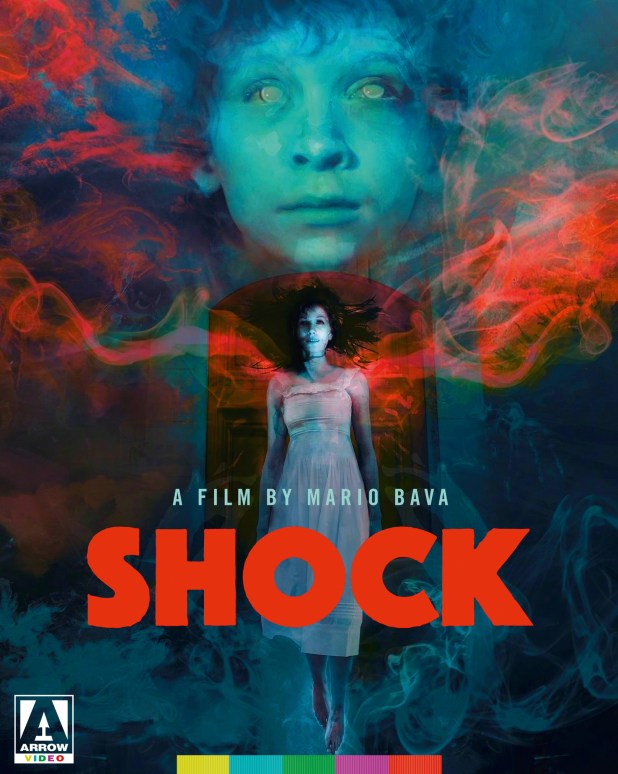
ARROW BLU RAY RELEASE: Shock (1977)

EDITOR’S NOTE: This article originally ran on October 17, 2017, which was early in the life of this site. I’ve adjusted it, added to it and hopefully improved it to celebrate Arrow Video’s release of Shock

We went to see Blood and Black Lace in the theater once and there was someone who talked about the movie before it began. Maybe he was bad at speaking in public, but in short, told everyone how the movie inspired Friday the 13th (I’d say A Bay of Blood versus that one) and how it had a different title. And that was it. I was incensed. I wanted to get up out of my seat and scream that Mario Bava is the reason why lighting is the way it is and his use of color and how I can cite hundreds of films that he influenced. But I sat in my seat and boiled while the movie unspooled, because I’m really passionate about Mario Bava and don’t need to make a scene and miss seeing one of his films on the big screen.

Shock is Bava’s last film. Following a series of failures to reach theaters, including Rabid Dogs, Lamberto Bava continued to push his father to make a new movie. Originally written by Dardano Sacchetti and Francesco Barbieri after they wrote A Bay of Blood, this movie was loosely based on Hillary Waugh’s The Shadow Guest. Lamberto has also stated that he wanted this to be a modern film — check out Stephen Thrower’s part of the Arrow Video release for more about that notion — that was influenced by Stephen King.

Bava started pre-production as early as 1973, shooting screen tests with MImsy Farmer for the lead role. Shot in five weeks, some of the film was directed by Lamberto based on his father’s storyboards, which is why he has the credit “collaboration to the direction.”

I kind of love that this was called Beyond the Door II here in the U.S., but I really like the original title better. It’s a sparse film — there are only three characters (well, three living characters).

Dora (Daria Nicolodi, who should be canonized for giving birth to both Suspiria and Asia Argento, as well as roles in Deep Red, Inferno, Opera and so much more) and Bruno (John Steiner, Yor Hunter from the Future‘s Overlord) are a newly married couple who have just moved back into her old home — the very same place where her drug-addicted husband killed himself — along with her son, Marco.

Dora’s had some real issues dealing with her husband’s death. And Bruno is never home to help, as he’s a pilot for a major airline. Either she’s losing her mind or her son is evil or he’s possessed or her new husband is gaslighting her or every single one of those things is happening all at once. You have not seen a kid this creepy perhaps ever — he watches his mother and stepfather make love, declaring them pigs before using his potential psychic powers to throw things at them. Then he tells his mom he wants to kill her, followed by nearly making his stepfather’s plane crash just by putting an image of the man’s face on a swing.

While Bava was sick throughout the filming (and his son Lamberto would fill in), you can definitely see his style shine through the simple story. There’s one scene of Dora’s face and her dead husband’s and then her face that repeats vertically that will blow your mind.

The secret of the film? Dora’s ex-husband forced her to take a mix of heroin and LSD, at which point she tripped out and killed him. Bruno dumped his body in the ocean and arranged for her to be placed in an insane asylum until she recovered. Now, the ex-husband’s ghost has returned and demands blood. And he gets it.

Perhaps the finest shot in here is when Dora is lying in the bed and you see her hair fall like she’s upside down, but then it goes back like it’s in the wind, all while it seems like she’s being ravaged. I have no idea how Bava did this shot, but it’s so visually arresting that it’s stuck in my mind for days. There’s also his famous Texas switch where Marco runs into his mother’s arms, only to be replaced by her ex-husband and that horrifying scene with the rake.

There’s also music from I Libra, a Goblin off-shoot. It seems kind of strange against Bava’s old school direction, but that doesn’t mean that I don’t love it. It’s a stylish and scary film that’s way better than any Exorcist clone, despite its U.S title.

Arrow Video’s new release of Shock features a brand new 2K restoration from the original 35mm camera negative. There’s new audio commentary by Tim Lucas, author of Mario Bava: All the Colors of the Dark, plus new interviews with Lamberto, Dardano Sacchetti and critic Alberto Farina.

You also get a video essay by author and critic Alexandra Heller-Nicholas, The Devil Pulls the Strings and Shock! Horror! – The Stylistic Diversity of Mario Bava, a video appreciation of Shock by Stephen Thrower that is worth the price of this disk.

You get even more — the Italian theatrical trailer, 4 U.S. Beyond the Door II TV spots, an image gallery and an illustrated collector’s booklet featuring new writing on the film by Troy Howarth, author of The Haunted World of Mario Bava.

You can get this from MVD.

CURTIS HARRINGTON WEEK: Ruby (1977)

EDITOR’S NOTE: As we explore the movies of Curtis Harrington, let’s discuss perhaps one of his better known films. This was originally on the site on February 1, 2020.

Curtis Harrington had the thread of magic running through all of his films. One of the leaders of New Queer Cinema, he also directed Queen of Blood, Voyage to the Prehistoric PlanetWhat’s the Matter with Helen?Who Slew Auntie Roo?, the Sylvia Kristel-starring Mata Hari, tons of episodic television shows and the TV movies Devil Dog: The Hound of Hell, The Dead Don’t DieKiller BeesThe Cat Creature and How Awful About Allan.

His links to the occult, include the study of Thelema with his close associates Kenneth Anger (he played Cesare, the somnambulist in the magician/filmmaker/author’s movie Inauguration of the Pleasure Dome), Marjorie Cameron — who is pretty much the nexus point of twentieth-century occult doings and appears in his film Night Tide — and avant-garde film pioneer Maya Deren, an initiated voodoo priestess.

Harrington was also the driving force in rediscovering the original James Whale production of The Old Dark House and — as a friend of Whale near the end of his life — advised the making of the movie Gods and Monsters.

His final film was Usher, based on a high school film he made of Edgar Allan Poe’s The Fall of the Hosue of Usher. He cast Nikolas and Zeena Schreck — the daughter of Church of Satan founder Anton LaVey — who financed the movie by brokering the sale of Harrington’s signed copy of Crowley’s The Book of Thoth. Perhaps even more interesting is the theory that singer Taylor Swift is a clone of Zeena. No, really.

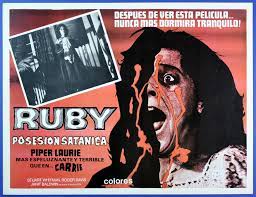
But hey — we’re here today to discuss 1977’s Ruby, a movie that brings Piper Laurie from Carrie into a story about possession and flashbacks.

In 1935, a lowlife mobster named Nicky Rocco is betrayed and executed in the swamps as his pregnant girl Ruby (Laurie) watches. The moment he dies, she goes into labor. Fast-forward sixteen years and she’s living with a mute daughter named Leslie (Janit Baldwin, Gator Bait, Phantom of the ParadiseBorn InnocentHumongous) and running a drive-in with several ex-mobsters like Ruby’s lover Vince (Stuart Whitman!) and Jake (Western actor Fred Kohler Jr.), a wheelchair-ridden man whose eyes were once cut out.

Ruby misses her days as a lounge singer, but the present has some nasty surprises. A poltergeist begins killing people at the theater, including the projectionist and a creepy guy who runs the concession stand (Paul Kent, A Nightmare on Elm Street 3: Dream WarriorsPrey for the Wildcats and the founder of the Melrose Theater). Before long, our heroine — such as it is — believes that Nicky’s spirit has returned and believes that she caused his death.

Vince is visited by Dr. Keller (Roger Davis, Dark ShadowsNashville Girl and the first husband of Jaclyn Smith), who helped him get out of jail early. He’s a clairvoyant who believes that there’s something in the drive-in, which is true, because Nicky starts speaking Ruby’s name over the speakers at the drive-in. Before long, Ruby’s daughter is speaking with the voice of her dead father and showing the wounds he endured before his death.

The producer chose to change the ending, and both Curtis Harrington and Piper Laurie refused to be involved in the re-shoot. It was allegedly shot by Stephanie Rothman (the director of The Student Nurses and the writer of Starhops). This ending, where Nicky comes back from the grave and drags Ruby into the swamp, was part of the TV commercials for the film.

Keep an eye out for Len Lesser in this — he was Uncle Leo on Seinfeld — as well as Crystin Sinclaire, who appeared in Eaten Alive and Caged Heat.