Beyond directing The Candy Snatchers, Guerdon Trueblood was the king of writing insect movies. Ants!, Terror Out of the Sky, The Savage Bees and this movie, all within two years is how he did it.
Directed by Stuart Hagmann, Tarantulas: The Deadly Cargo pulls a switch on you as you’ve been led to believe that Tom Atkins and Howard Hesseman are the heroes as they fly out of Ecuador with a huge haul of coffee beans that just so happen to be filled with spiders. Yet after they crash in Finleyville, California, the movie shifts to the townspeople battling the furry eight-legged creeps, including Dr. Hodgins (Pat Hingle), Bert Springer (Claude Akins) and Cindy Beck (Deborah Winters).
The town is more concerned about selling oranges than dealing with the spiders until it’s nearly too late. The solution: make the sound of wasps so that the spiders stop moving, then dump them into buckets of alcohol.
Also: these aren’t tarantulas. They’re Brazilian wandering spiders.
That said, I’ll let a silly TV movie play all day long, like a warm blanket when it’s cold outside. It is my joy.
The Kino Lorber blu ray of Tarantulas: The Deady Cargo has a new 2K master, commentary by The Made for TV Mayhem Show podcast hosts Amanda Reyes, Dan Budnik and Nate Johnson, art by Vince Evans and a limited edition slipcase. You can get it from Kino Lorber.
EDITOR’S NOTE: This film was originally on the site on December 31, 2021. Thanks to the new Kino Lorber blu ray release, I’m sharing a revised article on the film. The Kino Lorber release has a brand new 2K scan as well as commentary by author and film historian Lee Gambin, new interviews with Barbara Brownell, Barry Van Dyke, Anita Gillette, Moosie Drier and production assistant and daughter of producer Alan Landsburg, Valerie Landsburg. You also get both the TV and theatrical cuts of the film. It’s available directly from Kino Lorber.
Guerdon Trueblood, who wrote this, really had quite the resume. The grandson of General Billy Mitchell, the founding father of the U.S. Air Force, he was a dependable writer for TV as well as writing and directing The Candy Snatchers. You can also check out a few other TV movies he wrote like The Savage Bees, SST Death Flight, Tarantulas: The Deadly Cargo and even the theatrically released — and reviled — Jaws 3D.
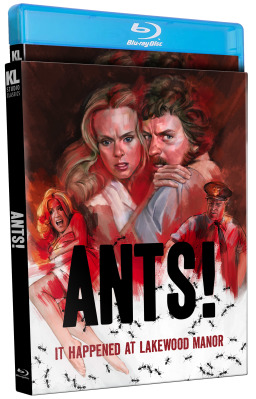
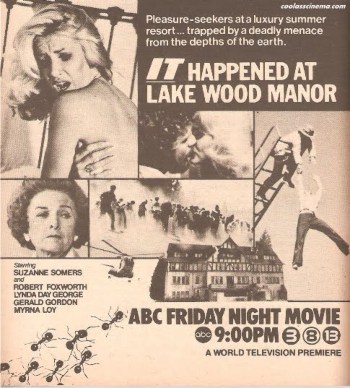
Ants — also known as It Happened at Lakewood Manor and Panic at Lakewood Manor — was directed by Robert Scheerer, who also made Poor Devil, the “Primal Scream” episode of Kolchak and episodes of Star Trek The Next Generation, Deep Space Nine and Voyager.
Probably the main reason to watch this is Lynda Day George, who we all know and love from movies like Pieces, Day of the Animals, Beyond Evil and Mortuary. But you also get Myrna Loy, Suzanne Somers (just before Three’s Company), Bernie Casey and Brian Dennehy, who was in twelve movies and TV programs in 1977.
As for the Lakewood Manor, a real estate madman wants to turn it into a casino while its owner (Loy) wants to keep it as it is. As it involves a pit of venomous ants that can’t be destroyed by pesticides and love to murder people. Imagine — millions of ants covering people, who can’t move or they’ll be killed, ants upon ants taking the life of the soon-to-be Chrissy Snow.
From the moment that two construction workers discover just how aggressive these ants are — they get buried alive before they can tell anyone — you know that these ants mean business. The Board of Health thinks that whatever is killing everyone is some kind of violent outbreak and quarantine the hotel, but it turns out that there’s a giant pit of ants, ants that can’t be stopped with pesticides. Millions of ants, ants smart and mean enough to build bridges over the dead bodies of their fellow insects and cross water and fire just to kill anyone that gets close to them.
There’s a square up reel at the end, as only two of the many characters in this movie survive and they’re told that there’s no way this could happen again because the hotel had “unique environmental conditions vital for the existence of the ants’ nest.” Seeing as how there was never a sequel, maybe they were right.
I also love that this movie was sold with an image of Somers — after she became a big star — covered in ants. She was terrified of them but the producers somehow convinced her to do it.
In the 70s, I spent most of my childhood worrying that I would be killed by a bug. Now, I’m more sure it’s going to be a heart attack any day now.
June 20: Junesploitation’s topic of the day — as suggested by F This Movie— is regional horror! We’re excited to tackle a different genre every day, so check back and see what’s next.
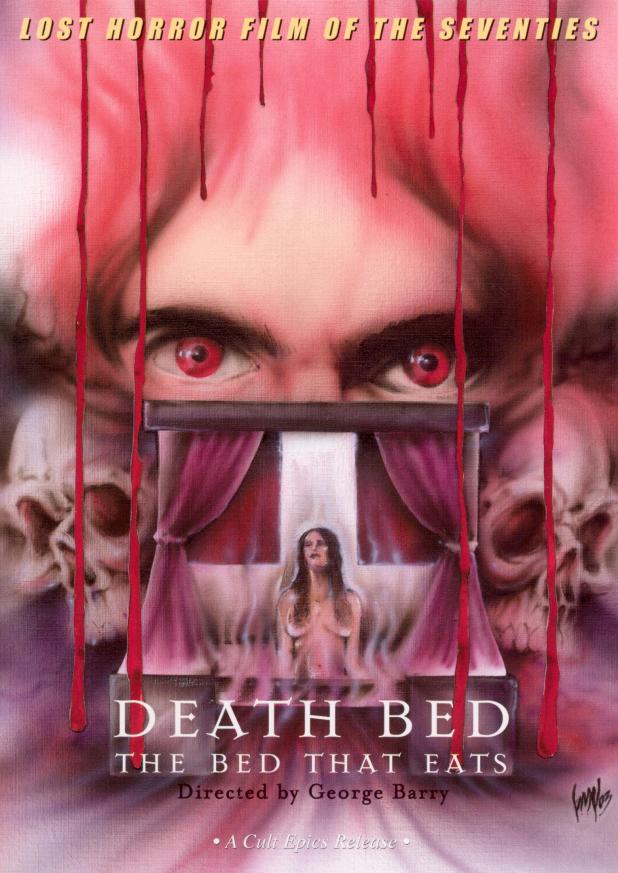
When I first saw Death Bed in the wild — 1989, I think, and at a Uni-Mart convenience store back in those magical days when every single retailer was renting VHS — I know that I wasn’t ready for it. I remember a friend showing me and laughing about it, saying that it had to be bad. I had not yet arrived at the place where I believe that there is no such thing as so bad it’s good. Today, I don’t feel right laughing at a movie because of its faults. I’d rather celebrate them and enjoy how happy they make me.
I’m glad I waited to watch this movie.
There’s no reason why Death Bed is as good as it is. It was shot between 1972 and 1977 for $30,000 around the Gar Wood mansion on Keelson Island in Detroit. Built in 1924 by designer, industrialist, inventor of the hydraulic lift and the modern garbage truck, and champion speedboat racer GarWood, this 43-room mansion had — at one time — the world’s largest pipe organ and a basement swimming pool. By the late 60s, it was a counter-culture commune thanks to Mark Hoover, who moved into the mansion after 15 years of it being vacant. He threw rent parties where the house band Stonefront would often jam with Joe Cocker, Van Morrison, Johnny and Edgar Winter, Rick Derringer and Leon Russell. By the next decade, a riotous party by the Outlaws Motorcycle Club, a drug bust and a lightning strike-assisted fire destroyed what was left of the once impressive manor.
Anyways, how do we get a bed that eats people?
Centuries ago, a demon fell in love with a woman and created the bed upon which they would consummate their love. Yet human bodies weren’t made for demonic lovemaking and she died, causing him to weep tears of blood which gave life to the bed. Every ten years, the demon awakens and the bed is able to satisfy its hunger by eating a human. Only one person — artist Aubrey Beardsley — has been spared, if you can call it that, by being trapped forever inside a painting that must watch the bed forever.
Beardsley is, of course, a real artist who was a leading figure in the aesthetic movement along with Oscar Wilde and James McNeill Whistler. He was also a significant member of the Art Nouveau despite dying at just 25 years old from tuberculosis. He would once say, “I have one aim—the grotesque. If I am not grotesque, I am nothing.” He was also rumored to have father a stillborn child with his sister, which there’s no proof of, but there is plenty of evidence of his genius work as an erotic artist. His work is so incendiary that it was still causing raids and obscenity charges seventy years after his death.
Wait — this is a regional horror movie?
The story is broken into meals for the bed, such as Breakfast, a time when a young couple trespasses into the mansion and use the bed for their own desires. As they start their horizontal dance, the bed does what it does and devours them as the artist makes fun of it. In response, the bed telekinetically tears the house apart and blows my mind mere minutes into this movie.
Three women discover the bed: Suzan (Julie Ritter, who went on to become a composer), Diane (Demene Hall) and Sharon (Rosa Luxemburg). Minutes after disrobing on the cursed mattress, Suzan is swallowed in the Lunch part of the story, soon to be followed by Diane. Only Sharon survives because her eyes remind the bed of the woman whose death created it. She’s also saved in the Dinner chapter by her brother, whose hands are eaten when he tries to stab the bed. He sits there, his flesh and blood digits replaced with crumbling skeletal fingers.
Finally, as the demon goes back to sleep, the artist reaches out to the mind of Suzan and helps her complete a ritual that will destroy the bed. It teleports it from its room and revives the dead mother of the bed at the cost of Suzan’s life. The mother and Suzan’s brother immediately do what you think they should — have sex on the evil bed — which sets it on fire and allows the artist to die.
Me telling you all of this should in no way spoil anything for you in a movie where we watch amber liquid dissolve body parts, a bed eat an apple, an orgy turn into an orgy of death and strange voiceovers in the place of dialogue. It’s also a movie where a bed drinks Pepto Bismol.
Creator George Barry — originally only his name was on the film — didn’t even release the movie other than showing it to a Los Angeles-based distributor to hopefully release the film on VHS in the UK. The distributor offered to pay Barry $1000 for a VHS release if he could supply them with a print of the film, complete with credits. Those credits would have cost $3000, so Barry declined and got his print back.
That’s how a British VHS label called Portland got the film, which they released as a bootleg. I have no idea how a copy ended up in a gas station in a southwestern PA mill town. Yet another mystery!
Somehow, Barry was making this movie in the woods at the same time as Royal Oak, MI — they shared the same hometown — horror icon Sam Raimi was making Within the Woods, which was the proof of concept for Evil Dead.
In 2014, Gwenyfar Rohler and Jock Brandis (who was a gaffer, did special effects and played the minister; he also worked on Serial Mom, Blue Velvet and four Cronenberg movies) created a two-act play that starts with how the movie was made and then has an on-stage adaption of the movie.
Barry sadly never made another movie and opened a bookstore instead.
What he did create is an absolutely deranged piece of film that would in no way pass through a Hollywood so-called idea factory. That’s why regional horror is such a vast resource, a place where anything can happen, plot is fluid and magic is everywhere.
Here’s one more insane Michigan regional classic to check out: The Carrier.
Have you ever started watching a movie and realized that it was exactly what you needed, when you needed it and then started delivering even more of what you wanted?
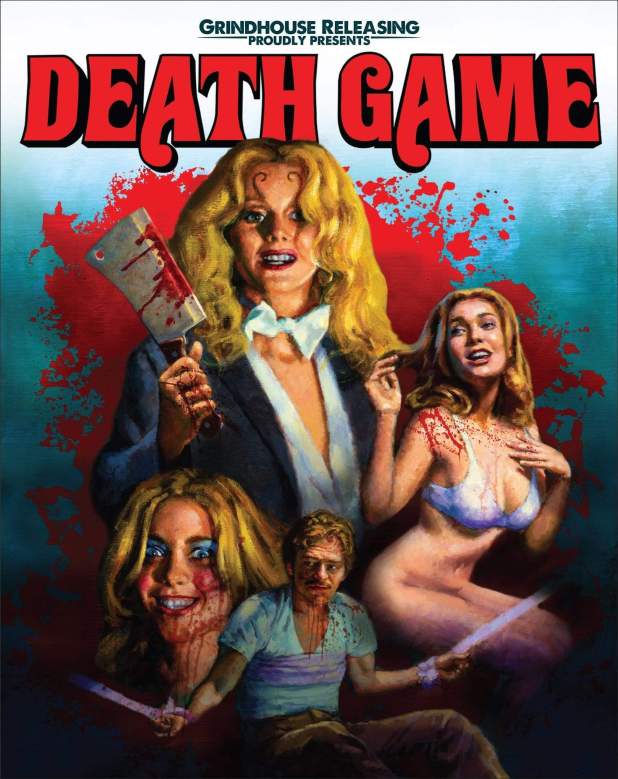
Life’s never that good but for some reason, Death Game — also known by the even better title The Seducers — did that for me. It’s a blast of seventies sleaze that somehow doesn’t forget to give all the power to its female leads and instead gives them free agency to absolutely decimate a man foolish enough to give in to their fantasy power play.
In short, sometimes the worst thing you can get is everything you ever dreamed about.
California real-estate financier Pete Traynor started making movies in the early 70s in the same way that people used to finance strip malls. That might seem strange — perhaps unethical — but whatever got this movie in my hands, I endorse it.
He chose this as his first film after founding Centaur Films with director-producer Mark Lester to produce Steel Arena and Truck Stop Women. He only directed one other movie, the also deranged Evil Town which rose from the ashes of another film Dr. Shagetz and also one that was remade by its co-director Mardi Rustam as the even more delightful Evils of the Night.
It was a smart and contained idea for a film, as it mostly takes place inside a large Los Angeles home. That was the plan — shoot for a few weeks in 1974 and release it the next summer. It just took a few years to come out thanks to disputes between Traynor and the cast. And then there was that whole federal investigation into the way that it was financed.
The script — originally called Mrs. Manning’s Weekend — came from Jo Heims, who wrote Play Misty for Me and the story for Dirty Harry, which she received no credit for. She also adapted the screenplay for the Patty Duke movie You’ll Like My Mother and wrote two great TV movies, the John Llewellyn Moxey-directed Nightmare in Badham County and Gordon Hessler’s Secrets of Three Hungry Wives. Sadly, she died from breast cancer at the way too young age of 48 in 1978.
Another film that Heims wrote for Eastwood was 1973’s Breezy, a movie that he only acted in instead of starring, as he felt he was too young for the role that was played by William Holden. As for the much younger female lead, Eastwood had intended for that part to go to Jo Ann Harris, but Heims felt she was wrong for the part. Instead, she suggested her friend Sondra Locke, even though Locke was twelve years older than the character. This would be the first time Locke would meet Eastwood and would end up spending much of the 70s and 80s together.
There isn’t enough room to get into here as to the relationship between Eastwood and Locke, but it really has colored the way that I view him. Sometimes, we can separate the art from the artist, but when an artist goes out of his way to ruin another artist’s career and life, well…it’s difficult to ever respect them.
Back to Death Game.
Kay Lenz ultimately played the lead in Breezy, as she was young enough for the part, even if Locke always played younger than she really was. So when Locke became interested in this film — she’d never played a bad girl before — the fact that she was twice the age of the character in the script wasn’t a big deal.
The other part of the film’s seductive duo was to be played by Colleen Camp, who had only done TV roles and commercials. As for the man they destroy, George Manning, Al Lettieri (The Godfather, The Don Is Dead) was to star before Seymour Cassel came on board.
Cassel was mainly known for his roles in the films of John Cassavetes, as well as numerous other independent films. Perhaps less known is the fact that he gave a young Saul Hudson the name the world knows him as — Slash.
The actual shoot for the film was, charitably, chaos.
The original script kept getting humor and exploitation added to it, while Locke claimed that Traynor really had no idea what he wanted the movie to be or what he was doing, often only directing the actresses to break things. Locke and Cassel then basically took over their roles and began directing themselves and Camp.
Tensions flared, as during one scene where the girl dumped food repeatedly on him, Cassel nearly hit Traynor and refused to loop any of his dialogue. David Worth, the film’s cinematographer, at least was able to work with everyone — he wasn’t the first person hired for the role, as his predecessor was fired — but he was able to give the film its unique look in the face of all this madness (and he’s the one who looped Cassel’s voice). He went on to direct Poor Pretty Eddie, Kickboxer and Warrior of the Lost World, as well as run camera on The Jesus Trip and work as the director of photography on Remo Williams, Innerspace and Never Too Young to Die.
Worth also stuck it out as the film went through a messy post-production, as it was held up due to the U.S. Securities and Exchange Commission investigating Traynor’s financing. After that was settled, Metro-Goldwyn-Mayer gave Traynor $100,000 to finish editing the film, working with Worth 15 hours a day, seven days a week.
And then, well, it played theaters and kind of went away. It earned the kind of reviews that you expect Leonard Maltin to give good trash, who said it was an “unpleasant (and ultimately ludicrous) film about two maniac lesbians who — for no apparent reason — tease, titillate, and torture a man in his own house.”
But it found an audience.
I mean, it found me.
Any movie that starts with the “based on a true story” always gets me just right.
George Manning (Kassel) has just left home for work, getting a weekend alone as his wife has an emergency to attend to. That night, while alone in his large house, a thunderstorm rages outside and he hears a knock on the door. It’s Jackson (Locke) and Donna (Camp), two girls who can’t find the party they were supposed to attend and simply need to use the phone.
Often, it’s one decision that changes a life. This would be one of those.
The three chat while waiting for a car to pick up the girls, but that conversation leads to George’s sauna and a threesome that’s shot in near acid trip style, giving George that male power fantasy that nearly every post-sexual revolution American male has had: sex with two young blondes.
The problem with fantasy is that it’s not something that we ever work through. For most men, the fantasy ends with ejaculation. There’s not the emotional side or the way that your life is changed once you step outside your marriage. No one fantasizes about guilt. Or wonders what happens when two young women simply won’t leave your house and start accusing you of statutory rape and threatening to ruin everything that is your life.
It’s a powerful journey for a movie to make, much less one made nearly fifty years ago. And it pushes that story further and further. And while of all the versions of this story — it’s been filmed four other times — Kassel’s take is the most innocent, the moment he steps from reality to fantasy is as if to give himself over to what is assuredly deadlier than the male.
My only gripe is that I wish the film ended with the girls laughing and running away. What occurs feels too much like a square up real, too much like a square up reel when we can simply accept that their power has won and that they are alive and seeking someone else foolish enough to make that mistake. It’s the one thing that Eli Roth gets right in his shiny and way too clean remake.
Death Game is a strange movie that was forged from a chaotic production, the pressures of which one assumes shaped it and molded it into something unique, a film that I’m still thinking about days after I watched it despite the sensory overload that I put myself through on a daily basis.
In short, you need to see this.
You can buy it for yourself from Grindhouse Releasing. It’s got a brand new 4K restoration created from the original camera negative, interviews with Colleen Camp and director Peter Traynor conducted by Eli Roth, plus interviews with Sondra Locke,producer Larry Spiegel, cinematographer/editor David Worth and screenwriter Michael Ronald Ross. Then you get two sets of commentary with Camp and Roth as well as Spiegel and Worth, plus still galleries, an embossed slipcover and a 24-page full-color booklet with rare photos and liner notes. It might even have a secret movie included! It’s currently sold out but keep an eye out for it, because this is one of the best releases of this year.
Why did it take this long to get this movie on this site?
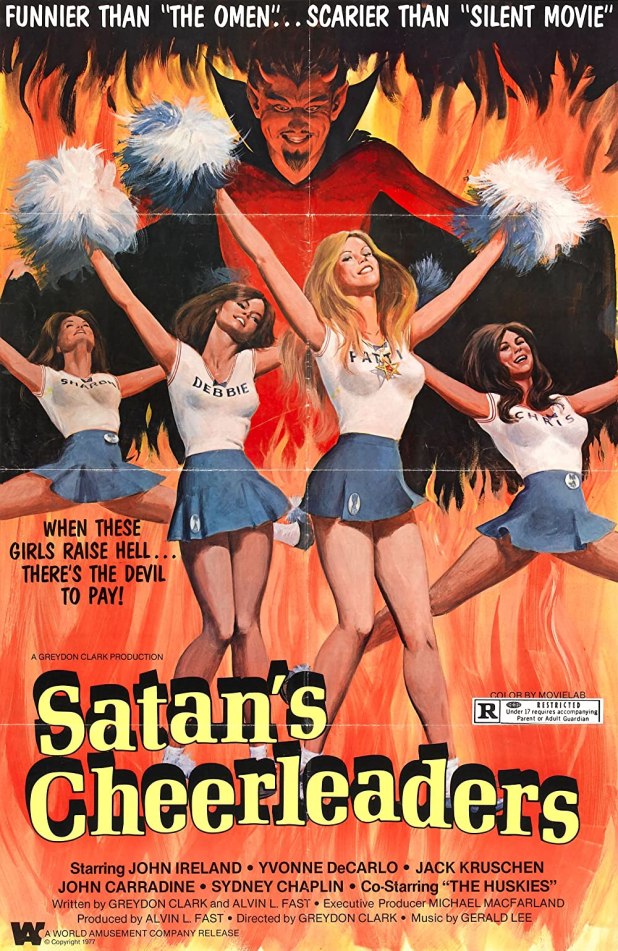
Ms. Johnson (Jacqueline Cole, director Grayden Clark’s wife) has perhaps the smallest cheer squad ever. Just four girls — Debbie (Alisa Powell, The Toolbox Murders), Sharon (Sherry Marks), Patti (Kerry Sherman, Eyes of Fire) and Chris (Hillary Horan, Young Doctors In Love) — who are more interested in playing touch football and getting scored on by the football team than doing their routines.
After their car breaks down on the way to their big game, Billy the janitor and bus driver (Jack Kruschen, The Apartment) rescues them. And by rescue, I mean sacrificing them on an altar to Satan. They’re saved again by a hobo (John Carradine), the sheriff (John Ireland) and his wife (Yvonne De Carlo) and you know what I always say: never trust Old Hollywood.
Shot in ten days with no permits, Satan’s Cheerleaders is mindless fun with an entire town devoted to the Lord of the Flies and a cheerleader with a secret of her own.
EDITOR’S NOTE: This originally was posted on the site on March 31, 2021 but now the Code Red blu ray has been re-released by Kino Lorber. This release has been remastered in HD from the original Italian 35mm camera negative. It’s a must buy.
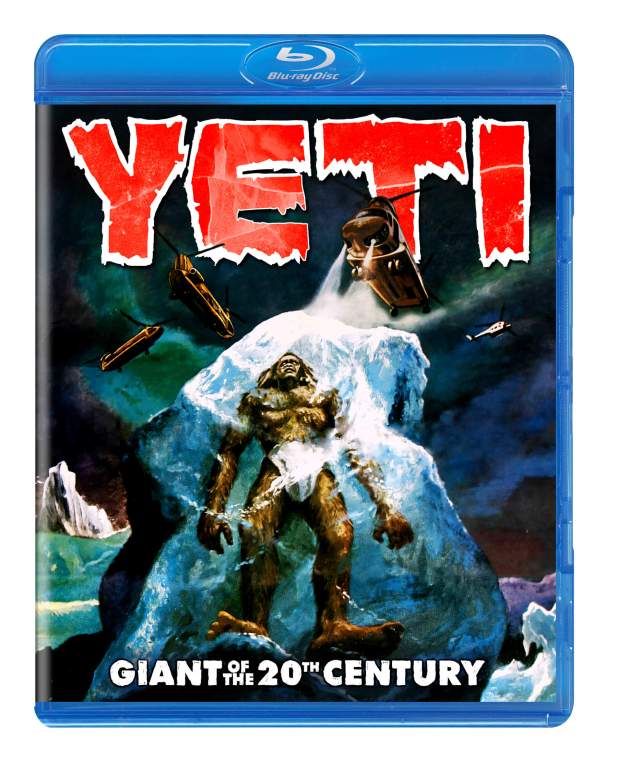
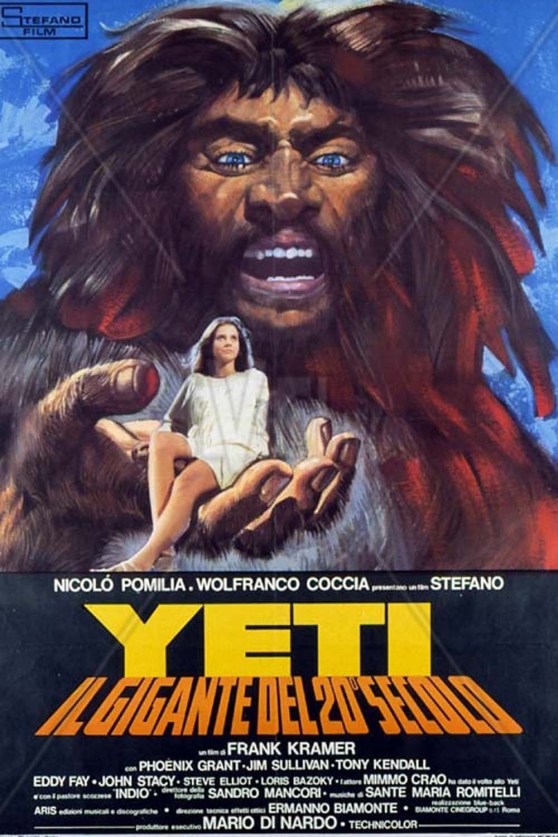
Somewhere deep in the middle of the Canadian mountains, Professor Wassermann (played by John Stacy and voiced by Gregory Snegoff, who was Scott Bernard on Robotech and Golgo 13 in the translated American version of his cartoon) is looking for a giant iceberg that has a yeti (Mimmo Crao, the only actor that I know that is in a Jesus movie — Jesus of Nazareth — and an Edwige Fenech sex comedy — Sex With a Smile — and this monster movie).
Morgan Hunnicut (Eddie Faye, who is really Edoardo Faieta from Plot of Fear, and also voiced by Snegoff) owns a multination oil company that funds the expedition to study him but he really wants the yeti to exploit. He’s also brought along his orphaned grandchildren for some reason — what, a Fortune Six company doesn’t have daycare for their CEOs? — named Jane (Phoenix Grant*, AKA Antonella Interlenghi, Emily from City of the Living Dead) and Herbie (Jim Sullivan), who had been mute since the death of his parents and only communicates with his dog Indio.
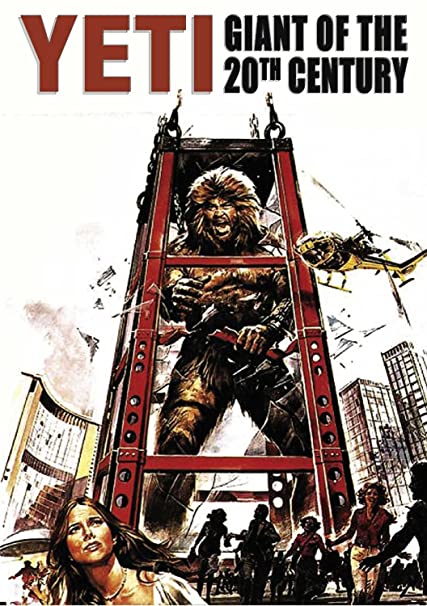
There’s an astounding scene where the Yeti is fitted into what is basically a giant telephone booth and airlifted by helicopter to a height of 10,000 feet because the air up there is what he’s used to and it’ll be easier to thaw him out up there. This is bonkers Italian cinema science at its finest, dear reader.
The paparazzi wants to see more of the yeti and surrounds everyone, freaking him out as if he were in a Dino De Laurentiis movie from 1976 and sending him running with Jane, Emily and Indio in his hand. He gets so excited by Jane rubbing against his paw — and I’m not making this up — that he gets erect nipples. Later, as he combs her hair with a giant fishbone — again, not making anything up — they are found by the professor who claims that she has been adopted as his wife and Herbie as his son. Cliff Chandler (Tony Kendall**, AKA Luciano Stella, AKA Kommisar X!) is one of the company men who comes to their rescue and he comments that she’ll have to put out soon for the ape man.
Speaking of putting out, the Yeti has been marked much like Kong was in the wake of Dino’s remake. You can find Yeti shirts that say “Kiss Me Yeti” — a phrase that makes no sense — and a disco song and a commercial for the gas stations that ask you to put a Yeti instead of a tiger in your tank.
Then things get bad when the new leader of Hunnicut turns out to be the evil Cliff. He decides to kill anyone connected with the big lug.
How bad do things get?
The kind of bad where autistic children are threatened, Yetis break free over the Niagra Falls, where old kindly professors are killed by Aldo Canti, who was once Angel the acrobat from Return of Sabata and even cute dogs get stabbed.
Somehow, however, Indoo shrugs off this 1d4 slashing damage and survives to come running across the field like Wuthering Heights at the end as the Yeti goes back home to the frozen Canadian tundra, leaving behind nothing but death, destruction and flipped over toy vehicles with dead industrialists trapped inside.
Oh yeah and Dr. Butcher himself, Donald O’Brien, is in this!
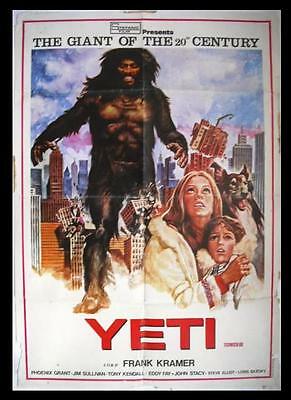
A lot of folks hate on this movie and for really poor reasons. This is the very best kind of trash, a movie blessed with great poster art and the worst in special effects. These people are morons that don’t understand the wonder of a film that has high budget dreams and bottom basement budget realities.
Director Gianfranco Parolini went from writing peblum films to the scripts for all three Sabata movies and God’s Gun. His directing resume has some decent stuff on it as well, including several of the Kommisar X films, If You Meet Sartana…Pray for Your Death and The Fury of Hercules. He also produced this film. Again, he had a record of producing solid work, but I think they shot too high and paid the price.
And by paid the price, I mean made a movie that completely entertained me for its entire running time.
*According to Wikipedia, Jessica Harper (yes, from Suspiria) is the voice of Jane. This seems way too good to be true.
**Kendall and O’Brien are dubbed by Ted Rusoff, the son of screenwriter Lou Rusoff and nephew to B-movie titan Samuel Z. Arkoff. He relocated to Italy to dub movies — where he met and married Carolyn De Fonseca — and you can hear his voice in movies like Voyage Into Space, Deep Redand The Strange Vice of Mrs. Wardh.
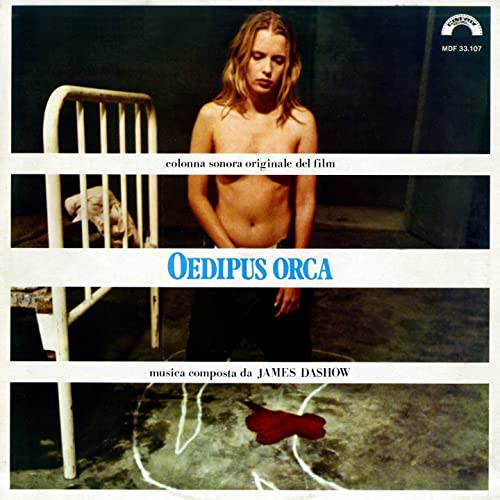
La Orca told the story of Alice (Rena Niehaus, who also was in Angel: Black Angel and Damned In Venice so she had no issues with being in offensive films), who was taken against her will by three men, one of whom she fell in love with.
This is the sequel and wow, it’s…something. Alice sits around reading in the nude, which is intercut with slaughterhouse footage because Italian movies. Seriously, this movie looks Umberto Lenzi and Ruggero Deodato right in their eye stems and raises them to a level that made me skip lunch. Then, she decides to pursue an old lover of her mother’s — who is probably her father — while remembering the criminal who died because of her — and when they finally have sex, well — spoiler warning — he’s killed by a gigantic pane of slow motion glass in an ending I had to watch multiple times to make sure I actually saw it happening.
This film’s director was Eriprando Visconti di Modrone, Count of Vico Modrone, who upset his noble family by deciding to make movies. Often, he’d spend his own money and use unknowns, and he bombed as much as he was a success. But he made this, and it blew my mind multiple times because while not good, it sure is willing to show you some things that you definitely never needed to see.
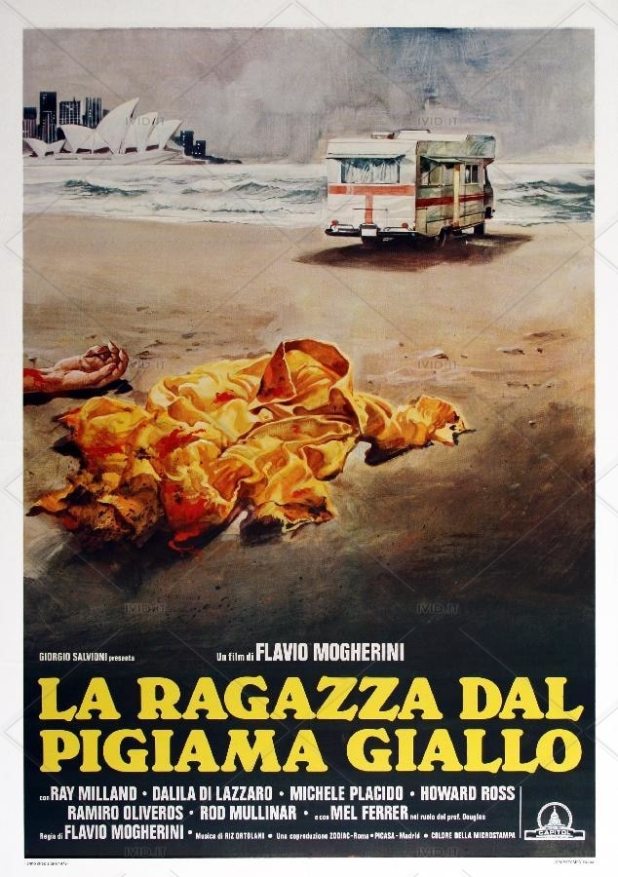
The Girl in the Yellow Pyjamas AKA The Pyjama Girl Case is more than just a giallo. It’s based on a true story, the 1934 Australian cold case that concerns the murder of Linda Agostini. Born Florence Linda Platt in a suburb of South East London, she left the UK behind for New Zealand after a broken romance, then went to Australia where she worked at a cinema and lived in a boardinghouse. Post-murder gossip claimed that she was a heavy drinker, a jazz baby and someone who entertained plenty of much younger men, which became an issue when she married the Italian expatriate Antonio Agostini. He moved her to Melbourne to try and get away from the bad influences that he felt existed in Sydney, but four years later she disappeared.
Her body was found inside a burning grain sack left behind on the beach. Her head was wrapped in a towel, her body was badly beaten and she had been shot in the neck. But what defined the case were her intricate silk pajamas, complete with a Chinese dragon design, a look that was not the type of clothing favored by your average Australian housewife.
Her body was kept in a formaldehyde bath for a decade and the public was invited to attempt to identify the body. In 1944, dental records proved that the girl in the yellow pajamas was Agostini. Meanwhile, her husband had been in an internment camp for four years during World War II due to his Italian heritage and sympathies toward the Axis. When he returned and was questioned by police commissioner William MacKay — a man he had once waited on — he immediately confessed to killing his wife.
There’s still some controversy over whether or not he actually confessed. There’s just as much as to who the pajama girl was. Regardless, her husband only served three years on manslaughter, as he claimed the shooting was an accident, and was extradited to Italy. Historian Richard Evans wrote The Pyjama Girl Mystery: A True Story of Murder, Obsession and Lies in 2004 and claims that police corruption meant that the case needed to be solved as quickly as possible, as the public sentiment had turned against the cops.
The giallo that is based on the case is really well made and has an intriguing split narrative. On one hand, we have the retired Inspector Thompson (Ray Milland) investigating the case and dealing with his own mortality. Meanwhile, we see Glenda Blythe (Dalila Di Lazzaro, Frankenstein 80, the monster’s bride in Andy Warhol’s Frankenstein, the headmistress in Phenomena, perhaps the other woman in Carlo Ponti and Sophia Loren’s marriage) struggle with the relationships in her life, including her husband Antonio Attolini, her lover Ray Conner (Howard Ross, The New York Ripper) and her mentor Professor Henry Douglas (Mel Ferrer). As the relationship with her husband starts to fall apart, she drifts into prostitution and in a harrowing scene, makes love to two men while one’s teenage nephew tries to not make eye contact with her.
Other than the Riz Ortolani score — Amanda Lear sings on two of them! — this isn’t a fashion-filled bit of fun. This is a dark and dreary journey through the end of a woman’s life and the elderly man devoted to finding out the answers to who and why, even if he knows that discovering that truth won’t change the fact that he’s closer to the end of his story than the beginning. At least he cares more than the modern police, who simply embalm her nude body, put it on display and allows people to stare at it.
I read the other day that giallo films were meant for the people outside of Rome, for provincial tastes that demanded a morality play. I’m not certain that’s entirely true, but this movie aspires to art and a heartbreaking moment as we reach the close and realize that the two stories are truly connected in the bleakest of ways.
I can tell you exactly where a five-year-old me was on the night of September 14, 1977.
Watching this movie on CBS.
I wasn’t alone, as it was the highest performing CBS production for the entire year and played as a theatrical movie in Europe, often in a double bill with Sinbad and the Eye of the Tiger.
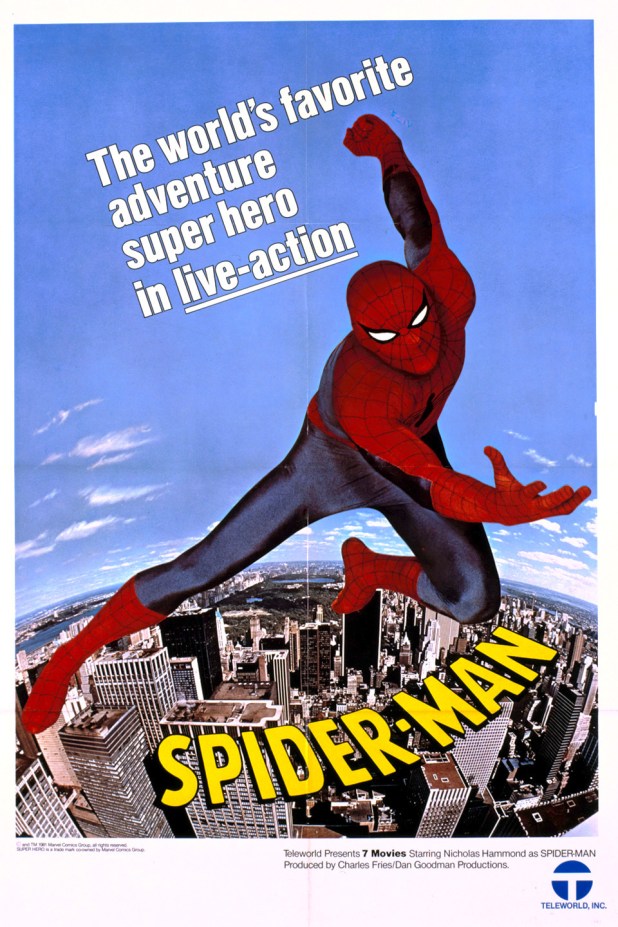
Directed by E. W. Swackhamer (Vampire) and written by Alvin Boretz, this TV movie has Nicholas Hammond as Peter Parker, who becomes Spider-Man when he’s bitten by a radioactive spider.
His first villain isn’t Doctor Octopus or the Green Goblin, but instead The Guru (Thayer David), who is mind-controlling people to rob banks and threatens to cause ten people to commit suicide unless he’s paid $50 million. The real drama happens when Peter becomes one of the people under the villain’s thrall.
It’s just sort of like the comic and not really filled with action, but it does have the wild stunt of Spider-Man climbing an actual building in New York City and swinging on a web, which wasn’t CGI back in 1977 and blew all of our minds.
Enzo G. Castellari directing the kind of action you demand from poliziotteschi.
Fabio Testi and David Hemmings as the tough undercover cop and driven agent against unstoppable crime.
Goblin fresh off Suspiriamaking this movie sound like nothing else.
The Heroin Busters is ready to own you..
Mike Hamilton (Hemmings) is an Interpol agent trying to keep heroin from taking over Italy from his office. And from the streets, Fabio (Testi) is his undercover agent, getting in deeper and deeper into the drug trade until his cover gets blown and the world of crime comes for him. Can Mike save him in time?
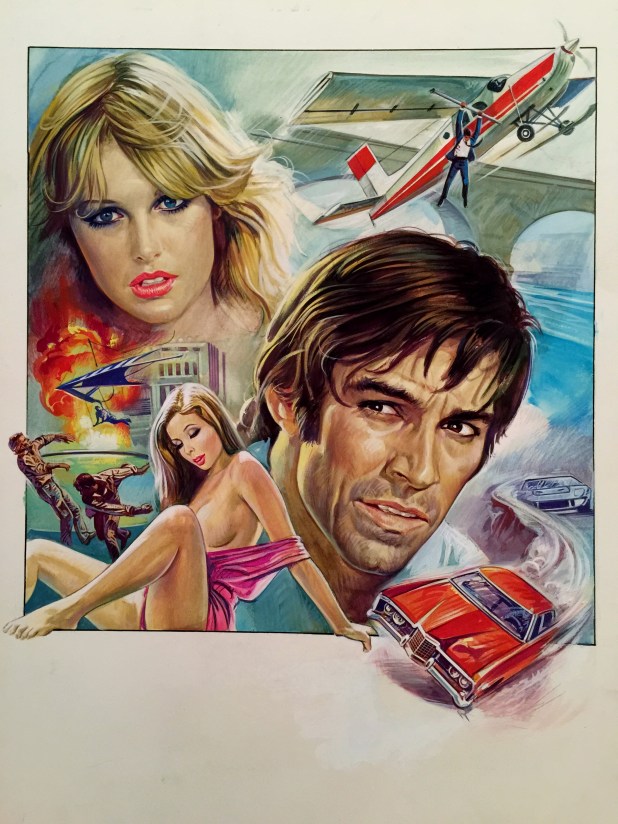
That’s also totally Testi flying the plane in this movie.
Years before John Woo gave us bullet romance violence, Castellari has Testi sliding down stairs, blowing people away while looking improbably, effortlessly cool. It takes some time to get the action at the end of this movie, but you know, we could all use a little patience, because the payoff, for once, is more than enough.
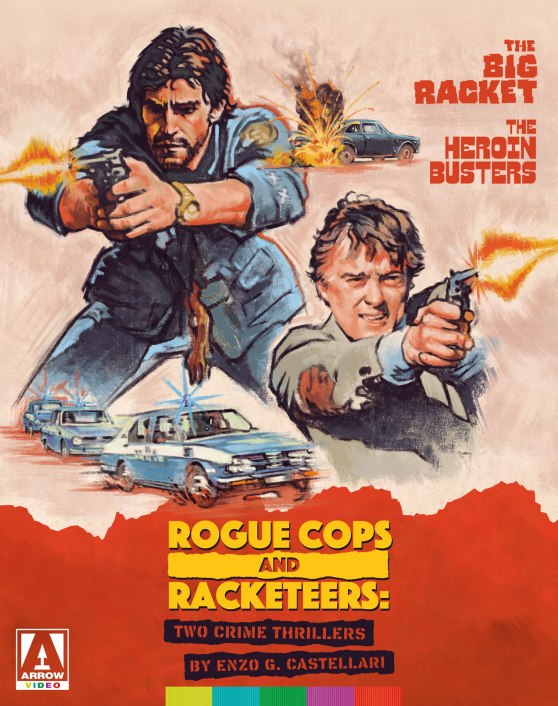
The Arrow Video limited edition of Rogue Cops and Racketeers: Two Crime Thrillers has this movie and The Big Racket. Both films have brand new 2K restorations from the original 35mm camera negatives by Arrow Films, with restored original lossless mono Italian and English soundtracks and newly translated English subtitles for the Italian soundtracks. Both movies also have new audio commentaries on both films by critics Adrian J. Smith and David Flint and the limited edition packaging has reversible sleeves featuring original and newly commissioned artwork by Colin Murdoch, as well as an illustrated collector’s booklet featuring new writing on the films by Roberto Curti and Barry Forshaw. If that’s not enough, you also get twelve double-sided, postcard-sized lobby card reproduction artcards.
The Heroin Busters also has new video interviews with Castellari, Testi, Vanni, editor Gianfranco Amicucci, retired poliziotto and criminologist Nicola Longo (who consulted on the film); The Eardrum Busters, a new appreciation and career retrospective of composers Goblin by musician and disc collector Lovely Jon; the film’s trailer and an image gallery.
You can get Rogue Cops and Racketeers: Two Crime Thrillers from MVD and Diabolik DVD.


 B&S About Movies
You must be logged in to post a comment.