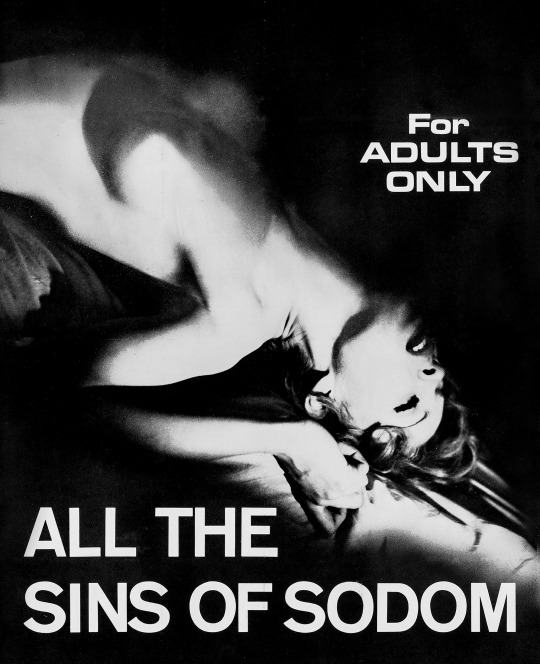
The title of this movie is awesome, but then I found out that it’s also called All The Evils Of Satan, and I don’t know if I could be more enthusiastic about a film.
New York City shutterbug Henning (Dan Machuen) is supposed to shoot some nudes for his agent Paula (Peggy Sarno), but is obsessed with shooting the evil that lives inside all women. To capture this, he takes images of Leslie (Maria Lease, who would go on to be a director of adult films, and Dolly Dearestand the script supervisor on Better Off Dead) as she hangs from the ceiling of his studio. After they make love, and while Henning usually never sees another of his conquests again, she feels different. She’s also mindblowingly gorgeous, which helps.
He also meets another model named Joyce (Marianne Prevost), for whom he feels sorry. She’s homeless and needs a hand up. He invites her to stay in his studio and assist him, but when he grows angry that he can’t capture with his camera what he sees with his eyes, he learns that she’s the perfect muse for his images of base morality. Paula even tells him she sent Joyce his way, claiming, “I sent her to you because she is what you’re looking for. If I ever I saw it, she’s the daughter of Satan.”
That means that things aren’t going to end well for anyone. Again, this is in stark black and white and while the lovemaking scenes are quite erotic, they’re mostly clothed. Then again, when they were made by Sarno, this burned the celluloid.
The first five and a half minutes of 1972’s All the Colors of the Dark (also known as Day of the Maniac and They’re Coming to Get You!) subvert what I call Giallo’s “graphic beauty” in intriguing ways.
An outdoor scene of a stream slowly darkens, replaced by an old crone with blackened teeth, dressed as a child and a dead pregnant woman are both made up to be anything but the gorgeous creatures we’ve come to expect from these films; even star Edwige Fenech (The Strange Vice of Mrs. Wardh, Five Dolls for an August Moon and so many more that I could go on and on about) isn’t presented in her usual role of a sex symbol. She’s covered in gore, eyes open and lifeless. As the camera zooms around the room and begins to spin, we see a road superimposed and hear a car crash. Even when Edwige’s character in this film, Jane Harrison, wakes up to shower, we’re not presented with the voyeuristic spoils that one expects from Giallo’s potent stew of the fantastique and the deadly. She stands fully clothed, the water more a caustic break with the dream world than an attempt at seducing the viewer or cleaning herself.
Again — in a genre where words possess little to no meaning — we are forced to wait five and a half minutes until the first dialogue. Richard (George Hilton, Blade of the Ripper), her husband, bemoans that he must leave but feels that he can’t. His therapy is a glass of blue pills and lovemaking that we watch from above; his penetration of her is intercut with violent imagery of a knife entering flesh. Instead of the thrill we expect from this coupling, we only sense her distance from the proceedings.
As Richard leaves her behind, we get the idea of the madness within their apartment: a woman makes out on the sidewalk with a young hippy man who asks when he’ll ever see her again. Mary (Marina Malfatti, The Night Evelyn Came Out of Her Grave, The Red Queen Kills Seven Times), a mysterious blonde, glares down at him, somewhat knowingly. His wife looks lost and trapped. Without dialogue, we’ve already sensed that some Satanic conspiracy is afoot. Echoes of Rosemary’s Baby? Sure, but you could say that about every occult-themed 1970s film — the influence is too potent, a tannis root that has infected all of its progeny.
Last year, a car crash took the life of Jane’s unborn child. Her sister Barbara (Nieves Navarro, Death Walks at Midnight, Emanuelle and the Last Cannibals) has advised therapy, which Richard laughs at. As Jane waits to see the doctor, she sees a man with the bluest eyes (Ivan Rassimov from Planet of the Vampires and Django in Don’t Wait, Django…Shoot!) — eyes we’ve seen before, eyes that hint at blood and murder and madness.
Even when surrounded by people, such as on the subway, Jane is lost in her thoughts and in another world, one of inky blackness and isolation punctuated only by the cool blue eyes of the sinister man who tracks her everywhere she goes. Even the teeming masses of the city make her feel more lost; only the light of the above-ground world erases the nightmare of her stalker. That is — until he finds her in the park, where she screams for him to stop following her. The camera is detached, following her from high above, watching her run away, needing the refuge of her home. Even then, the man is still there, banging on the door, demanding to be part of her reality.
The thing is — Richard has no faith in his wife’s sanity. And even when he’s telling her sister, Barbara, how he doesn’t trust psychiatry, he’s also watching her undress in a mirror. This scene really hints that they’ve had sex in the past (perhaps the past was just five minutes ago).
Jane finally finds a kindred soul—her neighbor, Mary, whom we saw earlier in the windows. Mary tells Jane of the Sabbath, the black mass and how it helped her. She sees Jane as a lost soul who needs to be saved and agrees to take her to her church.
The blue-eyed man returns, chasing Jane past a spiraling staircase, ax in hand. The camera spins, making us dizzy as it cuts from the building to the man and from Jane’s car to the man. Jane demands to be allowed to go to the Sabbath as she fears the madness that seems ready to overtake her.
As we approach the old mansion where the rite will occur, we feel more of a sense of belonging, a warmer color palette instead of the washed-out nature of the urban sprawl we’ve experienced until now. Everything is lit by a candle. Mary appears to have achieved a glow, and Jane stands in stark contrast to the beatific zombies of the assembled congregation. A taloned priest murders a dog in front of Jane’s eyes as Mary caresses her (trust me, this isn’t a Fulci realistic dog murder, although I hid my mutt Angelo’s eyes for this scene). The priest tells her that if she drinks the blood, she will be free. Hands and lips and bodies overtake her as an orgy breaks out, a bacchanal that she seems to want none of. This sex is presented as horror, as anything but pleasure, yet Jane seems ill-equipped to resist.
Immediately, we see her enjoying her husband, no longer frigid and everything back to normal, as he says. However, Jane tells her that she doesn’t feel real anymore. She walks to the bathroom, seeing multiple reflections of herself that harken back to the kaleidoscope effect we saw as the priest took her to the altar.
No matter what peace, love, and sex happen, Jane can’t escape the blue-eyed man. Even on a romantic lunch date with her husband, he’s outside waiting for her. A taxi drives her back to her home, the only sanctuary against the invasion that the man presents. As she goes through her husband’s effects, she finds a book of the supernatural emblazoned with a pentagram. He claims it’s just a second-hand book and accuses her of hiding things from him.
Jane returns to the Satanic church, this time willing to give herself over and actually seeming to enjoy lovemaking for the first time in this film. Mary intones, “Now you’ll be free.” Again, the long-fingernail priest takes her while the blue-eyed man watches her, his hands covered in blood. The members of the church dance around her as Mary calls to her. The priest tells her that Mary no longer exists. She is free to go, as she brought Jane to the church. The final act is for Jane to murder her, to send her away. Jane screams that she can’t do it, but Mary tells her that they must part, that this act will free her, as she lowers herself onto the dagger that Jane clutches.
Jane awakens, fully clothed, in a field. The blue-eyed man is there, telling her, “Now you are one of us, Jane. It’s impossible to renounce us.” He offers his hand, telling her to follow him. She’s expected. He takes her to an altar that is the same design as the pendant we just saw her wear during the orgy. She demands to know where Mary is, but the only answer she gets is that she belongs to the cult and will now be protected. Mary is gone, and Jane’s sacrifice allows her to be free. They show her Mary’s body, covered in black lace, as she runs screaming.
Perhaps in retaliation for the ritual, dogs chase her through the woods, tearing at her, stopped only by the blue-eyed man who knocks her out. She awakens, clad in virginal white, surrounded by white sheets. Her husband leaves a note in lipstick on her mirror. She looks, and the symbol is on her arm, which is covered in blood. When she goes to Mary’s apartment, an old woman lives there instead.
Jane is totally lost — the ritual has brought her nothing but more madness and the blue-eyed man even closer. Her husband is away on business, her sister is on vacation, and her therapist is dismissive. Even her apartment walls, which offer security, have become a maze of fear. The colors shift to Bava-esque hues of blackness and reds as we see the blue-eyed man attack her over and over again, with constant repetition of the frame as she screams — and then there’s no one there, just the room filled with red and a broken piece of pottery embedded in her hand.
After examining Jane, the doctor leaves her with an elderly couple. Her husband can’t find her and asks Barbara to help.
Jane awakens in a white room — of course, the blue-eyed man is waiting outside the house in the gauzy early morning hours. Yet there is an ominousness about the proceedings — no one is there. A tea kettle is boiling on the stove while the old man and woman sit there, in still repose, dead at the breakfast table. She’s trapped in the room with them as she frantically calls for help. She tells her doctor that the man is there and has killed everyone. He calmly tells Richard and Barbara that he has another patient to deal with, as he doesn’t trust Richard and wants to keep him in the dark. However, he does reveal the truth to Barbara. That lack of trust goes both ways as Richard follows the doctor.
Meanwhile, the blue-eyed man finds Jane, telling her she cannot renounce them. He tells her that the knife that he holds killed her mother when she tried to deny them. And it’s the same knife that killed the married man. He tells her she is beyond reality and will never find it again.
Following the sound of a hound, she finds the doctor’s car in the driveway — and, of course, he’s dead, too. The blue-eyed man gives chase and finally tries to kill her, but he’s stopped at the last minute by Richard, who stabs him with a rake. He repeatedly stomps on the man’s hand, revealing the tattoo symbol he stares at.
Meanwhile, Mary arrives home to a green-hued apartment, where Richard is smoking and accusing her of being part of black magic. He sees the symbol when he watches her undress, and she tells him that she wants him, that she can make him forget her sister. She promises him untold power and that he can become anyone he wants. As she leans in for a kiss, he shoots her, tossing the envelope of a letter that he received that explains it all.
Cut to a hazy white room where Jane has been given a sedative. An inspector — the priest from the cult! — demands to see her. Richard arrives and embraces her, telling her he will take her out the main door. They speed away in a car and return to their apartment. But all is not well — Richard is killed by an unseen person, and Jane is left holding the dagger. The police who arrest her all have the symbol on their wrists and are led by the leader. The camerawork becomes tighter and claustrophobic as we see the cult descending on her.
Wait — it’s all a Wizard of Oz dream, with the police and her husband at her bedside, explaining the film’s entire plot, which ends up even more ridiculous than everything that we’ve seen up until now (which is really saying something). Turns out there was no real magic. The cult was just a drug ring. Mary was real and just a heroin addict. Her sister was behind it all because she wanted all of the money from the will of their mother’s murderer, who wanted to give 600,000 pounds to both of them.
Jane rejects this reality, saying this cannot be true after all that she’s seen. The cop replies that he kept trying to call her, and she never answered, so he wrote it all in a letter — the letter that Richard showed Barbara after he shot her. It’s worth noting that the American version of the film ends with Jane being killed by the cult and all of the ending — nearly six minutes worth of important story and denouement — exorcised.
We return to where we were, with Richard going upstairs — just like we’ve seen before. Jane screams that she knows what will happen. The cult leader attacks him, blaming her for Barbara’s death. Richard follows him to the roof, where they fight, and the priest is thrown from the roof. Jane tells Richard that she knew the man was there; she knew that her husband had killed her sister, that it wasn’t a suicide, and that some strange force was guiding her. She asks for help, and the credits roll.
With this film, director Sergio Martino (Torso, 2019: After the Fall of New York) crafted an intriguing blend of the supernatural and the Giallo. Even the procedural elements come only after the film has descended into surrealism, as if a cold glass of water has been splashed in the face of a viewer who needs an explanation. Magic is madness, and we can’t even trust our heroine at the end when she begs to escape the power inside her.
This film is terrific, with Edwige Fenech turning in a strong performance. You really feel the isolation and madness that surround her and empathize with her. The strong visuals and the break from the genre conventions of masked killers, gloved hands and inept police make watching this film an absolute joy. From beginning to end, it makes you question not only the reality that it presents but also the objective trustworthiness of our heroine. And while it betrays an obvious inspiration to the aforementioned Rosemary’s Baby, it is not slavish in its devotion, making a powerful statement on its own merit.
Here’s a cocktail recipe.
They’re Coming to Get You
1.5 oz. J&B
.5 oz. lemon juice
.5 oz. simple syrup
1 egg white
3 dashes Angostura bitters
Shake all ingredients in a cocktail shaker filled with ice.
Alley Cat has three directors. I have no idea why, but Victor M. Ordonez (who is in Nine Deaths of the Ninja and Hellhole), Ed Palmos and Al Valetta (who is in Sole Survivor, Runaway Nightmare and Hollywood’s New Blood) all had their hand in this movie, leaving Robert Waters, who also wrote Fighting Mad, to write the actual story.
Billie (Karin Mani, who was also in Avenging Angel) is our heroine Billie. She starts the movie by stopping some scumbags from stealing her car. They go to their boss Scarface (Michael Wayne), who decides that he’s going to turn this tiger into an alley cat, a plan that starts by putting her grandmother in the hospital and beating her grandfather something fierce. The one good thing that happens is that she falls for a cop named Johnny (Robert Torti), who ends up having to arrest her with his partner Boyle (Jon Greene) when she defends some joggers from the very same criminals and has a gun without a permit.
When Billie goes to court, she pays twice the fine of the rapists, whose victims are intimidated by Scarface and never show. Billie reacts like a maniac, gets charged with contempt of court, and turns her movie into a WIP film for a little, complete with requisite shower moment.
This is the only women’s revenge movie — yes, Billie gets out and gets said payback — in which the lead character eats at an Arby’s. The old Arby’s had that giant beef hat on the sign before they had the meats and all. And oh yeah — while she’s in jail, her grandmother dies and Billie is robbed of those last moments, so even though her boyfriend wants to legally deal with Scarface, you will be hoping that she shoots him right in the dick.
Richard Pryor may have co-written Blazing Saddles, but didn’t star in it. Fred Williamson thought it was too silly, so the two of them got together and made their own Western comedy. The script was just 12 pages, and Pryor ad-libbed most of it.
Williamson said, “I wanted to give him an idea, a concept, and then just turn the light on him and let him do whatever he wanted. You know what they say about comedians—that you can just open the refrigerator door, and the light comes on, and the jokes roll on out. Well, Richard’s light didn’t come on.” Pryor also said, “Tell them I apologize. Tell them I needed some money. Tell them I promise not to do it again.”
Only the second movie Williamson would direct after Mean Johnny Barrows, he plays Big Ben and Pryor is Sam Spade. Ben is always making up for Spade’s schemes and, well, that’s the movie. You’ll hear the song “Adios Amigo” many times. Like, so many times that you’ll have no problem remembering the name of the movie. Too bad it’s nowhere near as good as it should be.
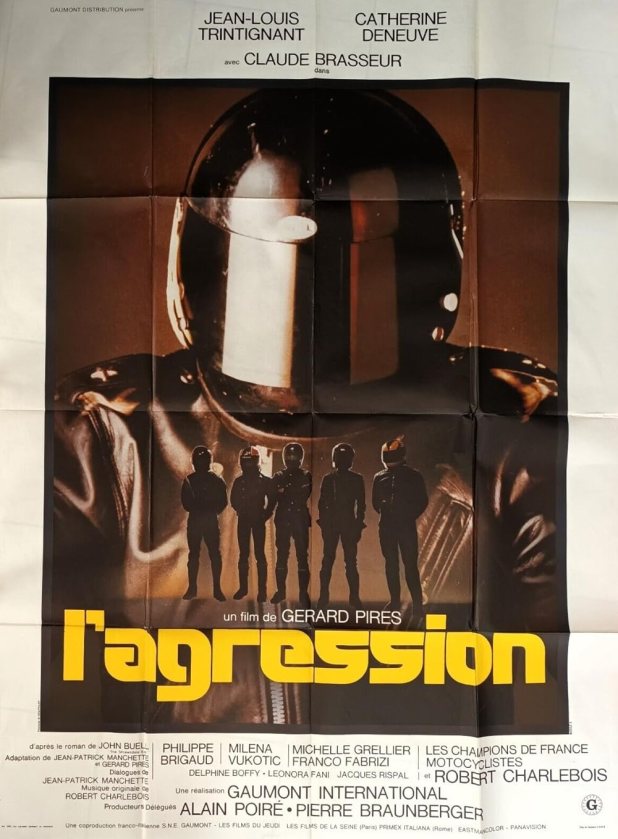
Directed by Gérard Pirès — who wrote the story with the author of the book that it’s based on, Jean-Patrick Manchette, although John Buell’s novel The Shrewsdale Exit has also been cited as an inspiration in other places — L’agression is the story of Paul Varlin (Jean-Louis Trintignant), who obviously has road rage issues. Well, after some bikers hit on his wife, those very same men end up nearly killing him and his family.
Stay tuned. As Paul pulls over, he charges the three helmeted motorcycle maniacs, who knock him out and then assault and kill his wife and daughter. Yes, Paul has screwed up and he can’t admit it to himself. All he wants is revenge.
There’s also Sarah (Catherine Deneuve), the sister of Paul’s dead wife, who realizes that her brother-in-law is going about this as badly as you can imagine. He’s no Paul Kersey. She even saves them both at one point, as she’s a better physical fighter — and maybe even mental — than he is.
Pirès went on to make the comedy series Taxi in France. There’s no hint of that in this movie.
There’s an edited version of this movie on YouTube that censors nearly every few words and has nearly half an hour missing. That’s how scuzzy this movie is, a film that feels like you’re in the middle of a New Jersey swamp, covered in toxic waste.
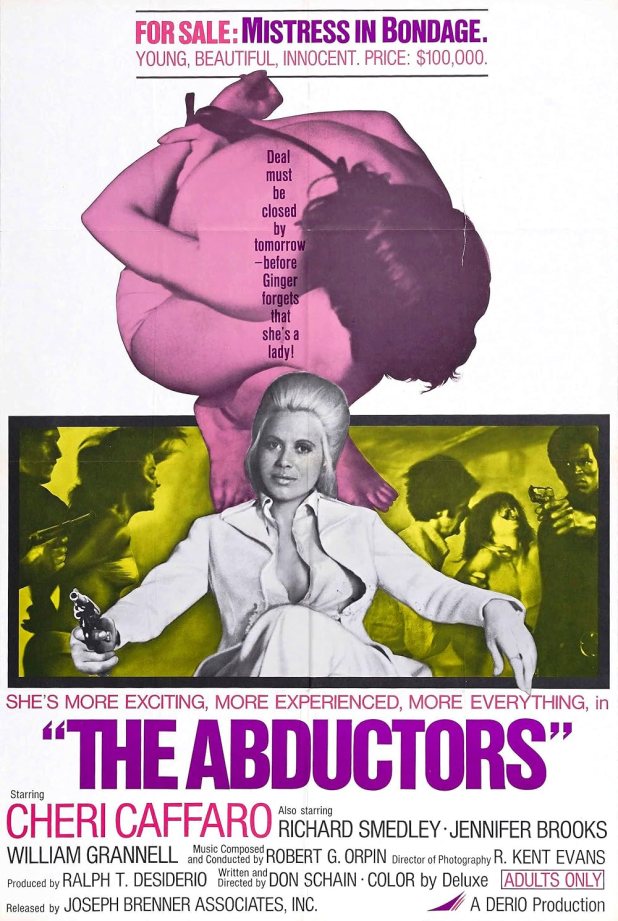
It was directed and written by Don Schain, the first president of the Motion Picture Association of Utah, a man who would go on to produced High School Musical for Disney. But not now. Now, he was making a series of three vanity films with his wife at the time, Cheri Caffaro, who once won a Bardot lookalike contest in Life Magazine. Now, we’re at the center of the Ginger trilogy, which started with — you guessed it — Ginger and will end with Girls Are for Loving.
Ginger McAllister is a tough private eye and super spy who is part of the swinging 70s, the porno chic era, who looks to sex up men instead of waiting for them to ask her. Don’t get too excited about this liberation — Ginger spends much of these movies getting tied up more often than Wonder Woman and assaulted more times than one can count.
The bad guys have figured out how to program women to be sex slaves and are selling them. Ginger is out to stop them, pausing only for an extended dance sequence. In-between the first two movies, Caffaro and Schain got married, so somehow this made her more comfortable getting naked on-screen and having love scenes. And oh, those love scenes. Never has sex felt more repellant and something not worth doing; sweaty, pale men just lying on women, grinding away until they get off. No one seems to be enjoying it, even if this entire movie is all about the lengths people will go to for the girlfriend experience.
One of the kidnapped girls is Jeramie Rain, Sadie from Last House On the Left. And, as if to make this even more offensive, Cheri’s boss Jason Verone (William Granne) is so swishy you feel like Paul Lynde will burst in and tell him to butch it up.
There’s also some great bullshit science in this, as Cheri swallows “radar disks” that are just cough drops so that people know where she is. Why does a roughie need Eurospy gimmicks? I don’t know but I’m happy it’s in this. I do wonder where the Geneva Convention comes into all of this spying, because Ginger has the habit of getting off the bad guys after she captures them. Everybody was fucking in the early 70s in New Jersey, even if they shouldn’t and even if you have no interest in seeing it. Sometimes, women could torture people too and they can still be on the side of good.
The bad guy (Richard Smedley) owns an ad agency, because yes, all advertising people are horrible bastards and I can say that because I’m one of them.
So anyways, like I said, the guy who made this went on to work for Disney. As for Cheri, she wrote and produced H.O.T.S.
Also known as SuperBlack and In Your Face, this movie features Dr. Kinkade giving a special formula to his bodyguard, John Abar, to transform him into a black superhero. It was shot in the Baldwin Hills and Watts neighborhoods of Los Angeles without any permits. When the cops showed up, the actors playing the motorcycle gang surrounded them and the crew kept right on shooting.
Directed by white actor Frank Packard, who acted in a few films and was a gaffer on The Runaways, written by J. Walter Smith (who also plays Dr. Kinkade) and funded and conceived by James Smalley, a pimp from Louisiana who had the connections to film this movie in an actual house of the rising sun. He ran out of money before the film was completed and then sold the movie to the owner of a film processing lab to settle his unpaid bills. It played the Southern drive-in circuit and black theaters, then disappeared until it was re-released in 1990.
John Abar (Tobar Mayo) has come to the aid of the doctor and his family after they move to an all-white neighborhood and are treated exactly as you’d expect. He leads the Black Front of Unity (BFU), which sadly can’t save the life of Kinkade’s son. He’s been given superpowers in the hopes that he can combine Dr. King and Malcolm X, along with the invulnerability he needs to not get killed.
He also gets mental powers, the kind that allow him to teach prostitutes how to kung fu their masters — I wonder how Smalley felt about that — and turns a racist’s dinner to earthworms years before The Lost Boys.
To quote Black Horror Movies — and Abar — the powers may have been his all along: “You see, the potion released from my soul an ancient wisdom. My powers are of a divine origin. I’m only a tool, a mirror reflecting man onto himself. By controlling the mind, I can hasten the retributive forces lodged in his unconscious mind.”
He then lets a literal Biblical plague loose on those honkeys.
This movie may appear cheap, because it is. However, it also presents some really great ideas, featuring a hero who brings intelligence instead of violence and offers multiple perspectives on the 1970s black experience. It’s also bizarre, almost unexpectedly so. I found myself loving every minute of this and I think you will as well.
This movie is quite literally the Justice League — more like the Legion of Doom — of scumbag film superstars.
It was written and produced by Harry Alan Towers, who transitioned from syndicating radio and TV shows to being arrested, along with his girlfriend, Mariella Novotny — who was played by Britt Eklund in Scandal — for operating a vice ring. He jumped bail and ran to Europe while his lover revealed that Towers was a Soviet agent using his girls to get info for the Russians. And Novotny, a high-class call girl, had already been linked to both John and Robert Kennedy, as well as having experience working for MI5.
Once he settled down in Europe, Towers married actress Maria Rohm — she’s in this, as well as several other Jess Franco movies — and started writing and producing movies based on the novels of Agatha Christie, the Marquis de Sade and giallo father — one of many, but a father nonetheless — Edgar Wallace.
Franco made at least 173 movies and took a gradual slide from horror, Eurospy and softcore films into grimier and grimier films. He’s an acquired taste that I’ve grown to enjoy, yet for every well-made movie like Bloody Moon, you’ll find one where you wonder if Franco had even seen a film before, much less made one.
The reason for that is often the funds that Franco had at his disposal. He’s the kind of filmmaker who would make ten bad movies instead of one good one, provided he had the chance to make a movie.
He reminds me a lot of the third member of our exploitation army of evil, and that would be the man that edited this movie — and from all accounts, directed the pornographic insert (pun intended) scenes — Bruno Mattei..
The French version of this movie features eight minutes of fully adult footage, shot with body doubles in similar settings, all to create the illusion that this movie is much more hardcore than it actually is.
To be perfectly frank, this movie is an aberrant work of absolute indecency, even without seeing gynecological footage of the old in and out.
New inmate Marie (Rohm, yes, the producer’s wife, yet she endures so much that you really get the idea that this is not an example of nepotism) has arrived at Castillo de la Muerte, an island prison where she’s given the number — she no longer has a name — 99.
She’s joined by Helga, now known as 97. She’s played by Elisa Montes, who had appeared in several peplum and westerns before this. And Natalie Mendoz — 98 — is played by Luciana Paluzzi, who was SPECTRE assassin Fiona Volpa in Thunderball, as well as showing up in everything from The Green Slimeto A Black Veil for Lisa, The Man Who Came from Hate and The Klansman.
They’re suffering under the oppressive sapphic rule of Thelma Diaz, a tough warden who is, shockingly, played by Oscar-winner Mercedes McCambridge, who won that award for All the King’s Men, was nominated for Giant and was also the voice of Pazuzu. She’s berserk in this movie, laying it all on the line, unafraid to go over the top and then keep her upward trajectory.
“From now on, you have no name, only a number. You have no future, only the past. No hope, only regrets. You have no friends, only me,” she barks at them before they even get into the prison.
Eventually, Diaz takes things too far, but even the new warden, Caroll (Maria Schell, who had an affair so memorable with Glenn Ford that she remembered it two decades later and gifted him with a dog named Bismarck who became his constant companion) can’t improve this hell on earth. So the women escape at the same time that several men break out from the similarly brutal rule of Governor Santos (Herbert Lom).
What happens when you have several damaged women on the run being followed by men who haven’t even seen a woman in decades? And what if that happens in a Jess Franco movie? Yeah, you can see where this is heading.
Rosalba Neri — Lady Frankenstein! — is also on hand to pretty much set the film on fire in every single frame that she shows up in.
Every Women in Prison movie that would follow in the slimy wake of this film would be based on the path it blazed, including Mattei’s own The Jail: Women’s Hell, which he waited nearly four decades to make and adhered mainly to what Franco had started. Well, he was also following the even more berserk template he’d established with Violence In a Women’s Prison and Women’s Prison Massacre. Man, if you want a WIP movie, call Bruno Mattei. Sadly, you can’t. He’s dead.
This is one of the Franco films where he’s not just making a movie, but a good one. The focus is soft, the feel is surreal and the interplay with the Bruno Nicolai score is fabulous.
Spike and Hoax (Stephen Geoffreys from Fright Night) are cousins who live under the overly watchful eye of Hoax’s super religious mother, Lucy (Sandy Dennis, Who’s Afraid of Virginia Woolf?, God Told Me To). They couldn’t be more different. Hoax is a nerd afraid of everyone, while Spike is a motorcycle-riding bad boy with the girl of his cousin’s dreams, Suzie (Lezlie Deane, Freddy’s Dead: The Final Nightmare).
Both boys start using the novelty phone number 976-EVIL, which reads them creepy-themed fortunes for a few dollars. The real truth is quite sinister: Satan uses the line to find people to give them what they want in exchange for their souls. There’s a great scene here where a religious investigator goes to the home of 976-EVIL, After Dark, Inc. There is room after room of people, Santas, phone sex women, and so much more, but in one dusty, cobwebbed closet lies the machine that powers this foul enterprise.
By the end of this movie, the cousins’ power dynamic has shifted, and the literal gateway to Hell appears in front of them. The way there is littered with ’80s clichés and a tone that is never sure if it fully wants to be comedic or horrific.
Still, this movie is not without its charms. The Deftones wrote the songs “Diamond Eyes” and “976-EVIL” about the film and it was popular enough to bring Spike back for the direct-to-video sequel 976-EVIL II: The Astral Factor. And England met his wife, set decorator Nancy Booth, while directing this movie. She would sneak R+N into the backgrounds of scenes that he would discover each day while watching the dailies. And hey, how many movies have uber religious old women get devoured by cats?
I’ve been inspired by the book Warped & Faded: Weird Wednesday and the Birth of the American Genre Film Archive and have decided that every Wednesday on the site will be films that played as part of the Alamo Draft House Weird Wednesday events.
William Castle loved a gimmick. Here, he promised that each of the thirteen girls would be from their own country, even if Judy Pace plays a Liberian. Our American heroine, Candace “Candy” Hull (Kathy Dunn), is fresh out of school and devoted to trying to win the heart of spy Wally Sanders (Murray Hamilton). She goes into espionage herself before getting in trouble.
The rest of the ladies, except Dunn, Lynne Sue Moon (who plays Mai Ling), and Gina Trikonis (who plays Natasha), won their roles in a contest and use their real names for their roles.
Candy and her friends are all the children of diplomats and used to be among the upper crust. But what happens when a spy is killed? Also, there are fifteen girls, not thirteen. But mostly, it’s Candy using the name Kitten and getting in too deep.
The other girls include Alexandra Basterdo (The Ghoul, The Blood Spattered Bride), Lynne Sue Moon (55 Days at Peking) and Gina Trikonis (West Side Story and later a costume designer).
This played double features with Gidget Goes to Rome, which may not be what you expect from a William Castle Movie.






 B&S About Movies