Night Gallery works best when it’s longer stories and not — am I a broken record yet? — the excruciating black out shorts. This episode also has a more experimental first story and I love when the show tries to break new ground.
“The Phantom Farmhouse” is about a sanitarium that allows its patients to roam outside for therapy. When one of them is killed another patient named Gideon (David Carradine) claims that a girl who lives nearby named Mildred Squire (Linda Marsh, Freebie and the Bean, The Dark Secret of Harvest Home) is the murderer. Doctor Joel Winter (David McCallum, three years removed from The Man from U.N.C.L.E.) refuses to believe that this could be true once he glimpses how gorgeous she is.
Directed by Jeannot Szwarc, written by Halsted Welles and based on a short story by Seabury Quinn, this is shot in a surreal style and Carradine is perfect as a character who feels like the antagonist but stay with it. I also read this referred to as a pre-80s werewolf story, as special effects made a leap in 1981, the year of the werewolf movie, but this still works for me.
Conrad Aiken’s best-known short story, “Silent Snow, Secret Snow,” was originally filmed as a 17-minute short movie produced by Gene Kearney. Kearney directed this story for Night Gallery and it’s a haunting tale of a boy who chooses the world of dreams and snow to the dirty real place that reality offers. It’s made even better because Orson Welles is the perfect narrator.
Paul Hasleman (Radames Pera) withdraws from our world when he starts to care about just one thing: the snow. Much like other Serling presentations that used fantasy or science fiction to explain issues of racism, this is an incredibly stirring tale of a boy with developmental issues that is failed by everyone. Kearney also wrote the teleplay for this and this is perhaps his finest work and amongst the best of Night Gallery.
This whole episode is what I want this show to be. My frustration when it isn’t aside, being able to enjoy this near-perfect journey into the Night Gallery is why I continue to champion this classic show.
Ultraman Max is the eighteenth installment in the Ultra Series, originally airing in Japan from July 7, 2005 to March 25, 2006. Across 39 episodes and one special, the special anti-monster task force DASH (Defense Action Squad Heroes) battles invading alien monsters, helped by Ultraman Max, who is secretly Touma Kaito, a DASH team member.
Unlike Ultraman Nexus, which went for a darker tone, this is a return to the original Ultraman series, bringing back old favorite monsters like Red King, Gomora, Antlar, Zetton, Eleking, Pigmon and Baltan. It also has a belief that humanity’s future will be a positive one, unlike so much of the science fiction of the 2000s.
There’s even a black and white episode that’s a tribute to the original Ultra Q and Ultraman Xenon makes a guest appearance.
Ultraman Max has an interesting role. As a Civilization Guardian, he studies developing civilizations and works to help the species of other planets exist as one. Like so many of the Ultras before him, he has bonded with Touma Kaito after a great sacrifice, honoring the human by saving his life and sharing a body with him.
I like the idea that even the evil aliens have to admit that they like Earth in this story and how we have a place in the universe. Ultraman Max himself is inspiring, as he believes in the human race and in having faith in others. He’s learned a lot in his 7,800 years of life.
Another cool part of this show is that the monsters aren’t just aliens, but mythological creatures from Earth’s past. This series gave me a warm, fuzzy feeling and memories of being on my parent’s couch, jumping all over the room and blasting imaginary monsters with my Ultra Beam pose.
You know, if I had first seen Urutoraman Kizzu: Haha wo Tazunete 3000-man Kouneback in 1992, I would have hated it. How dare they make a kid cartoon out of my beloved Ultraman? Now that I’m older, I find it charming and had a lot of fun watching it. Maybe there’s something to be said about not being so precious about things you love.
The 1984 Urutoraman Kizzuspecial was a hit, so why not do an entire show?
The hero of this show is Maa, an Ultra who survived a spaceship crash and met Grosser-sensei, a kind monster who raised him as if he were his own child. Grosser-sensai is voiced by Takeshi Aono, who was also Sanada Shiro on Space Battleship Yamato amongst so many other voices.
Even though he has friends and a new family, he still wonders where his parents could be, so he decides to travel into space to find them.
He is joined by other Ultras, including his crush Piko, the Ultraseven-lookalike Cebu, the Ultraman Taro sports star Taa, Rookie, Ace, Root and Nozzy. They attend class with a bully named Bal, which makes sense, as he’s an alien Baltan. His friend is an alien Guts named Gutsun, plus there are also monsters like Mephila, Pega, Gomotan, Elepy, Tacon, Poly Poly, Pigko the Pigmon and Midori.
This is a fun show for kids who love Ultraman as the Ultras and monsters get along together, even if they’re rivals at times. I watched most of the set over two days and it was a bright, candy colored burst of sheer joy. I’m going to return to it when I need to improve my mood. I’m so glad that it’s now available in the U.S., thanks to Mill Creek.
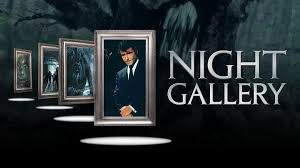
Another Friday, another Night Gallery. Ah, the magic of the past, the paintings hanging in abject blackness. Let’s get scared.
“A Fear of Spiders” tells the story of restaurant critic Justus Walters (Patrick O’Neal, The Stuff), a man afraid of spiders who is now dealing with several in his apartment, forcing him to turn to Elizabeth Croft (Kim Stanley, incredible as Frances Farmer’s mother in Frances), the neighbor that he has spurned, for help.
A simple story told well, this was directed by John Astin and written by Rod Serling and based on Elizabeth M. Walter’s “The Spider.” Even though the spider effect at the end may seem somewhat dated, you have to consider the budget of this show and be understanding. Steven Spielberg was slated to direct this episode but backed out. While Astin is mainly known for playing Gomez Addams, he turns in a solid episode.
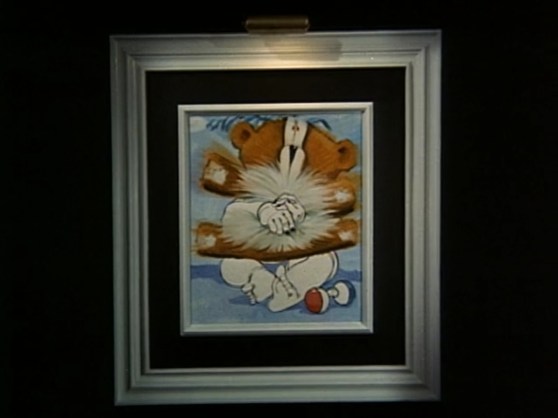
“Junior” is another blackout segment that has Wally Cox wake up in the middle of the night to stop his son from crying. That boy ends up being a baby Frankenstein’s monster. This is directed by Theodore J. Flicker, who also made Jacob Two-Two Meets the Hooded Fang, and was written by Gene R. Kearney. We’re lucky that these episodes are streaming or on blu ray, because if I had to sit through commericals only to come back for this, I would dislike it so much more.
“Marmalade Wine” was directed and written by Jerrold Freedman (Borderline) and is based on a story by Joan Aiken. It’s pretty wild for a TV show, as the entire set feels like a stage play surrounded by darkness. Photojournalist Roger Blacker (Robert Morse) is lost in the woods and finds Dr. Francis Deeking (Rudy Vallee, yes, the singer), a surgeon who amputates his feet so that he will stay and continue making predictions of the future.
It doesn’t exactly work but the fact that it tries is worthwhile. I’d rather Night Gallery had more experiments like this and less outright comedic pieces of fluffy nonsense.
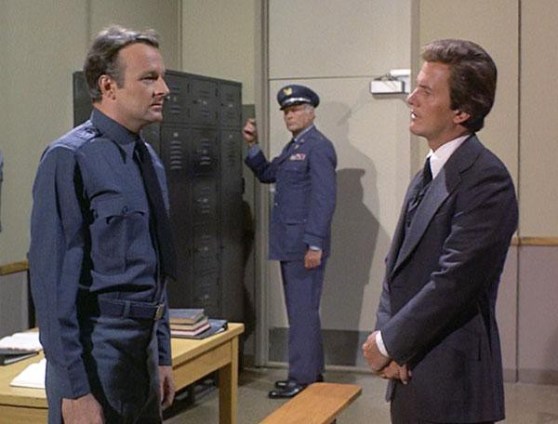
“The Academy” has a very simple idea, as the children of the rich and powerful never leave a military school, forgotten and thrown away, something that the school’s director (Leif Ericskon) feels is what a father (Pat Boone, the second acting singer in one night) wants to do with his delinquent son.
Director by Jeff Corey (who is better known for acting in movies including Beneath the Planet of the Apes) and written by Serling, based on a story by David Ely, this is quick and to the point.
This episode of Night Gallery feels more morality play than horror, yet still finds something worth watching.
Erica Benedikty also made Phobe: The XenophobicExperiments, the Canadian science fiction SOV movie and she kept on in that format when she made this one, a dungeonsynth on video epic in which six friends — Candace, Ray, Mark, Craig, Liz and Norm — sit around a campfire and play Dungeons and Dragons, which brings them into another world in which they actually have to be wizards, clerics, barbarians and thieves.
It’s also very Narnia in that in order to get back to our world, they have to rescue a princess or get stuck forever.
It’s wild that the SOV genre can encompass not just slashers, which are easier to make on a low budget, but several sword and sorcery movies like The Song of the Sword, Way Bad Stone, Masters of Magic and this film.
You can make fun of nerdy RPG players all you want but these guys got it togther and made something with enough story for more than one movie.
Canadian studio Emmeritus Productions may not have had much money, but they made some interesting movies, including porn-based detective story Blue Murder, Death In Hollywood, horror anthology Shock Chamber, post-apocalyptic Survival Earth, Diamon In the Rough, Body Count, Satanic conspiracy thriller Mark of the Beast, The Borrower, The Bounty Hunter, Lady Bear, Last Chance, The Hijacking of Studio 4, Niagra Strip, SOV history film The Chronicle of 1812, Fly With the Hawk, Virgin Paradise, Commando Games, Marked for Death, Price of Vengeance, Race to Midnight and The Edge.
Also, they made The Tower.
Directed and written by Jim Makichuk, the same man who created Ghostkeeper, this is a Canadian science fiction tale of the Sandawn Building, a high rise of tomorrow that has a computer running it named LOLA and man, avoid all futuristic buildings in the North-West Territory that have shopping and living amenities because I am convinced you’re either going to contract a disease that makes a sex organ grow in your armpit or you will be killed by a supercomputer.
None of this is obvious to the man who created her, Watson, who sees humans the same way she does: as sources of heat energy. So on the Friday night that LOLA loses its mind, the inhabitants of an ad agency — nuke these people from orbit — as well as Old Man Sandawn, his wife, his mistress, some criminals and a security guard and his way out of his league girlfriend who is just there to swim — all get trapped and menaced by a building.
For some reason, there’s also an exotic dancer who can barely dance who wants to sleep with Watson, but you know, it’s so cold in Canada that even their movies have padding.
This movie is worth watching not only for the worst depiction of an ad agency in a film — those marker renderings are trash — but also for an old woman who knows that a computer is trying to kill her and decides to go try on feather boas and have a mall makeover instead.
As I started discussing last week, the second season of Night Gallery is all about the split between Rod Serling and Jack Laird and their two visions for the show. This episode speaks to that and is the first to not have a story written by Serling.
“Since Aunt Ada Came to Stay” is a very 1970s occult story, as Professor Craig Lowell (James Farentino, Dead and Buried) comes to believe that his wife Joanna’s (Michele Lee, Karen from Knots Landing) elderly Aunt Ada (Jeanette Nolan) is not related at all but instead an incredibly powerful and quite evil magical being.
Directed by William Hale, written by Alvin Sapinsley and taken from “The Witch” by A.E. van Vogt, this story is also blessed by a small role for Jonathan Harris as a true occult believer of a teacher.
This totally could be an entire episode — and I wish it was — but it moves quickly and is a blast.
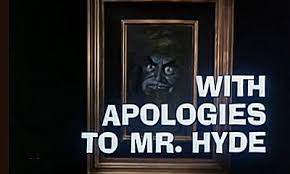
“With Apologies to Mr. Hyde” is another Jeannot Szwarc and Jack Laird quick story, this time with Adam West as the literary villain. Laird is in this as a hunchback as well, just to confirm that when people want to be known for being creators in the wrong way, they show up in their own material.
“The Flip-Side of Satan” has J.J. Wilson (Arte Johnson) as a DJ who soon learns that he is in Hell and on the air for the last time. This story worked so well that Tales from the Darkside also did a version with Jerry Stiller transforming into a monster as he takes calls for all of his eternal punishment in a story written by George A. Romero and directed by Michael Gornick.
This story is written by Jerrold Freedman, whose last directing job was as the Alan Smithee who made The O.J. Simpson Story, as well as much better TV movie work like A Cold Night’s Death, The Boy Who Drank Too Much, Victims and the theatrical Racquel Welch roller derby movie Kansas City Bomber, and written by Malcolm Marmorstein (who somehow both wrote Mary Mary Bloody Mary and Pete’s Dragon) and Gerald Sanford from a story by Hal Dresner (Sssssss, Zorro the Gay Blade), this is a welcome return to form after that quick Laird story.
If you can skip that moment of Adam West overacting, well, you just may like this episode.
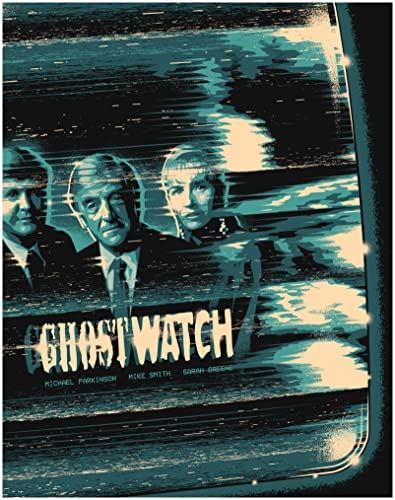
Thirty years ago, the BBC seemed to be doing another one of their “Watch” shows, as four presenters — Michael Parkinson (host of the talk show Parkinson for twenty five years), presenter Sarah Greene (who had worked on several of the “Watch” shows like Airportwatch), her real-life husband Mike Smith (a co-host of the BBC’s Breakfast Time and was a presenter on Top of the Pops) and Craig Charles (who worked as a presenter before playing Dave Lister on Red Dwarf, hosting Robot Wars and narrating Takeshi’s Castle) — and a camera crew descended on the most haunted house in Britain on Halloween night.
Pamela Early (Brid Brennan) and her daughters Suzanne (Michelle Wesson) and Kim (Cherise Wesson) have been dealing with Mr. Pipes, a poltergeist who possesses and harms Suzanne and lives in the basement of their home. Dr. Lin Pascoe (Gillian Bevan), a psychologist studying the phenomena, supports Pamela and the children as Sarah reports from inside the home with her husband Mike interviews the man on the street and Craig makes with the jokes.
As the program (programme!) unravels, it turns out that maybe this isn’t all a hoax. Several calls from listeners help construct the true story, as the story of the murderous Mother Seddons is retold, as is the case of Raymond Tunstall, who hung himself in the basement of the Early home and was eaten by cats. By the end, the beast known as Mr. Pipes has transformed the live broadcast into a seance circle and attempts to use the show to possess all of England.
For American viewers, it’s all rather well made but one wonders how people could have been so upset by this show. Well, for those in Britain, this movie seemed like anything but.
The crew making it took great pains to make it seem real, even if it was part of the BBC anthology series Screen One. It was shot in Studio D of BBC Elstree Studios, a place where many news shows had been aired from. The 081 811 8181 is an actual BBC call-in number, adding to the realism. In fact, the show was nearly canceled because the network didn’t want a War of the Worlds panic to happen. They demanded opening credits be added including the writer’s name, in addition to a Screen One title sequence.
No one noticed that.
The documentary style of Ghostwatch led to 30,000 phone calls from frightened viewers, including Parkinson’s elderly mother! In the days to follow, tabloids went to town criticizing the BBC — who never reaired Ghostwatch — which only increased when eighteen-year-old factory worker Martin Denham became obsessed by the show and upon hearing noises in his parent’s home much like the show would take his own life. The Broadcast Standards Commission rebuked the BBC, saying “The BBC had a duty to do more than simply hint at the deception it was practicing on the audience. In Ghostwatch there was a deliberate attempt to cultivate a sense of menace. The presence in the program of presenters familiar from children’s programs took some parents off-guard in deciding whether their children could continue to view.”
Considering that children and elderly people reported PTSD after watching this, you can see why Greene appeared on the following Monday’s Children’s BBC to reassure younger viewers that the show was not real.
Except that it kind of is.
The story is based on the Enfield poltergeist, a story that had been debated in the tabloids as well, which adds even more of a layer of truth to this story. Peggy Hodgson reported poltergeist activities in her home and voices that would emerge from her daughter Janet. The BBC had reported several times on this story, so Ghostwatch probably felt like a Halloween ratings sweeps stunt.
Writer Stephen Volk (Gothic, The Guardian) had seen this as a mini-series but producers thought that the final live segment, inspired by Nigel Keale’s The Stone Tape, would have more impact.
While this show destroyed minds and reaped souls in England, over here it’s been an influence on so many found footage films like Host and The Blair Witch Project, as well as the near-perfect UHF TV era U.S. remix WNUF Halloween Special.
I love that this is shot on video, not for the need to save money, but for the need to appear real. SOV continues to be a format that offers so many hallways to explore.
Volk wrote a sequel in the short story 31/10, in which he vists the sealed-off BBC studio space where the original show was made along with a group of people whose lives were somehow impacted by Ghostwatch. You can read it here.
In Britain, there are national seances every year to watch this and even a great website called Behind the Curtains that tells so many of the stories of this movie.
If you want to see it for yourself, the 101 Films blu ray release of Ghostwatch is perfect. In addition to the movie, you also get a 30th anniversary feature-length documentary, two sets of commentary — one with film historians Dr. Shellie McMurdo and Dr. Stella Gaynor and the other with Volk, producer Ruth Baumgarten and director Lesley Manning — as well as a Shooting Reality feature with Manning, a 32-page book and a first edition slipcase. You can get it from MVD.
As the second season of Night Gallery goes in two directions — the Serling side growing in dark energy and the Laird side being inane pablum — this episode has three of four stories directed by Jeannot Szwarc, who directed the TV movies Night of Terror, The Devil’s Daughter and You’ll Never See Me Again as well as Bug, Jaws 2, Somewhere In Time and, well, Supergirl and Santa Claus: The Movie. Let’s focus on the good like this episode.
“Death In the Family” was written by Rod Serling from a story by Miriam Allen DeFord. This is one of the segments on this show that could be a whole film. Doran (Desi Arnaz Jr., House of Long Shadows) is a prisoner on the run that hides in the funeral home — and home — of Jared Soames (E.G. Marshall), a man who has a secret of his own. The end of this episode is so perfectly dark and yet filled with love, another wonderful trip to Serling’s imagination.
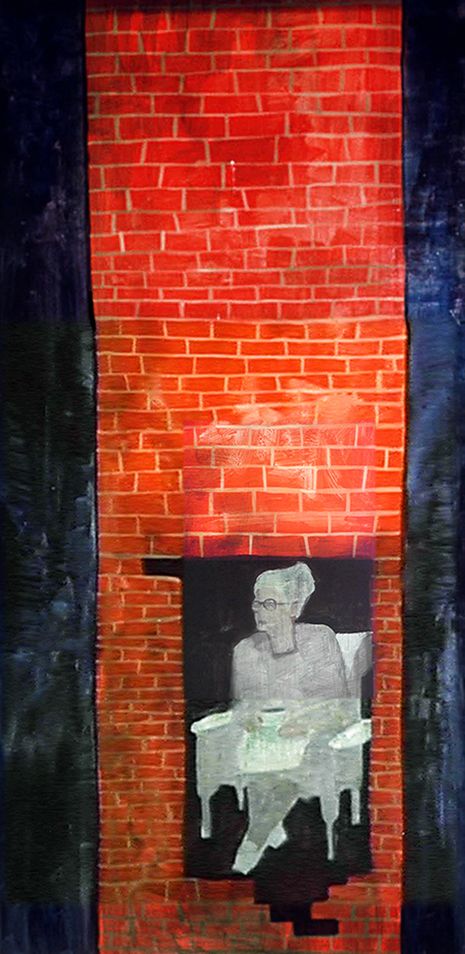
“The Merciful” is another Jack Laird-written chapter, based on a Charles L. Sweeney Jr. story. A man (King Donovan) is kept away from his wife (Imogene Coca) by a brick wall in another sketch that takes from a classic story is over in minutes.
“Class of ’99” works so well not just because of the tight script by Serling, but also because Vincent Price is able to be so sinister — and perfect — in his role of a teacher instruction the students of tomorrow in the violent ways of the past. Classism and racism are explored as he gives his class a final oral test and finds them all lacking. I just read a site that claims that this segment suffered from Serling’s “heavy-handed moralizing and misanthropic undertones.” That’s why I watch Night Gallery.
“Witches’ Feast” comes from director Jerrold Freedman and written by Gene Kearney. The cast is fine — Agnes Moorehead, Ruth Buzzi, Fran Ryan and Allison McKay — yet this is the very epitome of pointless, particularly in the same show that had two classic segments by Serling.
This Pop Matters article sums up the issue of Night Gallery so well: “Laird hated Serling’s downbeat, moralistic material. As a populist, he appreciated the clear cut over the complicated. He didn’t mind the dread or the depression, but there had to be a happy ending — or at least a little light at the end of the tunnel — before the final credits rolled.”
Some think Serling would check out by the end of this season. We’ll see.
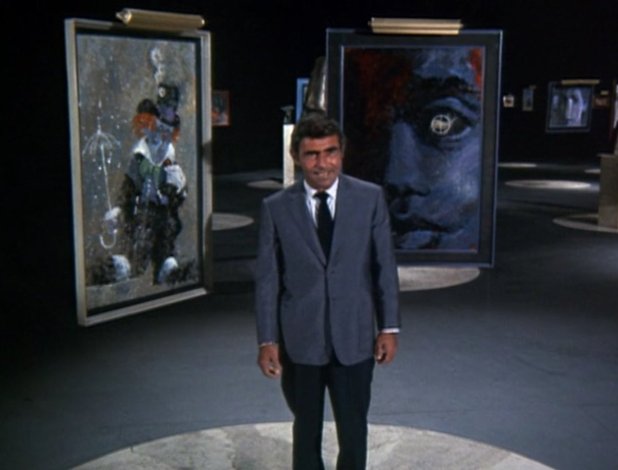
As Night Gallery moved into its second season, it would start becoming schizophrenic, caught between the darkness and the light of pained comedy or more to the point, creator Rod Serling versus producer Jack Laird. Yet when it works, well, man does it work.
I think about “The Boy That Predicted Earthquakes” so often. Directed by John Badham, years before he’d make Saturday Night Fever, it was written by Rod Serling from a Margaret St. Clair story. Clint Howard is astounding as Herbie Bittman, a young boy who simply talks like a real little kid going on and on about telescopes before dropping apocalyptic knowledge on TV audiences. What kid could hopefully deliver a message of hope when he knows that the world will end horribly the very next day? What a Satanic moment in a series known for so many, a child delivering the burnt out worldview of Serling to the masses. A near-perfect segment worth endlessly rewatching.
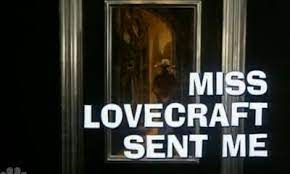
Less can be said about “Miss Lovecraft Sent Me,” the first of too many “black out” gags which has Joseph Campanella as a vampire and Sue Lyon as a babysitter. Director Gene R. Kearney wrote Night of the Lepus and would go on to contribute to the beloved 1979 series Cliffhangers, but the fact that he was involved in Laird putting his insipid fingerprints all over a masterwork is a strike against him. At. least Lyon is gorgeous; she did better work in Lolita and Murder In a Blue World.
“The Hand of Borgus Weems” has that most horrific and hoary of horror tropes: the haunted human hand. Peter Lacland (George Maharis) claims that his hand is possessed and demands that Doctor Archibald Ravadon (Ray Milland) amputate it. It’s simple and effective, with assured direction by John Meredyth Lucas, a producer on Star Trek and the director of several episodes of the Planet of the Apes TV series. Its writer, Alvin Sapinsley, also wrote Moon of the Wolf.
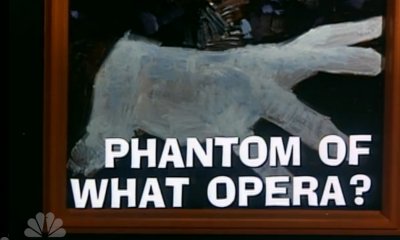
Sadly, “Phantom of What Opera?” is another gag with Leslie Neilsen as the Phantom and Mary Ann Beck as his victim. Directed and written by Kearney, it’s exactly the kind of two-minute silliness that would continue to mar this show all season long.
What do you think of this episode? Which story is your favorite? Let me know in the comments.
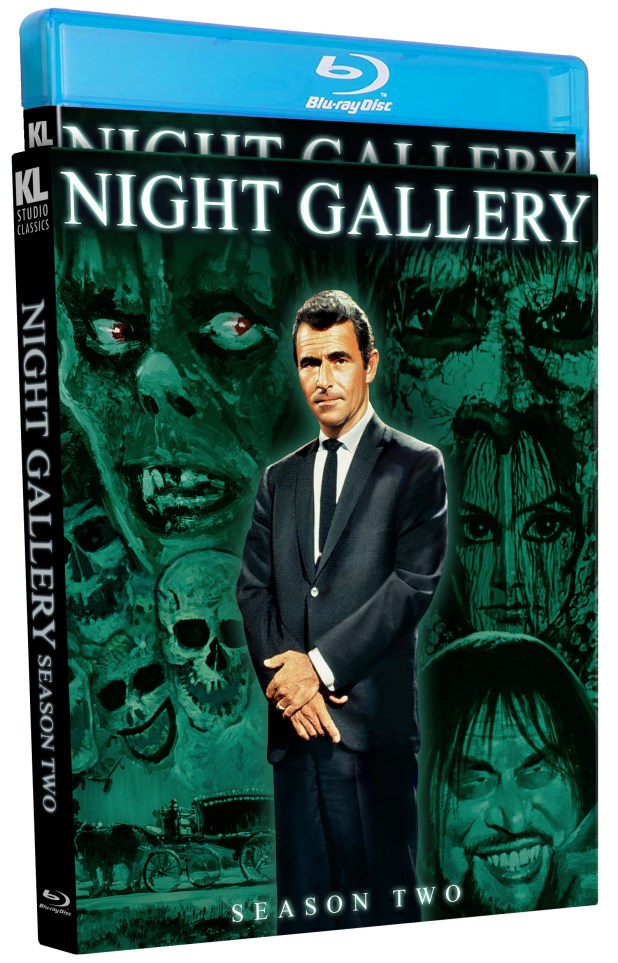
You can buy the second season of Night Gallery on blu ray from Kino Lorber.












 B&S About Movies
You must be logged in to post a comment.