Exclusive interview with Vernon Wells

Vernon Wells is someone that really needs no introduction, as his roles in movies like Mad Max and Commando define 80s action film villainy. I had the chance to interview him by phone in advance of the release of his film Tales from the Other Side and had a blast learning more about this hard-working actor.

You may notice how many times the word (laughs) appears. That’s no accident. Mr. Wells is one of the best-humored and genuinely funny people I’ve had the incredible opportunity to interview.

B&S About Movies: How did you go from working in a quarry to being an actor?

Vernon Wells: Well, I was a dumb ass (laughs). To be perfectly honest, I never wanted to be an actor. I was working in bands as a vocalist and following in the footsteps of my mother. Then I was in a car accident and I compressed three vertebrae in my back so I wasn’t able to do much. I was becoming very painful to be around so my manager took me around and got me work as an extra’s extra. Way back in the background.

I started getting work because I could ride horses and drive anything with wheels and shoot anything that’s a weapon. So I became the go-to boy for a while.

Then, George Miller’s girlfriend caught me in a stage play in Melbourne called Hosanna. It was written by Michel Tremblay, a French-Canadian writer, and about how Montreal wanted to secede from Canada and become a French-speaking autonomous area. I had one of the leads — it was a two-person play, so yeah it was a lead (laughs).

She spoke to George after seeing me, I spoke to George and the rest is history as they say.

Vernon about to do something ill-advised.

B&S: What was it like to go from a background character to suddenly being part of Road Warrior, a movie that became famous worldwide?

Vernon: Terrifying. If I had it my way, I probably would have never done it. And I had never really done a film, so I had no idea. I thought that it would be fun but I had no idea what I was in for.

B&S: You did the stunt work too, right?

Vernon: I did a lot of the stunt work on it.

B&S: Was it as terrifying as it looks in the film?

Vernon: It was probably more terrifying (laughs). Because we were doing it! No, it was very safe. George is very critical of anything that looks like it won’t be safe or that people could get hurt. He will figure out ways of doing it so that you’re not going to get hurt but it’ll still look terrifying on screen. I have to give him that. He always makes sure the actors and crew are taken care of.

Because I don’t care who you are, you can’t 100% of the time be safe all of the time. Someone is occasionally going to get hurt. Thankfully, no one was seriously injured except for the stunt coordinator. I think he got the same thing I got when I was young, the accident that I had before I became an actor — a compression fracture.

All that wild stuff we filmed and the fact that just one person got hurt was amazing.

Then again, we could show you where we buried the people who didn’t make it, but of course, we don’t talk about this. (laughs)

B&S: How did you end up in Weird Science?

Vernon: Joe Silver the producer decided that he wanted me to reprise the role of Wez in a comedy and I didn’t want to because it was like, “This isn’t gonna work.” We had to change the look and costume because of copyright infringement. And then it turned out to be great.

B&S: In my small hometown, it was a battle to rent Commando at the video store. And you’re so incredible in that.

Vernon: I find it it’s incredibly enchanting that people actually think enough of what I do in a movie and tell me, “Oh, I dressed up as you for Halloween.”

I think that’s the pinnacle we all look for is that people get so involved and invested in the character that they see themselves as that character. And just to have that is the greatest accolade an actor can get. Way more than any bloody awards.

B&S: It’s because you took what could be a generic bad guy role and you made a meal out of it.

Vernon: I think it’s because I was doing it my way. I believe one of the comments from Arnold was, “Never give him a real knife.” He was a bit afraid about me actually cutting his throat!

I couldn’t see any other way of doing the character because Arnold is so big. And if I don’t act bigger than him, my character is going to look so weak.

“Let off some steam, Bennett!”

B&S: I’m sure you’ve heard that both Wez and Bennett are homosexual characters.

Vernon: Yeah, I love that. I was gay in Road Warrior according to half the world and I was gay in bloody Commando too! (laughs)

No, I don’t think Bennett was ever in love with Matrix. I think what he thought was that he was better than him And the only way he could prove that — the whole film was about how he set up everything he could set up — the point for him was who was the tougher man when the two of them finally faced off? Mano y mano, only one could walk away.

Why would I fight him if I was in love with him? I was pissed off. I wasn’t him. I wanted to be the big boy. I wanted to be the big kahuna.

B&S: People find subtext in things even if you didn’t even think of it when you were the one actually acting in the role. They insist that it has to be true.

Vernon: Yes! Everybody insists that the kid on the back of a bike in Road Warrior was my boyfriend. Actually, I rescued him from being killed and he was like my son!

People buy into a theory based on one scene without looking back on what happened before. When I got pissed off that he got the boomerang in his head, well…and he was my son and then he got killed. Why wouldn’t they take it the other way?

B&S: I saw Road Warrior perhaps way younger than I should have, at a drive-in, and that scene was the first thing I saw and I was shocked.

Vernon: (laughs) Well, here’s how I look at it. The point is that my job, as an actor, is to give you an hour and a half to two hours of total fantasy. I need to take you away from the everyday problems of the world and even yourself and what’s going on around you. My job is to put you somewhere that has nothing to do with that. I want to give you a respite. And that’s what I look at as my job…to help people forget.

B&S: The escapism has become so necessary today when so many bad things happen outside our doors now. Road Warrior is looking more real every day.

Vernon: if you look at Road Warrior now, you go, “What was George Miller on when he wrote this?” (laughs)

Because so much of what we live in now today, the world is getting that way. You may not have all of the weird cars, but you do have the weird dress and weird clothes and what’s happening right now, you look around and say, “What happened?”

B&S: I didn’t think the end of the world would be being quarantined in my house. You didn’t prepare me for that!

Vernon: What’s going to happen when gas gets to $10 a gallon? It’s gonna be mohawks and assless chaps from here to the ocean! (laughs) It’s $6.46 here in Los Angeles!
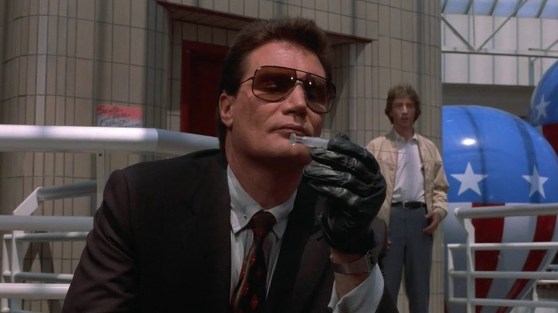
B&S: You’ve done so many memorable roles. Innerspace was a huge movie.

Vernon: Innerspace to me was funny because space was. To me it was funny. Interesting, because Spielberg loved the role I did in Road Warrior. And what he wanted was to create that character in his own way. But with Mr. Igoe, I couldn’t talk — I just had to be this entity, this thing and when you turned the corner and saw him, you just turned back.

It was actually a difficult part for me to play. I’m silent, I have on sunglasses and I had a fake arm. So it was like everything that I used to act was taken away and I was like, “Damn, what do I do?”

And I loved it. I thought that was such a cool movie. It was really cool to be able to put all those emotions on screen without talking.

And that was my introduction to Joe Dante! and I did three films with him. Love him!

B&S: You’re great in Looney Tunes: Back In Action as the Acme VP of Child Labor,

Vernon: That was so fun. That movie was never done as a comedy, it was done very straight. It was like another world! It was just so fun! I love all that kind of stuff. Like everybody was very strange, these major actors are being serious but saying these lines. He doesn’t play it for laughs which is why his movies are so funny.

I mean, only Joe could make that movie with the little guys — Gremlins! — and make it work. They’re so cute and then you get them wet and they become raving lunatics!

B&S: You’re in two different movies called Fortress. Which is better?

Vernon: The 1985 movie — that’s based on a true story and that’s why it’s so interesting. The kids were taken hostage and buried, then held for ransom. The kids didn’t escape and kill them, that’s made up for the film, but otherwise, that’s a true story.

I really enjoyed the other Fortress because they didn’t have a role for me. I auditioned and they liked me so much, they wrote Dabby Duck just for me. I’m 999 or 666 whichever way you look at me. I loved it and I had so much fun with the cast. We filmed it in Australia and I knew most of the crew.

B&S: You’ve been in a lot of cyberpunk films! What do you love about the genre?

Vernon: They don’t take themselves seriously. They do things that make you think, but they don’t take themselves seriously. They also often make you decide what is a good idea or a bad idea. And I like that attitude because it gives people a reason to want to go and see it so they can decide what they think on their own basis.
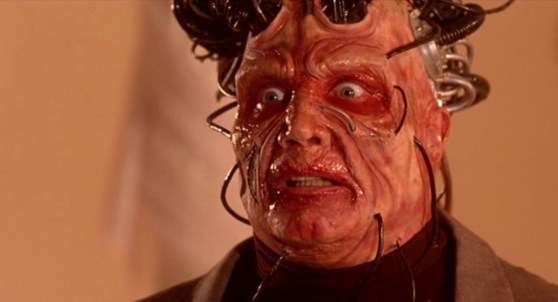
Vernon as Plughead from Circuitry Man.

B&S: You have so many different fandoms who know who you are. Some of them might only know you as Ransik from Power Rangers Time Force!

Vernon: It’s never little kids that come up to me at a convention that know that. It’s 25-year-old adults who are still mad that I killed the Red Ranger! (laughs)

Actually, I thought that series was really good because they really wrote good scripts. I’m very proud of it because they did a lot with my character. With Ranik, for the first time on that show, they did a backstory so you could see why he was the way that he was and maybe you understand him a little better. In other series, the villain is just the villain. He was once a doctor or scientist and not totally evil. I thought that was so interesting.

B&S: You also worked with Fred Olen Ray on Billy Frankenstein.

Vernon: I loved Billy Frankenstein and I loved Fred Olen Ray. It was such a fun movie. I had such fun with that character and that totally way out there — that scene where I don’t realize that I’m talking to the real Frankenstein! I loved it!

B&S: What’s the best role you’ve done?

Vernon: To answer that, I’d have to say there are probably five or six films that I’ve done. One was Beckett in King of the Ants. The role I have in it…they say no good deed goes unpunished and my character is a villain trying to be good and it ends up getting him killed!

There’s another one coming out where I play a priest and another where I’m a doctor who is trying to help a married couple dealing with cancer. There are a lot of really, really good films that I’m doing which has really good storylines and they have better storylines than a lot of the stuff I’ve done prior to that. Don’t get me wrong, I love everything I’ve done. But these movies are more adults now if you get what I’m saying.

Don’t get me wrong, I still like doing movies where I slam things around. But I love doing these movies where I am really getting into myself and my roles.  I get to have a variety of now — fathers, grandfathers, not just the bad guys, though I still do that!

B&S: You’re so busy! Are you enjoying it?

Vernon:  When I’m hired, I’m the happiest bloke in the world.
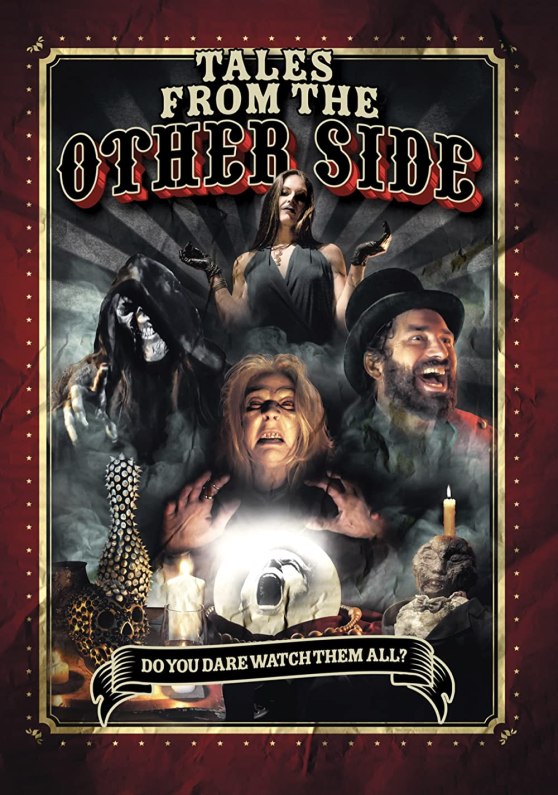
B&S: Tell us about Tales from the Other Side.

Vernon: It’s got some great stories that are all different and quite horrific. Each one gets more horrific! I’ve done two movies like this before and there was one where it was the devil coming to Earth and it was just him and me. I love that! I love anthologies because you get to tell a similar story three or four different ways and see how different directors and their actors handle that story.

B&S: So were you in a Fantasm movie? Or Felicity? I don’t want to embarrass you.

Vernon: (laughs) Don’t worry about it! When I was being an ass, my mother would threaten to tell my friends, “Vernon is doing porn now.” We all have something in our closets!

You can see Vernon Wells in Tales from the Other Side, a movie in which three kids want to have the most legendary Halloween night ever. It’s now available on DVD and on demand from Uncork’d Entertainment!

Interview with William Stout Part 5

In the final chapter of our interview with William Stout, we learn about how he worked on his first blockbuster and some of his greatest art achievements.

B&S: Did working with Henson before lead to your work on the Muppet Wizard of Oz?

Stout: No, that was all Kirk Thatcher. I helped him out very early in his career. He never forgot that. He was a big fan of my stuff and used to buy my paintings once he started becoming successful as a director. And he personally asked me to work on the project.

B&S: How did you come on for Pan’s Labyrinth?

Stout: Guillermo and I have a lot of friends in common and they all kept saying oh you got to get with Guillermo. You guys are like two peas in a pod. We kept just missing each other, though Frank Darabont was a big fan and collector of mine. He’s the host of a special dinner at Comic Con in San Diego every year where he would invite all his favorite artists and occasionally invite director friends of his like Cronenberg. He invited me to dinner and seated me opposite del Toro. We started talking and the next day, he came to my booth at Comic Con and bought a couple of paintings.

He asked if I would mind delivering them to his home; I was happy to. At his home he talked to me about this little Spanish film he wanted to make. That little film ended up being Pan’s Labyrinth

He had specific things he wanted me to design, so we were talking. He got a call he had to take, so he went into the other room. I could hear his side of the conversation. 

He said. “I feel so honored and that’s wonderful, but I’m sorry. Thank you so much. But I need to make my little Spanish film.”

He came back in and I asked what the call was about. He said, “That was Warner Brothers. They just offered me Harry Potter.”

My esteem for him skyrocketed — to just blow off the Harry Potter franchise so that he could make a personal film!

B&S: How much of the Predator did you design?

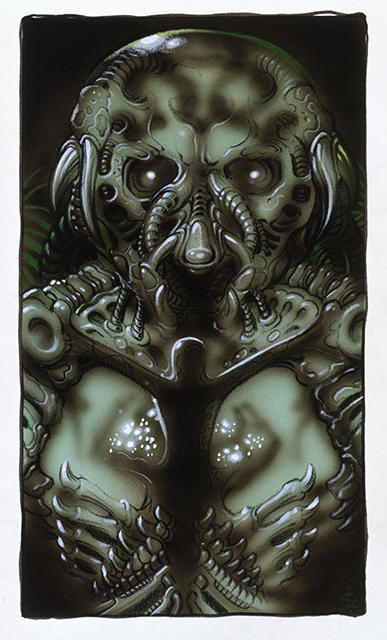
Stout: I did the original design, Robert Short added the sort of high-tech dreadlocks and then somebody working for Stan Winston added the four-pronged mouth which I thought was really awesome. 

Rick Baker brought me in on that. I had lunch with Rick and with the director John McTiernan and his production designer. We were discussing the design of the creature. They pulled out a book on H. R. Giger, the guy who designed the creatures in Alien. He turned to a page and said, “I would not be unhappy if it looked just like this.”

I said, “If you want that, just hire HR Giger because I’m not going to rip off his style. I don’t steal from people.”

They suddenly excused themselves and Rick leaned over to me and said, “You know what? I really don’t like these guys. I’m just doing this for the money.”

That was my first big studio film, though, and I was ecstatic. Prior to that I’d done all these independent non-studio movies, so this put me on the map in a major way in the film business.

B&S: Are there any projects – outside of the dinosaur film – that didn’t get made that you wished had?

Stout: That’s a favorite topic of discussion on any new film I work on. I always ask “Okay, what’s the greatest film you’ve ever worked on?” 

For me, it’s Godzilla – King of the Monsters. I worked for two years on an American Godzilla – Godzilla – King of the Monsters in 3-D – that was going to be absolutely spectacular. Really great script by Fred Dekker. I was the production designer. I hired Dave Stevens and Doug Wildey for the storyboards. For the stop-motion effects, David Allen. Steve Czerkas built the stop motion model for me. Rick Baker was going to build a huge robotic Godzilla head for me. And that’s when I first met Steve Miner. He was the producer and director.

It was the right project at the wrong time.

It was obviously going to be a very expensive film with effects shots in almost every scene. And at that time, four big budget films really died at the box office, particularly Heaven’s Gate. No studio wanted to put up the budget.

I would do the film today in a heartbeat. The script was so good. It all took place in San Francisco, starting out with Godzilla destroying the Golden Gate Bridge. Godzilla ends up dying on Alcatraz.

From William Stout’s site — https://www.williamstout.com/news/journal/2019/09/ — this movie SHOULD have been made.

Mr. Stout and Godzilla!

I also would like to make At the Mountains of Madness and Something Wicked This Way Comes, my favorite Bradbury novel. The Disney movie made the mistake of having Ray write the script for his own story.

B&S: Plus, you moved on to theme parks. Do you still do that work?

Stout: Theme parks were my main business for so many years. Occasionally something will pop up in Korea. That’s all over now. There used to be an entire floor at Universal for the theme parks. Now, it’s not even a chair.

Film stuff still comes my way. I was asked to direct a film by some producers in Louisville, Kentucky. I’ve been trying to get the script together for that. It’s nowhere near what it needs to be. I explained to them that you have just one shot when it comes to offering it to an actor. If you give the script to an actor and he turns it down, you can’t rewrite it and come back to him and say “It’s better now.” It should have been better from the beginning. It has to be absolutely perfect.

B&S: There are so many movies, but has the quality dipped with so much product?

Stout: There’s a lot of really amazing stuff out there. I really admire Steven Soderbergh and the work he’s been doing. He directed a great little film called Unsane that he shot entirely on his iPhone. It’s a fantastic thriller.

B&S: Your animal art has taken you all over the world, too.

Stout: I was in Antarctica for four months on my last trip there. Two months at McMurdo Station and two months at Palmer Station. Originally, my first time in 1989 was as a tourist on a cruise ship and I was blown away by how spectacular the place was. I had to do something to help preserve this place for my kids and grandkids. I got the idea of doing a one man show of paintings of the wildlife of Antarctica. To make sure that every kid dragged their parents to see the show, I included prehistoric Antarctica.

As soon as I got back from my first Antarctic trip, I made a beeline to the Byrd Polar Research Center in Columbus, Ohio, where I got a crash course in Antarctic paleontology. I started to notice the same paleontologists coming up over and over in articles and papers about prehistoric Antarctica. Those guys and gals became friends of mine. They shared a lot of their Antarctic knowledge with me. The Natural History Museum of LA County was nice enough to host my one man show and then they traveled the show for seven years. It was my attempt to raise the public awareness of why Antarctica is so special and what could be lost if we’re not careful. We need to take care of that place.

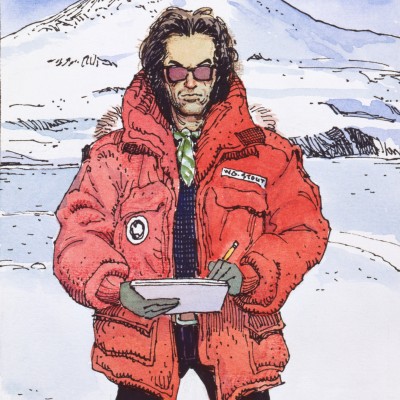
A self-portrait.

B&S: From Firesign Theater to bootleg albums to movies to theme parks to fine art, your career is everywhere.

Stout: I’ve got to be the hardest guy to collect because you never know where I’m going to pop up. (laughs)

Right now I’m finishing up a big three-volume box set, each book being 350 pages, on all my comics-related art. I’m almost finished with the book on all my underground comix art. And my most requested book is one on my music related work, like the bootleg record covers, and I’m about 80% finished with that book. I’m going to do a book on all my entertainment advertising work, like movie posters and TV ads, and then I’m going to do one on all of my film design. So, I’ve got lots of stuff in the pipeline.

I can’t even explain what a complete thrill it was to speak with Mr. Stout at length. His work on comics, film, music and so much more is of the very fabric of our pop culture.

Previous parts of this interview:

To learn more about William Stout, visit his official site at https://www.williamstout.com

Interview with William Stout Part 4

Last time, we got into William Stout’s work on Return of the Living Dead. This time, we learn about his visit to Eternia.

B&S About Movies: Masters of the Universe isn’t really a He-Man movie, huh? It’s a Jack Kirby movie. 

Stout: Oh, absolutely. You nailed it. Gary Goddard, the director of the film, is a huge Jack Kirby fan. When I started out in that film, it was just to storyboard the movie. But on the side, I would do some costume designs and different things. Gary just loved my work. And plus, we had a great shorthand, because we had such a passion for Kirby. 

When Gary would say, “Can you Kirby this up a little bit more?” I knew exactly what he was talking about. But the production designer we had didn’t know comics. He was a guy from England named Jeff Kirkland. He and Gary were constantly butting heads. Finally, Jeff left the film. He recommended to Gary that I take over as the production designer. A production designer, for those who don’t know, is responsible for everything you see on the screen except for the performances of the actors.

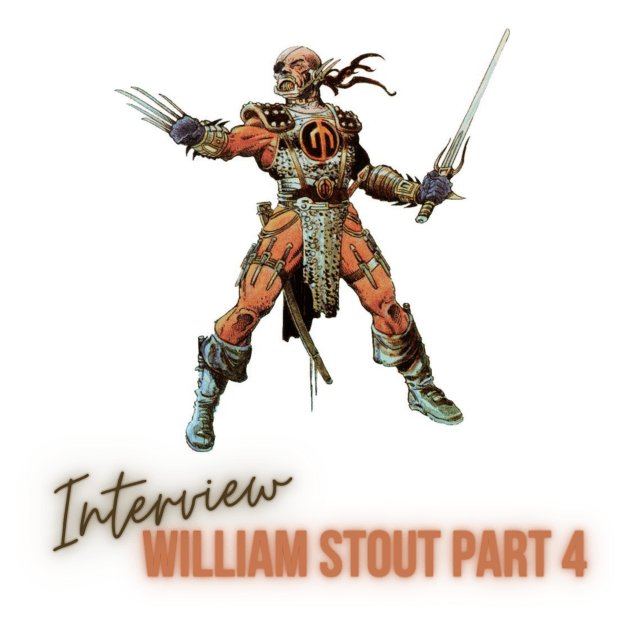
Skeletor from the Fourth World.

B&S: You had Jean “Moebius” Giraud working with you, correct?

Stout: Giraud was a really good friend of mine. He was living in Santa Monica at the time trying to get some animated films off the ground. I hired him to do some of the design work for Masters of the Universe

From William Stout’s website — https://www.williamstout.com/news/journal/2012/04/02/jean-moebius-giraud-–-part-five/ — which has even more about Moebius’ movie art.

B&S: I must confess, as a kid, I wanted the movie to look like the toys. And as I get older, I love the movie more and more.

Stout: I didn’t want He-Man to look like that toy because he looked like a rejected member of Abba. Horrible haircut! We did a redesign and Mattel, of course, fought me every inch of the way.

B&S: And now they make toys of your designs. Cannon referred to it as the “Star Wars of the 80s.” The movie has the feel of something like Star Wars, there’s some grandeur to the character designs. You did Kirby it up.

Stout: Our goal was unique and I wanted it to have a terrific look.

Masters of the Universe Collector’s Choice William Stout Collection by Super7

B&S: Did you know Kirby?

Stout: We were actually good friends. Here’s a Kirby story: I was doing a lot of work for Mattel. I did the box art for Heroes in Action, SWAT, Big Jim and other stuff. They called me up one day and said, “Oh, we’ve got something we think is right up your alley.”

It was an entire line of superhero stuff and they said, “We want art like this.” And they showed me some Jack Kirby art.

I said, “You know what? Why don’t you hire Jack? He just moved to LA and I bet he could use the work.” They replied, “Do you know how much money you’re turning down?” (laughs)

I knew how much they paid me, but I would have felt like such a jerk if I had ripped off Kirby and made money off Jack when he could have done it. 

Two months later, I’m at a convention and I run into Jack and I ask how the Mattel job went.

He got excited and said “You’re the guy. Oh my God, I never made so much money in my life. That job came just after I had moved to LA. I had no contacts. I had no jobs. I didn’t know where my next paycheck was coming from. This Mattel job saved my life. It was so much money. Why did you turn that job down?”

I said, “That job was meant for you. It had to be your gig. The right and proper thing was to have you do the job.”

Kirby’s art made Big Jim a must-have toy for me. From http://toy-history.blogspot.com/2012/10/big-jim-pack.html

He was a pretty spectacular guy. And so nice and so honest. So down to Earth. 

I got to ink an issue of The Demon. Mike Royer called me. He wanted to take some vacation time. He said, “Would you like to do Kamandi or The Demon?” The Demon! I wanted to do the monsters. Talk about a learning experience. I inked right over Kirby’s pencils. Talk about pressure!

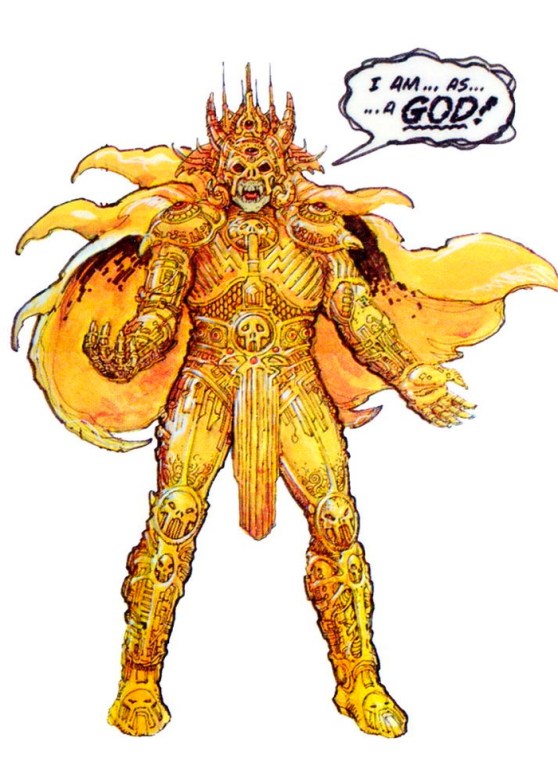
B&S: What inspired the gold costume for Skeletor?

Stout: Well at that point in the film, Skeletor gets all the power in the universe. It’s got to change him and I just decided this sort of gold supervillain look would be awesome. I tried to make the costume as lavish and intricate as possible. The costume designer fought me on that because she wanted to use Western Costume to make the costume. I wasn’t really happy with their work. She was also very upset that I was designing all the costumes for the film, which was her job. And I told her, “Look: 20 years from now, people will look at this film. It says ‘Costume Designer: Julie Weiss.’ And the public will never know I did it. So don’t sweat it.” (laughs)

The best-looking version of Skeletor ever.

B&S: Going through your resume and I thought I knew everything you worked on and I keep being surprised. You worked on House?

Stout: That was a fun gig. I did three or four huge paintings for that. I did the layouts for them and my studio mate Richard finished all of them but one. 

B&S: Big Ben looks like a Jack Davis drawing, so more EC Comics.

Stout: Yeah, I also did the art that got the financing for the film. I used to do a lot of that back when I was doing movie posters. They were called presentation paintings. Nobody in Hollywood likes to read, but they’ll happily look at a picture. As an example, there was a producer named Sandy Howard who produced low budget movies. He’d come to me every year and he’d have 12 titles. 

He’d say, “OK, Terror Train, teenage girls terrorized on a train:

I would do 12 pictures to go with those titles. He wouldn’t even have a script. But then he would take those pictures and those twelve titles to the Cannes Film Festival or to MiFed in Italy. He’d get the financing for all twelve films. And that’s how a lot of movies were sold back then.

B&S: The Cannon way of selling movies.

Stout: It was wacky. At a time when I think of the major studios, Warner Brothers had the most in production with six, Cannon had like 82 movies in production.

B&S: Sometimes an ad would say, “A new Dustin Hofman project” and that’s it.

Stout: And yet they had never talked to Dustin about that.

I actually attended the black tie opening for Delta Force, a film directed by the president of the company. It starred Chuck Norris. A tuxedo opening for a Chuck Norris movie! After the movie, the premiere audience went back to the Cannon offices where they had four parking garages. Each level of the parking garage had a different chef serving spectacular food all night long. And every single person who ever worked for Cannon was there that night. I ran into Charles Bronson and all kinds of movie stars. It was crazy.

The line producers on Invaders from Mars had worked with Menahem Golan when he was in Israel, because that’s where Menahem came from and they told me this one story about him directing this scene. His wife came onto the set with their new baby. Menahem got really excited when he saw the baby. He grabbed the baby and put him in the back of a buckboard and then he stood back and called “Action!” The horses took off and the buckboard hit a bump which launched the baby flying into the air. Menahem’s wife lunges to get the baby and he stops her and says, “Darling! Never in the middle of a take.” (laughs)

B&S: What did you do on The Willies? Creature design?

Stout: Was that Brian Peck’s movie? (laughs) Because I don’t even remember doing that. Brian was a great guy, he helped so much on the set, he even helped puppeteer the half corpse.

In our final chapter, we’ll learn about some of William Stout’s true passion projects.

Previous parts of this interview:

To get some of Mr. Stour’s art, visit The Worlds of William Stout and explore.

Interview with William Stout Part 3

In our last thrilling episode, we learned how William Stout nearly made a dinosaur movie with Jim Henson. This time, get ready for more about Roger Corman and Return of the Living Dead

B&S About Movies: You mentioned Corman back there and I love the work you did on the Rock ‘n Roll High School poster.

Stout: Yeah, that one was fun. I loved doing movie posters for Roger! When I would do a movie poster for any other client, I would have to do a couple dozen roughs, a few black and white comprehensives (or “comps”), and a full color one. By the time I had to do the final poster, I’d already drawn it two dozen times.

But this final finished poster art was the one that the public was going to see. So, I had to get all juiced up and get all the energy flowing and make this the best possible version of the work. Roger, however, did not want to spend all that money on all of those roughs, however. With Roger, I would just show him a single rough sketch in my sketchbook and he’d approve it.

When I went in for the Rock ‘n Roll High School gig, he said, “Bill…do whatever you like — as long as it looks like Animal House.” (laughs)

A great look at William Stout’s art with no logo for the movie. From Heritage Auctions.

B&S: It matches the movie, which is a live action Mad Magazine

Stout: During that movie, I started visiting Allan Arkus and Joe Dante who were editing the film just down the street from my apartment in Hollywood. Walking into that room…it was like seeing two kids in a candy store. They were having so much fun. They were just brimming with excitement and they couldn’t wait to show me some of the footage they had just cut. And that was how I first became friends with both Alan and Joe. 

Joe’s career took off and if you look at those early films, I’ve got work in almost every single one of them because they would call me up if they needed to dress a kid’s room and I’d send them some of my dinosaur posters. 

It was a really great time to make movies. They weren’t really expensive back then. You had guys like Roger Corman or later on Cannon, who you could fairly easily approach. Roger and the president of Cannon would give you their time for you to make a pitch. And if they liked the pitch, you got to make your movie. 

You wouldn’t get much money — but you’d get your shot at making a film.

B&S: Oh man, Cannon Films.

Stout: That was the wildest company to work for. I did two films for them: Invaders from Mars and Masters of the Universe, which might have been their very last movie. 

B&S: What was working with Tobe Hooper like?

Stout: One of the guys I was sharing my office with was a guy named Keith Crossley, who worked a lot with Tobe. He told me, “He’ll take a look at anything you’ll do. But here’s the thing. If he doesn’t like it, he’ll say, “Could do, could do.” But if he likes it, and he’s going put it in the film, he’d say, “Can do, can do.”” So, I learned that code. Really nice, sweet guy. And we were working from a script by Dan O’Bannon and Don Jakoby. I worked with Dan on Return of the Living Dead. There was a lot of talent on board.

A wild scene from Invaders from Mars.

B&S: Return of the Living Dead was a big movie for you.

Stout: I was the production designer for the entire film. I designed all the sets, all of the zombies. Some of the costumes, the special effects. That was my first deep dive into actually production designing a film. It was brutal. Really brutal. The work I had previously done as production designer on an American Godzilla movie was much more kicked back.

B&S: It’s the closest any movie has come to a Warren or EC comic. Even more than Creepshow

Stout: That was one of our goals. Dan O’Bannon, the director and writer of Return of the Living Dead, and I are both huge comics and EC fans. It was Dan, who when he was trying to find a production designer, told the producer that he didn’t want a traditional production designer. He didn’t want an architect. He wanted someone really familiar with comics because he wanted his movie to look like one. So, he handed our producer a really short list: Me and Bernie Wrightson.

The producer did his homework and found out that I already had a whole rack of film credits. And Bernie didn’t have any at the time. I think he was just starting out on Ghostbusters. The producer lied to Dan O’Bannon, because I think Bernie was Dan’s first choice. He said Bernie passed on this but that he got Stout. I found out later that he had never even talked to Bernie.

I mean, how amazing is William Stout? Tarman design courtesy of Heritage Auctions.

The film is more popular today than when it came out and that’s just amazing. For the 20th anniversary of the film I toured with the cast. We did every convention across the country. That movie is a lot of peoples’ favorite movie. It’s one of those rare combinations of comedy and horror. Scary and funny at the same time.

B&S: Plus, Linnea Quigley doesn’t hurt to have around. 

Stout: Oh yeah. Absolutely. 

In our next chapter, we’ll learn all about Masters of the Universe! I can’t wait!

Previous parts of this interview:

Want to learn even more or purchase some art? Visit The Worlds of William Stout to get started.

Interview with William Stout Part 2

In the second part of our interview with master artist William Stout, we’ll discover how he learned the art of screenwriting — the hard way — as well as working for Roger Corman and a project that he nearly made with Jim Henson.

B&S About Movies: So what came after Conan?

William Stout: First Blood, which was also produced by Buzz Feitshans. I said, “There are lots of storyboard guys out there…Why’d you hire me?” And he answered, “You’re cheap.”

I think I was making 500 bucks a week back then on those two films, as opposed to when I was doing advertising at the same time I was making about between $4,000 and $6,000 a week.

B&S: So you were single then.

Stout: Yeah. (laughs)

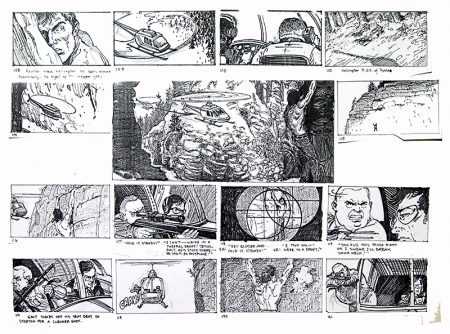
Storyboards from First Blood from William Stout’s website — https://www.williamstout.com/news/journal/2019/08/24/untold-tales-of-hollywood-39/

B&S: Then comes Conan the Destroyer. And I’ve been wanting to tell you, it doesn’t get the same level of notice as the first movie, but I’ve always loved it. It has more monsters and adventure.

Stout: Thank you. I think that’s the strength of that film. Because the script was horrible. It was embarrassing. I remember I ran into Mako, who played Akiro the Wizard, at LAX. 

I said, “Mako! Hey, we worked together on two films, Conan the Barbarian and Conan the Destroyer.”

He said, “Yes. Second film shit!”

I said, “You got that right, brother.”

B&S: And then, Red Sonja

Stout: Well, Red Sonja was originally going to be a Conan film. And the script was so atrocious that Schwarzenegger said, “If you hire me to be in this movie, I will refuse to do it if you call me Conan. You’ll destroy the franchise.”

B&S: How did you get into scripting Warrior and the Sorceress

Stout: There was a free hippie newspaper called LA Free Press. Occasionally I would scan the classified ads in the back of the newspaper and see if there was anything,  because every once in a while there’d be some sort of art job. There was an ad in which they were looking for someone – it was kind of vague – who was needed to work on a sword and sorcery film. I called the guy up and we got together and had lunch. And he asked, “Are you familiar with Gor?” I thought he was talking about g-o-r-e and I said, “Oh yeah, I love that kind of stuff.”

What he was talking about was Gor, a series of sword and sorcery novels with a heavy sadistic/masochistic content. I didn’t realize that at the time. He was looking for someone to write the screenplay; so I started writing it.

It was a really brutal learning experience because I would write the screenplay and then he would just rip it all to shreds and make me start over.I did this about twelve times. It felt after all those times like I was flaying the skin off my own body. I learned a lot, though, and I finally ended up with a screenplay that he was happy with. He wanted to direct it. He took it over to Roger Corman, then told me that Roger had rejected it. 

He was lying to me, because Roger actually gave it a green light and let him shoot it down in Argentina. I was doing advertising for Corman – Up from the DepthsThe Lady In Red, Rock ‘n Roll High School – and I called the art director just to see what was going on. And he said, “Oh, we’re making this new film. It’s called Kane of Dark Planet.”

(dramatic pause) 

“Do you have a copy of the script?” I asked.

He said, “Yeah, got it right here.”

“Can you read to me what it says on the first page?”

“Sure! Kane of Dark Planet. Screenplay by John Broderick.”

“…and?”

“That’s it.”

My name wasn’t on it! I called my attorney. Roger Corman is a very honest guy. He immediately paid me for my script. Of course, he took it out of the director’s salary. 

Then, John called me up from Argentina in a panic saying “What the hell’s going on?”

I said, “The script doesn’t have me credited.”

He said, “It’s easier to sell a script when there’s only one name on it.”

And I knew that wasn’t true. But that was my introduction to film writing. 

Not too long after that, Jim Henson was on vacation with his daughter Lisa in the Bahamas. She still wanted to do a film about Edward Drinker Cope and Othniel Charles Marsh, two rival paleontologists back at the turn of the century. He was looking to make his next “serious” Muppet movie, following Dark Crystal and Labyrinth, which were totally different styles than his regular Muppet movies.

Jim decided he would direct a Muppets dinosaur movie. That might help Lisa with her project. They were in the Bahamas, on the beach looking at a big stack of dinosaur books. And their maid came out and she looked at what they’re doing. She said, “You think those are dinosaur books? I’ll show you a dinosaur book!” And she went back into the house and she brought out The Dinosaurs: A Fantastic New View of a Lost Era.

They looked through it and they loved the book. Then on the last page, in my bio, they saw that I had worked in film. So, Lisa promised her dad that once she got back to LA, she would contact me. 

I wrote a script that both Jim, Lisa and Warner Brothers liked. Warners gave us $5 million just for research and development to make the Muppet dinosaurs and then another $20 million to make the film. I began designing the film. Around the same time, they found out that Lucas and Spielberg were doing The Land Before Time. Ironically, the look and story for The Land Before Time was taken from my award-winning children’s book The Little Blue Brontosaurus. Jim was told that they would have their film finished before ours (which was a lie). Jim Henson did not want people to think that he was ripping off George and Steven. So, he dropped the project. 

It got me into the Writers Guild, though, so that was great.

From William Stout’s site — learn more about The Little Blue Brontosaurus at https://www.williamstout.com/news/journal/2021/09/29/untold-tales-of-hollywood-116/

In the next installment of this interview, we’ll discover more about working for Roger Corman as well as a little movie called Return of the Living Dead.

Previous parts of this interview:

Please check out The Worlds of William Stout to learn more about this legendary artist and order his work, including books, prints and original art.

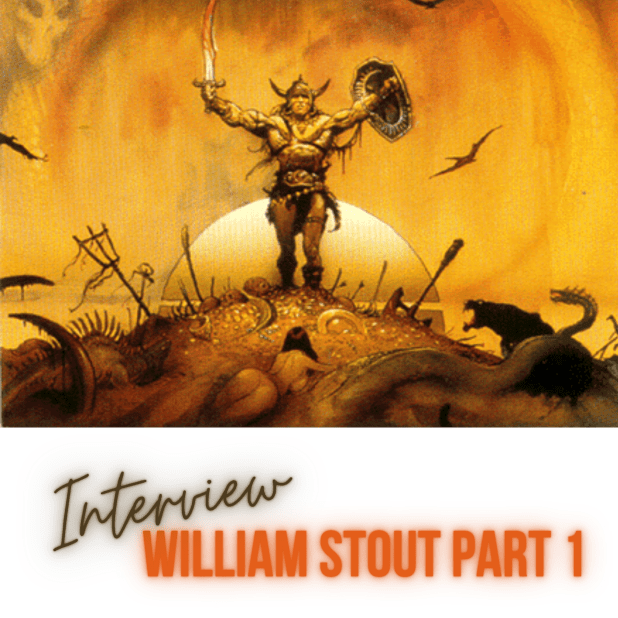
Interview with William Stout Part 1

I get the impression that if it wasn’t for William Stout, I might not love pop culture as much as I do.

From being one of the first American contributors to Heavy Metal to working on nearly seventy movies, countless posters, the world of fine art, theme parks, children’s books and so much more, I’ve been following his art before I even realized that one man was behind all of it.

It’s been beyond an honor to get to speak with Mr. Stout and learn even more. His time is more than appreciated. This was a true learning experience. 

B&S About Movies: I’m always interested in how artists got their start. What was yours?

William Stout: I attended the Chouinard Art Institute (California Institute of the Arts or CalArts) on a full California State Scholarship — not because of my art skills but due to my family’s poverty and my making perfect scores on my SATs. I was an illustration major and the school had a great policy which was if you got any real outside work, you could turn that in in lieu of your homework. I started picking up jobs my second year in art school, and by the end of the third year, nearly everything I was doing or submitting was a real job. It made the transition from Academia to the real world absolutely seamless.

First, I was taking any job that came around, like the first advertising for Taco Bell for whom my job was trying to convince people from the Midwest that Mexican food was safe for white people to eat. These jobs really informed me as to what I wanted to do and what I didn’t want to do. I started gravitating toward more stuff that I wanted to do. 

I got a call from an ad agency for whom I had been doing all kinds of miscellaneous ads and they said, “We’ve got something different for you this time. It’s a movie poster.”

“What’s the movie?,” I asked.

“It’s an animated feature called Wizards by Ralph Bakshi.” And I was like, great, show me the movie.

They replied, “It’ll be a better poster if you don’t see the film.”

Doesn’t speak well of the film, but it became the job of jobs. And it also became one of the most iconic images of my entire career. The missing ingredient is always the audience, the public. They’re the ones that determine whether something’s going to be famous or not. 

William Stout’s poster art from Wizards. Posted from Heritage Auctions.

I didn’t really get into doing movie posters until I did the very first commercialization of Star Wars. I created 21 designs for Coca-Cola glasses for Burger King. George Lucas has got a long memory and he always throws work my way. Not long after, he demanded that the agency use me for art for the re-release of American Graffiti. They didn’t want to use me because I was an unknown quantity. They weren’t familiar with my work. They didn’t know if I could make deadlines. But Lucas insisted that I do the poster and I came through like a champ. Because of that, the advertising agency – which was doing about 90% of the movie posters in town – started to hire me on a regular basis. 

At that time, corporate annual reports and movie posters were the best paying jobs for illustrators. So, I was making a ton of dough back then. Then I sort of accidentally fell into the film business.

B&S: How do you go from the ad side to being part of the product?

Stout: Those two sides usually never meet! They’re separate industries. 

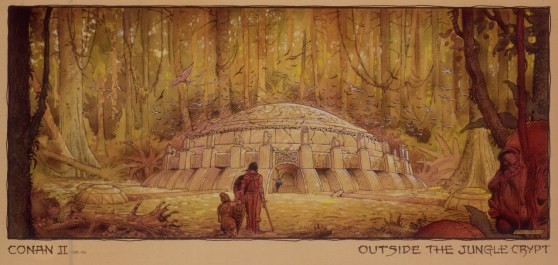
I was a big Conan fan. I loved the Robert E Howard books and the Frazetta paintings. A friend of mine, Bob Greenberg, was working as a production assistant on Conan the Barbarian. He told me the film’s production designer was Ron Cobb. 

I was shocked it was Cobb, because I only knew him from his political cartoons in the Los Angeles Free Press, which were distributed all over the world. I knew he created designs for some of the aliens in the Star Wars cantina sequence. I was really intrigued to see what this guy would do with Conan, but I was so busy doing movie posters that there was no way I could get over to their office. 

One day, I finally got a break in my schedule. Instead of going over to the Conan offices, however, I went to the American Booksellers Association, which was an annual event in New York or Los Angeles. Every single publisher and every single editor in the entire country are all in one big room, so it’s the perfect place for an illustrator like me to go booth-to-booth with my portfolio and pick up enough work for the rest of the year. So that was my plan. 

I walked into the ABA and by sheer coincidence, the first person I bumped into was Ron Cobb. He said, “You’re my first choice of who I want to work with in the Conan art department, but I have an agreement with writer-director John Milius. He has veto power over anybody I want to have in the art department. And I have veto power over anybody he wants to put in the art department. So would you mind dropping off your portfolio for John to see?”

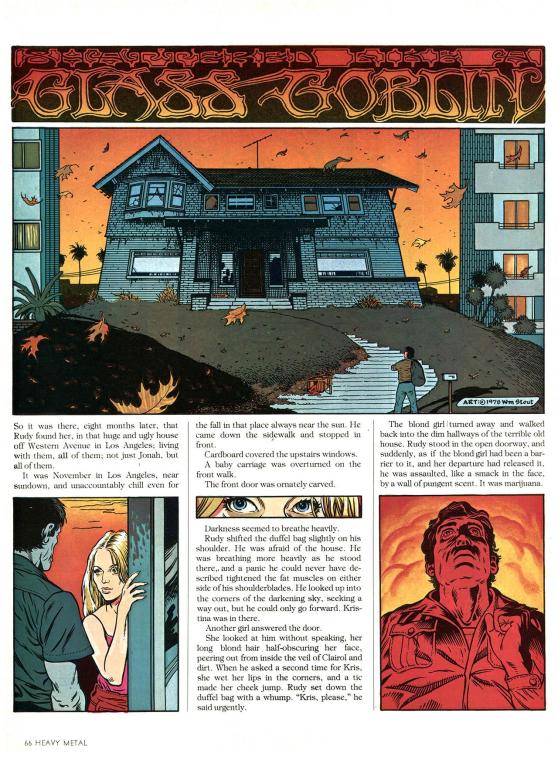
That seemed fun, getting a chance to learn how to make movies. So I went in the next day and Milius happened to be there. He remembered a Harlan Ellison story I had drawn for Heavy Metal – “Shattered Like a Glass Goblin” in vol. 2 issue 6 – that he really liked. He handed me back my book and as I walked out of the room he said – he’s a bigger than life kinda guy – really dramatically, he shouted, “Hire him!”

Stout’s incredible work on this Harlan Ellison story.

I walked into the line producer’s office – Buzz Feitshans – and when he told me what I’d be making on Conan, I nearly fell out of my chair laughing because it was about 10% of what I was making in advertising. But I was being hired for just for two weeks, so it didn’t bother me. Later, I learned that you’re always hired for two weeks because they want to find out whether or not you’re a jerk.

And if you’re a jerk, after two weeks, your job is over. No hard feelings.

But if you’re good and you deliver, well…

My two weeks on Conan turned into two years and it became my entry into the film business.

When I first got hired, Kathleen Kennedy (future President of Lucasfilm) was our receptionist. And we were sharing offices with Steven Spielberg! So, Cobb and I would work on Conan during the day and then run across the hall to Stephen’s office to kick around ideas for his next project which was Raiders the Lost Ark

I thought working in film would always be like that, but it wasn’t. (laughs) I was just incredibly lucky, a real example of right place, right time.

From William Stout’s site — https://www.williamstout.com/news/journal/2019/07/26/untold-tales-of-hollywood-21/ — and this post has an incredible Ron Cobb story.

B&S: It’s like how so many ad guys start wanting to do comics and then learn how little money they’ll make.

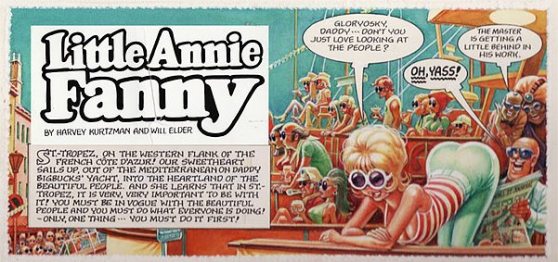
Stout: I worked with Harvey Kurtzman and Will Elder on “Little Anne Fanny”. Some years later, Kurtzman called me up and asked me to take over the strip for Playboy. I turned him down. 

“How can you turn down the best paying job in comics?” he asked.

I said, “Harvey — in comics. I work in the real world. I know how much work goes into “Annie,” because I worked on it with you. Each page takes almost a month. In that time, I could be making a hundred times what you’re paying me just by doing advertising.”

He later told me he was depressed for two months after that.

That’s why I kept trying to get him to come to Hollywood. I said, “You’re really funny. Comedy is gold in this town. You can be financially set up for the rest of your life.”

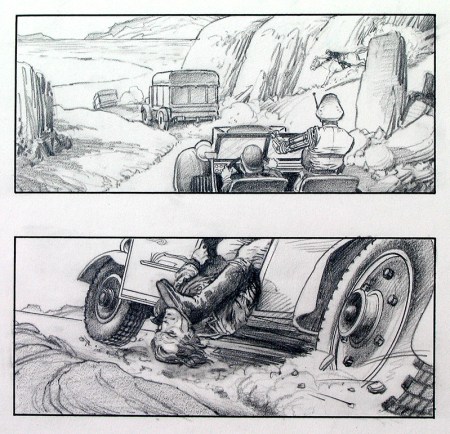
I helped out Spielberg by doing some of the boards for the sequence where Indy fights the Nazis on the truck. I knew he was trying to get me to leave Conan and work on Raiders but I didn’t want to do that. I wanted to stay loyal to Ron Cobb and John Milius for giving me such a break in my career. So, I recommended my studio mate Dave Stevens to do the boards. 

B&S: What was Dave Stevens like?

Stout: One of the nicest guys you’d ever want to meet and a really funny guy. Whenever I picture of him in my mind’s eye, he’s either laughing or smiling. He was a very private guy as well, often disappearing without telling anyone. One time, I tried for months to invite him over for dinner and never got a response. Eventually, he called back. 

I said, “Dave, I’ve been trying to get you over here for dinner and you never call me back.”

He said, “Oh. I’ve been living in Paris for the past couple months.”

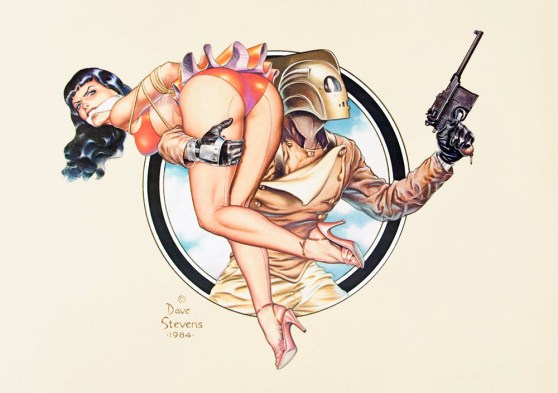
B&S: The Rocketeer was my introduction to the look of the 30s. And Bettie Page.

Stout: Dave was really obsessed with the 30s. If you walked into his house, it was like stepping into 1936. And watching all this stuff emerge at my studio that he was drawing; it was just amazing to come in each day and see what he had done the previous night.

Has there ever been a better comic?

In the next chapter of our interview, we discuss the Conan follow-ups, Mr. Stout’s introduction to screenwriting and his work for Roger Corman.

Please check out The Worlds of William Stout to learn more about this legendary artist and order his work.

Interview with Ed Glaser, author of How the World Remade Hollywood part 4

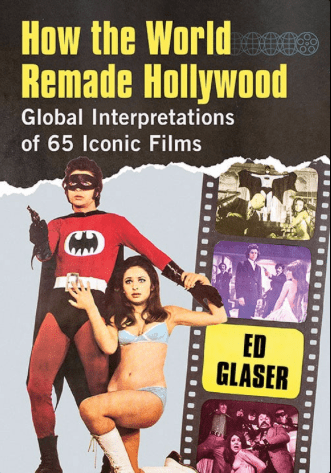
All week long, Ed Glaser, the author of How the World Remade Hollywood, has been discussing just why remake and remix cinema is great. Here’s our final segment.

B&S: Are there any movies that didn’t make it into the book?

Ed: I wanted to cap it at 75, so there were definitely some I couldn’t fit. In many cases it was a matter of not wanting to do too many “duplicate” movies. I did three takes on Superman and Star Wars, but generally I tried to limit the number of remakes of a particular film to one, maybe two. So there are several other Rambos and James Bonds and Batmen that had to sit this one out.

There were also some I would like to have covered that I simply couldn’t dig up enough information about — and didn’t have the contacts where I could reach out to the people involved, as I did with other movies. For example, there’s the Alain Delon Zorro film, which would have gone in the “Capes, Conquerors, and Comic Books” section. And there’s a Thai Charlie’s Angels remix called Chai Lai Angels. Another time!

B&S: You could do a whole book on Italian Conan remixes.

Ed: It’s like you said, had already made the peplum movies, so your Ators or your Thors the Conqueror are basically just redressed sword-and-sandal flicks.

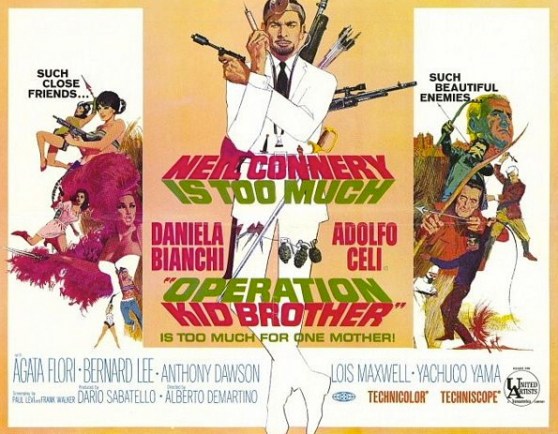
B&S: What about OK Connery?

Ed: It’s the most “all-in” Eurospy film ever made! Sean Connery’s brother plus five stars from the official Bond series! Producer Dario Sabatello was willing to throw a lot of money around to make it happen. The Bond supporting cast weren’t paid a lot in the UK for their roles. So Bernard Lee and Lois Maxwell and so on were happy to do it because they were paid more for OK Connery than they were for the actual Bond films. And that movie is an enormous amount of fun.

B&S: Even giallo makes its way to Turkey with Aska Susayanlar: Seks ve Cinayet, which is nearly a scene for scene remake of Sergio Martino’s The Strange Vice of Mrs. Wardh. How did they even find that movie? Maybe through the photonovels?

Ed: So, interesting thing. There’s a Turkish Snow White film Pamuk Prenses ve 7 Cüceler that’s a complete live action remake of the Disney movie. And what really surprised me was that it includes scenes that were planned for the Disney version but never actually animated. That had me absolutely baffled for a while until I discovered that those sequences were in the tie-in children’s books — both here in the States and in Turkey (some of which were bootlegs). So it’s pretty clear that the filmmakers saw at least one of those books and incorporated the “missing” material based on that. Before the days of VHS and DVD, it would have been handy to have a book version of the film to work off of. So I wouldn’t be surprised if tie-in photonovels were occasionally used when shooting international remakes.

B&S: With the advent of digital filmmaking, is it easier or harder for these movies to be made?

Ed: The world is more connected now so it’s very difficult. Certainly it’s no longer the Wild West it once was. What’s happening more is that Hollywood has discovered that there’s money to be made overseas with their existing IP and so they’ll partner with — or license that IP to — filmmakers in other markets. Thus the kind of stuff that you’re seeing in Bollywood now tends to be more officially licensed than it used to be. (I’m sure that’s not the case 100 percent of the time.) But there are major instances of that happening. There was a remake of the movie Knight and Day, and there’s been a Rambo film in the works for a number of years that I think is still in pre-production. There are specific deals between Fox and studios in India to make these kinds of films, and similar things happening in China, leading to movies like High School Musical China.

B&S: Does it feel different now because there’s less of a hunt for these films? 

Ed: I appreciate their newfound availability. While I was writing my book both Robowar and Shocking Dark came out on Blu-ray. That was wild, because at the time I had Shocking Dark on a Japanese VHS tape and Robowar was just digital, because you couldn’t get a physical copy for love or money — at least an original one. The availability is fantastic. I think the main difference is that it’s now a lot easier to go from one film immediately to another, rather than digging around and waiting to see if another one will turn up from a grey market VHS dealer. But there’s still a lot of history behind these movies that remains untold. And a film being available on YouTube doesn’t necessarily alter that.

B&S: I think now we can share them more easily. It reminds me of what Guillermo Del Toro said when he first saw Zombie that none of his friends believed it was a real movie. Now you can show people these movies.

Ed: There is something to that. And there’s also a certain amount of good-natured one-upmanship that can happen with friends who enjoy similar kinds of movies — “Yeah, but have you seen this?” That can be a fun way to kind of exchange movies but it’s great that the material is available and is more shareable than it once was.

B&S: Where should someone start with remakesploitation?

Ed: I think The Last Shark may be a good start. It depends on how comfortably you want to ease in and what your favorite genres are. If you want to be delighted, Vinni-Pukh, the Russian Winnie the Pooh is probably the most wonderful thing that I cover in my book.

You can get Ed’s book, How the World Remade Hollywood, from McFarland Books. Here are the films that he covers (to see our thoughts on movies we’ve watched, just click the hyperlink):

Capes, Conquerors, and Comic Books

Muscles, Magnums, and Machismo

Family, Fantasy, and Fairy Tales

  • Hindi Harry Potter: Aabra Ka Daabra: The School of Magic
  • Turkish ET: Badi (Shorty)
  • Portuguese Cars: Os Carrinhos em: A Grande Corrida (The Little Cars in the Great Race)
  • Chinese High School Musical: Ge wu qing chun (Disney High School Musical: China)
  • Indian Tamil The Parent Trap: Kuzhandaiyum Deivamum (Children and God)
  • German Lassie: Lassie—Eine abenteuerliche Reise (Lassie Come Home)
  • Russian Jungle Book: Maugli (The Adventures of Mowgli)
  • Turkish Snow White: Pamuk Prenses ve 7 Cüceler (Snow White and the 7 Dwarfs)
  • Brazilian Wizard of Oz: Os Trapalhões e o Mágico de Oróz (The Tramps and the Wizard of Oróz)
  • Russian Winnie the Pooh: Vinni-Pukh (Winnie the Pooh)

Monsters, Maniacs, and the Macabre

Androids, Aliens, and the Apocalypse

Outlaws, Outsiders, and Oscar Winners

  • Russian 12 Angry Men: 12
  • Bollywood Purple Rain: Akounak Tedalat Taha Tazoughai (Rain the Color of Blue with a Little Red in It)
  • Turkish Bonnie and Clyde: Cemo ile Cemile (Cemo and Cemile)
  • Bollywood Fight Club: Fight Club: Members Only
  • Turkish Rocky: Kara Şimşek (Black Lightning)
  • Turkish Straw Dogs: Kartal Yuvası (Eagle’s Nest)
  • Turkish The Godfather: Kılıç Bey (Mr. Kılıç)
  • Hong Kong The Untouchables: Lim jing dai yat gik (First Shot)
  • Nigerian Titanic: Masoyiyata / Titanic (My Beloved / Titanic)
  • Chinese Ms. 45: Pi li da niu (Girl with a Gun)
  • Indian Hindi Fatal Attraction: Pyaar Tune Kya Kiya… (Love… What Have You Done)
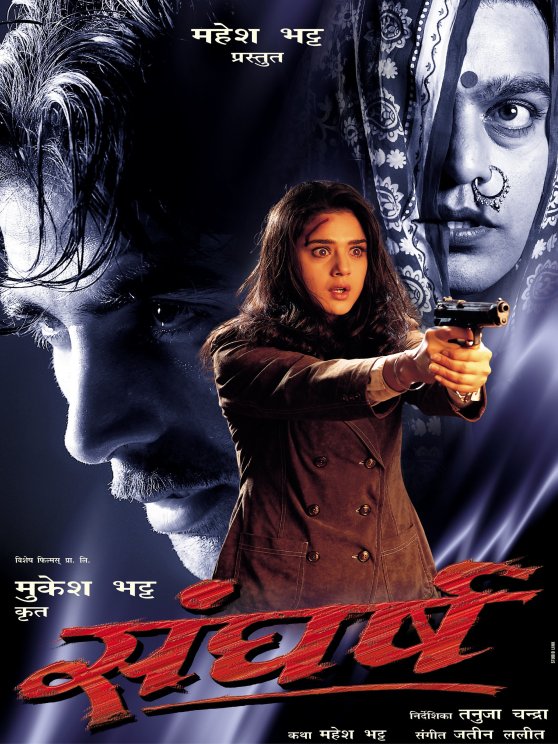
  • Bollywood Silence of the Lambs: Sangharsh (Conflict)
  • India The Godfather: Sarkar (Overlord)
  • Japanese The Unforgiven: Yurusarezaru mono (Unforgiven)

I hope that this article allows you to discover the world beyond our borders and how other filmmakers reinterpret pop culture. To see some of these movies and hear from Ed, check out Deja View: Remakes and Rip-Offs of Your Favorite Films

Interview with Ed Glaser, author of How the World Remade Hollywood part 3

In the second part of this interview, we learned from Ed Glaser, the author of How the World Remade Hollywood, exactly what Santo, post-apocalyptic movies and sharks have to do with remake and remix cinema.

Today, it’s all about Italian movies and if riffing ruins a film.

B&S: But sometimes in the midst of these mercenary endeavors, there’s art. Sometimes, right? Like Shocking Dark ends up being quite good.

Ed: I have no excuse to love it as much as I do. But I do. Because I think by all objective measures it’s slow, boring, and not especially interesting. And yet you have this polluted futuristic Venice, a gigantic mega corporation called the Tubular Corporation, a group of mercenaries called Megaforce who go in and try to find out what’s going down in the tunnels under Venice. And then it’s also this wild rip-off of Aliens and Terminator smooshed together.

B&S: Well, it is Terminator 2

Ed: Claudio Fragasso’s wife Rossella Drudi was basically given the brief, “I want it to be Terminator and Aliens,” and she mostly pulled from the latter.

It’s really true, though, about these films being mercenary productions. The producers want to make money — which, I mean, of course — but they’ll hire creative professionals who want to do more, or have their own particular passions. So they use those mercenary opportunities to pursue other things. 

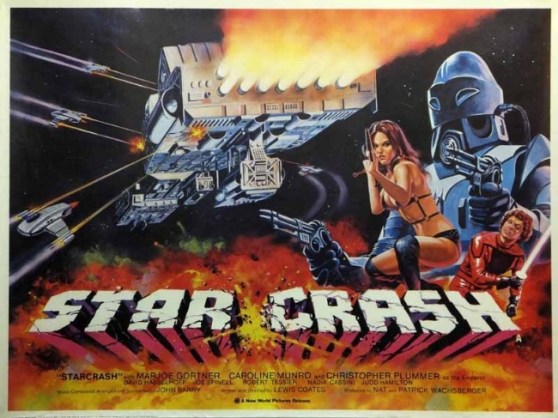
Like Starcrash

Luigi Cozzi loves science fiction. And he’d wanted to make a science fiction movie for years, but nobody would put up the money. It wasn’t going to sell, they said. And then suddenly, Star Wars comes out. And a producer calls him and says, “I need you to make Star Wars.”

Cozzi hadn’t even seen Star Wars when he wrote Starcrash. It hadn’t come out in Italy yet. He had the novel, though, and that was extremely useful. But he was more interested in doing what he called “Sinbad on Mars.” So that’s what he did. He pulled from swashbuckling adventure movies and science fiction authors that he loved. Yes, the film is unmistakably Star Wars in many ways because he had to meet the brief, but it’s so much more than that.

\

B&S: With Starcrash and Saru no Gundan (Time of the Apes), the only exposure so many people have had with these movies is seeing them riffed on Mystery Science Theater 3000

Ed: Time of the Apes is a great deal of fun if you love Planet of the Apes. The entire show is terrific. Yes, it was made on a tight budget as these things were but there’s a lot of really interesting stuff there.

There’s kind of a tug of war tug of war between movie fans when it comes to the Mystery Science Theater treatment. There are some that love it. There are some that think that it denigrates the films it features. But there are a couple of things that help swing the pendulum for me. Are the movies being riffed affectionately and not derisively? And then, as an audience member, does your interest in the film end when the episode ends?

My first exposure to Danger: Diabolik was on Mystery Science Theater. Later, as I learned more about Mario Bava, I saw the movie through new eyes and was delighted by it. I never thought the film was terrible. I thought it was kind of goofy. But I wasn’t “done” with it after MST3K

I think that, yes, there’s certainly that risk if you’re not familiar with a movie that if you first see it riffed then you’ll write it off as a bad film. But I hope that more often than not, that’s not the case. I hope you want to know more.

B&S: Maybe I’m being too precious about the movies that I love.

Ed: I think that the folks behind Mystery Science Theater really have evolved their technique over the years. The ones that went on to do RiffTrax have even done universally-beloved films like Casablanca or the original Star Wars. You can poke fun at just about any kind of movie; it doesn’t have to be mean-spirited.

B&S: There’s a tendency for people to say that a movie is so bad that it’s good. And I don’t subscribe to that. You don’t have to apologize for liking movies.

Ed: I mentioned that in my introduction in the book. I’m also not a big fan of the idea of guilty pleasures. There’s an excellent documentary from the UK called Guilt-Free Pleasures that interrogates what “guilty pleasure” really means. It also suggests that, if we continue to use the phrase, it might be better suited to movies that are in some way morally problematic; not merely “bad.” But saying that a movie is so bad that it’s good, it’s cheating. You’re having your cake and eating it too. Or maybe just saying “this cake sucks” but eating the whole thing because it’s delicious.

It’s just kind of arrogant and obnoxious. If you enjoy the film, then enjoy the film. It can be weirdly shot or technically wonky or awkwardly written, but if you’re enjoying the film, maybe it’s not actually a bad film.

Tomorrow, Ed and I wrap things up.

You can get Ed’s book, How the World Remade Hollywood, from McFarland Books. To see some of these movies and hear from Ed, check out Deja View: Remakes and Rip-Offs of Your Favorite Films.

Interview with Ed Glaser, author of How the World Remade Hollywood part 2

In the first part of this interview, we learned how Ed Glaser, the author of How the World Remade Hollywood, discovered remakesploitation films as well as some of why so many of these films come from Turkey and Italy. Here’s the next part of our interview, which gets into Santo, post-apocalyptic movies and sharks.

B&S: I think we’re still getting our heads around sampling in some ways. Isn’t it interesting that both Italy and Turkey have a crossover with Kilink, which is also Diabolik, which is also Fantomas. These characters cross between so many countries but are nearly the same.

Ed: Yeah, absolutely. You’re talking about characters, comics, or photo novels that were extremely popular throughout Europe, but not at all in the States. So it’s fun to see these characters iterated and reiterated on. There were like a dozen Kilink movies that came out of Turkey that all had sort of different slants on the character. And it’s likely that as an American viewer who is interested in international cinema, you may see those before you discover the photo novels, of which only like, half a dozen have been reprinted in English. 

B&S: Santo is like that too. I think it’s really interesting that in 3 Dev Adam (Three Giant Men) that Santo’s on the same level as the other heroes. His movies had become huge around the world, but maybe not as much in America outside of the Samson movies that K. Gordon Murray translated. But in this movie, Santo’s on the same level as Spider-Man and that’s kind of mind-blowing.

Ed: Spider-Man was basically unknown there. His comics came to Turkey briefly in the 70s, but not seriously until the 80s. So for a while audiences were more likely to be familiar with Spider-Man from the handful of episodes of the American TV series that were repackaged as self-contained movies internationally than they would have been from the comics. And that was still years later, after 3 Dev Adam, so Santo would have been substantially bigger.


B&S: We always apply our culture to others and don’t think that way. I just did it! That’s why I love these movies, because they make you less western-centric and explore how another culture sees pop culture and the world. 

Ed: With Spider-Man, it feels like they simply thought, “This guy looks cool. He can be a cool villain. We can do this with him.” I think that’s really hard for modern American pop culture fandom to wrap its head around, because there’s a real obsession with canon. And at the same time it’s wonderful because we get to see, as you say, something that we’re very familiar with but through a very different lens.

B&S: I’m really impressed with your book because so many of my favorite movies are in it and that just makes me happy. For example, I love all the Bronx Warriors movies and I actually think they’re somewhat of the best of the post-apocalyptic genre. 

My theory is that the Italians are the best at making post-apocalyptic movies followed by the Philippines. Of all those movies, the Bronx series synthesizes so many movies at once – The Warriors, Mad Max, all at once.

Ed: Hollywood studios didn’t fall in love with the genre the way that other countries did. I mean, you had the Mad Max films come over from Australia and then you had low budget versions from, for instance, Roger Corman, some of which were shot in the Philippines. But that was kind of it. 

You didn’t get a ton, whereas in Italy and the Philippines, you have sort of waves of those films. Post-apocalypse is one of those movie threads in Italy, where one film launches an iterative process where you get movie after movie after movie, just like the spaghetti westerns and the pepla and Eurocrime movies.

B&S: It’s nearly the United Nations of exploitation because giallo comes from Agatha Christie and Edgar Wallace in England, which turn into Hitchcock movies and krimi German-made films and then those migrate to Italy and become giallo and then eventually become slashers. 

Two or three years, the Italian film industry has taken one movie and made a hundred movies like it.

Ed: We forget that while there are hundreds of spaghetti westerns, the biggest years of them were a flash in the pan.

B&S: My theory is that the Italians are really good at it because they’re essentially just replacing the horse with the car in post-apocalyptic movies. They’re shot on the same sets from ten years before that are now destroyed and loners with no name having to come into these towns and rescue them.

Ed: There really is something to be said about the post-apocalyptic film as modern futuristic western. Even if you look at American examples like Steel Dawn, that’s just Shane set in the post-apocalypse.

B&S: So Jaws is a hit and Italy responds.

Ed: With The Last Shark, one of my favorites. And that movie doesn’t just rip off the story, but even gets cheeky with character names, like “Peter Benton” as a play on “Peter Benchley.” And with Vic Morrow looking and sounding exactly like Quint. I have a number of friends who love that movie too and they’ve developed a sort of playful fandom around Italian shark star “Squalo.”

There’s also Deep Blood, Cruel Jaws

Tomorrow, Ed and I discuss more Italian remakes, Luigi Cozzi and if riffing ruins a movie.

You can get Ed’s book, How the World Remade Hollywood, from McFarland Books. To see some of these movies and hear from Ed, check out Deja View: Remakes and Rip-Offs of Your Favorite Films.

Interview with Ed Glaser, author of How the World Remade Hollywood part 1

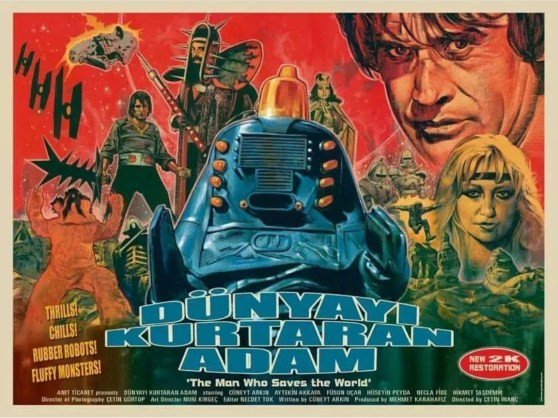
As you may have learned from reading our site, I’m obsessed with bootleg films or remakesploitation. From films like 3 Dev Adam (Three Giant Men) and Dünyayı Kurtaran Adam (The Man Who Saves the World) to just about everything that emerged from the 80s Italian horror boom, I’m just so astounded by how movies get culturally remixed. 

According to Ed Glaser, author of How the World Remade Hollywood, “Most of these films were low budget and many were unauthorized, but all of them were fantastic—and lately have begun to resurface thanks to cherry-picked YouTube clips. But why and how were they made in the first place?” 

I had the opportunity to speak with Ed and learn even more about how he discovered these films himself, how they’re often so much more than just a Xerox and how ideas shift as they cross borders.

I can’t thank him enough for the conversation that we had.

B&S ABOUT MOVIES: Should we call these movies remixes or rip-offs or remakesploitation?

Ed Glaser: It’s up you! But I use remakesploitation quite a bit. I picked it up around 2008 from an article by Jason McElreath. I think he coined it and then I just kind of kept using it relentlessly ever since. 

B&S: When did you discover these films?

Ed: Around 2002 I was reading Thomas Harris’s Hannibal novels and decided to rewatch the films. I knew there were a couple versions of Red Dragon and I was curious if there were any other alternate versions. I went to IMDb and sure enough, there was a movie called Sangharsh, which is a Bollywood film.

I wasn’t as familiar with Bollywood at the time, though I had been told that its movies always featured singing and dancing. So I was very curious to see how that would translate to Silence of the Lambs. Of course I immediately ordered the DVD and waited anxiously for it to arrive, and then ordered a bunch of pizzas and watched the film with friends — and no subtitles. 

Two hours later, it had changed my life. 

Since then, the film has been released with subtitles – thank goodness – and it’s really a marvelous film. It was just such a unique experience seeing a familiar story told through such an unfamiliar lens.

B&S: How do you go from this life-changing experience to deciding to write a book?

Ed: Very slowly. For a while, it was just a matter of discovering what other remakes, remixes, and rip-offs existed. After I showed Sangharsh to some more friends a few years later, I started wondering what other films like that were out there. 

I went looking and that’s how I discovered Dünyayı Kurtaran Adam (The Man Who Saves the World) or “Turkish Star Wars.” I started buying these films and watching them with friends and that sort of became a regular occurrence. 

The question I always had when watching them was, “How did this get made?” You know, what was the context around it? Because when you see these films sort of plucked from a vacuum on YouTube, you have no idea. It’s like this clip has come from another universe. But of course it didn’t.

The filmmakers made these movies under particular circumstances and for specific reasons. I wanted to hear the stories behind them. So I started digging, learning, and reaching out to people. Eventually, as I learned more, particularly about the Turkish film industry at the time, I discovered some clips from a film called Korkusuz (Rampage), which was sort of the “Turkish Rambo” from the same director as “Turkish Star Wars.” I ended up buying the rights to that film and producing an English language release. Shortly after that, since I had collected dozens and dozens of these films and learned the stories behind so many of them, I started doing a web series called Deja View, where each episode highlighted a single remakesploitation flick. 

I did that for a number of years, and meanwhile several people suggested I write a book on the subject. I’d never written a book before, so thus began another very slow process.

B&S: I think that a lot of people come into these movies looking for something to laugh at. And then some people stick around and understand that these movies give us the opportunity to view a culture through a different lens. So it’s not just a meme or a joke. There’s merit to these movies.

Ed: Absolutely. I get a little tired of the internet snark, when it’s just a case of people showing clips and saying, “Look at this crappy movie.”

I’m not saying all these films are amazing or all high art. Some of them have been roundly trounced by their own film industries and local audiences. So they’re not all great films, but it’s not fair to take them out of context and laugh at them. It’s weird and disingenuous to lump them all into the category of bad movies. And why wouldn’t you be curious where they came from? They may look low budget or rough around the edges because some international film industries in the ‘70s didn’t have the resources of Hollywood. But when you dig deeper, you see that many of these filmmakers were performing miracles.

You can’t just look at the surface.

B&S: I’ve always disliked when people call Dünyayı Kurtaran Adam (The Man Who Saves the World) a Star Wars rip-off. After all, isn’t Star Wars itself a cultural remix of Kurosawa and Jack Kirby and Flash Gordon? And The Dam Busters and a million other movies?

Ed: Absolutely. If you look at the film, it’s very much its own thing. It’s got a lot of Star Wars because of the footage that it lifts from that movie, but the story itself is pulled from Flash Gordon, Battlestar Galactica, religious mythology, and just all kinds of places.

B&S: It doesn’t look like it either. 

Ed: Çetin İnanç is such a fascinating director. The way he does action is so wild. He’ll thrust the camera right up into the action at crazy angles and swing it around and it’s so dynamic and unusual. His frequent director of photography Çetin Gürtop, his brother-in-law, the stuff that they did together was just like, you’re not supposed to do that. But I’m so glad they did.

B&S: It’s the next level of how jarring Hong Kong action films can be. 

Ed: Absolutely. I got to spend some time with Çetin İnanç and his wife a few years ago and interviewed him about some of his films. He’s just the nicest person in the world. But it was funny, I took some pictures with him. And then he took some pictures of us and he got my camera and the way he took pictures was just the same way that he must have shot those movies. He was getting in your face and then swinging back and then just like constantly clicking and moving all around and it’s very active and funny. It was a lot of fun.

B&S: Why Turkey? Why do they excel at cultural remixing?

Ed: In its heyday it was a country with a ravenous appetite for films but minimal resources to produce them. The screenwriting talent was also limited. There was basically just Bülent Oran, Erdoğan Tünaş, and Safa Önal who were the big three screenwriters of the Yeşilçam era in Turkey. There were others, of course, but they were the biggies. And they were overworked! You’re producing up to 300 films a year, which Turkey did in 1973, which at the time made it the third most prolific film industry in the world. They did this with none of the infrastructure that Hollywood had. 

They also had no real copyright laws for foreign intellectual property that would prevent them from using stories or other elements from existing media. So you get these remixes where they’re pulling from other sources, in part because they’re doing so many scripts.

B&S: It’s culturally similar to the Italian film industry in the 80s, particularly Bruno Mattei and Joe D’Amato, where it’s nonstop content creation. Filmirage made forty movies in 14 years!

Ed: Filmirage, Flora Film…they had a huge demand to fill. All the companies that Mattei worked with – I mean, he and Claudio Fragasso were there in the Philippines for years just churning out these dudes-in-the-jungle movies for their bosses.

B&S: Mattei takes cultural remixing to another level because he’ll just outright take footage.

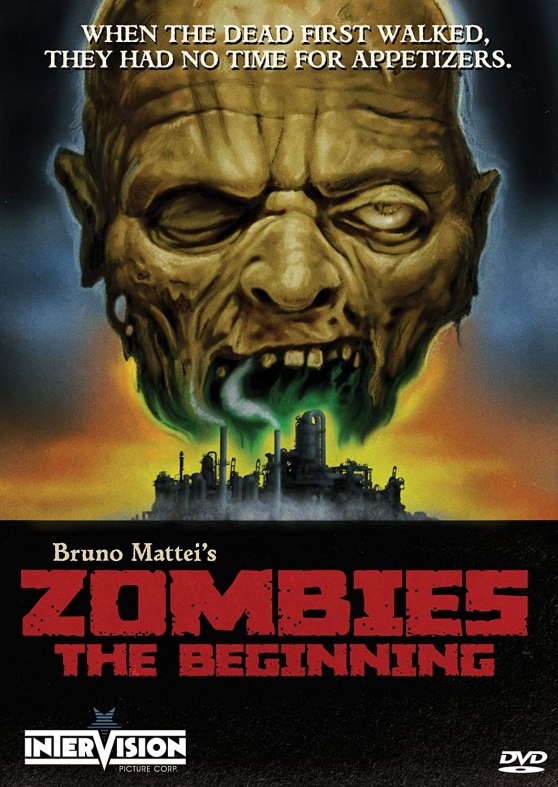
Ed: By the 2000s his budgets were slashed so much and he was shooting on digital video. So the last few movies he made – The Jail: The Women’s Hell, Zombies: The Beginning, The Tomb, In the Land of the Cannibals – it wasn’t even like the old days for him. 

When it comes to Turkish films, during the Yeşilçam period from the ‘50s through the ‘80s, music was something they’d also straight-up lift from elsewhere. How are you going to get composers to write new music and orchestras to record that music for all of the hundreds of films that they had to do that year and for no money? Why not just grab from your personal library of soundtrack LPs and score the film with those? There’s was no law saying you couldn’t.

B&S: I find it really interesting that people look down sometimes on these movies and decry them as rip-offs and unlike in hip hop, where sampling is accepted.

Ed: I couldn’t really venture much of a guess as to why that is beyond the fact that as long as the sampling falls within legal boundaries, you know, we think that that’s okay.

In our next chapter, we’ll get into where Santo fits in amongst world cinema, post-apocalyptic film and how sharks lend themselves to great remake and remix movies.

You can get Ed’s book, How the World Remade Hollywood, from McFarland Books. To see some of these movies and hear from Ed, check out Deja View: Remakes and Rip-Offs of Your Favorite Films.