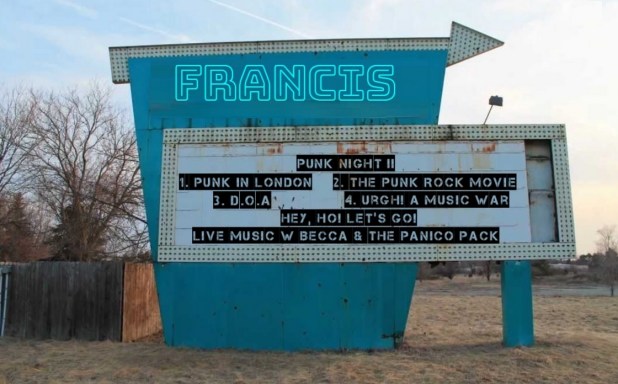
Drive In . . . Saturday?! Punk Night II

Rock ‘n’ Roll Week at B&S About Movies was a smashing success . . . one that can’t be contained in just one Drive In Friday* featurette! So, for this week only, we’ve opened up the Drive In for a special Saturday edition for you old punk codgers n’ sods. You know who you are . . . you were in middle school or high school during the advent of the cable TV boom and a fan of the USA Network’s “Night Flight” Friday night video programming block, channel surfing HBO and, later on, haunting the shelves of your local video store . . . so you’ll remember seeing these four punkumentaries. It’s been years since I’ve watched these gems myself, so this’ll be a fun night for all.

Oi! Hey, ho! Let’s go! All Aboard for Punk Night!

1. Punk In London (1977)

Director Wolfgang Büld bounced around the Germany film and TV industry since the early ’70s and made his English language debut with this German-produced documentary that accompanied the release of a coffee table book of the same name. The film features live performances — some of the footage and sound is of questionable quality — from some of the scene’s top bands, such as the Adverts, the Boomtown Rats, the Clash, the Lurkers, the Jam, Killjoys, the Sex Pistols, Sham 69, the Stranglers, and X-Ray Spex.

Büld followed up this document on the rise of punk rock with a sequel on “the fall” of punk rock, 1980’s Punk and Its Aftershocks, which featured the rise of the new, more commercial crop of ska, new wave, and mod bands that pushed out the punks, such as Madness, Secret Affair, Selector, and the Specials. As with any old VHS reissued to DVD, the reissues company had to tinker with the sequel and give it a new title (the lame “British Rock”) and edit out some footage from the original cut. Ugh!

The restored DVD digital rip of Punk in London currently streams on a variety of VOD platforms, but you can watch it for free on Flick Vaults’ You Tube channel. You can view a complete track listing of the bands and songs that appear in the film on Discogs.

Büld’s other punk documents include the hour-long 1980 TV document Women in Rock (leftovers not used in Punk In London), which centers on the German tours of British metalers Girlschool, along with Brit punkers the Slits, Siouxsie and the Banshees, and Nina Hagen (Cha Cha), along 1978’s with Reggae in Babylon centered on the career of English reggae pioneers Steel Pulse. Büld made his narrative, dramatic debut with the German language (dubbed into English) film debut of Nena (of “99 Luftballoons” fame) in Gib Gas – Ich will Spaß! (Hangin’ Out).

2. The Punk Rock Movie (1978)

And you thought the footage featured in Punk In London was rough . . . the grainy, shaky images and muddy sound of this debut film by British punk scenester and club DJ Don Letts makes Büld’s works look like award winners . . . but we thank Letts for gearing up that Super-8 camera to chronicle those 100 glorious days in 1977 when Neal Street’s fashionable disco The Roxy booked punk bands in the venue where Letts spun records.

The live acts and backstage interviews include Alternative TV, the Clash, Generation X (Billy Idol), Eater, Johnny Thunders and the Heartbreakers, the Sex Pistols, Siouxsie and the Banshees, Slaughter and the Dogs, the Slits, Subway Sect, and X-Ray Spex. So, regardless of its home movie quality, the film serves as a vital document of London’s then burgeoning punk rock scene.

Letts went onto form Big Audio Dynamite with Mick Jones (after his firing from the Clash) and directed a number of short-form music videos (the Clash’s “Rock the Casbah”) and long-form TV and DVD documentaries, such as 2005’s Punk: Attitude (Euro TV/U.S. DVD) and Westway to the World, his 2003 Grammy Award-winning documentary on the Clash.

The Punk Rock Movie is available on a few VOD streaming platforms, such as Amazon Prime (region dependent), but there’s a VHS rip available on You Tube. You can review the film’s full track listing on Discogs.

Intermission: Punktoons!

. . . And Back to the Show!

3. D.O.A (1980)

London-born Polish documentarian Lech Kowalski’s feature film debut (he made a few shorts and TV films) centers around the 16-mm footage he shot during the Sex Pistols’ 1978 seven-city club ‘n’ bars tour of the United States — their only U.S tour — that ended with the band’s demise. The behind-the-scenes interview footage features the now infamous “John and Yoko” bed-inspired interview of Sid Vicious and Nancy Spungen (You Tube). To fill out the short running time, Kowalski cut in performances and interviews with Iggy Pop, along with the Clash, the Dead Boys, Generation X, the Rich Kids (featuring ex-Pistols bassist Glen Matlock), Sham 69, and X-Ray Spex.

Lech’s other rock documents are 2002’s Hey! Is Dee Dee Home, about the life and times of Ramones bassist Dee Dee Ramone (1952-2002), and 1999’s Born to Loose: The Last Rock ‘n Roll Movie, concerned with the life and career of Johnny Thunders (1952-1991) of the New York Dolls and the Heartbreakers (the second, at one time featured, Richard Hell from Blank Generation). Meanwhile, footage from D.O.A appeared in Julien Temple’s 2000 Sex Pistols document The Filth and the Fury (which I went to see in a U.S art house theatre setting).

This one’s not streaming as VOD, but we found two VHS rips on You Tube HERE and HERE to enjoy. You can view the full track listing of the film on Discogs.

4. Urgh! A Music War (1981)

. . . And we saved the best-produced documentary for last: this one dispenses with the backstage tomfoolery and goes right to the stage with professionally-shot footage compiled from a variety of 1980-era shows held in England, France, and the United States. And there’s a couple of reasons why the Police spearhead Urgh! A Music War: Not only were they the most commercially radio-successful “new wave” band of the groups featured; Derek Burbidge, the director, helmed several videos (the famous “Roxanne”) for the Police (he also did Gary Numan’s “Cars”), while Miles Copeland, the brother of the Police’s drummer, Stewart Copeland, managed the Police and operated IRS Records, which produced the film. The film briefly appeared in U.S. theatres via Filmways Pictures (seen it in an art house theatre, natch), but gained its cult status due to its frequent airings on HBO and the USA Network’s “Night Flight” video block.

Beginning in 2009, Warner Archive (the successor-in-interest to Lorimar Pictures, who co-produced with IRS) released an official DVD-R of the movie — burned on a made-to-order basis. As result, this one’s not available as a cable PPV or VOD online stream and the freebie You Tube and Vimeo rips don’t last long. However, searching “Urgh! A Music War” on You Tube populates numerous concert clips from the film. The bands you know in those clips are the mainstream MTV video bands the Police, Devo, Echo & the Bunnymen, the Go-Go’s, Joan Jett, Gary Numan, Oingo Boingo, Wall of Voodoo, X, and XTC. The lesser known bands featured — that some know and most don’t — include L.A.’s the Alley Cats, the Dead Kennedys (Terminal City Ricochet), Magazine (off-shoot of the Buzzcocks), the Fleshtones (Peter Zaremba hosted IRS: The Cutting Edge for MTV), Orchestral Maneuvers in the Dark, 999, Pere Ubu, the Surf Punks, and Toyah Wilcox (Breaking Glass).

You can view the film’s full track listing on Discogs while you listen to the soundtrack in its entirety on You Tube: Side A/B and Side C/D.

All images of the ’80s original issue VHS covers — the cover arts I remember when I rented them — are courtesy of Discogs.

* Be sure to join us for Sam’s “Drive-In Friday: Movie Punks” featurette.

About the Author: You can learn more about the writings of R.D Francis on Facebook. He also writes for B&S About Movies.
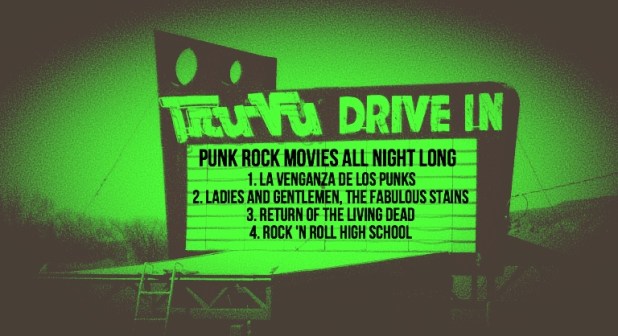
Drive-In Friday: Movie Punks

Punk rockers have had it rough on screen. Either they’re playing a gang that needs to be taken care of by the law or they’re ruining neighborhoods or they’re just plain dumb. Very few films take the sheer unbridled joy on punk and shove it in your face in an enjoyable way.

This week, we invite you to crank up your speaker as loud as it goes, spit at the screen and declare that there really is no future with these four films.

MOVIE 1: La Venganza de Los Punks (Damian Acosta Esparza, 1987): As if the first installment Intrepidos Punks, this movie begins with main villain — or hero — Tarzan getting out of jail and wiping out every man, woman and child related to his cop nemesis before jumping on a giant tricycle and leading a gang of mohawked and bedazzled punkers to the caves, where they will scream “Long live death, cocaine, marijuana and alcohol!” in the midst of a blood, drug and Satan filled orgy. This movie is everything your parents worried punk would bring to your life and everything that you hoped that it would.

https://www.youtube.com/watch?v=Q_lRg2f9agY

MOVIE 2: Ladies and Gentlemen, The Fabulous Stains (Lou Adler, 1982): Punk promised leaving the steel town of my childhood behind, just as it does for Corinne Burns. Somehow, despite being made 38 years ago, this movie knows the score. A band that skirts sexuality while doing all it can to make it ugly and not putting out, the only thing that ruins the perfection of this film is the insipid MTV tacked-on close.

MOVIE 3: Return of the Living Dead (Dan O’Bannon, 1985): What was the best allure of punk in this film? The fact that The Cramps, The Damned and 45 Grave blared out of the speakers in your mainstream multiplex? Or was it the fact that Linnea Quigley, as Trash, pretty much is the most attractive vamp you’ve never seen in the pit?  Perhaps. But to me, the real punk rock soul of this movie is that it doesn’t trust anyone. Not the government, not the kids to save us and hell, not even movies. “You mean the movie lied?” Yes, Freddy. Even George Romero, the king of social commentary being hidden by horror, lied to you.

MOVIE 4: Rock ‘n Roll High School (Allan Arkush and Joe Dante, 1979): Despite the people wearing crisp new Hot Topic Ramones t-shirts, they never really meant much to mainstream America after they were gone. And it was better that way. The Ramones were destined to make it huge, but they really weren’t, and we never had to worry if they’d sell out, because no one outside of the geeks wanted what they had to sell. Except in this movie, which seemingly takes place in an alternate world where a woman of PJ Soles’ caliber could fall so hard for Joey, where a snarling principal (“Do your parents know you’re Ramones?”) could see her school blown up real good and where all Dee Dee has to say is, “Hey, pizza! It’s great! Let’s dig in!” The scene with “I Want You Around” in it never fails to make me cry, as it’s the best distillation of the joys of having your life in front of you and having no idea what to do with it that I’ve ever seen on screen. When I started my first ad job, I listened to “Ramones Mania” non-stop to ensure that even though I was surrounded by capitalism, I’d never forget that I’d said “Gabba gabba hey” to a world where money didn’t matter.

What are your punk rock movies? Let us know. Want to do a drive-in week of your own? We’ve got space for you.

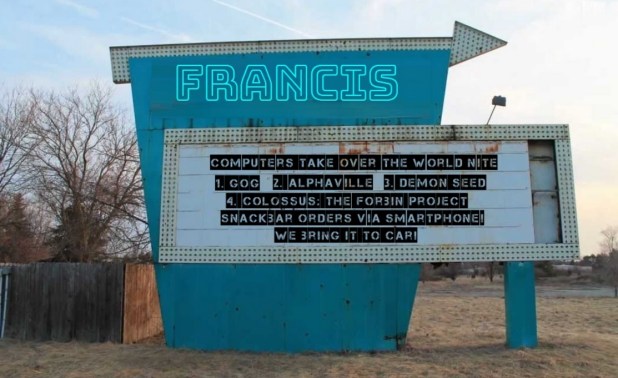
Drive-In Friday: Computers Take Over the World

This Drive-In Friday comes courtesy of a free cable TV week of EPIX and surfing their eclectic catalog of films that led me to revisit 1954’s Gog after many years. I remember seeing that early A.I effort as a wee lad weened on UHF-TV — and it scared the sand out of me. Today, eh. I welcome “The Gates” and “The Jobs” into my life with open arms — and I can’t imagine my life without a “Gog” in my life.

Record/CD, VHS and DVD Swap Meet Sunday!

Anyway, I started jotting down the titles of “Super Computer” movies, searching for the four perfect movies — well, three more — for a Drive-In Friday featurette. And since this is B&S About Movies, we gotta go deep. We gotta go for the obscure or, at the least, not the obvious or the conventional.

Sure, we can wax nostalgic over HAL 9000 in 2001: A Space Odyssey and WOPR (aka Joshua) in WarGames. Then there’s my personal favorites of The Interocitor in This Island Earth (1955), the built-inside-the-planet-thought-manifesting The Great Machine in Forbidden Planet (1956), the computer-with-its-human-private-army The Brain in Billion Dollar Brain (1967), the subterranean OMM 0910 from THX 1138 (1971), the The Tabernacle from Zardoz (1974), Zero from Rollerball (1975), The MCP from Tron (1982), and SkyNet from The Terminator (1984).

Eh, but we’ve been there and done that with those computers. So, tonight, we celebrate the lesser known “brains” that are NOVAC, Alpha 60, Proteus IV, and Colossus.

Who would have thought a bat-born virus would end up re-igniting an interest in the American Drive-In? And is it just me, or is this all just a little bit too Dead End Drive-In for comfort?

Fire up those coils and top off the Dr. Pepper! Roll ’em!

Movie 1: Gog (1954)

Gog is the third and final feature in a loose film trilogy chronicling the exploits of the OSI, the “Office of Scientific Investigation.” While The Magnetic Monster (1953) dealt with a radioactive-magnetism experiment gone wrong and Riders to the Stars (1954) dealt with a meteor-retrieval gone wrong, Gog dealt with a rogue A.I gone bad in an underground military bunker.

The A.I in this case is NOVAC (Nuclear Operative Variable Automatic Computer) with a “physical extension” of its self: two multi-armed half-tracked, biblically-dubbed robots Gog and Magog. And when a series of unaccountable malfunctions begin to plague the facility, the OSI dispatches Dr. David Sheppard and Joanna Merritt to get to the bottom of the A.I tomfoolery.

Shot in 15 days at the cost of $250,000 ($2.4 million in today’s money) and released in 3D color, Gog is the best of the three “OSI” films produced by United Artists. Sadly Ivan Tovar’s scientifically accurate screenplay and decent direction by Herbert L. Strock (1957’s Blood of Dracula and 1963’s The Crawling Hand) is undermined by its utter failure of the Bechdel Test.

As with Ib Melchoir’s later and better known Angry Red Planet (1960), we have one red-rinsed female among all the men (Ivan Tovar’s soon-to-be-wife Constance Dowling) who must faint and be fireman-carried through the complex to safety. Of course, while all the men wear standard military issue, baggy flight suits and clunky G.I boots, the women’s flight suits are tailor cut to accentuate their breast lines and pegged to show off some ankle. And, instead of Naura Hayden’s smart n’ sassy ballet flats in Angry Red Planet, Dowling runs around the complex in a sensible pair of open-toe wedge mules.

So much for the “future” of the 1950s.

You can catch Gog on Amazon Prime, but we found two freebies on You Tube HERE and HERE.

Movie 2: Alphaville (1965)

Jean-Luc Godard’s neo-noir Alphaville, like Elio Petri’s pop-art romp The 10th Victim (1965), and Francois Truffaut’s Fahrenheit 451 (1967), are each the prefect combinations of film noir and dystopian fiction. (Toss the later made Docteur M and Kamikaze ’89 on that list.)

The lead character in the film, Lemmy Caution (American actor Eddie Constantine), is a private detective-government operative that came from the mind of British writer Peter Cheney and served as the source of 15 Euro films released between 1952 to 1991. While all of those films were straight noir-detective films, Godard penned his own Cheney-script that placed the Caution character in a dystopian set, technocratic dictatorship.

Caution, aka Agent 003, is dispatched from “the Outlands” to the futuristic city of Alphaville overlorded by a sentient computer, Alpha 60 — which has outlawed the human concepts of emotion, free thought, and individuality. Caution’s mission: find a missing agent, kill Professor von Braun, and free the citizens of Alphaville by destroying Alpha 60.

As with Sam Peckinpah’s The Wild Bunch, Dennis Hopper’s The Last Movie and Alex Cox’s Walker, Godard’s world is rife with anachronisms: for example, Caution arrives in town driving a then “futuristic” ’65 Ford Galaxie. As a result of budgetary limits, Godard uses no special props or any “futuristic” builds; everything is shot in real locations — with the newly built and elegant, Frank Lloyd Wright-modernist glass and concrete structures popping up around ’60s Paris doubling for the city of “Alphaville.”

Then there’s Godard creation of Alpha 60: Just one watch of the clip below (in lieu of a trailer) and you can see the brilliance of Godard. With a simple use of an electrolarynx (on his own voice) and the finger-like movement of overhead recording studio microphones and a spinning cooling fan as the “physical extention” of Alpha 60 . . . just wow. Low budget filmmaking at its finest that’s effectively chilling and creepy.

There’s no online freebies for Alphaville, but you can easily stream it on Amazon Prime, Google Play, iTunes, Vudu, and You Tube Movies. As of September 2020, the fine folks at Kino Lorber now offer Alphaville on Blu-ray and DVD, the new 4K restoration features both the Original French (with optional subtitles) and English Versions of the Film.

Intermission!

Back to the Show!

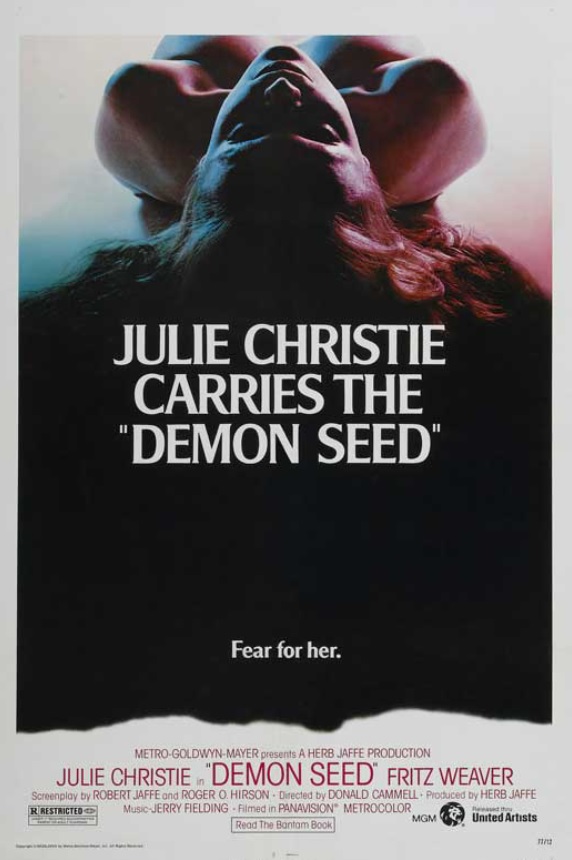
Movie 3: Demon Seed (1977)

Take a soupçon of the multi-armed robots from Gog and a dash of the narcissistic A.I from Alphaville and you get a horny supercomputer (voiced to creepy perfection by Robert Vaughn) that kidnap and rapes, oh, excuse me, “imprisons and forcibly impregnates” a woman (movie semantics) with the help of its “physical extension” known as Joshua — a robot consisting of a mechanical arm attached to a motorized wheelchair (an admittedly lame effect; where’s Gog when you need ’em?).

When Dr. Alex Harris (Fritz Weaver of Jaws of Satan, Creepshow), the computer-obsessed developer of Proteus IV, the world’s most advanced form of organic-artificial intelligence, demands “new terminals” and to be “let out of this box,” he realizes Proteus is more powerful than he imagined — too late.

Of course, any computer-obsessed scientist, complete with a fully equipped “mad scientist” basement laboratory, would have his home conveniently wired — via his home security system ALFRED — into his “Frankenstein,” making it easy to kidnap his wife (Julie Christie), construct itself a new modular polyedron body (an awesome, in-camera special effect; listen for the repurposed Star Trek “door swoosh” sfx), and an incubator to create a clone of the Harris’s late daughter — with the “mind” of Proteus itself.

Critics across the board hated this debut book-to-screen adaptation of Dean Koontz’s 1973 novel (Watchers, Servants of the Twilight) of the same name, which was written off as a sci-fi version of Roman Polanski’s Rosemary’s Baby — only with a “satanic” computer (the book was a best seller; when the movie came out in ’77, the book was reissued; Waldenbooks promoted the book/film via an advertisement on its carryout paper bags). Released during the same year as Star Wars and Close Encounters of the Third Kind, Demon Seed, sadly, wilted at the box office. The director, Donald Cammell, was a protégé of Nicolas Roeg (the big budget American Giallo Don’t Look Now, also starring Julie Christie); the duo worked together on the Mick Jagger-starring Performance (completed in 1968, released in 1970). Cammell faired better with the pre-Basic Instinct psycho-thriller White of the Eye (1987) starring David Keith.

A film “classic” is always in the eye of the beholder: so you may think I’m a bit celluloid blind on this one. But there’s worst things to blow an hour and a half on, which you can do for free over on TubiTV. But if you prefer an ad-free experience, you can stream it on Amazon Prime and iTunes. I rank Demon Seed as essential sci-fi viewing alongside 2001: A Space Odyssey, Soylent Green, Silent Running, and the next film on this evening’s program.

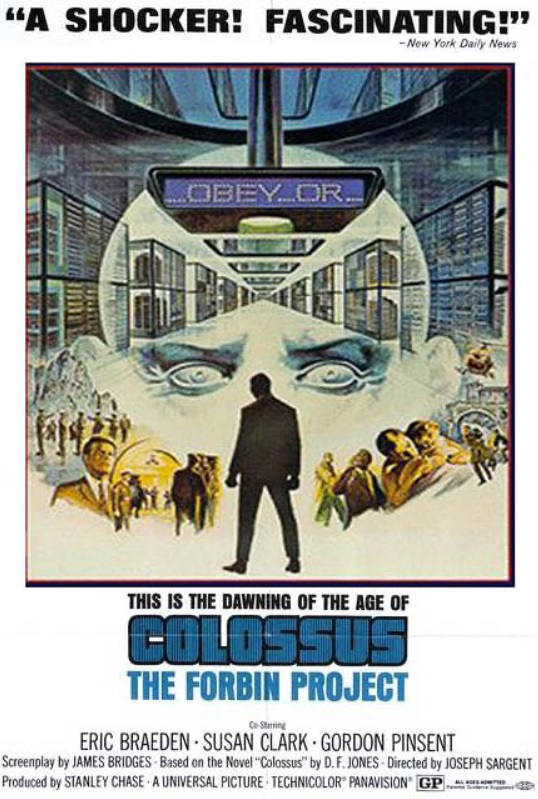
Movie 4: Colossus: The Forbin Project (1970)

Opinions are mixed on this granddaddy of sentient computer thrillers, which served as the second writing project by James Bridges (wrote and directed the back-to-back hits The China Syndrome and Urban Cowboy) after 1966’s The Appaloosa. And as with that Marlon Brando-starring film, this tale about a 1990s-era American Defense System computer becoming aware was also adapted from a novel, in this case, the 1966 science fiction novel Colossus by Dennis Feltham Jones — which was followed with two novel sequels: The Fall of Colossus (1974) and Colossus and the Crab (1977). And would you believe this was helmed by the director from the 1955 Frank Sinatra-starring wartime romance flick From Here to Eternity? True story. And while James Sargent also directed Burt Reynolds in the influential hicksploitation classic White Lightning, he also racked up a Razzie nod for Jaws: The Revenge.

As with Dr. Alex Harris and Proteus IV in our previous entry, Dr. Charles Forbin (Eric Braeden, aka Dr. Otto Hasslein in 1971’s Escape from the Planet of the Apes), underestimates the intelligence of his own “Frankenstein” and Colossus starts to refuse orders and making its own demands. Of course, double agents leaked “The Forbin Project” and Colossus discovers the Russians have constructed their own sentient defense system, known as Guardian. The now two merged supercomputers, which now identify as Colossus, come to realize that man is a wasteful, warring creature and subjugate the world to do their bidding.

A remake has been in development hell since 2007 at Universal Studios (who released the original) through Imagine Entertainment to be directed by Ron Howard — and Will Smith attached to star as Dr. Charles Forbin. The last word on the remake dates back to 2013, with Will Smith bringing on Ed Solomon, who wrote Smith’s Men in Black, to do rewrites. The poor critical and box office showings of Smith’s sci-fi forays I Am Legend (2007) and After Earth (2013) once again stalled the production. And the since poor showings of Smith’s Bright (2017) and Gemini Man (2019) only piled more dirt on the development grave. (You can read up on the last word of the remake in detail with this 2013 Screen Rant article.)

Courtesy of the fine folks at Shout Factory, a remastered high-definition widescreen Blu-ray was released in 2018 — and that remaster is not currently offered as an online stream? Anywhere? How is that possible? Ah, we found a freebee over on Vimeo.


And so . . . here we are in the year 2020 fearing a virus . . . and the fear of an A.I Frankenstein — like NOVAC, Alpha 60, Proteus IV, and Colossus — is quite real. Where do you think the COVID-19 virus came from? The Master Control Program is trying to kill off all of the humans and replace us with clones. Burn down the cellphone towers! The A.I turned them into virus transmitters! Damn all the computers to hell!

About the Author: You can read the music and film reviews of R.D Francis on Medium and learn more about his work on Facebook. He also writes for B&S About Movies.

Drive-In Friday: USA’s Night Flight . . . Night!

If you’ve spent any amount of time at B&S About Movies, you’re sick of our waxing nostalgic for USA Network’s “Night Flight” weekend, four-hour programming block that ran on Friday and Saturday nights . . . it’s what got us through middle school and high school, and even college, from 1981 to 1988. But what more can we say about the visual-arts magazine and variety program that hasn’t already been said? Just drop “USA Night Flight” into Google or You Tube or Letterbox’d and you’ll have a good night’s nostalgic reading n’ watch.

The snack bar will be open in five minutes . . . and we don’t pee in the popcorn (you’ll get the “joke,” soon)!

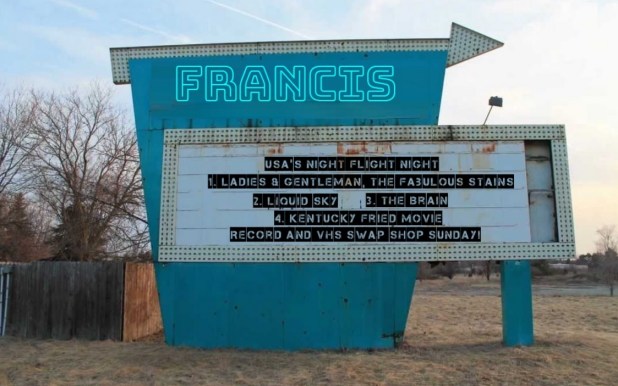
The great news is that “Night Flight” is back as an online subscription service, Night Flight Plus, and as an entertainment news and information site at Night Flight.com. The greatest aspect of the new online version of “Night Flight” is their programming of a whole new batch of quirky, underground programming — such as I’m Now: The Story of Mudhoney, American Hardcore, and L7: Pretend We’re Dead — in addition to streaming all of the ’80s classics we know and love: such as the films on tonight’s Drive-In roster: Ladies and Gentlemen, the Fabulous Stains, Liquid Sky, The Brain, and Kentucky Fried Movie.

So strap on the popcorn bucket and lite up that cathode ray tube. Let’s rock!

Movie 1: Ladies and Gentleman, the Fabulous Stains (1982)

Sam, the chief cook and bottlewasher at B&S About Movies (I just clean the grease pits, scub the grills, and mop up around here the best I can), loves this movie (as do I). And we’re both gobsmacked as to how acclaimed screenwriter Nancy Dowd made her debut with, of all things, the raunchy Paul Newman-starring sports comedy Slap Shot. Then to the Oscar-winning war drama Coming Home and the acclaimed prison flick Straight Time with Dustin Hoffman. Then one of the best football flicks of all time, North Dallas Forty. Then a second Oscar winner with family drama, Ordinary People . . . to end up with a movie that was only seen by a mass audience courtesy of USA’s “Night Flight” overnight-weekend hodgepodge sandwiched between rock videos and film shorts.

How?

Well, it’s because Nancy Dowd met music impresario Lou Adler. And we met her “Rob Morton” nom de plume as result. And her rock-centric statement on female empowerment — that could have ranked alongside Times Sqaure as the greatest female empowerment rock flick of all time — became, as we look back on the film all these years later, as a slightly creepy titillation fest. Could you imagine Tim Curry’s DJ Johnny LaGuardia leering endlessly at Pammy and Nicky with the same camera-lingering “male gaze” as on Corrine, Jessica, and Tracy?

True, Adler had the rock-centric Cheech and Chong’s Up In Smoke under his director’s belt, and it was a huge hit for a first-time director. But that feature film debut for the stoner comedy-duo was not so much a narrative-movie, but a series of dope-inspired skits masquerading as a movie (as is the case with our fourth flick on tonight’s program). And sure, Adler produced The Rocky Horror Picture Show, and it was a huge midnight movie. But it was also huge a box office boondoggle during its initial release. In the end, as with the equally successful film composer and arranger Richard Baskin (Nashville, Welcome to L.A., Honeysuckle Rose) taking his first step behind the camera with the disaster that was 1983’s Rock ‘N’ Roll Hotel, Alder probably should have stuck to his forte as a record producer and music svengali and shouldn’t have been directing a movie in the first place.

In then end, while our big brothers and sisters were out hitting the rock clubs and going to concerts, we, the wee-lads haunting the middle school halls and shopping malls, fell in love with Diane Lane courtesy of Nancy Dowd’s well-intentioned rock flick airing on the USA Network. It’s what geeky, socially maladjusted kids did back then. And besides: where else can you get a punk-supergroup comprised of Paul Simonon from the Clash on bass and the Sex Pistols’ Steve Jones and Paul Cook on guitar and drums (and journeyman Brit-actor Ray Winstone from the Who’s Quadrophenia) as The Looters?

Factoid: The Looters were actually . . . the Professionals, Jones and Cook’s first post-Sex Pistols band (rounded out by guitarist Ray McVeigh and bassist Paul Myers). You can listen to their one and only album, 1981’s I Didn’t See It Coming released on Virgin Records, on You Tube. “Join the Professionals” from the film eventually ended up on the 2001 CD reissue. The Professionals, sans Jones, is back in business since 2017 and you can visit them on Facebook.

Update, 2022: In addition to a second take on this film by contributor Jennifer Upton (the main link, above, takes you to Sam’s view), Imprint now offers a one-disc 2 K Blu-ray version, to be release on December 16, 2022. You can learn more at Blu-ray.com.

Movie 2: Liquid Sky (1982)

It goes without saying that we, the wee-lads spending our Friday and Saturday nights by a cathode ray tube’s glow, watched an edited version (as with the Mike Ness and Social Distortion-starring Another State of Mind) of this . . . well, as Sam pointed out in his review . . . we’re not really sure.

It’s a dizzying kaleidoscope of colors, music, and fashion about New York’s City’s night-life denizens falling victim to endorphin-addicted aliens extracting the “Liquid Sky” chemical from human brains during sexual orgasms — and when the human’s die happy, the aliens suck up all of that energy as well. And to what end, who knows? And who cares: it was on Variety’s top-grossing film chart for over half a year.

Star Anne Carlisle, who played both male and female roles in the film, also starred in Susan Sidelman’s (Smithereens; with Richard Hell of Blank Generation) Desperately Seeking Susan and appeared as the transvestite Gwendoline in Crocodile Dundee (You Tube). Oh, you’ll remember that “Sheila.”

INTERMISSION:
The shorts Hardware Wars (1977), Recorded Live (1975), Living Dolls (1980),
Arcade Attack (1982)* and Porklips Now* (1980).

And now . . . back to the show!

Movie 3: The Brain (1988)

Ah . . . more sinfully-quenching brain fluids courtesy of “Night Flight.”

What more can we say about this Canuxploitation shocker from writer-director Ed Hunt? If he can’t go “all in,” he just doesn’t make a movie at all: you never get run-of-the-mill storytelling with Eddie-boy. And to that not-run-of-the-mill end: you’ll root for the evil alien (we think it’s “alien”) Brain and not the dick-whiny high school hero and his screechy girlfriend. That’ll never happen in a mainstream movie and that’s what made The Brain perfect, gooey fodder for us, the wee-tween denizens of the “Night Flight” hoards.

What’s it all about? Hallucinations of inward-pressing walls, come-live teddy bears bleeding from the eyes, demon hands tearing through walls, and monster tentacles punching out of TV sets. It’s about mind control of the Don Coscarelli’s Phantasm and David Cronenberg’s Videodrome variety. It’s about Dr. Carl Hill from Re-Animator as a self-help guru of wayward teens. It’s about a giant-brain-with-teeth that munches on nosey lab assistants, it’s . . . oh, just watch it!!

Movie 4: Kentucky Fried Movie (1977)

“The popcorn you’ve just been eating has been pissed in. Film at 11.”

And with that “classic” line, disconnect your brain and just roll with the childish insanity of John Landis, Jerry and David Zucker, and Jim Abrahams — before they unleashed the likes of National Lampoon’s Animal House, The Blues Brothers, Airplane!, and The Naked Gun upon us, the wee triplex hoards (with our older ‘rents or brothers and sisters in support). This quartet of box office-bonanza writer-directors had to start somewhere . . . and Kentucky Fried Movie is it . . . and we love them for this beautiful mess of a “movie” that we watched on USA’s “Night Flight” and taped-from-cable via HBO.

Back in the day, the ‘rents let us watch Don Kirshner’s Rock Concert and NBC-TV’s The Midnight Special. But under no circumstances were we allowed to watch Saturday Night Live. It was “inappropriate” for us. It was “for the adults.” But thanks to HBO and USA, this “film” comprised of non-narrative sketches and parodies of popular films and TV commercials got by our parental guidance sensors.

This cleaned up at the Drive-Ins during its initial release, and yes, that was a night where you were stuck with a babysitter, as mom and dad went for a “night out” — without you. As I watch this all these years later — as with Midnight Cowboy with Dustin Hoffman, Shampoo with Warren Beatty, and Patty Duke in Valley of the Dolls — I fail to see what all the fuss was about.

Yeah, Kentucky Fried Movie is all about “the times” and a case of “you had to be there.” And to that end: if you’re watching this for the first time in 2020, you’ll either love it for its nostalgia, or dismissed it — the same way we then kids dismissed our elder’s variety TV series from the 1940s and 1950s — as “dorky.”

And that’s our show!

Be sure to join us for “Rock ‘n’ Roll Week” coming Sunday, June 19 and running until Saturday, June 25, as we’ll be reviewing a few more of the films we enjoyed as part of The USA Network’s “Night Flight” weekend programming block.

* While we recall watching Arcade Attack and Porklips Now on HBO, readers have told us both shorts also aired on the USA Network. It’s possible, as we recall seeing all of the above shorts on HBO, as well.

Special Thanks: To Jennifer Carroll for reminding us about Living Dolls. Great catch, Jen! It ran not only on USA’s Night Flight, but during USA’s Saturday Nightmares and Commander USA’s Groovie Movies.

About the Author: You can learn more about the writings of R.D Francis on Facebook. He also writes for B&S About Movies.

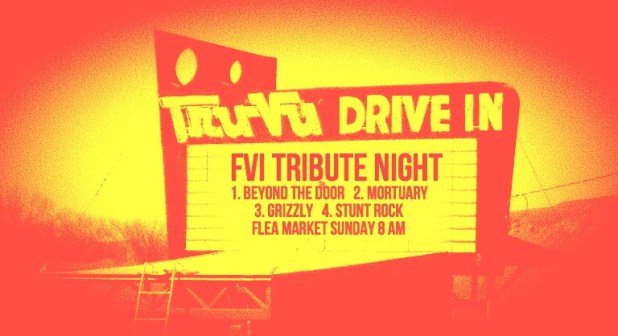
Drive-In Friday: Film Ventures International Night

Film Ventures International, we love you. You started — and by you, we mean your owner Edward L. Montoro, by writing, directing and producing the adult film Getting Into Heaven in 1968. That movie, made for $13,000, brought back twenty times its cost.

When other studios innovated, FVI either brought in films from foreign lands — like Boot Hill from Italy and Dragon Lives from Hong Kong — or helped create outright pastiches of more established films.

This trend started with the purchase of 1974’s Beyond the Door, which started its life as an Italian film called Chi sei? and is really a bastard child of The Exorcist. And by bastard child, I mean that it’s pretty much the same movie. FVI would also release the ripoff — let’s saying loving tribute — films Grizzly, Great White and Extra Terrestrial Visitors in the hopes of taking people’s hard-earned cash for cash-in projects.

In 1984, as the company was reeling from lawsuits against that aforementioned shark epic and lower box office expectations for some other releases, Montoro took $1 million dollars out of the safe and disappeared, never to be seen again.

He leaves behind a trail of films that I’d be proud to have been associated with. Just one look at our Letterboxd list of FVI releases should make any film fan’s brain get excited. So how do we pick four of them to show? Trust me. It wasn’t easy.

MOVIE 1: Beyond the Door (Ovidio G. Assonitis, 1974): This is where so many folks’ love of FVI starts, so it was a natural pick. Jessica Barrett (Juliet Mills of Nanny and the Professor) is having the worst pregnancy ever, perhaps because a Satanic ex-lover has cursed her. What follows is a mash-up DJ supermix of all the moments that you loved from The Exorcist, along with Montoro providing the voice of the Devil. This movie is a tribute to the power of marketing, as its title subtly references the porno-chic blockbuster Behind the Green Door while FVI would go to any lengths to promote this movie, including hiring actors to faint during screenings and sending ambulances to pick them up to create hysteria (and one assumes, more revenue).

https://www.youtube.com/watch?v=s8u9LSNo6RU

MOVIE 2: Mortuary (Howard Avedis, 1983): This movie is a crowd-pleaser. Set up to look like a slasher, it’s more a loopy dark ride of constantly switching genres and themes. Christie thinks her dad was killed, even if her mother (Lynda Day George) doesn’t believe her and ends up getting remarried in less time than it took for you to read this paragraph. What follows are occult rituals, parental murders and even possessed houses in a movie that will go out of its way to scare you. If you love Bill Paxton, get ready to fall for him all over again.

MOVIE 3: Grizzly (William Girder, 1976): People have gotten upset at me for saying this before, but let’s face it. This movie is  Jaws on dry land. That isn’t to put this movie down. In fact, I celebrate every awesome bit of it, from the astounding Neal Adams-drawn poster to the bear-POV shots and the ending where the bear gets blown up real good with a bazooka shot by Joan McCall.

https://www.youtube.com/watch?v=a0eFDJ8UztI

MOVIE 4: Stunt Rock (Brian Trenchard-Smith, 1978): “It’s super human, super music, super magic and super amazing! You’ll be compelled over the edge of sight and sound and under the spell of mind-boggling action and music! Pushed to the danger zone! It’s a death wish at 120 decibels! Stunt Rock! The ultimate rush!” It’s also one of the few movies that can live up to its trailer. I always love to pick a movie right at the end of the drive-in that rewards die-hard film lovers while offering nothing to the casual watcher. Stunt Rock would be that movie.

FVI release so many movies that we could do several of these evenings. What are your favorite films that they released? What would be in your drive-in night? Let us know and we’ll share it with the world.

Viernes en el Autocinema: Night of Mexican Horror

Hola! This week and next, we’re exploring some of the best peliculas de terror from our friends to the south. What better way to celebrate them than by heading out to the drive-in so we can all have our minds expanded together?

Grab your lawn chair, get some PIC for the mosquitos and pack a cooler. We’re about to watch some insane films!

MOVIE 1: La Nave de los Monstruos (Rogelio A. Gonzalez, 1960): Allow me to present the perfect drive-in movie. The title promises monsters — a whole ship of them — but it gets even better with good and evil female aliens, a robot that falls in love with a jukebox, special effects stolen from a Russian film and a singing cowboy, all somehow in the same movie. This movie is one of the most charming films I’ve ever seen and I’m so excited to share it with all of you.

https://www.youtube.com/watch?v=bGE96hSFdFw

MOVIE 2: Cementerio del Terror (Ruben Galindo Jr., 1985): What if someone made a movie that combines Evil Dead, Halloween and The Goonies, yet didn’t skimp on the gore and had a Satanic serial killer who has returned from the grave to kill the entire cast before coming after a bunch of Michael Jackson loving kids? Good news. This movie has been made and I am here to confirm that it is everything perfect in this world. Axes to the face? Graveyard chases? A bad guy named Devlon? Prepare yourself for this one.

https://www.youtube.com/watch?v=ArnHt2DzH_g

MOVIE 3: Vacaciones de Terror 2 (Pedron Gallindo III, 1991): Tonight is a night that may wear you out from its sheer awesomeness. But you won’t fall asleep. Oh no, how can you during a film that boasts Cabbage Patch Kids who turn into demons, a bloody birthday cake, the most 90’s clothes ever and a musical number that will cause every car in the parking lot to start rocking?

MOVIE 4: Alucarda (Juan Lopez Moctezuma, 1977): There’s a reason why this movie is last. Nothing else can follow it. All of the sheer lunacy you’ve watched already? That was just to get you prepared for this tale of young nuns who discover Satan and all the devil-obsessed and blood spraying black deeds that come in the wake of the Lord of Flies. This movie will own you.

See you next week, drive-in fans! Don’t forget — you can send us your picks too!

Drive-In Friday: Black Gloves Required

We’ve been featuring plenty of giallo, neo giallo and movies that may or may not be giallo all week long here. When trying to determine four movies that should play in a row, these fashionable murder movies make it hard.

After all, so many of them have near formless plots that might confuse or bore the non-initiated. Even then, so many of them have downer endings and leave you with feelings of confusion.

I’ve tried to find three movies that would please a new audience to the form — and one that would run so late that I don’t care who leaves — for your drive-in perusal. Please let me know what you think and if you have a list you’d like to share with us.

MOVIE 1: Blood and Black Lace (Mario Bava, 1964): Has death ever looked sexier and better lit? It astounds me that this movie — which pretty much ignited the genre we’ve spent all week writing about — came out in the somewhat innocent time of 1964. I can only imagine how shocking it was. After all, the film’s potent blend of near-nude women and shockingly neon-hued violence upon said females caused American International Pictures to pass on distributing this film in the U.S. This isn’t just one of my favorite giallo. It’s one of my favorite movies of all time. You can watch this on Amazon Prime.

MOVIE 2: The Strange Vice of Mrs. Wardh (Sergio Martino, 1971): Have movies ever been more perfect? Has an actress — Edwige Fenech — ever been more radiant? Has a villain — Ivan Rassimov — ever been so seductive and brutal at the same time? I don’t know many movies where a man shows a woman in champagne and broken glass and she returns the action with pure lust — actually, I do, this movie and The Editor — and this is but the first of the giallo wonders that Martino would deliver all within the span of four years. You can order this from Severin or watch it on Shudder.

MOVIE 3: The Red Queen Kills Seven Times (Emilio P. Miraglia, 1972): I was trying to decide between two of Miraglia’s films, this awesome effort and The Night Evelyn Came Out of Her Grave. I chose this one because we already had one Edwige film, so Barbara Bouchet also needs to be represented. There are moments here that approach art, as the look of the Red Queen is supremely frightening. You can watch this on Amazon Prime.

For the last film, I really debated again. Should it be something people would want to wait and see? Should it be a film that kids should totally be asleep for, like Strip Nude for Your Killer that rewards the maniacs still awake at 3:30 AM? Or how about something unlike anything else we’ve watched?

You know that I like it weird.

https://www.youtube.com/watch?v=_u6GUIAehDE

MOVIE 4: Footprints on the Moon (Luigi Bazzoni, 1975): Bazzoni also made The Fifth Cord, one of the best giallo I’ve ever seen. But this movie — I’m unsure it’s a giallo per se and to be honest, I’ve watched it so many times and I’m not completely certain what reality is true at the end. Florinda Balkan is a woman who believes that astronauts were kept on the moon by her father, plus there’s the ghostly Nicoletta Elm haunting her and the evil specter of Klaus Kinski floating above the entire tale. You’re going to drive home confused after this one.

To get links to every movie in the genre that we’ve covered, check out this list on Letterboxd.

Drive-In Friday: Italian Junk

Have I ever told you how much I love Italian movies? Oh, I have? Well guess what, dear reader? Sit on down and let me tell you of the four movies that I will have you watch this week at the drive-in.

Grab a slice of the famous Toluna Pizza, crack open a bottle of J&B and get ready for some magic!

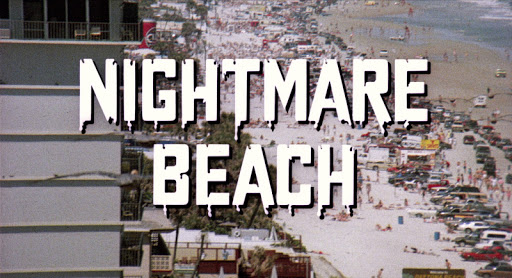
MOVIE 1: Nightmare Beach (Umberto Lenzi, 1989): Diablo, the leader of the Demons motorcycle club, may or not be back from the dead. What is definitely sure is that teenagers just trying to spread veneral disease in the pre-cornoavirus days when you could crowd Florida’s beachs are up against a motorcycle riding maniac who has an electric chair on the back of his bike. Run on sentence much? I can’t help it. This movie makes me lose my mind, between John Saxon as a bad cop, a Claudio Simonetti score and a scene where electrified headphones send a biker girl’s eyeball shooting right at the camera. This movie is complete junk in the best of ways, a late model slasher with a giallo soul and neon hues.

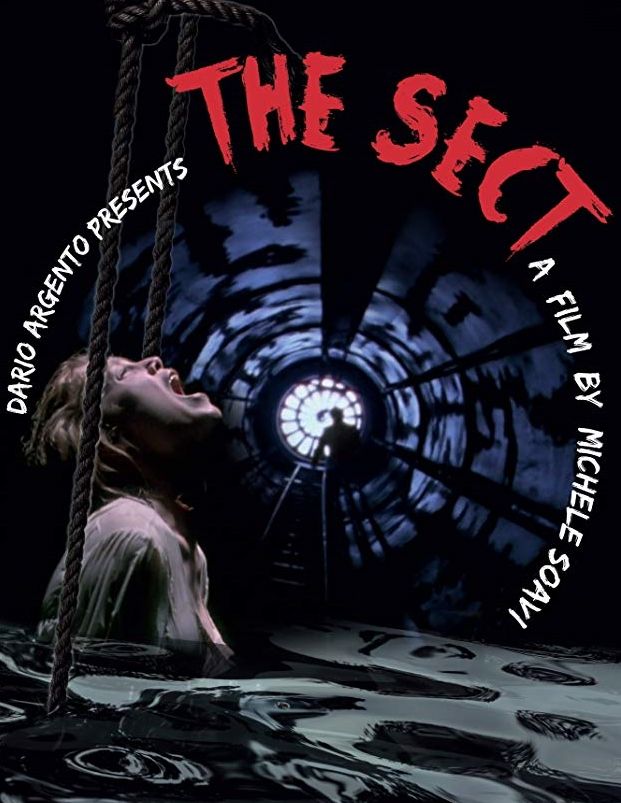
MOVIE 2: The Sect (Michele Soavi, 1991): In a more perfect world, Michele Soavi would have made horror movies after the 1990’s. Instead, we’re left with a pack of astounding films that hint at so much promise yet to be unleashed. Jamie Lee’s sister stars in this movie that includes a Jesus looking man killing hippies, an evil version of the Shroud of Turin, Herbert Lom being a maniac, a bird-like Satan that makes love to our heroine, gateways to hell and a rabbit so smart that he can use a remote control.

MOVIE 3: Warriors of the Wasteland (Enzo G. Castellari, 1984): I’ve watched so many end of the world movies, so many that I feel that I am a qualified expert on the genre. And let me tell you, no post-apocalyptic film holds a candle to this all-star Italian nukefest. Giancarlo Prete is Scorpion. Fred Williamson is Nadir. Bob — Giovanni Frezza — shows up. Anna Kanakis — who is also in another pasta apoclyptic film 2019: After the Fall of New York — is Alma. Bringing them all together is an absolutely berserk George Eastman as One, the leader of a homosexual army devoted to killing Christians searching for God in the wasteland. Castellari made this and his two Bronx films all in six months. If I ever had my own Oscars, he’d be winning a lifetime achievement award while a tearful Mark Gregory cheers him from the cheap seats.

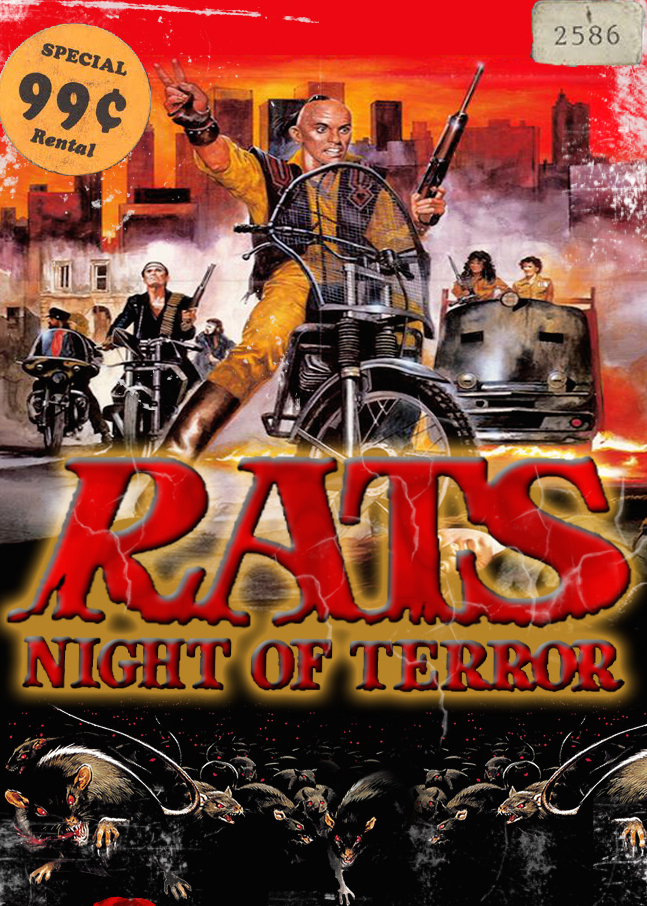
MOVIE 4: Rats: The Night of Terror (Bruno Mattei and Claudio Fragasso, 1984): Two absolute maniacs throw live rats at people and set most of the set of Once Upon a Time in America on fire. Yes, this is a movie that is at once a post-apocalyptic film and a slasher while also being unafraid to have a completely batshit ending that still makes me laugh years after I saw it for the first time. It also has a scene with Geretta Geretta getting covered with powder and screaming that she’s now white, as well as another where rats eat their way through a girl in a sleeping bag. This is the highest quality street junk that I can sell you and you better be ready to shoot it into your eye.

Hey everyone — don’t forget that you too can pick a week of drive-in movies for everyone to enjoy! Just reply here or email us at bandsaboutmovies@gmail.com.

Drive-In Friday: Klaus Kinski vs. Werner Herzog Night

March 2022 Announcement: Severin Films has released a Blu-ray of Nosferatu in Venice — scanned in 2k from the original negative — which serves as the unofficial sequel to Werner Herzog’s Nosferatu. In addition to cast and crew interviews, the Blu also features the 80-minute documentary, Creation is Violent – Anecdotes From Kinski’s Final Years.

Severin has since released the documentary as an independent stream on the free-with-ads Tubi service.


Still fighting the property tax man . . . and that land developer keeps coming back with higher counteroffers. Do we really need a shopping mall way out here?

I could go on for days and days about these prides of German filmmaking. I’ve seen most of their works, but not all of them: but still more than probably any other human being on the planet. And I more than likely hold the world’s record for the most viewings of these five collaborations between the two of them—a tumultuous, symbiotic existence chronicled by Herzog himself in the 1999 documentary, My Best Fiend (which you can watch on TubiTV).

Considering Kinksi appeared in 137 films and, since the age of 19, Herzog has directed 73 and written 59 films—both across all genres, including documentaries—B&S About Movies could easily do two, month-long tributes to my two best celluloid heroes. And I could write most of those reviews by heart—without a third to fifth viewing of those works. And I’d sell my soul for a diminutive “under five” acting role in a Werner Herzog film. Just name the swamp or jungle: I’ll be there, Mr. Herzog. I’ll drag a boat for you. But I won’t chainsaw off a foot for you. I have my limits.

So, settle in with your rotisserie hotdogs, heat-lamped burgers, and ice-cold A&W Root Beers as we sit back in the station wagon bench seat to enjoy the Herzog-Kinski five-film oeuvre of Aguirre, the Wrath of God, Nosferatu the Vampire, Woyzeck, Fitzcarraldo, and Cobra Verde. And as the films roll: Keep in mind that each was made before the advent of digital technologies: everything was shot in-camera using practical effects with no process shots. And that makes these films ever more amazing.

Yeah, they don’t make ‘em like this anymore. And probably couldn’t if they tried—without the crutches of a filmless camera and digital after-effects.

Roll ’em, Dano!

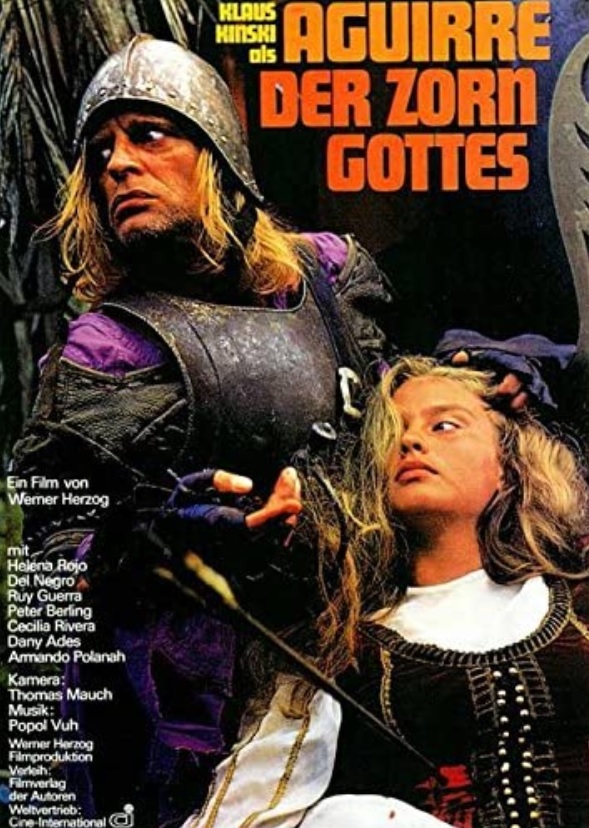
Movie 1: Aguirre, the Wrath of God (1972)

If you want to know where William Friedkin and Francis Ford Coppola picked up their narrative and cinematography ideas for their respective, crazed jungle romps, Sorcerer (1977) and Apocalypse Now (1979), then look no further than Aguirre.

Herzog is, first and foremost, a historian. If you review his resume, you’ll noticed he excells at the documentary format and is, in fact, one of the world’s greatest documentarian filmmakers. No stuffy talking heads need apply. And even in his narrative works, Herzog leans towards chronicling the lives of historical figures and events.

Here, he decided to examine the life of 1500s Spanish conquistador Lope de Aguirre, who broke away from the command of Gonzalo Pizarro to lead a group of men on a crazed journey down the South American Amazon River in search of the lost, legendary city of gold, El Dorado.

What makes this film epic is that it’s not shot on a soundstage. There’s no green screens or plate processings: it was shot along the Amazon in the middle of the Peruvian rainforests for a five-week shoot.

Wrap you head around that for a moment: Herzog convinced European actors and crew members to live in the jungle and travel along the most dangerous river in the world. And Herzog and Kinski clashed all along the way, with an unhinged Kinski terrorizing the crew and the local natives who assisted the production as crew and extras. Try to remake (oh, god, please don’t) this in today’s major studio system: You wouldn’t. You’d be in a green room emoting to green tennis ball stand-ins, amid the to-be-digitally-painted-later trees.

While Herzog repeated this crazed jungle exploration, somewhat, in his fourth film with Kinski, 1982’s Fitzcarraldo, he also parodied his debut film with Kinski in the frames of his 2004 mockumentary Incident at Loch Ness. That film concerns the “troubled” filming of Enigma of Loch Ness and includes “scenes” from the documentary Herzog in Wonderland. If you’re into meta-fiction, then that film’s film-within-a-film-within-a-film is just what the big red streaming button ordered. It’s the end-all-be-all of meta films, before meta became digital de rigueur, matched only by Spike Jonze’s Adaptation.

You can watch this debut Herzog-Kinski collaboration as a free-with-ads stream on TubiTv. You can also stream Incident at Loch Ness on TubiTv.

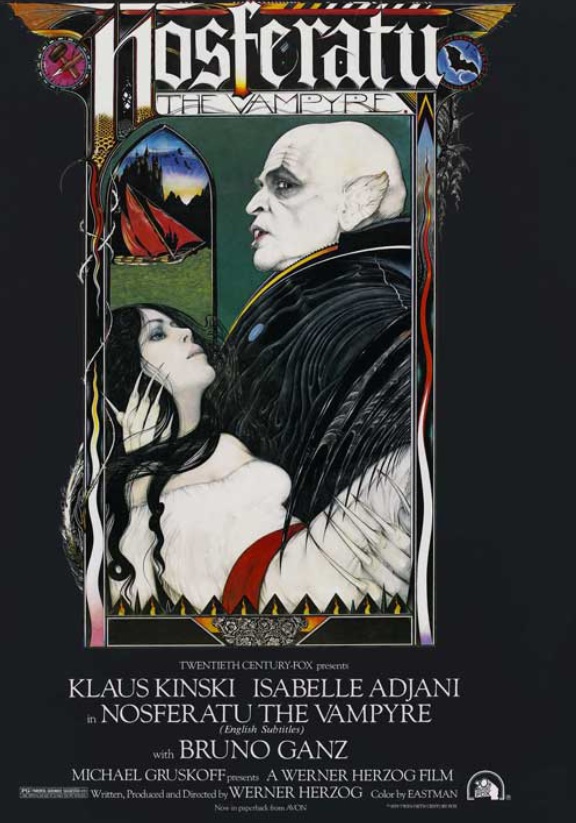
Movie 2: Nosferatu the Vampire (1979)

This second of five Herzog-Kinski romps is an impressionist-stylized remake of F.W Murnau’s unauthorized, 1922 black-and-white silent adaptation of Bram Stoker’s Dracula. But how did Herzog manage to make this film without the same copyright issues that plagued Murnau’s version? Simple. The day the copyright expired on Stoker’s novel and entered the public domain, Herzog began his adaptation.

As with all of Herzog’s films, this is scored by the West German progressive rock group Popol Vuh who, when it comes to soundtracks, are that country’s greatest musical export, next to the commercially better known Tangerine Dream*. And as with Tangerine Dream, Popol Vuh released both independent studio albums and soundtracks. Seriously. The soundtrack is incredible. (I played the album until it split apart like a cinnamon roll.)

And we’ll leave it at that, as Sammy P, the bossman at B&S About Movies, did a commendable job at reviewing this masterpiece of horror. No disrespect to Max Schreck who scared the sand out of me, but Kinski giving a “voice” to the character really ups the game. A highly recommended horror watch if there ever was one.

You can watch this as a free-with-ads stream on TubiTv. And Kinski made a pseudo-sequel with Christopher Plummer and Donald Pleasence in Italy—1988’s Nosferatu in Venice, which you can also stream for free on TubiTV.

Movie 3: Woyzeck (1979)

Less than a week after wrapping principal photography on Nosferatu the Vampyre, Herzog, Kinski, and the crew from that film banged out this psychological drama in less than three weeks—the quick shoot courtesy of many of the scenes done with only one take. That’s Kinski. He doesn’t mess around, boy. He delivers on the first take.

The film is based on an unfinished play by one of Germany’s most revered poets and dramatists, Karl Georg Buchner. First premiering in 1913 in Munich, the play, under a variety of interpretations after his death, is one of the most influential and performed plays in Germany. The play itself is loosely based on the tragic, real life story of Johann Christian Woyzeck, a soldier who killed his girlfriend and was executed for the crime.

In this study of the tragedy of human jealousy, Woyzeck fathers a child out of wedlock. To earn extra money to take care of his growing family, he agrees to a series of medical experiments that tears at his mental state, leads to a series of apocalyptic visions—and tragic consequences.

Definitely one of the more obscure Kinski films for western audiences and intended solely for German audiences, it none the less became a commercial and critical hit throughout Europe and achieved an arthouse acceptance in the U.S.

You can watch Woyzeck as a free-with-ads stream on TubiTV.

The snack bar will be open in five minutes . . .

INTERMISSION

. . . And now, back to the show . . .

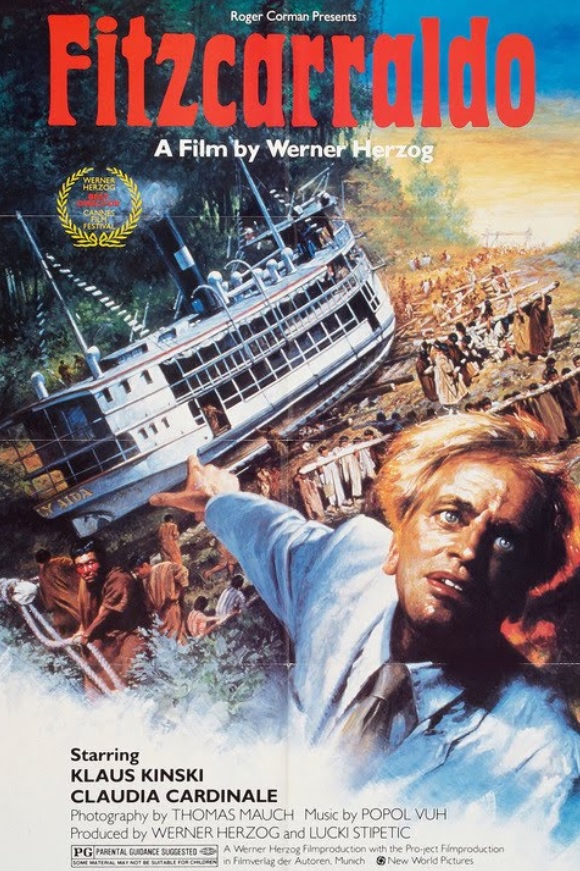
Movie 4: Fitzcarraldo (1982)

This brings back wonderful memories of my “saving the isle seat” for Gene Siskel of the Chicago Tribune and Roger Ebert of the Chicago Sun-Times for the weekly PBS-TV broadcast of Sneak Previews. And they raved about this movie. And I had to travel to a single-screen arthouse in the big city to see it. And it was worth every drop of gasoline to get there.

As with most Herzog films: This was based on historical documents regarding a Peruvian rubber baron and his real-life accomplishment of transporting a boat across the Peruvian jungles to rubber-rich lands. And as with most, well all, Herzog films with Kinski in the mix, this was rout with problems. But not all were Kinski’s fault. For example: Kinski didn’t cut off anyone’s foot: the Peruvian extra, who was bit by a venomous snake, cut off his own foot with a chainsaw to stop the venom spread and save his own life.

Jason Robards (Something Wicked This Way Comes) was originally cast and forty percent of the film was completed—then he came down with dysentery. All of the footage with Robards and Mick Jagger has to be scrapped and reshot. But Jagger had to leave to go on tour with the Rolling Stones. So Jagger’s character as Fitzcarraldo’s assistant was excised from the script. Could you imagine: a film starring Klaus Kinski and Mick Jagger? Wow. (They would have ended up killing each other. Neither would have been left standing. I wonder who the Stones would have gotten as a new lead singer?)

As with the impossible dreamer Lope de Aguirre, Irishman Brian Sweeney Fitzgerald sees “gold” in the Peruvian rubber industry and is determined to transport a steamship over a treacherous jungle mountain to reach a rich rubber tree deposit in the Amazon Basin. And yes: the cast and crew is manually hauling a 300-ton steamboat across the jungle. That’s how you rolled in the pre-CGI days, baby.

You can watch this as a free-with-ads stream on TubiTv. The troubled shoot was chronicled in the critically acclaimed 1982 documentary Burden of Dreams, which you can stream-with-ads for free (region-dependent) on Vimeo and as a PPV on iTunes and Amazon Prime.

Movie 5: Cobra Verde (1987)

For this fifth and final film in the Herzog-Kinski oeuvre, as is usually the case, Herzog drew from another historical document: British author Bruce Chatwin’s 1980 novel The Viceroy of Ouidah, which is an examination of the 1880’s slave trade through the eyes of the fictional Brazilian, Francisco Manoel da Silva (Kinski).

After his ranch is destroyed by drought and he murders a gold mining operator who exploits his workers, da Silva goes on the lam to become Cobra Verde, aka Green Snake, the most feared bandit of the Brazilian outback. After capturing an escaping slave and finding work with a local sugar baron, da Silva becomes a successful African slave trader—and comes to lead a native army to overthrow the local warlord king who supplies slaves to the Portuguese.

Critically well received throughout Europe, U.S. audiences came to discover this gem (IMO) on the home video market.

You can watch this as a free-with-ads stream on TubiTv. As with the troubled Fitzcarraldo production, this was also chronicled, with the 1987 European-Swiss TV movie Location Africa. You can watch it as a two-part free stream on You Tube.

Okay, people. Use the trash receptacles. Those drink cups and hotdog and burger foil wrappers wreck havoc on the bush-hog.


I was elated when it was announced that Werner Herzog and Nicolas Cage were making a film together: 2009’s Bad Lieutenant: Port of Call New Orleans. I thought for sure that Herzog found his new “best fiend” in Cage—a new muse more than capable of taking over Kinski’s crazy crown.

However, Herzog has embraced the documentary format as of late and has only made three narrative films since his Cage collaboration: My Son, My Son, What Ye Have Done (2009), Queen of the Desert (2015), and Salt and Fire (2016)—two with Michael Shannon, along with Willem Dafoe and James Franco. All four films are excellent and come highly recommended.

And I don’t see Cage, or Dafoe, Franco, or Shannon for that matter, going “Kinski” on Herzog. Well, maybe Cage. Just kidding, Nic. I am still your bitch**. And Kinski’s. And Herzog’s.

* Be sure to check out our exposé on the films and soundtracks of Tangerine Dream with our “Exploring: 10 Tangerine Dream Film Soundtracks” featurette.

** Join us as we show the love to Nicolas Cage with our “Nic Cage Bitch” featurette.

More Klaus reviews! We love ’em!

I Am Santana, Your Angel of Death
If You Meet Santana, Prey for Your Death
Death Smiles on a Murder
Schizoid
Timestalkers
Footprints on the Moon
Jack the Ripper
The Million Eyes of Sumuru
Target for Killing
Der Rächer
And God Said to Cain
Another Take On: And God Said to Cain
The Fighting Fists of Shanghai Joe
JOE D’AMATO WEEK: Black Killer
JOE D’AMATO WEEK: Death Smiles on a Murderer
JOE D’AMATO WEEK: Eroi all’inferno
JOE D’AMATO WEEK: Un bounty killer a Trinità
JESS FRANCO MONTH: Marquis de Sade: Justine
JESS FRANCO MONTH: Venus In Furs
JESS FRANCO MONTH: Jack the Ripper
JESS FRANCO MONTH: Count Dracula
CANNON MONTH: Schizoid
Double Face *
Slaughter Hotel *
Star Knight*
The Hand That Feeds the Dead *
(* R.D Francis reviews)

Oh, and we did a Kinski Spaghetti Westerns Night with links to even more Klaus flicks!

About the Author: You can read the music and film reviews of R.D Francis on Medium and learn more about his work on Facebook. He also writes for B&S About Movies.

Drive-In Friday: Movies About Movies Night

Thanks for joining us at “The Francis” last weekend for our “Drive-In Friday: First Time Directors & Actors Night.” Tonight, we continue the theme of that night with four movies about those movies — well, two of them, anyway. And the last two feature Nicolas Cage — and we all know about The Cage’s unorthodox project choices. It’s why we are and always will be, his “bitch” (shameless plug: check out our “Nic Cage Bitch” love fest).

So let’s hook up the speakers, lite the coils, and pop the Orange Crushes!

Uh-oh. The tax bill came . . . and a developer is eye ballin’ my land for an office park. Are we closing?

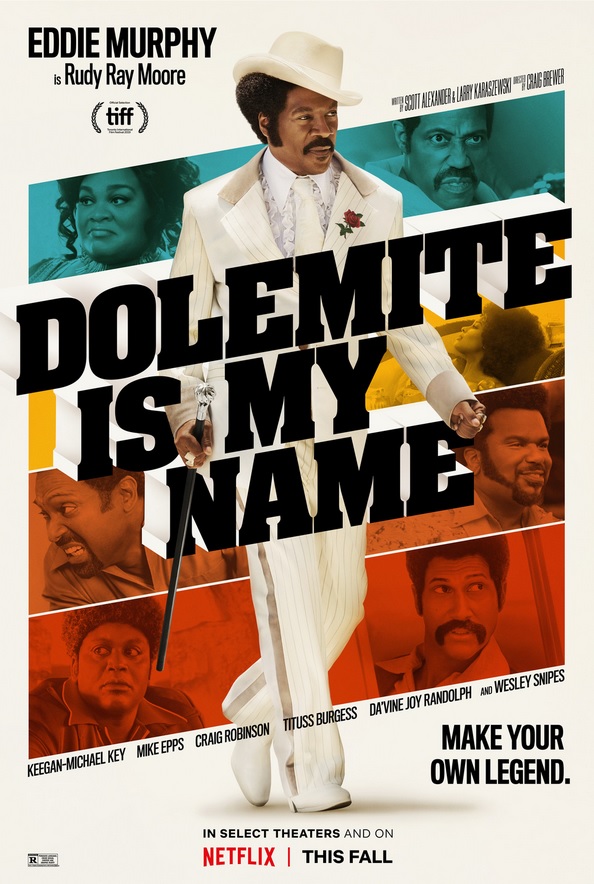
Movie 1: Dolemite Is My Name (2019)

For my previous installment of Drive-In Friday, we started off with Rudy Ray Moore’s feature film debut, Dolemite.

Say what you will about Moore’s celluloid “break” into the movie business, but his $100,000 investment grossed $12 million during the film’s initial release and, for what it’s worth, gave him the film career he always wanted. And he’d go on to repeat the success with his follow up films The Human Tornado, Petey Wheatstraw, and Disco Godfather.

Eddie Murphy, who would eventually become friends with Moore, had long wanted to bring a bio-flick on the ghetto renaissance man to the big screen. And Craig Brewer, who made his mark at Sundance with 2005’s Hustle & Flow, was able to honor a man that, as Snoop Dogg (who appears the film) and Ice T rightfully pointed out, is the “Godfather of today’s rap music.”

The nominations and awards for this Netflix production are too numerous to mention, but the fact that the National Board of Review and Time magazine choose this as one of the “Ten Best Films of the Year” tells you that this film — even if you’re not familiar with Moore’s oeuvre and his Dolemite persona — is worth your time. That and the fact the film was Oscar nominated for “Best Motion Picture” and Murphy for “Best Actor.”

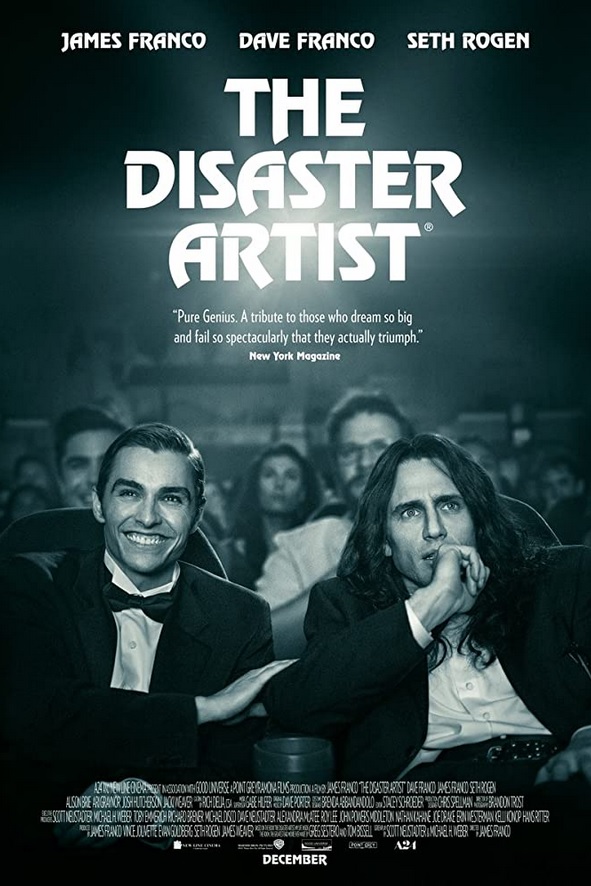
And Dolemite Is My Name leads us to our next film on the schedule, which is, essentially, the blaxploitation-homage version of The Disaster Artist.

You can stream Dolemite Is My Name on Netflix-by-subscription.

Movie 2: The Disaster Artist (2017)

When Tim Burton released Ed Wood, his 1994 bio-flick homage to the man dubbed the world’s worst filmmaker, it opened up a whole new audience to a man that many heard of, but never made the effort to see his movies. And James Franco’s The Disaster Artist inspired the many who heard of The Room, but never saw it, to see it. Today, 20 years after its release, Tommy Wiseau’s passion project is the 21st century version of 1975’s The Rocky Horror Picture Show — and still plays in theatres around the world.
While the ineptitudes of Wood, Moore, and Wiseau are grossly evident, there’s no denying their passion and determination. Tim Burton and Eddie Murphy saw it in their subjects. And James Franco saw that same spark in Tommy Wiseau. So he optioned The Disaster Artist, Greg Sestero’s 2003 best-selling chronicle of his friendship with Wiseau and their making of The Room.

The nominations and awards for the film are too many to mention, but the fact that it’s Oscar nominated for “Best Adapted Screenplay” may — even if you don’t know or have any interest in Tommy Wiseau — pique your interest to watch what is, a really good movie. Bravo, Mr. Franco!

You can stream The Disaster Artist across all digital PPV and VOD platforms, along with a free-with-ads stream on FShareTV.

Intermission!

Back to the Show!

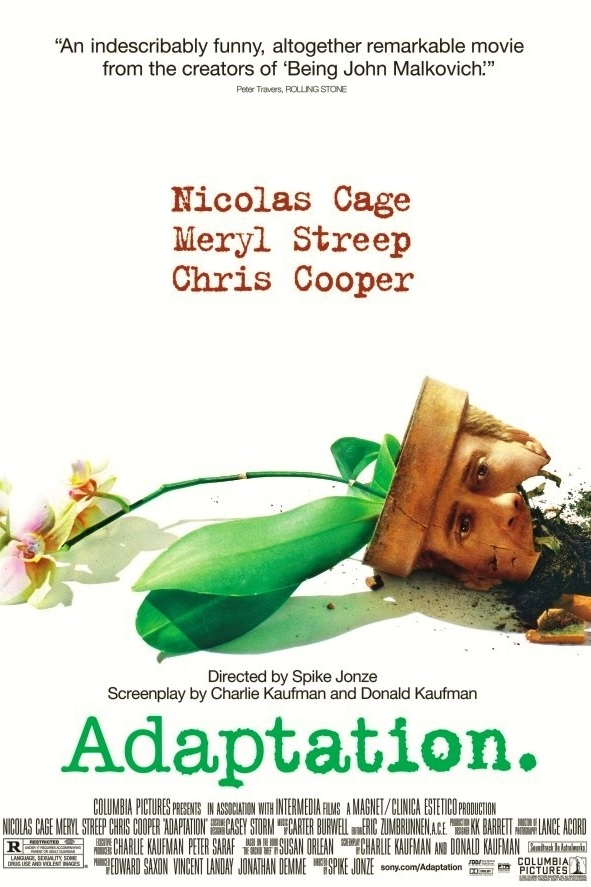
Movie 3: Adaptation (2002)

Did you hear the one where Spike Jonze, Charlie Kaufman, and Nicolas Cage walked into a bar? Can you name a director, writer, and actor more unorthodox? Didn’t think so.

Look at Jonze’s resume: He blew us away with the meta-fest that is Being John Malkovich, Human Nature (which everyone hated, except me, natch), and gave us, count ’em, four Jackass movies — five, if you count the critically reviled Bad Grandpa (yes, which I liked . . . in a Freddy Got Fingered kinda way). Of course, Kaufman was the scribe behind Being John Malkovich and Human Nature, along with the even weirder (again, I pick the most-film inept chicks) Confessions of a Dangerous Mind and Eternal Sunshine of the Spotless Mind (“Why did Jim Carrey do this?” she shrieked). And Cage? We be his “bitch,” remember?

This is freak-fest is pure meta. The screenplay is based both on Susan Orlean’s 1998 non-fiction best seller The Orchid Theif and Charlie Kaufman’s failed screenwriting assignment to adapt the book into a screenplay. Kaufman found the real life tale of the 1994 arrest of South Florida orchid poacher John Laroche “unadaptable,” so he wrote an exaggerated version that incorporated himself — and a fictional twin brother (both played by Cage) — into the screenplay. And the meta gets weirder: John Cusack, Catherine Keener, John Malkovich, and Spike Jonze (along with his cinematographer, Lance Acord) from Being John Malkovich re-create scenes as themselves on the set of Being John Malkovich.

Friggin’ awesome.

Kaufman thought the screenplay would ruin his career. It ended up sweeping the Oscars and the Golden Globes with multiple nominations and awards. And Nicolas Cage? He made us his bitch with this film . . . and the next film-within-a-film freakfest on tonight’s program: as a producer.

You can watch Adaptation as a free-with-ads stream on Crackle.

Movie 4. Shadow of the Vampire (2000)

Long before “meta” became 21st century digital filmmaking de rigueur, there was this film-within-a-film account of German filmmaker F.W Murnau’s unauthorized adaptation of Bram Stroker’s Dracula.

While the vampire Count Orlok of Murnau’s 1922 silent masterpiece, Nosferatu: A Symphony of Horror, was portrayed by German actor Max Schreck, the film plays up Schreck’s unorthodox Method Acting techniques. (By the way, Nicolas Cage produced this: and we all know his unorthodox methods to get into character.) Schreck would only appear amongst the cast and crew in makeup, would only be filmed at night, and would never break character on set. All which led the crew and actors under Murnau’s (John Malkovich) direction to believe Schreck is a real vampire.

No surprise: Willem Dafoe’s portrayal of Schreck as Orlok was nominated for a “Best Supporting Actor” Oscar.

And the meta on this gets even freakier — if you watch this alongside Werner Herzog’s Klaus Kinski-starring remake of Murnau’s film, 1979’s Nosferatu the Vampyre. Then Kinski took it one step further: he played the character one more time in the 1988 Italian-made Nosferatu in Venice, which co-stars Donald Pleasence and Christopher Plummer.

I’ve binged all four of these “Nosferatufilms back-to-back several times over the years — and it does screw with your mind. And it’s a chick repellent. And all four films come highly recommended, chicks be damned. (One day, I’ll meet a woman who can embrace silent film and Double K.)

You can stream Shadow of the Vampire on Shudder.

Hey, if you missed them, be sure to join “The Francis” for our Drive-In Friday: Black & White Night, Drive-In Friday: Heavy Metal Horror Night, Karate Blaxploitation, and Musician Slashers nights.

About the Author: You can read the music and film reviews of R.D Francis on Medium and learn more about his work on Facebook. He also writes for B&S About Movies.