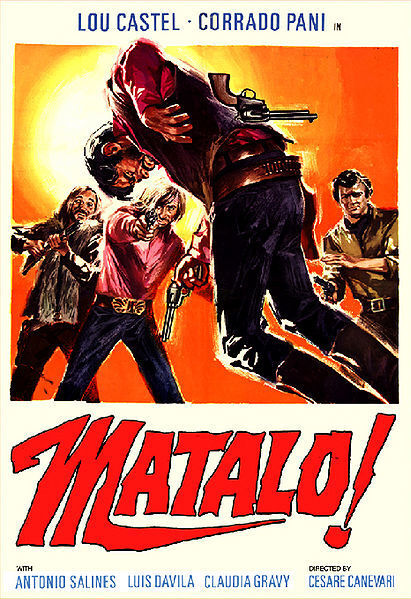
ARROW BLU RAY BOX SET RELEASE: Blood Money: Four Western Classics Vol. 2: Matalo! (Kill Him)(1970)

It would take other film industries decades to equal the sheer volume that the Italian exploitation machine could accomplish. In the four years since Django and five since A Fistful of Dollars and West and Soda, a traditionally animated movie whose creation predates Leone’s film, hundreds of cowboys thundered out of the European West and several genres emerged from comedies and Zapata westerns to films centered on the tragic hero, horror westerns and this film, Matalo! (Kill Him), which is uncategorizable but could maybe be an acid horror art deconstruction.

Cesare Canevari, with only nine movies under his belt, managed to traverse nearly every genre with his diverse direction: an early Western (Per un dollaro a Tucson si muore), Giallo (A Hyena In the Safe), an early Italian Emmanuelle (A Man for Emmanuelle), Eurospy (Un tango dalla Russia), Ajita Wilson’s first movie (The Nude Princess), late-era giallo with plenty of sleaze (Killing of the Flesh) and Naziploitation (the go all the way madness that is The Gestapo’s Last Orgy).

The film begins with a desperado named Bart (Corrado Pani) walking through the town as cocky as possible, even though he’s headed to the gallows. He even puts his own neck in the noose, knowing that some Mexican bandits are about to save his neck. His walk back out of town is even more audacious, as he’s just stood on the precipice of death and watched the chaos he ordered come true. He somehow tops that by killing off the men who saved him before meeting up with his friends Ted (Antonio Salines) and Phil (Luis Dávila) in a ghost town where the movie decides to slow down as they explore an abandoned hotel as electric guitars scream and wind blows through every frame of this film.

They’re joined by Mary (Claudia Gravy, Yellow Hair and the Fortress of Gold, Tuareg: The Desert Warrior), a snarling force of female nature that finds herself strong enough to be on the side of stagecoach robbing evil. That robbery seems to cost Bart his life, and the film switches gears as the gang hides out in the ghost town, abusing an old woman until Ray (Lou Castel) and a younger widow (Mirella Pamphili) arrive, and they too are abused by the gang. Luckily, Ray has a horse that seems smarter than him, and he’s pretty good with a boomerang, which this movie uses for wild POV shots as he whips them at the gunmen.

What’s wild is that a year earlier, Tanio Boccia directed Dio non paga il sabato (Kill the Wickeds), which is nearly the same movie but shot as if it were a normal film, not the sometimes wandering, other times hyperfocused Matalo!

 The Arrow Blood Money: Four Western Classics Vol. 2 set includes 2K restorations of all four films from the original 35mm camera negatives by Arrow Films, original Italian and English front and end titles, restored lossless original Italian and English soundtracks, English subtitles for the Italian soundtracks, brand new introductions to each film by journalist and critic Fabio Melelli, galleries for all four films, an illustrated collector’s booklet featuring new writing by author and critic Howard Hughes, a fold-out double-sided poster featuring newly commissioned artwork by Gilles Vranckx and limited edition packaging with reversible sleeves featuring original artwork and a slipcover featuring newly commissioned artwork by Gilles Vranckx. Matalo! is a significant inclusion in this set due to its unique and uncategorizable nature, making it a must-watch for fans of Italian cinema and exploitation films.

Matalo! (Kill Him) has brand new audio commentary by critics Troy Howarth and Nathaniel Thompson that I promise to listen to because I know how much Troy hates it when people just list the extras and don’t review them. I promise! There’s also an in-depth interview with filmmaker Davide Pulici discussing the career of Matalo! director Cesare Canevari, as well as another appreciation, this time of the soundtrack and its composer, Mario Migliardi, by musician and disc collector Lovely Jon. There’s also a theatrical trailer.

You can get it from MVD.
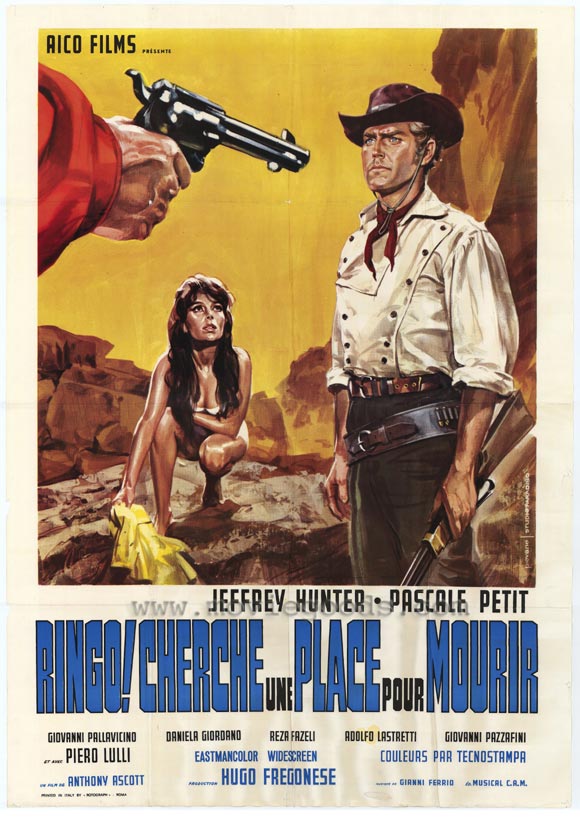
ARROW BLU RAY BOX SET RELEASE: Blood Money: Four Western Classics Vol. 2: Find A Place to Die (1968)

Inspired by the American Western Garden of Evil, this Italian Western was directed by Giuliano Carnimeo (Anthony Ascott), who also made Light the Fuse… Sartana Is Coming, Have a Nice Funeral On Me, Amigo… Sartana, Sartana’s Here… Trade Your Pistol for a Coffin, I Am Sartana, Your Angel of DeathThe Case of the Bloody IrisThey Call Him CemeteryRatman and many more. It was written by Lamberto Benvenuti, Giuliano Carnimeo and Hugo Fregonese. Some scenes were also directed by its producer, Hugo Fregonese, who directed Assignment Terror.

In Italy, it was known as Joe… cercati un posto per morire! (Joe…Find a Place to Die!). That title refers to Joe Collins, the hero of this movie, played by Jeffrey Hunter, who also produced and handled the initial distribution in the U.S.

After a long fight with a gang of killers led by Chanto (Mario Dardanelli), Lisa (Pascale Petit, Four Times That Night) escapes with her life while her geologist husband does not. She hires Collins, a former Confederate officer, and another gang to gain revenge. But all that gold Lisa and her husband had found, and her beauty put everyone against each other.

There’s also the crazy character of Reverend Riley, a man of the cloth who doesn’t deny himself the pleasures of the flesh. Played by Alfredo Lastretti he’s the best part of this movie. There’s also the fantastic scene where Daniela Giordano (Four Times That NightYour Vice Is a Locked Room and Only I Have the Key) sings the theme song inside a saloon that was once a church.

Sadly, a year after this movie, Hunter was injured in an explosion gone wrong while making the crime movie Cry Chicago (¡Viva América!). On his way back to the U.S., he went into shock and couldn’t speak or move. Doctors could only find a displaced vertebra and a concussion, yet within seven months, he would suffer an intracranial hemorrhage while walking down the stairs at his home, crack his skull and die after brain surgery was not successful. He was only 42.

The Arrow Blood Money: Four Western Classics Vol. 2 set offers a thrilling viewing experience with 2K restorations of all four films from the original 35mm camera negatives by Arrow Films. The set also includes original Italian and English front and end titles, restored lossless original Italian and English soundtracks, English subtitles for the Italian soundtracks, brand new introductions to each film by journalist and critic Fabio Melelli, galleries for all four films, and an illustrated collector’s booklet featuring new writing by author and critic Howard Hughes. The limited edition packaging with reversible sleeves featuring original artwork and a slipcover featuring newly commissioned artwork by Gilles Vranckx adds to the excitement of owning this set.

Find A Place to Die features extras such as brand new audio commentary by author and critic Howard Hughes, a newly edited archival interview with director Giuliano Carnimeo and an in-depth appreciation of the soundtrack and its composer, Gianni Ferrio, by musician and disc collector Lovely Jon.

You can get it from MVD.

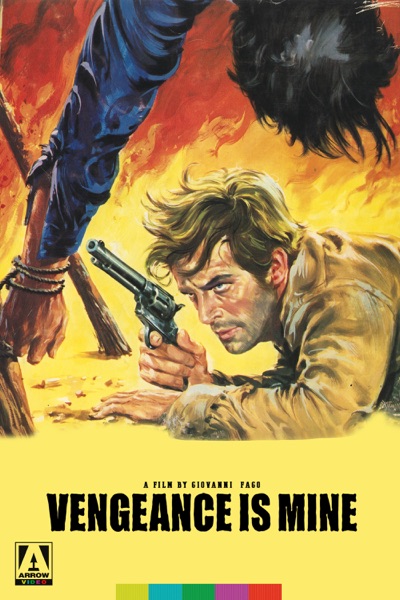
ARROW BLU RAY BOX SET RELEASE: Blood Money: Four Western Classics Vol. 2: Vengeance is Mine (1967)

Per 100.000 dollari ti ammazzo (Will Kill You for 100,000 Dollars) was also released as For One Hundred Thousand Dollars for a Killing and its title in this Arrow Video set, Vengeance Is Mine.

It’s a big film in the life of star Gianni Garko, who met Czechoslovakian actress Susanna Martinkova while making it. She was married to him from 1973 to 1986, and they have a daughter named Maria Clara.

Director Giovanni Fago is billed as Sidney Lean here. Before this film, often using the name John M. Farquhar, he’d worked as an assistant director on films like Werewolf in a Girls’ DormitoryThe Loves of Hercules and Massacre Time. It was written by Ernesto Gastaldi, whose resume boasts some of the most essential films in Italian genre cinema, including All the Colors of the DarkMy Name Is NobodySo Sweet… So PerverseThe Whip and the Body, and so many more. His co-writer? Sergio Martino!

John Forest (Garko) has had a rough life. Ten years in prison for a murder he was innocent of committing, a brother named Clint (Claudio Camaso) who kicked him out of the family when it turned out he was illegitimate and now working as a bounty hunter. And oh yeah, that murder? When their father tried to bring John back home, Clint gunned him down like a dog and said his brother did the deed.

John’s mother dies just as a bounty on Clint’s head is named. She has a dying request for her son: Clint is to be brought to justice but not killed. But John can’t fire the first bullet if there is a gunfight between the brothers.

As always in the Italian West, the lure of happiness — a life for John with Annie (Claudie Lange) and her son — isn’t as strong as money, blood or vengeance. She tells him that they could have a life together. He replies, “Sorrow and hate just don’t mix with happiness, Annie.”

Interestingly, this film is part of the same set as $10,000 for a Massacre, sharing leads, writer, and composer Nora Orlandi. Garko plays a bounty hunter in both, with Camaso as his bounty. The key difference is that Garko’s morals are not in question in this film. Instead, it’s a tragedy, as the rift between brothers has led to a decade in prison for one and a descent into darkness for the other. Both movies are tragic for anyone who tries to build a life with Garko’s characters, serving as a poignant reminder of the destructive power of violence and retribution in the Italian West.

When watched one after the other, they make for a fascinating study of how violence and retribution in the world of the Italian West destroy the lives of its heroes.

The Arrow Blood Money: Four Western Classics Vol. 2 set offers a treasure trove for film enthusiasts. It features 2K restorations of all four films from the original 35mm camera negatives by Arrow Films, original Italian and English front and end titles, restored lossless original Italian and English soundtracks, English subtitles for the Italian soundtracks, brand new introductions to each film by journalist and critic Fabio Melelli, galleries for all four films, an illustrated collector’s booklet featuring new writing by author and critic Howard Hughes, a fold-out double-sided poster featuring newly commissioned artwork by Gilles Vranckx and limited edition packaging with reversible sleeves featuring original artwork and a slipcover featuring newly commissioned artwork by Gilles Vranckx. This meticulous restoration work ensures that these classic films are presented in the best possible quality, preserving their cinematic legacy for generations to come.

Vengeance Is Mine has brand new audio commentary by critics Adrian J. Smith and David Flint; Cain and Abel, a newly edited featurette with archival interviews with actor Gianni Garko and screenwriter Ernesto Gastaldi; an archival interview with composer Nora Orlandi; a new interview with producer Mino Loy and a trailer.

You can get it from MVD.

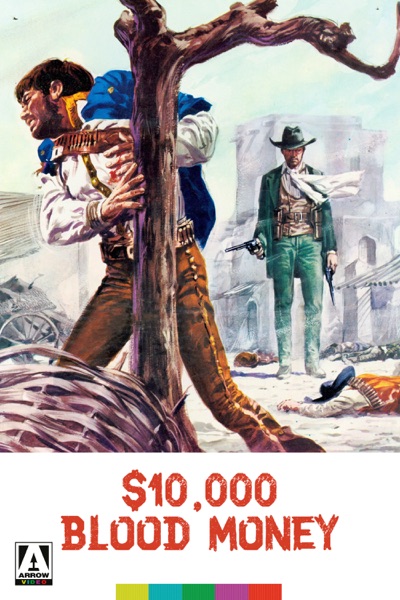
ARROW BLU RAY BOX SET RELEASE: Blood Money: Four Western Classics Vol. 2: $10,000 Blood Money (1967)

As one of the many unofficial sequels of Django, this film, originally titled 7 dollari su Django (7 Dollars on Django), is a must-watch for fans of the original. It’s also known as Ten Thousand Dollars for a Massacre and Guns of Violence, further cementing its place in the Django universe if such a thing can be constructed from pastiches.

Django (listed as Gary Hudson, but come on, we all know Gianni Garko when we see him) is a bounty hunter — he’s more like a bounty killer, as he never brings back anyone alive — who is watching Manuel Vasquez (Claudio Camaso) as he goes on a crime spree, knowing the more he kills, the more he’ll be worth. Once there’s a price of $10,000 on his head, Django will take care of business.

That price is reached when Vasquez kidnaps the daughter of Mendoza (Frank Little), a rancher. Dolores Mendoza (Adriana Ambesi, who often went by Audrey Amber and is also in Secret Agent Super DragonMalenka and The Bible: In the Beginning…) is a young woman beloved by her older father, so he doubles the reward.

Django was ready to quit killing for money and wanted to settle down with Mijanou (Loredana Nusciak, The Tiffany MemorandumSomething Creeping in the Dark). But the lure of big money was too much, and after all, he’d only be gone for a week.

Yet once he’s on the trail of Vasquez, fate puts them together as partners. Money will do that. But at the end of it all, they have to face one another, this time in a ghost town where only one will walk out alive. That’s because Django — who often kills when his prey isn’t ready and usually continues shooting them long after their dead — has finally screwed up in his cynical pursuit of the almighty dollar, and Vasquez has gotten one over on him by killing Mijanou. To say that this Django has issues that cost him everything that’s putting it lightly. His lover once begged him to leave this life behind. Now, she’s dead, and he’s reached his rock bottom with no prize for clawing his way out.

Now, you’d think that at least Django gets to save Dolores from being with such a horrible man, a criminal put in jail by her father and used to get back at him. But she’s found that she loves this life just as much as Django once did, the excitement, money and blood. So, one more death may bring him that $10,000, but money is meaningless at the end of all this unpayable loss.

Directed by Romolo Guerrieri and written by a talented team, this film delivers on the brutal promise of the Italian West. What sets it apart is the Theremin soundtrack composed by Nora Orlandi, adding a unique and haunting dimension to the film’s atmosphere.

The Arrow Blood Money: Four Western Classics Vol. 2 set has 2K restorations of all four films from the original 35mm camera negatives by Arrow Films, original Italian and English front and end titles, restored lossless original Italian and English soundtracks, English subtitles for the Italian soundtracks, brand new introductions to each film by journalist and critic Fabio Melelli, galleries for all four films, an illustrated collector’s booklet featuring new writing by author and critic Howard Hughes, a fold-out double-sided poster featuring newly commissioned artwork by Gilles Vranckx and limited edition packaging with reversible sleeves featuring original artwork and a slipcover featuring newly commissioned artwork by Gilles Vranckx.

$10,000 Blood Money has brand new audio commentary by author and film historian Lee Broughton; Tears of Django, a newly edited featurette with archival interviews with director Romolo Guerrieri and actor Gianni Garko; The Producer Who Didn’t Like Western Movies, a brand new interview with producer Mino Loy; a brand new interview with screenwriter Ernesto Gastaldi and the theatrical trailer.

You can get it from MVD.

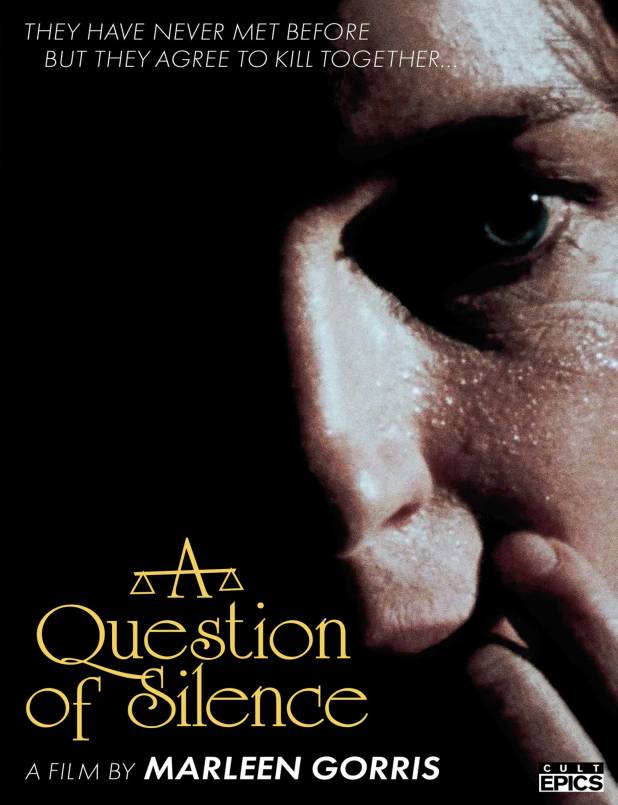
CULT EPICS BLU RAY RELEASE: A Question of Silence (1982)

Three women — a housewife named Christine M. (Edda Barends), a waitress named Ann Jongman (Nelly Frijda) and executive secretary Andrea Brouwer (Henriëtte Tol) — have murdered a male shopkeeper in the middle of the day for no reason. No premeditation. And none of them know one another. A female psychiatrist (Cox Habbema) must now discover why.

Directed by Marleen Gorris, who also made the Oscar-winning Antonio’s Line, this film takes us into the lives of each of the women as the doctor interviews each of them as well as the people in their lives, all to learn if this murder was thought through or was simply a random act.

The movie finally shows precisely how the woman led the man to his death without revealing the actual killing. But we do learn all of the negative experiences they’ve had with men throughout their lives and what would lead them to destroy a man, even castrating him and crushing his face. By the end, they laugh about the murder during their trial and their laughter is repeated by every woman in the room. To the credit of the director and her cast, this movie is still so potent more than forty years later.

The Cult Epics Blu-ray release of A Question of Silence has a new 2K HD transfer and restoration audio commentary by film scholar Patricia Pisters. It also features interviews with director Marleen Gorris and actress Cox Habbema, a promotional gallery, trailers and more. You can get it from MVD.

CBS LATE MOVIE MONTH: The Story of Mankind (1957)

EDITOR’S NOTE: The Story of Mankind was on the CBS Late Movie on August 15, 1974.

Hendrik Willem van Loon, a Dutch-American historian, wrote and illustrated The Story of Mankind in 1921. The book is a unique exploration of the history of Western civilization, told through a series of brief chapters. Van Loon’s narrative style is characterized by his constant questioning of the pivotal role of certain individuals or events in shaping the course of history. He often asks, ‘Did the person or event in question perform an act without which the entire history of civilization would have been different?

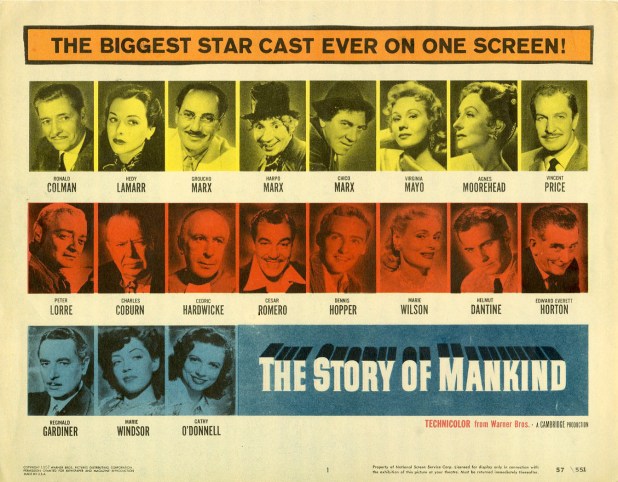
Thirty years later, former publicist Irwin Allen, in a bold move, chose the book as his first non-documentary film. He directed, wrote, and produced the movie, initially planning for only an actor and actress to appear in the film. However, he then decided to take a page out of the recent box office hit Around the World In 80 Days and assembled a cast of nearly fifty stars to tell the story. This unique approach, along with the use of lots of repurposed B-roll from other movies and stock footage, makes The Story of Mankind a truly one-of-a-kind cinematic experience.

Ronald Colman is The Spirit of Man, and Vincent Price is Mr. Scratch. They’re testifying in front of a tribunal that will decide the fate of mankind, who has created a Super H-Bomb, and the powers that run the universe will determine whether they stop the bomb or allow it to destroy the human race. That leads to a cavalcade of stardom, with Hedy Lamarr as Joan of Arc,  Virginia Mayo as Cleopatra, Agnes Moorehead as Queen Elizabeth I, Peter Lorre as Nero, Charles Coburn as Hippocrates, along with all three Marx Brothers in their last film together.

But wait — there’s more. Cesar Romero! John Carradine! Dennis Hopper as Napoleon!  Francis X. Bushman as Moses! Jim Ameche, taking over the role his brother made famous, Alexander Graham Bell!

They are all on sets that seem made for TV, with dialogue made for the grade school stage. Yes, The Story of Mankind certainly is something else. Everyone in this showed up for one day to film their part and was all paid pretty well. The movie’s odd presentation, resembling a religious epic with no religion, adds an intriguing element to the viewing experience.

When asked if the film was based on a book, Colman replied, “Yes. But they are using only the notes on the dust jacket.”

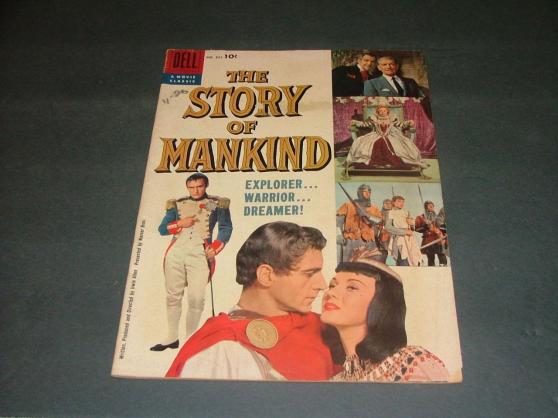
There was a comic book, though. Dell released an adaption written by Gaylord Du Bois and illustrated by Bob Jenney.

CBS LATE MOVIE MONTH: The Horror at 37,000 Feet (1973)

EDITOR’S NOTE: The Horror At 37,000 Feet was on the CBS Late Movie on October 31, 1975 and October 29, 1976.

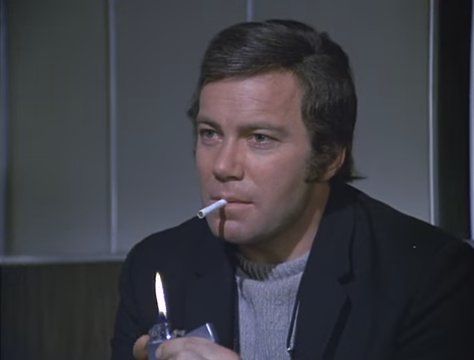
Someday, scholars will speak in awe of the post-Star Trek Satanic twosome of Shatner films, which would be this movie and The Devil’s Rain! Until then, maniacs like me will yell into the uncaring silence and tell you that for a shining moment — or literally two — the once and future Kirk would die twice (spoilers be damned, again literally) while facing off with the Lord of the Flies.

Originally airing on CBS on February 13, 1973, I first learned of this movie in a TV Guide Book of Lists that featured Anton LaVey discussing the most Satanic TV moments of the last decade. This movie has it all: Mario Bava lighting, a cursed altar, Shatner drunk and railing against humanity, and finally, a bunch of Old Hollywood actors daring to sacrifice a young child to the Left Hand Path.

Sure, the flight from London to New York is supposed to be mainly cargo — that druid altar I hinted at before — but the plane still has plenty of talent on board. There’s Captain Ernie Slade (Chuck Connors), as well as an architect (Roy Thinnes, who would enter this territory again in The Norliss Tapes) and his wife (Jane Merrow, Hands of the Ripper) who have placed said altar on board. There’s also Paul Kovalik (Shatner), a priest who has lost his way, and super-rich Glenn Farlee (Buddy Ebsen, who makes it extraordinary as it’s basically Jed Clampett and Barnaby Jones against Satan). You also get Tammy Grimes — whose daughter Amanda Plummer looks just like her — as well as Lynn Loring (also in the occultist Black Noon), Paul Winfield, France Nuyen (Code Name: Diamond Head), Will Hutchins, Darleen Carr (she’s in the TV remake of Piranha), Russell Johnson (The Professor!) and H. M. Wynant (Hangar 18).

Some people have the wrong idea that this movie, shot on the sound stages at CBS Studio Center, is one of Shatner’s worst films. They’re wrong. This movie is everything. Near the end, my wife looked at me and said, “This is pretty intense for TV.” I told her that life was cheap in 1973.

Director David Lowell Rich also made Satan’s School for GirlsSST Death Flight and The Concorde … Airport ’79, all movies that some people would make fun of. Not me—this is my bread and butter. It tastes delicious.

You can watch this on YouTube:

CBS LATE MOVIE MONTH: Kolchak: The Night Stalker: Zombie (1974)

EDITOR’S NOTE: This episode of Kolchak: The Night Stalker was on the CBS Late Movie on June 8, 1979; June 5, 1981; October 9, 1987 and January 15, 1988.

Directed by Alexander Grasshoff (The Last Dinosaur) and written by Zekial Marko and David Chase (the creator of The Sopranos), this episode starts with a gangland slaying committed by a gigantic and unstoppable man and then an even more unbelievable happening. And that’s Vincenzo being friendly to Kolchak, all to ensure that he takes young reporter Monique Marmelstein (Carol Anne Susi) under his wing. She’s important because her uncle is a company bigwig.

Carl saves her from a police shootout with the Russo brothers and then heads to the morgue where his informant, Gordy the Ghoul (John Fiedler), is making bets and selling information. Kolchak learns that all the gang-related deaths have had multiple blunt force traumas to their dead bodies and that one of the other dead people was filled with bullet holes and chicken blood.

It all points to the death of a Haitian named François Edmonds, and the investigation even takes Carl to a voodoo shop owned by Uncle Filemon (Scatman Crothers), which is soon crawling with organized crime figures. He soon meets up with “Mamalois” Marie Juliette Edmonds (Paulene Myers), the mother of the dead man and, as we soon learn, now the undead killer who she can command by writing the names of his victims on tiny coffins. And now Kolchak’s name is on one of them!

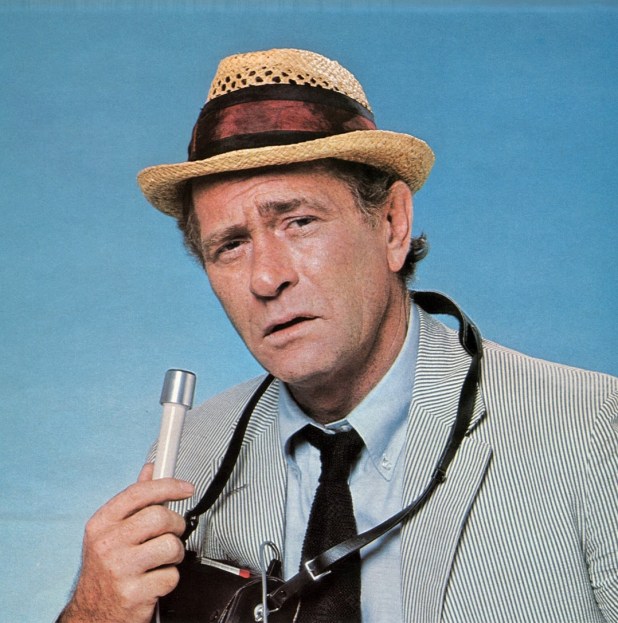
This episode has one of my favorite endings. Carl enters a junkyard and has to fill the sleeping zombie’s mouth with salt and sew it shut. It gets wild when the zombie awakens mid-stitch and chases our intrepid reporter through the maze of crushed cars. Sure, Carl stops him, but he does it at the expense of another Rollei 16 film camera.

The zombie is played by defensive lineman Earl “Tree” Faison of the San Diego Chargers, who, at 6′ 5″ and 260 pounds, looks absolutely monstrous next to the much smaller McGavin. Antonio Fargas also appears in this one.

The monsters on Kolchak: The Night Stalker sure do like throwing people through the air, huh?

CBS LATE MOVIE MONTH: The Creeping Flesh (1973)

EDITOR’S NOTE: The Creeping Flesh was on the CBS Late Movie on November 16, 1973.

Directed by Freddie Francis* for Tigon, this film is a thrilling collaboration that pairs the iconic Christopher Lee and Peter Cushing. It’s a gem from the end of the era of British gothic horror, and despite its occasional silliness, such as Cushing holding a gigantic prehistoric finger that appears as sexualized as it gets, I find every moment of this film utterly captivating.

Cushing is Prof. Emmanuel Hildern, a scientist who discovers a colossal skeleton — Anunnaki alert — that is older than other skeletons in the area yet much more advanced. He hopes that this finding will win him the Richter Prize, but that award looks like it’s going to be won by his brother John (Lee), who has been looking after Emmanuel’s institutionalized wife for years. He plans to use his study of his brother’s wife to win that award and refuses to pay for the professor’s skeleton-finding trips.

Whatever this skeleton is, legend says that it was a monster that feared rain—maybe because the Great Flood wiped out the other Nephilim—and that it could grow skin when it came into contact with water.

Hildern has a theory that if evil itself—the skeleton—can be a living being, then it can be biologically contained and treated like a disease. He created a serum that can stop evil using cells from the skeleton’s fleshy finger. After testing the drug on a monkey with good results, Emmanuel also immunizes his daughter Penelope, who may have inherited her mother’s mental illness.

Of course, the next day, the monkey has gone wild, and now we have Penelope dancing on tables and slashing sailors. Soon, James finds out about the serum, kidnaps his niece and steals the skeleton. The skeleton gets exposed to the rain and becomes, well, a pretty goofy-looking monster that I can’t help but completely fall head over heels for.

The ending of this movie is a masterstroke, leaving the door wide open for interpretation. You can see it as Lee’s character denying that his brother is related to him to save his reputation or that Emmanuel was never a doctor at all but just another patient. If that’s true, then who really took his finger in revenge? Does the monster exist? It’s a thought-provoking conclusion that will keep you pondering long after the credits roll.

You can watch this on Tubi.

*Don Sharp, who also made Psychomania, was the original director before Francis was hired to replace him.

TUBI ORIGINAL: Escaping Paradise (2023)

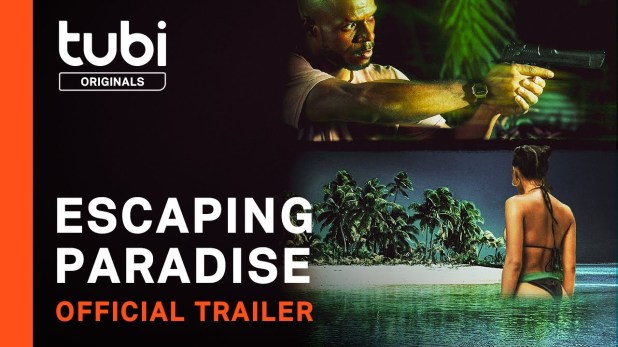
Floyd (Deji LaRay) and Zena (Shayla Hale) head to the Phillippines to celebrate their fifth anniversary. While there, they meet one of the few English speakers, Kane (Simon Phillips). In fact, Kane’s lover, Nihla (Kylah Dela Peña), barely speaks a word. One night, when Zena is tired, Kane asks if he can borrow her husband for a guy’s night. Of course, that turns out like something out of The Hangover, but it’s murderous instead of fun hijinks. Are you surprised that Kane is a dangerous fugitive? Well, our protagonists are!

Directed by Paul Tanter (Age of the Living DeadStealing Chaplin) and written by LaRay, this ends up with people dead, Zena kidnapped and Floyd looking for help to save his wife and get off the island. I mean, once you watch a guy act like a jerk in a strip club, you know what kind of person he is. I don’t see why the young lovers got mixed up with this guy, but we wouldn’t have a movie otherwise. You expect Kane to kill exotic dancers like Flower (Christies Paglinawan).

Floyd must not get much vacation time because while his wife is being taken by a wanted international fugitive, he’s taking his time eating a traditional Filipino dinner when his wife could very well be getting tortured and killed. I was also kind of confused by the attitude of Ambassador Danilo (Ken Bressers) at the end, who goes from “you’re in trouble” to “you’re heroes” in the exact same scene. There was no drama there, just one weird conversation. And if my wife dealt with all this drama and I wanted to go play basketball before we went home, I’d be going home divorced.

You can watch this on Tubi.