CBS LATE MOVIE MONTH: Kolchak: The Night Stalker: The Energy Eater (1974)

EDITOR’S NOTE: This episode of Kolchak: The Night Stalker didn’t air on the CBS Late Movie. It wasn’t offered to CBS because ABC made a TV movie from it and “Firefall” and titled it Crackle of Death. As a completist, I’m covering the episode this week.

The new, modern Lakefront Hospital is supposed to save lives. But why don’t its machines work correctly? How are there cracks in the foundation and walls already? And why have so many people died from horrifying deaths in a place of wellness?

These are the kinds of questions that Carl Kolchak would like the answers to.

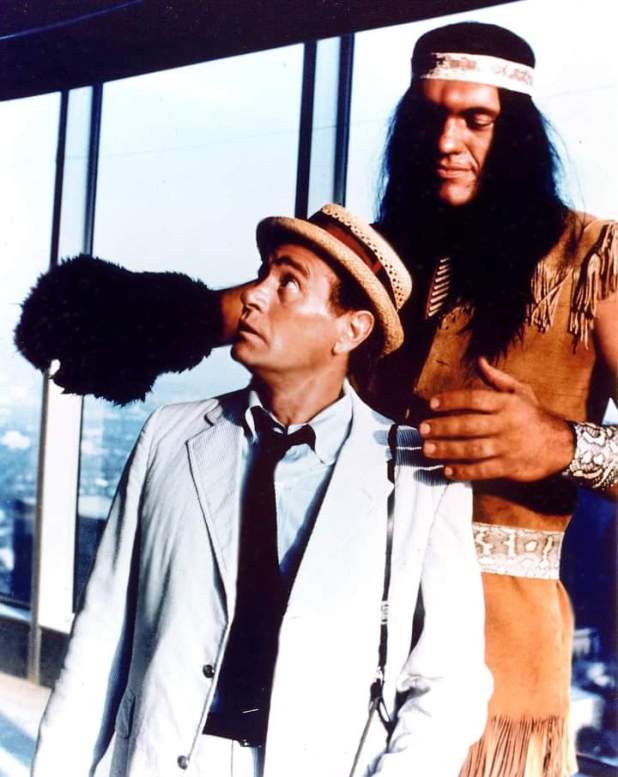
He gets his answers from one of the foremen who left the construction before it was finished, Jim Elkhorn (William Smith!), who explains that he and the rest of his Native American crew didn’t want to anger Matchemonedo, an invisible bear spirit that Kolchak must send back into hibernation.

Joyce Jilson (Superchick) and Elaine Giftos (Angel) also appear in the cast. Beyond being in danger, they’re two conquests for Elkhorn, who seemingly is as interested in lying down with lovely women as he is in erecting buildings.

The episode’s highlight is when Karl takes two of his paper’s most expensive cameras to get a photo of the monster. Vincenzo stops him and wants to know what’s happening.

Vincenzo: What are you doing with two of our best cameras?

Kolchak: I’m gonna hock ’em, what do you think? You ask a stupid question, you get a stupid answer.

As Elkhorn is helping Karl do research, he translates some French. Smith could do that, as he was fluent in Russian, French, German and Serbo-Croatian, languages he learned while serving as an Intelligence Specialist for the U.S. Air Force during the Korean War.

This episode was directed by Alexander Grasshoff and written by Arthur Rowe, who wrote thirteen episodes of Fantasy Island and nineteen episodes of The Bionic Woman and served as a producer on those shows. It also has scripting by Rudolph Borchert, who wrote five Kolchak episodes.

While not the best episode, this does have Kolchak trying to freeze the basement floors and foundation, which is pretty impressive as he’s just one man against a Native American spirit that has been murdering humans since we first showed up on this planet.

CBS LATE MOVIE MONTH: Santee (1973)

EDITOR’S NOTE: Santee was on the CBS Late Movie on October 16, 1975 and January 5, 1977.

Here’s some trivia you can use on your friends. Santee was one of the first motion pictures to be shot electronically on videotape, a groundbreaking technique at the time. This was achieved using Norelco PCP-70 portable NTSC cameras and portable Ampex VR-3000 2″ VTRs, marking a significant shift in film production technology.

Director Gary Nelson mainly worked in TV before this, but he has some interesting films to his credit, like the original Freaky FridayThe Black Hole and the Mike Hammer TV movies.

Jody’s long-awaited reunion with his father takes a dramatic turn when he discovers that his father is an outlaw on the run from a relentless bounty hunter named Santee (Glenn Ford). The story takes an unexpected twist when the two adversaries, Jody and Santee, find themselves forming an unlikely bond, realizing that they share a deeper connection than they could have ever imagined.

Santee boasts a diverse and intriguing cast, including Dana Wynter (Invasion of the Body Snatchers), Jay Silverheels (Tonto himself, who for some reason has been showing up in nearly every movie I’ve watched lately), Robert Donner (who also is in Nelson’s Allan Quatermain and the Lost City of Gold), Dark Brothers repertory actor Jack Baker, X Brands (the oddly named actor who may have been of German descent and from Kansas City, but always played Native Americans), Chuck Courtney (who played Daniel Reid Jr. on The Lone Ranger, the character who would grow up to be the father of The Green Hornet) and Lindsay Crosby (Bigfoot).

Edward Platt, the Chief on Get Smart, produced this film and played a crucial role in financing it. Platt raised the money to buy the video cameras, a significant contribution to the film’s production. One can only assume that his involvement also led to Nelson’s directorial role in the TV movie Get Smart, Again.

You can watch this on YouTube.

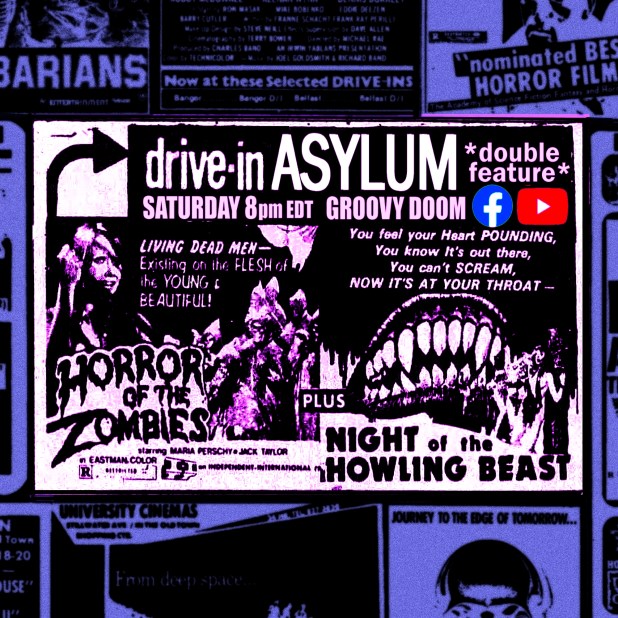
INDEPENDENT-INTERNATIONAL WEEK ON THE DRIVE-IN ASYLUM DOUBLE FEATURE!

This Saturday at 8 PM EST on the Groovy Doom Facebook and YouTube channels, Bill and I will be recreating a double feature that played drive-ins all over the country.

The first movie is Horror of the Zombies, which is also The Blind Dead 3, Horror of the Zombies, Ship of Zombies, The Ghost Ship of the Swimming Corpses, The Ghost Ship of the Blind Dead and The Ghost Galleon. You can watch it on YouTube and Tubi.

Every week, we watch two movies, discuss them, look at the ad campaigns and make two themed cocktails.

Here’s the first one.

Spanish Zombie

  • 1 oz. Midori
  • 1 oz. Malibu rum
  • 1 oz. spiced rum
  • .5 oz. apricot brandy
  • .5 oz. Cointreau
  • 3 oz. orange juice
  • 2 oz. pineapple juice
  • .5 oz. lime juice
  • Mint
  1. Shake all ingredients like you’re on a boat surrounded by fog and the waves have grown larger.
  2. Pour over crushed ice and top with mint.

The next movie is a Paul Naschy werewolf film that is listed as Night of the Howling Beast. It’s also known as The Curse of the Beast, The Werewolf and the Yeti and Hall of the Mountain King. You can watch it on Tubi.

Here’s the second recipe.

Werewolf In Tibet

  • .5 oz. 99 Bananas
  • 1.5 oz. cherry brandy
  • .75 oz. lemon juice
  • 2 oz. iced tea
  • .5 oz. orgeat or almond syrup
  1. Shake all ingredients in a shaker with ice as if you’re battling a yeti in an ice cave.
  2. Pour it out, savor it and dream of Paul Naschy’s lustrous hair.

See you Saturday!

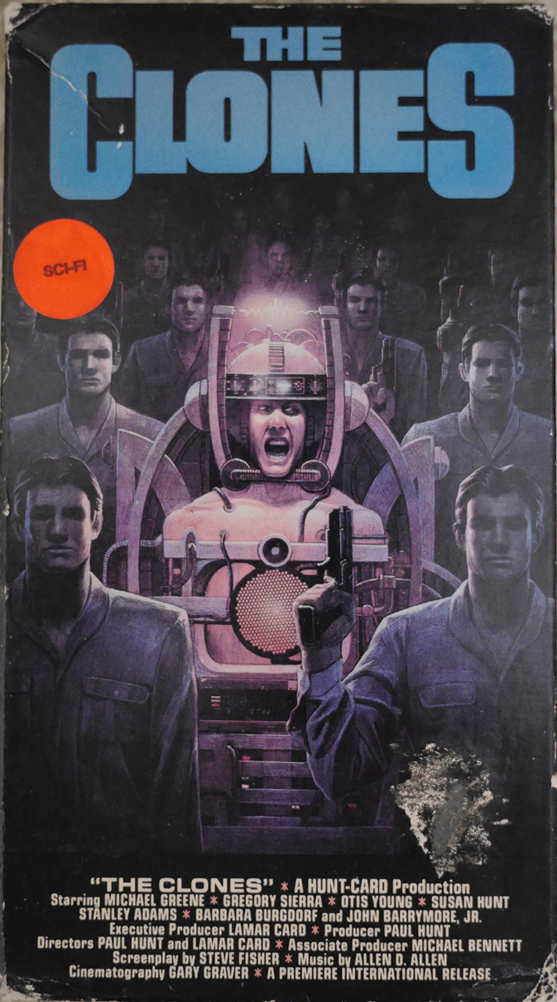
CBS LATE MOVIE MONTH: The Clones (1973)

EDITOR’S NOTE: The Clones was on the CBS Late Movie on November 7, 1975, and April 18, 1977.

Dr. Gerald Appleby (Michael Greene) finds himself in a perplexing situation. He believes he’s been cloned. His conviction stems from a near-fatal escape from his lab’s explosion and the unsettling reports of his sightings in places he’s never been. This sets the stage for a gripping narrative as he goes on the run, pursued not only by the deranged scientist Carl Swafford (Stanley Adams, Cyrano Jones from the original Star Trek) but also by the ruthless thugs Sawyer (Otis Young, Blood Beach) and Nemo (Gregory Sierra, a stark contrast to his usual role as the virtuous Det. Sgt. Chano Amenguale on Barney Miller).

Directed by Paul Hunt (he also directed Twisted Nightmare and produced Demon Wind) and Lamar Card (who directed Supervan and Jukebox AKA Disco Fever, as well as the producer of Nashville GirlSavage Harvest and Project: Metalbeast), who co-wrote the film with Steve Fisher, who started writing movies back in 1938 with Nurse from Brooklyn. He also wrote the novel and screenplay for I Wake Up ScreamingHell’s Half AcreJohnny Angel and episodes of Peter GunnMcMillan & WifeCannon and Fantasy Island.

Most people will watch this movie and see a slow-moving film that goes nowhere, filled with fish-eye lens-addled drug scenes and an overwhelming sense of conspiracy doom. As for me, I read that sentence and only see the positives. Young and Sierra are having a blast; the ending is as cynical as it gets, and a lot of the ending takes place inside an amusement park that runs itself. It’s a movie that came out on VHS, has had no major DVD release and has never come out on Blu-ray.

You can watch this on Tubi.

CBS LATE MOVIE MONTH: Night of the Lepus (1972)

EDITOR’S NOTE: Night of the Lepus was on the CBS Late Movie on September 13, 1974; October 17, 1975 and June 13 and August 24, 1976.

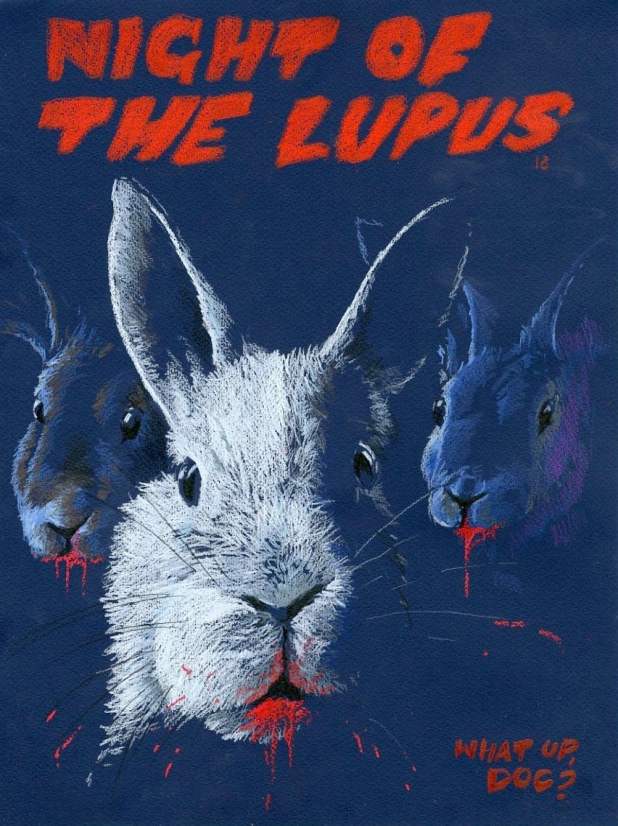
Based upon Russell Braddon’s 1964 science fiction novel The Year of the Angry Rabbit, this movie pits mankind against mutant rabbits and, well, if you can get past that idea, you’re probably going to love this movie.

Director William F. Claxton and producer A. C. Lyles came from Westerns, which explains the cast of this movie, which includes Stuart Whitman, Rory Calhoun and DeForest Kelley being in the cast as well as the shooting location, the Old Tucson Studios. It does not explain the effects, which are a combination of regular-size rabbits on miniature sets and people dressed in rabbit costumes.

Janet Leigh, who is also in this, told Starlog, “No one put a gun to my head and said I had to do it. What no one realized was that, no matter what you do, a bunny rabbit is a bunny rabbit. A rat, that can be menacing — so can a frog. Spiders or scorpions or alligators, they could all work in that situation, and they have. But a bunny rabbit?! How can you make a bunny rabbit menacing?”

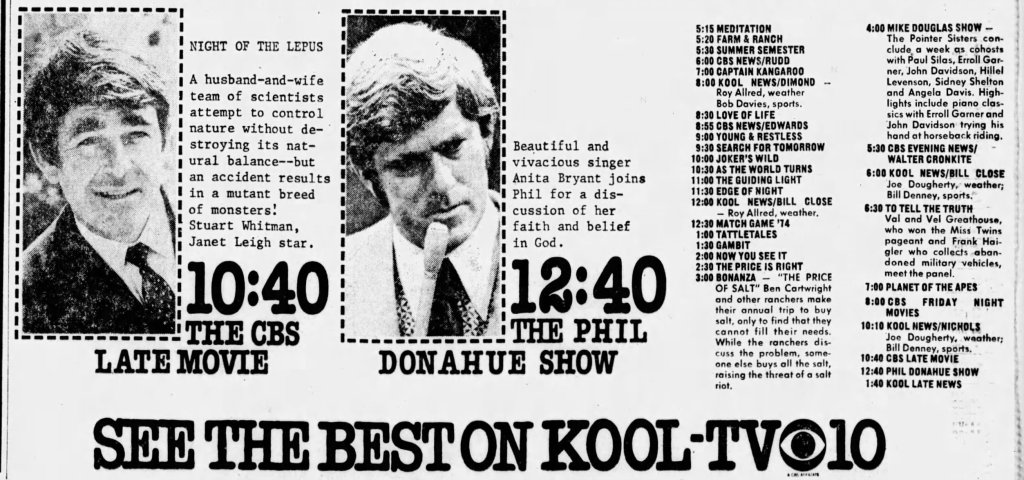
Rancher Cole Hillman (Calhoun) seeks the help of college president Elgin Clark (Kelley) when thousands of rabbits invade his farm after their natural predators, coyotes, are killed off. Roy and Gerry Bennett (Whitman and Leigh) are brought in and they work on using hormones to disrupt the rabbits’ reproduction cycles but their daughter falls in love with the bunny and switches it out; the mutant bunny runs away and pretty much declares war on humanity.

The towns of Galanos and Ajo are eaten by the giant rabbits before the strange team of a drive-in audience and the National Guard trap the gigantic hares in an electrified field that kills all of them. And good news, because regular rabbits — and the coyotes — are back at the end of the movie.

They tried to hide the rabbits on the poster — even changing the title from Rabbits — and then changed their mind at the last minute and gave away rabbit’s feet with the film’s logo on it.

Check out this ad for the CBS Late Movie show from Bill Van Ryn of Groovy Doom and Drive-In Asylum!

CBS LATE MOVIE MONTH: Kolchak: The Night Stalker: The Spanish Moss Murders (1974)

EDITOR’S NOTE: This episode of Kolchak: The Night Stalker was on the CBS Late Movie on June 29 and October 26, 1979; July 17, 1981; October 30, 1987 and February 26, 1988.

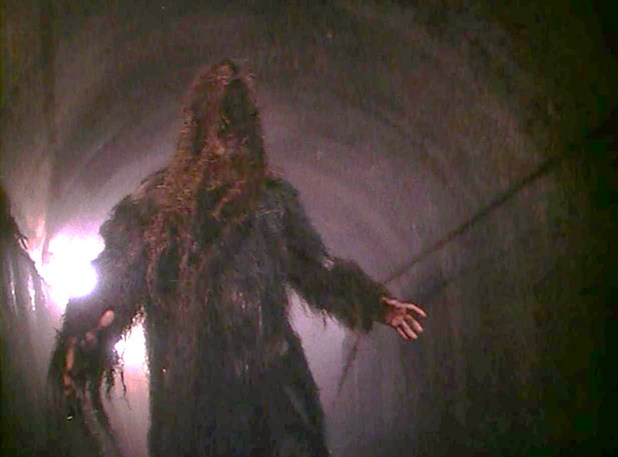
Chicago is filled with supernatural murders. This time, the only thing linking the killings of a sleep research center assistant (Elisabeth Brooks from The Howling!) and the chef of Chez Voltaire is that their chests were crushed, and their bodies were covered with Spanish Moss. Somehow, Kolchak learns that the crimes come from the Cajun myth of Pere Malfait, the Bad Father. Only a spear made of gumwood from the bayou can stop the monster, which Kolchak also finds, and then goes into the sewers to again battle the supernatural.

The monster has come to life thanks to the sleep studies of Dr. Aaron Pollack (Severn Darden), and as one of his patients (Don Mantooth) dreams of the boogeyman, the tactics to help him sleep unleash it in the real world. Kolchak comes up against another Chicago cop who wants none of his monkey business, this time Captain Joe “Mad Dog” Siska, played by Keenan Wynn.

The Spanish Moss Monster is played by Richard Kiel, the same bad guy two episodes in a row. The creature is based on a legend of a soldier who kidnaps, rapes and beheads and hangs a Native American princess from a tree. Her spirit becomes one with the tree, and she hunts down the soldier, killing him with the tree’s roots, which have become one with his hair. There’s also a Florida Moss Man legend of a “large man-like beast with a rank odor and covered with swamp grass” that was seen often in the late 1800s.

This was directed by Gordon Hessler, who also directed Scream, Pretty PeggyCry of the Banshee and Scream and Scream Again. It was written by Alvin R. Friedman and David Chase.

CBS LATE MOVIE MONTH: The Mephisto Waltz (1971)

EDITOR’S NOTE: The Mephisto Waltz was on the CBS Late Movie on July 29, 1977.

Paul Wendkos may have directed most of the Gidget movies, but he has quite the horror pedigree. There’s the TV movie Good Against Evil, Haunts of the Very Rich, the 1985 remake of The Bad Seed and the legendary 1975 TV movie The Legend of Lizzie Borden.

Because this is a Quinn Martin Production and CBS aired it extensively on TV, many people believe that it was a made-for-TV movie. However, it was actually released in theaters—the only movie that Twentieth Century Fox released for the entire calendar year of 1970, due to several of 1969’s movies failing at the box office.

Myles Clarkson (Alan Alda) once wanted to be a pianist but is now a music journalist. He gets to interview the world’s greatest piano player, Duncan Ely (Curd Jurgens, The Vault of Horror). It doesn’t start well, but then Ely discovers that Myles has hands perfect for the piano.

At that point, Duncan and his daughter Roxanne (Barbara Perkins) become friends with Myles and his wife Paula (Jacqueline Bisset), who doesn’t trust either of them. She was right to suspect them, as they’re Satanists who have transferred Duncan’s mind to Myles’ body. However, as Myles becomes a major star, she starts to like the man she’s married to more and more. She becomes seduced by the power, even if Duncan comes to her in dreams and tells her that their daughter must die.

After that dream, the daughter dies, which pushes Paula to investigate the Ely family. She then finds herself falling into the arms of Roxanne’s ex-husband, Bill (Bradford Dillman).

This is the 1970s, so of course, incest figures in. It turns out that Duncan and Roxanne have bartered with Satan to enable them to pursue their incestuous relationship by placing Duncan’s consciousness into Myles’ body. When Bill is killed with the same blue forehead murder style as Paula’s daughter, she starts to worry for her life. But simultaneously, she decides that no matter who is in her husband’s body, that’s the man she wants to be with.

So she does what any of us would do. She turns to Satan and kills herself, moving her mind into Paula’s body. Then, she returns to her husband, Paula’s father, in her husband’s body. Whatever issues there were with the marriage have been solved, thanks to the left-hand path and outright murder.

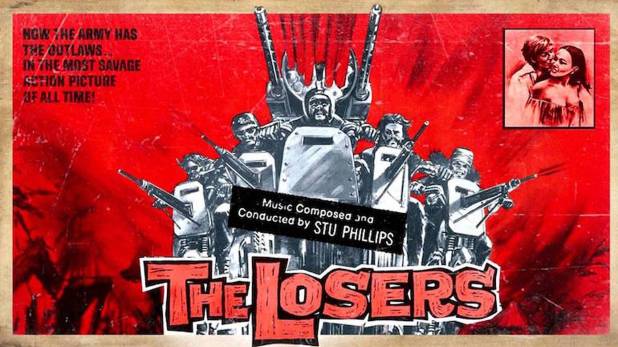
CBS LATE MOVIE MONTH: The Losers (1970)

EDITOR’S NOTE: The Losers was on the CBS Late Movie on October 3, 1975 and October 8, 1976.

Also known as Nam Angels, this Jack Starrett-directed film (he also made Run, Angel, Run!Race with the Devil and Hollywood Man, among others) has a great high concept: a biker gang called The Devil’s Advocates is sent to Cambodia to rescue an American diplomat because they are the only ones who can get the job done.

They’re led by a Vietnam vet — and the brother of the Army Major who has recruited them — Link Thomas, played by the always dependable William Smith. They’re under the orders of Captain Johnson (Bernie Hamilton, who was Captain Harold Dobey on Starsky and Hutch) and include fellow vets Duke (Adam Roarke from Dirty Mary, Crazy Larry and Frogs) and Dirty Denny, as well as Limpy (Paul Koslo, Vanishing Point) and Speed (Eugene Cornelius, who was Space in Run, Angel, Run!).

They head to Vietnam,  but come on, we all know it’s the Philippines because the mechanic who works on their bikes, Diem-Nuc, is played by Vic Diaz. It doesn’t matter because by the time you start trying to figure out locations*, our heroes are doing wheelies and blowing things up with rocket launchers and machine guns while they do wheelies.

This movie does have some basis in reality. Sonny Barger, the Maximum Leader of the Hells Angels, sent LBJ a telegram offering the skills of his club in the Vietnam War. That inspired Alan Caillou, who originally wrote that The Losers would live. Starrett and Smith rewrote the script to the ending we know now.

If you watch Pulp Fiction, you can see a scene from this movie being watched by Butch’s girlfriend the day after his fight. When he asks what she is watching, she says, “A motorcycle movie, I’m not sure the name.”

*They’re reused from Too Late the Hero.

CBS LATE MOVIE MONTH: The Story of G.I. Joe (1945)

EDITOR’S NOTE: The Story of G.I. Joe was on the CBS Late Movie on October 13, 1972 and May 18, 1973.

Ernie Pyle, a Pulitzer Prize-winning American journalist and war correspondent, is revered for his stories about the ordinary American men who fought in World War II. His work was so impactful that President Harry Truman acknowledged, “No man in this war has so well told the story of the American fighting man as American fighting men wanted it told. He deserves the gratitude of all his countrymen.”

As for this movie, when they were picking someone to play Pyle, he told the filmmakers, “For God’s sake, don’t let them make me look like a fool.”

Producer Lester Cowan picked Burgess Meredith, a captain in the Army at the time and could not be released from active duty. Presidential advisor Harry Hopkins overruled that order, overruled that order, and General George C. Marshall approved Meredith’s honorable discharge.

He spent time with Pyle in New Mexico as the writer recovered from surviving an accident bombing at the start of Operation Cobra in Normandy. They believed that Meredith was the best actor for the role besides Leslie Howard, who had recently died in a plane crash.

Director William A. Wellman, a decorated combat pilot during World War I who served in the Lafayette Flying Corps of the French Air Force and earned a Croix de Guerre with two palms for valorous action, asked the Army for 150 soldiers and demanded that they speak their own dialogue, live with the actors and train with them.

The 18th Infantry, U.S. Army, a unit that had never seen combat, is sent to the front lines. Lt. Bill Walker (Robert Mitchum) allows Pyle, who is inexperienced in combat, to accompany him. Despite a brutal defeat at the Battle of Kasserine Pass, they become efficient killing machines. The movie doesn’t shy away from the horrors of war, depicting a battle near Monte Cassino that forces the men into caves, eating from cold ration cans for Christmas and slowly losing their sanity. As a man Pyle watched get married dies in combat and another suffers a breakdown, the writer learns that he has won the Pulitzer, which seems like no comfort. After reuniting with the unit after the battle, he sees a long line of mules carrying the dead, the last one holding his friend Walker, which causes the men to weep openly.

Pyle’s poignant words, “For those beneath the wooden crosses, there is nothing we can do, except perhaps to pause and murmur, ‘Thanks pal, thanks.'”, encapsulate the profound loss and the enduring gratitude felt by those who survived the war.

Pyle was pretty honest about the movie, saying, “They are still calling it The Story of G.I. Joe. I never did like the title, but nobody could think of a better one, and I was too lazy to try.” Sadly, he was killed in action on Ie Shima during the invasion of Okinawa two months before the premiere of the movie about his life.

Sources

Cotillion : Ernie Pyle – War Correspondent. http://cotillion.mu.nu/archives/223272.php

William A. Wellman — Wikipedia Republished // WIKI 2. https://wiki2.org/en/William_Wellman

Story of G.I. Joe | International Military Forum – IMF. https://www.military-quotes.com/forum/story-g-joe-t515.html?s=71be3e6c2acdb3eb06984571079155df

In the Movies: Wartime Columns: Ernie Pyle: Indiana University. https://erniepyle.iu.edu/wartime-columns/in-the-movies.html

CBS LATE MOVIE MONTH: Kolchak: The Night Stalker: Bad Medicine (1974)

EDITOR’S NOTE: This episode of Kolchak: The Night Stalker was on the CBS Late Movie on September 21, 1979; July 10, 1981 and October 23, 1987.

“F. Scott Fitzgerald once wrote, ‘The rich are different than you and me.’ They sure are. They got more money. But there wasn’t enough money in the world to save some of Chicago’s upper crust members from a fiendish force so dark, it can only be called diabolic.” This quote sets the tone for the episode, hinting at the episode’s focus on the wealthy and their encounter with a sinister force.

With those words, Carl Kolchak embarks on a new episode, delving into the mysterious deaths of two Chicago socialites who killed themselves the same night and lost their precious gems. This leads him to the intriguing Native American legend of the Diablero, a sorcerer amassing a fortune in gems to break its eternal curse.

The highlight of this episode is when Karl goes to battle the legend at the Champion Towers, a luxurious high-rise in Chicago, bringing along a small mirror as seeing its reflection is the only way to stop this monster. Of course, Karl gets spooked and drops the mirror, shattering it and is alone, afraid and up against pure terror.

Despite facing a force that can hypnotize people into doing its bidding, Kolchak finds a mirror in the bathroom, transforms it into a skeleton, and then dusts. In a surprising turn of events, Canadian actor Victor Jory plays Charles Rolling Thunder, a role that might raise some eyebrows. And to top it off, the tribe in this episode, the Yoshone, is a fictional creation.

This episode was directed by Alexander Grasshoff (The Last Dinosaur) and was written by L. Ford Neale and John Huff, both of whom wrote the Burt Reynolds movie The Hunter’s Moon.

The makers of Kolchak must have really liked Kiel, as he would return the next episode to play the Paramafait in the next episode, “The Spanish Moss Murders.”