CBS LATE MOVIE MONTH: The Illustrated Man (1969)

EDITOR’S NOTE: The Illustrated Man was on the CBS Late Movie on July 14, 1972 and October 11, 1973.

Beyond Bird with the Crystal Plumage, there’s one movie my mother has already brought up that she hated. And that would be this one.

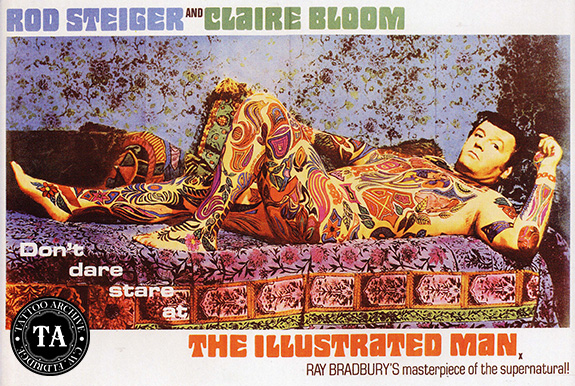
The book that these stories come from has eighteen of them, but Howard B. Kreitsek and Jack Smight picked these three for the film without ever speaking to Ray Bradbury, the author of the book. The tattooed man who appears in the book’s prologue and epilogue would become this film’s main story and be played by Rod Steiger.

The funny thing is that when Steiger takes off his glove to reveal his hand, it’s tattooed and played off as a horrific moment. A half-century after this movie was made, nearly all my friends have this many tattoos.

Carl, the tattooed man, meets Willie and uses his skin illustrations to tell tales throughout time. The ink came from a mysterious woman named Felicia. At the end of the film, Willie sees his death at Carl’s hands in the only bare patch of skin on the Illustrated Man.

The stories that are told include “The Veldt,” which takes place in the future and involves children who study within a virtual version of the African veldt. Soon, the lions will solve this issue of their parents. “The Long Rain” has solar rains* that drive an entire crew to madness in space. And “The Last Night of the World” predates The Mist, with parents who must decide if their children should survive the end of the world.

The final story—and its bleak ending—is exactly why my mom hates this movie. The fact that she may have told me all about it when I was a kid may have given me nightmares.

This movie did poorly critically and financially. Rod Serling, an expert on adapting short stories to film, called it the worst movie ever made.

*Their spaceship is recycled from Planet of the Apes, Beneath the Planet of the Apes and Escape from the Planet of the Apes.
Bucheon International Fantastic Film Festival: Kids vs. Aliens (2022)

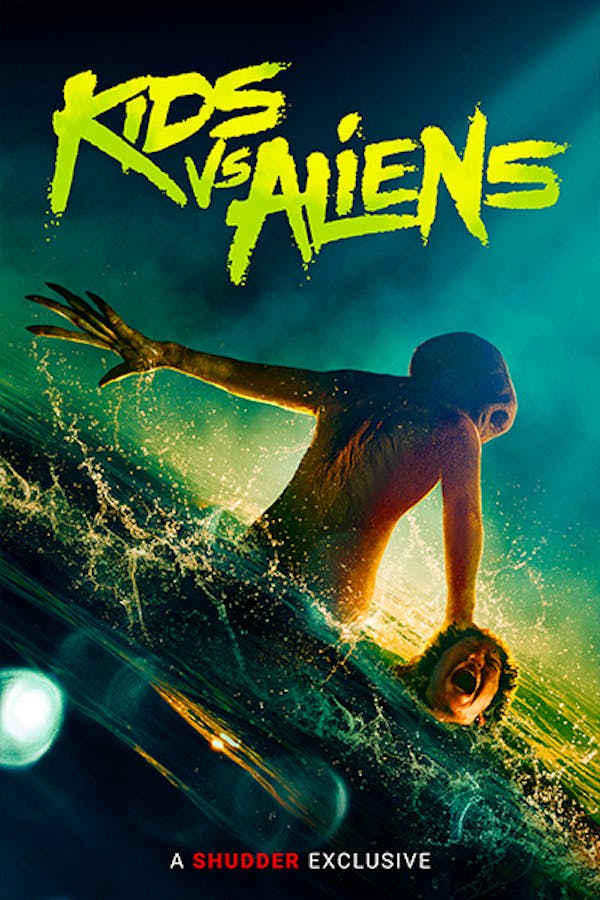
A feature-length adaptation of “Slumber Party Alien Abduction” from V/H/S/2, this finds kids Gary (Dominic Mariche), Jack (Asher Grayson) and Miles (Ben Tector) being bullied by teens Billy (Calem MacDonald), Dallas (Isaiah Fortune) and Trish (Emma Vickers) with Gary’s sister Sam (Phoebe Rex) caught in the middle. You see, the kids love to backyard wrestle and make home movies, but Sam is growing up and it’s time for her to decide if she really wants a boyfriend. That said, Billy might not be the best pick.

It’s all a moot point, because on the night of a party gone wrong that the bad kids force Sam to throw, aliens attack and all extraterrestrial hell breaks loose.

Directed by Jason Eisener (Hobo With a Shotgun), who wrote the film with John Davies, this is a movie that’s gorier, weirder and more profane than it’s title would suggest. It also has characters that — other than Sam (Phoebe Rex) — are cookie cutter at best and annoying at worst. It feels like a mean spirited cliche of Spielberg-esque alien movies and while it looks great and has wonderful practical effects, I kept asking if there was more. The end feels so abrupt that you feel cheated; it doesn’t have to have a happy ending, but it just feels like the filmmakers ran out of ideas and time.

I watched this film as part of The Bucheon International Fantastic Film Festival (BIFAN). You can learn more at their official site.

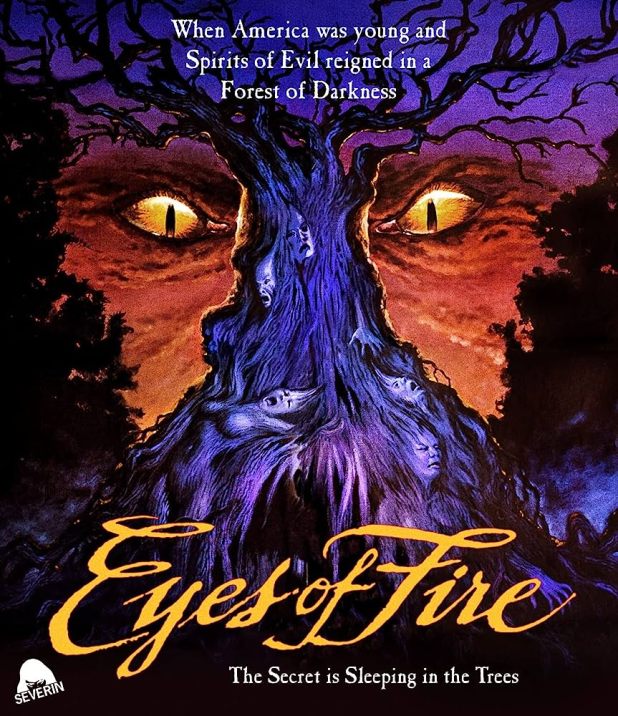
Bucheon International Fantastic Film Festival: Eyes of Fire (1983)

Released by Vestron Video in 1987, this forgotten folk horror—also known as Cry Blue Sky—is very similar to The Witch, minus any arthouse aspirations. Instead of a man whose pride casts his family out of their village, this movie is about a reverend accused of adultery and polygamy.

Reverend Will Smythe (Dennis Lipscomb, Under Siege) and his followers leave their town behind to live in a valley haunted by an ancient evil. A rugged woodsman, Marion Dalton (Guy Boyd, Body Double), is along for the ride because he has his eye on Smythe’s lusty wife, Eloise. Hijinks, as they say, ensue. And by hijinks, I mean whatever is in the woods begins to haunt and kill everyone.

Rob Paulsen, who plays Jewell Buchanan, would become a voice actor. Perhaps you’ve heard him as Raphael and Donatello, two of the Teenage Mutant Ninja Turtles, or Pinky from Pinky and the Brain. He’s also in the movies Stewardess SchoolWarlock and Body Double. He’s also the voice that says, “Cheers was filmed in front of a live audience.” In all, he’s been in 1,000+ commercials and been the voice of 250+ cartoon characters.

Director Avery Crounse started his career as a photographer and only made two other films: The Invisible Kid and Sister Island, which starred Karen Black.

I watched this film as part of The Bucheon International Fantastic Film Festival (BIFAN), as part of the Folk Horror: Lands of Cruelty, Beliefs of Terror program which also includes Valerie and Her Week of WondersKill List, the 2019 French version of la LloronaWoodlands Dark and Days BewitchedBldg. NIn My Mother’s Skin and To Fire You Come at Last. You can learn more at their official site.

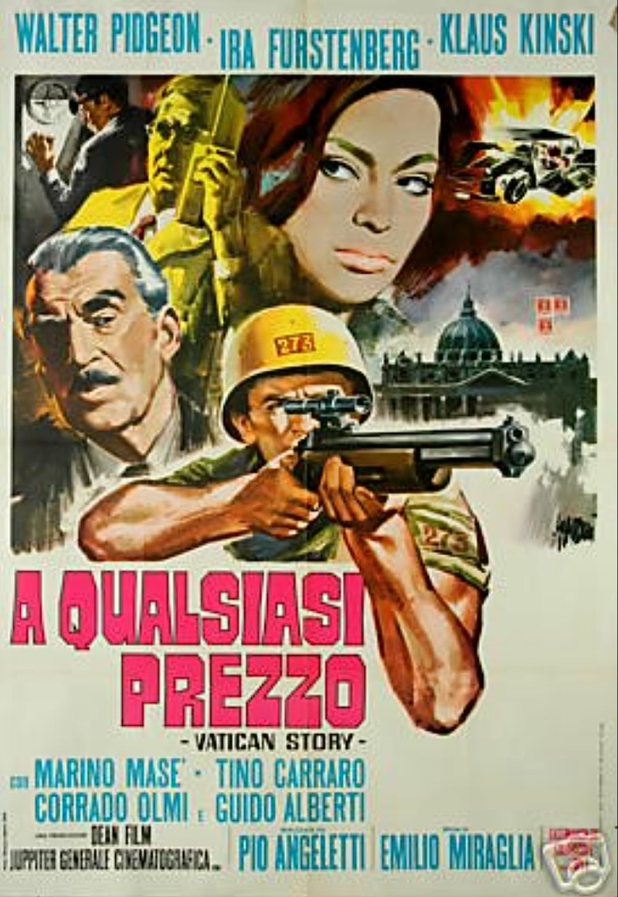
CBS LATE MOVIE MONTH: The Vatican Affair (1968)

EDITOR’S NOTE: The Vatican Affair was on the CBS Late Movie five times, airing on March 14, 1972; March 19, June 10 and December 29, 1975 and June 22, 1988.

Emilio Miraglia is best known to readers as the director of The Night Evelyn Came Out of the Grave and The Red Queen Kills Seven Times.

Professor Herbert Cummings (Walter Pidgeon) seems like no threat to anyone. After all, he’s blind. But in a surprising turn of events, he’s also looking to rob gems from St. Peter’s and has hired Clint Rogers (Klaus Kinski) to help get the job done. Richard (Marino Masé) and Pamela Scott (Ira von Fürstenberg) complete the crew.

The plot is similar to Operazione San Gennaro, directed by Dino Risi, and Operazione San Pietro, the sequel, directed by Lucio Fulci. It’s like another movie with Kinski, Ad ogni costo (Grand Slam). However, the true star of the film is the captivating soundtrack, composed by Luis Bacalov, which adds more excitement than what’s happening on screen. Bacalov, known for his work on DjangoThe Great SilenceThe Designated VictimIl Postino and Hell of the Living Dead, delivers a score that will keep you on the edge of your seat.

Source

Emilio Miraglia – Wikipedia. https://en.wikipedia.org/wiki/Emilio_Miraglia

CBS LATE MOVIE MONTH: Dracula Has Risen From His Grave (1968)

EDITOR’S NOTE: Dracula Has Risen From His Grave was on the CBS Late Movie on May 19 and October 12, 1972 and August 9, 1974.

This was the fourth Hammer Dracula movie and the third to star Christopher Lee (he doesn’t appear in The Brides of Dracula). It was directed by Freddie Francis, who stepped in to replace Terence Fisher, who injured his leg in a car accident. It has an extraordinary and wonderful effect when Dracula appears in the film, as the edges of the frame take on the colors of crimson, amber and yellow.

There’s a fantastic beginning where a young altar boy (Norman Bacon) finds a dead woman hidden inside a church bell, just one more of Dracula’s victims. But a year after — and the events of Dracula: Prince of Darkness — finds the greatest of all the undead quite dead.

Monsignor Ernst Mueller (Rupert Davies) visits the village from the opening and learns that the altar boy can no longer speak and the town’s holy man (Ewan Hooper) has lost his faith. Because Dracula’s castle has a shadow that extends over their church, they refuse to even come near it. The Monsignor decides to exorcise the castle, which leads to the kind of strange occurrences that always bring Dracula back: lightning strikes, the older priest slips, he hits his head on a rock, and the drips of his blood through the cracks in the ground make their way to the deceased vampire.

As Mueller returns home, Dracula quite literally rises from his grave and takes on the frightened priest as his familiar. Now unable to enter his castle, he flips out and demands revenge, heading off to Keinenberg, where he plans on making Mueller’s niece Maria (Veronica Carlson, Frankenstein Must Be DestroyedThe Horror of Frankenstein) into one of his lovers.

Luckily, her boyfriend Paul (Barry Andrews) is ready to protect her, even if he has to defeat the advances of a barmaid Zena (Barbara Ewing, who has since become a well-reviewed author) who has been hypnotized by Dracula. There’s a wild moment when Dracula orders the priest to kill Zena, so he burns her body in a bakery oven while Dracula leaps across the rooftops to find and bite Maria.

This has some fascinating ideas as Paul has to go it alone after the Monsignor dies. As an atheist, he and the lost faith priest are unable to properly stake and destroy Dracula. As always, Dracula is stopped, and faith is restored. This is the most challenging time for achieving that end goal.

As a kid, the Hammer movies were quite literally the end-all, be-all of my existence. I thought about them all day and would discuss them with anyone who wanted to hear about them—often, many who didn’t.

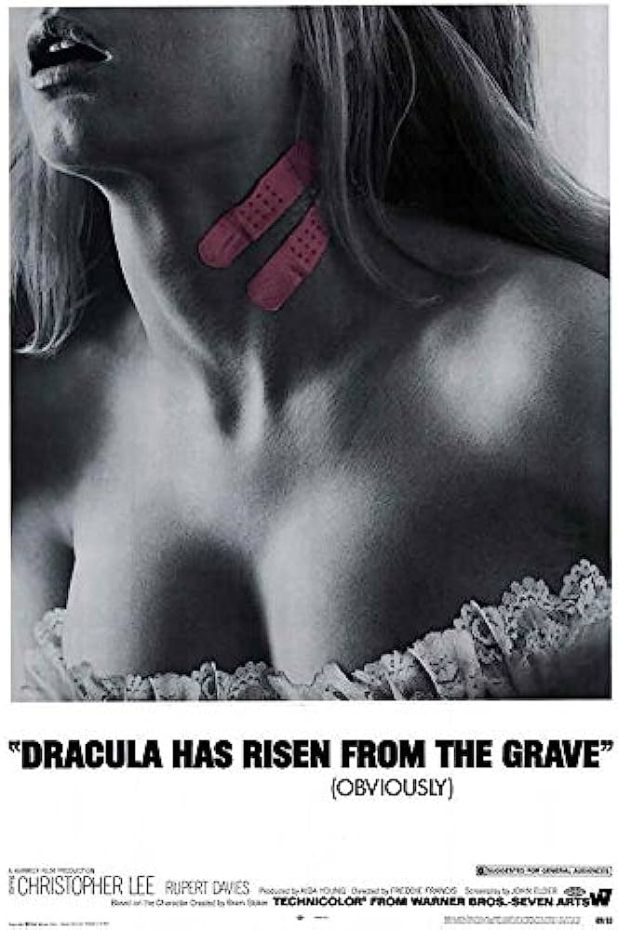
As an old man, I’m struck by how often the film in the movie is sped up, which doesn’t work, while the color effects and rooftop scenes have lost none of their infernal power. Plus, this has one of the best posters I’ve seen, just the throat of a bosom woman with band-aids where Dracula’s teeth have penetrated her.

CBS LATE MOVIE MONTH: Kingdom of the Spiders (1977)

EDITOR’S NOTE: Kingdom of the Spiders was on the CBS Late Movie on April 28, 1982 and January 12, 1983.

Directed by John “Bud” Cardos and written by Richard Robinson and Alan Caillou, whose real name was Alan Samuel Lyle-Smythe MBE, M.C. and who was an author, actor, screenwriter, soldier, policeman and professional hunter.

Despite the initial fright they may cause, it’s worth noting that tarantulas’ venom is about as dangerous as a bee sting. They mostly cause itching from the shedding of their bristles, which are used to make itching powder. This fact, coupled with the humorous association of itching powder with comedy movie scenes of mischief, adds a delightful touch of humor to the film.

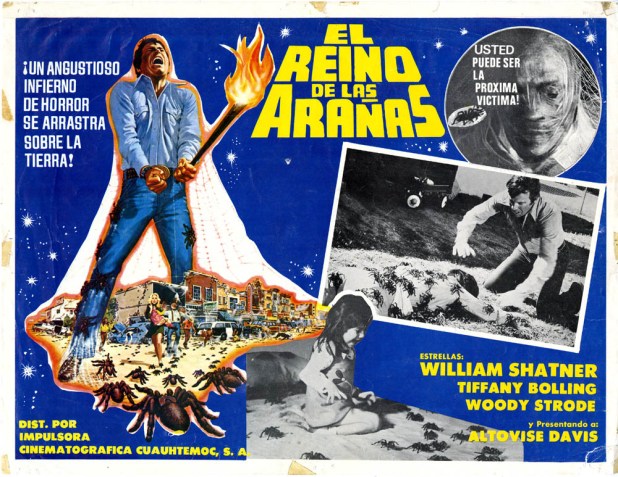
This film features 5,000 tarantulas in its cast, a staggering number that took up 10% of the film’s budget. It’s safe to assume that star William Shatner was compensated more than his eight-legged co-stars. Interestingly, these spiders, being cannibals, had their own set of demands. All 5,000 of them had to be kept in separate containers, adding a unique challenge to the production process.

They’re also very shy, so to make it appear that the spiders were attacking people, fans and air tubes were used.

Let’s take a trip to Camp Verde, Arizona.

That’s where Dr. Robert “Rack” Hansen (Shatner) practices. He’s heading out for a house call to see Walter Colby (Woody Strode), whose prize calf dies for reasons that puzzle Hansen. Diane Ashley (Tiffany Bolling) comes down from the big city of Flagstaff to blow his mind: spider venom killed the cow.

It gets worse. Walter’s wife, Birch (Altovise Davis, Sammy Davis Jr.’s third wife), soon discovers that their dog is dead and that a giant spider nest is in the backyard. Thanks to all the pesticides, the spiders have lost their natural food source, and instead of turning on one another, they’ve decided to eat larger meals.

Their big scientific plan is to burn the spider hill, which doesn’t go well because the arachnids escape into tunnels and show an advanced intelligence that conducts a revenge hit on Walter, his wife and Hansen’s sister-in-law Terry (Marcy Lafferty).

The mayor (Roy Engel) gets Sheriff Gene Smith (David McLean) to spray the town with pesticides, which is how things got this bad in the first place. Ashley says rats would have been a better idea, but obviously, the mayor met Larry Vaughn at a convention of mayors in Las Vegas and saw his seminar on never canceling the county fair, no matter what common sense tells you. More pesticide is planned, but the spiders deal with that by crashing a crop duster.

The survivors plan on escaping in an RV, but by the time they try, the entire town has been webbed up as the outside world forgets them and plays country music on the radio.

In 1998, Shatner told Fangoria that he was working with Cannon Films in the late 1980s to produce a sequel, but he probably meant Menahem’s 21st Century, which did run trade ads for Kingdom of the Spiders 2. Shatner would direct, write and star in the film, in which a man would be tortured with spiders. As you can imagine from Menahem’s playbook, this ad was just a photo of Shatner and the title of the movie.

Producers Igo Kantor and Howard James Reekie, using the name Port Hollywood, planned a sequel in the 2000s that promised Native American myth and spiders driven mad by secret government experiments involving extremely low-frequency tones.

I love this movie because you can tell that the spiders want nothing to do with anybody, much less feel the need to attack them. The entire cast of Bela Lugosi fights an octopus, and the emotion of fear is present, but no one is ever in danger.

CBS LATE MOVIE MONTH: Gargoyles (1972)

EDITOR’S NOTE: Gargoyles was first on the CBS Late Movie on May 1, 1973; May 16, 1975 and September 3, 1975.

EDITOR’S NOTE: Gargoyles was first on the CBS Late Movie on May 1, 1973; May 16, 1975 and September 3, 1975.

When I was a kid, I remember asking my dad what movies he thought were scary. He answered Night of the Living Dead and Gargoyles, so I was always nervous to watch this movie. It just looked strange, and in the late 1970s, it wasn’t like I could find it on demand. But the unique storytelling of Gargoyles always intrigued me.

Originally airing on CBS on November 21st, 1972, it was directed by Bill L. Norton (Baby: Secret of the Lost Legend, More American Graffiti) and written by Steven and Elinor Karpf (Devil Dog: The Hound from Hell, The Jayne Mansfield Story), Gargoyles may be uneven, but has moments of pure joy.

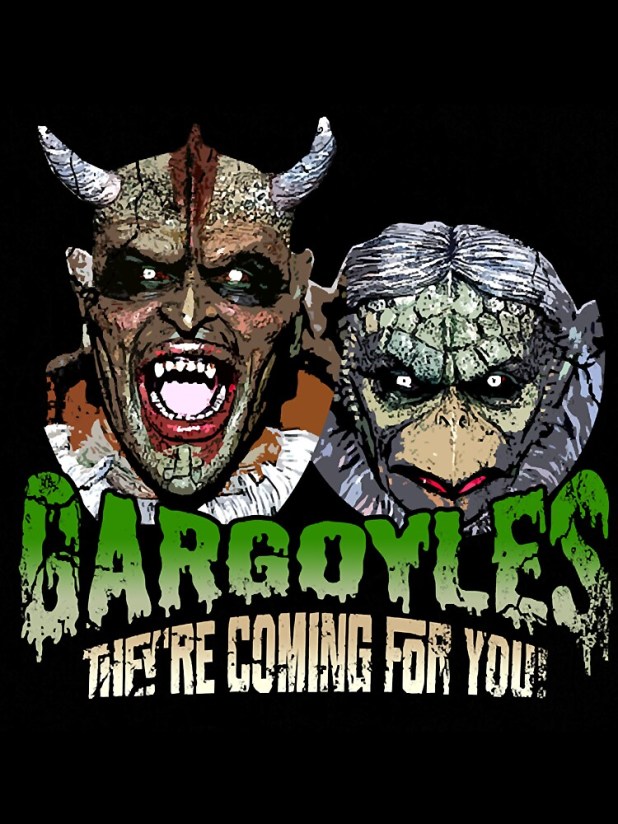
It’s one of the first films Stan Winston (Terminator, Aliens) worked on, providing a variety of gargoyle makeup. The look of the creatures is not just terrific, it’s downright amazing, as they don’t all look the same. The leader (Bernie Casey (Felix Leiter in Never Say Never Again, UN Washington in Revenge of the Nerds) has a perfect look that balances a regal bearing with an otherworldly aura. You can see why this won an Emmy. It’s big budget-worthy work on a shoestring budget.

Speaking of budget, the film was shot with just one camera over 18 days, which chased away the original director. Temperatures at the Carlsbad, NM location, baked the cast and crew, reaching 100 degrees or more the entire shoot. So it’s incredible that what emerged is so interesting.

The opening dialogue informs us that Satan lost the war in Heaven, with his children being the gargoyles who rise against man every six hundred years (there’s even an image from Haxan to symbolize the devil). This dialogue is by Vic Perrin (Tharg from the “Mirror, Mirror” episode of Star Trek, and the voice of Metron and Nomad), who also provides the crazy VO for the head, Gargoyle.

We join Dr. Mercer Boley (Cornell Wilde, No Blade of Grass), author of the occult, and his daughter, Diana (Jennifer Salt of Sisters and Son of Sam TV movie Out of the Darkness) as they head off to the desert — and Uncle Willie’s Museum — where they find a skeleton of a creature that Willie (Woody Chambliss of Zero Hour! and The Devil’s Rain!) claims he saw in the hills. The doctor doesn’t believe a word, but his daughter listens to his tales, only to be cut off by the sound of wings and something trying to get into the museum. Whatever it is, it sets off a fire that kills Uncle Willie.

They head to a local motel run by Mrs. Parks (Grayson Hall, who played Dr. Julia Hoffman in Dark Shadows and Carlotta Drake in Night of Dark Shadows), who is never without a drink in her hand (an acting choice by Hall that we can endorse). Two of the gargoyles try to take back the skeleton they’ve rescued from the inferno, but one is hit by a truck. It seems like the doctor sees money in the bodies of these gargoyles, alerting the group’s leader to his plan. He kidnaps Diana, showing her the eggs his people care for and explaining that they just want to live in peace with humans.

Throw in a bunch of motorcycle riders (including Scott Glenn of The Right Stuff and Silence of the Lambs), cops who can’t understand what is going on, the finest hound dogs in the area, an all-out war between humans and Gargoyles with way too much talking and you have this movie. But I can’t dislike it — it’s filled with great moments like the leader making Diana read to him about the historical account of an incubus seducing a woman and the speech he gives to the humans at the end. The closing image of a Gargoyle flying away, clutching a wounded female of his species? Amazing.

It’s worth seeking out, if only to see how horror used to be all over 1970s TV. If you grew up in that era, you have less of a chance of dismissing this movie as dumb.

Bucheon International Fantastic Film Festival: King On Screen (2022)

Starting with Carrie, Stephen King was adapted by more than fifty directors and eighty or more films and series were filmed. The beauty of King On Screen is that it brings together nearly every living director who worked on these films, including Tom Holland (The Langoliers, Thinner), Mick Garris (The StandSleepwalkers), Frank Darabont (The Green MileThe Shawshank Redemption, The Mist), Taylor Hackford (Dolores Claiborne), Mike Flanagan (Dr. Sleep, Gerald’s Game), Mark Lester (Firestarter), Mikael Håfström (1408), Josh Boone (The Stand), Tom McLoughlin (Sometimes They Come Back), Lewis Teague (CujoCat’s Eye), Fraser C. Heston (Needful Things), Craig R. Baxley (Storm of the CenturyRose RedKingdom Hospital), Mikael Salomon (Nightmares and Dreamscapes: From the Stories of Stephen King), Scott Hicks (Hearts In Atlantis), David Carson (Carrie 2002), John Harrison (CreepshowCreepshow 2), Zak Hilditch (1922), Greg Nicotero (Shudder’s Creepshow), Vincenzo Natali (In the Tall Grass), Tod Williams (Cell) and so many more.

Director Daphné Baiwir starts this with a sequence that takes you directly into nearly every one of King’s stories. If you love the author, you’ll have so much fun going back in and out of this scene to see how many references you can catch. My wife is a fan, so she was excited to see Jeffrey DeMunn show up, as he was in The Shawshank RedemptionStorm of the CenturyThe Green Mile and The Mist.

Don’t expect anyone to knock on any of these movies. Well, the movie likes The Shining TV movie more than Kubrick’s, but these are all friends of King. However, if you’re watching this, there’s a significant chance that you don’t have too many bad things to say about any Stephen King movies.

The part of this that I loved the most was the part about Tom Hanks, as Frank Darabont discussed how giving he is to everyone on set.

You can learn more about this film at the official website and Twitter and Instagram pages.

I watched this film as part of The Bucheon International Fantastic Film Festival (BIFAN). You can learn more at their official site.

Bucheon International Fantastic Film Festival: With Love and a Major Organ (2023)

ABOUT THE AUTHOR: Joseph Perry writes for the film websites Gruesome Magazine, The Scariest Things, Horror Fuel and Diabolique Magazine; for the film magazines Phantom of the Movies’ VideoScope and Drive-In Asylum; and for the pop culture websites When It Was Cool and Uphill Both Ways. He is also one of the hosts of When It Was Cool’s exclusive Uphill Both Ways podcast and can occasionally be heard as a cohost on Gruesome Magazine’s Decades of Horror: The Classic Era podcast.

Many of us human beings have felt at times like ripping out our own hearts, but in the fantastical world of director Kim Albright’s Canadian genre-blender With Love and a Major Organ (Canada, 2023), it is not only literally possible, but others can make off with them, too. 

Anabel (Anna Maguire) is a sensitive, artistic sort who seems to feel things much more than most of those around her. Friends and other acquaintances are obsessed by such things as online apps that require fewer feelings and less thinking. 

After having her romantic feelings toward George (Hamza Haq), a man she recently randomly met in a park, rebuffed, and becoming disenchanted with her friends and others, Anabel tears out her own heart and becomes a less feeling person. Meanwhile, George replaces his own heart with hers, and the world opens up to him in ways that he never felt before. 

Blending surreality, science fiction, and other genre-film elements with drama and occasional bittersweet humor, With Love and a Major Organ —written by Julia Lederer and based on her own play — aims for the heartstrings and plucks them quite splendidly. Though based on a play, Albright opens the story to a big, wide, colorful world, making it a true movie-watching experience rather than simply a filmed play. Anabel and George are wonderfully complicated characters, and they are brought to vivid cinematic life by Maguire and Haq, who lead a talented cast of supporting actors. 

Joe watched this film as part of The Bucheon International Fantastic Film Festival (BIFAN). You can learn more at their official site.

Bucheon International Fantastic Film Festival: Valerie and Her Week of Wonders (1970)

The film Jaromil Jires, directed before this one, 1969’s The Joke, has been described as “possibly the most shattering indictment of totalitarianism to come out of a Communist country.” As a result, it was banned for nearly twenty years.

Valerie and Her Week of Wonders is based on the 1935 Vítezslav Nezval novel. Much like that work, this movie is a work of surrealism and one of the films that I can best point to being part of a genre I’ve been referring to as ‘dark childhood’ films. This genre, which I’ve come to represent as movies that use the supernatural to explain the pains of oncoming adulthood, often features dreamlike sequences, allegorical storytelling, and a focus on the psychological aspects of growing up.

Valerie is asleep when a thief steals her earrings. She’s frightened by the masked Constable, who grows angry when the thief returns what he has stolen to her. That’s when she learns that the earrings were a last gift from her mother before she entered a convent, but they once belonged to the Constable.

The Thief and the Constable remain at odds over the earrings and Valerie. That night, she meets the masked man in the street, where he leads her to a chamber where her grandmother ritualistically whips herself all in the name of a past lover. Oh yeah — there’s also a woman named Elsa who was once the Constable’s lover and grows young again when she tastes blood.

The earrings pass through multiple owners, and Valerie’s blood is the key to nearly everyone’s survival. People transform into monsters and cats, and if you didn’t guess already, the movie has descended into a dream that only Valerie can wake up from.

Honestly, it’s hard to rationally write about this film. The film is a visual masterpiece, with magic infused in every frame. You’re either going to be captivated by its artistic brilliance, or you’re going to find it too arty or strange. Obviously, I belong to the former camp.

Members of the bands Espers, Fern Knight, Fursaxa and other musicians formed the Valerie Project in 2006, performing original songs while the film plays.

If you’ve ever read Angela Carter’s works or seen the film The Company of Wolves, which she wrote for director Neil Jordan, you’ve seen work directly influenced by Valerie.

Grab the Criterion blu of this and do yourself a favor. It’s a perfect film.

I watched this film as part of The Bucheon International Fantastic Film Festival (BIFAN), as part of the Folk Horror: Lands of Cruelty, Beliefs of Terror program which also includes Eyes of FireKill List, the 2019 French version of La LloronaWoodlands Dark and Days BewitchedBldg. NIn My Mother’s Skin and To Fire You Come at Last. You can learn more at their official site.