CBS LATE MOVIE MONTH: Whoever Slew Auntie Roo? (1972)

EDITOR’S NOTE: Whoever Slew Auntie Roo? aired on the CBS Late Movie on October 31, 1973 and March 8 and June 1, 1976.

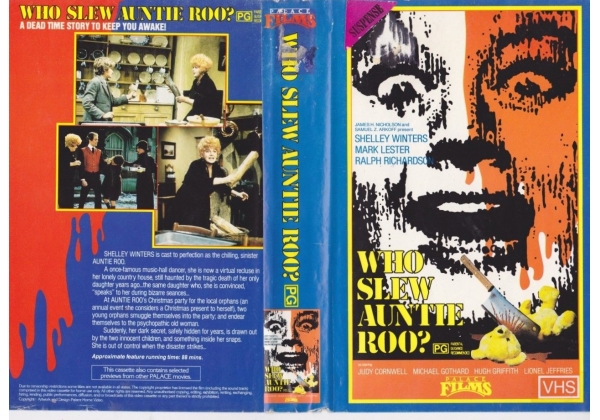
Following the success of What’s the Matter with Helen?, Curtis Harrington directed this intriguing psycho-biddy film. In it, Mrs. Rosie Forrest (Shelley Winters), the Aunty Roo of the title, is known by the children of a local orphanage as a kindly old lady who throws a huge Christmas party every single year for them. However, the truth is far more sinister. She’s obsessed with her dead daughter Katharine, whose mummified body lies in state in her attic so Aunty Roo can sing lullabies to her every night.


Mark Lester and Chloe Franks from The House That Dripped Blood play Christopher and Katy Coombs, two orphans who find themselves in Roo’s clutches. She believes that Katy might be her daughter, and the story takes a turn that’s reminiscent of the classic Hansel and Gretel tale, adding an intriguing layer to the narrative.

Ralph Richardson plays Mr. Benton, a fake psychic who tries to help Aunty Roo connect to the spirit of her long-departed daughter.

The early 70s are filled with what I call enjoyable junk. This would be one of those films with Winters practically devouring the scenery. It makes an outstanding double bill with the aforementioned What’s the Matter with Helen?, which is the superior of the two films. While Whoever Slew Auntie Roo? shares some thematic and stylistic similarities, it stands out for its more compelling narrative and character development.

CBS LATE MOVIE MONTH: The House That Screamed (1969)

EDITOR’S NOTE: The House That Screamed aired on the CBS Late Movie on January 30, 1973 and June 14, 1974.

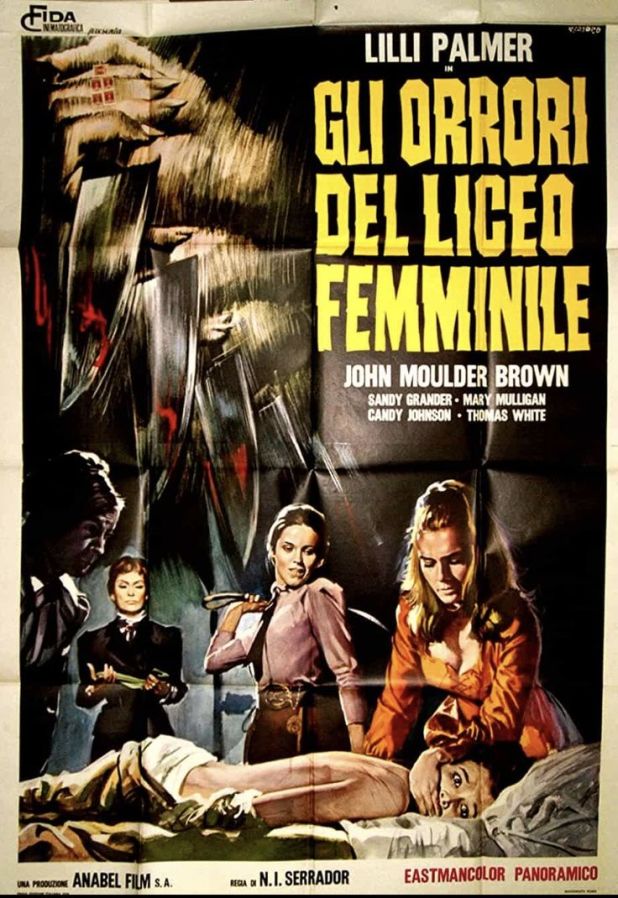
Spain’s first major horror film production, The House that Screamed—AKA La Residencia and The Boarding School—was based on a story by Juan Tébar. Because the cast included both English and Spanish actors, the film was shot in both languages and then dubbed into English in post-production.

Directed and written by Narciso Ibáñez Serrador (Who Can Kill a Child?), it takes place at a school for girls—reforming them and making them acceptable wives for their future husbands—in 19th-century France run by Headmistress Señora Fourneau (Lilli Palmer). Teresa Garan (Cristina Galbó, The Living Dead at Manchester Morgue) is a newcomer to the school and instantly notices just how strange of a place it is. For example, she always feels like she’s being watched.

Fourneau rules the school by the whip—quite literally, she has no problem beating her students into submission—and has Irene Tupan (Mary Maude), an older student, as her near WIP second-in-command.

Yet things are not alright. Students keep going missing, Teresa is bullied when the girls discover that her mother is a prostitute, and Luis (John Moulder-Brown), Fourneau’s son, is in love with Teresa despite the rules of her mother, who believes that none of these girls are good enough for him. He was once interested in Isabelle (Maribel Martín, The Blood Spattered Bride) until his mother roughly helped his face and intoned, “These girls are not good enough for you. What you need is a woman like me!”

That’s when the film literally goes Psycho, wipes out a main character, and the narrative transforms an antagonist into the protagonist. The horror, however, is nowhere near over for anyone. That idea of Luis finding a woman just like his mother haunts the headmistress.

This gorgeous movie predates Argento’s Bird With the Crystal Plumage by a few months and Suspiria by eight years. It’s as much a slasher as a gothic horror movie and works as both, and it has elements of Giallo and Women in Prison films. Yet, above all, it remains classy and has lush colors, incredible cinematography and luscious interiors, making this quite the furniture movie. Even better, you can see the film that was taken from it. Pieces might be a tribute movie, even if it’s not a movie discussed all that often in the U.S.

CBS LATE MOVIE MONTH: The Curse of Frankenstein (1957)

EDITOR’S NOTE: Curse of Frankenstein aired on the CBS Late Movie on May 24 and September 21, 1972 and June 28, 1974.

Hammer was initially founded in 1934 by William Hinds, whose stage name was Will Hammer, as he grew up in the Hammersmith section of London. They produced the now-lost The Public Life of Henry the Ninth and The Bank Messenger MysteryThe Mystery of the Mary CelesteSong of Freedom and Sporting Love before going out of business. That said, Hinds also co-owned a distribution company, Exclusive Films, with Enrique Carreras, which stayed in business.

In 1947, Hammer was revived after the war and began shooting low-budget radio show adaptations. They learned that they could save money by shooting in country homes rather than film sets—and stayed with that for much of their output—and would remodel Down Place on the Thames into Bray Studios, their best-known base of operations.

Hammer’s first horror movie was their 1955 adaptation of Nigel Kneale’s BBC Television science fiction serial The Quatermass ExperimentThe Quatermass Xperiment and Quatermass 2 were big hits; while the TV show was an unknown entity in the U.S., it was exported here as The Creeping Unknown to play a double feature with The Black Sleep. The results were so successful that United Artists offered to pay for part of the sequel.

Also — in the November 6, 1956 issue of Variety, it was claimed that a nine-year-old boy died of a ruptured artery while watching that movie in Oak Park, Illinois. According to The Guinness Book of Records, this would be the only known case of an audience member dying of fright. William Castle immediately took notice, one imagines.

As production began on Quatermass 2, Hammer needed someone in the U.S. willing to invest in and promote their movies. This led them to Associated Artists Productions. At the same time, Max J. Rosenberg and Milton Subotsky had sent Associated Artists an adaption of Mary Shelley’s novel Frankenstein, or The Modern Prometheus. They’d only made one movie and were hard to bet on, but Associated Artists’ boss Eliot Hyman did send the script to Hammer.

Until the day he died — and beyond — Rosenberg claimed that he produced The Curse of Frankenstein. However, Subotsky’s script was perhaps very close to Universal’s Son of Frankenstein and was only 55 minutes long. Screenwriter Jimmy Sangster said he had never seen Subotsky’s script or was unaware of Rosenberg’s involvement. In fact, he had never seen the Universal Frankenstein films and had just written what he thought the movie should be.

If the names Rosenberg and Subotsky are familiar, well — they became Amicus.

Another issue Hammer had to deal with was that studios had to submit their scripts to censors before making them in England. The censors said, “We are concerned about the flavour of this script, which, in its preoccupation with horror and gruesome detail, goes far beyond what we are accustomed to allow even for the ‘X’ category. We can give no assurance that we will be able to pass a film based on the present script, and a revised script should be sent to us for our comments, in which the overall unpleasantness should be mitigated.

You can only imagine how much more upsetting it would all be in vivid color instead of black and white. Hammer’s new take on horror didn’t avoid blood or gore; compared to the horror of the past, it zoomed in on it and let it take up the screen. It may seem tame today, but in the days before splatter and even Blood Feast, it was incendiary.

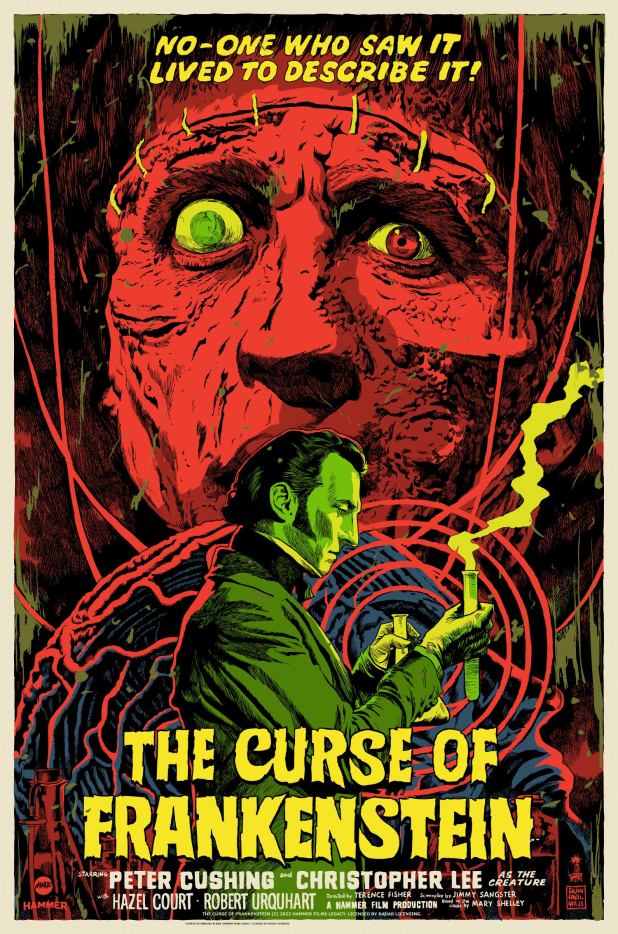
Directed by Terence Fisher, The Curse of Frankenstein has an intriguing opening that puts you right in the middle of the story: As Baron Victor Frankenstein (Peter Cushing in his first significant film role) awaits execution for the murder of his maid Justine (Valerie Gaunt), he reveals his story to a priest (Alex Gallier).

With the death of his mother, Victor owns the Frankenstein estate and pays for his remaining family, Aunt Sophia (Noel Hood) and her daughter Elizabeth (Hazel Court). He also pays for Paul Krempe (Robert Urquhart) to teach him science, which leads to them bringing a dead dog back to life. Indeed, they can do the same with human beings, but as Victor descends into scientific butchery, Paul leaves just as Victor’s fiancee — his cousin Elizabeth — comes to live with him.

His plan is sound, if not maniacal, as the dead body parts are sewn together to make the ideal human being, which will be guided by the brain of a professor. Sadly, that brain is damaged as Paul returns to try and stop Frankenstein. At this point, the scientist is so deluded that he thinks that it’s fine that he’s pushed the old teacher to his death. The creature (Christopher Lee) he brings to life is a madman, and Paul helps him stop it; later that night, Frankenstein still brings it back to life and uses it to murder Justine, with whom he has been having an affair. She seals her fate by claiming that she will reveal that he has impregnated her and is conducting experiments against nature.

Paul is invited back to the house the evening before the Frankenstein wedding, but the creature goes wild and grabs Elizabeth. Victor stops it and sends it into a vat of acid, where it disappears; he is arrested, and Paul refuses to tell the truth. Standing outside with Elizabeth, they remark about the insanity that took Victor as he is led to the gallows.

Released on May 20, 1957, with Woman of Rome in the UK and on July 20 in the U.S. with Hammer’s Quatermass-inspired X the UnknownThe Curse of Frankenstein made back seventy times what it cost. It led to five sequels and one comedic remake, the only time Cushing didn’t play Victor. The look of this film led to a Gothic craze in horror that everyone from Corman to Bava eventually took to greater heights. It sensationalized British critics who hated how bloody and exploitative it was, but as for fans of horror films, well…Hammer was the new name on their lips.

CBS LATE MOVIE MONTH: The Green Slime (1968)

EDITOR’S NOTE: The Green Slime was on the CBS Late Movie four times: March 23 and November 20, 1972; January 25, 1974 and March 10, 1976.

Known in Japan as Ganmā Daisan Gō: Uchū Daisakusen or Gamma 3: The Great Space War, this was directed by Kinji Fukasaku (Battles Without Honor or HumanityBattle RoyaleMessage from Space) and written by American screenwriters Tom Rowe, Charles Sinclair and Bill Finger, the uncredited for decades co-creator of Batman. It was shot with a Japanese crew and had non-Japanese actors, Robert Horton, Richard Jaeckel, and Luciana Paluzzi, in the lead roles. A  co-production between Metro-Goldwyn-Mayer, Ram Films, and Toei had MGM paying and providing the script, along with Toei hiring the film crew and getting a location to shoot this.

Commander Jack Rankin (Horton) takes command of space station Gamma 3 to destroy Flora, an asteroid about to end all life on Earth. Along with Commander Vince Elliot (Jaeckel) and science officer Dr. Hans Halversen (Ted Gunther), they set bombs off on the surface of the asteroid, but they end up bringing back some of that green slime. That slime starts eating any energy and turns into a one-eyed creature that loves to kill humans.

As we’re getting into the United Nations nature of this movie, it all started in Italy, as years before, MGM had contracted Antonio Margheriti to direct four films about the adventures of space station Gamma One: Wild, Wild Planet, War of the Planets, War Between the Planets and Snow Devils. MGM was so happy with these movies that they released them theatrically. This was intended by producers Walter Manley and Ivan Reiner as the fifth film in the series.

Charles Fox, who wrote the theme song for this film, would go on to co-write “Killing Me Softly With His Song,” the Wonder Woman theme and music for Barbarella. The song features Randy Nauert on sitar, Richard Delvy on drums, who also produced and arranged it, Rick Lancelot singing, Rob Edwards on guitar, and Paul Tanner playing the theremin.

Bucheon International Fantastic Film Festival: Nightsiren (2022)

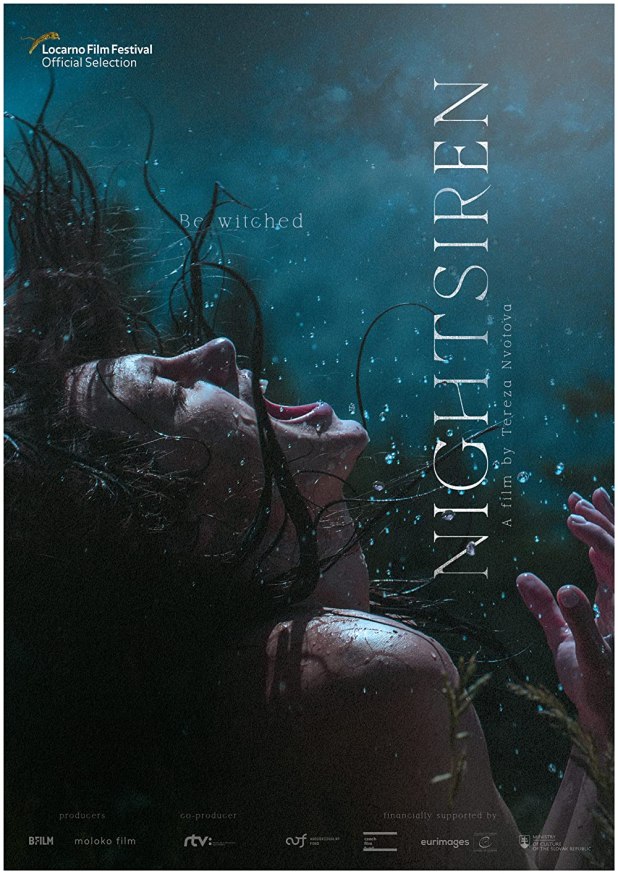
Two decades after a tragedy with her sister, Šarlota — pronounced Charlotta — comes back to her remote mountain hometown in Slovakia to claim an inheritance left by her dead mother. Yet when she gets there, her mother’s house has burned to the ground. Staying in her former neighbor’s abandoned cabin — rumored to have been a witch’s house — Šarlota remembers the misogyny, patriarchy and superstition that she had left. As she approaches a herbalist named Mira, the locals believe Šarlota must also be a witch.

A deserved winner of the Best Picture in the Cineasti del Presente Competition at the Locarno Film Festival, director Tereza Nvotová has made a movie that looks absolutely gorgeous and from another world. The witch sabbath scene in this is incredibly evocative and blew me away.

We live in a world that fears what it does not understand and seeks to hold back things of beauty and passion. These issues exist from big cities to small towns and everywhere in between; things are sliding back into a world where women no longer even have autonomy over their own bodies. Nightsiren presents a place where the power within women is challenged by old beliefs and an even older guard.

I watched this film as part of The Bucheon International Fantastic Film Festival (BIFAN). You can learn more at their official site.

CBS LATE MOVIE MONTH: The Woman Hunter (1972)

EDITOR’S NOTE: The Woman Hunter debuted as a CBS Movie of the Week on September 19, 1972. It played the CBS Late Movie on October 7, 1974.

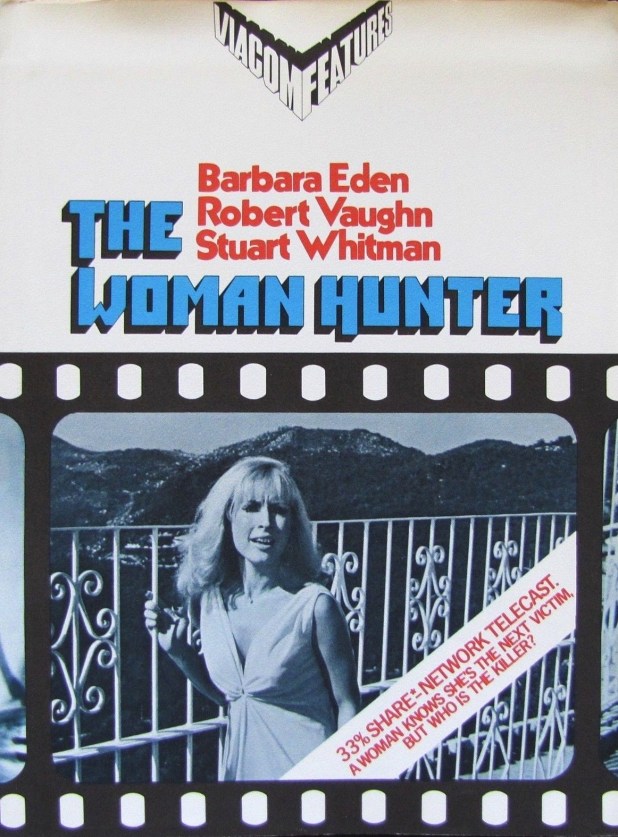
The Woman Hunter has an all-star cast, with Barbara Eden in the lead, alongside Stuart Whitman, Larry Storch and Robert Vaughn. Like I said — it’s what I say is an all-star cast.

Most Giallo heroines are characterized by their wealth and potential mental issues. However, in The Woman Hunter, when Dina Hunter (Eden) survives a car accident and plans a trip to Mexico with her husband (Vaughn), who would have thought that the artist she hired to paint her portrait (Whitman) could be a jewel thief and a murderer?

Enrique Lucero, who plays the Commissioner, would go on to try and hunt down Mary, Mary, and Bloody Mary and also appears in The Wild Bunch, Guyana, Cult of the Damned and The Evil That Men Do.

This was written by Brian Clemens (Captain KronosAnd Soon the Darkness) and Tony Williamson (Adam Adamant Lives!The Avengers). It is Clemens’ first U.S. work and Williamson’s only script made over here. It’s directed by Bernard L. Kowalski, who stepped in for John Peyser (The Centerfold Girls). I assume that everyone enjoyed shooting this on location in Acapulco. Larry Storch even brought his wife Norma along.

You can watch this on YouTube.

CBS LATE MOVIE MONTH: She Waits (1972)

EDITOR’S NOTE: She Waits debuted as a CBS TV movie on January 28, 1972. It played the CBS Late Movie on September 12, 1972 and January 14, 1974.

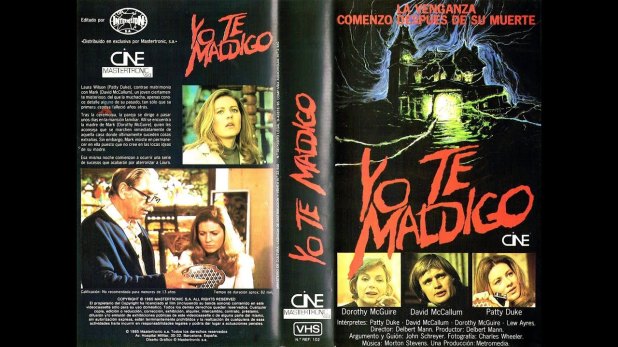
Laura Wilson (Patty Duke, Valley of the DollsThe Swarm) and Mark (David McCallum, Illya Kuryakin on The Man from U.N.C.L.E. and better known to today’s TV audience as Dr. Donald Mallard on N.C.I.S.) haven’t been married long. On their first trip to meet his mother (Dorothy McGuire, The Greatest Story Ever Told), she learns that maybe this marriage wasn’t the best of ideas. Mom has been ready to go nutzoid ever since Mark’s first wife, Elaine, died, and she’s convinced that her ghost is inside her home.

Everywhere Laura goes, she starts hearing Elaine’s favorite song and even her voice. Is she trying to possess her? Or is she just being ridiculous, as the family doctor suggests? The movie never fully embraces the supernatural. It’s more about Mark shutting himself off and not dealing with the past.

The family maid thinks that Mark’s mother is getting worse and worse, with Laura in danger of the very same insanity. And what’s the deal with Mark’s friend David (James T. Callahan, the dad from Charles in Charge)? And can you talk a ghost out of possessing someone just by talking to them?

Director Delbert Mann (Marty) weaves a competent story, penned by Art Wallace, the main writer for TV’s Dark Shadows. It’s a tale that fits snugly into the 1970s, a time when possession, Satan, and the ghosts of murdered wives lurked around every corner. The film’s slow pace is a deliberate nod to the conventions of TV movie horror, inviting you to revel in the nostalgia of a bygone era.

Bucheon International Fantastic Film Festival begins next week!

I’m honored to have been asked to review films for The Bucheon International Fantastic Film Festival (BIFAN).

Launched in 1997, BIFAN is the representative cultural festival of Bucheon, Korean, a UNESCO creative city of literature. Works by master filmmakers such as Peter Jackson, Christopher Nolan, Darren Aronofsky, Guillermo del Toro Jang Joonhwan and Na Hongin have been discovered and introduced at BIFAN.

The festival called into question the topic of censorship through provocative special programs, such as the blue movie special program, and it built a fan community through a program dedicated to martial arts movies by the Shaw Brothers Studio and the Bollywood special program. BIFAN has experienced its share of ups and downs following changes in authority, but it has received endless love and support over the past 26 years from audiences and guests, for presenting new sensibilities, rich imagination, and unique programs. With “Stay Strange” as its motto, BIFAN strives to be a film festival that cheers for the nonmainstream, while discovering and giving courage to talents that are pushed to the margins.

The genre films and talents discovered and introduced by BIFAN become more amplified and can meet the world through the festival’s industry program, B.I.G. built upon the foundation of the Network of Asian Fantastic Films (NAFF), which launched in 2008 to help with the production and development of genre films, B.I.G has developed into a platform that represents the genre film industry. Asian genre filmmakers have been discovered and nurtured through the world’s first genre film project market, It Project, and our film education program, Fantastic Film School. Through Made in Asia, we have accumulated data on popular movies in Asia and created a network of industry leaders.

BIFAN runs from June 29 to July 9 and will have 262 films from 51 countries.

To learn more, visit the official site.

I’m truly excited as there are some major surprises coming to the site this week from BIFAN!

CBS LATE MOVIE MONTH: Frankenstein Created Woman (1967)

EDITOR’S NOTE: Frankenstein Created Woman played the CBS Late Movie on February 9 and June 18, 1973.

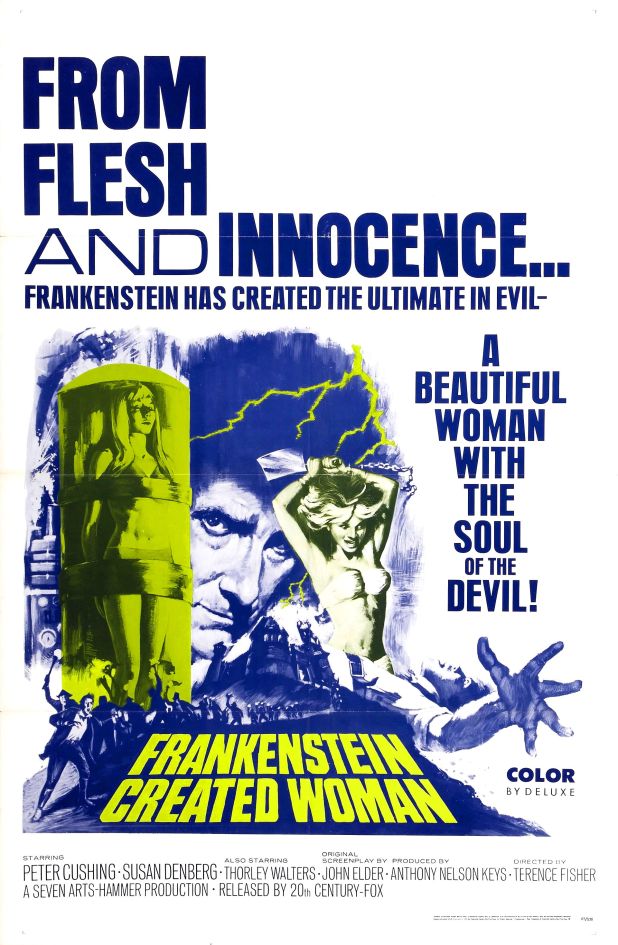
From flesh and innocence, Frankenstein has created the ultimate in evil. A beautiful woman with the soul of the devil!

With a tagline like that, how can you not watch this movie?

The fourth film in Hammer’s Frankenstein series is a thought-provoking exploration of the soul and morality. It’s the one in which we stop thinking about death as a physical matter and start delving into these profound questions.

The movie starts with Hans Werner watching his father executed by the guillotine. Then, we see him as a young man, working as an assistant to Dr. Hertz and Baron Victor Frankenstein (Peter Cushing, as it always must be). The doctors have learned how to trap the soul before it leaves the body — they must have been watching The Asphyx* — and think that they can transfer it into another body.

They get their chance when Hans is put to death defending the honor of his girlfriend Christina (Susan Denberg, Playboy Playmate of the Month for August 1966) after several rich men abuse her for her deformities and kill her father. After he follows in his father’s footsteps, the doctors can extract his soul.

Unable to live without Hans, Christina tragically drowns herself in a river. The doctors, however, decide to transfer Hans’ essence into the body of his lover. For months, the two doctors work to heal her physical maladies and make her the perfect woman. The big problem is that she’s haunted by Hans, who she sees as a ghostly apparition, and begins to hunt down the men who killed him and her father.

As the film closes, Christina realizes that she should have never come back to life, so she drowns herself again as Frankenstein somehow learns a lesson and walks away.

Directed by Terrence Fisher, this is the kind of Hammer film that I love. It boldly moves away from simply being modern versions of classic horror and creates its own unique commentary on the world through the lens of the fantastic.

*I realize that the movie was made five years after this, but the joke was too simple not to use.

CBS LATE MOVIE MONTH: Over the Top (1987)

EDITOR’S NOTE: Over the Top was on the CBS Late Movie on the next to last month of its run, airing on October 19, 1990.

Stirling Silliphant wrote the Oscar-winning screenplay for 1967’s In the Heat of the Night, as well as The Towering InfernoThe Poseidon AdventureVillage of the Damned,  TelefonThe EnforcerShaft In Africa and more than 700 hours of prime-time television drama to his credit. He was also a close friend and student of Bruce Lee, who he featured in the movie Marlowe and four episodes of the series Longstreet. They also worked together on a script called The Silent Flute, which was eventually filmed as Circle of Iron.

Those are some fantastic credits. Somehow, someway, he eventually found himself working with Sylvester Stallone to write the screenplay for the movie that would take arm wrestling from the bar to the mainstream. And who was ready to direct?

None other than Cannon Group co-owner Menahem Golan, the director of Delta ForceEnter the Ninja and The Apple. Yes, that Menahem Golan.

https://www.youtube.com/watch?v=jJ8d_czhqeA

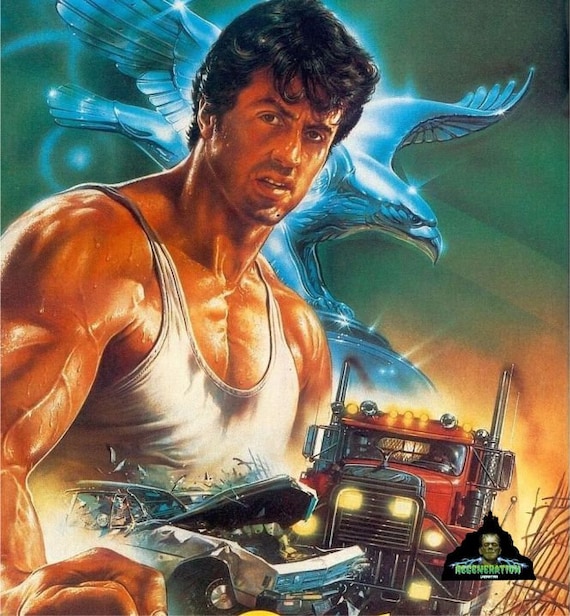
Lincoln Hawk (Stallone) is a man trying to rebuild his life. While he does that, he’s driving a truck and arm wrestling. His ex-wife Christina (Susan Blakely, My Mom’s a WerewolfThe Concorde … Airport ’79) wants him to bond with their son Michael (David Mendenhall, Space RaidersStreets and the 12-year-old drug dealer in the Diff’rent Strokes episode where Nancy Reagan shows up) because she knows that she’s dying.

Michael has been in military school and calls everyone “sir.” His grandfather, Jason Cutler (this movie is yet another in my quest to see every film with Robert Loggia in it), hates Hawk and never wants him in their family.

On the journey from Colorado to California, Michael develops a deep bond with his father, who teaches him the art of arm wrestling and the essence of manhood. However, their reunion at the hospital is marred by the news of Christina’s demise. Blaming his father for not being there in her final moments, Michael returns to his grandfather’s home. Hawk, in a desperate attempt to free his son, ends up getting arrested. The mansion where Cutler resides may look familiar, as it was also featured in The Beverly Hillbillies.

Michael visits Hawk in jail, informing him of his decision to stay with his grandfather. Determined to win back his son’s trust, Hawk sets off to compete in the World Armwrestling Championship in Las Vegas, with a grand prize of $100,000 and a new, larger semi-truck. In a bold move, he sells his truck and places a $7,000 bet on himself at twenty-to-one odds. The discovery of the letters Hawk had written to him over the years, trying to establish a connection, further fuels Michael’s belief in his father.

Hawk advances to the final eight but suffers his first loss in the double-elimination tournament and hurts his arm. Cutler summons our hero and tells him that he’s always been a loser, but if he leaves forever, he’ll give him $500,000 and a better truck than the prize.

Hawk refuses and makes it to the finals, taking on his rival, the undefeated Bull Hurley. His son finds him and gives him the emotional energy he needs to survive, just as Hawk doesn’t only beat Bull but gains his respect. Somehow, Cutler gets over ten years of being a complete asshole and is happy about Michael and Hawk being reunited because that’s how eighties movies work. The guys get so sweaty in the final battle that they have to get the strap, and people go wild for it. It’s pretty impressive, and you’ll yell, “Get the strap!” too.

The film’s climactic finals were shot during a tournament organized by Cannon, the production company. This year-long competition, starting in Beverly Hills, featured events across North America, Europe, Israel, and Japan. The actual crowd and the B-roll footage of matches at the Las Vegas Hilton are what you see in the movie. The scene where Michael Bociu breaks his elbow? That’s as real as it gets.

If you’re into pro wrestling, Terry Funk, Reggie Bennett and Scott Norton show up here (Ox Baker, who was in Escape from New York, and Manny Fernandez and The Barbarian almost made it into the movie). Plenty of professional arm wrestlers like professional arm wrestling personalities such as Allen Fisher, John Vreeland, Andrew “Cobra” Rhodes, John Brzenk (who inspired the story) and Cleve Dean are also on hand.

The music in this movie is astounding. Kenny Loggins sings “Meet Me Halfway” numerous times, and there is also some Giorgio Moroder, some Asia, some Robin Zander, some Eddie Money and Sammy Hagar singing “Winner Takes It All,” which was also made into a music video to promote the film.

The film received three nominations at the 8th Golden Raspberry Awards in 1988. David Mendenhall won two for both Worst Supporting Actor and Worst New Star, which seems kind of crappy for them to abuse a kid. Sylvester Stallone was nominated for Worst Actor, an award he’s won four times, but he lost to Bill Cosby in Leonard Part 6 this time.

Stallone has claimed that if he had directed this, he would’ve changed the setting to an urban environment, used scored music instead of rock songs, and made the Las Vegas finale more ominous. These changes would have significantly altered the film’s tone and atmosphere. So why was he in it? He answered, “Menahem Golan kept offering me more and more money until I finally thought, “What the hell – no one will see it!””

Speaking of Stirling Silliphant, he only did the screenplay. Actor/writer Gary Conway (American Ninja 2: The Confrontation) and director/writer David Engelbach (America 3000Death Wish II) created the original story. Engelbach cried when he saw the finished movie, remarking that his original draft “wasn’t nearly as dumb as the final film and was more about truck driving and arm-wrestling than it should’ve been.”

When this movie came out, my brother and I were in our early teens and couldn’t wait for it. There was an entire line of toys that had knobs in their backs that allowed them to arm wrestle and, even better, an actual competition table. We begged our parents for it nearly every day for six months, but our mother continually told us to use an actual table. She had no vision. At this point, I could have a father-in-law who hates me, a bedridden ex-wife and a son who doesn’t know me, but I could flash anyone and put their arm down in no time. Get the strap!

Even more magical, fifty miles from the filming of this movie, Sergio Martino had assembled an Italian/American crew to create Hands of Steel, the only Road Warrior by way of The Terminator truck driving movie that also has arm wrestling in it. Coincidence? Do you know anything about Italian cinema?