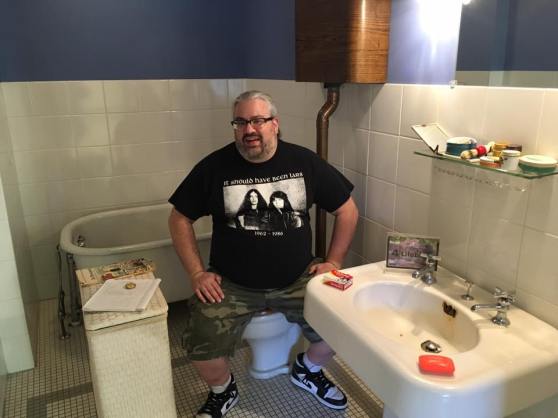
DISMEMBERCEMBER: A Karate Christmas Miracle (2019)

Directed by Julie Kimmel, who wrote this with Ken Del Vecchio and David Landau, all of whom I can only assume are aliens from some other plane of reality who had never met human beings before but sent this to our planet to show us that they want to be our friends yet have no idea how humanity reacts to things, kind of like how there’s that scene with the orange tree in The Last American Virgin and we’re all supposed to say, “Yes, that’s a universal symbol that makes perfect sense.” Imagine that kind of disconnected emotion for an entire film.

Jesse Genesis (Mario Del Vecchio, whose father is the writer of this in case you wondered, I can only assume that he is also extraterrestrial) is a ten-year-old whose father has been missing since his father went to a movie theater where James Whitmore (Eric Roberts) appears and gives his daughter Aurora (Lacy Marie Meyer) the ownership of the place before a gun rights meeting and then a clown shows up and shoots up the place. Jesse thinks that if he completes a series of tasks, including getting his black belt in five days, his father will come back.

At the same time, his busy advertising agency working mom Abby, (Mila Milosevic) goes to find the psychic who told her that she would get married, Elizabeth (Julie McCullough, who was in The Blob remake!), who is now a law professor. Elizabeth still has visions that she can’t control and those same images are being seen by Jesse. Also, he talks on the phone with Martin Kove, who used to own the theater.

This movie has left me with so many questions. Is Jesse like Bruce Lee, creating his own martial art and awarding himself his own black belt? Is McCullough’s character insane and why do we get the scene where she sees her old boyfriend at the bar and it never really pays off other than to crush her dreams and show that her visions rarely come off? How does Abby keep her job when she just walks out on a major pitch?

Anyways, all the theater footage is recycled from Joker’s Poltergeist: The Aurora Massacre, a movie that Del Vecchio made to cash in on the real life July 20, 2012 mass shooting at a movie theater. If you think that movie sounds upsetting, he also made The Life Zone, a story of Robert Loggia’s character going all Saw and kidnapping three pregnant women who want an abortion and it turns out that everyone is in Hell. He also made a sequel, Cries of the Unborn, as well as An Affirmative Act (a positive gay marriage film with Charles Durning, so this guy can’t be pigeonholed), The Great Fight (an autistic man become an MMA fighter in a movie starring Loggia, Durning, Joyce DeWitt and Martin Kove) and O.B.A.M. Nude (a movie he wrote and starred in as Barrack Obama, who sells his soul to Satan to be President). He was a former New Jersey judge who quit that to make movies and host the Kenneth Del Vecchio’s Hoboken International Film Festival, where this movie premiered (and Martin Kove was given the Hall of Fame Award; ironically many of the award winners at this festival have been in Del Vecchio’s movies).

Yes, Kenneth plays Bob, the missing dad.

Yes, this was shot at Caldwell University, a Catholic university in New Jersey where the film’s co-producer — and Kenneth’s wife and Mario’s mom — Dr. Francine Del Vecchio is a full-time Professor of Education.

Yes, the dad comes back because all it takes to be a black belt is to break a board.

This movie is baffling because it is somehow both religious and secular, embracing the divine and the occult. There are so many missing pieces, as if the entire movie is one big plothole in search of a story, all explained by psychological terms and a long rambling explanation of what the belts in karate mean.

Once, as a kid, my rich neighbor paid for me to be the tackling dummy for her grandson and teach him how to fight back against bullies. I was told I was to learn nothing and be there simply to be thrown and struck. I ended up becoming a pro wrestling with a few MMA fights on my resume. I have no idea what happened to that kid because once I started showing some skill, she told me that I was not there to learn and fired me from a job where I was not getting paid.

None of these lessons involved breaking boards.

You can watch this on Tubi.
DISMEMBERCEMBER: Santa’s Christmas Circus (1966)

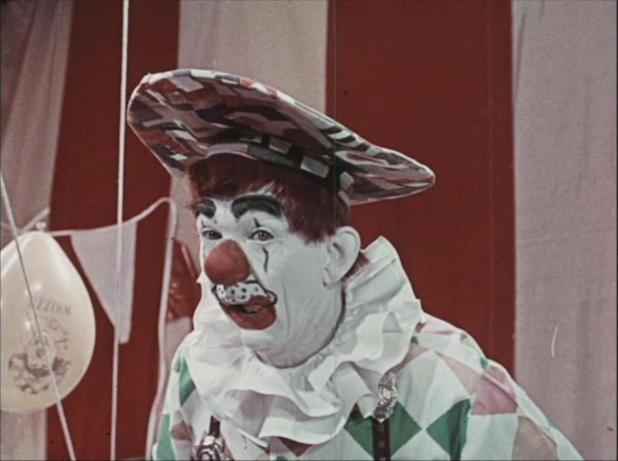
From 1953 to 1987, Frank Wiziarde played Whizzo the clown on TV stations in Kansas City and Topeka. He and his family had had their own traveling act, the Wiziarde Novelty Circus, so he had some level of big top know-how. None of this comes out in this film, which he directed and by that he set the camera up and just started talking. And talking.

Whizzo may be in the middle of a nervous breakdown during this because he keeps babbling about all of his problems and I know its Christmas but man, the dude just keeps talking about all the things he’s worrying about and then they bring in some kids and he asks where their circus outfits are and then he makes a kid dress like a lion and then he narrates some department store windows, all the while a child is literally dying from a horrific cough.

This is an hour long and even a trip to see Santa can’t save it. It’s mind-destroying in how braying Whizzo is and I wonder who was entertained by this.

According to the Kansas Historical Society, “Whizzo jumped out from behind a curtain, tripped over items scattered around his set and sang the song he composed, “Who’s always smiling, never sad? It’s Whizzo!” Whizzo’s set was always filled with props, most of which he made himself. His suitcase contained a number of amusing tricks. Among the animals on the show was “Hissy the Goose,” who would drop down on Whizzo, give him a bump and fly back up. Whizzo pretended not to know what hit him, only to be bumped repeatedly by “Hissy.” It was up to the kids in the studio audience to explain to Whizzo what had happened.”

This is Whizzo’s sad suitcase.

Kansas City Mayor H. Roe Bartle once said “If kids could vote, Whizzo would be mayor of Kansas City.” I see no better argument for never adjusting the voting age.

You can watch this on Tubi.
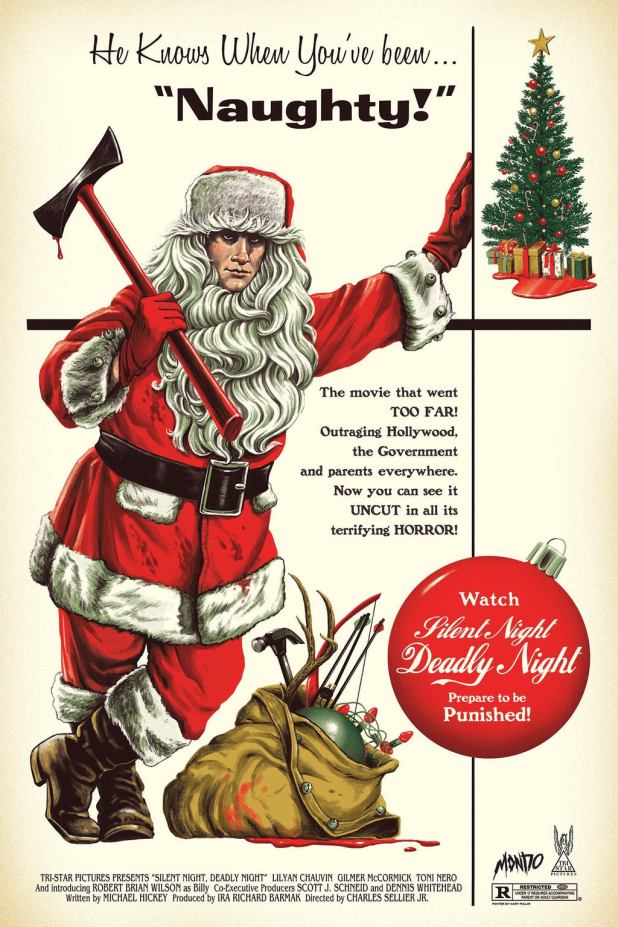
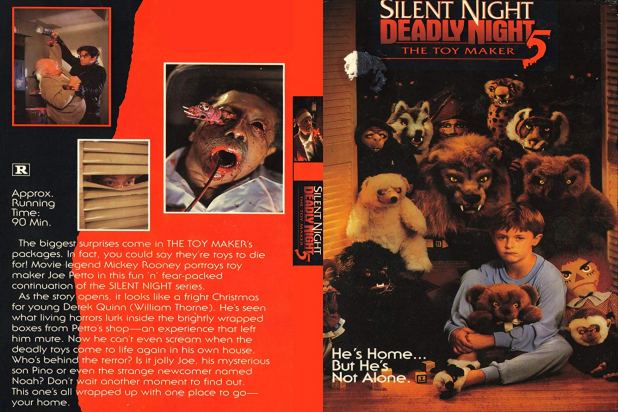
DISMEMBERCEMBER: Silent Night, Deadly Night 5: The Toy Maker (1991)

EDITOR’S NOTE: This was first posted on December 24, 2019.

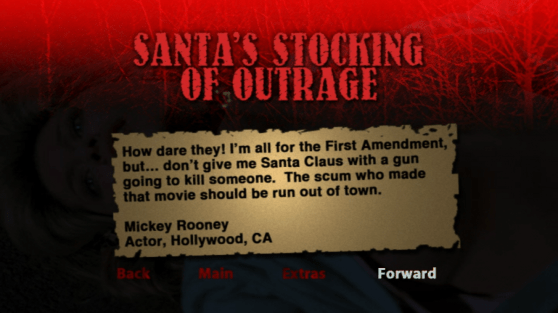
Mickey Rooney famously decried the original Silent Night, Deadly Night. He said that the scum who made it should be run out of town for having sullied the sacredness of Christmas. Yet here he is, starring in the fifth installment. Hollywood is funny that way.

Neith Hunter, Clint Howard and Conan Yuzna — who played Kim, Ricky and Lonnie in Silent Night, Deadly Night 4: Initiation — make cameo appearances, but as far as I know, they aren’t the same characters.

One night in December, Derek Quinn finds a gift on his porch. His father yells at him for being awake so late and opens the gift himself, which has an orb shaped like Santa inside it. Soon, it unleashes some tentacles which strangle dad and make him fall down on a fireplace poker. His wife Sarah soon finds his body.

Two weeks later, Derek’s mom takes him to the toy store of Joe Petto (Rooney) — get it, JOE PETTO — to pick out a toy. Petto’s son Pino — yes, Pino Petto — is a weird duck who tries to get Derek to pick Larry the Larvae. Derek rejects the toys and Joe begins screaming at Pino, blaming him for the toy store failing. While all that’s going on, Noah Adams has followed the family and takes that worm toy, which he gives to his landlord. Larry the Larvae crawls into that dude’s mouth and out his eyeball, proving that this movie isn’t screwing around when it comes to holiday gore.

The next day, Sarah takes Derek to see Santa, who ends up being Noah. There’s also another gift on the porch and if someone didn’t want a gift any more than this kid, I have no idea who that person is.

So that gift ends up being rocket skates and a kid ends up getting hospitalized by them. And oh yeah — Pino gets beaten into oblivion by his dad. And oh yeah part two — Noah is really Derek’s real dad.

What follows next is a sequence where the babysitter and her boyfriend are accosted by a toy hand and then annihilated by an entire army of toys that basically dissects them. Joe steals Derek and Noah reveals that the old toymaker hurt a whole bunch of kids after his wife died by selling them toys that would hurt them.

As they get to the toy store, Noah is knocked out and Pino reveals that he is a robotic boy created by Joe to replace his dead son, but that he can never live up to being a real boy. Joe beats him to the point that he dies time and time again, but now he wants Sarah to be his mom, so he sexually assaults her. Yep. This movie is taking no prisoners.

The end of this movie is completely out of control. The robotic kid — who has an asexual body like a Ken doll — gets chopped in half and his head stomped on, as he cries for his father. You really have to see it to believe it.

Director Martin Kitrosser has had an interesting career, writing starting as a script supervisor on the first Friday the 13th before eventually writing the third and fifth films in that series. He also wrote Meatballs Part II and has gone on to be a script supervisor for nearly all of Quentin Tarantino’s films, with his credit in Once Upon a Time…In Hollywood listing him as Martin “The Cobra” Kitrosser.

Brian Yuzna, who produced Re-Animator, was also on board for this. The effects, by Screaming Mad George, are incredible, with tons of gore and some really inventive deadly toys. Actually, this whole movie is way better than it has any right being, seeing as how it’s the fifth movie in the series. To be honest, it’s several cuts above the other ones all put together.

You can watch this for free — with commercials — on Tubi.

You can also get it on the Vestron Video Silent Night Deadly Night set which you can buy from Diabolik DVD.

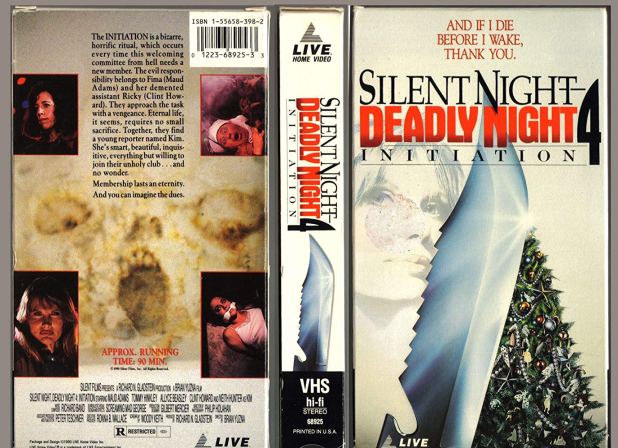
DISMEMBERCEMBER: Silent Night, Deadly Night 4: Initiation (1990)

EDITOR’S NOTE: I hope you don’t mind a used gift, because this was first posted on December 24, 2019.

This entry in the Silent Night, Deadly Night series has nothing to do with any of the others, dropping the killer Santa Caldwell brothers for an entirely new plot. It was directed by Brian Yuzna and written by Yuzna, Woody Keith and Arthur Gorson. In the UK, it’s called Bugs, which is a much more descriptive title.

Keith took several of the ideas he had for the movie Society but was unable to get into that movie. Thanks to the miracle of how movies are released, that film came out two years after this one.

Kim Levitt (Neith Hunter, who is also in Less Than Zero and Carnosaur 2) is an aspiring journalist working at the L.A. Eye. Her boss gives breaks to all the guys, including her boyfriend Hank.

However, when she finds a spontaneously combusted body on her sidewalk, she starts her own investigation. That brings her to the bookstore of Fima (Maud Adams, the titular heroine of the James Bond film Octopussy), who gives her a book on feminism and the occult.

On Christmas Eve, Kim spends a rough evening with her boyfriend’s family, dealing with way too many questions and anger about her lack of religious faith. On Christmas Day, she attends a picnic Fima invited her to, where she meets Katherine Harrison (Jeanne Bates, Mrs. X from Eraserhead) and Jane Yanana (Sheeva from Mortal Kombat: Annihilation), who tells her about Adam’s first wife Lilith.

Merry Christmas, huh?

Soon, our heroine’s writing career is going well but she’s eating bugs and drinking weird tea and you know, it’s tannis root all over again. She passes out, only to awaken to Jane, Fima, Katherine, and Li performing a ritual where they cut open a live rat, pulls out some larva and shoves it inside her secret garden. It then comes out of her mouth as a vomited giant roach, which their assistant Ricky (Clint Howard!) slices up and drips all over her face.

The mania continues with her running to her man’s apartment and Ricky following her to stab Hank to death. Her co-worker Janice comes to help  — no she doesn’t she’s in on all this — before taking her back to meet Fima. Janice is played by Allyce Beasley, who you may remember as the secretary from TV’s Moonlighting.

This all leads to the Curse of Lilith, burning bugs, Ricky wiping out a family, an office holiday party and Reggie Bannister from Phantasm playing Eli, the horrible boss. Oh yeah — you also get to watch a gigantic insect eat Clint Howard, which really sounds like the best Christmas gift possible for me. Thank you, everyone involved.

You can watch this for free — with ads — on Tubi.

You can also get it on the Vestron Video Silent Night Deadly Night set which you can buy from Diabolik DVD.

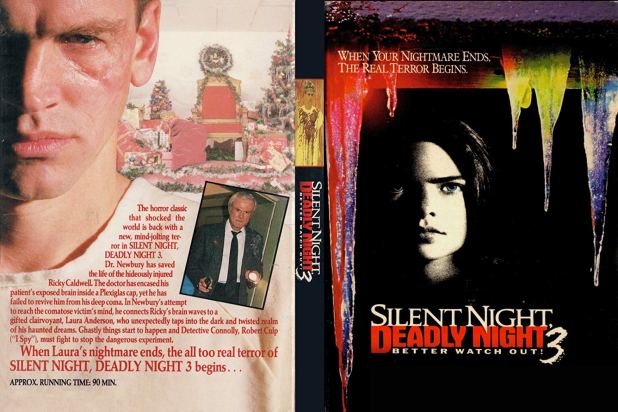
DISMEMBERCEMBER: Silent Night, Deadly Night 3: Better Watch Out! (1989)

EDITOR’S NOTE: This was first on the site on December 24, 2019.

Monte Hellman started his career by directing Roger Corman’s Beast from Haunted Cave before working with Jack Nicholson on the westerns The Shooting and Ride in the Whirlwind, as well as creating the films Two-Lane Blacktop and Cockfighter. He also shot second unit on RoboCop and executive produced Reservoir Dogs.

The original script was thrown out and rewritten in one week, with that rejected version becoming the fourth film in the series. Shooting was completed by the next month and then editing was complete two months after that. This is a down and direty direct-to-VHS rental film, but it isn’t without its charms.

After being shot by police at the end of the previous film — cue the stock footage from Silent Night, Deadly Night — Ricky Caldwell has been in a coma for six years. Now, he has a transparent dome covering his damaged skull and the blood sloshes all around inside his brainpan.

Dr. Newbury (Richard Beymer, Ben Horne from Twin Peaks) is an eccentric doctor who wants to reach Ricky (now played by Bill Moseley!)  by using a blind clairvoyant named Laura Anderson (Samantha Scully, Best of the Best).

Laura hates the experience and decides to quit. She goes home for the holidays to visit her grandmother (Elizabeth Hoffman, Fear No Evil) with her brother (Eric Da Re, Leo Johnson from Twin Peaks) and his girlfriend Jerri (Laura Harring, who played Rita and Camilla Rhodes in Mulholland Drive, as well as being the first hispanic Miss USA).

Meanwhile, a drunk hospital employee dressed as Santa taunts a comatose Ricky, who wakes up and kills the guy. Soon, he’s on a trail of bloody murder all over again, tracked by Newbury and Lieutenant Connely (Robert Culp).

Ricky can see into the mind of our heroine — and vice versa — which means she can tell that he’s probably already taken out grandmother and that her brother, his girl and she are next.

Honestly, this is my favorite of the series so far because it’s sheer madness punctuated by people who have acted in David Lynch movies. I wonder if he used this as an example of who to cast?

You can watch this for free — with ads — on Tubi.

You can also get it on the Vestron Video Silent Night Deadly Night set which you can buy from Diabolik DVD.

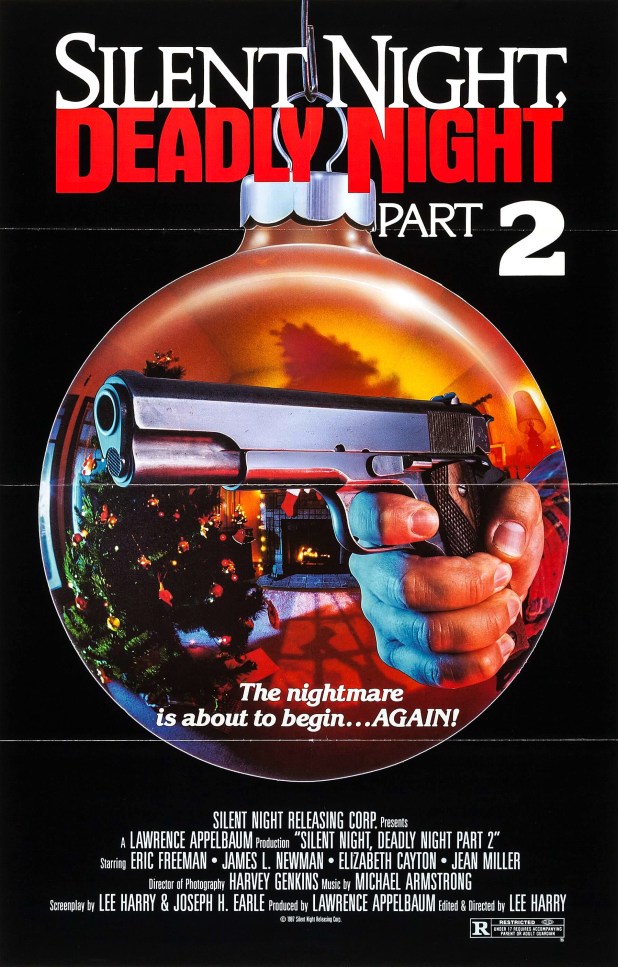
DISMEMBERCEMBER: Silent Night, Deadly Night Part 2 (1987)

EDITOR’S NOTE: Garbage day! This was first on the site on December 24, 2019.

Remember Silent Night, Deadly Night? Well, that movie was a big deal before it was pulled from theaters and then became an even bigger deal on home video. A sequel was demanded and it was delivered, but it was made on a shoestring, with director Lee Harry trying to make something other than a greatest hits reel of the first film. Seriously, though, this movie is nearly the entire first film with a couple of new scenes.

Ricky Caldwell, the 18-year-old brother of Billy from the first movie, is in a mental hospital after a series of murders. He’s being interviewed by psychiatrist Dr. Henry Bloom, which allows us to watch pretty much the entire first film before Ricky goes off on his own rampage.

Ricky did have a chance once, because he fell in love with Jennifer Statson (Elizabeth Kaitan, Savage DawnFriday the 13th Part VII: The New Blood and several of the Vice Academy films). However, her ex-lover Chip sends Ricky over the edge, which ends with Ricky hooking his head up to some jumper cables and then him killing his girlfriend just because. Then he goes even crazier, causing cars to nearly hit him (an incredible stunt) and then yells, “Garbage Day!” and wipes out everyone.

Ricky is captured by the police, but now we flash forward (or back) to the beginning of this film, where he kills the doctor and goes after Mother Superior, whose face now looks like Catholic school lunch pizza. Billy gets stopped, but he isn’t dead. And why should he be? After all, it’s Christmas.

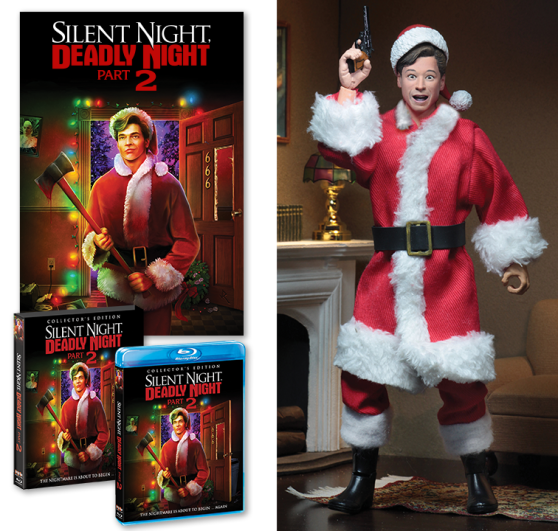
You have so many options to watch this movie with. You can see it for free on Tubi or Amazon Prime. Or watch it with or without commentary from Joe Bob Briggs on Shudder. Finally, you can get the collectors set from Shout Factory, complete with an action figure.

DISMEMBERCEMBER: Silent Night, Deadly Night (1984)

ABOUT THE AUTHOR: Jennifer Upton is an American (non-werewolf) writer/editor in London. She currently works as a freelance ghostwriter of personal memoirs and writes for several blogs on topics as diverse as film history, punk rock, women’s issues, and international politics. For links to her work, please visit https://www.jennuptonwriter.com or send her a Tweet @Jennxldn

We’ve all read about the controversy surrounding the release of Silent Night, Deadly Night (1984.) We’ve all seen VHS news footage of angry moms protesting the film’s original release and re-release in 1985. 

Re-watching the film in 2022 – a world in which we are all free to watch hours of YouTube videos made by mental health professionals – re-frames the film as something quite different. Yes, it’s still an exploitation film filled with boobs, blood and violence. Yes, it’s set on a holiday just like Halloween (1978.) But, at its heart, the film is about the creation of a serial killer. 

A child named Billy who might have had a normal life had he only received the PTSD therapy he so desperately needed following the brutal murder of his parents on Christmas eve in 1971. Instead, the poor kid gets thrown into an orphanage. Worst of all, it’s a Catholic orphanage run by an old-school battle axe of a mother superior who believes that beating Billy’s trauma from his psyche and tying him to his bed is the correct course of action. 

Billy is in no way a bad kid. At 8, he’s polite and respectful. Billy is a kid who, no matter how hard he tries to do good, is perceived as “bad” by the hierarchical establishment who summarily dismiss the concerns of his one ally Sister Margaret. He commits his first murder at age 18 while trying to save his female co-worker from sexual assault. Rather than thanking him, she calls him crazy. That’s the moment Billy’s barely there last frayed mental thread snaps. To quote Hannibal Lecter’s musings, “Our Billy wasn’t born a criminal, Clarice. He was made one through years of systematic abuse.” The sacred is the profane.

Given what we know now about the Catholic Church, I’d say this movie was pretty darned accurate in its depiction of cruelty towards children. In fact, I’d argue the freeze frame of Billy’s terrified face at the end of the 1974 sequence is emblematic of thousands of kids who grew up under the sick and cruel tutelage of Catholicism. Writer/director Charles Sellier was (no surprise) raised Catholic and spent his career producing both secular and faith-based material while bouncing between Catholicism, Mormonism and Evangelical Christianity in his personal life. Knowing these facts, I couldn’t help but feel Sellier was exorcising a few personal demons in the making of this film. 

When Siskel and Ebert named and shamed Sellier on their show back in 1984, they literally doubled down on the “punishment” theme and brought it into the real world. Despite their reputations for being academic-minded film critics, they did so seemingly with no self-awareness, believing their virtuousness to be equal to or greater than the mother superior in the film. Viewed in this light, the film takes on an altogether more important function in the history of exploitation cinema. One whose conception arose from abuse and who mere existence triggered more of the same. It’s a perfect example of how even the sleaziest art can both reflect and influence life. Also, it’s got Linnea Quigley topless in short shorts in cold weather. Merry Christmas! 

DISMEMBERCEMBER: Home for the Holidays (1972)

EDITOR’S NOTE: This holiday giallo was first on the site many years ago, all the way back on December 16, 2017.

Originally airing on November 28, 1972, this ABC-TV movie was produced by Aaron Spelling and debuted on VHS in 1986. It’s packed with future talent and is at the center of what we love most here: TV movies, Christmas movies and horror.

Benjamin Morgan (Walter Brennan, Rio Bravo) is rich and dying and suspects his wife, Elizabeth (Julie Harris, one of America’s most famous stage actresses), of poisoning him. He sends his oldest daughter, Alex (Eleanor Parker, Eye of the Cat) to find her three sisters and bring them home — the first time they’ve been back since their mother’s suicide.

The three sisters are Freddie (Jessica Walter, Arrested Development), Joanna (Jill Haworth, The Brides of Dracula) and Christine (Sally Field, Steel Magnolias). Their father tells them that they must kill their stepmother before she kills them. At dinner that night, Joanna harangues her stepmother with questions about how her first husband died, while Freddie screams in her room about how their father’s affairs led to their mother killing herself.

This is obviously the holiday get-together everyone hoped for.

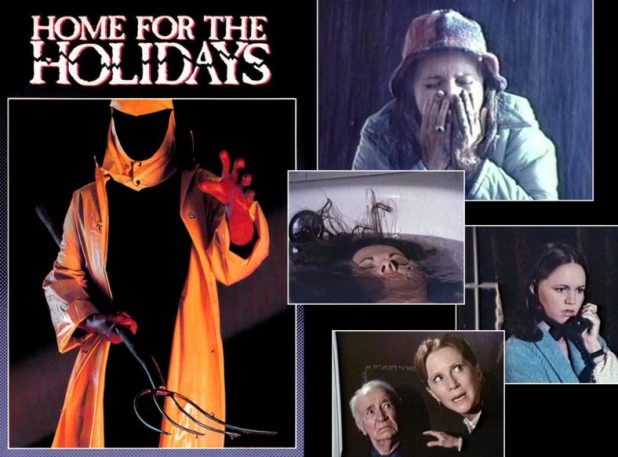
Soon after, Joanna tries to leave but is killed by a pitchfork-wielding person in a yellow raincoat. That same killer also drowns Freddie in the bathtub while Elizabeth keeps offering everyone warmed milk and honey. Soon, the phone line gets cut and everyone is trapped with a killer. But who is it?

There are plenty of twists and turns here, as the love between a father and daughter and the love between husband and wife is contested. It’s bloodless, as it’s a TV movie, but it’s also pretty dark, because the 1970’s were the end of the world and the movies made then reflected it. You also get a cast packed with Oscar winners and nominees, all acting within basically one or two rooms, so there’s plenty of emotion and suspense.

You can watch this on YouTube.

DISMEMBERCEMBER: Black Christmas (1974)

EDITOR’S NOTE: The ultimate Christmas horror movie, this is as good as it gets. It was first on the site on December 20, 2017.

Based on a series of Canadian murders and the urban legend of calls coming to a babysitter from within the house (also see When a Stranger Calls), Bob Clark and A. Roy Moore created what many feel is one of the precursors to the slasher film genre.

Bedford is a small college town, complete with a sorority house filled with victims, err, characters. While they’re celebrating at a holiday party, Jess (Olivia Hussey, who was told by her psychic to do this movie) gets a phone call from “The Moaner,” a crank caller who has been bothering the other sisters: Barb (Margot Kidder, Sisters), Phyllis (Andrea Martin, SCTV) and Clare (Lynne Griffin, Strange Brew). Barb is a real firecracker, provoking the caller, who tells the girls that he will kill them all.

Clare goes upstairs to pack and is suffocated by plastic wrap by an unseen killer and placed on a rocking chair in the attic.

The next day, Clare’s dad comes to take her back home for Christmas. The girls and their housemother, Mrs. MacHenry (Marian Waldman, Phobia), are surprised, as they thought she already went home. While all that is going on, Jess tells her boyfriend Peter (Keir Dullea, 2001: A Space Odyssey) that she is getting an abortion. He argues with her but can’t change her mind.

Meanwhile, the police get involved after learning that another girl, Janice, has gone missing. Jess also tells Chris (Arthur Hindle, Porky’s), Clare’s boyfriend, that something is up.

While everyone else joins police lieutenant Fuller (John Saxon!) to search for the missing girls, Mrs. Mac is killed inside the house. Sadly, her life of hiding booze and yelling at everyone was cut short. As the girls return home, they find Jess’ body and get another obscene call, which she reports to the police, who decide to bug the line so they can trace the calls. Then, Peter sneaks into the house for another argument.

Black Christmas is unafraid of using holiday traditions to allow its killer to get away with murder. While carolers sing outside, Barb’s screams go unheard as she is stabbed to death by a glass unicorn.

Another phone call happens — one that quotes the argument Jess had with Peter. And while that’s occurring, Phyl goes to check on Barb and is killed.

Finally, Jess keeps the obscene caller on the line long enough for a trace, which reveals that the calls are coming from inside the house. She goes upstairs, armed with a fireplace poker, to get the rest of the girls, only to find their dead bodies. The killer chases her into the cellar and when Peter appears outside the window, she assumes that he is the killer and murders him with the poker.

The police arrive to find Jess sitting with Peter’s dead body. They’re convinced that he is the killer, although they can’t find Clare or Mrs. Mac’s bodies. After she is sedated, the cops leave while one officer remains behind to wait for forensics. Then, we hear a voice whisper, “Agnes, it’s me, Billy.” Jess’ phone rings, which means her fate — and who the killer is — will remain a mystery.

One of the most frightening parts of the film are the obscene phone calls, which were performed by Clark and actor Nick Mancuso (Under Siege), who stood on his head while recording to make his voice sound more insane. Mancuso would come back to record a “Billy Commentary” on the film, which is on the recent Scream Factory! release.

Warner Brother studio executives hated the ending and demanding that Clark change the final scene to have Chris appear before Jess and say, “Agnes, don’t tell them what we did” before murdering her. However, Clark stuck to his guns and kept the ending that he believed in. The studio further tinkered with the film, calling it Silent Night, Evil Night in its original release.

When NBC aired the film as Stranger in the House on the January 28, 1978 edition of Saturday Night at the Movies, it gave stations the option of airing Doc Savage, as the Ted Bundy murders had just occurred two weeks earlier.

There’s an urban legend that this was Elvis’ favorite horror movie. It definitely made an impression on Steve Martin, who told Olivia Hussey “Oh my God, Olivia, you were in one of my all-time favorite films” when she was being considered for Roxanne. She thought he meant Romeo and Juliet, but he told her that he meant Black Christmas, claiming that he had seen the film 27 times.

There’s another urban legend — how many can one film have — that says that Halloween was originally intended as a sequel to this movie.

Clark would go on to direct Porky’s and a film that failed at first before becoming a holiday tradition, 1983’s A Christmas Story. Yep — he pretty much made both the happiest and darkest films about the Yuletide, which is pretty awesome.

I love this movie. It’s a true classic that’s unafraid to go against conventions even as it creates them. Nearly every actor and actress in this movie went on to do more and play their roles perfectly here.

You can watch it on Shudder or grab the Scream Factory collectors edition blu-ray!

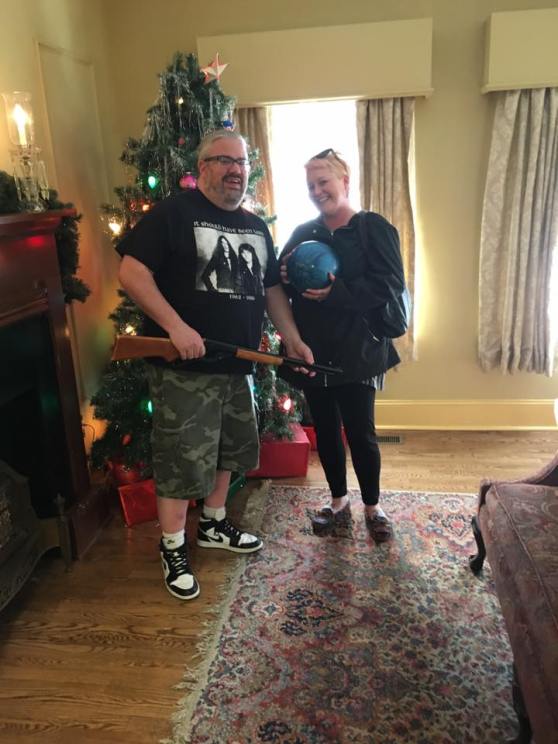
While we often feature dark films here, Becca and I love Clark’s other holiday film, too. Here’s some proof, as we toured Ralphie’s house in Cleveland, OH.

The decoder ring was there and yes, the soap had teeth marks in it.

DISMEMBERCEMBER: It’s A Wonderful Life (1946)

There’s a cut of this that I watched on Tubi and it literally cuts out all of the parts where Clarence (Henry Travers) shows George (James Stewart) what life would be like if he was never born and wow, what a choice. Like, imagine if you never watched this before and that’s the one you saw. Why was this made? Who is it for?

Directed by Frank Capra, who wrote it with Frances Goodrich and Albert Hackett, this movie bombed upon release and started the idea that Capra had lost touch. It didn’t become a classic until 1974 when it became a public domain film — all because of a clerical error — and stations started showing it for free.

It was also a movie that the FBI was worried about, writing a memo that said: “”With regard to the picture It’s A Wonderful Life, redacted stated in substance that the film represented rather obvious attempts to discredit bankers by casting Lionel Barrymore as a scrooge-type so that he would be the most hated man in the picture. This, according to these sources, is a common trick used by Communists. In addition, redacted stated that, in his opinion, this picture deliberately maligned the upper class, attempting to show the people who had money were mean and despicable characters.”

What’s funny is that Mr. Potter gets away with his crime.

This is a classic and seen as a movie that’s a positive holiday movie, yet consider the review of it by Wendell Jamieson in the New York Times who said that it “is a terrifying, asphyxiating story about growing up and relinquishing your dreams, of seeing your father driven to the grave before his time, of living among bitter, small-minded people. It is a story of being trapped, of compromising, of watching others move ahead and away, of becoming so filled with rage that you verbally abuse your children, their teacher, and your oppressively perfect wife.”

I mean, you’re married to Donna Reed, dude.

Capra was shocked that it became a classic. In 1984, he told the Wall Street Journal, “It’s the damnedest thing I’ve ever seen. The film has a life of its own now, and I can look at it like I had nothing to do with it. I’m like a parent whose kid grows up to be President. I’m proud but it’s the kid who did the work. I didn’t even think of it as a Christmas story when I first ran across it. I just liked the idea.”

Watching it again, this movie feels like one that makes so much sense today. You work as hard as you can and you get a review that says meets expectations and yet despite helping everyone else, you are one missed paycheck or one mistake away from losing everything, constantly afraid of letting everyone down which will be worse because you’ve never let anyone down before despite it gnawing at you forever. This movie sticks with me so hard because in that moment that George wonders, drunk on the bridge, if he should dive into the icy waters of death below I had a moment when I realized when my professional life fell to pieces that I would soon be worth more dead than alive that I should turn my car off a bridge so that my wife could get the insurance money and move on and have something more than me staring into nothingness wondering where it all went wrong. I had no angel reading Tom Sawyer to guide me, only several dark nights where I put a time limit of how much longer I could remain alive before I found something valuable to do and when I did, I put everything into it.

Yes, so this may be a maudlin old movie filled with sentimental notions and Capra was worried that he saw so much atheism when he made it but you know, it means something. It’s a supernatural holiday story but at its heart it has something true. These moments of ennui and pain can and will end, even at the time that we are in them that they feel that they are endless. I hope that my story and this holiday will ease these moments from your mind and that you can see that tomorrow will come.

Even Orson Welles said, “There’s no way of hating that movie.”