Golgo 13 (1973)

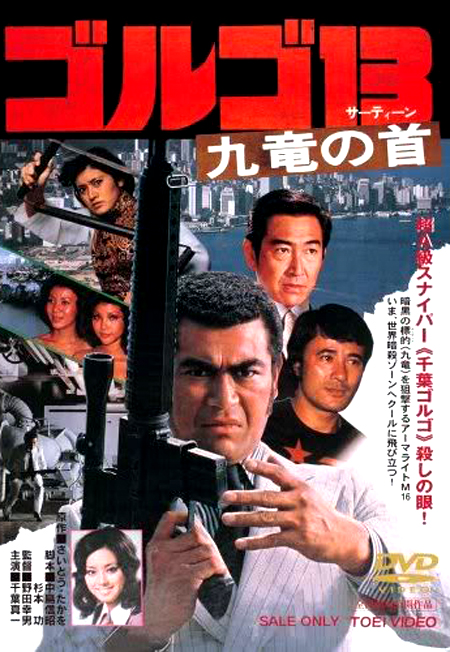
Filmed almost entirely in the Imperial State of Iran, with an almost entirely Persian supporting cast, the first live action adventure of Duke Togo — Golgo 13 — stars Ken Takakura, considered the Clint Eastwood of Japanese film.

The world’s best killer, Golgo 13 has been recruited to kill Max Boa, who leads a worldwide crime syndicate responsible for most of the drugs, weapons and human trafficking everywhere. This takes him to the Middle East and as you may — or may not — know, Golgo 13 never fails an assignment. He also has a samurai code about his assignments, only meeting clients once and only doing one job for them. They must also be honest about why they’ve hired him and no double-crosses will be forgotten or forgiven.

As for his name, it supposedly was his nickname in a West German workcamp that references Golgotha, the skull place on which Jesus Christ was crucified as well as the thirteenth disciple, Judas. His logo has a skeleton wearing a crown of thorns, so that seems to make sense.

For as wild as the series gets, this movie is pretty basic. I mean, it’s solid, but I expect more lunacy out of Golgo 13. Luckily, the anime movies get it exactly right.

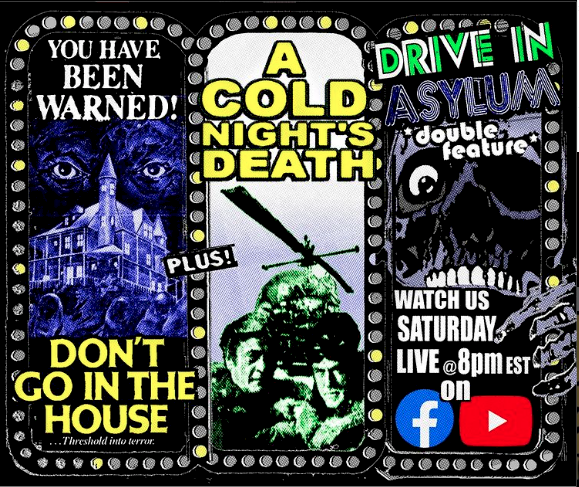
HOT DEATH! COLD DEATH! DOUBLE FEAR ON THE DRIVE-IN ASYLUM DOUBLE FEATURE!

Bill, Gigi Graham and I are all back this Saturday at 8 PM EST on the Groovy Doom Facebook and YouTube pages. And oh man — we’re bringing the wild movies.

Up first is one of those movies they always warned you about, a video nasty that more than lives up to its name, Don’t Go in the House, which you can watch on Tubi.

Every week, we discuss the movies, show an ad gallery for each film and have a themed drink. Here’s the first one for this week:

Burned Alive

  • 1 oz. vanilla vodka
  • 1 oz. Fireball
  • 5 oz. apple juice
  • 1 dash vanilla extract
  • .5 oz. lemon juice
  • 1 shake cinnamon
  1. Mix all of the top five ingredients together in a shaker with ice. Shake it up and pour over ice.
  2. Top with cinnamon to taste.

Up next is the TV movie A Cold Night’s Death, which you can find on YouTube.

A Cold Winter’s Drink

  • 4 oz. pineapple juice
  • 1 oz. rum
  • 1 oz. cream of coconut
  • 1 oz. blue curacao
  1. Shake with ice until super cold and well mixed.
  2. Pour over crushed ice, or maybe even better, some snow in a glass.

See you on Saturday!

Golgo 13: The Professional (1983)

“…”

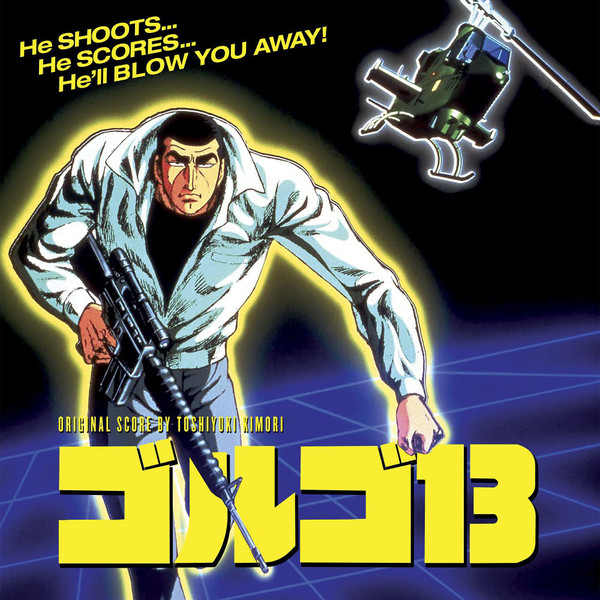
Man, if you were a kid in the 80s, you were lucky if you had Golgo 13: Top Secret Episode for the NES, a game that somehow had sniper rifle murder, conspiracy, bioterrorism and a sex scene that gives you back your energy. How did we get this game?

After two live action attempts* at telling the story of Dick Togo, the world’s greatest killer, Golgo 13: The Professional was made. It isn’t just an animated film. It’s also one of the first animated films to incorporate CGI animation.

After killing Robert Dawson, the son of oil baron Leonard Dawson and the heir of Dawson Enterprises, as well as liquidating a mob boss named Dr. Z, Golgo 13 finds himself hunted by the Pentagon, the FBI and the CIA, as well as Snake, their genetically-enhanced supersoldier named Snake. It seems like he’s finally killed the wrong target, one who has a father who wants him dead.

Dawson is willing to put everyone in his family into the line of fire to kill Golgo 13. He gives Robert’s wife to Snake to use and abuse, while sending his granddaughter Emily and butler Albert to assassinate the killing machine. They fail. He just walks away.

So why isn’t Dawson going after the people who ordered the hit? Is he rich enough to shut down America? And will the government release the terrifying criminals Gold and Silver to kill Golgo 13?

If you’ve never experienced Golgo 13 before, you may wonder, how can a man just keep getting shot, stabbed and beaten over and over again, yet have women throw themselves at him, and he never changes his expression? If you get it, you get it, I guess.

* 1973’s Golgo 13 and 1977’s Golgo 13: Assignment Kowloon. There’s also a sequel to this animated movie, 1987’s Golgo 13: Queen Bee.

You can watch this on Tubi.

Ghost Story: Episode 4 “Bad Connection”

If you’ve watched enough made-for-TV horror, you may have asked, “How long will it be until Karen Black shows up as part of Ghost Story?” Good news. She’s here.

In this episode — written by John McGreevey (The Death of Richie) and horror master Richard Matheson and directed by Walter Doniger, who made a lot of TV but I’m going to celebrate him for writing the Brian Bosworth vehicle Stone Cold — she plays Barbara Sanders, a widow who is just getting used to the idea that her husband died in Vietnam, which is a tremendously edgy thing for a network TV horror anthology to tackle back in 1972.

As she plans to remarry, the phone starts to ring, with her dead husband’s voice on the other side, asking her to remember her promise and telling her that she’ll soon die. Throw in the sound of army boots haunting her at night and you get what you want Karen Black to do: open up those gigantic eyes and just start screaming.

Anyone else would scream loudly and act slightly afraid.

When you hire Karen Black, you get full-on mania, the kind you’re worried will stay with her long after the acting is done.

You can watch this on YouTube.

Dark Water (2002)

ABOUT THE AUTHOR: Jennifer Upton is an American (non-werewolf) writer/editor in London. She currently works as a freelance ghostwriter of personal memoirs and writes for several blogs on topics as diverse as film history, punk rock, women’s issues, and international politics. For links to her work, please visit https://www.jennuptonwriter.com or send her a Tweet @Jennxld

Yoshimi Matsubara (Japanese soap opera star Hitomi Kuroki) is involved in a bitter custody battle with her ex-husband over their 6-year-old daughter Ikuko (Rio Kanno.) While a decision is being made on the matter, Yoshimi and Ikuko move into a run-down apartment building and attempt to build a new life. At first, things seem fine save for the annoying leaky ceiling in the bedroom. As time passes, the leak gets worse and Ikuko starts talking to an imaginary friend named Mitsuko. 

It is soon revealed that Mitsuko (Mirei Oguchi) is the ghost of a missing child who used to live in the apartment upstairs. It appears she has returned to take Ikuko away from Yoshimi who tries to protect her daughter at all costs. 

Mother Yoshimi has some childhood abandonment issues of her own stemming from her own parents’ split. She wants nothing more than to be an excellent mother to Ikuko, and to keep them together. When the story of Mitsuko’s own maternal abandonment comes to light, Yoshimi realizes to her horror that it’s not Ikuko’s company, which Mitsuko desires, but her own. Ikuko is simply in the way. Yoshimi must choose between being Ikuko’s mother and Mitsuko’s. Her decision fulfills the needs of both children.

 Dark Water shares many characteristics of Hideo Nakata’s other hit film Ringu with a better screenplay. Mitsuko is given plenty of backstory within the two-hour running time. She is a tragic and potentially dangerous spirit who serves as a metaphor for Yoshimi’s own inner child. It took Nakata two films to accomplish the same depth of character with Ringu’s Sadako. Also, where Ringu ended on an anticlimactic note with the curse continuing, Dark Water has a satisfying, albeit melancholy, conclusion that takes place ten years after the events. It’s a very cathartic film and will probably have more of an emotional impact on viewers who come from divorced families. Nobody from the golden era of J-horror knows how to build quiet tension the way Nakata does. Through his skill as a director and the convincing performance of lead Hitomi Kuroki, something innocuous as a child’s book bag becomes ominous and terrifying. Sound effects and music play a big part in the chilling mood of the film and the scene where Mitsuko pounds on the inside of the water tank was as effective a use of them as any I’ve ever seen. 

Skip the bland American remake with Jennifer Connelly. Do yourself a favor and see the Arrow Video subtitled DVD instead. It’s an engaging and emotional thriller with a low body count and high intellect. For a dive down the creepy coincidence rabbit hole, watch Joe Berlinger’s Crime Scene: The Vanishing at The Cecil Hotel documentary after Dark Water. The similarities between Mitsuko’s death and the case of Elisa Lam are eerily similar.  

Akai bôkô (1980)

In my experience, performance — whether in a band or as a pro wrestler — is a lot of things you don’t want to do at all. In fact, a good portion of it is the kind of work that you wouldn’t want to do if you were being paid for it. Non-stop practice in the worst of conditions for sets that last ten minutes in places where no one wants to see you perform, but you keep at it, and every few times you reach a level of transcendence that no drug can give you so you keep at it even when everyone thinks you’re dumb for caring so much.

Director Chûsei Sone directed many of Nikkatsu’s Roman Porno movies, which are not porn, but films that revolve around sex to tell narrative stories. His Angel Guts movies are well-regarded and he eventually moved away from the genre and even made a mainstream hit, Flying, before he died.

So while the draw of this movie may seem to be the groupies, the truth is that it’s incredibly realistic as to what it’s like to be in a band. Rehearsals are tense at times. Not everyone gets along. And it feels like it could fall apart and your loved ones would be happier if it did. And then you play a show and you’re high and staring at the lights and you remember being a fat kid in your room trying to do David Lee Roth spin kicks and there you are, the one on the stage, and for at least a few seconds, you’ve made it. You’re living your dream. And then it’s gone.

But at least you had it.

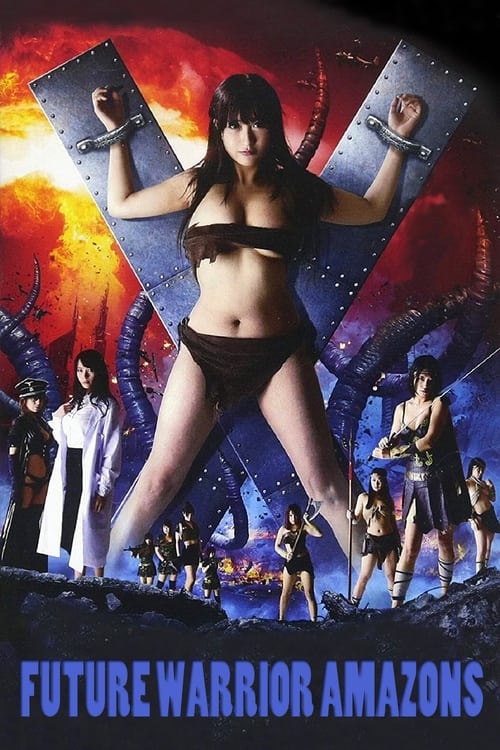
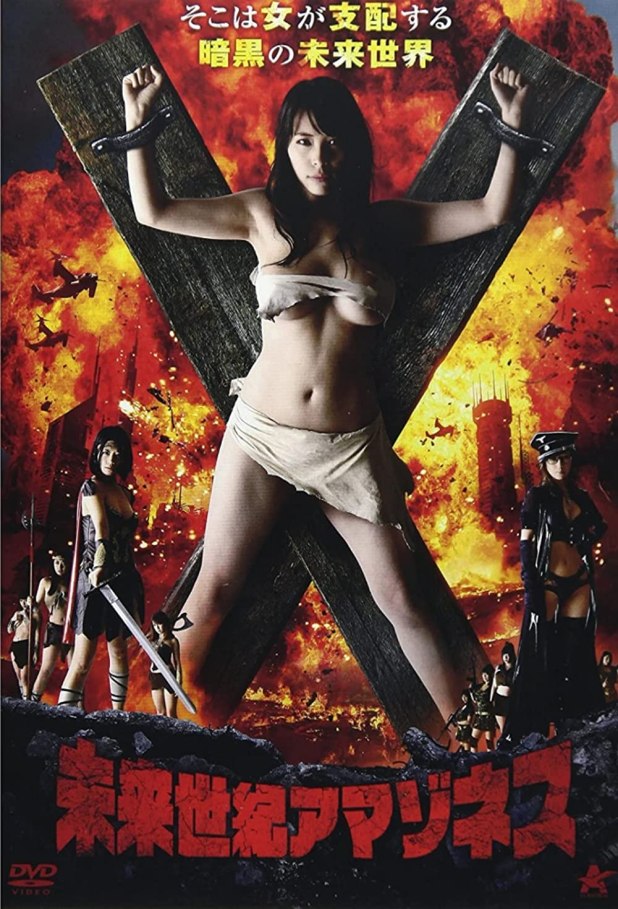
Future Warrior Amazons (2017)

If you thought there was nowhere else to go after Future Century Amazons, oh man, well, there is.

Put on your PPE, galoshes and grab a barf bag, I guess.

Remember how Dr. Maki Amamiya had come to Amazon City to become the new artificial insemination expert? Well, that’s about when a Christian missionary named Kenta is captured while trying to give some of the castrated men of the city a proper burial. For some reason, he’s selected for Amazon City’s new and ultra-secret Male Weaponization Program. He’s dosed with testosterone. which seems against everything this tribe of amazons — let’s call then Future Warrior Amazons –standsd for, so who knows what will happen next?

Also, this movie shows us that the great unwashed of the forbidden zones yearn only to be horrible men and act as you’d expect. Also, tentacles. Also, Alien ripoff monsters. Also, the end of this world.

Also also also: more women removing the testicles of men while dressed in paramilitary costumes.

I’m sure this is someone’s fetish. They probably bought this off the rack at Lawson’s or 7-11 because that’s how Japan does it.

Future Century Amazons (2017)

I think director and writer Naoyuki Tomomatsu has some issues.

I mean, who would make this movie? A film in which radical feminism has caused the downfall of civilization, with the few remaining humans live in various settlements with vast fobidden zones between them filled with mutant creatures, all while the warring female factions battle over their male cattle and remove their bloody scrotums in ritualistic fashion to keep the human race alive? Indeed, who?

Amazon City is one of the large cities left, a place where men are more than a source of, well, balls. They’re also canned and given to the women for food. The Love Liberation Army wants to return to the days when man and woman could lie together and as such, have been killed all of the scientists. But now, Dr. Maki Amamiya has come to bring her science — and her husband — to this strange new world.

Obviously, this movie has next to no budget, but for what it has, it has a cast that throws themselves into its berserk exploitation storyline. Don’t expect any deep thinking on how men and women can fix their relations. Just enjoy the costumes, I guess. Not for long, with this being a modern Pinky Violence movie, after all.

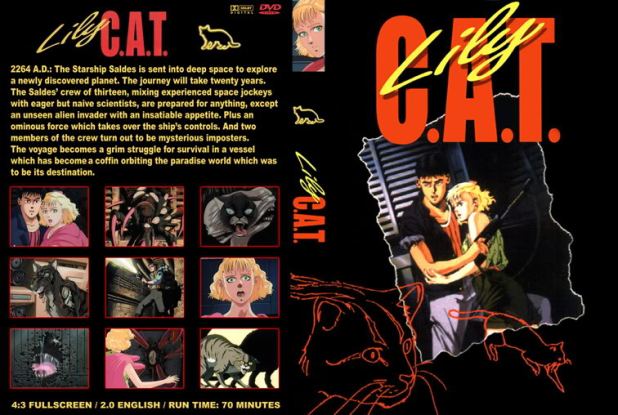
Lily C.A.T. (1987)

Sure, Lily C.A.T. is Alien, but isn’t Alien also Queen of BloodPlanet of the Vampires and It! The Terror from Beyond Space? Hey, what if they throw in some of The Thing too?

The Syncam Corporation is investigating a new planet and has hired the deep-space cruiser Saldes to take a hypersleep trip of 20 years — which will feel like a month for its crew — to see what they can find. At least two of the crew are imposters and one of them is definitely a killer, which gets worse when each dead body disappears, a victim of a super bacteria, while another member of the crew — perhaps one you’d least expect — is something more than they seem.

Director Hisayuki Toriumi directed Gatchaman, the anime that was translated here as Battle of the Planets, while writer Hiroyuki Hoshiyama wrote episodes of The UltramanUrusei yatsura and Mobile Suit Gundam. These shows will not prepare you for how gory this movie is, even in its American version. That’s due to creature designer Yoshitaka Amano, who worked on Gatchaman and Vampire Hunter D.

My favorite part of this is when the captain explains how once you start time jumping, the things you are working for and the people you are making the money for no longer matter and you become forgotten. It’s a shockingly raw and honest moment of pain in the midst of a science fiction gore cartoon.

You can watch this on Tubi.

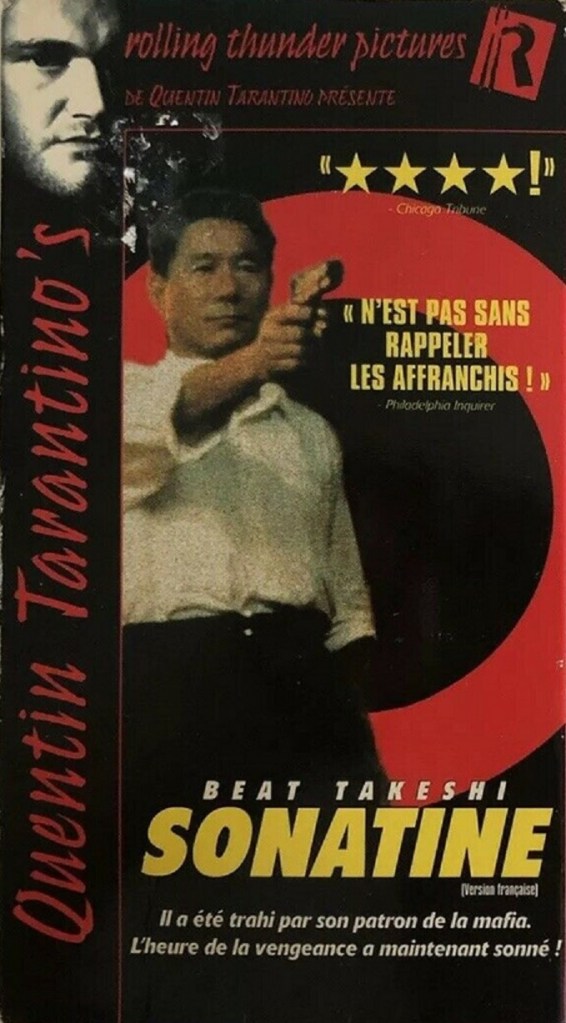
Sonatine (1993)

This Japanese yakuza gangster-noir written, directed and edited by Takeshi Kitano was his response to Martin Scorsese’s Goodfellas. Courtesy of Quentin Tarantino’s fandom, the film found its way to U.S. theater — art house — screens in 1998 via his Rollling Thunder-imprint, which subsequently released it to home video in 2000.

Of Kitano’s 18-film writing-directing career, it remains his best-known international film, although his action-revenge thrillers Violent Crime (1989), which served as his feature film debut, and the follow up, Boiling Point (1990), were sought out by Tarantino fans and came to find an audience on post-’90s home video imprints.

Kitano got his start as an actor in the late ’60s, making his debut in Go, Go, Second Time Virgin (1969), but he’s best known to U.S. audiences in that discipline, courtesy of Senjō no Merī Kurisumasu, aka Merry Christmas, Mr. Lawrence (1983), co-starring David Bowie — Kitano starred as “Sgt. Gengo Hara.” You may also know Kitano for his work as a ruthless yakuza in William Gibson’s Johnny Mnemonic (1995), as well as the imported Battle Royale (2000) and Battle Royale II: Requiem (2003).

As for Sonatine — a play on the musical term sonatina — was a critically appreciated but a commercial failure in its homeland. Its commercial acceptance in the west was courtesy of Tarantino touting the film; it didn’t hurt that America’s leading critic at the time, Roger Ebert, gave it a “thumbs up” and three and a half out of four stars. The film’s failure in Kitano’s homeland is attributed to the fact he was, at the time, primarily known as a television comedic actor.

Kitano stars as Murakawa, a burnt-out yakuza enforcer who discovers his newfound, lackadaisical attitude towards his profession has led to his bosses wanting to get rid of him. As with Scorsese’s gangster opus, Sonatine is a film of not of dumb-down, trite action-driven dialog of no substance, but an introspective intelligence — that revels in its silent moments — that pulls back the reigns on the ultra-violence to use the violence as — to carry through with the musical imagery of the title — punctuating crescendos across its celluloid measures.

This is a film that is disserviced by the usual rat-a-tat-tat reviews scoring every “beat” of the film for you to decide to watch it. It’s a film where you simply need to stream it, sit back, and enjoy Takeshi Kitano’s sonata.

You can watch the trailer and this seven-minute vignette of Quentin Tarantino speaking of the film and the works of Takeshi Kitano on You Tube.

You can stream Sonatine on Amazon Prime and Vudu.

You can learn more about Quentin Tarantino’s Rolling Thunder-imprint with our “The 8 Films of Quentin Tarantino’s Rolling Thunder Pictures” featurette.

About the Author: You can read the music and film reviews of R.D Francis on Medium and learn more about his work on Facebook. He also writes for B&S About Movies (links to a truncated teaser-listing of his reviews).