Fugitive Alien (1986)

EDITOR’S NOTE: R.D already covered this one, but I figured that because we’re doing a week of science fiction movies, why not watch it again?

Fugitive Alien is an example of how strange something is when it’s translated into one language, then translated back into its original language. It’s a Japanese TV series — Space Hero Star Wolf — that was based on an American series of science fiction novels by Edmond Hamilton — The Weapon from Beyond, The Closed Worlds and World of the Starwolves — that were then dubbed and sent back to America as two movies somehow summarizing multiple episodes into an amazingly condensed narrative.

There’s a Star Wolf warrior named Ken — who supposedly comes from the planet Valna Star but was born on Earth — who is attacking our planet at some point in the near future. He doesn’t fully believe in his mission and stops his best friend from killing a human. When his friend dies, he becomes a, well, fugitive alien and joins the crew of the Bacchus 3, which is made up of Dan, Billy, Rocky, Tammy and Captain Joe.

Tammy may be in love with Ken, but he already has a lover named Rita. It just so happens that the friend that he killed was Rita’s sister, so now she’s been ordered by Lord Halkon to avenge her brother’s death. She tries to murder him, but their love is too strong, so of course, she gets killed in moments after that revelation.

If you watch this and it makes no real sense to you, remember how this movie basically played the telephone game with itself. And then realize that one of the writers was Keiichi Abe, who also wrote Time of the Apes.

This movie appeared in the UHF era Mystery Science Theater 3000 and the Comedy Central episodes, too. You can watch the latter on Tubi.
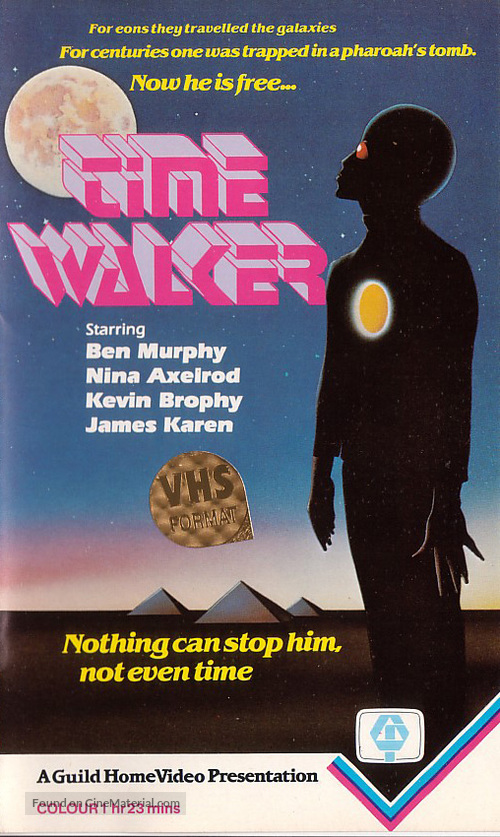
Time Walker (1982)

Also known as Being from Another Planet, this is a movie I have tried to finish so many times, pushing myself to the kind of hard-to-watch film brink. I’m happy to report that after several years, I have finally completed this movie and can share the results with all of you.

California University of the Sciences professor Douglas McCadden (Ben Murphy, the Gemini Man!) is exploring the tomb of Tutankhamun when an earthquake causes a wall to fall down, revealing a mummy that is really an alien kept alive through suspended animation thanks to being covered with a green fungus.

Dr. Ken Melrose (Austin Stoker!) calls a press conference to reveal the mummy, but at some point student named Peter Sharpe (Kevin Brophy, who was in Lucan, so this is really a collection of people who were in failed science fiction shows of the 70s that really only I care about) steals some gems from the body, which keeps getting bathed in radiation, bringing it back to life.

The mummy — who is way faster than your normal wrapped up Egyptian in rags — ends up killing anyone who has the crystals, putting a cop named Lt. Plummer (Darwin Joston, so this movie is also an Assault on Precinct 13 reunion thanks to him and Stoker appearing) on the case.  He thinks it’s a serial killer, but the truth is that the mummy was worshipped like a god and needs the crystals to go back home.

This movie also has James Karen from Return of the Living Dead and Shari Belafonte, who certainly knew that she deserved much better.

Time Walker was produced by Dimitri Villard and Jason Williams. If you recognize that last name, it’s because Williams plated Flesh Gordon. He co-wrote this movie (he also scripted The Danger ZoneDanger Zone II: Reaper’s RevengeDanger Zone III: Steel Horse War and Nude Bowling Party, which certainly needed some level of wordsmithing) with Tom Friedman and Karen Levitt. It’s director, Tom Kennedy, edited Silent Night, Bloody Night and the American release of Goodbye Uncle Tom. This was the only movie he ever directed.

There’s a “to be continued” at the end of this movie and I have to tell you, I’ve never been so excited that a sequel wasn’t made.

I’ll forgive Film Ventures International nearly anything, though. Even Time Walker.

You can watch this on Tubi.

Undergods (2020)

In a future world, a series of stories tells the narrative of a world just about ready to die. Whether its soldiers like K (Johann Myers) and Z (Géza Röhrig) seeking meat to survive or children going missing, this is a world much worse than our own, were that possible. Welcome to the time of Undergods.

This film gets a lot of mileage out of its bleak cityscapes of Serbia and Estonia, the synths of Wojciech Golczewski and a constantly shifting narrative. It doesn’t really all add up, but it does point to writer and director Chino Moya being a formidable talent.

The stories that are told — a married couple is split by a neighbor who never wants to leave, a businessman screws over a stranger who ruins his life and a woman’s first husband returns to ruin her life even further  — could take place at any time. The fact that they take place in a world that may one day be our own has a certain dark charm to it.

You can watch Undergods on demand from Gravitas Ventures.

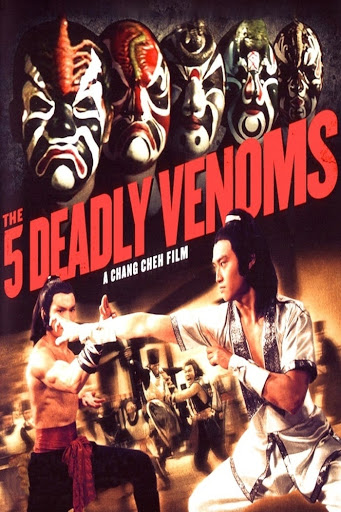
Five Deadly Venoms (1978)

The Venom Mob had been in Shaw Brothers movies before, but this was the film where they showed the world that they were amongst the greatest theatrical martial artists of all time.

As the master of the Poison Clan dies, he sends his last student Yang Tieh (Chiang Sheng) to warn Yun (Ku Feng) that five of his students — Gao “Scorpion” Ji, Meng “Lizard” Tianxia, Liang “Toad” Shen, Qi “Snake” Dong and Zhang “Centipede” Yiaotian — plan on stealing the clan’s gold. Yang must fight them all or join with the ones still loyal to the clan to fulfill his dying teacher’s final request.

What follows is a series of double crosses — and triple crosses even — as the students of the Poison Clan battle to either keep the money for themselves or save it for the good of the clan. Because Yang Tieh knows a small bit of each of their five styles, he may have a chance to live. Yet who, if anyone, will be the ally he needs to win?

Chang Cheh made more than ninety films, among them the One-Armed Swordsman series, Crippled AvengersKid with the Golden Arm and many more. His style of heroic bloodshed films has influenced everyone from John Woo to Robert Rodriguez and Quentin Tarantino.

Her Name Is Cat (1998)

Cat (Almen Wong) is a professional killer falling in love with a policeman named John (Michael Wong). John feels torn between his job, his ex-wife and child, and Cat, whose life is anything but simple.

Clarence Fok, who also made Naked Killer, directed this and to be perfectly frank, he’s making his version of The Killer, but featuring Almen Wong looking stylish as she kills everyone in her way. Also — one of the kills is totally ripped off from The Omen.

You may look at this poster and wonder, “Why is this scene not in the movie?” This is how movie posters should work, creating something that you need to watch just to see that image come to life.

Like kaiju movies, this film has really boring moments of human interaction that serve only to give you time to rest in-between moments of stylized violence. Less people, more bullets, I always exclaim.

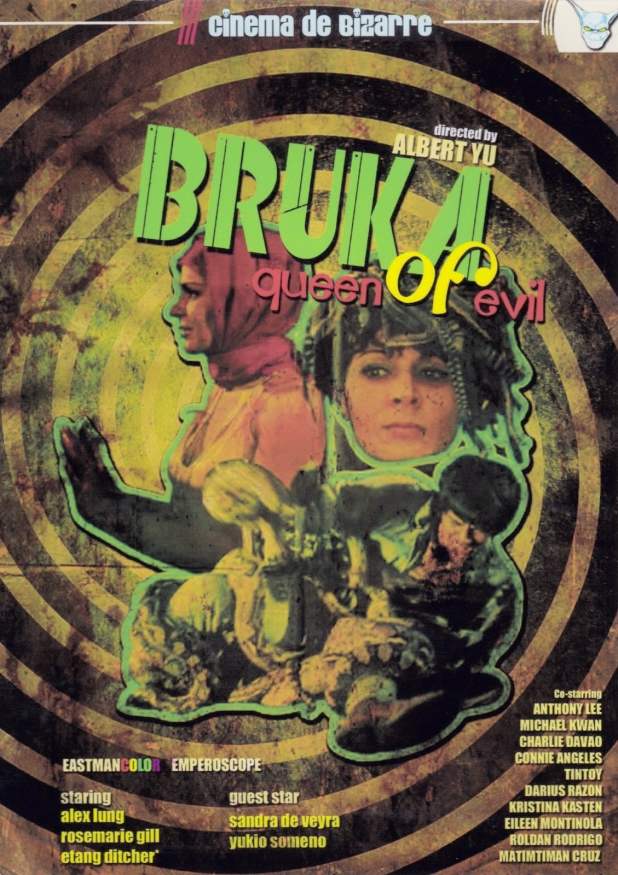
Bruka: Queen of Evil (1973)

When Hong Kong and the Philippines team up, things will not be normal.

In Devi Woman, a young orphan returns from her parents’ grave and, oh yeah, she just so happens to have hair like Medusa, long flowing snake locks. She falls down a hillside, which is kind of a good thing for her, as she soon meets a sorceress with the body of a snake and the face of an old woman. She reveals that she is the girl’s ancestor and pledges to make Manda into a Queen of Evil.

Well, at the end of that movie, she was set on fire and died, but in this movie — a sequel that many felt was just a remix of the original for a long time — her witch grandmother brings her back from the dead. But more than that, she also gives her the power to call snakes to her side, an empress with power over bat people, demons, stone men, living trees and so much more.

To keep on being the Queen of Evil, Manda must destroy virgin women, which brings martial artist Shu Wen to the rescue.

Both of these films were inspired by the Filipino comic Darna, which was written by Mars Ravelo and drawn by Nestor Redondo. One of Darna’s villains is her former friend Valentina, who becomes the snake-haired Serpina.

Yeah, this movie is absolutely wonderful.

You can watch the first film on Tubi and the sequel on YouTube:

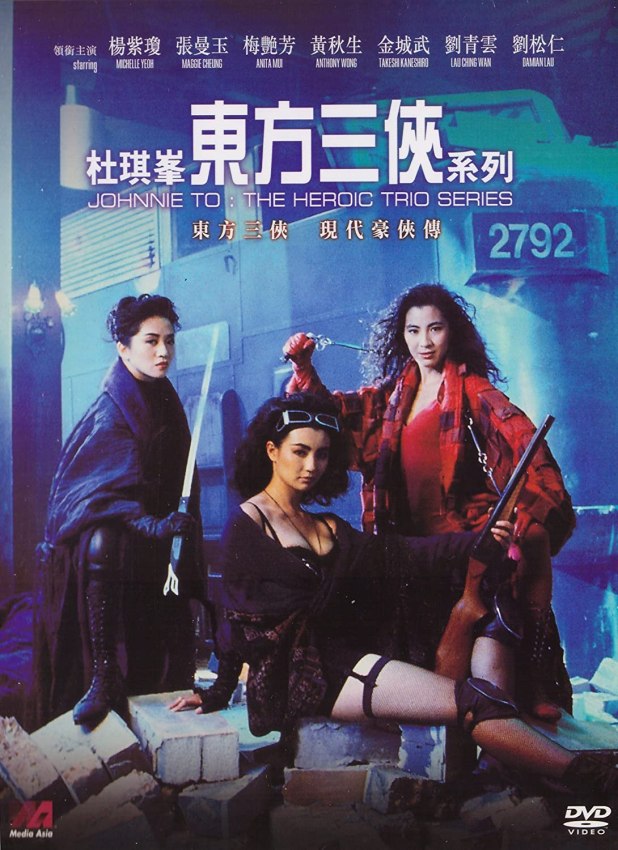
The Heroic Trio (1993)

An invisible woman — actually, Invisible Woman as played by Michelle Yeoh — is stealing newborn children who are destined to be world leaders for her boss, the Evil Master. He needs to be stopped, but Invisible Woman owes him her life after leaving behind an abusive father. Luckily, she has two other heroes to push her to the path of righteousness — Wonder Woman (Anita Mui), who is the mild-manner wife of a cop by day and a sword and knife-wielding heroine by night and Thief Catcher (Maggie Cheung), a motorcycle-riding, bomb-throwing mercenary struggling to also find her good side.

It was produced by Ching Siu-tung (who directed A Chinese Ghost Story) and directed by Johnnie To, who also directed its thematically different sequel, Executioners.

Let me be clear: this movie is a unique blend of monstrous bad guys, unstoppable women, and kinetic martial arts. It’s a perfect mix of style and substance, which is exactly what I’m looking for in a film.

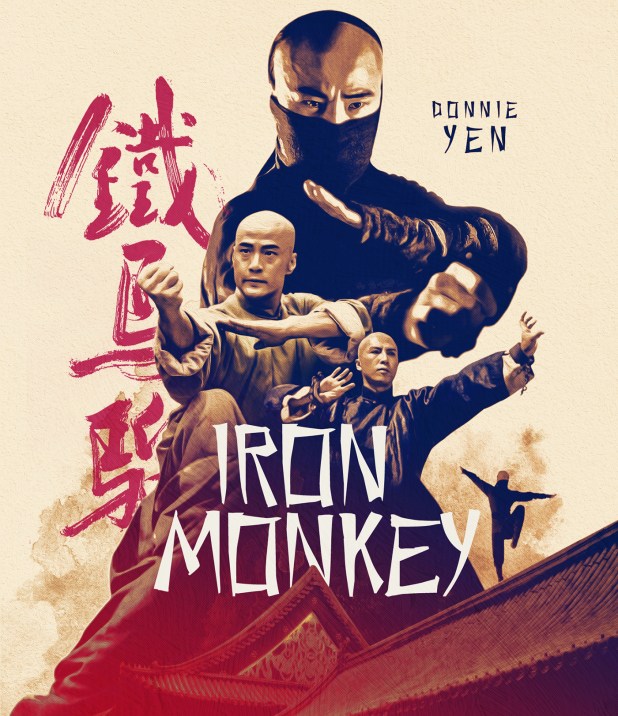
Iron Monkey (1993 HK/2001 U.S.)

ABOUT THE AUTHOR: Jennifer Upton is an American (non-werewolf) writer/editor in London. She currently works as a ghostwriter of personal memoirs for Story Terrace London and writes for several blogs on topics as diverse as film history, punk rock, women’s issues, and international politics. For links to her work, please visit https://www.jennuptonwriter.com or send her a Tweet @Jennxldn

I saw Iron Monkey for the first time during its 2001 U.S. release.

Settling into my seat, I knew relatively nothing about it other than it was considered a modern classic Kung Fu film. When I realized it was about young Wong Fei Hung it was like opening a surprise gift. Being a big fan of Once Upon a Time in China with Jet Li and being familiar with the long, rich cinematic history of the character in HK movies made Iron Monkey even more enjoyable than it would have been otherwise.

I patiently waited for the Wong Fei Hung theme music to kick in. When it never did, I realized it was because the film had been re-scored for the American release. The cinematic equivalent of watching a James Bond film without the classic theme. That being said, the music in this version was actually pretty good when compared with some of the criminal hack jobs Miramax perpetrated on to other Asian films in the ‘90s. Quentin Tarantino’s name in the credits no doubt had something to do with the overall respect shown here. That it was given a wide release in North America with subtitles is a glorious thing.

Iron Monkey tells the story of a Dr. (Yu Rong Guang) who dons a mask during his off-time to steal riches from corrupt village officials and give the money to the poor. When a pre-teen Wong Fei Hung (played in the grand Cantonese tradition by a female – Angie Tsang) and his legendary father Wong Kai-Ying (Donnie Yen) come to town, it makes for one of the best Kung Fu movies I’ve ever seen. Each fight is better than the last and the final battle, which takes place mostly on top of wooden poles over a burning fire is truly a thing of beauty. Younger audiences will be familiar with Donnie’s amazing fighting techniques from Rogue One: A Star Wars Story. The equally talented Yen Shi-Kwan (Iron Robe Yim from OUATIC) plays the main baddie.

Every time I read a discussion centered on this film, everyone always goes on and on about Yuen Woo-Ping. He is indeed a brilliant artist. However, I feel just as much of the credit for the success of Iron Monkey should go to Producer/Writer Tsui Hark. I have viewed other films from roughly the same time period of both men and have to say that I have consistently enjoyed Tsui Hark’s body of work more than Yuen Woo-Ping’s. Iron Monkey is a great collaboration and should be viewed by all who are even the slightest bit curious about Kung Fu films.

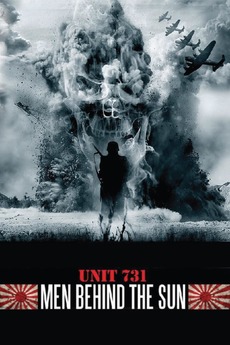
Men Behind the Sun (1988)

Man, when Hong Kong filmmakers make a video nasty in no way do they fuck around.

The first category III rated film in Hong Kong, this movie sets out to document the World War II atrocities committed by the Japanese at Unit 731, the secret biological weapons experimentation unit of the Imperial Japanese Army during World War II.

Of course, by proclaiming this as educational, it’s equally about watching Chinese and Siberian prisoners being horribly tortured and killed.

Director Mou Tun-fei went to a film school that had so little money that its graduates could only learn from watching and never getting to make their own movies. The style of his early work is based on the Italian neorealist movement and while he made numerous movies for Shaw Brothers*, he was the first Taiwanese director to make movies on the mainland. After this film — he was working on a children’s kung fu movie when the idea came to him — Tun-Fei would make two more movies, the pornographic Trilogy of Lust and the sequel to this movie, Black Sun: The Nanking Massacre.

The main goal of the facility is to learn how to weaponize the bubonic play and destroy China. Somehow, this also means capturing children and operating on their organs while they’re still alive and freezing the hands of people and shattering them with hammers. There’s also a harrowing scene where a cat is attacked by rats and then prisoners are crucified and a flea bomb is meant to be dropped on them before they escape and are run down.

If that doesn’t bother you enough, the effects in this movie include the corpse of a child and the arms of another corpse, this time held by the director’s niece, the only actress brave enough to stand in the cold holding the arms of a dead man.

This is the kind of movie that I don’t think I could make it through again, but for the sake of the sight, my need to see every infamous movie and just plain morbid curiosity, I made it.

*His 1980 film for the studio, Lost Souls, has been compared to Pasolini’s Salò.

Threshold (2020)

After years of no contact, a phone call reconnects Leo (Joey Millin) with his sister Virginia (Madison West). Their estrangement comes from her years of drug abuse and when he finds her, she’s seemingly going through an overdose. However, she tells him that she’s been clean for eight months thanks to a mysterious group that has revealed themselves to be a cult. Worse, they have tied her emotions and feelings to a dark man that she has never met. She begs Leo to help her find him. She agrees that if her story is not true, she will finally go to rehab. Yet in the midst of this emotionally charged time, Leo starts to realize that Virginia may be finally telling the truth.

Threshold was improvised and shot on two iPhones over the course of a 12-day road trip with a crew of just three. It’s the second movie by co-directors Powell Robinson, Patrick R. Young and producer Lauren Bates. It’s not a traditional horror film, but builds to dense and dark ending. And hey — it’s 78 minutes, which is pretty much the perfect length.

You can watch Threshold on Arrow’s online service. Beyond this film, the Arrow online service also offers many of this boutique label’s latest releases, with everything from Asian cinema to westerns, giallo and horror.

Arrow is available in the US, Canada and the UK on the following Apps/devices: Roku (all Roku sticks, boxes, devices, etc), Apple TV & iOS devices, Android TV and mobile devices , Fire TV (all Amazon Fire TV Sticks, boxes, etc) and on all web browsers at https://www.arrow-player.com. Subscriptions are available for $4.99 monthly or $49.99 yearly. You can start with a 30-day free trial.