Hackers (1995)

Before we begin discussing Hackers, perhaps the most 90’s movie of all time next to Singles, let’s apply our version of the Turning test to it to see if we can consider Hackers a true cyber punk film.

Does it have the title of a Philip K. Dick book but not really have much to do with it?

Nope. This is grounded in the world of phreaks and hackers, as best seen in real life in the documentary Hackers: The History of Hacking.

Is there a lot of rain?

Not so much.

Does the male hero wear dress clothes and/or a trenchcoat?

Oh man, everyone wears a trenchcoat at one time or another, as well as having their own very distinct style of uniform. It’s kind of like The Warriors on a much, much smaller scale.

Do Keanu Reeves, Ben Affleck, Dolph Lundgren or Udo Keir appear in it?

No, but man, I sure wish they did.

Does the internet do something it can’t do yet, yet look dated AF?

That’s this entire movie. Seriously, a lot of the internet appears as if it lives in the characters’ heads as clips from old movies and TV shows, as if this were Dream On (an ancient HBO reference I realize is going over the heads of way too many of our readers). Also: there’s a scene where the Internet is used to turn off a Wally George-style show (I was born in 1972, people) and a videotape of The Outer Limits plays in its place. Low tech in the service of high tech.

Are Stabbing Westward, KMFDM, Ministry or God Lives Underwater on the soundtrack?

This movie didn’t just have one soundtrack, it had three different releases. The first has Carl Cox, Machines of Loving Grace, Leftfield, Underworld and Orbital on it. The second has The Orb, David Bowie, BT and Moby. And the third has those artists plus Fluke and John Lydon. Even better, Simon Boswell, who did the music for Stage Fright and Phenomena, amongst others, did the score.

Is it a crappy version of Blade Runner?

Nope. There is a William Gibson reference, which I may need to add to the test.

Are there numerous Asian-influenced scenes?

Surprisingly, no.

Do people use future terms that make no sense?

Throughout.

Are there a lot of whirring sound effects?

Of course they do.

Do people stare at the camera as it moves through a neon-lit strip club?

Yes, it has a party scene that is so opulent that you wonder, “How can these be teenagers?”

Are there rock stars in it?

Yes! Marc Anthony plays an FBI agent. One could argue that Angelina Jolie is beyond a rock star if you want to get technical.

Is there a feral child?

I’d argue that every single one of the Hackers is a feral child.

By following the rules of this text, as designed by our team of engineers here — me, basically — the ruling is that Hackers is not post-apocalyptic (barring a Tenebre-level in the director’s head twist) nor is it cyberpunk. It is, however, an ancient future film and one that had my wife wondering, “Was this what the nineties were like?” She was born in 1984 and I have to confess to you, dear reader, that my 90’s were spent in college and working eighty-plus hour a week advertising jobs.

I told her, “This is what it was like all the time.”

Back in August of 1988, a hacker named Zero Cool used his 1200 baud modem to crash 1,500 computer systems and cause a seven-point drop in the NYSE. It turns out that said hacker was really eleven-year-old Dade Murphy, who is banned from all computers and touch-tone phones — how would he call 911? — until he turns eighteen.

Literally the day he turns legal, Dade becomes Crash Override and pulls off that VHS switcheroo we discussed above. He’s met and countered by another hacker named Acid Burn, who kicks him out. Oh yeah — and he’s also played by Johnny Lee Miller now.

He has a new school and has to fit in. Magically, this school has an entire roster of hackers who all follow the Hacker Manifesto.

“This is our world now… the world of the electron and the switch. We exist without skin color, without nationality, without religious bias… and you call us criminals. Yes, I am a criminal. My crime is that of curiosity.”

They are:

Ramon “The Phantom Phreak” Sanchez: Able to get into any phone system, he’s played by Renoly Santiago from Dangerous Minds and Con Air.

Emmanuel “Cereal Killer” Goldstein: Matthew Lillard is this guy, who seemingly dresses as if he was inside the Matrix four years before that movie ever got made. He’s also edgy and wears dresses because he’s a hacker and hackers do whatever they want. Lillard was also 25 when this was made, making him the oldest of the high school hackers.

Paul “Lord Nikon” Cook: Given this name because he has a photographic memory, this hacker is played by Laurence Mason.

Joey Pardella: Played by Jesse Bradford, he’s the youngest member of the group and has not yet earned his hacker code name (when I went to my first hackathon, they have us all printed name badges that many of us covered up with electric tape so no one could tie our faces in to our handles; I was 14 and my parents dropped me off. I was the youngest person there by several decades).

Kate “Acid Burn” Libby: Pretty much considered the greatest hacker around, she’s the frenemy of our lead and a rich girl who throws indulgent parties. She’s also Angelina Jolie and coming into her peak of power here. This part was originally going to be played by Katherine Heigl, who did the second Under Siege movie instead.

Crash Override has to prove himself to his new hacker buddies, so he breaks into “The Gibson” — yay cyberpunk reference —  the supercomputer that runs the Ellingson Mineral Company. While downloading a garbage file as proof, his mother — who is convinced he’s back to his evil hacking ways — unplugs the computer.

This brings him to the attention of sell-out hacker turned computer security officer Eugene “The Plague” Belford (Fisher Stevens, which when you think about it is amazing casting, as just eight years earlier he was playing the hero version of the hacker role in Short Circuit; Johnny Five would not be pleased by this turn of events). Yes, he is pulling off the Richard Pryor Superman III scam that would one day become the Office Space scam.

It turns out that the file our hero has downloaded isn’t garbage. It’s a virus that will destroy a fleet of oil tankers that The Plague plans on taking advantage of and blaming hackers. He brings in the Secret Service to go after our heroes, who have to use their powers of typing, logging on and pranking people to win the day.

There’s also an internet TV show called “Hack the Planet” that for some reason has no buffering issues, which remain a problem in 2021 much less in 1995 when this was made.

Also — how about getting Lorraine Bracco as our hero’s mom, Felicity Huffman as an attorney and Penn Jilette as Hal, an IT guy who gets no nickname? Plus, that bearded London-based hacker? That’s David A. Stewart of Eurythmics!

This is my favorite fact about this movie: “The cast spent three weeks getting to know each other and learning how to type and rollerblade.” Yes, rollerblading is an essential part of the plot!

Director Ian Softly — who also made Backbeat — would go on to direct K-PAX, a movie in which Kevin Spacey eats a banana skin and all.

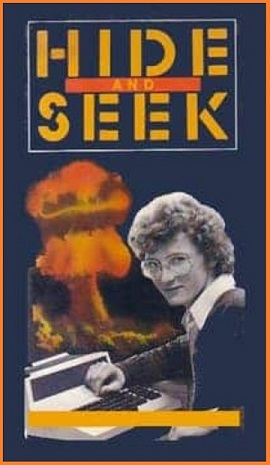
Hide and Seek (1984)

Hide and Seek is a Canadian-made, CBC-TV adaptation of Thomas Joseph Ryan’s novel The Adolescence of P-1; the book’s first edition was released in Canada in 1977. In a tale that’s somewhat similar to Colossus, the 1966 novel by Dennis Feltham Jones that served as the basis for Universal Studios’ Colossus: The Forbin Project (1970), Ryan’s novel also features a sentient artificial intelligence that goes rogue, taking over other computers as a form of survival. The novel is noted as one of the first fictional depictions of computer viruses.

Colossus, Joshua, and P-1! Oh, my!

In the novel, which begins in 1974, Gregory Burgess, the story’s protagonist-hacker, is a liberal arts major enrolled at the University of Waterloo. When he discovers the school’s IBM System/360 mainframe for the first time, he changes his major to computer science; he becomes obsessed with using A.I. protocols to crack other systems.

In this adaption that appeared as part of the daytime, young adult anthology series For the Record, the story is reset in a Toronto high school and Gregory is now a high school computer whiz, nicknamed “Hacker” by his friends, who develops P-1, a computer program that becomes self-aware; as P-1 begins taking over other systems to expand its consciousness, it logs onto the mainframe of a nuclear power plant, with plans to use it as a weapon to subjugate man.

TRS-80s and Commodore 64s rule!

Many sci-fi fans have made the point that Hide and Seek is a “ripoff” of the better know WarGames (1983), which is a disservice to this well-produced CBC effort. The genesis of the MGM/UA film began in 1979 with The Genius by screenwriters Walter F. Parkes and Lawrence Lasker. So while Ryan’s 1977 novel came first, the initiation of the CBC-TV production was obviously inspired the success of the MGM/UA film, but certainly not a ripoff. (Parkes and Lasker would go on to write another “ancient future” caper, 1992’s Sneakers.)

Back in 1975, Gerry Anderson, between the first and second seasons of Space: 1999, produced a British-Canadian TV pilot movie, The Day After Tomorrow, which was imported to U.S. television that same year as part of NBC-TV’s late-afternoon weekday programming block, Special Treat, under the title, Into Infinity (trailer). While Hide and Seek doesn’t have that installment’s production values, considering it was, itself, a daytime public television production, it would have been a perfect fit for a U.S. rebroadcast as part of the analogous “Big Three” network’s ABC’s Afterschool Special and CBS’s Schoolbreak. Why the CBC failed to license Hide and Seek for a U.S. rebroadcast — especially in the wake of WarGames and the fact that all three U.S. anthology series were still on the air — is unknown. It did, however, become part of U.S. PBS-TV’s WonderWorks programming block that adapted hour-long movies from children’s books from 1984 to 1992; as result of its “for children” stigma, the many tweens and teens for which Hide and Seek was intended, bypassed the programming (but it was my first exposure to the film).

If you’re a fan of (and, most importantly, appreciate the production values of), PBS-TV’s late-’70s rebroadcasts of BBC-TV’s Dr. Who (The Tom Baker years! Davaros!) and remember the 1980 public television production of Ursula K. LeGuin’s A Lathe of Heaven (starring Bruce “Willard” Davison), then you’ll enjoy watching the intelligence behind Hide and Seek — in spite of its budgetary restraints and dated material. When it comes to “ancient future” flicks regarding the dangers and horrors of computers, this one’s well worth your time.

If you haven ‘t guessed, we’re big fans of the U.S. “Big Three” network’s daytime TV movies for young adults, so be sure to check out these reviews:

ABC Afterschool Special: The Amazing Cosmic Awareness of Duffy Moon
ABC Afterschool Special: Blind Sunday
ABC Afterschool Special: Hewitt’s Just Different
CBS Schoolbreak Special: Portrait of a Teenage Shoplifter
NBC Special Treat: New York City to Far From Tampa Bay Blues

As for Hide and Seek, you can watch it on You Tube. And be sure to check out our other “ancient future” film reviews all this week.

About the Author: You can learn more about the writings of R.D Francis on Facebook. He also writes for B&S About Movies and publish music reviews and short stories on Medium.

Interface (1984)

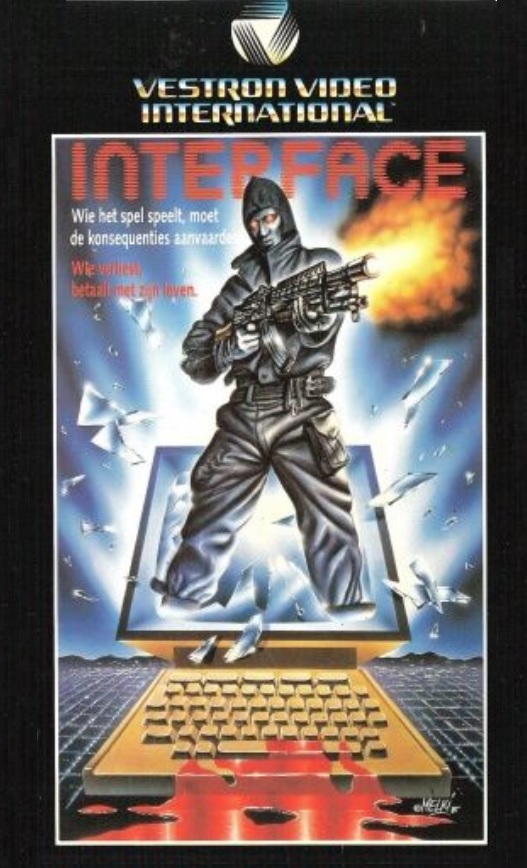
Interface takes me back to the days of those “Big Box” in-a-plastic-tray oddball obscurities of yore that one happened upon a couple-of-years-after-the-fact of its release courtesy of one’s obsession (moi) of exploring the breathing-their-last-breath mom n’ pop video stores in the nooks ‘n crannies of strip malls. Just one look at that Pinhead-esque (Hellraiser didn’t come out until 1986!) villain peppered with wires . . . well, an early ’90s rescuing of this Vestron Video-imprint from the $1.00 cut-out rack was a non-brainer.

The cover I remember — and had — only it had a Vestron logo/courtesy of IMDb.

Speaking of brains: Creatively — in terms of the concepts running through its Pons connector — Interface is an SOV-styled cyberpunker with Cerebrum and Cerebellum to spare. In terms of everything else: it’s a decent could-have-been-a-concept-to-an-award-winning short that, with the proper execution of the film disciplines, could be a revered, cyberpunk-version of Equinox, THX-1138, and Dark Star — three analogous student short films so impressive, additional funding was provided to the projects for expansion into feature films.

Instead, with Interface, we ended up with a very special, but not-very-good, but still cool to watch-for-the-ideas “ancient future” (before the Wachowski’s The Matrix in 1999!) obviously influenced by David Cronenberg’s “body horror” classic Videodrome and John Badham’s cyber-forefather WarGames. If writer-director Andy Anderson (in his debut effort) had been a-few-more-years Tinseltown advanced in his career with A-List representation — and not a University of Texas at Arlington film student at the mercy of volunteer acting and film students — and made a “David Cronenberg’s Videodrome meets John Badham’s WarGames” meeting pitch — in conjunction with his villainous concept art and the tagline: “It’s not just another fantasy game. These players are serious . . . dead serious,” we’d be discussing a film that Variety proclaimed “. . . is an all-new, groundbreaking feature film from Andy Anderson, a new voice in sci-fi.”

Sure, Interface is notable for providing Lou Diamond Phillips his first film role (as Punk #1 in the film’s opening scenes) among an inexperienced University of Texas-student cast, and while seeing Lou in his debut may pique your interest, there’s a lot more, very special moments — in spite of the strained acting and ill-timed comedic moments — that makes this early cyberpunker worthy of a watch.

Art department for the win! Now that’s a rental-inspiring VHS sleeve!/courtesy of Rosalio Noriega Pinterest via movieposterdb.com.

As you can see from the two, embedded clips below, Anderson was way ahead of the cyber-curve — with women making-out with TV sets before Cronenberg thought of the idea. And we love, based on the voice-synthesizer preferred form of commutation by the members of the Circle, that Anderson’s a fan of the pinnacle of ’70s Frankenstein-as-a-computer flicks: Colossus: The Forbin Project — okay, maybe it’s more of an ’80s MTV-video voice-synth-thing, but we still dig it! Domo arigato, Mr. Roboto!

And yes, these clips are washed-out and muddy — the same goes for the full-length upload we’ve found. But that’s not ineptitude: the image is the result of multiple VHS rental-replays. The film is, to be honest, well-framed with solid camerawork. And kudos to Chief Production Designer Betty Burkhart (who also stars as the cyberbandit Futrista) for the obviously-up-against-the-budget art design.

These clips — HERE and HERE — give you a tease of the story: Upon the murder of his prized student and teaching aid — who’s running an on-the-sly computer scam — computer professor Dr. Rex Hobson and his students discover (Before there was a “dark web”!) the Circle of Logic (an actual circle of TRS-80s and Commodore 64s — complete with wireframe vector graphics), a vigilante computer cult comprised of masked members who go by the names Xardon, Manborn, Olympius, Eveton, Futrista, Orion, and Modem — and worship the “Master Process” (think TRON’s MCP “Master Control Program”).

Polybius is coming for you, again. So, you do feel lucky, cyberpunk? Do ya?

However, the cult is no longer content in righting the world’s wrongs via hacking and altered passwords (think of Micheal Douglas’s “Circle of Judges” in 1983’s The Star Chamber, sans computers; in fact that film is foretold in the more-violent frames of 1979’s Delirium): they’ve resorted to serial murder-by-computer. Another cult target is The Prankster, a clear-masked and cloaked vigilante that commits theft-by-computer while setting-up stings on drug dealers (one of which in Lou Diamond Phillips in his debut). Another student on the Circle’s CRTs is Bobby, who, like cinema’s most-likeable computer nerd, David Lightman, hacks the report card database to change grades — only for profit. (In part of the films comedy (?), the before-his-murder, geeky Bobby is bullied by one those thirty-year-old teenager trope-types: a college football star with one of the worst receding hairlines ever suffered by a college student). In addition to the prostitute murder-by-remote-television, our college baldy-boy has his police record tweaked with a “rape charge” and, after destroying his life, the Circle dispatches him — in a world where an “Enter” key can accomplish miracles — by electrocution-via-telephone.

Yep, the Internet back in those “ancient future” days past, is pretty scary, even if one learned their murder-by-computer tactics from a chalk board.

An overhead projector with acetates or dry-erase board wasn’t in the budget: computer science by chalk board. How ’80s!

One of those University of Texas student-cast members, Lauren Lane, who stars here as our heroine Amy Witherspoon, worked her way up the Tinseltown chain to main cast roles in NBC-TV’s Hunter (1989-1991) and L.A. Law (1992), as well as a six-year run as C.C. Babcock on CBS-TV’s The Nanny. Our male lead, John S. Davies, who stars as computer science professor Dr. Rex Hobson, Ph.D. (and worked on Anderson’s 1986 feature, Positive I.D, and his third and final film, 1998 Detention) ended up in Robocop (as Chessman, for the fans who go a-lookin’), appeared in multiple episodes of Walker, Texas Ranger during its seven-season run, and worked alongside The Rock in the 2004 remake of Walking Tall. (You can learn more about Davies’s career at his official website. What a career! And it all began with Interface.)

G.D Marcum, a member of the camera crew on Interface and Positive I.D. — as well as the Fred Williamson movies South Beach, Steele’s LawThee Days to a Kill and Night Vision — became a director in his own right, with his lone-feature film, Through the Fire. That film, while also known as City of the Living Dead: Part II in some quarters (and dedicated to the zom-maestro), has nothing to do with Lucio Fulci’s City of the Living Dead.

In December 2019, Interface was double-packed with another 1984 Vestron Video release, Soul Survivor, for sale on Amazon Prime. Uh, oh. Emptor the Caveat alert!!! Thanks to user J.L Host, we know to not let the fact that both films are Vestron releases on a single disc, fool us into thinking it’s an official release: it’s a single-layered, grey-market DVD-R — with all the ubiquitous quality-control issues for the R-format — with two films compressed onto a single-disc; as a disc only has enough space for one film. This is one time we’d appreciate a public domain, VHS-to-DVD box-set rip by the fine folks at Mill Creek (a “Cyber-Mania” set). Amazon sells VHS-ripped DVDs, as well, but the quality of those rips are unknown: beware.

But wait! In a case of the ultimate, celluloid irony: we found a very clean, 2019 You Tube rip of Interface, courtesy of Jackson Yoemans, which he discovered at the shop of our buds out at Seattle’s Scarecrow Video. Thanks for the efforts in persevering a lost film, Jackson!

So, yeah . . . Tinseltown. You can keep your major studio cyber-drivel with The Net and Disclosure. We’ll take Andy Anderson’s George Orwellian-cum-Commodore 64 debut — as well as Steven Lovy’s Circuitry Man — any day of week, and twice on Sundays. Domo arigato, Andy, for a fun film!

Interface with 40 more “Ancient Future” films with our “Exploring” round up!

Update: March 24, 2022: Clinton Rawls contacted us regarding his friendship with writer-director Andy Anderson. You can learn more about Clinton’s wares at Comics Royale.com. A fan-based site, Clinton takes foreign-language Bond comics, many which were unofficially produced, and translates them into English for the first time for the enjoyment of the Bond community and fans of the ’60s and ’70s spy craze. It’s a very cool labor of love you should visit.

By the way, B&S has reviewed all manner of Bond and the Eurospy films, so click around and discover!


Clinton: “The way Andy explained it to me: He got his students at the University of Texas at Arlington to look at the budgets for their various short films, and to also consider all of the work they put into the films: pre-production, storyboarding, etc. He convinced them that if they were able to put their budgets together, that they could make a feature film. That’s exactly what they set out to do. I believe a student wrote the script, the crew was made of students, and a student director. They set out to film during the winter break between semesters.

“They filmed one single day before (I’m not exactly sure why) it became clear that the student director wasn’t going to work out and couldn’t complete the project. With all of that money in place, actors cast, equipment and locations secured, sets built, etc., Andy stepped-in on day two of the production and took over directing the film so that the students wouldn’t see their hard work go to waste.

“I got the impression that Andy wasn’t terribly proud of the finished product, and he rarely claimed it as one of his films. In fact, someone joked that they had tracked a copy of the film down and were organizing a screening. Andy was not amused. He told them, ‘If you’re going to do a screening, have a bunch of beer and make it a fun time, but don’t look at it as one of my serious films.’

“That said, Andy was incredibly proud of all the students who went on to have careers in the business — getting their start on the film. In addition, the film played at a film festival in Germany before its purchase by Vestron for release. As result, Interface earned a profit on home video and Andy was pleased, as it allowed him to make his next feature film: Positive ID: a film he was proud of for the rest of his life.

“Sadly Andy died in 2017, and the loss was felt by many. He had a great body of work, some of it in the permanent collection of the Museum of Modern Art in New York, and his short films were especially wonderful. He was a great teacher and friend.”

About the Author: You can learn more about the writings of R.D Francis on Facebook. He also writes for B&S About Movies and publish music reviews and short stories on Medium.

feardotcom (2002)

At one point, William Malone was on top of the horror world — well, of the 90’s and the less said about that era the better — thanks to his remake of House on Haunted Hill. And then came feardotcom.

Wanting to make a movie that looked “basically like a nightmare,” this ended up being one of twenty-one films* that audience polling service CinemaScore — “the industry leader in measuring movie appeal among theatre audiences” — rated an F.

Stephen Dorff is Detective Mike Reilly and Stephen Rea is serial killer Alistair Pratt. They’re up against one another and have one thing in common: both actors deserve much better.

Also deserving better: Udo Keir and Jeffrey Combs.

All of Pratt’s victims have visited a website called feardotcom.com which shows torture porn. Once they view it, they all go insane and then kill themselves within 48 hours, kind of, sort of and totally like The Ring.

The site is actually the ghost of one of Pratt’s first kills, so there’s the twist. Did I ruin it for you? Or did I save you from watching this?

Well, it’s on Tubi. So watch it if you dare, I guess. Right?

*The others are Alone in the DarkThe BoxBigDarknessThe Devil InsideDisaster MovieDoctor T and the WomenEye of the BeholderI Know Who Killed MeIn the CutKilling Them SoftlyLost SoulsLucky Numbersmother!Silent HouseSolarisThe Turning, the remake of The Wicker ManWolf Creek and the remake of The Grudge.

Breaking News In Yuba County (2021)

You know, it’d be one thing to deride this attempt at making a Fargo-esque crime film that utterly wastes the talents of some really good actors, including Allison Janney, Mila Kunis, Awkwafina, Wanda Sykes, Juliette Lewis, Matthew Modine and Ellen Barkin.

Tate Taylor has also made better films, like The HelpMa and Girl On a Train.

But this really doesn’t go anywhere when it starts with its premise of Janey’s character being left behind by life and going for the lure of being on television. It feels done before and done better. It says absolutely nothing new.

The real reason for my vitriol is that this is an American-International Pictures movie.

That’s right. AIP. The logo that makes my heart sing every time I see it.

Metro-Goldwyn-Mayer relaunched the studio as a label for films they will acquire for digital and limited theatrical releases without ever understanding that AIP is the studio that didn’t bring dreck like this to viewers. Instead, it was the studio that gave us the ARKOFF formula — Action (exciting, entertaining drama), Revolution (novel or controversial themes and ideas), Killing (a modicum of violence), Oratory (notable dialogue and speeches), Fantasy (acted-out fantasies common to the audience) and Fornication (sex appeal for young adults).

AIP gifted us with It Conquered the World; I Was a Teenage WerewolfBlack SundayBlack Sabbath*; The Masque of the Red DeathFrankenstein Conquers the WorldPlanet of the VampiresThe TripWitchfinder GeneralThe Honeymoon Killers; Venus In FursThe Vampire Lovers; the Count Yorga, Blacula and Dr. Phibes movies; A Lizard in a Woman’s SkinFrogsUnholy RollersHell Up In HarlemSugar HillCooley HighWhat Have You Done to Solange?The Town That Dreaded SundownThe Little Girl Who Lives Down the LaneChatterbox; Andy Sidars’ Seven and literally hundreds more. I could go on and on, but AIP used to mean something.

It still means something.

This movie means less than nothing.

*One could argue that they also took away a lot of what made this movie great and Bava’s genius allowed it to succeed even beyond their tampering.

DOUBLE TELLY ON THE DRIVE-IN DOUBLE FEATURE!

This week, we’re exploring two wild movies on the Groovy Doom Facebook page starting at 8 PM East Coast Time.

Up first — it’s a deadly train ride filled with all manner of fright. In fact, it’s a Horror Express, which you can watch on Tubi.

In case you didn’t know, we make a drink with each movie.

Trans-Siberian Express

  • 1.5 oz. gin
  • 1 oz. blue curaçao
  • .5 oz. lemon juice
  1. Shake all ingredients in a shaker with ice.
  2. Strain into a chilled cocktail glass.

Up next, it’s our next Mario Bava movie — we’ve already shown ShockBaron Blood and A Bay of Blood — and it was his dream project: Lisa and the Devil which is on YouTube.

Here’s the cocktail.

Lisa and the Cocktail

  • 1 oz. vodka
  • 2 oz. blue curaçao
  • 2 oz. peach schnapps
  1. Shake all ingredients in a shaker with ice.
  2. Pour into a glass with ice.

Wow! Two Telly Savalas movies and two blue curaçao drinks! What are the odds?

We’ll see you on Saturday!

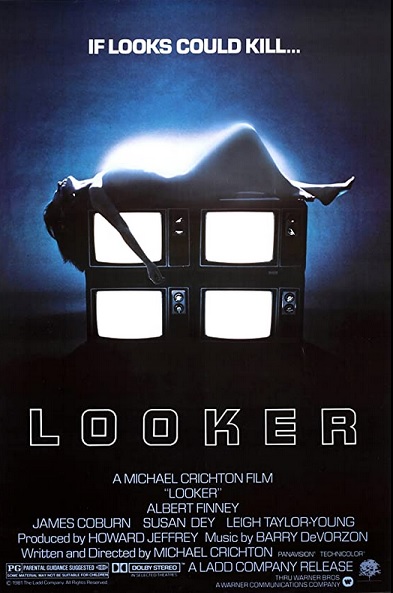
Looker (1981)

British actor Albert Finney was, first and foremost, an acclaimed British stage actor, which is why he vanished from our theater screens after his tour de forces as Hercule Poirot in Murder on the Orient Express (1974), and in Ridley “Alien” Scott’s The Duellists (1977).

Then, in 1981, Finney returned to our theater screens — and our HBO cable programming, where most of us seen the films — with a vengeance, in the heist-caper Loophole (never seen it), the horror film Wolfen, and this Michael Crichton-penned and directed science fiction-suspense flick. It’s another patented, intelligent statement on the state of man by Crichton that takes the worlds of television and its related advertising to task, as well as the medium’s obsession with beauty. To than end: Susan Dey goes topless in a couple of scenes (for three minutes and tastefully done).

But seeing Laurie Partridge from our TV past isn’t why we’re here, this week. For this week isn’t about boobs: it’s about goofy and outdated computer technologies and whacked techno-predictions of films from the ’80s and ’90s.

Welcome to our “Ancient Future Week.”

Sure, Looker is noted as the first commercial, mainstream movie to commit a full, computer-generated, three-dimensional solid representation of the human body to film. But that’s not what makes this one of our favorite, goofy “ancient future” favorites around the B&S About Movies cubicle farm. It’s those nifty Light Ocular Oriented Kinetic Emotive Responses guns, aka the L.O.O.K.E.R gun.

But alas, the movie, sans the gun scenes, is a hot mess of chopped up celluloid and not even a LOOKER gun can wipe the box office bad from our memory.

Don’t believe us? Then let co-star James Coburn tell it — from the pages of Psychotronic Video No. 9/1991:

My part was pretty much on the cutting room floor. They really pissed that film away. They had Albert Finney running around in a security guard’s uniform throughout the film. It didn’t make any sense. It could have been a good picture. It was about how television controls. It was about how commercials manipulate people to buy products, politicians, whatever. But, they cut the film up for a television print. I don’t know why they did that. They spent some bread on the picture too. It was a $12 million production. That’s not much today, but back then it was a pretty big budget.”

And it shows, Mr. Coburn. We believe you.

Sure, those LOOKER guns and goggles and light wand-bar thingies are pretty cool — zapping away people’s memories and all, but what in the hell is going on? And we could say, “What in the hell made Albert Finney hold out three years — only to pick Looker as a project he wanted to do?” As we learned from James Coburn as to what happens often with a box office failure: The film in the script and on the storyboards never ends up on film. And the story that ends up on film, doesn’t come out of the editing suite quite the same way.

If you recall that Crichton also wrote and directed Westworld (1973) and Coma (1979) — both awesome films that we enjoyed that became critical and box office hits — and remembering he dipped his toes into the “ancient future” with the less successful Tom Selleck bomb that was Runaway (1984) — you’ll see those film’s concepts are laced throughout the plot. Looker is a tale about how technology can be used to manipulate consumers’ impulses and responses to advertising. This same concept, even less effectively, plays out in the 1980 Lee Majors-starring Canadian thriller, Agency — only with a stronger political slant and without the sci-fi angle. And to that end: Digital Matrix/Restin Industries (run by Coburn’s John Restin) is “backing” the next President of the United States.

Albert Finney is Dr. Larry Roberts, a Beverly Hills plastic surgeon who comes under suspicion for the murder of four of his model-patients. He comes to discover each were employed, and sent to his practice by, an advertising research firm that’s developed a process of digitally scanning bodies into 3-D models — and never having to use the real models in advertising campaigns, ever again. Why do they have to be murdered after? Exactly. And the reasons are never explained.

Well, guess what?

Thanks to the advent of film restoration reissues on DVD and Blu-ray, the “scene” that explains the “why” can finally be watched, albeit a couple decades too late. Why was this cut from the U.S. and theatrical and home video versions — and left in the European prints that run 15 minutes longer than the domestic 93 minute (one hour and thirty-three minutes) cut — is only for a Warner Bros. executive to tell. Since then, there are commercial TV prints that have this missing scene restored. And we wish someone would rip the TV version, as this missing scene is absolutely crucial to the story — so we can see James Coburn’s point about his dissatisfaction (you’ll notice the local station ID logo that appears within the clip, below). The “document shredding” analogy as to why the girls were murdered is an excellent testament of the sharp mind and pen of Michael Crichton.

In addition — we think — to using their “Light Ocular Oriented Kinetic Emotive Responses” technology to hypnotize consumers into purchasing a product — and vote — they also developed a weapon-version of the technology for military applications: when fired, the LOOKER gun creates the illusion of visibility of the user, as the victim “shot” looses all sense of time.

So, this one has it all: consumerism manipulation, political manipulation, and the distortion of technologies to, instead of helping people, lull them into submission. And you get a great soundtrack by Barry De Vorzon, who also gave us the soundtracks to Bobbie Jo and the Outlaw, Rolling Thunder, and The Warriors.

Unfortunately, what Looker does not have is the editing that gave it a lick of sense when we went to see it at the local twin cinema all those years ago. I have watched the longer, overseas version since then, and Looker is better than I remembered.

And it’s probably more likely to happen now, than then — thanks to social media. And the way everyone has been carrying on this past year and change in cities across America, probably is. Is Mark Zuckerberg, Jack Dorsey, and Sundar Pichai today’s John Restin?

They’re looking at you.

No freebie, kids. Ah, but we found a deleted-scene clip and the trailer. You can rent-to-stream on Vudu and You Tube. Because of its oft-runs on HBO in the early ’80s, it’s a fan favorite and has a wealth of ripped clips to sample via You Tube and Google’s video-search feature. You can purchase Looker via the Warner Archive at WBShop.com. You can also purchase copies of the hard media and streaming version at Amazon.

About the Author: You can learn more about the writings of R.D Francis on Facebook. He also writes for B&S About Movies.

Freejack (1992)

I saw Freejack in the theater nearly thirty years ago and have to tell you, the future that it promised has not arrived.

Does it have the title of a Philip K. Dick book but not really have much to do with it?

No, it’s based on his contemporary Robert Sheckley’s* book Immortality, Inc.

Is there a lot of rain?

Oh man, blame it on the rain.

Does the male hero wear dress clothes and/or a trenchcoat?

Nope.

Do Keanu Reeves, Ben Affleck, Dolph Lundgren or Udo Keir appear in it?

Strangely, no.

Does the internet do something it can’t do yet, yet look dated AF?

This movie looked dated the moment it came out. The video game that Jagger plays in the bar would have been dated during the Atari 2600 era.

Are Stabbing Westward, KMFDM, Ministry or God Lives Underwater on the soundtrack?

This movie has a bonkers soundtrack with Little Feat, Scorpions, Jesus Jones, Jane Child, The Jesus and Mary Chain and — you knew it — Ministry performing “Thieves.”

Is it a crappy version of Blade Runner?

Not really.

Are there numerous Asian-influenced scenes?

Throughout!

Do people use future terms that make no sense?

Even the name of the movie is a future term that makes no sense.

Are there a lot of whirring sound effects?

It’s as if the Transformers are constantly transforming.

Do people stare at the camera as it moves through a neon-lit strip club?

Yes.

Are there rock stars in it?

Not just the biggest rock star of all time — arguably — in Mick Jagger, but also New York Doll David Johansen AKA Buster Poindexter, who if I think about long enough, I begin speaking like him. “Zat you, Zantee Claus?”

Is there a feral child?

Nope. That means that this movie is officially a cyberpunk ancient future movie!

Get ready for the crazy future words!

In 2009 — which is now 12 years ago and the irony is not lost on me — the super-wealthy use bonejackers that snatch people from the past and pull them to the future to use their brain dead bodies to become immortal. Those that escape from this process are no longer considered human and are instead called freejacks. And everyone else is so hooked on drugs and beaten by pollution that they’re all unattractive and basically dying.

Alex Furlong (Emilio Estevez) was a Formula 1 racer who died in an explosive crash back in 1991 but has been bonejacked by Victor Vacendak (Jagger), a killing machine for the McCandless Corporation. Oh yeah — his girlfriend Julie Redlund (Rene Russo) works there too because movie logic.

It turns out that her boss (Anthony Hopkins) is really dead and wanted to use Furlong’s body because, well, again let’s blame movie logic.

Of course, Jagger is the main reason to watch this. He got his girl at the time Jerry Hall — who is amazingly married to Rupert Murdoch today — a role, has a code of honor in spite of being the bad guy and wears a ridiculous helmet. Every time I see him, I think of how he responded to John Mulaney writing lines for him on SNL: “Good! Bad!”

I kind of wish that Jagger’s Vacendak was the hero of this movie, because everyone else in this is boring by comparison.

This movie was a mess and at one point it may have been an even bigger one. Producer Ronald Shusett (the writer of Alien, Dead and BuriedThe Final TerrorKing Kong LivesTotal Recall) was brought in to re-shoot around 40% of original director Geoff Murphy’s (Young Guns IIUnder Siege 2: Dark TerritoryFortress 2) film.

*Other Sheckley movie adaptions include CondormanThe 10th VictimDead Run and Escape from Hell Island.

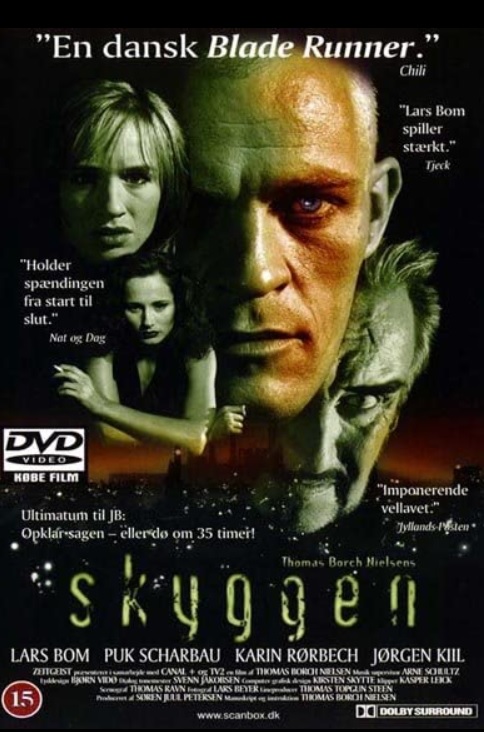
Skyggen, aka Webmaster (1998)

“We will soon fix the programming error in the super semantic subset of your linguistic structure.
— JB

Remember how, when Neil Marshall’s Doomsday came out 2008 and Luc Beeson’s Lockdown came out in 2012, we all groaned at the absurd Escape from New York/L.A. ripoffness of it all? Well, this Danish sci-thriller copies that absurdity-of-it-all rip with Bladerunner. Only this shot-on-a-low-budget-with-Digital Betacams thriller gives us — not a Ridley Scott rip — but an ersatz-sequel to the (dopey-to-crappy) Lawnmower Man franchise (when you see the graphics, you’ll see the analogy): a “Part III” that’s cyber-adrift between 1995’s William Gibson-based Johnny Mnemonic and the Wachowskis’ 1998 cyber-standard, The Matrix.

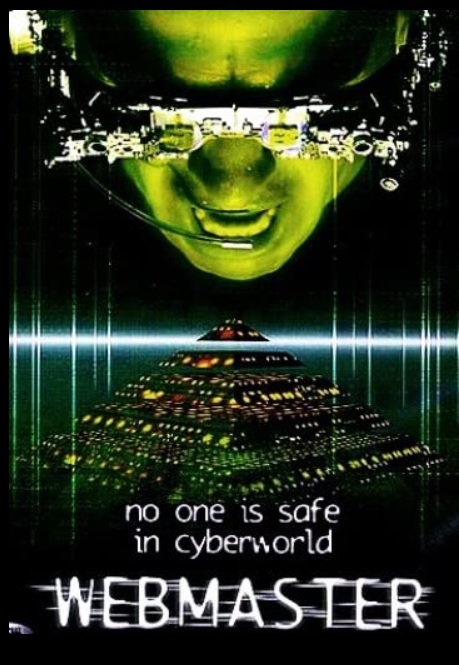
The 2000 U.S-English-market reissue.

And you know what?

Regardless of its student film ambition-over-budget production design, character-arcs and plotting that’s even more tech-ludicrous than the cyber non-realities of Disclosure, Hackers, and The Net (all reviewed this week, look for them) writer and director Thomas Borch Nielsens produced a debut feature film with a heartfelt, Tommy Wiseau-commitment to the film (and I dig Nielsens’s convincing tech jargon). Courtesy of rescuing a copy of the dubbed-and-retitled U.S.-version of Skyggen (Danish for “Shadow”) from a Blockbuster cut-out barrel for $2.00 bucks — and having the ability to revisit it a few times over the years — Webmaster grew on me in an enjoyable, Circuitry Man kind-of-way. It’s a film where your individual “love to plug” into it may vary; however, it’s a hell of a lot better than the assembly-line glut of Asylum when-hybrid-animals-and-environments-attack romps backing up the direct-to-streaming rivers. The film’s only negative: its arthouse-vibe would have been better served in an English-subtitled form, as the dubbing is a poorly-done distraction.

As with Bladerunner, the world of Skyggen is a dark, atmospheric world where computers are available at every corner and everyone is a VR-addict clad in black leather and vinyl because, well, in the “ancient future,” all clothing stores only sell S&M gear (and you have your comparisons to The Matrix), everyone is mainlining something into their veins, ’90-era tech music perpetually throbs, and you have two hair-color choices: blonde or one of the rainbow’s seven spectrums.

The 1998 Danish-Euro version. No, that’s not Juliette Lewis in the upper left corner.

JB is a reformed hacker — who wears VR goggles and hangs upside down as he hacks and codes — hired as the webmaster of a cyber-domain (foreshadowing Bitcoin) that specializes in the illegal transfers of digital currency (and the only way for users to log on is with a VR-headset, natch). When a cyber-intruder hacks the domain and steals the site’s funds, Stoiss, the site’s web-mogul founder, pulls a “Bob Hauk”: but instead of injecting JB with a set of carotid-artery severing micro-explosives, he installs a heart-explosive that runs out in 35 hours (and you have your comparisons to Escape from New York, but due to budget, more 2019: After the Fall of New York; a film which we love, so all is well). At that point, JB is off the net and thrust into the underbelly of a tech-noir detective thriller — with a hacker instead of a detective — navigating the usual double crosses and murders rife with bounty hunters, femme fatales, and cyberpunk gangs.

There’s no deying Jean-Luc Godard’s neo-noir Alphaville, Elio Petri’s pop-art romp The 10th Victim (1965), and Francois Truffaut’s Fahrenheit 451 (1967) are the prefect combinations of film noir and dystopian fiction. The same holds true for the later tech-noirs spun in the frames of Wolf Gremm’s Kamikaze ’89 and Claude Chabrol’s Docteur M. While Webmaster may not be up to the cinematic level of those regarded films, Thomas Borch Nielsens has, none the less, dreamed up a very creative and enjoyable, low-budget gem that’s worthy of you seeking out a copy of the VHS or DVD in the online marketplace.

Sadly, there’s no online streams to share. The best we have to expose you to the film is a trailer and the film’s opening title sequence that sets up the cyber-verse. Yes. This film has fans . . . and deserves the love!

About the Author: You can learn more about the writings of R.D Francis on Facebook. He also writes for B&S About Movies.

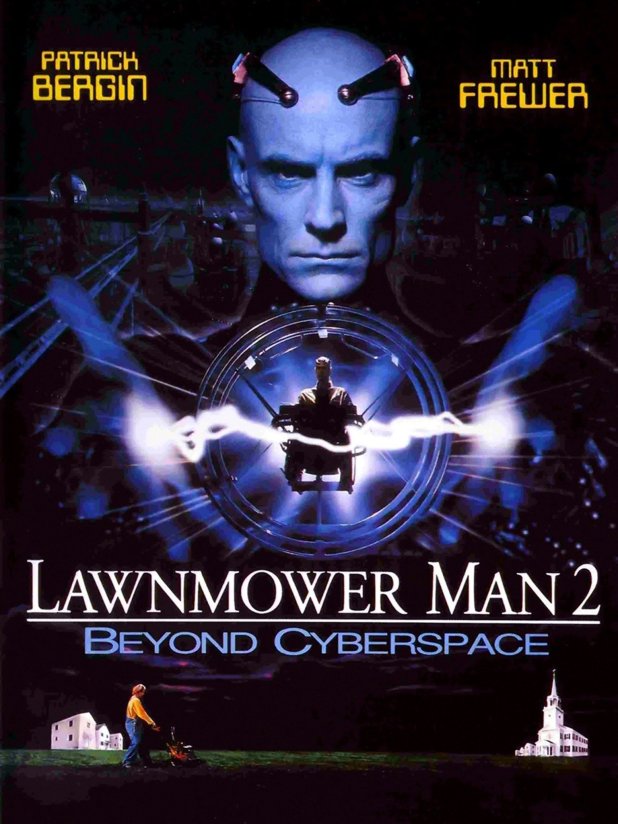
Lawnmower Man 2: Beyond Cyberspace (1996)

Farhad Mann had some major success in TV. Perhaps most importantly in our study of ancient future film, he was the director of the U.S. pilot for Max Headroom (as well as the pilot for Forever Knight). He’s done tons of commercials and now makes TV movies, but at one point, he wrote and directed a sequel to a movie that people hated. And the few people who liked The Lawnmower Man hated this one.

The founder of virtual reality, Dr. Benjamin Trace (Patrick Bergin, who once menaced Julia Roberts in Sleeping With the Enemy), lost his legal battle to patent the Chiron Chip, which could be the tool that makes mankind slaves to computers. Of course, once entrepreneur Jonathan Walker (Kevin Conway, the barker from The Funhouse) finds a barely alive Jobe Smith (now played by Matt Frewer, speaking of Max Headroom) and hooks him up to the virtual reality grid, well, that’s exactly what happens.

I kind of loved this movie, because I kept yelling out lines in the voice of Sark from Tron, stuff like “The Master Control Program has chosen you to serve your system on the Game Grid.” and “Bring on the Logic Probe!” and “Welcome to the video game grid!”

If you can watch this incredibly dated VR movie with that attitude, you just may enjoy it.