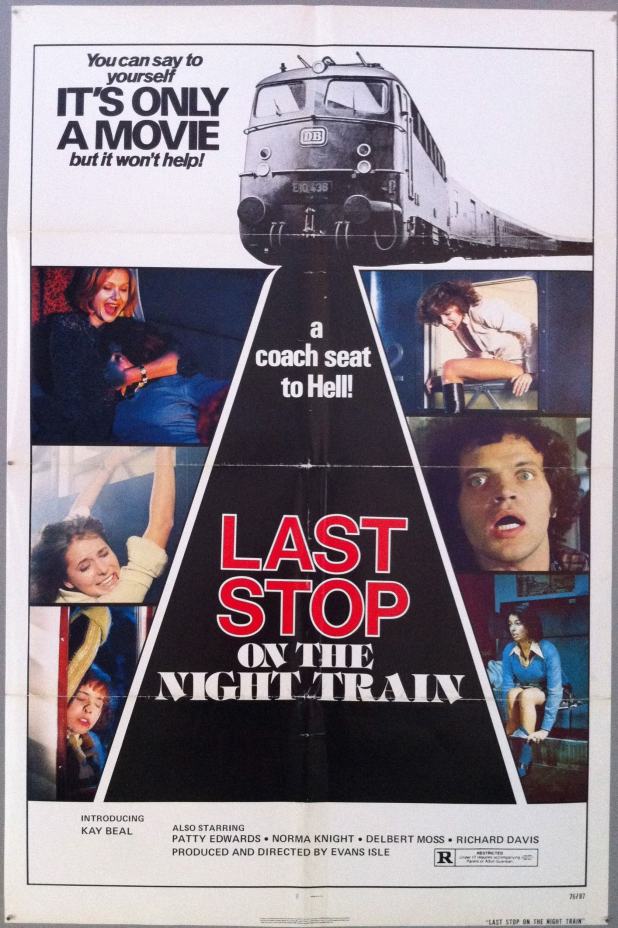
Last Stop on the Night Train (1975)

As of December 20, 2020, if you can believe it, I’ve never seen Last House on the Left. But I have seen nearly every ripoff of it and movie that stole its ad campaign or title. I have no idea why. It just worked out that way.

This Aldo Lado-directed piece of Italian grime also went by the names Night Train Murders, The New House on The Left, Second House on The Left, Don’t Ride on Late Night Trains, Late Night Trains, Last House Part II and Xmas Massacre, depending on the whims of fate (and Hallmark Releasing).

Margaret (Irene Miracle, who was also in Midnight ExpressInferno and Puppet Master) and Lisa are set to taking the night train from Germany to Italy, but the train is full and they have to sit in a long corridor. They help Blackie (Flavio Bucci, Suspiria) and Curly (Gianfranco De Grassi, The Church) hide from the ticket taker as they board the train and hide from the cops. Of course, instead of saying thanks, they end up decimating the two girls, along with the help of an upper class blonde (Macha Méril, Deep Red) who has already turned the tables on Blackie’s attempts at assaulting her by seducing him. The two thugs really have no idea what they’re in for, because this mysterious blonde is more dangerous than both of them put together.

The whole time the girls are being victimized, murdered and forced into suicide, Lisa’s parents are hosting a Christmas dinner party where her doctor father speaks on the ills of a more violent society.

Later, when they arrive at the station to get the girls, they are worried when they don’t arrive. If you wonder, “Will they end up taking the people that killed them home?” then yes, you have seen your share of revenge movies. The most shocking thing is that the blonde may be the only survivor of the evil trio, as her fate is left open.

This video nasty is the kind of movie that I don’t put on when people come to visit.

While some decry the bumbling cop comedy in Craven’s film, this one jettisons any attempt at levity, adds some 1975 Italian style, gets a soundtrack from Morricone and gets way, way dark.

Lado also made Short Night of Glass Dolls and Who Saw Her Die?, two of the more original and downbeat giallo to follow in the wake of Argento. Even when he’s ripping someone off — not that Craven didn’t also rip off The Virgin Spring, so there are no innocents here — he can’t help outdoing his competition.
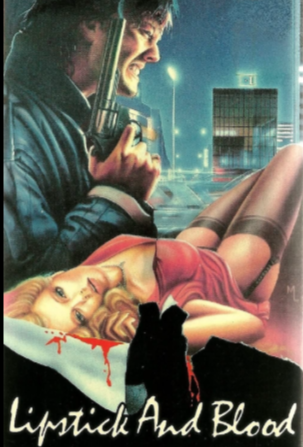
Lipstick and Blood (1984)

Don’t ask me why, but in 1984, Lindsay Shonteff, who spent most of his career making spy spoofs like The 2nd Best Secret Agent in the Whole Wide World decided to make a Shot On Video* giallo.

Is it any good? No.

Is it weird? Yes.

Is that why we watched it? You know it.

Starring Jane Linter — who never made another movie — and Joseph Peters, who played a Hooded Ghost in two of The Adventures of Justine films, which are very similar to Gwendoline, this is all about a man stalking an exotic dancer who is only dancing to raise money for her wedding.

The stalker, Jay Preston, lives in a world of Mayfair-esque lad mags, call girls and yes, a blow-up doll to sate his strange passions. But soon, when he watches Jennie on stage, he knows that he has found the woman who can satisfy him. Sure, she has a fiancee, but fantasies don’t take into account the real world.

This, of course, means killing her fiancee, murdering multiple people to earn enough money to keep moving from motel to motel, then forcing her to dance for him and him alone when he isn’t assaulting her or killing her parents. You may ask yourself, “Really, who is all this depravity for?” Then you realize that the 1980’s had a burgeoning video nasty market in the UK and see where Shonteff was trying to make some much-needed cash in the economic crunch of 1984.

Sadly, the director already made a much better version of this kind of story back in 1969 with Night, After Night, After Night, but hey, you’re looking for giallo that no one else has and you need to get your kicks somewhere, right? And look who has the skinny on some scummy VHS era hackwork that only two other maniacs on IMDB have reviewed? Me. I’m not proud of it either, but here we are.

Despite having a lead character who blames a woman for his inability to even make a complete bowel movement — a first! — this is one of those movies where the lead character is an exotic dancer that somehow never gets naked, which really seems to challenge this movie’s goal of being repellant filth. Imagine if David Hess said poopy in his rants. It just doesn’t work. If you’re going to be a cesspool dwelling movie that upsets people enough to get on the cover of tabloids, go for it. Instead, other than its ranting leading man, a final act turn toward proto-American Psycho satire and a shotgun blast of an ending, this is a rather tame affair. You know, except for that blow-up doll.

*He also made another SOV movie, a post-apocalyptic film called The Killing Edge.

Zegen (1987)

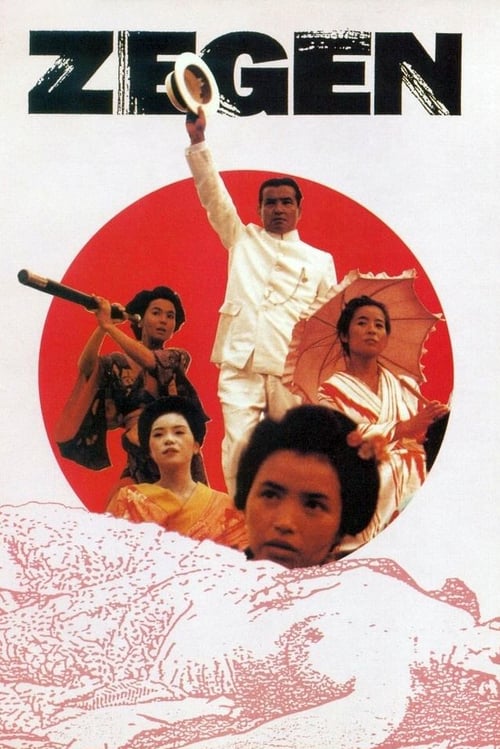
Iheiji Muraoka (Ken Ogata) had plans to be a shopkeeper. However, as he begins to learn that the Japanese armed forces will soon advance across Asia, he instead goes into business as a brothel owner. After all, an army moves on its stomach, but it often stays ready to fight based on its desire.

This is one of Shôhei Imamura’s later movies, but still rich with the black humor and desire to explore the hidden castes and stories of Japan.

Muraoka became Zegen, quite literally the most powerful seller of women in modern Japanese history, known as “The Boss of the South Seas.” Yet beyond the monetary and carnal rewards of this vice, he saw the business of turning out women as an almost patriotic duty.

At the close of this film, as the Japanese forces return to Malaysia, Muraoka rushes to greet them, seeing them as the children of the men that he had worked with to keep Japan strong. He is shoved down by a commanding officer who does not even recognize the old man’s attempts at speaking Japanese. In the end, despite his fanatic devotion and the ruin of so many lives, he himself has been rendered meaningless.

Zegen is one of the three films on Arrow Films’ new Survivor Ballads: Three Films By Shohei Imamura set. I’ve learned something new from each of these movies as we covered them this week and this set has my complete seal of approval. You can get yours from MVD.

Hanai Sachiko No Karei Na Shōgai (2003)

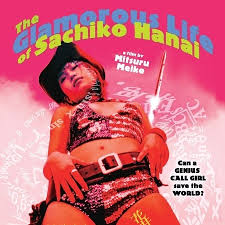
The Glamorous Life of Sachiko Hanai started life as a pink film — a term that refers to any Japanese film that includes nudity or sex — called Horny Home Tutor: Teacher’s Love Juice. The producers allowed Mitsuru Meike to turn it into a full length film that would eventually play at international film festivals.

Make no mistake, this is one of the stranger films you’ll watch. Also, if you don’t watch much pornography, one filled with an obscene amount of body fluids.

Sachiko Hanai (Emi Kuroda) is a cosplay callgirl who often dresses like a teacher. While relaxing at a cafe after attending to a clint, she witnesses a gun battle between a Middle Eastern and North Korean man that ends with her shot in the head. However, instead of dying — for some reason, she was taking selfies in the midst of the shooting — she gains the powers of ESP, advanced mathematical knowledge, deep insight and being able to speak several languages. She also finds the cloned finger of U.S. President Goerge W. Bush that quickly brings her to orgasm and then reveals that she must run, as everyone wants his finger because it unlocks the nuclear payload of the United States.

Still with me?

Somehow, this all leads to a cave that will determine the fate of the world and an ending that echoes losing a game of Missle Command.

I really liked this, as it’s just on the right side of strange, with a call girl acting as a teacher when she really holds the fate of the free world in her hand. Or Bush’s painted and cloned thumb. It also taught me the terrifying “Bush Technique.”

Tomie Unlimited (2011)

After eight Tomie films, the time seemed ready for a reboot and Tomie Unlimited — kind of like Marvel’s Unlimited newer universe — was the answer. Noboru Iguchi (Zombie Ass: Toilet of the DeadThe Machine Girl) would be the creative force to make this one happen.

The movie starts with Tsukiko Izumikawa (Moe Arai) taking photos when she runs into her stepsister Tomie Kawakami (Miu Nakamura). The two both are in love with the same boy, Toshio Shinoda (Kensuke Owada). Tsukiko hates her stepsister yet is in love with her beauty, unable to stop taking photos of her, even as a steel cross falls from a building and kills her.

A year later, on her eighteen birthday, Tsukiko is trying to get back to a normal life, which changes forever when Tomie returns. On the first night, she grabs an electrical cord and demands that her family beat Tsukiko for letting her die.

Meanwhile, Tomie has grown a scar in her shoulder that contains a talking tumor before her father kills her and her mother tears apart her body. This unleashes multiple Tomies, from small heads that can infect others to her main head that asks her father to kill his wife and feed the remains to her.

By the end of the film, women all over Japan, including our heroine, have all become Tomie, all destined to die at the hands of men, all fated to come back to ruin the sanity of everyone they encounter.

After watching all of the Tomie films, this is up there as one of my favorites in the series. It has just the right mix of abject horror and ludicrous humor. And the floating head of Tomie conjures pleasant memoirs of Mystics In Bali and that’s a good sign.

You can watch this on Amazon Prime and Tubi.

The Golden Bat (1966)

AUTHOR’S NOTE: This article originally ran in Drive-In Asylum issue 20. You can get it right now on the Etsy store.

While many of us would consider the first superheroes to be Superman or Batman, the truth is that The Golden Bat (Ogon Batto) predates both of them by nearly a decade and is considered the world’s first comic book superhero. 

The character was created by sixteen-year-old Takeo Nagamatsu and twenty-five year-old Suzuki Ichiro in 1931. They were inspired by, of all things, Golden Bat cigarettes and the mythology department of Tokyo’s Ueno Royal Museum. However, they sought to create a hero based on science rather than magic. 

The Golden Bat made his debut in a traveling storytelling show known as kamishibai, which means paper play. He was so popular that after World War II, his adventures continued in both manga comics (including work by Osamu “The Father of Maga” Tezuka), anime and film.

I know you didn’t crack open this issue of DIA to read about obscure comics. So let me get to the reason why I’ve picked Ogon Batto to spotlight. The first live-action film starring this character was made by Toei — yes, the same studio that brought you The Green Slime, Female Prisoner 701: Scorpion and Message from Space — in 1966. 

While made in the same year that the Batmania craze was spreading like wildfire, this film is a strange mix of movie serial and Eurospy with a watchful eye toward the sentai shows that would dominate Japanese kids TV by the late 70’s. 

Professor Yamatone (Sonny Chiba, eight years before he’d make The Street Fighter for this very same studio) and his family have taken a visit to Egypt. While exploring the tomb of a legendary god of justice — you guessed it, Ogon Bat — the agents of Dr. Erich Nazo take Yamatone captive. This has something to do with Nazo’s home planet Icarus being drawn toward Earth to destroy it and a giant robot that he keeps under the sea.

As his daughter Mari begins to wail and plead for her father’s life, her tears fall into the Golden Bat’s tomb and bring him 10,000 years forward into our time from his native land of Atlantis.

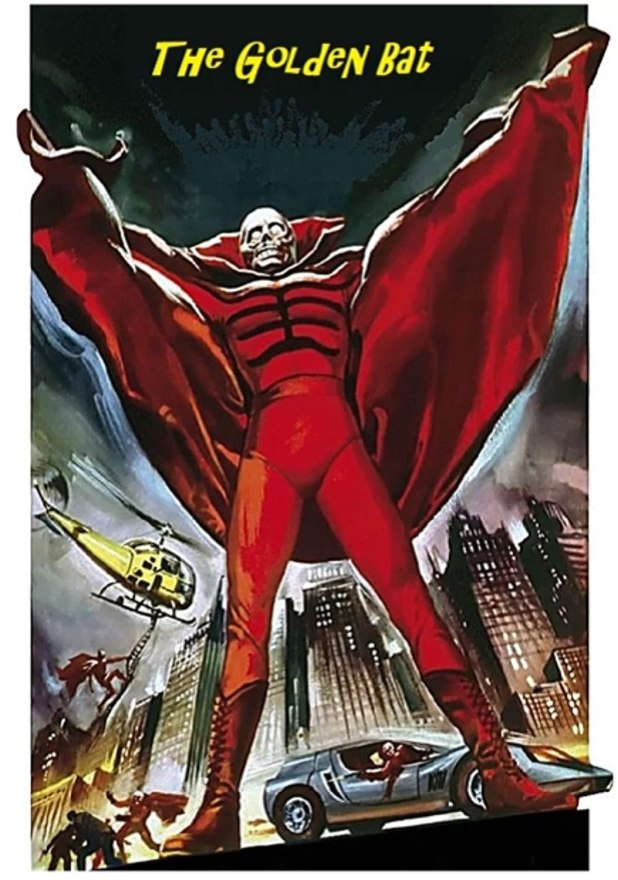
This would be a strange origin story to start with, but it’s the design of Golden Bat that makes it sublime. He’s literally an aurum-armored warrior with a face like, well, a skull. He looks like the villain of the piece, more Kriminal than Superman. He pretty much invented the bat-signal, casting a giant gold bat and his laughter before each battle, before a large golden skull appears as he does. Most fights between Golden Bat and his adversaries end with most of them dead, which is strange for a hero who fights for small children.

He’s also incredibly similar to Fantomas, a fact not lost on Italian and Brazilian audiences, which renamed him as Fantaman and Fantomas respectively. Even cooler, this movie was released in Italy as Il ritorno di Diavolik or The Return of Diavolik. Deep deep down, indeed.

This is probably the point in which I should explain that the insidious Dr. Nazo looks like a giant stuffed bear with four eyes and a giant mechanical claw for a hand. His agents all have burned up faces, deploy tricks like gigantic hypno-wheels and have no compunctions menacing young children and old people.

Director Hajime Satô was also behind the senses-shattering Goke, Body Snatcher from Hell. Just imagine the weirdness of that movie, but instead harnessing it to create a superhero movie for kids. Now you have a good idea of what to expect here.

Keep an eye out for Andrew Hughes, a Turkish-born import/export businessman who inexplicably became a Japanese movie star. He was on speed dial — yes, Japanese directors had that way before we knew what it was — for anyone who wanted a Western-looking face in their film, showing up in everything from King Kong Escapes and Destroy All Monsters to Crazy Adventure, where he played Adolf Hitler. 

Sure, Golden Bat has every superpower ever — and then some — but this movie flies, making you never even realize that seventy-plus minutes of aliens, lighting-blasting staffs and skullman versus robot fisticuffs have battered your brain into jelly. 

Of course, Golden Bat’s story — not in this film, mind you — ends like every Japanese hero story ever, with both the protagonist and his arch-nemesis dead. There’s something in the Japanese culture that demands that each of its monster heroes must pay the price for their daring-do in blood. 

But The Golden Bat will return. Even death can’t hold him in her grasp when a young girl’s tears call from beyond, after all.

You can watch this movie on YouTube.

Kawaii Akuma (1982)

When a young girl named Ryoko traveled to Europa to study music, her lover was killed in a traffic accident. However, she believes that her psychic powers are what killed him and no one believes her, which sends her to an asylum. As she recovers, she is placed into the care of her brother-in-law Kouji and eventually becomes the governess for his daughter Alice.

Nobuhiko Ôbayashi is best known for Hausu in America, but he made plenty of movies, including this 1982 made-for-TV movie, which is just as surreal and wonderfully strange as his most famous film.

I mean, how can you not love a movie that has a wedding end with the bride doing the Oliver Reed Burnt Offerings leap out a window? I’ve seen folks refer to this as Ôbayashi’s take on The Bad Seed and that works for me. It’s a kid with too many powers being watched by a woman who has had too many horrible things happen in her life, now with no grip on reality.

So many matte paintings, plus ghosts wandering the night, people being set ablaze, tons of broken glass and a really gothic feel — dare I say it’s a Japanese Kill, Baby, Kill! — that hits everything I love in film and then just takes it all up to another level.

You can translate the title as Cute Devil or Lovely Devils. Either way, this is a movie worth tracking down.

Kataude Mashin Gâru (2008)

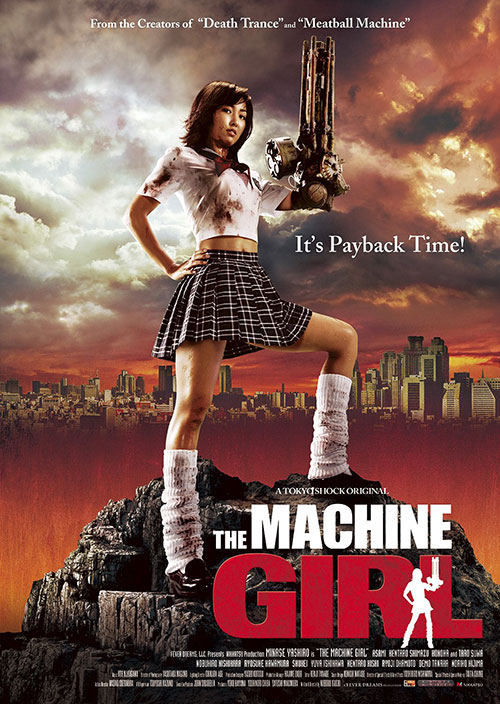
Ami is a schoolgirl just trying to deal with avenging the death of her brother and his best friend when her quest for revenge leads to a ninja yakuza clan cutting off her arm. Luckily, two mechanics give her a machine gun where her arm once was, then she teams up with the chainsaw carrying mother of the slain best pal and all hell breaks loose.

Yes, welcome to The Machine Girl.

Writer and director Noboru Iguchi was influenced by the sideshows and ghost houses that he went to as a kid. He started as an AV director (Adult Video) but the first evidence of this horror angle to his films began with Final Pussy, which features crossover star Nana Natsume as a woman who has guns emerge from her breasts when she reaches arousal. He’s since made everything from horror comedies like Koi-suru Yōchū (A Larvae to Love), the manga adaption Nekome Kozō (Cat-Eyed Boy) and the update to 1970’s robot show Denjin ZaborgarKarate-Robo Zaborgar.

The special effects for this movie come from Yoshihiro Nishimura, who made Tokyo Gore Police and has been called the Tom Savini of Japan.

While this movie is relentlessly gory and ridiculous, it’s also surprisingly effective in its exploration of grief. That is probably the weirdest part of this very strange film. Come for the blood sprays and chainsaw death, stay for the strong female heroine, you know?

You can watch this on Tubi.

Vāsasu (2000)

Back in the days of buying VHS tenth generation dubs of movies at comic conventions, getting a copy of Versus was a big score. Written, produced and directed by Ryuhei Kitamura (Godzilla: Final WarsThe Midnight Meat TrainNo One Lives), it was a non-stop fistfight zombie massacre, the kind of movie you could put on at a party and no one would complain about the subtitles.

Today, twenty years later, there’s nerd rage because Arrow dared to tweak the colors on this blu ray release, even though they worked directly with Kitamura and most of them saw a copy that was either many, many versions removed from an original or saw it streaming. As for me, I’m beyond happy to have an incredible looking version of this movie in my collection.

Originally intended as a sequel to Kitamura’s Down to Hell, instead this became a movie all its own that starts with a story that there are 666 portals on Earth that connect this world to the other side which are concealed from human beings. Somewhere in Japan, there exists the 444th portal known as The Forest of Resurrection, where we see a samurai battle zombies before being killed by an evil priest and his followers.

That brings us to here and now, as two prisoners escape through the forest and meet up with a gang of Yakuzas. Prisoner KSC2-303 (Tak Sakaguchi*, Battlefield BaseballDeadballWhy Don’t You Play In Hell?) notices that they have a girl — known only as The Girl — kidnapped and decides to kill several of them and escape with her.

The yakuza call for The Man (Hideo Sakaki, Battlefield BaseballKamen Rider × Super Sentai × Space Sheriff: Super Hero Taisen Z), who berates them for letting them go. They retaliate by killing him and in turn, he rises from the dead — as do a forest full of their victims — because he and Prisoner KSC2-303 are reincarnations of past lives. The Man plans to sacrifice The Girl to open the portal hidden in The Forest of Resurrection and obtain the power of darkness. He kills Prisoner KSC2-303, but The Girl revives him with her blood.

While he is coming back to life, he learns he was the ally of the samurai we saw die and that The Man and his gang were the evil priests. The Girl was a princess whose blood was the secret to opening the power of darkness, so Prisoner KSC2-303 sacrificed her to save the world, then was killed by The Man.

What follows is the fight to end all fights. Pretty much every action-oriented gunplay film from 2000 on owes something to this movie**, a film so out of control that the two shoot at one another point blank multiple times, their bullets blocking each other every single time.

99 years later, despite the Earth being destroyed, they find one another again. The Man is now the hero, Prisoner KSC2-303 has his gang and The Girl is still alive, telling him that she should have been on his side. With nothing left to blow up, Prisoner KSC2-303 demands another battle. The look on The Girl’s face says it all, because they will fight forever.

Versus at the same time is a wildly original mashup of gunplay, zombies, humor and martial arts while at the same time a homage to The Evil Dead and Highlander. Kitamura says that he was inspired by the films of Sam Raimi, John Carpenter and George Miller.

You have to love a director this in love with film, someone getting high off his own supply, who spent the majority of the film’s budget on food for his cast and crew. You can spot the references — The FrightenersPredator; The GoodThe Bad and The UglyThe Harder They Come — just as easily as you can see the movies that refer to it afterward.

It’s as close to a perfect movie as you can get.

You can get the new Arrow blu ray release of Versus from MVD. It features a new 2K restoration from original film elements by Arrow Films, approved by the director, of both Versus and the 2004’s Versus Plus, which has ten minutes of new and improved action.

Plus, you get a treasure trove of extras, including Nervous and Nervous 2, two mini-movies showing side stories of other characters in Versus, as well as Versus FF Version, a condensed, 20-minute recut of the film.

This is why they make blu ray. Physical media — even if you’ve bought numerous bootlegs of this film already — forever!

*Sakaguchi claims that he met Kitamura during a street fight that he was involved in. Kitamura offered him a role in his film after asking him if he’d rather fight in the streets or fight in his films. Yes, that sounds like something out of Street Fighter, but it’s supposedly true.

**So do video games. Metal Gear producer-director Hideo Kojima is an extra in this and he picked Kitamura to direct the remake of Metal Gear Solid: The Twin Snakes, which is full of Versus influence.

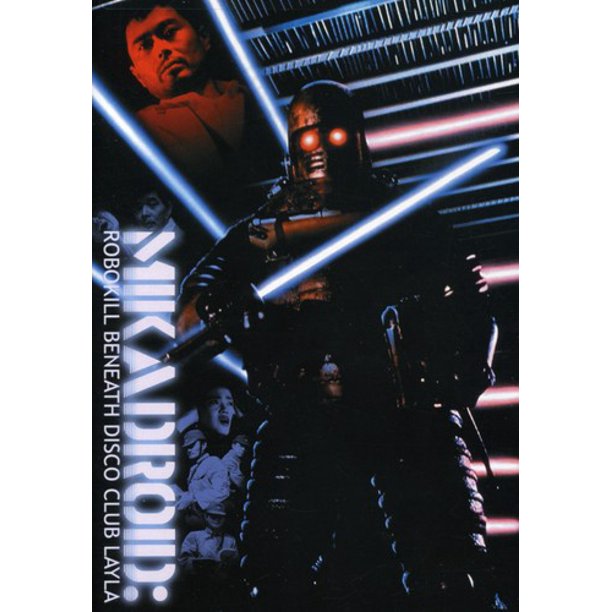
Mikadroid: Robokill Beneath Disco Club Layla (1991)

During World War II, the Japanese military had a secret lab in Tokyo where three soldiers would be transformed into Jinra-go, which were armored superhumans. By March 1945, only one soldier was ready when the atomic bomb was dropped and Japan surrendered.

45 years pass, as modern Tokyo is being rebuilt and an area is being made to a nightclub called Discoclub Layla, the bad wiring of the new development has reactivated the lab in the basement and now Mikedroid is loose.

Director Tomo’o Haraguchi also made Death Kappa, some of Ultraman Ginga and Kibakichi: Bakko-yokaiden, which is one of my favorites. It’s interesting in this movie that the action never really seems to be seen on screen. It’s either in shadow, a silhouette or in close-up almost manga-like panels, done as stills. Whether this was a budgetary or artistic choice is unclear.

There’s also two ancient supersoldiers who were part of the same program as the robot, who looks like a steam-driven samurai, which is quite the artistic choice. Actually, this movie is full of that kind of off the beaten path magic, such as a kill that has a girl leave behind a stick figure of blood that perfectly fits into a mural, the drab bunker that houses the robot and plenty of shadowy kills that never really show the monster until the end. For a budget direct-to-video movie, this has plenty to like.

You can watch this on YouTube.