WE’RE HEADING TO ITALY AND THE SWAMPS ON THIS WEEK’S DIA DOUBLE FEATURE!

We’re back this Saturday on the Groovy Doom Facebook page at 8 PM East Coast Time! Make sure to “like” the page so you get an alert when we go live throughout the night.

You can join us in between the films for chat and discussion on the two films we’re showing, ask questions, request movies for next week, learn how to make our drink recipes and see ad galleries for each film!

Up first, Sergio Martino’s The Strange Vice of Mrs. Wardh, which you can watch on Tubi and Shudder (or buy the blu ray from Severin).

For those of us who enjoy a drink with our film — please drink and watch giallo responsibly — here’s a cocktail. And if you’re drinking with giallo, you know that only J&B will do.

The Strange Cola of Mrs. Wardh (tweaked from this recipe)

  • 1 1/2 oz. J&B Scotch
  • 5 oz. cola
  • 4 dashes Angostura Orange Bitters
  • An orange wedge
  1. Put on your black leather gloves and use a switchblade to slice an orange wedge.
  2. Fill a tall glass with ice and pour in the J&B and cola.
  3. Add the bitters, then squeeze in the orange juice and use the rest of teh wedge for a garnish.

Up next, it’s Bog, which you can watch on Amazon Prime.

Here’s a drink perfect for that film.

Bog Water (tweaked from this recipe)

  • 1 oz. vodka
  • 1 oz. Midori
  • 1 oz. lime juice
  • 3 oz. Squirt soda (or any lemon-lime/grapefruit soda)
  1. Shake vodka, midori and lime juice with ice, then pour into a glass.
  2. Stir in soda and enjoy.

See you on Saturday!
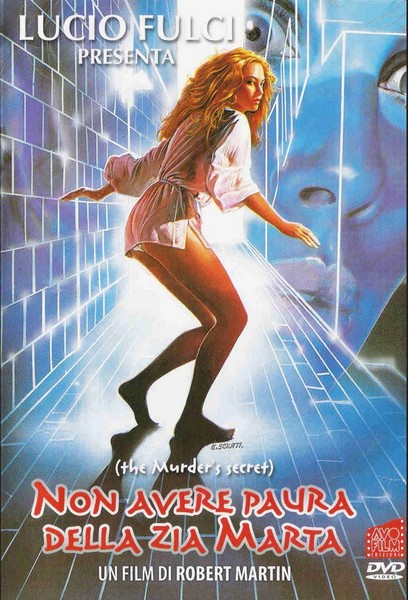
Non Aver Paura Della zia Marta (1989)

Don’t Be Afraid of Aunt Martha is the translation of this title, which makes me wonder, in a week where I also watched Sometimes Aunt Martha Does Dreadful Things and Marta, is the name cursed?

Also known as Murder Secret, this Mario Bianchi written and directed movie had one of those presented by Lucio Fulci* titles on it. Bianchi also directed Satan’s Baby Doll under the name Alan W. Cools and Kill The Poker Player as Frank Bronston. Later, he’d move into adult** under the aliases Martin White, Nicholas Moore, David Bird and Tony Wanker. To add to that, he also wrote the well-regarded giallo The Weapon, The Hour and The Motive.

One of six movies that Fulci edited — cannibalized, I guess — for Cat in the Brain***, this is closer to slasher than giallo and only really comes alive when the bloody murders kick in, which is really why you hire Fulci, I guess.

Richard Hamilton (Gabriele Tinti****, Emanuelle in AmericaEndgame) gets a letter from Aunt Martha (Sacha Darwin, Voices from Beyond), who he has not seen in decades and who his family has written off as dangerously psychotic. So he does what you and I would by bringing his enire family —Georgia (Jessica Moore, D’Amato’s Eleven Days, Eleven Nights and its sequel), Charles, Maurice and Nora, his wife — to visit Martha at her estate.

The only person they find there is her caretaker Thomas (Maurice Poli, Five Dolls for an August Moon), who seems kindly but you know, this is an Italian gore movie, so no one is all that nice. The murders begin pretty much immediately.

Betraying the other films that Bianchi made, the nude shower scene goes on forever and is even stranger because although the daughter is an adult, she acts like she is 15. She’s somehow luckier than the youngest child, who runs directly into a chainsaw, and at that point, I thought to myself, “Well, now I can’t give this a bad review.”

The end of this movie is complete fake-out junk and therefore is wonderful. Also, big points for somehow getting Tinti to slowly kiss the maggot spewing corpse of his long dead aunt before getting into a slapfight with Poli.

You can watch this on YouTube.

*He also helped Fulci with the horrible Sodoma’s Ghost.

**In 2001, he released John Holmes vs. Ilona Staller, which is stranger because it has Ron Jeremy in it, plus it was released 13 years after Holmes’ death and didn’t use Staller’s more famous Cicciolina name.

***The other films are Bloody Psycho, Hansel e Gretel, Massacre, Sodoma’s Ghost and Touch of Death.

****The rare four asterisk footnote is just for me to tell you that even thought Tinti has passed on, I still am jealous that he was married to Laura Gemser.

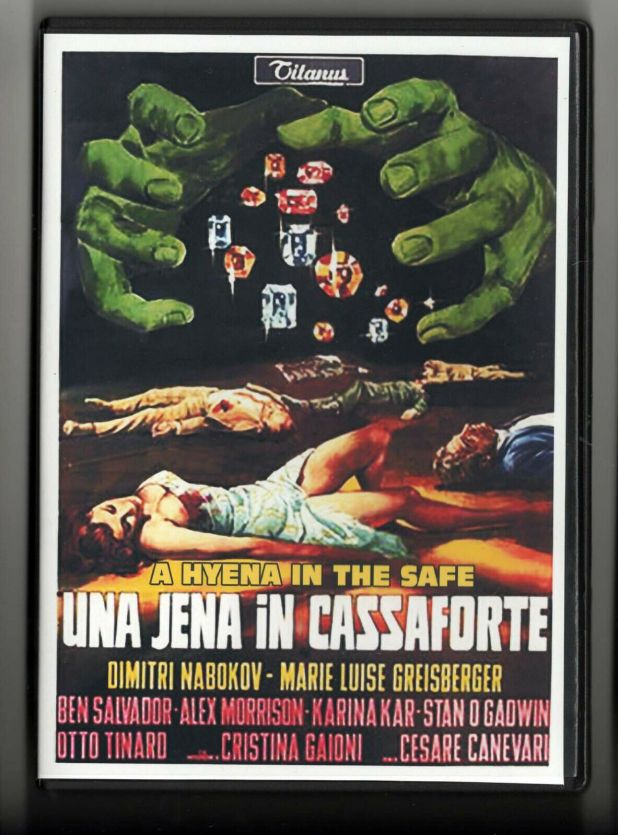
Una Iena In Cassaforte (1968)

A Hyena In the Bank Vault might have the best looking fashions I’ve ever seen in a giallo. Oh man, glitter eyeshadow, furs, striped suits, insane patterns — I’m in love.

Four thieves — Klaus from Germany, Albert (Sandro Pizzochero, So Sweet, So Dead), from France, Juan from Spain and Carina from Tangiers — have met up in what they think is an isolated castle to split up some diamonds. That said, their dead boss’s wife Anna is throwing a party. Complicating matters further, all five keys must be used at the same time to open the vault, so everyone has to keep getting along, even when Albert’s new girlfriend Jeanine annoys everyone. And when people start getting killed, how will anyone get their reward?

Cesare Canevari is probably better known for his scummy side, with movies like A Man for Emmanuelle, Killing of the Flesh and The Gestapo’s Last Orgy on his resume.

I kind of love these kinds of pre-Argento giallo that haven’t started aping his style and instead are all over the place in influence. This is the kind of movie that I wished had showed up in Vinegar Syndrome’s last Forgotten Gialli set, because I want more people to see it. It’s got the brightest colors, the furriest upholstery, the most theatrical makeup and a soundtrack that swings. It is, well, everything.

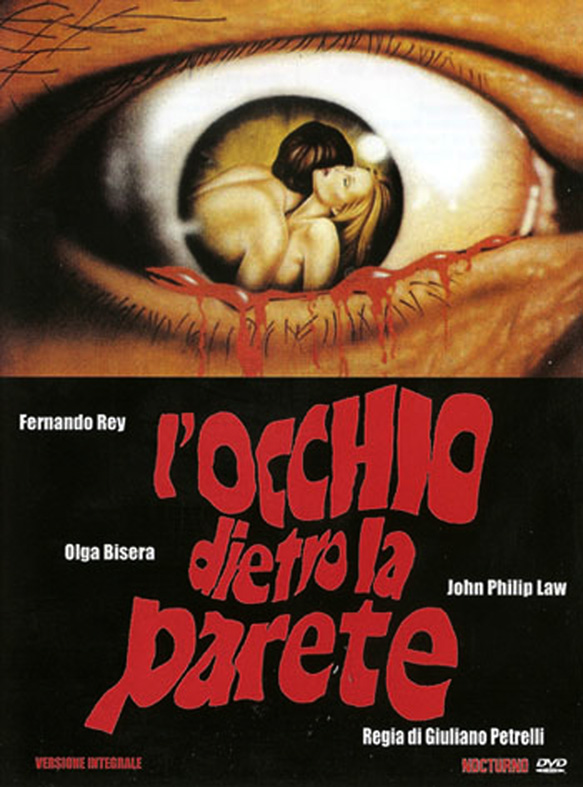
L’occhio Dietro La Parete (1977)

Eyes Behind the Wall tells the story of Ivano (Fernado Rey, The French Connection), a wheelchair-bound man who has an apartment filled with audio-visual equipment that allows him to spy on Arturo (John Phillip Law, Danger: Diabolik) and his various sexual conquests. He also gets off making his wife Olga (Olga Bisera, The Spy Who Loved Me and obviously a confidant woman, as she was the partner of Luciano Martino — who had been married to Edwige Fenech and Wandisa Guida — from 2004 until his death in 2013) watch these shenanigans. But now, he wants her to seduce him and be part of the action. And that’s where things get…giallo.

There’s also an astounding disco sequence with Bava-esque lighting, public nudity and a song called “Disco Boogie” that made me lose my mind. There’s nothing quite like a disco scene butting its way in to a movie that has nothing to do with dancing and these scenes are always quite welcome. I mean, everyone in this scene is going for it in a way that I never could on the dance floor.

Giuliano Petrelli was usually an actor — he’s in Massacre in Rome and The Italian Connection — and this was his one and done as a writer and director. It’s a shame, because this definitely has some great moments and was way better than I thought that it was going to be. It’s an adjacent giallo, I guess, as it’s more Rear Window than The Bird With the Crystal Plumage. And I did not expect that post-disco scene coming where  Arturo’s black friend (Jho Jhenkins, The Perfume of the Lady In Black) takes him from behind on the floor while Ivano gleefully watches and Olivia runs screaming to her bedroom.

Seeing as how the movie starts with Arturo assaulting and murdering a young girl on a train, these things certainly can’t end well for anyone. And what’s with the butler, who seemingly worships Olga, picking up her body hair and underwear in an almost state of religious ecstasy?

This is an adjacent giallo that could fit into the sex thrillers of the late 80’s and 90’s, except that it doesn’t have any negative attitude toward sexual behaviors, from normal to, well by the end of the movie you learn more, totally aberrant. Nor does it shy away from male nudity, so it’s totally the least closed minded pervy 1977 Italian movie you’re ever goign to see. And hey — that Pippo Caruso (Primitive LoveEscape from Women’s Prison) soundtrack is all over the place, from that aforementioned disco number to the strange ambient music that Arturo listens to and the score that drives this film.

The end of this movie will either make total sense to you, gross you out or all of the above. Here’s to 70’s movies that end on the flaming wreckage of their main characters.

You can watch this on YouTube.

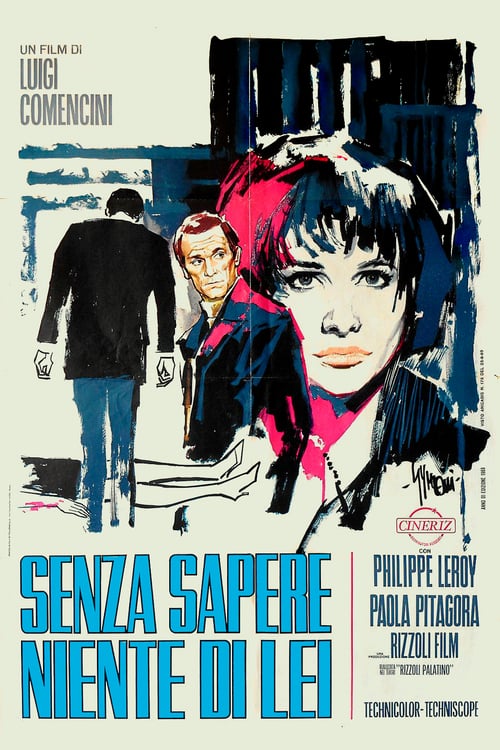
Senza Sapere Niente Di Lei (1969)

In my quest to watch giallo that not many have and bring them to you, dear reader, I’ve been looking into the pre-Argento years and I’ve discovered this one, known in America as Without Knowing Anything About Her.

An old woman dies before the expiration of her life insurance policy and a lawyer (Philippe Leroy) investigates, but ends up falling in love with her daughter, played by Paola Pitagora. His intentions aren’t good, but neither are hers.

This is less in the shadows, light on the murder and has plenty of Milan scenery and a Morricone score to liven things up, plus an ambiguous ending that comes out of nowhere and is pretty awesome. It’s not perfect, but if you’re seeking something different, here it is.

You can watch this on YouTube.

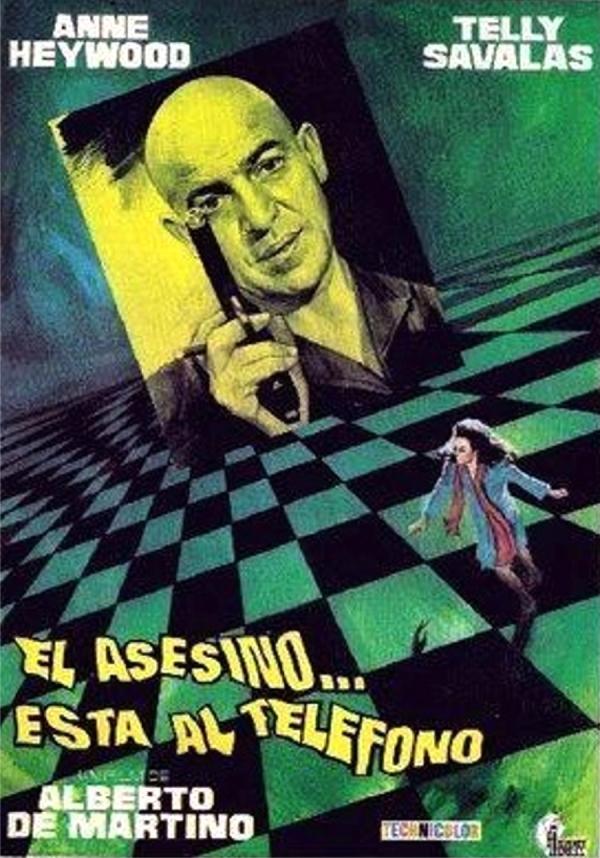
The Killer Is On the Phone (1972)

Man, two Alberto De Martino giallo movies in one week? You know it.

I’ll be honest right off the bat. I’d watch a movie where Telly Savalas just sat there and read a menu for two hours, so I’m not going to be objective about this movie at all.

Telly plays Ranko Drasovic, a silent knife-wielding assassin dispatched to kill a UN ambassador trying to stop the oil crisis, which is pretty forward thinking way back in 1972. He also is trying to fulfill another assignment, because one of the few people who has ever seen his face is actress Eleonor Loraine (Anne Heywood, The Fox), as Ranko had killed her lover five years before.

Now, she’s a mess, her head filled with flashbacks which might not be true and lovers she may have never slept with. All she sees is the face of Ranko, a man constantly in the shadows, always one step away from taking her life.

I actually liked this movie more than most critics, as unlike many giallo, it ends with the female lead taking agency over her fragmented life, destroying her many enemies and reclaiming her sanity. It’s a rare positive ending for a giallo heroine, you know?

That said, the direction is just good where it could be great, but any time women appear on screen, the camera seems to perk up and the shots end up getting more inventive. That’s because Aristide Massaccesi is the cinematographer, the man who would one day be Joe D’Amato. And David Hills. And Michael Wotruba. And Raf Donato. And Robert Yip. And…

The alternate title, Scenes from a Murder, isn’t as evocative, but makes plenty more sense. Ranko never calls anyone. He does spend plenty of time buying tin soldiers, which also makes no sense.

Hey — giallo aren’t supposed to make sense. Remember that, love every scene Telly is in and you’ll be fine. Who loves you baby?

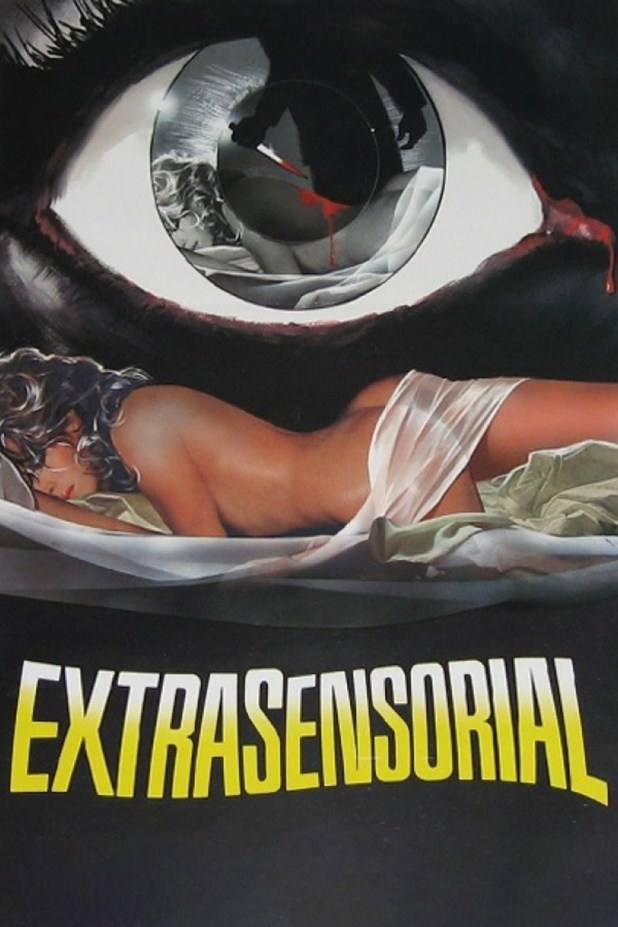
Extrasensorial (1982)

Despite the worries of this past year and my normal thoughts that this is existence can be a prison, the truth is that the world can be a magical place at times. Case in point, I just learned that one of my favorite actors, Michael Moriarty, made a giallo with one of the great ripoff artists, Alberto De Martino. Who knew?

Beyond making movies that take a Hollywood idea and going wild with his own craziness — witness The AntichristOK ConneryHolocaust 2000 — this movie goes so far to feature a poster that blatantly lifts from The New York Ripper.

Credit Meathook Cinema (https://meathookcinema.com/2020/10/02/31-days-of-halloween-2020-day-1-blood-link-1982-out-of/) who pointed this out. The poster may be ripped off, but I’m not stealing their find.

Michael Moriarty plays Craig Manning, a doctor who has visions of women being killed somewhere in Germany by someone who he believes is his thought burned to death twin brother Keith — yes, also played by Moriarty — who he feels that he must stop, despite his girlfriend Julie (Penelope Milford, Coming Home).

How can we make this more of a movie that I’d enjoy? By having Cameron Mitchell play an ex-boxer goaded into a boxing match that Keith kills him in, that’s how. The good twin falls for Mitchell’s daughter. After they aardvark, the bad twin shows up, kills her and lets his brother take the blame for all the killing.

I totally love the ending of this, which leaves it up in the air whether or not Keith had psychic control over Craig, or whether he is calling to him from the grave, or whether they’re all insane or if — my personal feeling — is that there was only one of them all along.

Made in Germany with an all-Italian crew and a Morricone score, this is the kind of movie that you’d rent when the store was closing and the sales clerks were looking annoyed and then when you watched it, you’d be the only one of your friends who liked it and then for years, they’d all make fun of you for enjoying it so much. Hey — it has Moriarty and Mitchell, two guys I thought I’d never see in a movie together. To be fair, when you make as many movies as Mitchell did, those odds aren’t all that high.

You can watch this on YouTube.

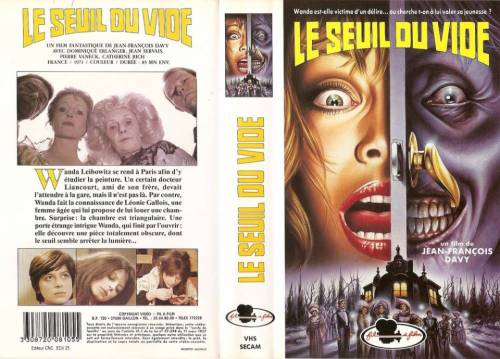
Le Seuil Du Vide (1972)

Threshold of the Void is all about an artist named Wanda Leibovitz who comes to Paris to escape heartbreak, only to find a room for rent — once kept for the dead sister of her landlord, now containing a forbidden door — that will dominate her life.

Of course, Wanda is told that she can’t ever open that door, but she does, and once she experiences the  exquisite unending blackness of that room, she learns that she can paint better than she ever has in her life. That said, she now feels like she’s dying and that all of the people in her life — like her landlady and her brother’s friend Dr. Liancourt — are not what they seem.

When Michel Lemoine (he directed and starred in Seven Women for Satan and also appears in Castle of the Creeping Flesh) is in a movie, nothing normal is about to happen. This is kind of 70’s slow creeping burn — think Rosemary’s Baby and Don’t Look Now — and proves to me that that decade was the most downer ten years of all time.

Director Jean-François Davy’s career is mostly in adult, with movies like Wife Swapping: French Style and Infidélités to his credit. But this one, well, he’s making an art film that I guess you could call a giallo just because it really doesn’t fit any other category.

Based on an André Ruellan’s novel — the author also wrote the script — this is the kind of forgotten movie that once it comes out on blu ray will blow people’s minds.

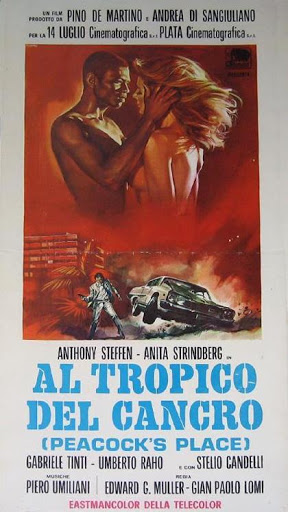
Al Tropico del Cancro (1972)

Anita Strindberg is in Your Vice Is a Locked Room and Only I Have the KeyA Lizard in a Woman’s SkinThe Case of the Scorpion’s TailWho Saw Her Die?, The Two Faces of Fear, L’uomo Senza Memoria and Murder Obsession, but is never mentioned with the same devotion as Edwige Fenech or Barbara Bouchet. Well, she’s great in this and in nearly everything else I’ve seen her in.

In this film, she plays Grace, the wife of Fred (Gabriele Tinti, Endgame) and their vacation has led them to Haiti and Dr. Williams (Anthony Steffen, who mostly is known for Italian westerns, but also appeared in The Night Evelyn Came Out of Her GraveEvil Eye and An Angel for Satan), who has invented a new drug that can change the world. It’s so astounding that everyone from drug cartels to drug companies — which are really close to one another, when you really think about it — will kill for its formula.

There’s also a scene where the doctor takes our heroes to watch a voodoo ritual, all so this movie can have a bit of mondo* within it. Because it’s an Italian film, that means we’re about to watch a real bull really get killed and then lose its scrotum in gorgeous living color. The film then tops this with actual cows being slaughtered, so if you’re upset by the side of Italian cinema that doesn’t shy away from putting animal butchery right in your face, make a mark to avoid.

This movie leaves me with so many questions. What kind of doctor is Williams? He says he’s a veterinarian, then he makes a magical anti-venom drug and oh yeah, he’s also a meat packing inspector. And just what kind of wonder drug has he made? And did the filmmakers realize that the Tropic of Cancer is nowhere near Haiti?**

So yeah — most of the movie is spent wondering whether or not Grace is going to succumb to the lure of the native men***. And the best character in it is Peacock (Alfio Nicolosi, who was also in Goodbye Uncle Tom), who pretty much runs the island. Also, the murders in this go from high tech to voodoo-based death and faces getting melted right off, which is different for a giallo****.

And hey — that Piero Umiliani (Orgasmo, Baba Yaga) score is perfect!

It’s not a great giallo, but it certainly is weird, and sometimes, that’s good enough.

*One of the directors of this film, Giampaolo Lomi, was the production manager for perhaps one of the most notorious mondo films, Goodbye Uncle Tom. The other, Edoardo Mulargia, directed Escape from Hell, which was edited into the Linda Blair movie Savage Island. So with backgrounds like those, the scummy mondo nature of this film makes a bit more sense.

*Of course, we can assume that with the Henry Miller novel being such a big deal getting banned and causing controversy that the title itself seemed like a good idea to get curious folks into the theater. Better than Death In HaitiPeacock’s Place or Inferno Under the Hot Sun.

***The flower that poisons her takes her on an insane erotic fever dream that we all get to watch and the movie is better for this scene.

****There’s just as much — if not more — male than female nudity, too.

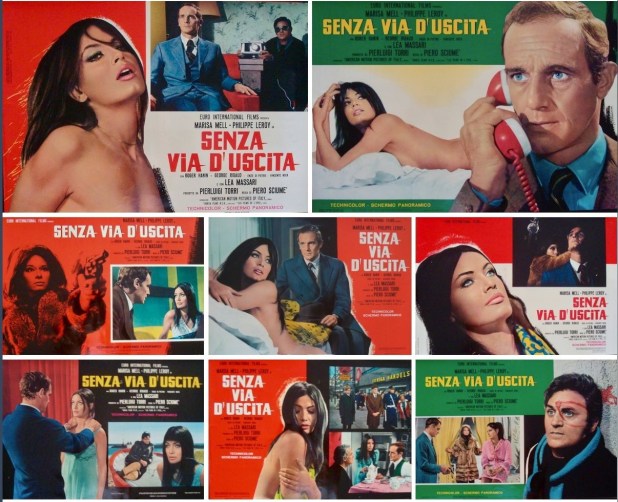
Senza via d’uscita (1971)

Translated as No Way Out, this movie is also known as Devil’s RansomLa MachinationTerroriThe VictimsDiabolicalThe Devil and His Diabolical Mistress and Photos of a Decent Woman. 

While this was sold to me as a giallo, it feels closer to a krimini film, as the genre had not yet fully begun to ape — bird? cat? — Argento yet.

Gilbert Mardeau (Philippe Leroy) is a bank courier stuck in a loveless marriage with Michele (Marisa Mell, so obviously this is science fiction because Marisa Mell is literally the entire reason why I have suffered through some movies). He has a woman on the side (Lea Massari, who no offense, but is a major step down) and a problem: someone has kidnapped his son and wants big money or he’ll never see him alive again.

Piero Sciumé only directed one more and this is it. It’s definitely not a straight-up black gloved, knife wielding killer movie, but the end has some nice psychedelic visuals, Mell is actually really solid as the mother driven to do unspeakable things and setting it in Stockholm is an interesting change of pace.

Obviously, for giallo completists only, but if you read this far, look in the mirror and realize that yes, you are one.