Beginning of the End (1957)

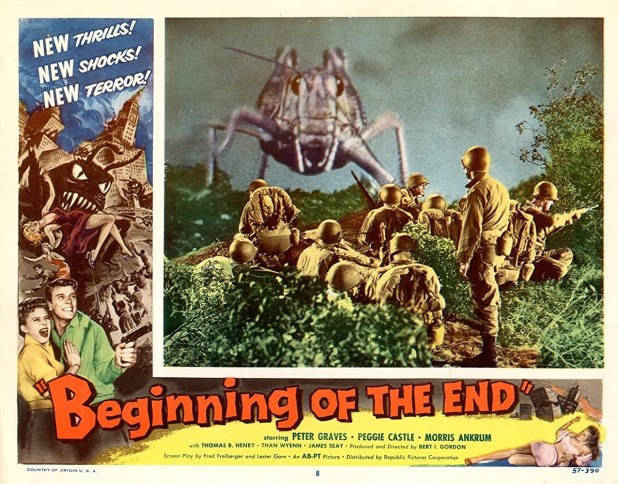
American Broadcasting-Paramount Theatres, or Am-Par, decided to create their own film studio to make low-budget movies that they could place into their theaters, signing a deal with Republic Pictures to make them. And after the success of Them!, who else but Burt I. Gordon to make more giant bug movies?

Gordon did the effects by himself in his garage, bringing the magic effect he used for King Dinosaur: grab some animals and shoot them in front of a still photo. So he grabbed 200 non-hopping, non-flying live grasshoppers in Waco, Texas and brought them to California. At that point, the agriculture department got involved and somehow, only 12 grasshoppers live after they all turned into cannibals. One would assume the dozen that are in this movie are the toughest ones of all time.

That said, the film’s title was prophetic. For some reason, the studio stopped making films. Luckily for Gordon, he landed at American-International Picture where he kept making giant movies. The Amazing Colossal Man was next.

There’s a decent cast in this, with Peter Graves* as the scientist who uses radiation to better grow crops until some crazy locusts eat it all and — you guessed it — get big as well. Peggie Castle, Miss Cheesecake of 1949, was born for films like this and Invasion U.S.A. It also seems like character actor Morris Ankrum was a lock for nearly any science fiction film of this time, as he made Rocketship X-MFlight to MarsRed Planet MarsInvaders from MarsEarth vs. the Flying SaucersFrom the Earth to the Moon and this movie in the 50’s.

*Whose brother James Arness was in Them!

You can watch this on YouTube.

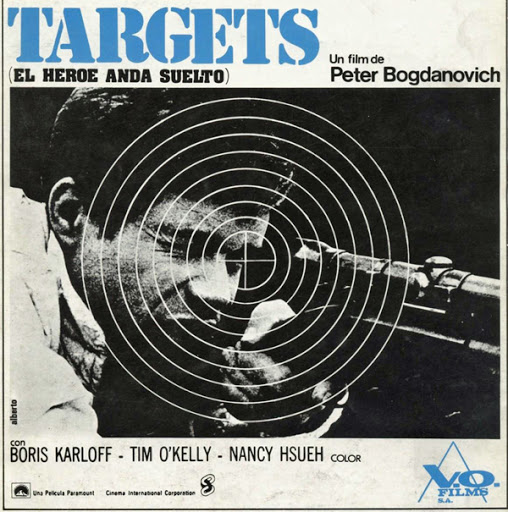
Targets (1968)

Peter Bogdonovich may have debuted by fixing up a movie for Roger Corman called Voyage to the Planet of Prehistoric Women, but Targets was his first film. He directed, co-written and co-produced a movie that does not feel like the work of an inexperienced filmmaker.

Maybe it was because he had been studying. As the film programmer for the Museum of Modern Art in New York City, he saw up to 400 movies a year.

Byron Orlok (Boris Karloff) sees no reason to be in horror films any longer. The news on TV every night is way more frightening than any film he can conjure. However, as a favor to a young director named Sammy Michaels (Bogdanovich), he will make one more appearance at a drive-in before leaving for his native England.

Bobby Thompson is an insurance agent and Vietnam War veteran who snaps. One morning, he decides to start killing, taking out his wife, mother and a delivery boy before climbing an oil tower to kill people in passing cars before heading to the very same drive-in that Orlok will appear at.

As Orlok’s final film is shown, Thompson begins murdering more people. However, as the elderly actor appears on screen and in-person, Orlak smacks him down with his walking cane, giving the police the opening they need to arrest him.

I love the concept of this film: it exists in the middle of two eras, with Karloff as the last remaining Universal Monster, coming up against the cynical and all too real evil that the New Hollywood would use as monsters.

While Thompson is based on Charles Whitman, Orlok isn’t anything like Karloff. Instead of being tired after years of acting and angry that he was only known for horror, Karloff was proud of his legacy.

The actor was in ill health. He had emphysema along with rheumatoid arthritis, with only one half of a lung still functioning. Years of abuse to his body wearing the heavy Frankenstein’s Monster makeup led to braces on both his legs, as well as the need to use a cane.

While this would be his last major film, he’d keep working, making films like Curse of the Crimson AltarFear ChamberHouse of EvilCauldron of BloodAlien Terror and Isle of the Snake People.

Bogdanovich only got to make this because Boris Karloff owed Roger Corman two days’ work. Corman told the young director that he could make any film he liked provided he used Karloff and stayed under budget. What really speaks to the actor is that even though he was only supposed to do two days work, he was so impressed with the script that he refused pay for the three additional days of work he did to complete the film.

Writing about the film for the New Beverly Cinema, Quentin Tarantino said, that Targets was “the most political movie Corman ever made since The Intruder. And forty years later it’s still one of the strongest cries for gun control in American cinema. The film isn’t a thriller with a social commentary buried inside of it (the normal Corman model), it’s a social commentary with a thriller buried inside of it… It was one of the most powerful films of 1968 and one of the greatest directorial debuts of all time. And I believe the best film ever produced by Roger Corman.”

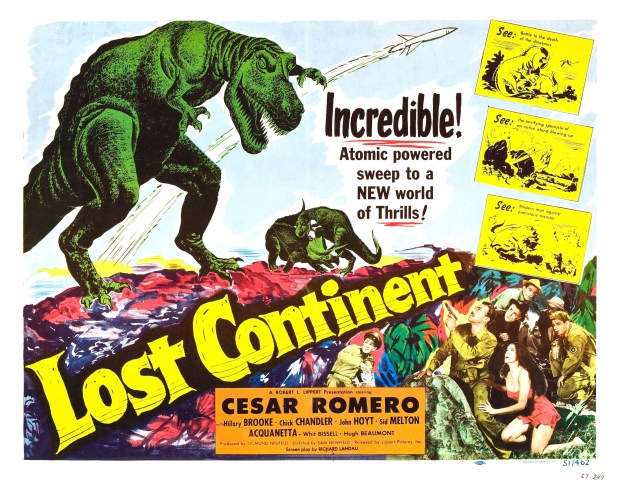
Lost Continent (1951)

Maj. Joe Nolan (Cesar Romero, the only Joker never to shave), Lt. Danny Wilson (Chick Chandler) and Sgt. William Tatlow (Sid Melton, Alf Monroe from Green Acres) and three scientists — Stanley Briggs (Whit Bissell, the undertaker in The Magnificent Seven), Robert Phillips (Hugh Beaumont from Leave It to Beaver) and Russian Michael Rostov (John Hoyt, Flesh Gordon) — are headed out to find an atomic rocket that has crashed in the South Pacific.

Spoiler: they find dinosaurs.

Yes, if you want to see a movie where dinosaurs wipe out a team of smart men and military guys, by all means, Lost Continent is the movie for you.

You’ve got Ward Cleaver being brutalized by a brontosaurus and a triceratops goring one of the team members, who eventually get back at the dinos by shooting a pterosaur for food. If this was an Italian movie, that would have been a real pterodactyl and we would have watched one of the natives hack at it with a dull machete.

Also, if you like rock climbing and tinting a black and white film green so that it doesn’t seem dated or uncool, then you’re also going to love this.

Director Sam Newfield has 277 directorial credits on his IMDB page, among them Radar Secret Service and I Accuse My Parents. In fact, he made so many movies that he also used the names Peter Stewart and Sherman Scott to hide the sheer amount of films that he directed. He’s considered to be the most prolific film director in the history of American film and some believe that his final number of movies could be well over three hundred projects thanks to his industrial promotional one-reelers, training films, comedy shorts, TV series episodes, full-length features and the very same TV series episodes that were padded into full-length features.

Sadly, all of this work came from the fact that Sam suffered from a serious gambling addiction, making him poor for most of his life and even breaking up his marriage. After thirty years of directing, he was so broke that his brother Sigmund, the head of PRC Pictures, paid off all his debts and gave him a place to live for the last six years of his life. After all, he’d only paid him $500 a movie for years, so it was the least that he could do.

The Mask (1961)

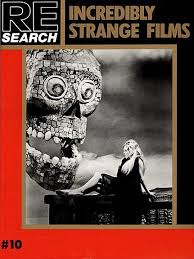
When I was just getting really into psychotronic film, I was obsessed with the RE/Search book Incredibly Strange Films. It’s where I learned all about obsessions like Blast of SilenceSpider BabyGod Told Me To and the movies of Russ Meyer, Herschell Gordon Lewis, David F. Friedman, Ed Wood, Radley Metzger, Ray Dennis Steckler, Ted V. Mikels and many more. If you don’t have a copy, I find it indispensable even in today’s internet era.

The cover of that guide had a photo of The Mask, AKA Eyes of Hell, that blew me away. It’s at the same time so goofy looking and yet so sinister, like a piece of outlaw art ready to steal your soul.

It’s taken me around thirty years to get around to watching this movie, because I was sure that it could never live up to that image. Guess what? It’s even better.

The story itself is pretty simple. Dr. Allen Barnes (Paul Stevens, Battle for the Planet of the Apes, The Black Six) has just received a tribal mask from one of his patients who has committed suicide. Whenever he puts on the mask — which demands to be worn — he goes into a trance with visions that become more violent, like some lo-fi version of Videodrome.

The thing is, how that story is told is astounding. The dream sequences shift to 3D, with some of the most bizarre imagery to ever appear in a studio picture, seeing as how this was put out by Warner Brothers. This wasn’t some movie they hid, either. It had a ton of hype behind it and patrons even got a pair of Magic Mystic Masks to see the other world with.

The majority of the movie is just fine, but much like any time a giant monster walks into a Toho film, the movie comes alive any time you hear a voice say, “Put on The Mask!” That’s when things get out of control, with fog, flame and pseudo-occult rituals filling every part of the screen. Seriously, just wait until you see just how wild this movie gets. Somehow, it’s a drug movie in 1961 with practical effects that blows anything made today with full technology out of the ozone.

Director Julian Roffman would go on to write and produce The Glove, as well as produce another startling strange movie, The Pyx. He can claim that he made Canada’s first horror movie, of the country’s first films to be exported to the United States and its only 3D movie, too.

You can get this from Kino Lorber.

Invasion, U.S.A. (1952)

Invasion, U.S.A. was the second film from American Pictures Corporation, who had just made their first film, Captive Women. The company was made up of Albert Zugsmith (Girls Town, the bizarre The Chinese Room), Peter Miller, Aubrey Wisberg  (who would write Hercules In New York) and Jack Pollexfen (Indestructible Man) with Joseph Justman as the producer. Their plan was to make six films a year and for this one, they worked alongside the U.S. Civil Defense to make a film that would prepare people for the horrors of nuclear war. It even boasted the alternate title The Complacent Americans and If the Bomb Falls: A Recorded Guide to Survival.

The film takes place in a New York City bar, where Mr. Ohman (yes, that’s Conal Cochran himself, Dan O’Herlihy) is trying to explain to a group of well-to-do Americans, including TV anchorman Vince Potter (Gerald Mohr, The Angry Red Planet and the voice of Reed Richards on the original Marvel cartoons that barely moved), an industrialist, a rancher, a Congressman and a society girl (Peggie Castle, TV’s Lawman and Beginning of the End). None of them are against Communism and just want to enjoy the spoils of living in America.

Within oh, 74 minutes, their lives go to Hell as troops land in Alaska while atomic blasts rock America’s cities. Every single one of them dies horribly, even if the TV announcer and rich girl fall in love, as he’s shot on the air and she leaps to her doom from a balcony. Luckily, everyone had been in a trance and as we see our heroine fall into a glass of brandy, Ohman releases everyone. Now they know what Americans need to do — which is ironically pitch in and work for the needs of the collective instead of individual needs, which sounds a lot like Communism, which makes sense, because now we live in a country where anti-fascism is referred to as fascism and no one really knows what socialism means.

Politics aside, this movie features two actresses that played Lois Lane (Phyllis Coates and Noel Neill), Clarence A. Shoop (beyond being a Two-Star General, Shoop was the technical advisor on a number of films including So Proudly We Hail!, One Minute to Zero and Jet Pilot, as well as being on The Bob Cummings Show, as he was Cummings base commander while the actor was a pilot; he was also a Vice President at Hughes Aircraft and definitely saw an alien at some point, right?), Edward G. Robinson Jr. and voice-over star Know Manning (who told kids all over America the dangers of, well, everything in She Shoulda Said No!).

You can watch this on Tubi.

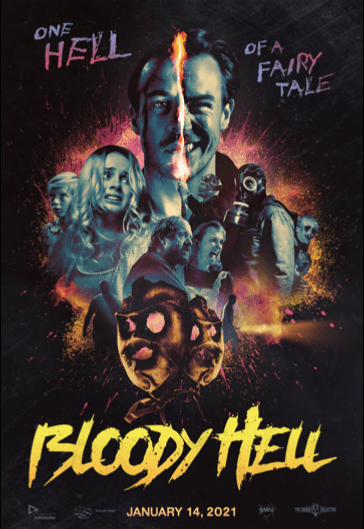
Bloody Hell (2021)

Bloody Hell is an absolute blast.

I have no fancy words to add, really — I’ll try — but I was absorbed by every twist and turn of this movie.

From its description, “A man with a mysterious past flees the country to escape his own personal hell… only to arrive somewhere much, much, much worse,” I wasn’t expecting all that much. Imagine my surprise when I was on the edge of my seat from frame one.

Rex (Ben O’Toole, Nekrotronic) is a hero to some and a villain to others. That’s because when fate literally fell into his lap during a bank heist, he went over the top wiping out all of the masked criminals, which may or may not have led to the death of one innocent bystander. So imagine his surprise when he has to spend five years in jail, which all seem to lead him to a horrific destiny somewhere in Finland. After all, he wants away from the press and the constant attention he gets everywhere he goes.

Well, the attention doesn’t stop once he arrives. That’s because he’s become the next meal of a family of cannibals that are more Von Trapp than Sawyer family. They’ve already taken one of our hero’s legs and if he stays around too long, that would be all they eat.

Rex has two people on his side — maybe. One is the voice inside his head, which is sarcastic and cruel at times, but does have a vested interest in both of them getting out of Helsinki alive. The other is the black sheep of the family who has kidnapped him, Alia (Meg Fraser). But can she escape the family she has cared for her entire life? And will she run off with a man she barely knows who only has one good leg?

Bloody Hell is a movie in love with film, referencing and quoting so many other movies along the way, but in a way that celebrates the joy of movies instead of making you want to go back and watch something else.

Bloody Hell is now available right here and is also on Shudder.

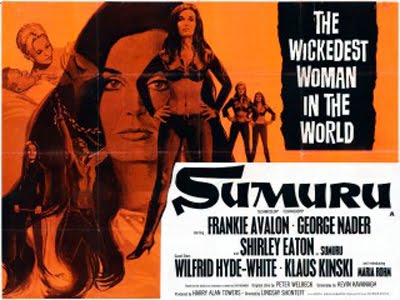
REPOST: The Million Eyes of Sumuru (1967)

EDITOR’S NOTE: This film and its Jess Franco-directed sequel The Girl from Rio, as well as the 2003 movie Sumaru, are all based on Sax Rohmer’s Sumuru, who leads the Order of Our Lady, a secret society that recruits beautiful women from around the world and teaches them how to seduce and exploit men, all with the goal of establishing a matriarchal world order. 

If there’s a Venn diagram of what I love in movies, this movie would be at the center of it. It’s directed by Lindsay Shonteff, who was behind so many spy films and other moments of outright cinema lunacy like Night After Night After Night. It was filmed at the Shaw Brothers studios in Hong Kong. And it was produced by Harry Alan Towers, whose life included moments of bringing rock and roll to Europe, making Fu Manchu movies and oh yeah, running a vice ring. To top it all off, it’s a movie about an army of women ready to take over the world.

Sumuru is a woman as gorgeous as she is cunning, using an all-female army to kill off world leaders — like Klaus Kinski as President Boong of Sinoseia! — and replace them with more capable women. I really have no issues with her plan, her choice of henchwomen or Shirley Eaton in this role (she was also Jill Masterson in Goldfinger).

Nick West (Frankie Avalon!) and Tommy Carter (George Nader, Robot Monster) are on the case, particularly after Sumuru frames Nick for murder.

Krista Nell (The Bloodsucker Leads the Dance), Maria Rohm (Towers’ wife, who would end up being in all manner of Jess Franco films) and Essie Lin Chia (Return of the One-Armed Swordsman) all make appearances.

You can watch this on Amazon Prime and Tubi. It’s also available from Blue Underground.

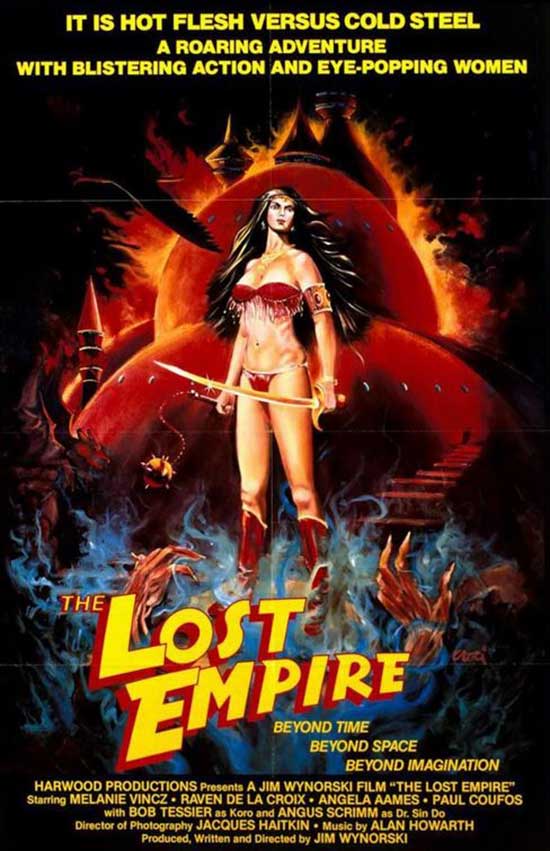
The Lost Empire (1984)

I’m always saying I’m not a fan of Jim Wynorski’s movies and then find myself realizing that yes, I like several of his films.

The director may have flunked out of film school, but he turned an introduction to Roger Corman into a career and a chance to write scripts, starting with one of my favorite Corman science fiction films, Forbidden World, and moving on to SorceressScrewballsBeastmaster 2: Through the Portal of Time and so many more.

This is the movie that he started directing with, also making Chopping MallDeathstalker IIBig Bad Mama IISorority House Massacre II and III, Return of the Swamp Thing and 976-EVIL II, which is another film of his that yes, I admit that I enjoy. I even like his Cinemax After Dark movies like the Body Chemistry sequels as well as stuff like Munchie.

So alright. I like his movies. I’ve learned something. I can even respect that he’s gone the way of most horror directors of my youth, alternating between children’s movies like A Doggone Christmas and A Doggone Hollywood with the softcore stuff he’s known for, SyFy-style creature movies and weirdness like Sharkansas Women’s Prison Massacre.

But if every movie Wynorski made was like The Lost Empire? He’d probably be one of my favorite directors.

We start in Chinatown, where three masked intruders try to steal the glowing eye of a statue. Everyone dies in the battle except for one cop who barely makes it. And then, the next day, terrorists take over a school before Inspector Angel Wolfe (Melanie Vincz, Hunk) takes out everyone, which almost includes an undercover fed named Rick Stanton (Paul Coufos, 976-EVIL II). Luckily, she stops from killing him just in time and then, as is customary in police and federal working relationships, they aardvark.

When they wake up the next morning, Angel and Rick learn that her brother Rob (Bill Thornbury, Jody from Phantasm!) was the police officer who survived the jewelry store shootout. In the hospital, he hands her a throwing star and says, “The Devil exists and the Eye knows where.” Instead of being freaked out, Rick launches into exposition mode to tell us all about Lee Chuck (when I realized this was Angus Scrimm, I lost my mind), a man who has become immortal yet must give Satan a new soul every day.

Keep in mind that we are about fifteen minutes into this movie and we’ve already had a cop versus ninja battle, terrorists fighting a lone cop, a sex scene and an occult backstory. I already was head over heels for this one.

When Angel examines the crime scene, one of the glowing eyes makes its way into her purse — all on its own — before Inspector Charles Chang (Art Hern, Simon King of the Witches) goes into even more exposition, explaining the Eyes of Avatar, two jewels that the Dragon-God blessed with the power to rule the world. He tells her that Lee Chuck is real, has one of the eyes and has joined up with the cult of Dr. Sin Do (also Angus Scrimm!).

With her brother dying from his wounds, Angel decides that she must destroy Sin Do, who has begun recruiting an army of terrorists, including Anthony Kiedis’ dad Blackie Dammit and Angel Pettijohn as Whiplash. So she does what any of us would. No, she doesn’t file the paperwork to get a task force and multiple police and federal units involved. She instead learns that Dr. Do — no relation to the video game character Mr. Do, although both have castles — only accepts groups of female soldiers in threes. And that means that she has to bring in her old friend, the Native American supersoldier Whitestar (Raven De La Croix, perhaps the greatest of all Russ Meyer’s women next to Tura Satana; she was also the associate producer, costume designer and animal handler of this movie while doing all of her own stunts) and Heather (Angela Aames, Fairy TalesH.O.T.S.), a convict who she promises to parole — how does she have that power? — if she helps like some nascent version of the Suicide Squad.

Whatever. Logic be damned, the ladies are off for Golgotha, Dr. Do’s castle fortress, where more ninja battles and a cast that includes Robert Tessier (who was one of the four members of Stunts Unlimited along with Hal Needham, Glenn R. Wilder and Ronnie Rondell Jr.), Linda Shayne (Miss Salmon from Humanoids from the Deep who would go on to direct Purple People Eater), Kenneth Tobey (who was in so many movies, like the original The ThingDirty Mary Crazy LarryThe Howling and more), Anny Gaybis (who was in a movie with one of my favorite titles, Wam Bam Thank You Spaceman!) and Tommy Rettig (Jeff Miller from the Lassie series and the star of one of the strangest movies to ever escape Hollywood, The 5,000 Fingers of Dr. T) await.

I mean, this movie is so close to being in the same continuity as Big Trouble In Little China that Alan Howarth did the music for it. I’ll go ever further and say that thanks to Blackie Dammit being in it, it might even be in the same universe as 9 Deaths of the Ninja. It’s a total blast, a movie that is somehow the answer to the unasked question, “What if Russ Meyer directed Enter the Dragon?”

This is definitely the movie to put on if you’re down. I mean, how can you be sad after watching a movie where Angus Scrimm’s bad guy character has a giant snake and can survive losing his head, much less one that features a prison shower flashback just to prove that one of the heroines was in jail at one point and hints that Raven De La Croix has supernatural powers? We’re going to have to go through a black hole and out the other side to create new stars to come up with how many I’d give this movie.
Calmos (1976)

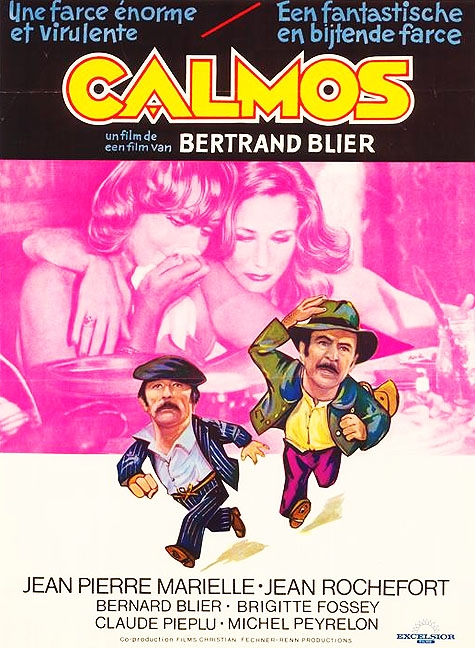
Also known as Femmes Fatales, this Bertrand Blier-directed film presents a satire of both the rise of feminism in France and the traditional attitudes of Frenchmen.

Paul (Jean-Pierre Marielle, The DaVinci Code) is a married gynecologist who has grown sick of looking at women’s bodies. As he runs from his office into the street, he meets Albert (Jean Rochefort, who narrated the French versions of Disney’s Pooh movies). Realizing that they both want the same things in life, they leave town for a small village where they eat and drink away from their wives.

The village priest, who they bring into their world of food and wine, soon takes the side of their wives (Brigitte Fossey from Quintet is one of them) and forces them back to Paris and anything but marital bliss.

Here’s where things get weird.

After weeks of freedom, our heroes — such as they are — run away from the demands of their wives and hide at a farm. They’re soon joined by hundreds of men who want to get away from the demands of their feminist wives.

That’s when an army of women attacks, with a captain who demands that Paul and Albert pleasure all of them before she lets them go. They make a run for it before they are taken back to Paris, operated on and forced to have sex with woman after woman.

Somehow, after all that, they are shrunk down to miniature size and taken to an island, where they fly hang gliders directly into the anatomy of a woman. The end.

I really struggled to figure out what Blier wanted me to feel here. Is it just a joke, all a laugh about the fact that women finally had control of their bodies and may want to initiate sex more often than men, which is a major reversal in the ways of the world in 1976? Then why is every woman in this an amazon obsessed with having sex with men in their late 40’s (as someone who is 48, this is not a complaint as much as an observation)? Is the inversion of the way men treat women any better than the alternative?

I know that I should probably just be laughing or titillated, but I’m just confused.

Cannibal Women in the Avocado Jungle of Death (1989)

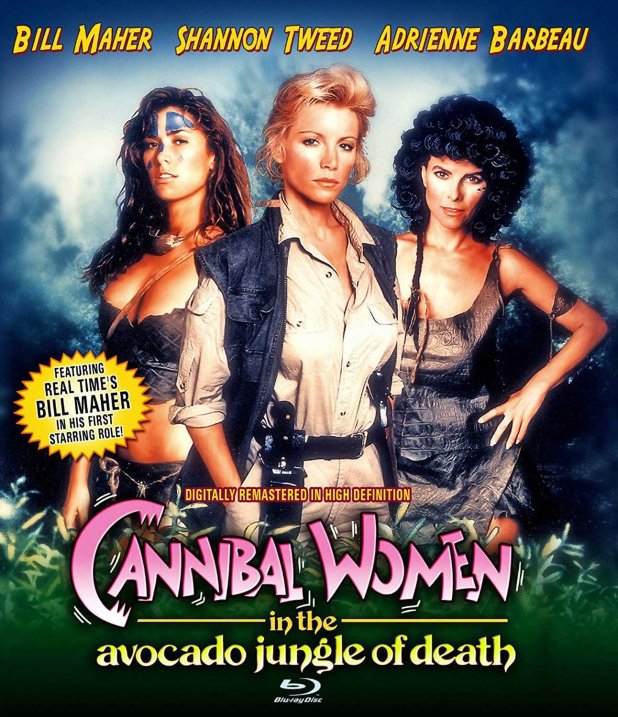
How weird is it when Bill Maher shows up in a movie and you don’t expect it? Like his roles in D.C. Cab or Pizza Man? Or when he shows up in the party scenes of Ratboy and House II?  But would you ever expect him to play the Indiana Jones of a jungle adventure movie?

The government is worried that our nation’s avocado supply is low — spoiler warning, this has happened several times, including once when I nearly got to make a post-apocalyptic Commerical for Wholly Guacamole before the price increases of avocado attacked that company’s fortunes — because of the Piranha cannibal women who live in the mysterious avocado jungles of San Bernardino. Well, they don’t eat women. They only eat men. So the powers that be send Professor Margo Hunt (Shannon Tweed), jungle guide Jim (Maher) and Bunny, an undergraduate student.

Along the way, they meet the men who serve the Piranhas — known as the Donnahews* — and learn that the last professor who went into the jungle — Dr. Kurtz (Adrienne Barbeau) — has gone feral and become the queen of the cannibals. This makes the second female society movie this week that Ms. Barbeau features in as the leader of women while also the first where her name is a Joseph Conrad joke. At least she got to kidnap Sir Arthur Conan Doyle in Burial of the Rats.

There’s also another tribe of cannibal women, the Barracuda Women, and their main argument with the Avocado Women is over what condiment — clam dip or guacamole — goes best with male flesh.

Director J. F. Lawton would go on to write Pretty WomanUnder SiegeBlankman and create the Pam Anderson series V.I.P. Oh yeah, he also wrote the video game adaption Dead or Alive, the only one of those movies to feature a cast that includes Eric Roberts and Kevin Nash, who should definitely make a buddy cop movie together.

It’s pretty astounding that a movie that should totally be a softcore junk movie can somehow be an exploration of feminism while making fun of Cannibal Holocaust and have a character named after Conrad collaborator Ford Maddox Ford. It’s also a movie that dares to feature Shannon Tweed as a feminist professor and theorizes that there are light and dark sides to feminism, as if it is The Force.

You can watch this on Tubi.

*In 1989, this joke would have made sense, as it refers to Phil Donahue, whose feminist-slanted TV show really pushed that men should become more emotional. It wouldn’t be funny, but at least it would have made more sense.