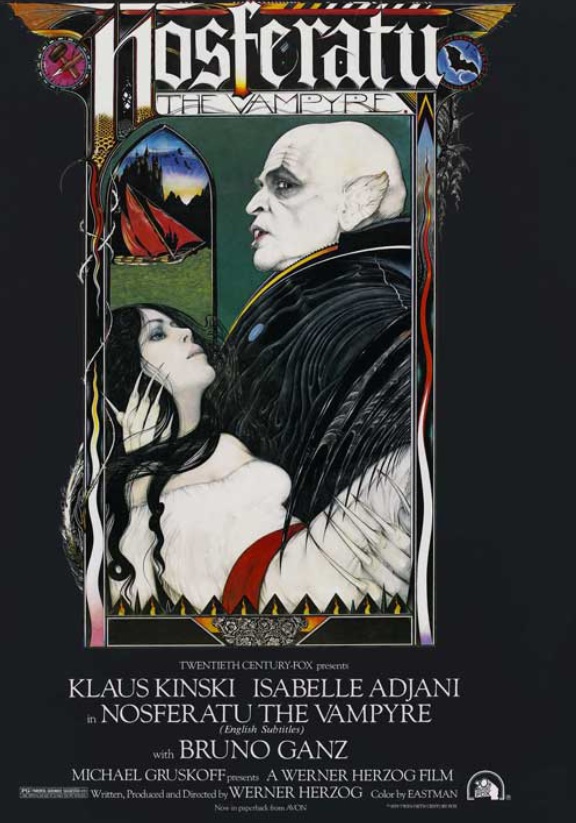
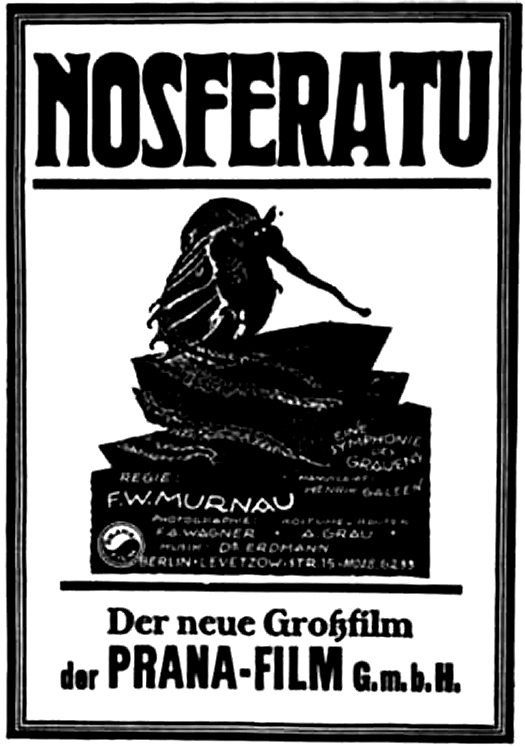
This second of five Herzog-Kinski romps* is an impressionist-stylized remake of F.W. Murnau’s unauthorized, 1922 black-and-white silent adaptation of Bram Stoker’s Dracula (loosely chronicled in the drama Shadow of the Vampire). But how did Herzog manage to make this film without the same copyright issues that plagued Murnau’s version? Simple. The day the copyright expired on Stoker’s novel and entered the public domain, Herzog began his adaptation.
As with all of Herzog’s films, this is scored by the West German progressive rock group Popol Vuh who, when it comes to soundtracks, are that country’s greatest musical export, next to the commercially better known Tangerine Dream**. And as with Tangerine Dream, Popol Vuh released both independent studio albums and soundtracks. Seriously. The soundtrack is incredible. (I played the album until it split apart like a cinnamon roll.)
The original Murnau film.
And we’ll leave it at that, as Sammy P, the bossman at B&S About Movies, did a commendable job at reviewing this masterpiece of horror. No disrespect to Max Schreck who scared the sand out of me, but Kinski giving a “voice” to the character really ups the game. A highly recommended horror watch if there ever was one. You know me and Kinski.
You can watch this as a free-with-ads stream on TubiTv. And Kinski made a pseudo-sequel with Christopher Plummer and Donald Pleasence in Italy—1988’s Nosferatu in Venice, which you can also stream for free on TubiTV. You can see Sam’s take on the film from 2019, HERE.
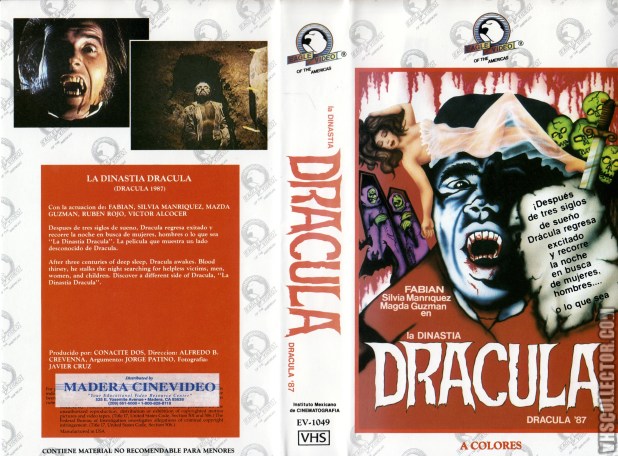
Here, he tells the story of Duke Antonio de Orloff, who starts the film as a dog before Holy Water is thrown on him. He’s led through the streets by a priest, who then stakes him and buries him. Luckily for our vampire — and this movie — he’s rescued 300 years later by Madame Kostoff (Erika Carlsson, The Devil’s Rain!, Demonoid, Muerte Infernal), who attempts to take the land that he is buried on.
If you can imagine a Hammer film made in 1980 in Mexico, then you understand the movie that is The Dracula Dynasty. Also, these vampires have a healthy command of the occult arts, having given their souls over to Satan. Oh yeah — in addition to wanting to bring back Orloff, Kostoff has brought Dracula himself — using the name Baron Von Helsing! — to town to drink all the victims that he’d like.
The main reason why I sought this out was that some sources list the male lead as Fabian. However, it’s not Fabian Forte, but Mexican actor Fabian Aranza. The idea that crooner Fabian was battling South of the Border blooddrinkers is way too much for my mind to bear.
As Dracula and Kostoff attempt to bring Orloff back to the land of the living on Walpurgis Night — paging Paul Naschy! — Mexican Fabian and a priest suddenly decide to turn the last part of this movie into The Exorcist.
God bless Eagle Video, whose pendant logo fills the screen. It appears that you only released the best in junk.
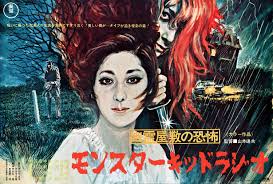
Michio Yamamoto was the assistant director on Throne of Blood and second unit on the Mifune film Shogun Assassin before creating a trilogy of bloodsucker thrills for Toho*, the same studio that gifted us with Godzilla. It comes in the wake of Hammer’s Technicolor remakes of classic horror films like Horror of Dracula, a movie which was a big deal in Japan. In fact, the original ending — complete with a much grislier ending for Christopher Lee — was found in the Land of the Rising Son.
According to this article by Michael Crandol, “Although there appears to be no truth to the rumour that Hammer routinely prepared a “Japanese cut” of each film that included extra bits of gore, the filmmakers were likely aware that scenes which would not make it past the United Kingdom censors would be able to be retained in the Japanese release.”
He goes on to explain how the gothic Hammer mood is incredibly similar to the kaiki eiga, which some take to mean horror films but which truly means strange films. Yamamoto takes the feel of these movies and translates them to a Japanese sensibility, but fans of British horror need not fret: there is much to love here beyond simple pastiche.
After a six month business trip, Kazuhiko goes to visit his girlfriend Yuko (Yukiko Kobayashi, Destroy All Monsters) at her lonely country home. However, her mother later tells everyone that her daughter has already died in a car accident. That makes sense, because the last time we saw Kazuhiko, he was following Yuko to a grave with her name on it.
Why did Kazuhiko go there? That’s what his sister Keiko (Kayo Matsuo, Lone Wolf and Cub: Baby Cart at the River Styx) and her fiancee Hiroshi (Akira Nakao, Commander Takaki Aso in the 1990’s Godzilla films and Premier Hayato Igarashi in Godzilla Tokyo S.O.S.) want to know.
The truth? Spoilers, but Yuko’s family history is beyond insane, with her father murdering numerous people, impregnating her mother against her will and refusing to just let his daughter die.
This is a brightly hued masterpiece that would be the perfect side dish between a serving of some Lee and Cushing films.
Okay. So we told you about the celluloid hodgepodges of two the Harrys, aka Hope and Tampa, with their respective films Smokey and the Judge (from our “Fast and Furious Week”) and Nocturna (from our now showing “Vampire Week”).
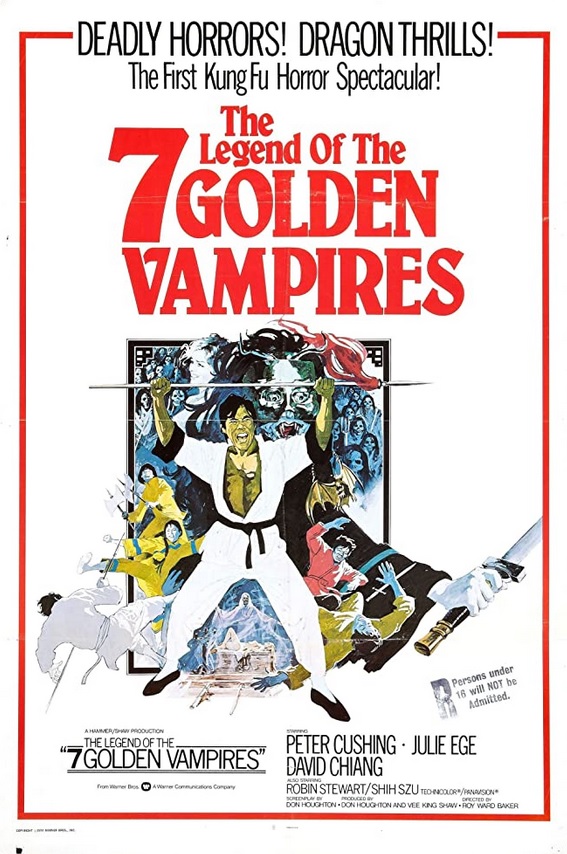
Now, if you enjoyed (I sure did!), but thought Hope’s grafting hicksploitation into disco was nuts, and that Tampa’s splicing vampires into disco was insane, then you’ll go bonkers for this intercontinental boondoggle of a co-production between Britain’s horrormeisters Hammer Studios and Hong Kong martial arts purveyors Shaw Brothers:
In 1804 seven vampires clad in gold masks were resurrected by Count Dracula. 100 years later, in 1904, Professor Van Helsing is hired to kill the fanged hoards.
We’re not kidding. That’s the plot: A mix of ancient Chinese legends with Bram Stoker-inspired vampires—who just happen to be martial arts masters—and experienced Hammer vampire hunter extraordinaire Peter Cushing. The ensuing 75-minutes of karate bloodsucking mayhem became one of the biggest bombs in cinema history and shut the doors on Hammer Studios. And caveat those alternate titles of The Seven Brothers Meet Dracula and Dracula and the Seven Golden Vampires. In the end, is this as bad as the bunny-hopping vampires in the Mill Creek public domain ditty Robo Vampire (1988)? No. Did this need, not backflipping vamps, but Qing Dynasty Jiangshi-inspired vamps of the Midnight Vampire variety? Yes. . . but this Roy Ward Baker-directed fangsocky is way, way better than Nocturna, that’s for sure. (We’re blowing out Robo Vampires as part of our tribute to the 50-Film Mill Creek set, Sci-Fi Invasions, in November; sorry, shameless plug.)
So . . . do we blame Roy Ward Baker for this? Hah, he gave us Quartermass and the Pit (1967), the Hammer-Warner Bros. piece of the Kubrick pie with the “space western” Moon Zero Two (1969) (a childhood favorite, but another Hammer film-hybrid flop that contributed to their demise), The Vampire Lovers (1970; Ingrid Pitt! Schwing!), and Sam’s favorite, The Monster Squad (1989). So all is well, Mr. Ward Baker.
Hi-yah! SenseiWard!
You can watch this on You Tube or pick up the Shout! Factory DVD restoration that’s wildly available at traditional and online retailers.
About the Author: You can learn more about the writings of R.D Francis on Facebook. He also writes for B&S About Movies.
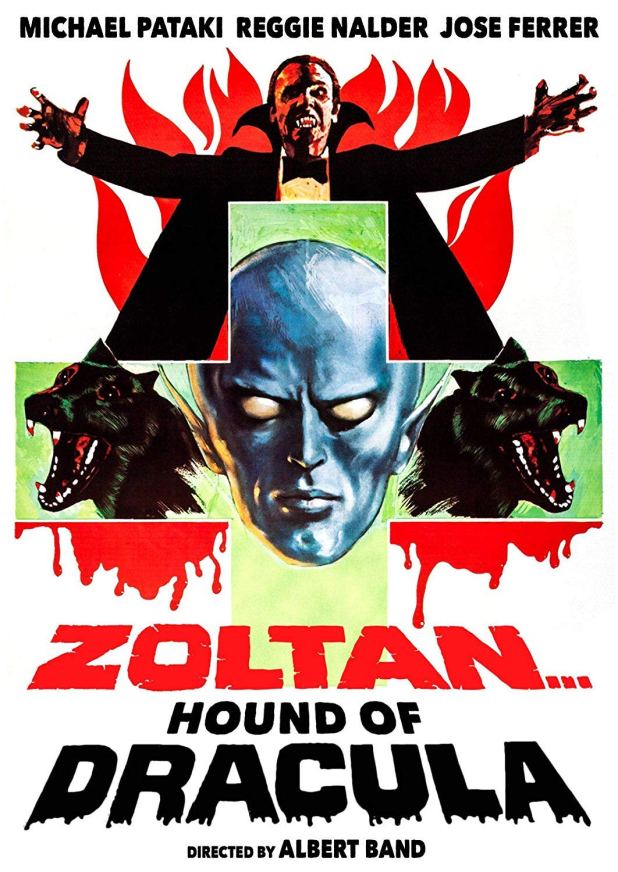
You know how some idiot always ends up pulling the stake out of Dracula? This time, a moron does the same thing to Dracula’s dog Zoltan. Yes, an entire film about vampiric dogs — not to be confused with Devil Dog Hound of Hell — directed by Albert Band.
Veidt Smit (Reggie Nadler, who would go on to be Mr. Barlow in a much better vampire film, Salem’s Lot and Van Helsing in Dracula Sucks) was once the owner of the dog in the title, but Dracula (Michael Pataki!) turned man’s best friend against him.
Pataki also is the ancestor of Dracula, who Smit wants to carry on the family curse. So they start biting every dog — the family has four, which seems close to hording — including a really cute puppy that ends up surviving at the end — and looking like my much-missed long-eared pal Angelo, so this made me happy.
Star Trek fans will be overjoyed to see Arlene Martel (“Amok Time”) show up for a few minutes, as well as Jan Shutan (“Lights of Zetar”).
Let me tell you how dumb this movie is. We’re repeatedly told that Pataki is the last descendent of Dracula, but he has two kids. That’s how dumb it is.
The Zoltan
1 oz. Kahlua
1.5 oz. vodka
4 oz. milk
1 splash cola
Pour the Kahlua and vodka over ice. Add the milk then top with cola before stirring.
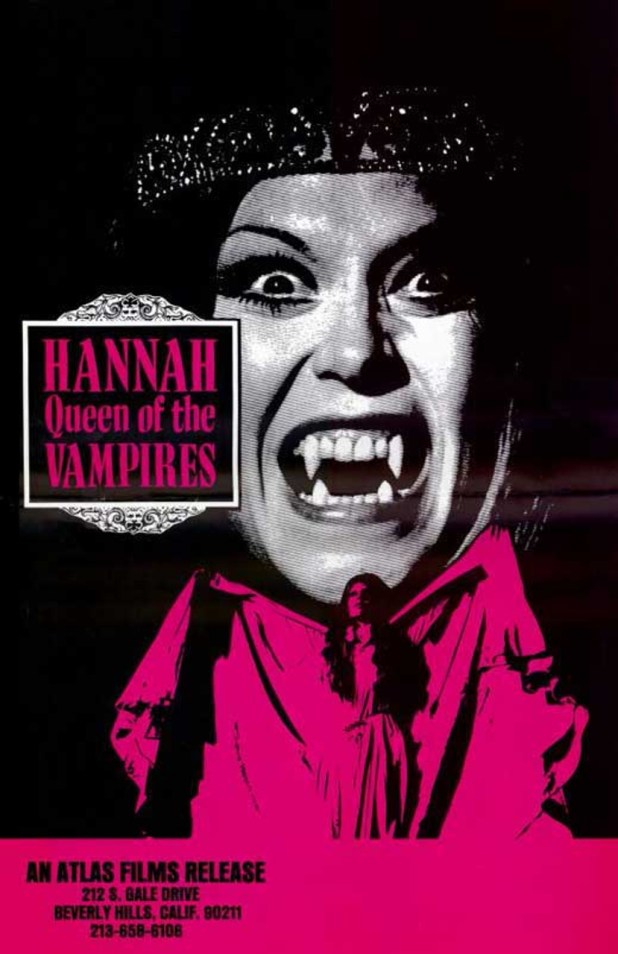
Also known as La Tumba de la Isla Maldita (The Tomb of the Cursed Island); Young Hanna, Queen Of The Vampires; Crypt of the Living Dead and Vampire Woman, this Spanish film was originally directed by Julio Salvador with new footage added by Ray Denton (Deathmaster, Psycho Killer). TV western-bred scribe Lou Shaw, who wrote The Bat People, tweaked the Spanish dialog for the less-gory U.S.-version.
Andrew Prine (Simon King of the Witches) stars as Chris Bolton, a man who has traveled with his sister Mary (Patty Shepherd, The Werewolf Versus the Vampire Woman) to attempt to remove his father’s body from where he died. It turns out that there was a heavy sarcophagus that he found inside a hidden tomb but now his body lies smashed under it. The townspeople refused to help, as inside that coffin lies Hannah (Teresa Gimpera, Lucky the Intrepid) and they don’t want her ever coming back.
The 70’s were filled with female vampires of all shapes and sizes, from the Hammer lesbian-tinged vampires of The Vampire Lovers, the Satanic Twins of Evil, Jean Rollins’ sexual starved bloodsuckers, Daughters of Darkness, the fairy tale world of Lemora, Lina Romay as Jess Franco’s Female Vampire and the future vampires of Thirst. Every one of these films makes me happy despite the darkness and gloom of these days.
What if Kevin Smith introduced vampires into his 1994 debut breakthrough film, Clerks? Well, courtesy of that spare $35,000 in actor-writer Sean Farley’s pocket, we have our answer. Oh, and don’t be distributor duped: Troma didn’t bankroll or produce this: they only gave it a national release (beyond the film’s initial, self-distributed Midwest boarders) via the Tainted Vampire Collection, a DVD three-pack with the SOV-analogous Sucker the Vampire and Rockabilly Vampire. But this Michigan-lensed slacker vs. vamp fest is definitely more Lloyd Kaufman than Richard Linklater. It’s more Andy Milligan that Quentin Tarantino. It makes Don Dohler look like John Carpenter. And check the Sam Raimi comedy-horror mix at the door of the Evil Dead cabin, Sumerian demons be damned.
So. Is this a ripoff or homage to Smith?
Well, Clerks had a convenience store. Tainted has a video store. Clerks had the customer-abusing smart assery of video clerk Randal Graves and the less verbally-sharp convenience store jockey Dante Hicks. Tainted has the customer-abusing smart assery of video clerk J.T. (actor-writer Sean Farley) and the less verbally-sharp clerkin’ sidekick with Ryan. All Randal and Dante wanted to do was play hockey on the roof. All J.T. and Ryan want to do is go to a midnight-moving screening of Bladerunner*. And like Randal and Dante, J.T. and Ryan slack off and yakity-yak riff on each other all day long. Smith had $7,500 less-in-his-pocket than Farley. And Clerks was shot on an Arri SR camera running 16mm black and white. Farley shot in color on video.
Yeah, uh, we’re not in the View Askewiverse anymore, Antie Em. For this ain’t Blade. This ain’t Near Dark. For you’ve just clicked your heels into the Ed Wood Plan Niniverse, Dorothy.
You ever have one of those co-workers who rat-a-tat bulldozers their way through conversations with a faux-poignancy, so impressed with themselves and opinions and, with each jaw-hinging, you’re hit with their pretentious-tainted and substance-void breaths? And you just want to punch them in their trite-spewing face, then cram a Tic-Tac down their throat — in lieu of doing them the “favor” they just asked for?
That’s J.T.
And J.T. and his he-makes-me-seem-more-important sidekick Ryan are stranded after hours at The Video Zone (actually Detroit’s Thomas Video) when their ride punks out — and there’s nothing of more importance in this world than making that Bladerunner showing. So, as any self-centered I-could-give-a-shite-about-you personality would do: the slacker-duo beg a ride from the new clerk, Alex (Dean Chekvala). Oh, and unbeknownst to our two Clerks-clone: Alex is a vampire. And so is Aida, Alex’s girlfriend. And when Alex’s car breaks down (natch), they hoof it to Aida’s house — and find her staked by local sociopath vampire Slain, who’s intent on tainting the local plasma supply and hoarding all the clean corpuscles for his own fangs. And, with that, Alex recruits Randal and Dante J.T. and Ryan on a low-budget, hallucinogenic journey across the “D” to foil Slain’s insane plan. And J.T. and Ryan, for once, have to care for something bigger than their Seinfeld-nothingness selves (sorry, Sam!).
Granted, Tainted is surely an interesting, fresh take on the played-out vampire vs. vampire genre, but if this had only nixed the vampires and stuck to being a low-budget tale about two (or three) carless losers on a Homeresque odyssey across Detroit (say, like Adam Rifkin’s pretty-darn-cool coming of age get-to-the-Kiss-concert-at-any-costs teen comedy Detroit Rock City) to get to that Bladeunner midnight movie showing, we’d be onto something. But $35,000 does not a (good) vampire flick make. And Farley is off the vanity calling-card rails with his purposeful, spotlight dialog-diatribes. Yeah, it’s intelligent at times, but the “snappiness” simply runs-on (and on) way too long — like some of the shots in the film (including “shakey cams”!) — and quickly transitions from a cut-’em-some-slack-because-it’s-an-SOV-and-they’re-trying quaint blood sucker to being just plain annoying. And in a closing twist that would send Sam on a Shirley Doe-killing spree across Lawrenceville, we have the longest-running set of end credits (to pad that running time) in horror film history.
In a cool, ironic twist: Dean Chekvala kept on thespin’ away (he’s actually very good here) and worked his way up to guest-starring roles on TV’s Num3bers, the NCIS franchise, and Without a Trace to a recurring role on HBO’s True Blood. Sam Raimi junkies may recognize Sean Farley from his work on Raimi’s failed post-Evil Dead work, Crimewave (1985), but he’s since retired from the biz. Director Brian Evans hasn’t directed, lensed, or edited a film since, but he’s carved (sorry) himself a commendable, behind-the-scenes career on a wide variety of direct-to-video flicks, feature films, and network television series.
There’s no trailer or clips available, but you can watch the full film on You Tube.
About the Author: You can learn more about the writings of R.D Francis on Facebook. He also writes for B&S About Movies.
* We had a post-apoc blowout back in September 2019, so do check out our two-part “Atomic Dustbin” catch-all overview of the genre that also features links to all of our film reviews.
When you see the name John Llewellyn Moxey on the credits of a movie, you know you’re getting into something awesome. Just look at The House That Would Not Die, A Taste of Evil, The Night Stalker, Nightmare In Badham County, Deadly Deception and, well, just about everything he did. I didn’t even mention The City of the Dead and Psycho-Circus!
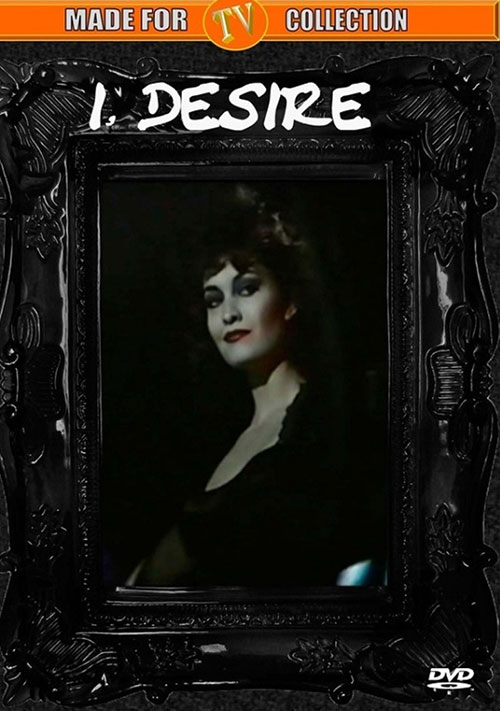
Originally called I, Desire and airing November 15, 1982 on ABC, who knew this little vampire film would be amongst the best ones I’d find for our vampire week? There’s a great cast — David Naughton from An American Werewolf In London makes for a fine lead, as well as Brad Dourif as a priest, Barbara Stock as the bewitching vampire, Dorian Harewood (he was in Sudden Death!) as a cop, Marilyn Jones as Naughton’s fiancee and even an appearance from Not Necessarily The News‘ Anne Bloom (or Frosty Kimelman in that long-lost HBO program). Oh yeah — and Marc Silver, who was the guitarist in Ivan and the Terribles, the ill-fated band in Motel Hell.
There are some great twists and turns in this one, as well as an incredible vampiric apartment at the end that I wish that I could live in. I’ll assume it’s just a studio set so that I don’t get sad that I can never go back in time and see it for myself.
You can watch this on YouTube and feel the same way.
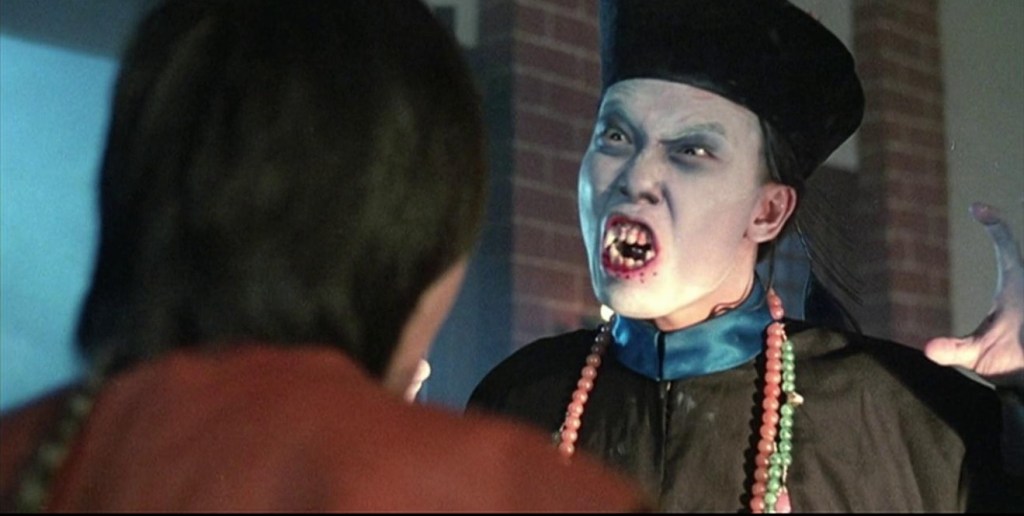
Coming up in November we’re reviewing Mill Creek’s Sci-Fi Invasion 50-Film Box Set — and we take a poke at Willie Palmer, aka Godfrey Ho, and joke about his bunny vampires in Robo Vampire; however, those rascally vamp-rabbits aren’t from cinematic ineptitude: they’re from Chinese legend: the Qing Dynasty legends of the Jiangshi (meaning “hard or “stiff”). Their tales first appeared in widespread print in 1789 by way of the literary visions of writer Ji Xiaolan. Director Yeung Kung-Leung was the first to bring the Jiangshi to the big screen with 1936’s Midnight Vampire. The Chinese text, spoken, is pronounced Wǔyè jiāngshī, and actually translates as “Midnight Zombie” in the English. Thus, while me may be a bit rough on Ho’s inversion of Chinese vampires, it actually works as a smart parody on the Jiangshi genre. Who knew?
From Ricky Lau’s Mr. Vampire (1986) courtesy of the IMDb.
As you can guess: this movie — a tale about a dead man who returns from the grave to kill his brother — is impossible to find, with trailer/clips and images even harder (pardon the pun). How difficult? Even the film’s IMDb page is a barren wasteland; Letterboxd doesn’t list the film in its digital catalog. Where’s Criterion Collection and Kino Loeber on this one? (Hey, at least Kino Loeber picked up all of Jean Rollin’s ’70s erotic vamp tales, so all is well, KL!)
The Hong Kong film industry — as with Italy’s — is not one to pass up a hot trend when they see one: they’ve been responsible for more of its fair share (starting in the ’80s) of hoping vampire movies than any other Pacific Rim country, starting in 1936 with Yeung Kung-leung’s Midnight Vampire — released just five years after Universal’s Dracula in 1931 (the first licensed cinematic adaptation of Bram Stoker’s 1897 novel). While it was shot first — but released after (and not based on Stoker’s work) — Danish director Carl Theodor Dreyer brought his silent, 1932 vampire tale (the exquisite) Vampyr, aka The Dream of Allan Gray, based on elements of five short stories — “Carmilla” in particular — from J. Sheridan Le Fanu’s 1872 collection of supernatural stories In a Glass Darkly. However, prior to these tales was F.W. Murnau’s unauthorized, 1922 inversion of Stoker’s work, Nosferatu.
The most popular and widely accessible Jiangshi tale is Ricky Lau’s 1985 action-comedy take on the Qing Dynasty legends, Mr. Vampire (which provides the above image; so don’t email us: we posted the image on purpose to make a point). That film was produced by Sammo Hung who, if you know your Walker, Texas Ranger trivia, starred on that CBS-TV program and had his own spinoff series, Martial Law. And Sammo Hung got the industry-fad of ‘80s jiangshi movies a-hopin’ with 1980’s Encounters of the Spooky Kind; the loose sequel/sidequel was, of course, Mr. Vampire.
And how it is that Chuck Norris never fell into Hong Kong B-Moviedom and kicked some comedic, Jiangshi stiff-ass punks? The tales of the hoping bunny vampires will never tell. . . .
Update, October 2022: We had an enjoyable Facebook exchange this weekend — with a reader, the chap below in the comments — and one of our critical contemporaries, one well-versed in Asian cinema, regarding Yeung Kung-Leung’s Midnight Vampire.
The short of the story: Courtesy of Lingnan University in Hong Kong, we’ve collectively confirmed this classic of Hong Kong Cinema — the first film from that country concerning vampires — film is truly lost, forever: both images of and the film itself, are gone.
About the Author: You can learn more about the writings of R.D Francis on Facebook. He also writes for B&S About Movies.
“On the other hand . . . if I’m dead, why do I have to wee-wee?” — Grandpa Dracula (aka, John Carradine)
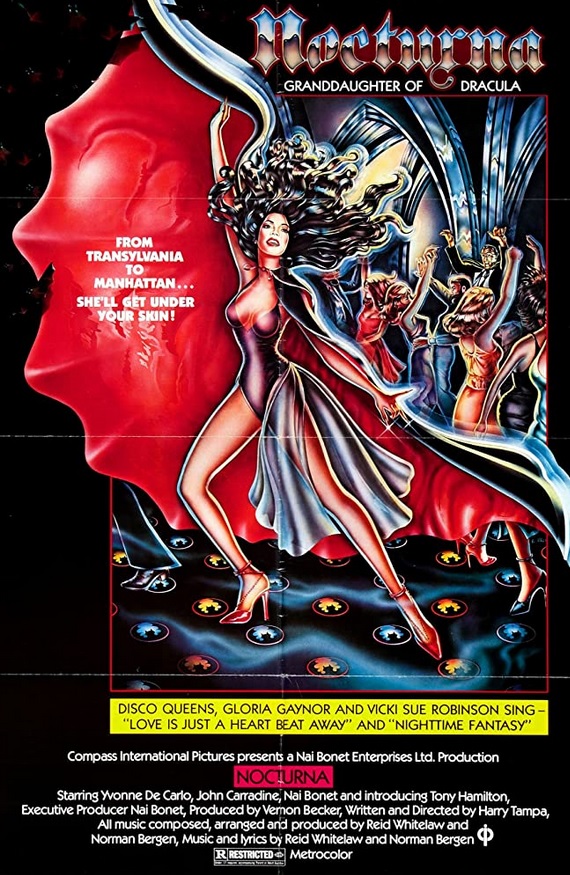
Vietnam-born Nai Bonet began her show business career as a belly-dancer at the age of 13 and headlined a popular belly-dancer show at the famed Flamingo Hotel in Las Vegas. And when a commercial, film, TV show (she appeared as a harem girl on The Beverly Hillbillies, for example), or a record company needed a belly-dancer for a cover shoot, Nia was there. Her famed reached a point — coinciding with the ’60s then-hot “Go-Go” craze — that, at the age of 15, she released the 1966 novelty-pop go-go song “Jelly Belly”; the video recorded for the song became a centerpiece exhibit of bar-arcade Scopitone video jukeboxes.
But what Nai really wanted to do was act. And she made her big screen debut alongside John Cassavetes and Mimsy Farmer (The Wild Racers) in the Daniel Haller-directed and Charles B. Griffith-penned Devil’s Angels (1967). But parts were hard to come by; so it wasn’t until 1973 when Nai was cast in her next co-starring role, this time alongside ex-60s teen idol Fabian Forte (Thunder Alley) in Soul Hustler. By the late ’70s, Nai wasn’t a star; she was buried in the credits of the “biggest” film of her career: the biographical sports drama The Greatest (1977) about and starring Muhammad Ali.
Frustrated, Nai decided to take matters into her own hands by writing and producing her own leading lady role (see Loqueesha and Easy Rider: The Ride Back for other examples of this filmmaking approach). And she wrote a vampire tale that filmed during a two-month period in October and November of 1978 for Compass International Pictures. At the time, Compass had a worldwide hit on their hands with their debut release: John Carpenter’s Halloween. Then the studio used their Halloween profits to finance Roller Boogie. And Tourist Trap. And Blood Beach. And Hell Night. And Disco Dracula, aka Nocturna. You see where this is going? Yep. The studio shut down for good in 1981. But, at the hands of studio co-founders Irwin Yablans and Moustapha Akkad, the 1985-reimaged and re-incorporated company, now known as Trancas International Films, retained the copyrights to the Halloween franchise and came to produce every picture in the series.
And Nai Bonet’s leading lady and writing debut wasn’t just any low-budget ($200,000) Dracula picture. Compass International negotiated with MCA Records to release a disco-flavored double album film soundtrack headlined by then hot disco-queens Gloria Gaynor and Vicki Sue Robinson. (You can review the album’s liner notes on Discogs.) Was the soundtrack more successful than the film? Oops. It was. Not that the soundtrack saved Gaynor and Robinson from their inevitable, new-wave career oblivion. Of course, all those pesky music rights and major-label legalese gibberish bit (sorry) the film in the arse neck because, the film was barely released in the home video market; it’s currently lost to the ages, only available as a battered and ultra-rare VHS. The LP soundtrack is easier to find.
Yes. You heard right. In the grand tradition of Harry Hope meshing disco with hicksploitation in Smokey and the Judge (and hiring disco band Hot as “actors”), low-budget auteur Harry Hurwitz (here as Harry Tampa; he then taught at the University of South Florida in Tampa) came up with the idea of meshing disco with a Dracula picture. For reals. So what you have here is Saturday Night Fang. Or Thank God It’s Fang Day. Or Disco Dracula. And Uncle Harry probably wanted to use the titles Vampire Hookers and Lust at First Bite, but those were already used for a pair of slumming ’70s drive-in vamp romps. And Universal took Love at First Bite for their own George Hamilton-starring vamp comedy. So Harry and Company came up with — the admittedly original — Nocturna handle. And knowing he needed icon-horror names on the box to sell this mess — and that most of those “iconic” names were down-and-out and available on the cheap, he was able to convince Yvonne De Carlo and John Carradine to star. (Papa Carradine’s previous tenure as The Count was the western-vampire hybrid that was 1966’s Billy the Kid Versus Dracula. Poor John.)
And don’t be duped by that R-rating; this is a pure PG-13 boondoggle that ol’ Harry decided was a celluloid cluster that needed to be spiced-up with nudity because, well, no one counted on the Knack coming along and driving a new-wave stake through disco’s heart. What was Harry T. gonna do? Wipe the soundtrack and hire the Cars and Berlin to score the movie? Cut Vicki Sue Robinson’s part and graft-in Terri Nunn? Fire Moment of Truth and hire the Knack as Drac’s Castle house band? Let Rick Ocasek get fanged buy Nai?
There’s no doubt that Nai Bonet gives you that Garth Algar climbing-up-the-rope-in-gym-class-feeling, but yikes . . . she’s as wooden as a Van Helsing stake. So thank god Sy Richardson (Cinderella) shows up as a jive-talking vampiric pimp and Theodore “Brother Theodore” Gottlieb (Tom Hanks’s The ‘Burbs) is a piss as the Hotel Transylvania’s manager (with a boner for Nocturna that Papa Drac uses to his advantage). And Carradine — as Grandpa Dracula — and Yvonne DeCarlo — as “old” family friend and Drac’s ex-squeeze, Jugulia Vein — probably full knowing they were in a stinker, brought their A-game anyway and decided to have fun with this mess and own their roles. (There’s nothing finer than seeing the actors that you care about making chicken salad out of chicken shit. It only makes you love ’em more.) And Nocturna? Well, in addition Brother T., the Wolfman has the hots for her, but she only has eyes for Jimmy: the disco-drumming (and gay) Tony Manero-clone (Antony Hamilton, in his film debut; you might remember his later roles in Howling IV: The Original Nightmare and the late-’80s TV Mission: Impossible reboot).
And that sets up the movie. The tax man “haunts” the House of Dracula, so ol’ Drac turned the family castle into The Transylvania Hotel to pay the bills. Overseeing the operation is his granddaughter Nocturna, who also cares for ‘ol Drac hiding in the basement-crypt bowels (i.e., giving him his breakfast goblet of blood every morning, helping him with his false-fangs, and listening to him bitch about his erectile dysfunction and enlarged prostate).
But the estate’s blood supply is running low and business needs a pick-me-up, so Nocturna books American disco band Moment of Truth (who appear on the aforementioned soundtrack) to entertain the guests. And she begins to experience human love for the first time for Jimmy; she doesn’t want his blood and she sees her reflection for the first time. And she, unlike Elaine Benis in Seinfeld (sorry, Sam), can “turn” Jimmy back to the heterosexual nether regions.
So she runs away to New York with Jimmy and finds support with de Carlo, herself a vampire, who resides in darkness under the Brooklyn Bridge, and helps Nocturna avoid Grandfather’s henchmen who’ve come to return her to Transylvania. And mortal-immortal love, disco dancing, bat transformations, faux improv-crosses of neon-letter Ts, and vampires sharing their final kiss under a romantic sunrise, ensues.
Wow. There’s an actual VHS rip in the digital ethers? Yes! You can watch the full movie on You Tube, but because of the nudity, you’ll have to log in . . . if you dare to “turn that beat around,” that is. Bill Van Ryn is watching and getting his disco fix. So why not you? Don’t fret. You will survive.
Hey, be sure to check out our “Drive-In Friday” tribute to five of good ol’ Uncle Harry’s films!
About the Author: You can learn more about the writings of R.D Francis on Facebook.He also writes for B&S About Movies.



 B&S About Movies
You must be logged in to post a comment.