Editor’s Update: We’ve recently learned this car-crashin’ classic will receive a hard media reissue via Dark Force Entertainment. Learn more with their January 2022 Facebook post.
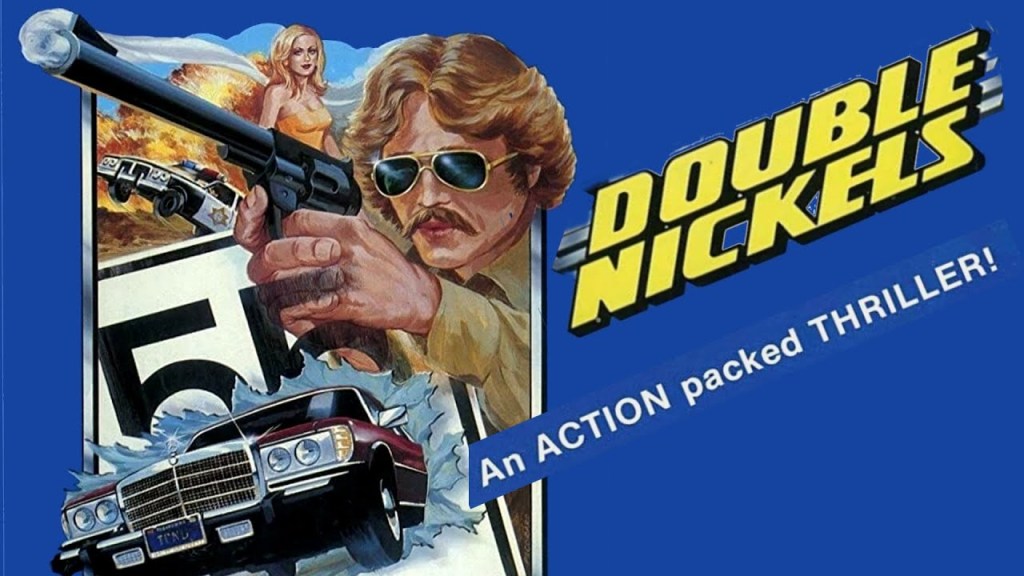
While it’s not an official sequel, car aficionados and ’70s drive-in connoisseurs consider this rebel-rousing Smokey and the Bandit ripoff as a “sequel” to 1974’s Gone in 60 Seconds, as result of most of the cast and crew — Jack Vacek in particular, who serves as writer and director — from Gone appearing-working on this film; when Burt Reynolds broke box office records in his Pontiac Trans Am infomercial, this was re-released to drive-ins as Split-Second Smokey.
If you’re familiar with the plot and action of Gone in 60 Seconds, then you’re up to speed and ready to enjoy this loose hicksplotation entry in the drive-in derby. This time, instead of a professional car thief . . . Smokey is the bandit, aka car theif, as two highway patrolmen (Jack Vacek and Ed Abrams from Gone) who pick up extra cash repossessing cars . . . and come to realize they’re working for a car theft ring. They, of course, spring into action to break up the ring and stay out of the slammer.
Is it dumb and pointless? Yep. But it’s also a lot of fun and the amateur Vacek and Abrams actually make an affable screen duo and the comedy is well-written and executed. Vacek went on to work with H.B Halicki on his own follow ups to Gone: The Junkman and Deadline Auto Theft.
Vacek’s second and final film is the even more obscure and hard-to-find 1988 Dirty Harry knockoff Deadly Addiction (that made it onto home video as Rock House), starring Vacek and his wife, Trice Schubert, from Double Nickels.
To say this film has fans is an understatement. You can find a wealth of extended clips centered on the car chases and crashes — with at ’72 Plymouth Satellite and ’68 Chevy Chevelle going head-to-head, among others — as well as uploads of the film, on You Tube.
From the Phantom 309 files: In addition to the film trivia assist (see the comments, below) with Double Nickels, the Phantom schooled us on a Smokey Bites the Dust and Escape to Witch Mountain connection. No, really! Who knew?
Editor’s Note: All this week, from Sunday, December 6 to Saturday, December 12 we’re featuring car flicks. Welcome to our “Fast and Furious Week II” of reviews.
When the commercials ran on television for this . . . oh, man, we, the wee-little middle schoolers freaked out. Everyone in my class went to the drive-in to see this, and my parents took me, along with Kevin and Tommy from the neighborhood, along with a sky-blue-metal-with-red-logo Pepsi cooler filled with drinks and snacks to the neighborhood quad-drive in.
The theatrical original.
The late H. B. “Toby” Halicki developed his lifelong affection for speed while working as a young boy at his family’s New York towing business and assisting his father in his second-hand car dealership business. After experiencing the loss of his two brothers, he decided to move to California for a fresh start; he came to own an impound and towing business, H.B. Halicki Mercantile Co. & Junk Yard.
Fascinated by the world of film around him Los Angeles, he decided to use his impound and junkyard’s resources to make the ultimate car-based action film: Gone in 60 Seconds. And with no previous film experience, he assigned himself as the film’s writer, director, producer, star, and, most importantly, its lead stuntman and coordinator. He was Tommy “The Room” Wiseau before Tommy — only better.
Since this was all about car chases and automotive destruction that’s centered around the now iconic (dialogless) escape of Maindrain Pace (H. B. “Toby” Halicki) — a 40-minute car chase ensues, with 93 vehicles destroyed across six California cities stretching fom Long Beach to Carson.
Halicki had the action sequences all planned out, so there’s no “official script” for the film, outside of a few pages that outlined its thin plot and its related dialog, which was mostly the product of improvisation and ad-libbing by the amateur cast. In addition, Halicki incorporated some good ol’ fashion Roger Corman ingenuity: when he heard about a train derailment in the area, he incorporated the tragedy into the “plot,” so as to increase the film’s production values.
Drawing from his life experiences, Halicki’s anti-hero of Maindrian Pace is a respectable insurance investigator who runs an automobile chop shop in Long Beach that serves as the homebase for his professional car theft ring. He conceals the stolen cars by incorporating parts (and VIN numbers) from legitimately purchased wrecks.
His profitable business goes off the rails when a South American drug lord makes Pace an offer he can’t refuse: steal 48 vintage and exotic cars, along with limos and semi-trailer trucks for $400,000 under a deadline. Pace accepts the work order.
And that takes us back to us wee-lads convincing our parents to take us to the drive-in on the film’s opening weekend: shot for $150,000 the film went onto gross $40 million.
Now, everyone knows about the has-nothing-to-with-the-original 2000 remake starring Nic Cage (we’ll always be a “Nic Cage Bitch”), but did you know (as with Easy Rider), there were no less than four sequels to Gone in 60 Seconds?
The first was the sort-of 1977 sequel titled Double Nickels, so dubbed because it featured most of the cast and crew from Gone, including Ed Abrams, Mick Brennan, George Cole, and Jack Vacek.
Then, in 1982 and 1983, Halicki recycled footage from Gone into the meta-fiction “sequels” The Junkman and Deadline Auto Theft, both which feature Mick Brennan from Gone. The cinematographer from Double Nickels, Tony Syslo, also worked on those “sequels.”
While “Gone in Sixty Seconds II and III” are interchangeably used as titles or subtitles on The Junkman and Deadline Auto Theft in their various reissues in various markets, Halicki began shooting the actually Gone in 60 Seconds 2 in June 1989 with himself and his new wife, Denise, as its stars. Not taking any chances, and as with most sequels, Halicki stuck to the original story — only a bigger and badder version — concerned with the exploits of an international car thief.
Two months later, on August 20, 1989, the film — with its plans to crash n’ smash 400 cars, was over. Halicki died while filming a dramatic stunt centered around the destruction of a 160 foot water tower that fell on the car and killed him instantly.
After several trials over his estate culminating in 1994 with a final decision, Halicki’s wife, Denise, vowed to finish the sequel. And that film eventually became the Jerry Bruckheimer-Nic Cage 2000 remake (Sam’s review).
The remake with the Cage!
There’s two choice to watch the 1974 original HERE and HERE — the second with a fan-restored, original soundtrack version. Here’s the official Mill Creek reissue trailer.
There was once a magical underwater cave located deep where crocodiles were born under a floating magic ball that made the bottom of the ocean, or at least this cave, glow like it was day and not far under the ocean. Here, Chalawan ruled, turning every crocodile into human forms that needed no sustenance. Yet the leader was no Buddhist like his ancestors. He wanted to taste human flesh.
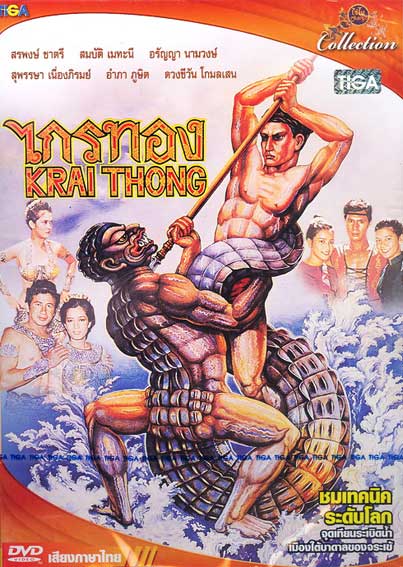
This is really the story of Krai Thong, who must kill Chalawan to win the heart — and some of the cash — of the millionaire Tapaokaew’s daughter. That said, the villain is also killing all sorts of villagers, with his two wives — who can also turn into alligators — helping him in all the human eating fun. Our hero is going to have to make a spear from seven different metals if he wants to put away this weregator for good.
This same story has been told many times, starting with 1958’s Krai Thong. There have been six versions, with the last one made in 2017.
This one was made by Sompote Sands. Way back in 1972, he made another version of this called Chalawan. Sompote is a man that knows monsters, as he pretty much took Japanese kaiju movies to Thailand, making The 6 Ultra Brothers vs. the MonsterArmy, Hanuman and the Five Riders (a bootleg Kamen Rider) and Jumborg Ace & Giant. He also must love reptiles because he also made Crocodile, a children’s movie named Magic Lizard and this film and a sequel in 1985.
This movie has the cheapest — and yet most awesome — sets you’ve ever seen, as well as a bad guy so amazing that he doesn’t just transform into a man-eating alligator, he also has a laser ring that mesmerizes women into marrying him.
Also known as Legend of the Crocodile, this is a movie filled with padding, stock footage of crocodiles, slow motion strip fights between reptile/human hybrid brides of an evil king, people being bit in half, so much blood in the water and — at least in my copy — hardcoded English subtitles and the worst VHS quality ever.
Samuel Wanamaker, CBE was an American actor who moved to the UK after his communist leanings led to a fear of being blacklisted. He was also a director — we’ll get to that in a minute — but strangely enough, he has the credit for saving The Rose Theatre, which led to the modern recreation of Shakespeare’s Globe Theatre in London.
On his first trip to London, he searched for the theater and only found a plaque. He was upset and in 1970, he started paying for the new theater out of his own pocket, despite the scepticism of British actors and a hostile city council. So yeah — that’s why he has a Commander of the Order of the British Empire honorary title after his name, which is rare for an American.
Oh yeah — he also directed this movie (and plenty of TV, including an episode of Lancer, which means that he shows up in Once Upon a Time In…Hollywood and is played by former Spider-Man Nicholas Hammond).
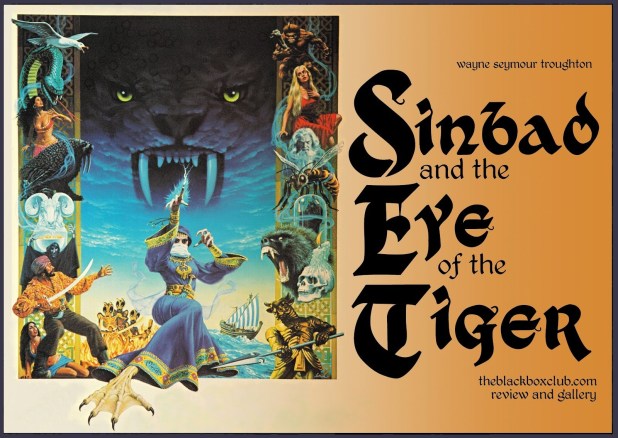
The third and final Sinbad film released by Columbia Pictures was produced by Ray Harryhausen and Charles H. Schneer, who told Starlog he hired Wanamaker because “I wanted an actor’s director for Eye of the Tiger, to see if we could get more dimension out of other-wise cardboard characters. Sam didn’t have to handle any of the technical aspects of the picture. He merely had to pay attention to them. Within the parameters of the technical work, he directed the dramatic sections. The technical work was carried out by Ray and me.”
As for the actors, this is an attempt at using the next generation of Hollywood royalty, as John Wayne’s son Pat as Sinbad and Tyrone Powers’ granddaughter Taryn as Dione.
Sinbad has come to Charak to ask Prince Kassim (Damien Thomas, Count Karnstein from Twins of Evil) if he may marry Princess Farah (Jane Seymour), but the evil stepmother Zenobia (Margaret Whiting) has transformed Kassim into a baboon and sent all manner of creatures after our hero. Even worse, if he can’t figure out how to change his friend back into a human, the evil Rafi (Kurt Christian) will take over.
Of course, adventure beckons, which means that Sinbad and his crew encounter everything from ghouls, giant wasps, a magical bronze robotic minotaur called the Minoton (the first appearance of Peter Mayhew, who would go on to be in some space movie made the very same year that came out at the same time as this movie), an evil walrus and a sabretooth tiger. Luckily, said crew contains Melanthius (Patrick Troughton, the second Dr. Who), his daughter Dione (Power) and a caveman they call Trog*.
Let me tell you what, escaping the news by watching old stop motion movies is the best decision I’ve made in 2020.
*The stop motion model for Trog was used again for the villainous Calibos in Clash of the Titans.
Mika Mifune once said, “I heard from my father that he was offered the role of Obi Wan Kenobi, but he was concerned about how the film would look and that it would cheapen the image of samurai, on which George Lucas had based a lot of the character and fighting style. At the time, sci-fi movies still looked quite cheap as the effects were not advanced and he had a lot of samurai pride. So then, there was talk about him taking the Darth Vader role as his face would be covered, but in the end he turned that down too.”
Mifune did not, however, turn down the role of Sukezaemon Naya in Daitōzoku, which means The Great Bandit. It was later released in the U.S. as Samurai Pirate and, finally for the purposes of this article, The Lost World of Sinbad*.
Sukezaemon (Mifune) is a pirate who has been shipwrecked in one of the weirdest corners of the world. He must help restore the king to life and defeat an evil premier by joining with some rebels and a wizard to battles a witch, pirates, the imperial guard and free the kingdom from slavery. Yeah, Lucas watched plenty of Mifune’s movies.
*It played double bills with War of the Zombies, which is a crazy pair.
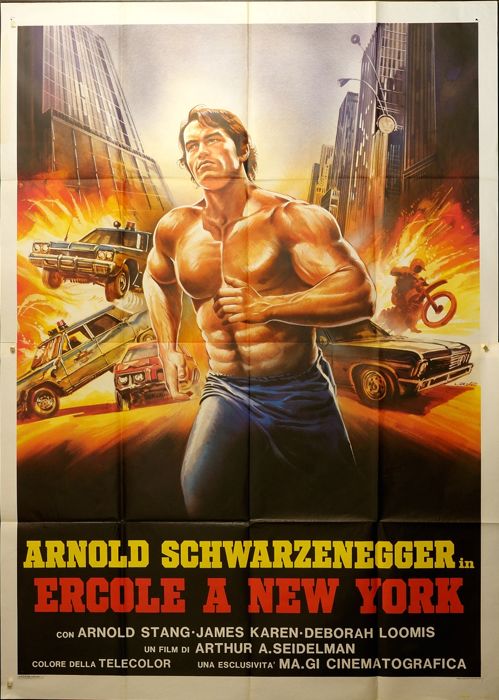
Whatever happened to the star of this movie, Arnold “Mr. Universe” Strong? Oh yeah. He grew up to be the greatest action star of all time, that’s what. But this movie is the very definition of starting small, as Arnold Schwarzenegger — 22 years old and laying brick with his lifting buddy Franco Columb — was told by his friend Reg Park (who took over for Steve Reeves in Hercules and the Captive Women) that he should shoot for his dream of being a movie star.
This wouldn’t do it.
It’s also the first film for director Arthur Allan Seidelman, who mainly did stage and TV work like the Nancy McKeon TV movie of the week Strange Voices.
If you ever wanted to see Hercules get sick of Mount Olympus and go to Earth, where he becomes a pro wrestler as well as best friends with a pretzel salesman named Pretzie (Arnold Stang, who between this movie, Ghost Dad, Dondi and Skidoo* has pretty much been in the very worst of the worst in film), well, then this movie fills out all of your boxes with a sharp number two pencil.
James Karen (Poltergeist, Return of the Living Dead) and Richard Herd (the Supreme Commander from V) show up, as does four-time Mr. Universe, one-time owner of the biggest escort service in California and later evangelist Dennis Tinerino.
Also, just to be a total anal retentive nerd, I want to mention that while Zeus, Nemesis, Eros, Pluto and Atlas are Greek gods, Hercules, Venus, Juno, Mercury and Neptune are the Roman versions, while Samson — who is kind of, sort of Hercules’ brother in this — comes from The Bible.
You can’t really judge Mario Bava’s work on this film, as he entered a troubled production and rewrote and reshot it in just six days.
After the apparent death of her husband King Arald (Giacomo Rossi Stuart, The Crimes of the Black Cat, here called Frank Stewart), Karin (Elissa Pichelli, using the Americanized name Lisa Wagner) has run from the murderous Hagen (Fausto Tozzi, billed as Frank Ross). Now, Rurik, a knife-throwing stranger (Cameron Mitchell, using the name…well…Cameron Mitchell) has rode into town like a Roman Shane and is defending her and her son Moki. Of course, Moki may also have been his son and he could very well have assaulyed Karin in the past, but I guess him learning how to throw knives — and aiming them at the right people — is some kind of redemption?
This is much closer to a western than a peblum, but when you think that Bava pretty much fixed this movie — or at least got it done — in less than a week, you have to admire his talent. That said, this is not one of his best.
This played on double bills with Gamera the Invincible, which seems like a pairing I’d never put together. It’s on Tubi, but fair warning, the print is horrible.
You know, I’ve put off writing this review for a while because I had nothing wittier to say than, “I wish I could beat up every single person in this movie.” But seriously, a few months and another watch later and I still feel the same way. Nothing upset me, nothing moved me, I just felt like my life was slowly slipping away when I could have been watching something, anything else better than this.
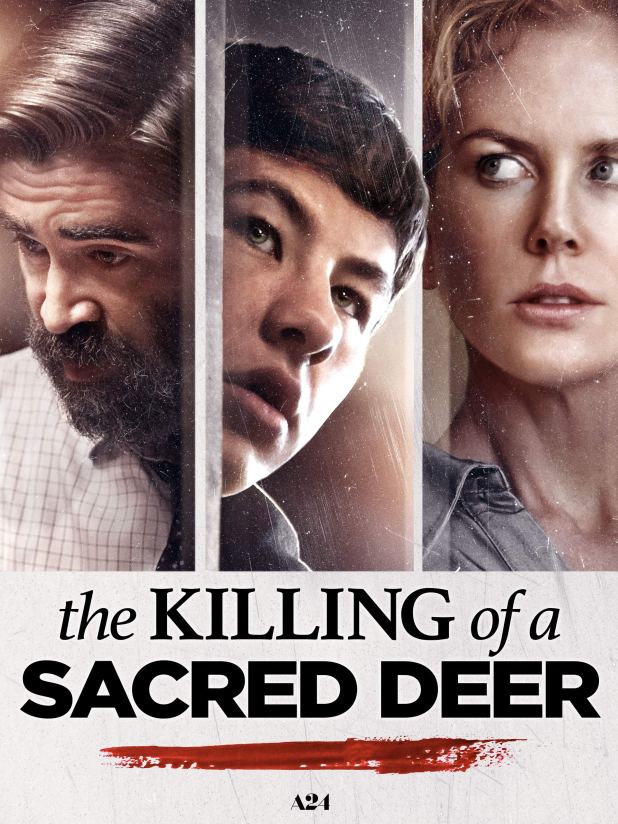
Maybe it’s because this movie is based on the ancient Greek tragedy Iphigenia at Aulis by Euripides and isn’t a movie where Bobby Rhodes turns into a demon at a cinema, but I could see what director Yorgos Lanthimos was doing in every frame, just like the last movie of his that I struggled through, The Lobster.
I am not made for this. I am made for screaming at Jess Franco movies, for knowing all the strange dialogue to Fulci films, for crying during Mario Bava homicides.
Colin Farrell plays a surgeon who screwed up and Nicole Kidman plays yet another wife who has a husband that she pretty much hates, a role that she seems to do in everything I see her in. She also pretends to be under anesthesia while she makes love to her husband in a car and then jerks off an anesthesiologist, so I have no idea what this movie has to say about putting people under other than it’s really hot.
Barry Keoghan is the weird kid that screws up the whole family and gets them to stop eating. He’s a laugh riot, in the way that I guffawed that anyone took any of this remotely seriously.
Reviews like this are why I’ll never make it out of the genre gutter and get to be part of Rotten Tomatoes. Their logo sucks anyway and makes me angrier when I see it on a blu ray cover than when I see the Troma logo and Lloyd Kaufman’s stupid face before my copy of Fulci’s Warriors of the Year 2072.
Toho knows about multiple headed dragons. But here, they are in service to a fairy tale film that deals with the birth of Shinto.
Honestly, this movie blew my mind and I’m not certain I’ll ever be able to get it fixed again.
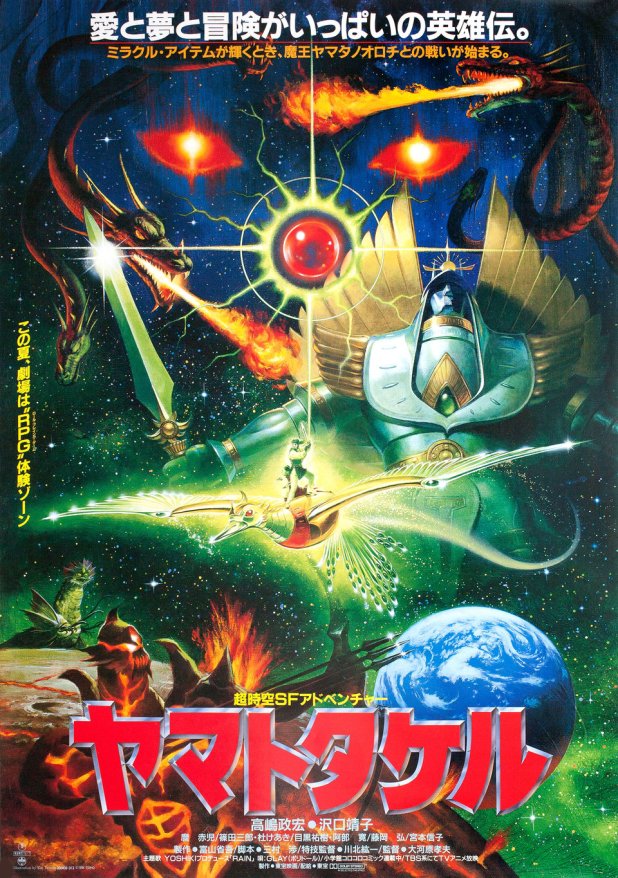
After the birth of twin princes, the emperor feels hatred for one of them, Ousu. He orders a shaman to kill his son, but Amano Shiratori, the White Bird of the Heavens, appears and the shaman decides to raise him.
Yet when he finally grows up and his father pardons him, within days Ousu’s mother has died mysteriously and his brother attacks him, dying in the process. The emperor sends his son away again, into the Kumaso area to battle the barbarians that live there.
Along with a girl named Oto and his friends Genbu and Seriyu, the prince changes his name to Yamato Takeru and begins to complete a series of heroic feats. However, he must now find the Sword of Dark Clouds before the evil moon god Tsukuyomi who has somehow learned how to transform himself into the eight-headed dragon named Orochi. And oh yeah, Tsukinowa — the evil priest who caused all this — is the one who killed our hero’s mother and brother. And get this, Oto is really the sun goddess Amaterasu. And then a sword gets pulled from a stone. And…
Seriously, this movie is absolutely packed with astounding moment after astounding moment, like heroes dying and being reborn, Amano Shiratori becoming a mecha phoenix and the titular eight-headed dragon. You should pause and realize that this effect is a physical effect and not CGI. It’s one of the most incredible looking monsters that I’ve ever seen, blowing away nearly any kaiju movie.
A remake of 1959’s The Three Treasures, this was intended to be a trilogy, but didn’t do well in theaters. It did lead to a Yamato Takeru anime. It was directed by Takao Okawara, who also made Godzilla vs. Destoroyah and Godzilla 2000. He also was an assistant director on one of Toho’s weirdest movies, Nosutoradamusu no Daiyogen. Wataru Mimura, who wrote the script, also worked on several of Toho’s 2000’s kaiju movies.
This is the closest a movie has come to a Harryhausen effort in decades. I say that with the highest praise, as this is a visually stunning feast that kids of all ages will love.
Gordon Hessler is one of those directors that no one talks about, but he made a lot of movies worth watching. The Oblong Box; Scream and Scream Again; Scream, Pretty Peggy and Prey for Death are all pretty great. He also made the George Hamilton kind of, sort of giallo Medusa and Kiss Meets the Phantom of the Park, but not every movie can be a winner, right?
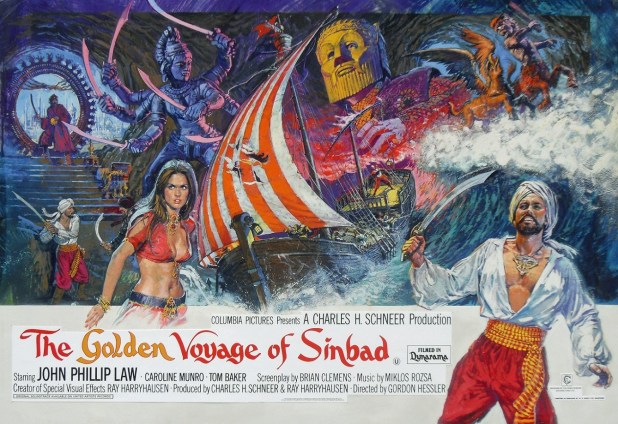
That said, here he has a script by Brian Clemens (Captain Kronos, And Soon the Darkness and Highlander II: The Quickening, proving that yes, not every movie can be a winner all over again), effects by Ray Harryhausen and a cast that inclues a pre-Dr. Who Tom Baker, John Phillip Law and Caroline Munro, somehow making a G-rated film sexy.
Seconds into this movie, I was already writing a review to tell all of you how much I loved it. Get this opening scene: Sinbad (Law) Sinbad finds a golden tablet that was lot by a mysterious flying creature before he falls asleep and dreams of Margiana, as she reveals an eye tattooed on her hand before a man dressed all in black calls his name and makes her disappear between the folds of his cape.
That man is Prince Koura, who battles Sinbad throughout the film for the three pieces of a medallion which will point the way to the Fountain of Destiny of the lost continent of Lemuria. Whoever gets there first will discover youth, a shield of darkness and a crown of untold riches.
With each use of his magic, Koura ages more and more. Yet he still sends all manner of beasts after our hero, who has assembled a crew to discover this uncharted island which includes a deposed Vizier (Douglas Wilmer, who played Sherlock Holmes on British TV) who hides his scarred features behind a mask.
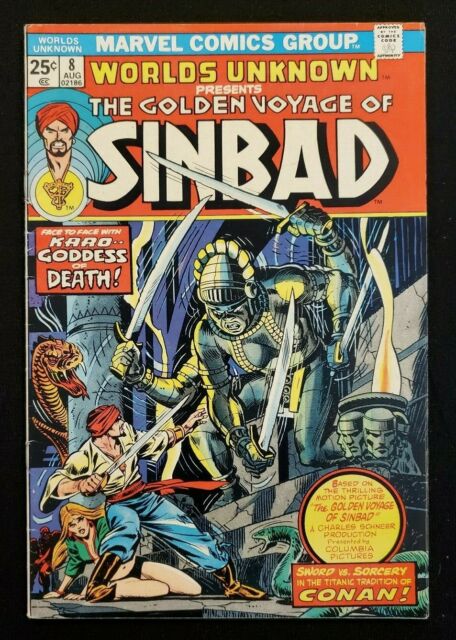
A homunculus, an animated statued of Kali*, a one-eyed centaur, a griffith, an invisible shield — this movie really does have it all in full Technicolor. This even had a tie-in Marvel comic (Worlds Unknown #7–8)!
Even cooler, the Oracle of All Knowledge was Robert Shaw! He was a friend of producer Charles H. Schneer, who got him to play the part — which took 20 minutes — covered in make-up and with his voice altered. He’s uncredited, but yes, that’s really him. Orson Welles was originally supposed to do this part, but he had asked for too much money. Shaw was on vacation in Spain and ended up taking the role as a favor to Schneer.
This is the kind of movie that helps you escape from the world into the better than real life world of monsters, magic and, well, Caroline Munro. This is a movie I foresee returning back to over and over again.
*This entire section of the movie is based on one of Harryhausen’s favorite movies, 1940’s The Thief of Bagdad.




 B&S About Movies
You must be logged in to post a comment.