The Red Right Hand (2001)

Editor’s Desk: This review originally ran on October 1, 2020, as part of our October 2020 annual “Slasher Month” and we’ve brought it back for “John Doe Week.


As I write this, Boston’s iconic, trendsetting alternative rock station, WFNX 101.7 FM, is no more.

When the station went on the air in 1947 as WLYN, it broadcast a programming palate of simulcasting its sister AM station with the same callsign on AM 1360, then originated its own programming at night after the AM went off the air at sundown (an AM-FM combo broadcast standard until the mid-70s). Upon the convergence-birth of Los Angeles’ alternative rock station KROQ (the home of Rodney Bingenheimer; his career chronicled in The Mayor of the Sunset Strip) and MTV in the early ’80s, the station came to drop its variety-ethnic programming in 1981 and began experimenting with new wave music in the evenings.

By 1982, WLYN became known as “Y-102,” one of the first full-time new-wave rock stations in the country; a station sale in 1983 resulted in the format remaining, but birthing a new set of call letters — WFNX — until another station sale in 2012 to Clear Channel Communications (now iHeartMedia) resulted in an automated format flip to an “Adult Hits” and a new set of call letters: WBWL (a common practice — live to automation — in these digital times).

The first song WFNX played under its new, full-time alt-rock format was the Cure’s “Let’s Go to Bed.” In August of 1991, with buzz on the group in full effect, DJ Kurt St. Thomas gave the then commercially unknown Nirvana their world broadcast premiere of their new album, Nevermind, from start to finish — and we all know how that album turned out.

At that point, WFNX became a trendsetter of the alt-rock community, giving the first national airplay to the top-selling bands The Darkness, Franz Ferdinand, Florence and the Machine, Hawthorne Heights, and Jet, just to name a few. When the station when off the air in 2012, they went off with the song that started it all: the Cure’s “Let’s Go to Bed.” Nirvana’s first major, mainstream concert appearance beyond the college-rock club scene was for WFNX’s annual anniversary party in August 28, 1991.

To call St. Thomas — as do Beatles historians with New York DJ Murray the K as “The Fifth Beatle” — the “fourth Nirvana member” (or fifth, if you count the late addition of Pat Smear of the Germs as a second guitarist during the In Utero years), is no understatement.

VHS image courtesy of sweesus-smasher/Paul Zamerelli of VHS Collector.com

By 1996 Kurt St. Thomas transitioned into filmmaking. Along with fellow WFNX DJ Mike Gioscia, they made the 1999 black and white film noir Captive Audience. The film dealt with the odd, symbiotic relationship between an overnight DJ and a gun-toting intruder at the station. Winning several international and domestic film awards, St. Thomas and Gioscia were encouraged to shoot a more adventurous feature production.

Recruiting John Doe of X (Border Radio) as their star, The Red Right Hand is a horror film that begins in 1963 as it follows five high school friends forced to relive a terrifying secret at their 15th high school reunion in 1978. Also released to video under the titles Above and Below and Jon’s Good Wife, the original title was taken from a Nick Cave song. 

As with most of the Troma Entertainment catalog, don’t let the logos from The Asylum deter you from spinning the DVD, as the studio only distributed the film; they were not involved in its production.

Is it “The Creepiest movie since Rosemary Baby!” as the DVD box claims? No. And The Asylum marketing department has a lot of balls making us thing we’re getting a film that matches the majesty of Roman Polanski. However, St. Thomas and Mike Gioscia have crafted a solid mystery drama rife with blackmail, murder, private demons, and rattling bones: all the plot points you expect in a noir.

St. Thomas would later work at the KROQ, the L.A. rock station responsible for birthing WFNX; while there, he came to produce the long-running specialty show “Jonesy Jukebox” for Steve Jones of the Sex Pistols (The Great Rock ‘n’ Roll Swindle). He and John Doe are currently in post-production stages on their latest effort — and St. Thomas third feature film overall — D.O.A: The Movie, with co-star Lucinda Jenney, who we last saw in Rob Zombie’s 3 from Hell. A noir homage, it concerns Frank Bigelow (John Doe), a Florida private detective hired to follow the ne’er-do-well husband of a St. Augustine socialite. The spiraling double-crosses ensue.

Even though The Asylum made the VHS and DVD widely available in the marketplace — I’ve seen it numerous times on rental and retail shelves, cut-out bins and second hand stores — they’ve opted not to offer it as an online stream. There’s not even an online trailer or clips to share. But if you Google it, you’ll readily find VHS and DVD copies in the online marketplace.

About the Author: You can learn more about the writings of R.D Francis on Facebook. He also writes for B&S About Movies.

Santa Visits the Magic Land of Mother Goose (1967)

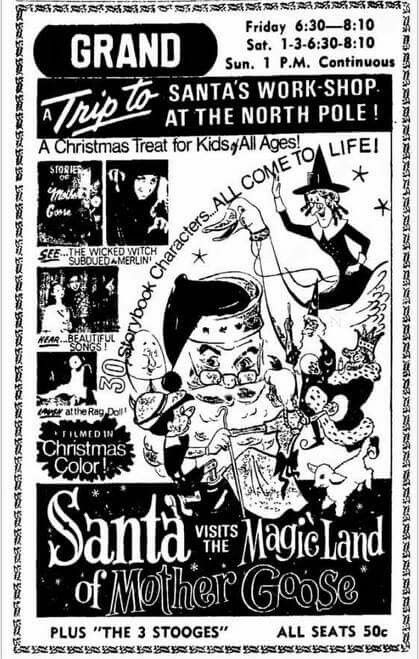
Happy holidays, everyone. To help celebrate, this is the first of two very horrifying holiday options for you to watch. Despite Santa being in the title of this movie, he only briefly appears, but that isn’t why we watched this movie. No, we’re here because this is another film in the career of Herschell Gordon Lewis that we had to check off.

Yes, parents that dropped their kids off at the theater for an all-day matinee in 1967 probably had no idea that just a few years earlier, the man they are trusting with the psyches of their children made Blood Feast.

So how did this even happen? Well, producer J. Edwin Baker was also a spook-show performer known as Dr. Silkini — his act was The Asylum of Horrors — and he hired Lewis to make a movie for his friend magician Roy Huston.

Huston plays Merlin, making this the second baffling holiday movie* I’ve seen where Santa joins forces with King Arthur’s closest confidant. I have no idea why this is a thing, to be perfectly honest.

The film starts with Santa Claus chilling out on the day after Christmas by reading some Mother Goose, which puts him to sleep. This section is tacked on, of course, to the original film so that they could get more money out of it. It’s also so shoddily made that we can audibly hear Lewis yell cut.

As for the movie itself, Old King Cole calls Merlin, a rag doll who is legally never referred to as Raggedy Anne (or Annabelle, for that matter), Prince Charming, Sleeping Beauty, Mother Goose and a ghost who they originally called Casper before an audio edit saved the production from a lawsuit onto the stage for singing, something resembling dancing and the kind of magic tricks that you could have bought from a mail order store to bore your friends with.

Do you remember — if you’re a jerk like me — how much you hated up with people school assemblies? This is just like being stuck at one of those, with Lewis just plopping his cameras down and shooting whatever happened on stage.

There’s so much hand work and goofy acting tics and a witch that gets set on fire and not Raggedy Ann is just horrifying and the real magic trick is that somehow the hour running time of this feels like a hundred years. But hey, it’s Christmas and I have pledged to watch everything the Godfather of Gore ever did, so if you’re going to hit the highs of She-Devils on Wheels and Two Thousand Maniacs! then you’re going to suffer the valleys on the journey.

*The other is, of course, the Mexican mind melter known as Santa Claus.

Repost: The Rage: Carrie 2 (1999)

Editor’s Desk: This review originally ran on May 25, 2018, as part of our “Stephen King Week” of reviews and we’ve brought it back for John Doe Week.

Originally titled The Curse, this film, based on the real-life Spur Posse case (read up at Wikipedia; you’ve seen the case as plot fodder for Law & Order), sat in development hell for two years. One can only wish that it had remained there. How did we as a people allow this movie to happen? If only social media had been around to shame this film into nothingness back then!

The original story was so close to Carrie that the producers decided to go for it and the film finally went into production in 1998 under the title Carrie 2: Say You’re Sorry. However, just a few weeks into production, director Robert Mandel (School Ties, F/X) quit over creative difference and Katt Shea (Stripped to KillPoison Ivy, Nancy Drew and the Hidden Staircase) stepped in with less than a week to prepare and two weeks’ worth of unusable footage.

Did you like Hackers? Well, if you did, good news. The writer of that movie, Rafael Moreu, also wrote this. Chances are, however, that you disliked that movie. Most people do.

Man, where to start? Well, how about in the past, where Barbara Lang paints a red paint barrier throughout her house to protect her daughter Rachel from Satan? There’s a nice transition here where we go from the young girl holding her puppy to the teen version holding an older version of Walter the dog.

Rachel hates her foster parents (the dad is John Doe from X! and A Matter of Degrees) and only has one friend, Lisa (a pre-American Pie and American Beauty, if only by a few months, Mena Suvari). On the bus, Lisa shares that she just gave up her virginity to Eric (Zachery Ty Bryan of TV’s Home Improvement), a football player.

The truth? It’s all an elaborate game where players get points for sleeping with different girls. Eric rejects her and Lisa dives off the roof of the school, igniting Rachel’s telekinetic powers.

That’s when we meet Sue Snell (Amy Irving, who asked Brian De Palma for his blessing), the only person who came back from the original. She’s now a school counselor and she and Sheriff Kelton are trying to figure out why so many girls have come to her in tears. Never mind that one of them just did a perfect dive off the garden club’s roof.

Meanwhile, Walter the dog gets hit by a car and Jesse, the nice football player takes her to the animal hospital. Becca assures me that Jason London and his twin brother, Jesse, were once a big deal. All I know is that he was in Dazed and Confused.

The football players learn that Rachel figured out the game and alerted the police, so they try and intimidate her. Her powers nearly kill them before her foster parents arrive.

Sue Snell drops the bomb on Rachel soon after. Her father, Ralph White, also was the father of Carrie White, who burned down the school that Sue attended and killed 70 people thanks to her powers. Rachel refuses to believe that they are half-sisters, even after a visit to the burned down school. This is probably where the planned Sissy Spacek cameo would have gone, but she did not want to be in the film. She did allow her old footage to be used, however. There was even a version shot of this scene where Rachel kicked the metal bucket that dropped onto Carrie’s head, but thankfully smarter heads won out.

So Jesse falls in love with Rachel, despite popular girl Tracy being all butthurt about it. Oh yeah — I forgot that American Pie alumnus Eddie Kaye Thomas shows up, too.

The players get out of jail free thanks to the status of their parents. But they want revenge, so they decide to humiliate Rachel. They secretly tape Rachel and Jesse making love and play it at a big party that they’ve invited Rachel to. The players also reveal their sex game and make her believe that Jesse never really loved her.

As they all scream and yell at her (one of them even yells, “They’re all going to laugh at you,” which one imagines they would only know from an Adam Sandler routine), she finally unleashes her power and kills nearly everyone. This is the one great scene in the film, as her shitty tattoo (which looks like the fakest tattoo in the history of the fake tattoo game) becomes vines that descend down her arm.

Sue has somehow stolen Barbara from the mental institution to try and save Rachel, but it causes her death (shades of Miss Collins in the original). Even spear guns and a flare gun can’t stop her. Finally, her mother tells her that she is possessed by Satan and wants nothing to do with her and Rachel begs to die.

Tracy comes into the house and Rachel kills her with absolutely no mercy. As the videotape of Jesse and Rachel plays, she makes him explain. He screams that he loves her but she doesn’t believe it until she hears the same tone on the video. The ceiling collapses on her and he stays by her side to kiss, but she pushes him away as she dies.

A year later, while in his college dorm with her dog (he must have one of those great football player deals that allow you to have a pet on campus and yes, I get the silliness of me being bothered by this when I’ve just watched an entire movie about psychic powers), Rachel appears to him in a dream before she shatters. And yes, that’s the dumbest ending I’ve seen in some time.

This movie is a complete piece of 1990’s shit. It’s all shot with that crushed black/blue filter, everything on the soundtrack sounds like Fear Factory and it makes you realize a time and place where horrible sequels like this and An American Werewolf in Paris were considered good ideas. This would have been better if it were a movie that stood on its own so that I could have ended this article with something like, well, it’s no Carrie. Instead, it shoves that fact into your face from the very first frame.

If you’d like to suffer through this for yourself, Amazon Prime and Hulu have you covered. Man. I hope Stephen King got more than his traditional $1 advance for this.

Sins of the Flesh (1974)

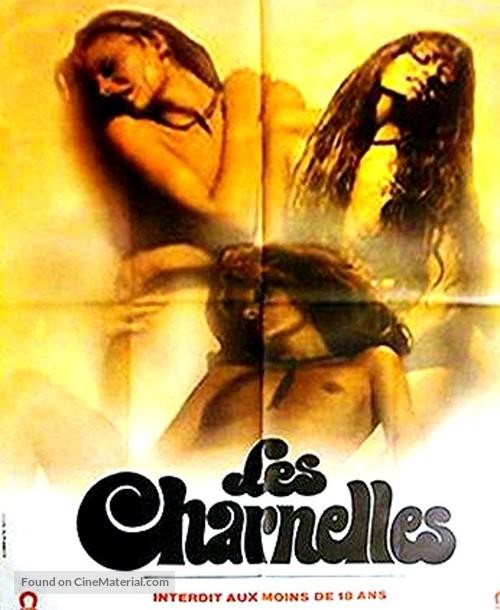
Director Claude Mulot used the alter ego of Frederic Lansac — a character from his previous film The Blood Rose — to make this movie, which was known as  Les Charnelles (The Carnals) when it was released in its native country.

Of course, Mulot would move on to hardcore with his next movie, Pussy Talk, but he was also known for comedy and thrillers, too. And, well, softcore, as evidenced by Black Venus. Sadly, he drowned at the way too young age of 44. His last film was 1986’s Le Couteau sous la gorge (The Knife Under the Throat).

Sins of the Flesh is all about Benoît Landrieux, the potentially insane son of a rich industrialist who comes into the lives of car thief Jean-Pierre and Isabelle (Anne Libert, who was the Queen of the Living Dead in A Virgin Among the Living Dead, along with appearing in House of 1000 Pleasures and numerous Jess Franco films, such as Sinner: The Secret Diary of a NymphomaniacThe Erotic Rites of FrankensteinThe DemonsDaughter of Dracula and Dracula Prisoner of Frankenstein), who is saved by the duo when she’s being assaulted by her stepfather.

Benoît is many things: maniac, coward, killer and perhaps even an impotent voyeur, as the only way he is able to perform is after watching other couples make love. Now, he has a new goal: to rob his father’s safe, to make his stepmother fall for someone else and blackmail her for it, then finally, to kill and kill again.

The sequence where our threesome ingests psychedelic mushroom tea before swimming and aardvarking amongst fuzzed out acid rock*, strobing lights and statues of alebrijes is the highlight of this affair. It’s a scene filled with crazy lenses and a complete lack of body hair grooming, so it’s pretty much everything wonderful about exploitation circa 1974.

The region free Mondo Macabro release has a brand new 4k transfer from the film negative, along with interviews with Anne Libert, Gerard Kikoine, distributor Francis Mischkind and assistant director Didier Philippe-Gerard. Plus, there is an original trailer, an alternative title sequence** and optional newly created English subtitles.

All hail this label, which continually finds movies I never knew existed and makes the best versions of them that have ever been released. You can get this directly from Mondo Macabro.

*The score is by Eddie Vartan, father of actor Michael.

**Émotions secrètes d’un jeune homme de bonne famille is the other title, which translates as Secret Emotions of a Young Man from a Good Family.

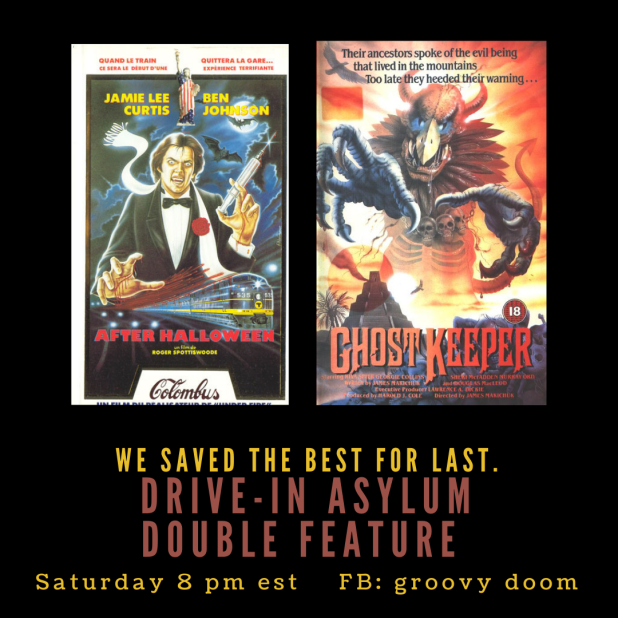
CELEBRATE THE NEW YEAR’S EARLY WITH THE DRIVE-IN ASYLUM DOUBLE FEATURE!

Join us this Saturday on the Groovy Doom Facebook page at 8 PM East Coast Time for two NYE themed movies a few days early! Don’t forget! Make sure to “like” the page so you get an alert when we go live throughout the night.

Up first, Jamie Lee joins David Copperfield, Vanity and Ben Johnson for a sinister steam-powered journey through Canada in Terror Train!

You know what NYE is all about, right? The drinks! Well, we got one for you!

Train Number 1293 (based on this recipe)

  • 2 oz. bourbon
  • .5 oz. peach liqueur
  • 1 tsp. maple syrup (because its Canadian)
  • 2 dashes Angostura bitters
  • Dash of lemon
  1. Place all ingredients in glass.
  2. Add ice and stir as if you were on a train going through snowy mountains.

Ghostkeeper, another Canadian tax shelter slasher, is next!

Wendigo on a Snowmobile (modified from this recipe)

  • 1.5 oz. half and half
  • 1 oz. Kraken rum
  • .5 oz. vanilla vodka
  • .5 oz. cream of coconut
  1. Add all ingredients to your shaker with some ice.
  2. If you’re feeling fancy, strain into a martini glass. If not, over some ice in a tumbler is fine, too.

You can watch the movies here:

Terror Train: YouTube (Spanish subtitles), Plex, Amazon Prime

Ghostkeeper: Tubi, Amazon Prime

Man Maid (2008)

Although Man Maid was made in the backwash of the 2005 critical and box office comedy hit The 40 Year Old Virgin (Jane Lynch from that film cameos here as a dominatrix) — and lost somewhere in the Judd Apatow comedic raunch-o-verse — this quirky tale about a male housekeeper at a dying hotel in the Pacific Northwest feels like one of those off-beat, innocuous ‘80s comedies John Cusack used to make — on his way up to the likes of Con-Air — such as Better Off Dead and The Sure Thing. But since Man Maid was released in the early 2000s and filled with eccentric characters, a more accurate reference would the out-of-the-ordinary, ’90s indie comedy hits Bottle Rocket, Little Miss Sunshine, and Napoleon Dynamite. And if this was made in the ’80 with major studio backing, John Cusack would have been our male maid; in the ‘90s, Jon Heder would have been cleaning rooms; a pre-Office Steve Carell would have been tailor made for the role of our off-the-grid geek hero — complete with motor scooter — who gets the girl and saves the day. In fact, if DreamWorks-Paramount had backed Man Maid, Jay Baruchel from their 2010 joint venture, She’s Out of My League, would have his face inside the washing machine.

Also known as The Cleaning Man in overseas markets, Man Maid was plucked off the festival circuit by Canadian TV Movie purveyor Marvista Entertainment, which airs their catalog on channels such as Hallmark and Lifetime.

Shot in 22 days on a shoestring in Oregon back in 2006 and hitting the festival circuit in 2008, Man Maid feels as if it comes from a place of erudition. Self-financed and mini-major indie comedies usually come from aspiring filmmakers and burgeoning actors with the burning desire to make something and, to that end, they’ll keep the story simple and write it around locations that they know (and know they can secure for shoots to avoid costly set builds) and write characters that they know. And considering this is a tale about a male maid, one wonders if writer-director Chris Lusvardi and lead actor Phillip Vaden worked as maids — or at least as hotel concierges or managers — to work their way through college.

Vaden — who’s very good here and brings a definite Cusack-Carell vibe to the proceedings — is Vincent Van Metcalf: a slightly more ambitious Pacific Northwest slacker — and second generation male maid — who finances his camping-tent lifestyle as a member of the housekeeping staff of a historic, dying hotel. During his off-days, he feverishly builds a piecemeal structure — as an act of love (reminding of the tale of eccentric South Floridian Edward Leedskalnin and his Coral Castle mystery) — that’s to serve as an outdoor concert stage for the way-out-of-his league Chloe Flaminghawk (nary a strand of Elizabeth Warren’s Native American DNA in her body), a free-spirited, aspiring singer who can’t sing, write, or play a harmonious chord on her accordion. (Played by a wonderfully ditsy-cute Amanda Walsh from SyFy’s Lost Girl, she’s bumped-off-the-marquee for Jane Lynch; that’s Walsh, poster right. And yes . . . the Bryce Johnson on the marquee is Detective Darren Wilden from ABC Family’s Pretty Little Liars.)

Move it on over, Woody. This machine kills fascists.

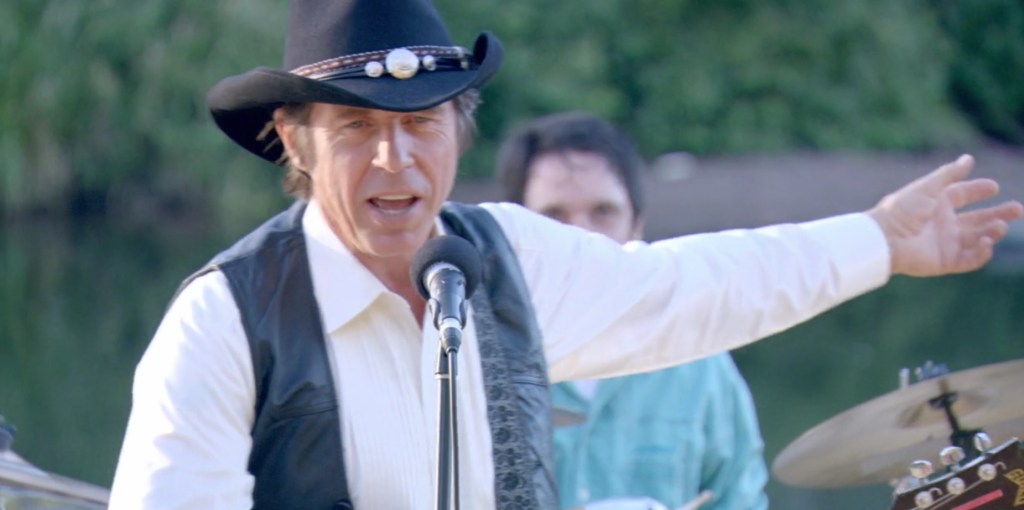
Proving that even off-beat dorks can get girls . . . and couldn’t be more clueless: Vincent is oblivious to his more realistic romantic goal of Tory (Sara Rue, TV’s The Big Bang Theory), the hotel’s “plain and boring” manager. Love blossoms when it’s learned the in-debt-to-the-IRS hotel is about to face foreclosure at the hands of a heartless developer (is there any other kind), played by omnipresent comedic television actor Stephen Hytner (who — sorry, Sam — will always be the ovaltine-obsessed Kenny Bania from Seinfeld). So the makeshift, outdoor stage, once to serve as a musical home for the dreamy-eyed Chloe Flaminghawk, will now host a benefit concert to save the hotel. And Chloe’s godfather — Americana-Country star Sissy Taylor (John Doe), known for his protest anthems — will headline the show.

Aggravating Sam — one Seinfeld reference at a time.

Ah, but beware, ye streaming John Doe fan. While John gets top-billing on the theatrical one-sheets, he only appears in the film’s last 15-minutes — to stand up to the cops and sing a tune — but it’s worth the wait to see Doe mixing it up with Stephen Hytner. (Oh, and while Rue and Doe worked together in Gypsy ’83 — also reviewed this week — they have no scenes together here.) All in all, Man Maid is an enjoyable, competently shot and acted film that rises above the usual indie norms — and is actually on par with the other comedies named checked in this review.

Sadly, unlike indie writer-directors Wes Anderson, Jonathan Dayton and Valerie Faris, and Jared Hess, each who found critical and box office acclaim with their respective indie-darlings, along with major studio and A-List actor acceptance with their sophomore films, the equally quirky Man Maid — which served as their film debuts — would be the only feature film from the writer-director and acting team of Chris Lusvardi and Phillip Vaden.

You can enjoy this “John Doe Week” entry — with its hard-to-find DVDs currently out-of-print — as a free-with-ads stream on TubiTV and decide to give it a go after you watch the trailer.

About the Author: You can learn more about the writings of R.D Francis on Facebook. He also writes for B&S About Movies and publishes on Medium.

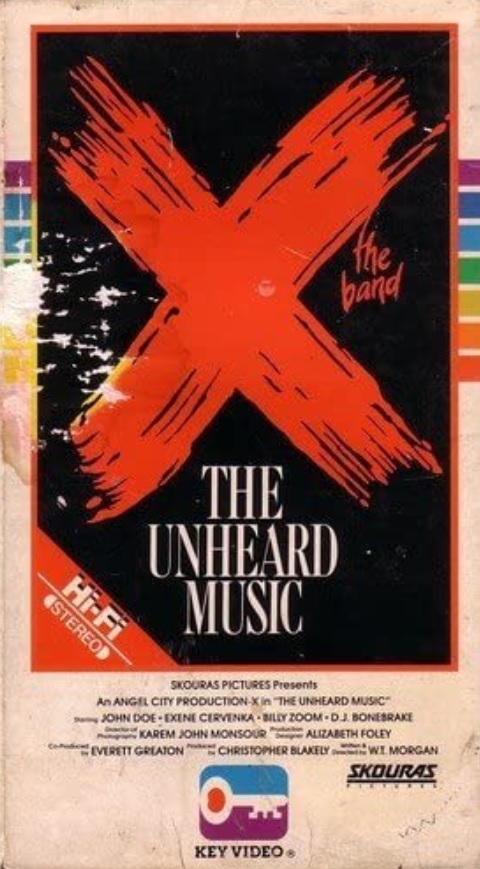
X: The Unheard Music (1986)

Writer and director W.T Morgan is a name engraved in the history of the Los Angeles punk band X. When Morgan made his debut foray into feature film narrative work with his rock ‘n’ roll love letter to his college radio roots in A Matter of Degrees (1991), he cast X’s bassist John Doe in one of Doe’s best-remembered roles as a burnt-out college rock disc jockey at odds with the commercialization of radio broadcasting. And that theme of the homogenization of music and radio industries carries through in this rock-doc.

Watch the trailer.

As with the four-years-in-production schedule Doe experienced with his first acting gig in Border Radio (started in 1982, released in 1987), W.T Morgan followed the band around Los Angeles and Southern California between 1980 to 1985. In addition to its sixteen-song strong soundtrack of the band in the studio and live on stage, the film also features band interviews, along with footage and insights from local disc jockeys, record store owners, and other local movers and shakers.

Granted with a limited art house release, this is one that punkers were first exposed to as result of its multiple showings on HBO and the resulting VHS tapes that hit the shelves. The DVD and Blu-ray version was issued on December 7, 2011, and includes a special features section with John Doe and Exene Cervenka discussing the film.

X: The Unheard Music is available on a wide variety of VOD streaming platforms, but we found a copy on You Tube. This is X in their prime. If there’s any punk document to watch, it’s this one. Watch it. And they still got “it,” as this 2019 full concert, courtesy of The Current.

About the Author: You can learn more about the writings of R.D Francis on Facebook. He also writes for B&S About Movies.

Black Cat Run (1998)

Before he gained mainstream Hollywood notice for the Val Kilmer-starring The Salton Sea (2002). Before he went mainstream with two back-to-back Shia Labeouf-starrers with Disturbia (2007) and Eagle Eye (2008). Before he gave us xXx: The Return of Xander Cage (2017) and tossed his hat in the ring to direct the upcoming G.I Joe: Ever Vigilant, D.J Caruso directed this Frank Darabont (The Shawshank Redemption, The Green Mile, The Mist) co-penned retro-action flick for HBO Films that aired on the cable network on September 18, 1998.

Hot from his 30-plus episode run on TV’s Melrose Place and his debut in a theatrical-starring role with Starship Troopers (1997), Patrick Muldoon (American Satan, The Comeback Trail) stars as Johnny Del Grissom, a gas-station attendant who chases down the chain gang escaped convicts who abducted his girlfriend — and he’s also on the run, as he’s blamed for her father’s murder (Rex Linn, TV’s Better Call Saul and Young Sheldon). And, of course, her pappy is the sheriff. And so ensues the Fast & Furiousness with Johnny chasing down the convicts and Deputy Norm Babbit (Jake Busey, S.F.W. and Starship Troopers) chasing down Johnny.

Macon County Line or Jackson County Jail, anyone? Yes, please!

Seriously, how can you not like a movie (and there are detractors) that rolls out a tricked out Olds 442 tweaked with Nitrous . . . and gives you John Doe, our favorite punk bassist from Los Angeles, matching thespin’ chop-for-chop alongside Kevin J. O’Connor (Deep Rising, The Mummy), Peter Greene (Pulp Fiction, The Mask), our favorite ex-Bond girl Lois Childs, and Jeffrey DeMunn (currently starring on Showtime’s Billions; Dale Horvath on The Walking Dead)?

You can’t. Not with a writer and director and cast like that.

In spite of its obviously low budget, Black Cat Run burns rubber and then some, all working in a Mad Max, big-dumb-engine sort of way, which was just an Aussie western trading out horses for horsepower.

And we love it, for this is pure A.I.P retro-cinema: a ’70s Drive-In dream that would make Roger Corman proud, filled with 44-Magnums, exploding tanker trucks, cheesy one-liners that would make make Eastwood cringe, and every other B-Movie absurdity you can think.

Watch the full movie as a free rip on You Tube. You can thank us later.

About the Author: You can learn more about the writings of R.D Francis on Facebook. He also writes for B&S About Movies and publishes on Medium.

Touch (1997)

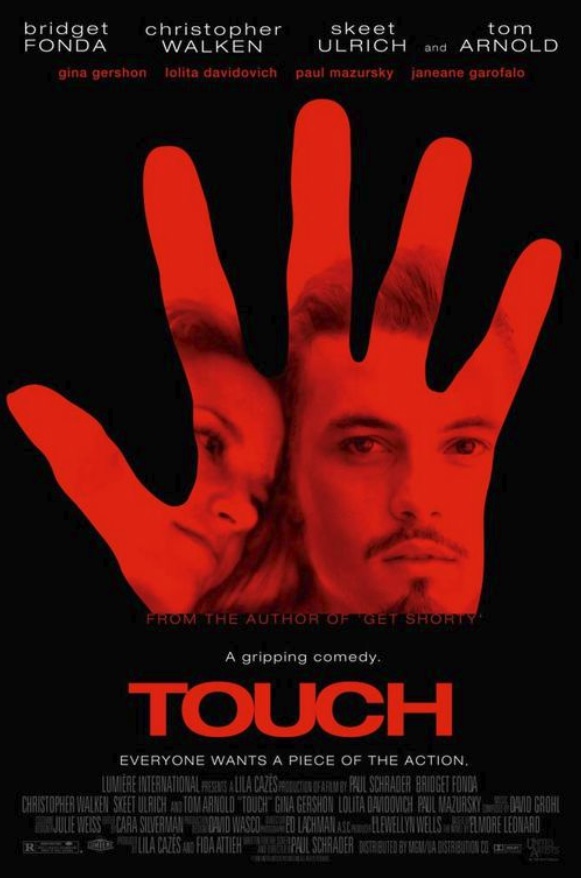
If you know your Quentin Tarantino, and we know you do, you know the career of American novelist Elmore Leonard through the Q’s adaptation of Leonard’s Rum Punch (1992) as Jackie Brown (1997). Of course, that was preceded by Barry Sonddenfeld’s adaptation of Get Shorty (1995) starring John Travolta, which was based on the 1990 novel of the same name, and Steven Soderbergh’s Out of Sight (1998) starring George Clooney, which was based on the 1996 novel of the same name.

Of course, long before Tarantino exposed Leonard to a new audience, Leonard’s novels produced the Burt Lancaster-starring Valdez is Coming (1971), the Charles Bronson-starring Mr. Majestyk (1974), Stick (1985) with Burt Reynolds (Smokey and the Bandit), and 52 Pick-Up with Roy Scheider (Sorcerer). And Tarantino hasn’t given up on Leonard: back in 2009 he optioned the 1972 novel Forty Lashes Less One. But since the Q has stated he’s not making anymore films after Once Upon a Time . . . in Hollywood, sans his interest in doing a Star Trek film, we’ll have to accept that film will never come to fruition.

Courtesy of impawards.com

In all, twenty-six of Leonard’s novels and short stories have been adapted for the screen, with nineteen as motion pictures and another seven as television series and TV movies. And this film co-starring John Doe of X is one of those movies.

And unlike most of his works, which were westerns, mostly crime dramas, and a smattering of suspense thrillers, Leonard broke “format” and came up with Touch (1987), a lesser known, dramatic-black comedy concerning an ex-Monk (Skeet Ulrich of Scream fame) who becomes a substance abuse counselor; when he acquires the divine abilities of faith healing, he’s manipulated by a fundamentalist preacher (Tom Arnold) and washed up evangelist (Christopher Walken). Love triangles ensue with Bridget Fonda (Singles) and Gina Gershon (Prey for Rock & Roll). And Anthony Zerbe (Mathias from The Omega Man) shows up as a Father Donahue, a Catholic Priest.

Now, you would think that an Elmore Leonard novel adapted and directed for the big screen by Paul Schrader of Taxi Driver fame (and his rock ‘n’ roll love letter with Joan Jett’s Light of Day) would be a box office winner.

Wrong.

As with the poorly reviewed and, in most cases, rarely seen, and/or poorly distributed Be Cool (2005; with John Travolta), Freaky Deaky (2012; with Christian Slater of Playback), and (the truly awful) Life of Crime (2013; with a woefully miscast Jennifer Aniston), Touch failed in its test screenings and in its limited theatrical release before being dumped into the home video market.

And not even its alternative rock tie-in to the then “hot” grunge-rock wave engulfing America from the Pacific Northwest could save the film.

At the time, I was spinning alt-rock tunes and the Touch soundtrack was an instant add to our station’s rotation due to its grungy pedigree. All of the alt-rock rags and radio trades of the day made much ado about the film as one of the post-Nirvana projects by Dave Grohl; the drummer composed the film’s soundtrack (and played all of the instruments) for his new Capitol Records imprint, Roswell Records, a concern that found great success with the 1995 freshman and 1997 sophomore releases by Foo Fighters: Foo Fighters and The Colour and the Shape. While the majority of the soundtrack features instrumental tracks to score the film, it also featured the songs “This Loving Thing (Lynn’s Song),” a collaboration between John Doe and Dave Grohl (Doe would later rearrange the song with his solo band, John Doe Thing). Grohl also collaborated with Louise Post of Veruca Salt (remember “Seether“?) on the film’s title cut theme song, “Touch.” (Luckily, the extremely rare soundtrack is uploaded to You Tube to enjoy.)

Now, remember as you watched the quintessential grunge flick, Singles (1992), after Soundgarden released their fourth studio album, Superunknown (1994), you began to recognize snippets of that album’s songs — “Spoonman” in particular — appearing as instrumentals in the film? (An uncredited Chris Cornell scored the film for Cameron Crowe.) Well, in the grooves of Touch you’ll hear snippets of Dave Grohl’s drum rolls and fills — “Stay Away” (aka “Pay to Play” in its demo form) in particular — from Nirvana’s breakthrough album, Nevermind.

At the time, Nirvana was hot, John Doe knew a good thing with grunge when he heard it and got X back into the studio — after their 1987 demise — with Hey Zeus! (1993), and Louise Post was the new alt-rock darling with MTV offering their full support to Veruca Salt and their debut, American Thighs (1994; You Tube).

So, with that alt-rock pedigree behind it, darn right alt-rock stations were spinning the soundtrack. My station even used the instrumental tracks for various production vignettes. And, as with the John Doe-starring A Matter of Degrees (1991), the Touch soundtrack was better known and more successful than the actual movie it intended to promote.

Now, if you remember your grunge (soap) operas, you’ll recall Dave Grohl wrote “Everlong” from The Colour and the Shape (1997), inspired by his ongoing romance with Louise Post. However, prior to her romance with Grohl, Andy Thompson, the lead vocalist and guitarist with the Dallas, Texas, alt-rock quartet the Buck Pets was a bit more blatant in his love for Louise Post: the Buck Pets’ eponymous Island Records debut (1989) closed out with “Song for Louise Post.”

Ah, sigh . . . alt-rock love with Punk Rock Girls.

Been there. Done that. And heart broken. Curled up on the couch watching the VHS of Touch with Kim, my little “punk rock girl,” aka my “Louise Post,” is one of my cherished memories; her apartment wafted with vanilla incents and clove cigarettes. A “Greasy Boys Pizza” on the coffee table. And she never did return my copy of the Touch compact disc.

I hope Kim still has that CD, plays it, and remembers me the way I remember her, as I write this review for B&S About Movies “John Doe Week.” And Kim and I really did hang out a place called the Zipperhead (Room). And she liked Mojo Nixon and we went to see the Dead Milkmen live. We went to quite a few club concerts together.

True love. Now I am an adult and life sucks. To touch that alt-rock dream, again. So thanks for the memories, Mr. Doe. I need to buy you beer, my friend.

Touch was previously available as a free-with-ads stream on TubiTV, but has since been pulled. You can, however, stream it for a nominal fee on Vudu.

About the Author: You can learn more about the writings of R.D Francis on Facebook. He also writes for B&S About Movies.

Vanishing Point (1997): John Doe Week

Editor’s Desk: This review originally ran on August 7, 2020, as part of our “Fast and Furious Week I” week of reviews and we’ve brought it back for “John Doe Week.


Did you know their was a remake of Vanishing Point? It’s okay. No one does.

The FOX-TV Network—back when they were in the business of creating original content, in lieu of reality programming and weirdo-dorky Seinfeld (sorry, Sam) wanna-be shitcoms—retooled this 1971 classic made by their sister film studio. Ack! No one should be poking around Richard C. Sarafian’s classic. And how did Sarafian go from this, to Farrah Fawcett’s Sunburn (1979), to become “Alan Smithee” on Solar Crisis (1990)? And so it goes in the B&S About Movies universe. (See? Too many movies, so little time. So many reviews to write!)

Of course, since this is a TV film, the vague existentialism and “thinking road flick” gibberish of the original is excised, thus transforming Barry Newman’s Kowalski into an action hero. Luckily: it features the same model 1970 Dodge Challenger R/T as the original film. Sadly: the messages regarding religious cults, racism, drug abuse, homophobia, and police entrapment are lost . . . and we’re stuck with a Challenger-driven Bonnie and Clyde redux.

And if you thought Sarafian’s transition from Vanishing Point ’71 to Farrah was odd: The director, Charles Robert Carner, wrote Gymkata (1985)* for Robert Clouse. Yes. The film starring American Olympic gymnast Kurt Thomas—as if no one learned their lessons from trying to turn Olympian Mitch Gaylord into a film star with American Anthem* and American Tiger.

Watch the trailer.

In the Challenger cockpit is the always welcomed Viggo Mortensen (who starred in the rock-religious flick Salvation with his then wife, Exene Cervenka of X (we are reviewing it this week; look for it) ; and yes, he’s Aragorn from Lord of the Rings) as Kowalski; he’s still employed by a car delivery service, but now he’s a Desert Storm veteran pining for his glory days as a stock car racer. This Kowalski’s “need for speed” isn’t the result of drugs, bets or personal demons: he’s a clean, faithful husband desperate to get home to his pregnant wife who’s suddenly hospitalized. While the ‘70s Kowalski didn’t need a reason to say “Fuck the Man!” to earn his folk hero status, the ‘90s Kowalski becomes an Americana hero as result of being mislabeled as a “terrorist” by an overzealous government abusing new anti-terror laws. 

Helping out on the radio front is a politically outspoken DJ simply known as “The Voice,” (Jason “Beverly Hills 90210” Priestly, a FOX-TV series, natch) on KBHX 106.5, “The Voice of the Rocky Mountains.” At least Priestly’s DJ is hip enough to spin tunes such as “Volunteers” by the John Doe Thing. Not helping matters is a hard-edged, ex-stock racer turned Utah State Trooper (the always welcomed Steve Railsback of Lifeforce) in hot pursuit with a Hemi of his own and a catch-Kowalski-at-all-costs attitude (if this sounds a lot like the Marjoe Gortner-Railsback persuit in The Survivalist, it probably is.) And in with the desert-dwelling assist is rocker John Doe (A Matter of Degrees) as an anti-government tax evader with a knack for repairing Hemis. (And rock trivia buffs take note: This is only time you’ll see the ex-husbands of X vocalist Exene Cervenka—Viggo and John Doe—together in the same film.)

It’s interesting to note that while a TV movie, Vanishing Point ’97 has a 90-minute, theatrical-running time. Movies shot-for-TV run 80 minutes, then 40 minutes of commercials are added to fill a two-hour programming block. Thus, 10 minutes of advertising are lost to fit the film into that 120-minute programming block. That’s bad business. So, considering Viggo’s status at the time, was this intended as a theatrical feature, and 20th Century Fox realized their production faux-pas and dumped it on TV?

What do you think, Eric?

“Jesus. Even the poster for this sucks. What the f**k was Viggo thinking.”
— Eric, purveyor of film quality and Seinfeld hater

Indeed, Eric. Indeed.

You can watch Vanishing Point ’97 on You Tube.

* Sam? Bossman? How many times must I lay down the American Anthem/Gymkata gauntlet? At the very least, all I want for Christmas is a Sam Panico review of Gymkata. Amen.

About the Author: You can learn more about the writings of R.D Francis on Facebook. He also writes for B&S About Movies.