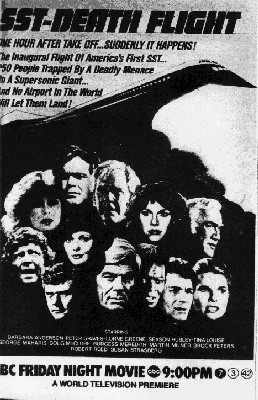
David Lowell Rich directed Eye of the Cat andSatan’s School for Girlsbefore this made-for-TV movie, which originally aired February 25, 1977 on ABC. He also directed The Horror at 37,000 Feet, which probably is why he was selected to make the final movie in the Airport series, the absolutely insane The Concorde … Airport ’79.
There’s also a European version of this called Death Flight that has nudity in it, if you want some more death in the sky with breasts action. You’ll get that but no realism, as the plane model used for the film is actually American SST as the first of its kind. The aviation sequences utilized a Concorde with Boeing 747 turbofan engines attached in some scenes and a Lockheed L-2000 in others. Neither of these planes ever flew at these speeds.
On the maiden flight of Maiden 1, Captain Jim Walsh (Robert Reed, The Brady Bunch), Flight Engineer Roy Nakamura (Robert Ito, Quincy M.D.), stewardess Mae (Tina Louise, Gilligan’s Island) and steward David (Billy Crystal, City Slickers) are preparing for the first supersonic flight from New York City to Paris. Joining them are plenty of guest stars, like the designer of the ship (Burgess Meredith, Rocky), the head of PR (Bert Convy!) and the supermodel who he’s sleeping with (Misty Rowe, Hee-Haw, Meatballs Part 2) and a former pilot (Doug McClure, Firebird 2015 A.D.).
There are so many people in this and you know that I love movies like that. Peter Graves, John de Lancie (the Q!), Season Hubley (Hardcore, Escape from New York), Susan Strasberg, Regis Philbin, George Maharis, Martin Milner, Brock Peters …1977 was such a great time for TV movies like this.
There’s also a virus unleashed on the plane beyond all the mechanical failures that you’d expect. Man, disaster films — on a budget! — are where it’s at.
Somehow, despite both being on Route 66, Milner and Maharis don’t appear in a single scene together.
This was one of the first movies that Mystery Science Theater 3000 riffed back when they were KTMA. Here it is on YouTube so you can watch the unadulterated movie all on its own:
Editor’s Note, January 2023: Lance Kerwin passed away on January 24, 2023, at the age of 62. Lance got his start in acting by way of his mother, who worked as a booking agent, and his father, who worked as an acting coach. Kerwin, who came to prominence for his work in the Michael Landon TV movie The Loneliest Runner (1976), the NBC-TV series James at 16 (1978), and the Stephen King adaptation, Salem’s Lot (1979), left Hollywood in the late ’90s to serve the Lord as a Christian youth minister.
Thank you for the films, Lance. You were loved and you will be missed.
If you read our reviews for the ABC Afterschool Special: Hewitt’s Just Different, along with the CBS Schoolbreak Special: Portrait of a Teenage Shoplifter, and the NBC Special Treat: New York City Too Far from Tampa Blues, then you’re up to speed on the backstory of the “Big Three” network’s competition for a slice of the young adult audience during the late afternoon school days during the ’70s and ’80s. So let’s jump right into the review!
This movie that aired on February 4, 1976, is simply too special to casually mention in passing amid some of the other notable young adult flicks aired during the ABC anthology series, which we pointed out in our review of Hewitt’s Just Different.
Why?
Because during that spring, and into the summer of 1976, anytime we faced a challenge, e.g., scaling a particularly tall tree, a knee-scraping bike stunt, or a dive off the pool house, someone would inevitably say, “You can do it, Duffy Moon!”
Yeah, to hell with J.J, Rerun, The Fonz, and Gary Coleman (please tell me you know your ’70s television characters) and their tired catch phrases. We had Ike Eisenmann fueling our kiddie vernacular.
And besides: How can you pass up a young adult flick starring Jim “Thurston Howell III” Backus and Jerry Van Dyke (Luther Van Dam from ABC-TV’s long-running Coach), and Lance Kerwin? (Yes, the epic Lance Kerwin* from TV’s James at 15, the Robbie Benson-starring TV movie The Death of Richie, the Michael Landon’s biographical The Loneliest Runner, Salem’s Lot with David Soul, and Wolfgang Petersen’s Enemy Mine.)
You don’t.
Ike Eisenmann (Star Trek II: The Wrath of Kahn, Escape to Witch Mountain) is the undersized sixth-grader Duffy, and he’s sick and tired of being called “shrimp” by the other boys in his class. Then, one day, he buys a mysterious, magical book, “Cosmic Awareness,” which enables him to “Think Big,” not just figuratively—but literally. And with the puff of his cheeks, he chants the self-motivational mantra “You Can Do it, Duffy Moon!” in his head and develops powers that enable him to beat life’s challenges.
As with the previously reviewed New York City Too Far from Tampa Blues, everybody check-out this book by Jean Robinson from the school library. Yeah, those were the days. Today, young adults are shilled Twilight and The Hunger Games. And we in the pre-Internet epoch got this. And we became better adults because of it. And that was the whole point of young adult fiction in the ’70s.
They just don’t write ’em like this anymore. To say this carries the B&S About Movies’ “Seal of Nostalgic Approval” is an understatement. Watch it!
“You can do it, Duffy Moon!”
Well, that concludes our fourth and final review of the afternoon anthology movie programming offered by the “Big Three” networks during the ‘70s and ‘80s. You can relive those days with this pretty cool catch-all playlist we found on You Tube that features a mix of the ABC Afterschool Break, CBS Schoolbreak Special, and NBC Special Treat young adult films. Enjoy! You can watch the full episode, here.
* Lance did five ABC Afterschool Specials in all. He also starred in 1974’s Pssst! Hammerman’s After You! and The Bridge of Adam Rush, and 1976’s P.J. and the President’s Son and Me and Dad’s New Wife. Looks like you’re surfin’ You Tube!
About the Author: You can read the music and film reviews of R.D Francis on Medium and learn more about his work on Facebook.He also writes forB&S About Movies.
After ABC-TV found late-afternoon, weekday rating success with their Afterschool Special, NBC quickly followed with their weekday Special Treat anthology series that debuted in October 1975 and ran for eleven seasons until its 1986 cancellation.
While not as popular ABC’s trailblazer or CBS-TV’s Schoolbreak Special knockoff, Special Treat had its share of standout episodes.
Sunshine’s on the Way (November 1980; You Tube) starred Amy Wright (The Amityville Horror ’79) as a musician and nursing home volunteer who tries to boost the spirits of a legendary jazz musician portrayed by Scatman Crothers (The Shining).
Another was December 1975’s The Day After Tomorrow, aka Into Infinity, which concerned the interstellar mission of the Altares. Produced by Gerry Anderson between the first and second seasons of Space: 1999, it starred Brian Blessed (Flash Gordon) and Nick Tate from that show, along with Ed Bishop from Anderson’s UFO. (Trailers on You Tube/You Tube.)
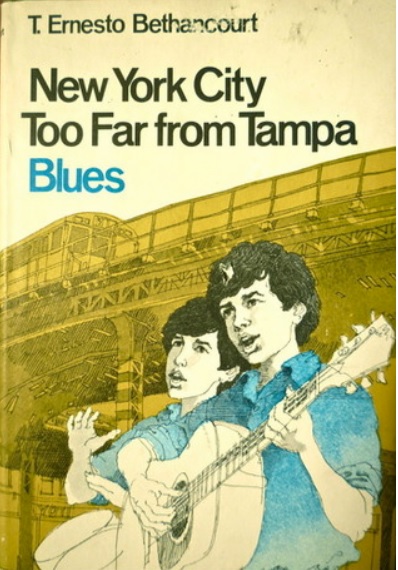
But it’s this musical entry from November 1979 during the fifth season, based on the book by award-winning young adult author T. Ernesto Bethancourt, that’s best remembered by the wee-rockers.
Alex Paez (as an adult, he returned to acting to star on ABC-TV’s NYPD Blue and CBS-TV’s CSI: Miami) stars as Tom, a 14-year-old Puerto Rican kid who moves from Florida to Brooklyn with his family. He finds solace—to the dismay of his hardworking father—in an acoustic guitar he was taught to play by his Uncle Jack. Along with a 12-year-old bongo-playing Italian kid, Aurelio, they become the “Irish” Griffith Brothers. With costumes made by Tom’s mother based on Greg Guiffria’s Angel, they win the local church talent show with their original composition “New York City Too Far from Tampa Blues.”
Everybody checked-out the book from the school library (Kirkus Reviews)—and everybody watched the movie. Then we all went out and bought our first Angel albums. And we were drawing griffins in pastels-on-velvet in art class alongside our portraits of Eddie, Iron Maiden’s mascot. Pair that with our Black Sabbath and Nazareth tee-shirts and long hair . . . to say “Mr. Hand” was a bit concerned is an understatement.
About the Author: You can read the music and film reviews of R.D Francis on Medium and learn more about his work on Facebook.He also writes forB&S About Movies.
Do you want to see Sheriff Andy Taylor as a sociopath? Do you want to see a spineless, suicidal Captain Kirk? How about Mike Brady as a bastardly dolt of a husband? Or Marjoe Gornter (Starcrash and The Survivalist) with a knocked up girlfriend half his age? How about a movie where they’re bedding and cheating with Angie Dickenson (Dressed to Kill) and Lorraine Grey (Jaws)?
Aired on ABC-TV January 23, 1974/image courtesy of blue-ray.com.
Well, Robert Michael Lewis, who made his network teleplay debut with 1972’s The Astronaut, and cut his teeth with episodes of ABC-TV’s The Mod Squad and McMillan & Wife, answered that question with this, his fifth telefilm. The scribe behind the scenes, Jack Turley, was known for his work on Rawhide (where Clint Eastwood got his start), The Fugitive (starring David Jannsen of Inchon, but the TV Movie Birds of Prey), and the show where he met Lewis: The Mod Squad. The duo also worked together on their next telefilm, 1974’s The Day the Earth Moved (starring Jackie Cooper from The Astronaut).
Andy Griffith (No Time for Sergeants) is Sam Farragut: a businessman who hires William Shanter (Big Bad Mama), Robert Reed (Haunts of the Very Rich), and Marjoe Gortner’s advertising executives for an ad campaign shot in Baja, California. But before he’ll sign on the dotted line, Farragut pressures the trio to take a dirtbike trip though the desert to “search for just the right location.” Desperate for business — and with no camping or dirtbiking experience — they accept, as the deal could save the agency.
Yeah, you guess it.
Farragut is a reckless sociopath and adrenalin junkie that dragged them into the desert for a little “human death sport” of his own making. The “game” goes sideways after a couple of American hippies at a Mexican bar smart mouth Farragut . . . and now the “Wildcats” are not only Farragut’s game pieces, but murderers on the run. The Most Dangerous Game on dirt bikes ? Yep. And it’s awesome.
Oh, check out this very smart, funny send-up trailer for the film. And, are those old Star Trek jerseys?
Surprisingly, unlike most high-rated TV movies, this one actually made it to home video in 1987. The caveat is that the only official DVDs are the 2012 versions issued on the now-out-print 8 Movies for the Man Cave – 4 and the four-movie Andy Griffith Collection: America’s Favorite Actor sets (which features the TV films A Song for the Season, Street Killing, and Daddy & Them). Any single-DVD issues you find are grey market burns, so emptor that caveat when you buy.
This movie is a really fun watch, as we get to see Andy Griffith as we’ve never seen him before, along with the range of the underrated shakespearean trained Robert Reed (Gene Hackman was originally cast as Mike Brady; when Hackman hit pay dirt with The Conversation and The French Connection, it gnawed at Reed until his dying day), and Bill Shatner going way, way out of his comfort zone.
There’s several rips of varying quality on You Tube, but with the way uploads come and go, we’ll give you three to choose from HERE, HERE, and HERE.
About the Author: You can read the music and film reviews of R.D Francis on Medium and learn more about his work on Facebook.He also writes forB&S About Movies.
Bernard L. Kowalski has a decent horror pedigree, directing Night of the Blood Beast, Attack of the Giant Leeches,Krakatoa: East of Java, Terror in the Sky and Sssssss. Here, he puts theterror on a slow boil and puts Reverend John Keyes (Roy Thinnes, constantly battling the occult) and his wife Lorna (Lynn Loring, The Horror at 37,000 Feet) against an unseen force bedeviling a small Western town named San Melas. There’s voodoo, devil worship and a mute young girl and a gunslinger possessed by the Left Hand Path.Ray Milland shows up, proving that Old Hollywood is never to be trusted. Plus, there’s Gloria Grahame (Blood and Lace), Henry Silva (Almost Human, Megaforce, the epic Escape from the Bronx), stuntman Stan Barrett, Joshua Bryant (Salem’s Lot), a young Leif Garrett (Thunder Alley) and Jodie Foster’s brother, Buddy.This 1970s made-for-TV horror neglects the Old West, so it is a strange film to start with. Then again, it also plays the Troll 2 trick of a town with a backward name and a connection to witches, but it doesn’t telegraph that. The ending—which moves to 1971—more than makes up for the slow-moving last 68 minutes. I love dreamy TV movies that take forever to get anywhere.
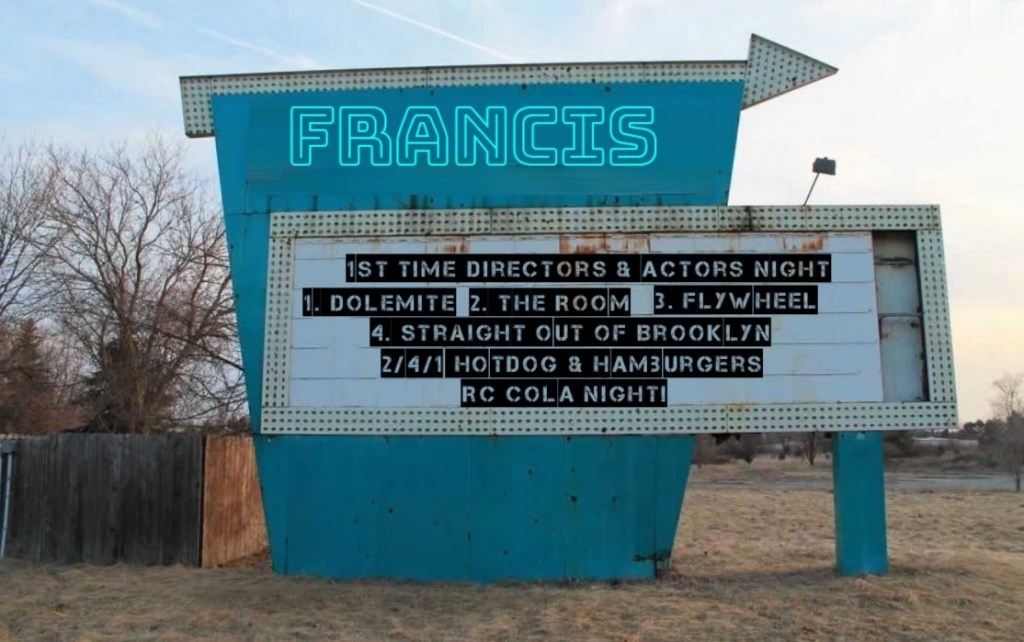
The criterion for this Friday’s theme night is simple: all of tonight’s films are by first time directors and actors who didn’t attend, or at the very least, complete their studies through, a theatre arts program.
First 50 cars get coupons for a free Eskimo Pie (2 per car only). Darn freezer’s on the fritz and I don’t want to throw them out.
Sure, we could revisit Kevin Smith’s Clerksand Troy Duffy’s Boondock Saints. But we’ve been there and done that with both of those films, and besides: the casts of both films featured formally trained actors. No, Quentin Tarantino doesn’t make the cut with Reservoir Dogs: while he had no formal schooling beyond his obsessive passion for film and working in a video store, he knew more about filmmaking that the four filmmakers we’re honoring this evening. No, Ridley Scott (Alien) doesn’t make the list either: while not a film school student, he graduated from London’s Royal College of Art and worked his way up the creative chain as a set designer for the BBC before making his debut, 1977’s The Duellists.
No, tonight we’re honoring indie filmmakers Rudy Ray Moore, Tommy Wiseau, Alex Kendrick, and Matty Rich — and while a diverse list, they have a lot more in common than you think. Each of them, along with their actors, possessed little to no film knowledge. But each had big dreams and unique purposes behind their respective films.
So hang up those speakers and lite the coils. Let’s get on with the show and enjoy Dolemite, The Room, Flywheel, and Straight Out of Brooklyn.
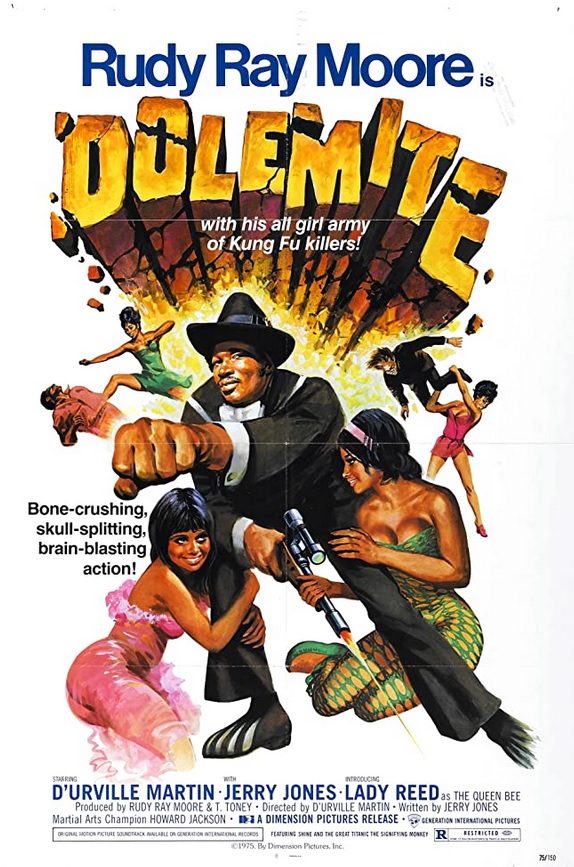
Movie 1: Dolemite (1975)
Rudy Ray Moore spent years struggling in the business as a musician, eventually finding his voice as a comedian by portraying a character called Dolemite. But his dreams weren’t over. He wanted to become a star of the silver screen. But even with his urban street cred as a comedian, none of the studios producing films in the then hot blaxploitation genre wanted to hire him or adapt his Dolemite character into a film.
Sure, Moore had a gift for a turn of the phase and rapping a prose, but he couldn’t act. And he had a potbelly and couldn’t fight. He’d never be a “Shaft” as he aspired. Oh, and he had no skills as director, writer, or producer. He didn’t know what a DP was or what a key grip or best boy did on a set. No matter. He spent his own money and took all of his non-industry friends along with him to make a movie.
So, taking the character of Dolemite from his Billboard Top 25 comedy album, 1970’s Eat Out More Often, he crafted a film about a pimp and nightclub owner granted an early prison release to work as an uncover agent to bust up a dope and gun-running ring operated by his old partner, Willie Green.
Is it awful? Yes. Is it Ed Wood-meets-Blaxploitation? Yes. Is it a charming picture overflowing with passion? Oh, absolutely. So much so you end up rooting for Rudy. And for his $100,000 investment in himself, he grossed $12 million during the film’s initial release. How loved is the life and oeuvre of Rudy Ray Moore? They made a movie about him starring Eddie Murphy: Dolemite Is My Name.
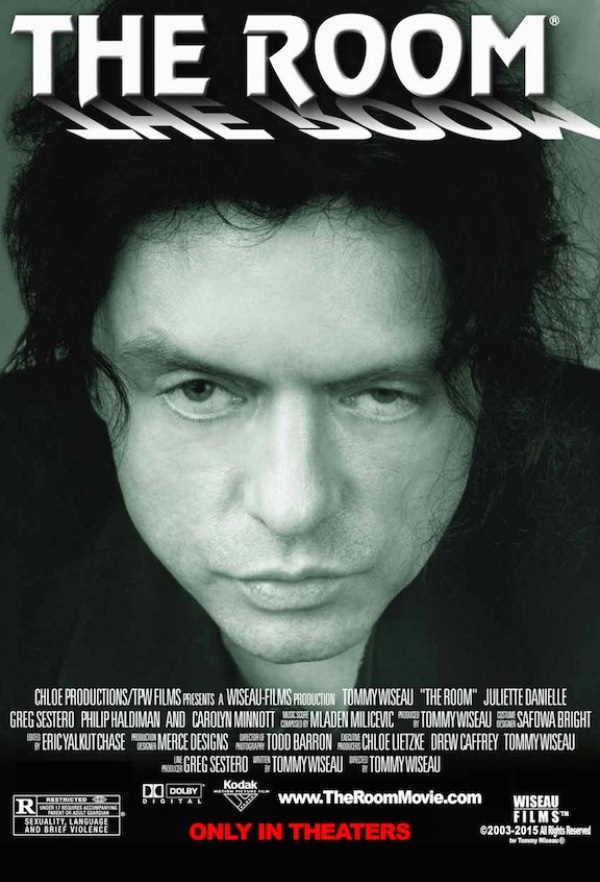
Rudy Ray Moore always intended Dolemite to be an extension of his comedy albums and wanted to people to laugh with him. Tommy Wiseau, on the hand, set out — and failed — to emulate the works of A Streetcar Named Desire and Cat on a Hot Tin Roof penned by American playwright Tennessee Williams.
Today, Wiseau claims that his celluloid calling-card to the industry, initially intended to a be a “great American drama about love and betrayal,” was actually an intentional “black comedy.” Opinions vary on that assessment of his successful artistic disaster, and do we care? No. We love Tommy Wiseau’s Rudy Ray Moore-esque heart and tenacity in making his dreams come true.
The true beauty behind The Room is that much to the chagrin of Tommy’s harshest late night, D-List celebrity guests-cum-might Internet Warriors and purveyors of cinematic quality, The Room is still playing in theatres and breaking box office records 17 years after its release.
And, like Rudy, Hollywood made a movie about Tommy: 2017’s The Disaster Artist, which went on to win Golden Globes and Critics Choice Awards, and earned an Oscar nomination. So who’s laughing now, D-Listers? Who’s laughing now?
Surprisingly, none of the online PPV-VOD services offer streams of The Room, not even a free-with-ads stream on Tubi or Vudu. The free streams on You Tube come and go, so watch it while you can. Vudu does, however, carry Tommy’s two-part sophomore effort, 2018’s Best F(r)iends. The clips from the film abound on You Tube, so search and enjoy!
Intermission!
Back to the Show!
Movie 3: Flywheel (2003)
This feature film screenwriting, directing, producing, and acting debut from Alex Kendrick is not only my favorite film of this evening’s films: it is also the most technically adept “first” film of the evening. And, unlike Dolemite and The Room, each which had some assemblage of a semi-pro crew and a couple of trained actors on set, none of the cast and crew on Flywheel ever worked behind or in front of a camera. (Sans one actor: Lisa Arnold, a church member who worked in local theatre and did some local commercial work; she plays a news reporter who exposes the lead character’s dishonest business practices.)
Along with this brother, Stephen, Alex Kendrick oversaw the audio-visual ministry as the Associate Pastor of Sherwood Baptist Church in Albany, Georgia; their duties dealt with the recording and distribution of church sermons and other messages of faith. Not exactly what you would call filmmaking. And it’s a job they just picked up and learned along the way.
Now, while Rudy Ray Moore’s and Tommy Wiseau’s goals against their lack of experience to make their debut films were rooted in an earthly quest for fame, Alex Kendrick never aspired to be a screenwriter, director or actor: his filmmaking goal was purely spiritual. His was a quest to expand the audio-visual ministry of Sherwood Church and reach young people and teenagers. And young people and teens love going to the movies.
So with a Tarantino-inspired self-study tenacity and a budget of $20,000, the Kendrick brothers figured out how to write, produce and direct their own screenplay: a simple tale about Jay Austin (Alex Kendrick), a used car salesman with a crisis of faith. And that spiritual crisis has not only negatively affected his business; it’s damaged his marriage and his relationship with his son. And an acquisition of a classic ‘60s Triumph Roadster with a broken transmission flywheel becomes a catalyst to repair his own “spiritual flywheel.”
Once the Kendrick brothers’ film was completed, they released it “roadhouse” style, going from church to church across the state. And the response was overwhelming. So, to answer the demand, they four-walled two local theatres in Tifton and Columbus, Georgia. And the crowds kept coming. And they grossed $37,000. Then a distributor expressed interest. And the film opened across the country. Then it found distribution on faith-based television networks around the world. And it became one of the top-selling Christian films on DVD of all time, selling 300,000 plus copies. And the Kendrick brothers went on to make several more faith-based films (2006’s Facing the Giants, 2008’s Fireproof, 2011’s Courageous, 2015’s War Room, and 2019’s Overcomer)—each with an improved quality and even greater box-office successes. Their second film, Facing the Giants, was made for $100,000 and grossed over $10 million.
Is Flywheel a little rough in spots? Yes. Since neither Kendrick brother made a movie before, they made the usual rookie mistakes that all first-time filmmakers make—even the ones with formal training (and even the ones who have several other films on their resumes)—they forgot to film pick up shots, to create coverage, and inserts (all of the same mistakes Sam Raimi and Bruce Campbell* made with their little film about demons that everyone hails today in high praise as a “classic”). So, during the course of the Kendrick brothers’ debut film, you’ll notice a couple of scenes where the film quality changes. But make no mistake: Flywheel is not an Ed Woodian production that induces the guffaws of a Rudy Ray Moore or Tommy Wiseau production. It’s a film with well-drawn, complex characters that shine under the amateur thespians who volunteered their time to the production.
Now, if you’re just a movie fan, the faith-based aspect of the film will most likely be a turnoff and you’ll scoff at my praises for Flywheel. However, if you’re a filmmaker or actor and watch with those creative eyes, you’ll understand why this is a special film—probably the greatest first-time film by a group of cinematic novices ever made. Yes—even more so than the Sundance ballyhoo’d final film on this evening’s program.
Flywheel is widely available across all PPV and VOD platforms. But since this a Christian film you probably don’t want to gamble on—and we really want you to watch it—you can sample the film for free in two-parts on Daily Motion: Part 1 and Part 2.
* Bruce Campbell chronicled all of those mistakes in his biography If Chins Could Kill: Confessions of a B-Movie Actor.
Movie 4: Straight Out of Brooklyn
Filmmaker Matty Rich had it all: he had the start of a very promising career in Hollywood as a member of the “New Black Wave” alongside fellow filmmakers Bill Duke, Spike Lee, Mario Van Peebles, and John Singleton.
At the age of 19 Rich took Sundance by storm with Straight Out of Brooklyn, a film that he produced, wrote, directed, shot, edited, and acted in for $450,000 and, like Rudy Ray Moore before him, Rich brought along all of his friends. After winning the 1991 “Special Jury Prize” at the Sundance Film Festival and a 1992 Independent Spirit Award for “Best First Feature,” the film was picked up for distribution by MGM/Samuel Goldwyn Company and grossed over 2.5 million dollars in art-house box office. Rich’s debut was a vibrant, exciting and real story about a young man living in poverty in Brooklyn’s Red Hook housing project who concocts a plan to rob a drug dealer and change the course of his life—and it does: for the worse. It was an absolutely amazing film by a kid one year out of high school that left you feeling that same Kevin Smith-exuberance after watching his independently produced films, Clerks.
Sadly, as in the case with fellow first-filmmakers Troy Duffy (Boondock Saints) and Rob Weiss (Amongst Friends), Matty Rich believed he knew it all and knew it better than everyone else; studio executives couldn’t reason with him. Accepted into New York University’s famed Tisch School of the Arts—from where Spike Lee graduated and previously took Sundance by storm with his debut film, Do the Right Thing—Rich dropped out of the school because of its “racist” policies. And Lee—then the toast of tinsel town—called Rich “ignorant.” Rich countered Lee was a “middle-class third-generation college boy.”
Then the sophomore jinx hit Rich—and it hit hard: Rich’s first major studio-produced film, 1994’s The Inkwell—complete with a professional crew and actors and an $8 million budget—bombed. Chalk up its failure to the studio’s “racism” or Rich’s “ignorance,” but the magic displayed in Straight Out of Brooklyn was gone.
The Inkwell started to go off the rails during its pre-production, with Matty Rich’s university drop out accusing Andover and Stanford University graduate Trey Ellis’s script (based on his best-selling novel optioned by Walt Disney’s Touchstone Pictures) for “not being black enough.” Ellis countered the “screenplay wasn’t stereotypically black enough [for Rich] . . . a Stepin’ Fetchit black minstrel show for white audiences.” (The trials and production tribulations of the production were chronicled in a 1994 article published by Entertainment Weekly.)
And Rich hasn’t made another film since.
While The Inkwell is still widely available as a VOD on all platforms, Straight Out of Brooklyn is not. But we found a 10-part You Tube upload for you to enjoy. It’s a powerful film that, even with its rough edges, is a highly recommended watch.
About the Author: You can read the music and film reviews of R.D Francis on Medium and learn more about his work on Facebook. He also writes for B&S About Movies.
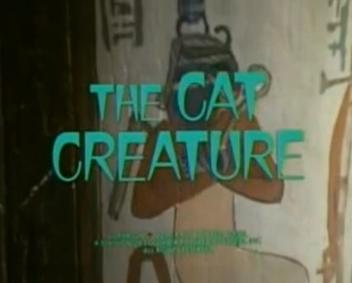
Originally airing December 11, 1973 on ABC, this Curtis Harrington-directed, Robert Bloch-written take on Cat People was originally planned as a starring vehicle for Diahann Carroll. However, her ABC contract ended and the film needed to be rewritten.
It’s such a tribute to Cat People that Kent Smith, who starred in that film and its sequel, The Curse of the Cat People, appears.
Smith plays an appraiser who finds a sarcophagus in a house that he is surveying. Inside is a mummy wearing a solid gold cat’s head amulet that has a curse attached to it. Just then, he’s killed by a cat creature and a thief played by Keye Luke steals the amulet.
David Hedison — who played Felix Leiter to two different James Bonds — is a cop on his trail. Showing up for support are Meredith Baxter as a salesgirl, John Carradine as a hotel clerk and Stuart Whitman as a police lieutenant.
Gale Sondergaard, who played Universal’s Spider Woman in two films, is also here as an occult bookstore owner named Hester Black. It was one of the first movies that she had made since 1949, thanks to the blacklist and her support of husband Herbert Biberman.
The day after shooting wrapped, she was called back for some closeups. It was all a ruse When she arrived on the set in makeup and costume, Charlton Heston presented her with an Academy gold statuette to replace one that she had won for 1936’s Anthony Adverse.
Want to check this out for yourself? Here it is on YouTube:
As with our yesterday’s review of CBS-TV’s The Killing of Randy Webster, this NBC original movie held a young adult appeal, yet was far too dark for their weekday, Special Treat young programming block that also dealt with the issues of drug abuse — but not like this.
Dick Lowry, best known for his Kenny Rogers song-to-TV movie adaptations and NBC-TV’s In The Line of Duty film series, directs a script by actress Darlene Craviotto (feature film debut in Zoltan: Hound of Dracula, aka Dracula’s Dog) based on the biographical book Angel Dusted: A Family’s Nightmare by Ursula Etons.
Jean Stapleton and Arthur Hill stars as Betty and Michael Etons, while Stapleton’s real life son John Putch stars as the drug addicted Owen. Helen Hunt (Trancers, Twister, As Good As It Gets) appears as his sister, Lizzy. Percy Rodrigues (Primus Isaac Kimbridge from Genesis II, the “voice” of the Loknar in Heavy Metal!) stars as one of the doctors treating Owen.
Okay . . . this is where, as with the mix up of actors in The Killing of Randy Webster, we need to clear up the Helen Hunt-confusion with Angel Dusted.
Helen Hunt, after making this cautionary juvenile delinquency tale in a supporting role, headlined — alongside Diana Scarwid (Mommy Dearest) and the who’s who cast of Tom Atkins, (pick a John Carpenter movie), Sam Bottoms (Open House), Art Hindle (Clint’s Dirty Harry movies), and Diane Ladd (Something Wicked This Way Comes) — the other “Angel Dust” cautionary tale, Desperate Lives, for NBC in 1983 . . . and Desperate Lives is the movie where a drug-crazed Helen Hunt “touches the grass” and jumps out of a high school’s third floor window (clip).
There. Glad that’s settled.
Now back to the other PCP movie with Helen Hunt.
In this tale, John Putch (Sean Brody inJaws 3-D; now a director banging out American Housewife episodes for ABC; Scrubs for NBC) is a doted-upon son who finds solace from the pressures of excellence from his affluent parents by developing a drug addiction. And he falls into a drug-induced psychosis after smoking pot laced with PCP.
While Putch is stellar in his acting debut, this is clearly mom’s show. For anyone who’s never experienced Jean Stapleton outside of her Edith Bunker character on CBS-TV’s long running All in the Family, they’ll be amazed at this master thespian’s range.
While the doctors just go through the motions — plying Owen with even more drugs-as-antidotes, such as the schizophrenics Haldol and Thorazine — Betty Etons struggles to hold her marriage and family together as she tries to nurse Owen back to a life of normalcy.
You can watch a pretty clean TV-taped VHS rip of Angel Dusted on You Tube. And since it’s owned by Warner Brothers (they provide an official trailer) this one is readily available to purchase for your collection of Jaws ephemera. Warner Bros. also owns Desperate Lives and since released it on VHS and DVD; that is if you’d like a copy for your ’70s juvenile delinquency film collection.
About the Author: You can read the music and film reviews of R.D Francis on Medium and learn more about his work on Facebook.He also writes forB&S About Movies.
CBS-TV’s young adult programming block first aired in December 1978 as CBS Afternoon Playhouse and went through a revamp during the start of its 1983 season with the “Schoolbreak Special” moniker. After an 18 year run—and like everything else killed off by the multi-channel cable universe and the Internet—it was cancelled in January 1996.
Image screencap by R.D Francis via Timmy Faraday/You Tube
Under the old banner, CBS aired this lesson regarding teen crime on December 1, 1981. The cast stars Katherine Kamhi (later of Sleepaway Camp and Silent Madness), Laura Dean (a two-year stint as “Sophie” on NBC-TV’s Friends), and Maureen Teefy (Alan Parker’s Fame, Grease 2, and Supergirl ’84.)
Teefy is Karen Hughes, a high school ballet dancer and cheerleader dealing with the usual boyfriend problems, a snotty head cheerleader, and nagging parents. To compete with her better well-to-do friends and the popular girls, she develops a shoplifting addiction, gets caught, and jeopardizes her future. Of course, the friend that got her hooked (Laura Dean) leaves her high and dry.
Made during the days when stores relied more on human eyes and not so much the technological eyes of security cameras—she’s almost caught by none other than door guard Joe Spinelli of Rocky and Maniac fame (and yes, he’s a creepy lech). This is one of the darkest-ending young adult anthology movies you’ll ever watch—no happy ending here. This ain’t The Brady Bunch, after all.
Other standout episodes from the CBS series include Year of the Gentle Tiger (1979; starring iconic TV actor Lance DeGault; U.S. Army Colonel Roderick Decker on TV’s The A-Team), and the Dan Curtis-produced I Think I’m Having a Baby starring Jennifer Jason Leigh, Helen Hunt (Trancers, Twister), and Tracy Gold (TV’s Growing Pains). Another adored episode was Welcome Home, Jellybean, which starred Dana Hill (Audrey Griswold from National Lampoon’s Vacation) as a special needs teen that moves back with her family (her put-upon brother is Christopher Collet from the aforementioned Sleepaway Camp, First Born, and The Manhattan Project).
You can watch the CBS Schoolbreak Special episodes mentioned in this review—and more—on a pretty nifty catch-all playlist we found on You Tube.
About the Author: You can read the music and film reviews of R.D Francis on Medium and learn more about his work on Facebook.He also writes forB&S About Movies.
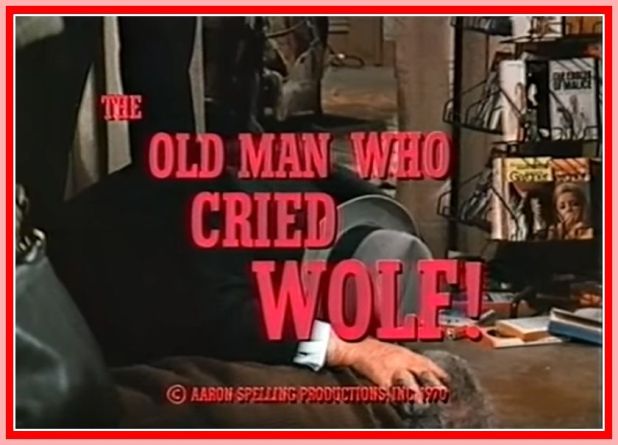
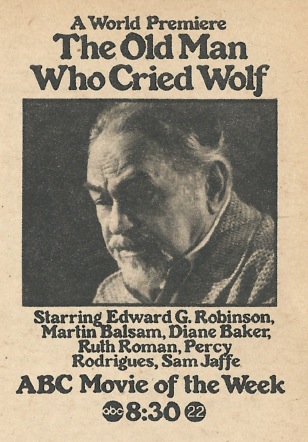
Luther Davis wrote Across 110th Street and this nihilistic TV movie, originally airing October 13, 1970. It’s directed by Walter Grauman, who was behind more than fifty episodes of Murder, She Wrote.
What a cast — from Jay C. Flippen (a former blackface vaudevillian known as “The Ham What Am”), Martin E. Brooks (Dr. Rudy Welles from The Six Million Dollar Man, the role originated by Martin Balsam, who is also in this), Ed Asner and Sam Jaffe to Percy Rodriguez (Genesis II, as well as the voiceover artist on the trailers for The Exorcist, Chopping Mall, House, The Great Outdoors and many more), Ruth Roman (The Baby), Diane Baker (Lorraine Warren in The Haunted), Balsam and Edward G. Robinson.
Robinson is an old man who watches his friend die and no one believes him. When he keeps telling anyone who will listen that they were attacked, his relatives try to get him psychiatric help. He decides to try to find the killers himself, but someone is watching his every step and the story grows darker and darker.
If you want to watch a real downer, the kind of rough ending that only the 1970’s can give you, this movie is on YouTube:








 B&S About Movies
You must be logged in to post a comment.