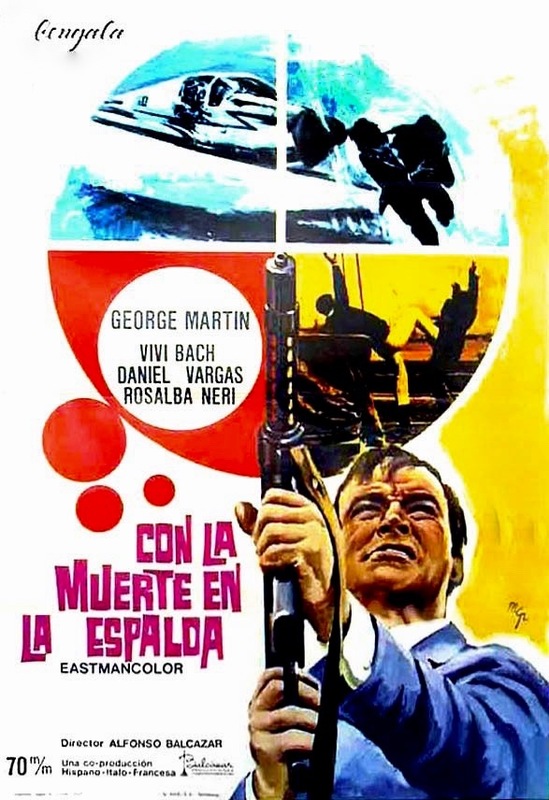
This 1967 Spanish/Italian/French film was directed by Alfonso Balcazar (A Pistol fromRingo) in an experimental 70mm 3D filming technique.
A criminal organization — led by Electra One (Daniele Vargas, Eyeball, The Arena) — has created an aggression serum that they plan on using to hold the world hostage. The Americans and the Soviets join forces to stop them.
George Martin, who appears in The Three Supermen films, is Gary, the hero of this movie. Rosalba Neri is also in this. You should know her for her body — pun intended — of bonkers erotic horror films. She’s in everything from Franco’s 99 Women to Amuck!, The Seducers, French Sex Murders, The Devil’s Wedding Night and Lady Frankenstein.
You know how I’ve discussed how Eurospy films often feel like the United Nations, what with so many countries working together to make these movies? This American/French/Austrian made-for-television spy and anti-drug film — also known as Danger Grows Wild — was made with the United Nations themselves as part of a series of television specials designed to promote the organization’s work. It was produced by Xerox.
So how does it tie-in to Bond? Well, 007 director Terence Young is at the helm — he passed up Thunderball to direct this — and it’s based on a story by Ian Fleming.
In an attempt to stop the heroin traffic at the Afghanistan–Iran border, some United Nations operatives inject a trackable radioactive compound into a seized shipment of opium and let it go go back into the wild to try and find Europe’s top heroin distributor.
German-born Sente Berger — who is also in The Man from U.N.C.L.E. film The Spy with My Face and The Ambushers — is here, as is Stephen Boyd (Ben-Hur), Yul Brynner, Angie Dickinson, Georges Geret, Hugh Griffith (another Ben-Hur alumnus), Jack Hawkins (who took as many roles as he could late in his career before his three-pack-a-day habit stole his voice), Rita Hayworth (!), E.G. Marshell, “If I Had a Hammer” singer Trini Lopez as himself, Marcello Mastroianni, Amedeo Nazzari (a huge Italian star from before World War II and well afterward), Omar Sharif, Barry Sullivan, Nadja Tiller (Death Knocks Twice), Eli Wallach (who won an Emmy for his role), Grace Kelly (this is the only movie she made after retiring from acting in 1957) and Harold “Oddjob” Sakata. Truly, this is the very definition of a star-studded affair.
All of them were paid $1 each to be in this film, with Young working for free.
One of the producers, Edgar Rosenberg, was of course the husband of Joan Rivers. This is the movie where Joan would meet Hayworth and write that she was demanding and incoherent, yet still glamorous. That said, it’s possible that Hayworth was already beginning to suffer from the effects of Alzheimer’s Disease.
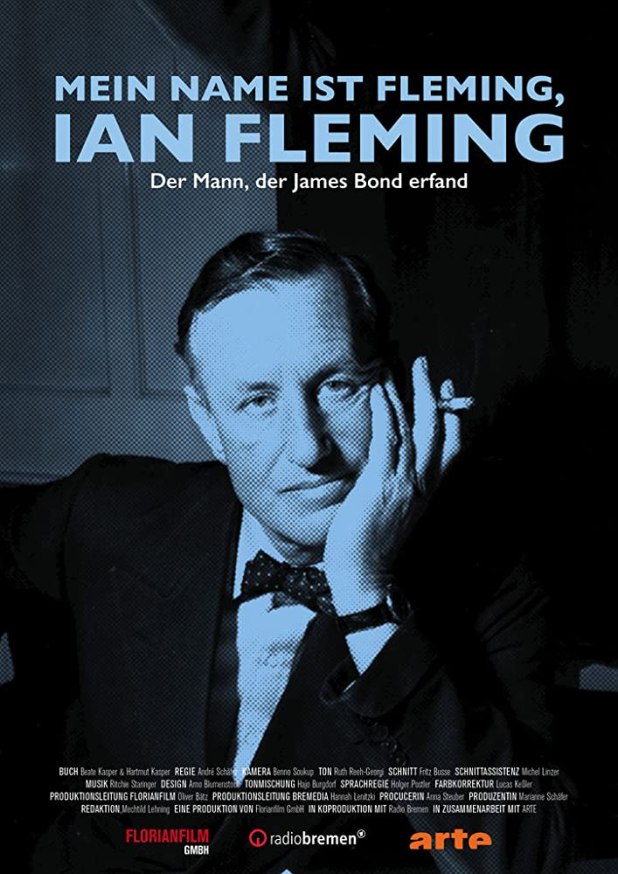
This documentary tells the story of Ian Fleming, real-life spy, ladies’ man and sportsman. He was there at the real birth of MI-5 and the CIA, which gave him the background to tell the story of one of pop culture’s most beloved heroes, James Bond.
From how Fleming created Chitty Chitty Bang Bang for his son to how he fell in love with SCUBA diving, it really tells so much about the man who created Bond.
If you’re a Bond fan, you will already know much of this, such as how the man with a license to kill was named after a bird watching writer. However, if you are just learning about the universe of MI6 and SPECTRE, this is a quick watch that will get you up to speed.
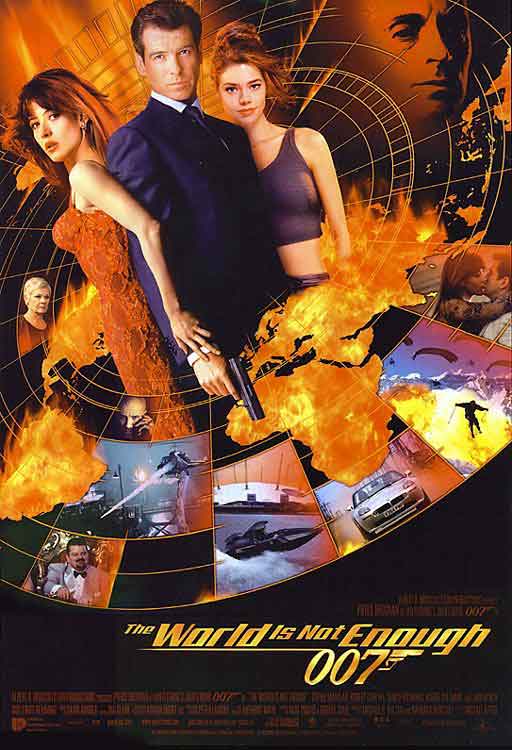
The first Eon Bond film to be released by MGM, this is the third Pierce Brosnan outing, with Bond dealing with the murder of billionaire Sir Robert King by the terrorist who cannot feel pain, Victor “Renard” Zokas (Robert Carlyle, whose cameo as John Lennon makes Yesterday). Soon, Bond must protect King’s daughter Elektra (Sophie Marceau, Braveheart) as well as learn why a nuclear meltdown could increase worldwide petrol prices. And oh yeah — deal with Dr. Christmas Jones (Denise Richards).
This was a Bond movie with many potential titles, such as Bond 2000, Death Waits for No Man, Fire and Ice, Pressure Point and Dangerously Yours. The final title is based on Alexander the Great’s epitaph “Orbis non sufficit,” which is the Bond family motto.
Robbie Coltrane returns from GoldenEye — his office is covered with cheesecake photos of former Bond girls — and Desmond Llewelyn, who died in a car accident not long after the film’s premiere, appears for the last time as Q. He’s shown training his successor, who is jokingly referred to as R and played by John Cleese.
Joe Dante and Peter Jackson, were initially offered the opportunity to direct this one. The producers eventually hired Michael Apted (Coal Miner’s Daughter, Enough).
This one feels like a misstep after two solid Brosnan entries. Alas — there are good moments, but just not enough. Man, I feel bad even ending that sentence that way.
About the Author: Paul Andolina was looking for a Bond movie for this month and found a great example of a foreign take on the spy film. You can check out his blogs Wrestling with Film and Is the Dad Alive? for more.
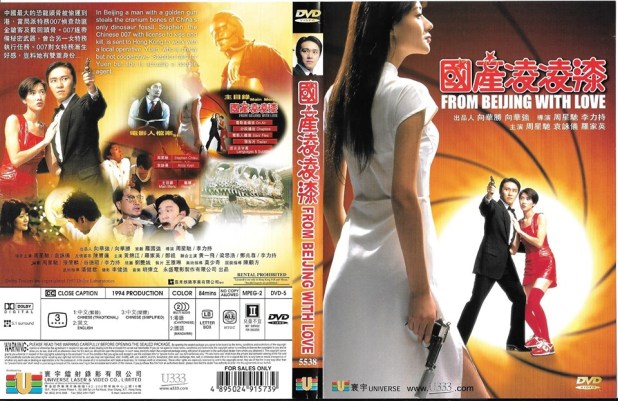
I’m probably not the most qualified person to write about Bond parodies as I’ve seen so few actual James Bond movies, however, I am a huge fan of Stephen Chow’s particular brand of humor. I can’t understand Cantonese so a lot of his puns and jokes go over my head but I love the physical comedy in his films which is why I sought out From Beijing with Love.
A man in an iron suit with a golden gun has stolen China’s prized dinosaur skull and Ling Ling Chat (Stephen Chow) is sent to Hong Kong to retrieve it from the foreigners. He comes across the woman he believes to be his contact in Hong Kong, Lee Heung Kam but Golden Gun has instructed her to kill him. The commander who sent Ling Ling Chat on his mission is none other than Golden Gun himself!
This movie is as funny as Stephen Chow’s other films. Ling Ling Chat, a pork vendor with amazing dagger skills but who is not smart enough to be a spy is played by Chow himself. I love his characters who are usually dumb as hell but usually have hearts of gold. I am fascinated by the foolish antics of these types of characters in his films, which are usually full of nonsense. These types of films are known as mo lei tau. Stephen Chow is a phenom in Hong Kong and now Mainland China.
I can’t speak on much of the parody aspects of the film because I am not super well versed in Bond films. Some of the references I did pick up though was there was a character modeled after Jaws from Moonraker (Moonraker is one of the few Bond films I have actually watched), the golden gun, and the soundtrack which parodies so many of the bond type introductions I have caught here and there on television.
If you’re not familiar at all with Stephen Chow’s output but are a huge fan of Bond films, their ripoffs and parodies you will find a lot to love with this film. I hope it leads to you seeking out some of his other films as well, even the stuff he just acts in but doesn’t direct can be hilarious and heartfelt. This movie has plenty of explosions and blood in it as well for those who enjoy carnage in their spy films. If you are a fan of Chow and mo lei tau and have not seen this film, I encourage you to seek it out. It’s especially funny how it is critical of communist China and its corruptness when 3 short years later Hong Kong was ceded back to China after British rule would end there. It’s quite amazing that this film didn’t get Chow blacklisted after the transfer of sovereignty either.
From Batman to Manimal, Buck Rogers in the 25th Century, The Misadventures of Sheriff Lobo, Love American Style, Mission: Impossible and movies like The Rescue of Gilligan’s Island and Batman: The Movie, if something needed to be directed for TV, Leslie H. Martinson was your guy.
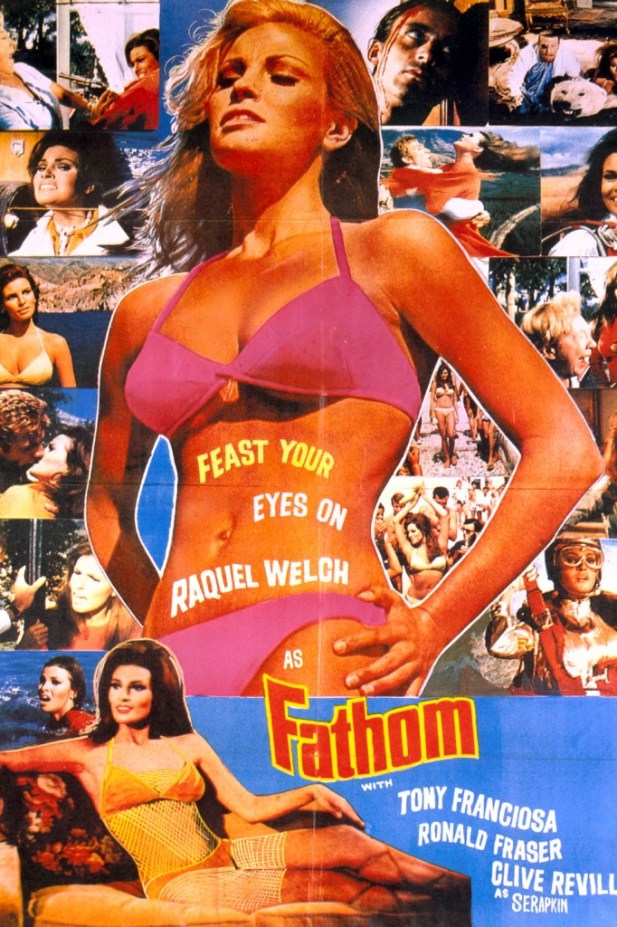
Fathom is based on a series of books by Larry Forrester. It was made thanks to the success of Modesty Blaise. It was written by Lorenzo Semple Jr., who had teamed with Martinson on Batman on the quick and cheap.
The main selling point? Racquel Welch.
In this movie, she plays skydiver Fathom Harvill, a beautiful skydiver who is abducted by H.A.D.E.S. (Headquarters Allied Defences, Espionage, and Security) agents and asked to be part of a team that is looking for a lost nuclear weapon. That same weapon — hidden inside a Fire Dragon figurine — is being hunted down by the Communist agent Serapkin.
In his December 13, 1967 review of this film, Roger Ebert said, “So anyway, if she had been Italian, her voice would have been dubbed for the American market. So we would have seen this beautiful broad with a great figure and really first-class cheekbones. And when she talked, we would have heard another voice, a voice belonging to some girl in a studio somewhere with a low, sexy tone and a certain amount of acting ability. And we would have flipped, I guess, because anyone looking like that and able to read her dialog would have been — well, nice. But the trouble is, Raquel Welch is not Italian, She’s American, which would still be OK, except that she uses her own voice in her movies, and she talks wrong for the way she looks. This is the big problem with her.”
This should be an exciting spy film but it isn’t. And that’s kind of sad, because it has great posters and plenty of potential. That said, it does have Anthony Franciosa (Tenebre) in it, so it has that going for it.
In this emotionally rewarding, scruffy London-based crime drama, ex-mob thug Tony Ward (the excellent Anthony Mark Streeter) finds himself a free man after a decade-long prison stretch. He soon discovers the incarceration the outside world offers is as difficult as the inside kind when his well-intentioned efforts to reconnect with his estranged wife and now adult son unravels as the temptations of his criminal past catches up with him.
The opening of the film is smartly nuanced—and quite stunning. It opens on black with the sound effect of a roller-slamming gate. Then we see Tony standing outside of a prison. He looks around. You can hear him say, “Now what the fuck do I do?”—without saying it. Meanwhile, his wife and son clean their home and prepare for his arrival. And that’s how the first nine minutes unrolls—without dialog: dialog that’s not needed. And it’s beautiful because this is a film that realizes images and body language speak louder than physical words.
Now, at first mention of a “British crime drama,” your mind calls up Guy Ritchie’s Lock, Stock, and Two Smoking Barrels (1998), Layer Cake (2004), and In Bruges (2008). And if you’re looking for the violence of those films, you’ll be disappointed. Writer-director Anthony Z. James knows we’ve been down this road before and we know hard-ass guys like Tony. This isn’t about the crime caper that put Tony in prison or the crime that’ll put him back in there. It’s not about revenge. Even at their most violent, criminals have families. They experience love. And self-loathing when they disappoint the ones they love. That’s this movie. This is a movie that goes behind the violence.
If the pioneering, independent spirit of John Cassavetes was still with us (he’d be 91 this year), and still spry enough to shoot films, he would have utilized smartphone technology and made Ghost. (Why not: Asian action-stars Leo Fong and Chun-Ku Lu are still making films at the incredible, respective ages of age of 91 and 74.) So keep that in mind, as I know the modestly budgeted tales by Cassavetes that focus on characters and story, shot with handheld cameras, available lighting and spontaneous improvisation isn’t easily digested by a mass audience. (And it’s interesting to point out: Unlike James, Cassavetes was unable to find an American distributor for his debut film, 1960’s Shadows.)
I have to admit that, at first, the concept of making movies via smartphones didn’t sound too promising. I’ve worked on my share of shorts as an actor where my directors couldn’t even handle professional cameras and editing suites with aplomb (or finish their masterpieces 50 percent of the time), so the use of phones and MacBooks to make movies sounded like amateur hour.
Then James Cullen Bressack proved us all wrong with 2013’s To Jennifer: the first commercially released film shot and edited entirely on an iPhone 5. Then Steven Soderbergh (Erin Brockovich, Ocean’s Eleven, Magic Mike) upped the game with his smartphone-shot feature, 2018’s Unsane.
Since then, Apple has gone through three upgrades and now we have this impressive feature film debut by British filmmaker Anthony Z. James shot on a pair of iPhone 8s and edited on a MacBook Pro equipped with a freeware version of DaVinci Resolve editing software. And if you didn’t tell me Ghost was shot smartphone DIY guerilla-style, I would have thought it was shot “more professionally” via permits, a Canon EOS C200, and Final Cut Pro.
Which just goes to show you: It’s not the technology. It’s not the “cost” of the filmmaking tool. It’s the person behind the technology that creates great film.
And I am glad that Anthony Z. James is the man behind the technology. If he accomplishes this with a minimal crew and budget on smartphones, then what can he do with an $80,000 Red Digital and a seven-figure budget?
Amazing things.
And Ghost is only his beginning.
After a limited theatrical release in the UK this April, Ghost is now available in the U.S on Amazon Prime and Vimeo-On-Demand. You can find more info on the film at ghost-movie.com.
About the Author: You can read the music and film reviews of R.D Francis on Medium and learn more about his work on Facebook.He also writes forB&S About Movies.
Disclaimer: This movie was sent to us by its PR company. As always: you know that has no bearing on our review of the film.
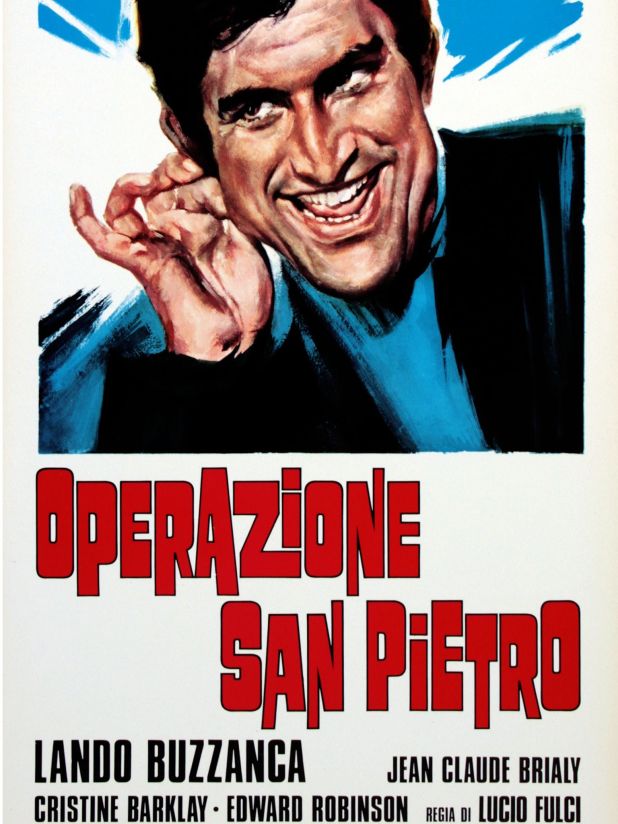
This movie was a Italian, French and West German co-production. It was released in France as Au Diable les Anges (To Hell With the Angels) and Germany as Die Abenteuer des Kardinal Braun (The Adventure of Cardinal Brown). It’s also an unofficial sequel to Operazione San Gennaro, a heist-comedy film that Dino Risi directed.
This one is directed by Lucio Fulci, not yet the Godfather of Gore.
Napoleon has big plans for being such a small-time crook. He’s accidentally released from prison by a villain named the Baron and his henchmen, who were on their way to rob a bank vault. Despite how well-dressed they are, they’re broke. Napoleon takes over the gang and they move to Rome, where they joing up with a used car selling gigolo named Cajella.
While the rest of the gang steals money from tourists, Cajella falls for a gangster’s moll named Samantha. Her man ends up being Joe Ventura (Edward G. Robinson!), a big league American gangster. They both get involved when the gang steals the Pieta, one of the most famous statues in the world.
As they say, all manner of shenanigans ensure. It’s interesting to see Fulci’s early comedies knowing the sheer insanity he had inside him and was ready to unlease in a decade or so.
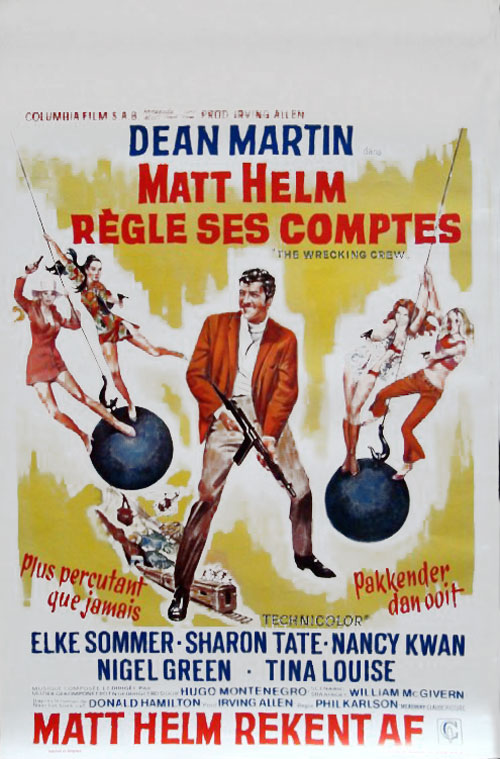
Directed by Phil Carlson (Walking Tall, Ben), the last of the Matt Helm movies dispenses with screenwriter Herbert Baker, James Gregory as MacDonald and Beverly Adams as Lovey Kravesit.
Thanks to Once Upon a Time…In Hollywood, this is probably the best known of the four Matt Helm movies (not to mention the Tony Franciosa-starring TV series).
Matt Helm is assigned by ICE to bring down Count Contini (Nigel Green, Countess Dracula), who is trying to Auric Goldfinger the world economu. Matt’s assistant is now Freya Carlson (Sharon Tate), a gorgeous but goofball Danish tourism bureau agent.
Elke Sommer (Baron Blood, Lisa and the Devil) and Nancy Kwan (Wonder Women) play the women out to kill Matt. It turns out that Freya is actually a deadly British agent who, of course, ends up in Matt’s bed. It’s kind of funny that Sommer and Green play pretty much the exact characters as they did in Deadlier then the Male.
Matt’s boss is played by John Larch (Bad Ronald, The Amityville Horror) this time and Tina Louise — Ginger Grant herself! — also makes an appearance.
While The Ravagers was revealed as the next Matt Helm movie in the credits, it was not to be. Martin had no interest in returning after the death of Sharon Tate. So when he refused to make the film, Columbia held up his share of the profits on the second Matt Helm film, Murderers’ Row. As we learned from Airport, Dean was about to be rich and no longer care. Man, I wish the proposed Martin and Sinatra double bill of Matt Helm Meets Tony Rome had been made.
This movie is packed with pro wrestlers and karate experts. That makes sense, as Bruce Lee was the karate advisor for the film. Some examples include:
Karate champion Mike Stone was Dean Martin’s fight double. You may know him better as Elvis’ karate instructor who ran away with his wife Priscilla.
Prince Wilhelm von Homburg, who is perhaps better known as Vigo the Carpathian in Ghostbusters II.
Pepper Martin, a pro wrestler who was friends with Woody Strode; he also appears in the 1981s slasher Scream.
Boxer, stuntman and friend of Henry Miller, Joe Gray.
Joe Lewis, considered the best American karate fighter in the 1970’s.
Ed Parker, founder of American Kenpo karate.
And in his first movie ever, Chuck Norris.
I’m sad to see the Matt Helm movies end. Hollywood has been discussing remaking them, but I’ll always have my four DVD box set to go back to.
“Please don’t make this another metaphor for your body.“ “If the clothes fit. . . .” — Mads and Junior
What do you get when you take a 65-page screenplay written over a weekend that’s tossed into a car (okay, two cars) with four people traveling 4500 miles for 14 days from Los Angeles to Las Vegas to South Dakota to Portland?
You get the instantly engaging industry calling card The In-Between, an indie road movie that, we hope, will do for the multitalented Mindy Bledsoe what She’s Gotta Have It, Clerks, and Flywheel did for Spike Lee, Kevin Smith, and Alex Kendrick.
Now, before you’re turned off by the “road movie” aspect of The In-Between, take note: this isn’t a Melissa McCarthy or Tim Allen slapstick comedy rife with oddball characters. And if you’re in the market for a Todd Phillips road comedy, keep on truckin’—and zip right on by the Judd Apatow comedy exit.
A film, at its core, should entertain. And the films by those A-List La-La Landers, in their own way, certainly do. And The In-Between definitely does. However, at its best, a film should give the viewer a new perspective on the lives of others. And most films—a lot of films—don’t. Why? Because they’re product made to fill seats; they’re not personal. The In-Between is that personal film. It’s the one that shakes the viewer out their little I-Me-Mine world. For Bledsoe’s film possesses a depth and warmth that Jennifer Aniston’s corporate chronic pain romp, 2014’s Cake, lacked. Aniston researched and acted (for Oscar gold). Bledsoe, as well as her co-writer and co-star, Jennifer Stone, live it—everyday.
While The In-Between is a brave journey into the world of everyday people dealing with their “invisible chronic illness”—the illness, takes a back seat courtesy of an intelligent screenplay (filled with natural, realistic dialog). Most of us never think twice of eating a pizza; a person with Type 1 diabetes, does (which afflicts actress Jennifer Stone). Washing our hands is a pain-free experience; not for a person with Complex Regional Pain Syndrome Type 2 (which afflicts Mindy Bledsoe). The monitors. The needles. The compression sleeves. The pills. The schedules. It’s those we-take-for-granted moments that provide an insight to the lives of Mads (Jennifer Stone, of Disney Channel’s The Wizards of Waverly Place) and Junior (writer, director, producer Mindy Bledsoe) that serve to elevate the script to its true purpose: not as an Oscar violin about dealing with illness, but as an examination on the importance of friendship, and the spiritual and emotional voids a bond of trust between friends, fills.
In addition to its exquisite cinematography, screenwriting, and acting, there’s the soundtrack. In so many films, a soundtrack’s creation is solely for the purposes of mood; most times, the soundtrack is nothing more than a record company’s product placement. In the case of The In-Between, the music serves as a third character that drives the plot and develops the other characters. We come to learn the reason for the cross-country trip is to visit the place where Junior’s musician-sister, Veronica, was killed in a car-crash and caused Junior’s chronic pain. Veronica’s “voice” is beautifully portrayed by the music of the common-bands Super Water Symphony/Hydrogen Child, which plays via car-based CDs and vinyl albums on a portable, battery-powered record player.
Everything about this movies works. And the festival crowds agree. The In-Between recently came off a successful film festival run, where it won multiple awards at the Austin Revolution, Toronto Female Eye, Twister Alley International, and Women Texas film festivals. It’s currently in the market for distribution and we hope it finds a deserving home in the PPV and VOD universe, soon. You can keep up to date with film’s success at its official Facebook page.
You can also visit Louisiana’s Hydrogen Child on Facebook and Twitter, and listen to their music on You Tube.
About the Author: You can read the music and film reviews of R.D Francis on Medium and learn more about his work on Facebook. He also writes for B&S About Movies.
Disclaimer: We discovered this movie via social media, were intrigued by the trailer, and reached out to the filmmakers to provide us with a screener copy.



 B&S About Movies
You must be logged in to post a comment.