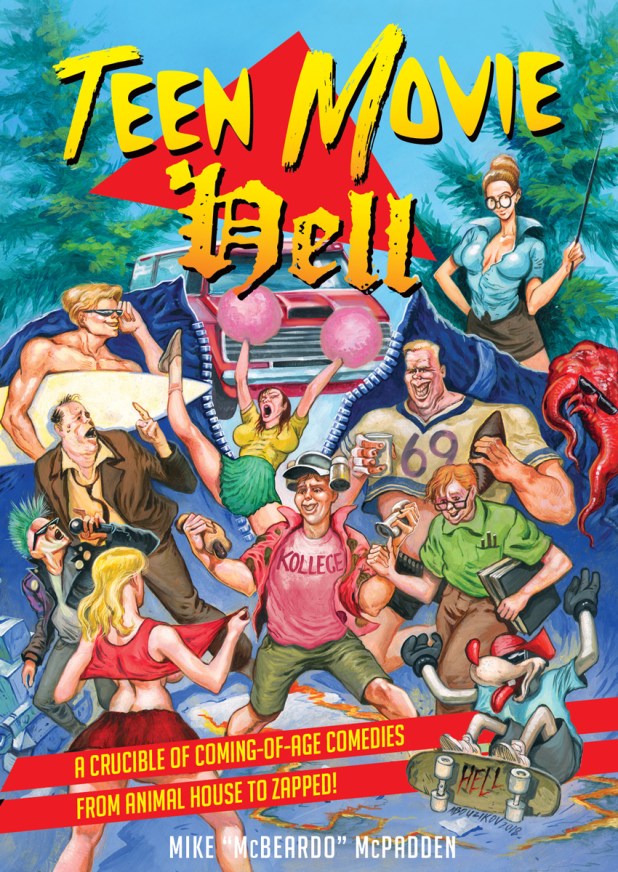
Mike “McBeardo” McPadden’s writing has long been an influence on my work. His last book, Heavy Metal Movies, is a brick-like tome packed with attitude that I’ve used as a reference since it was released. Now, he’s back with Teen Movie Hell, which I’m declaring the ultimate in any info you’d ever need on movies with half-naked co-eds.
From the genre’s origins in beach movies and American Grafitti to Animal House, Porky’s and beyond, McPadden details it all, along with letting you know exactly how much he loves some films and hates others, particularly John Hughes related endeavors.
Each page is jam-packed full of info and poster art. Yet my favorite moments in the book are when McPadden yields the spotlight at times to those with a dissenting viewpoint. In a time of both nondebate and too much debate, this book makes an effective case for celebrating these movies, which are the next drive-in screen cousins of horror movies in the junky world of pre-internet exploitation.
Your love of this book will probably be directly in proportion to how much you remember these films. For me, someone who had no VCR and would stay up late into the summer night to watch movies like Hamburger the Motion Picture, this is straight furburgerage from heaven! Even if you don’t know any of these movies, I’d give this book my highest recommendation. These movies may seem silly or strange today, but they’re worth celebrating and cataloging with the good humor and smarts that this book employs in spades.
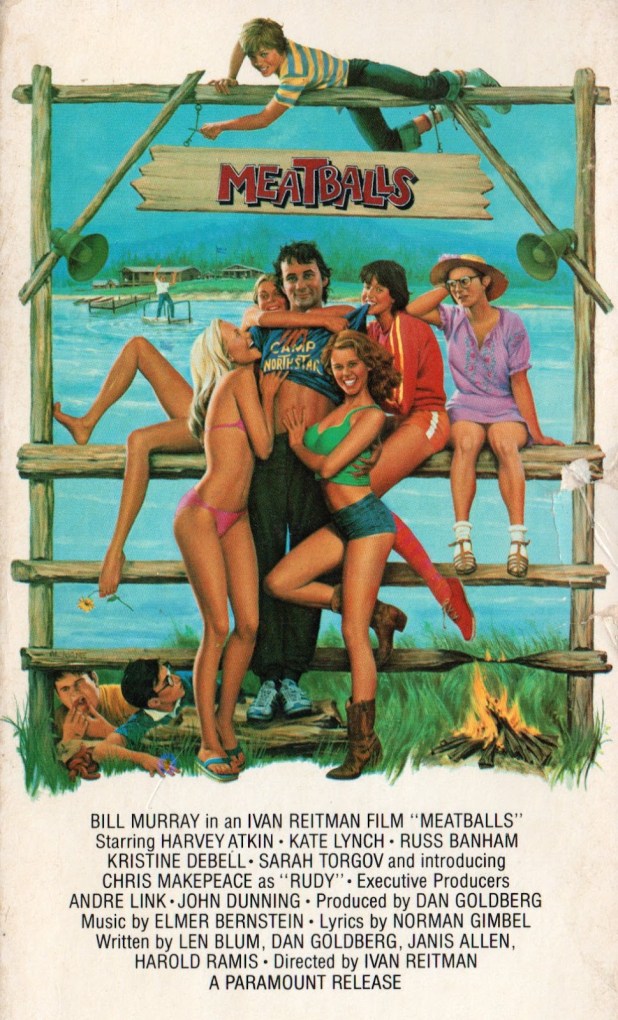
After appearing on The National Lampoon Radio Hour and several seasons of Saturday Night Live, Bill Murray was poised for stardom. This is but the first of the many starring roles he’d gift us with over the years. His role as camp counselor Tripper Harrison is basically him playing the role of Bill Murray, an exaggerated version of himself, that he’d been doing on SNL for some time.
The first of four films that Murray would make with director Ivan Reitman, this is pretty much one of the ultimate hijinks ensue films. That’s my theory of what makes an imminently watchable film: start with a simple concept, create some great characters, place them into some funny situations and let the hijinks ensue.
This is also the first of six collaborations between Murray and writer Harold Ramis. Incredibly, Ramis claimed in interviews that he and Reitman had no idea if Murray was going to be in Meatballs until he showed up for the first day of shooting.
This was also the first movie that Ramis wrote after Animal House. Originally, Reitman was going to produce and that film’s director, John Landis, was also going to work on Meatballs. He decided to do The Blues Brothers, so Reitman decided to direct.
Harrison (Murray) is in charge of the counselors and kids of the cheapskate Camp North Star, which has never defeated the rich Mowhawk in twelve years of Summer Camp Olympiad competition. There’s young love, pranks and Murray’s continual camp announcements, so many of which were part of my childhood and teen years as our local radio station WDVE played them for years.
The film’s best segment is Harrison rallying the troops to win the big game with a speech that seems to go nowhere. “And even if we win, if we win, HAH! Even if we win! Even if we play so far above our heads that our noses bleed for a week to ten days; even if God in Heaven above comes down and points his hand at our side of the field; even if every man woman and child held hands together and prayed for us to win, it just wouldn’t matter because all the really good looking girls would still go out with the guys from Mohawk because they’ve got all the money! It just doesn’t matter if we win or we lose. IT JUST DOESN’T MATTER!”
Five years later, Meatballs Part II would be released, which has no connection to this film but does have an alien named Meathead. Meatballs III: Summer Job catches up with Rudy, played here by Patrick Dempsey instead of Chris Makepeace. This time out, he’s haunted by the ghost of Roxy Doujor (Sally Kellerman), an adult film star who can’t get into Heaven until she helps Rudy lose his virginity. Finally, the movie Happy Campers became Meatballs 4, bringing together Corey Feldman, Sarah Douglas (Ursa in the Superman movies) and Eraserhead star Jack Nance.
Finally, some interesting Reitman and Murray trivia. In the early 1980’s, Tom Mankiewicz (the writer of Live and Let Die, The Man with the Golden Gun, Supermanand Ladyhawke, as well as the director of Dragnet and the creative consultant for TV’s Hart to Hart) wrote a script called The Batman. Reitman would have directed, with Murray has Batman, David Niven as Alfred Pennyworth, William Holden as Commissioner James Gordon, and singer David Bowie as The Joker. After Reitman left the project, Joe Dante took over but nothing ever happened. Most interestingly, this movie would have been based on the Steve Englehart/Marshall Rogers/Terry Austin run of the comic.
You can legally watch Meatballs for free on YouTube.
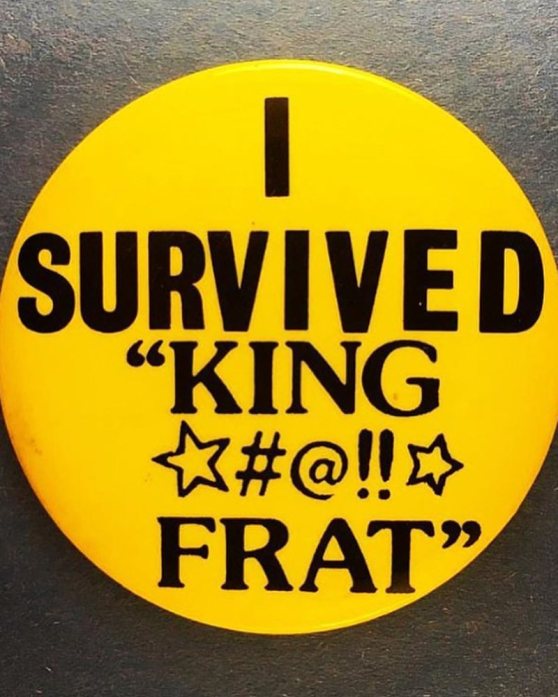
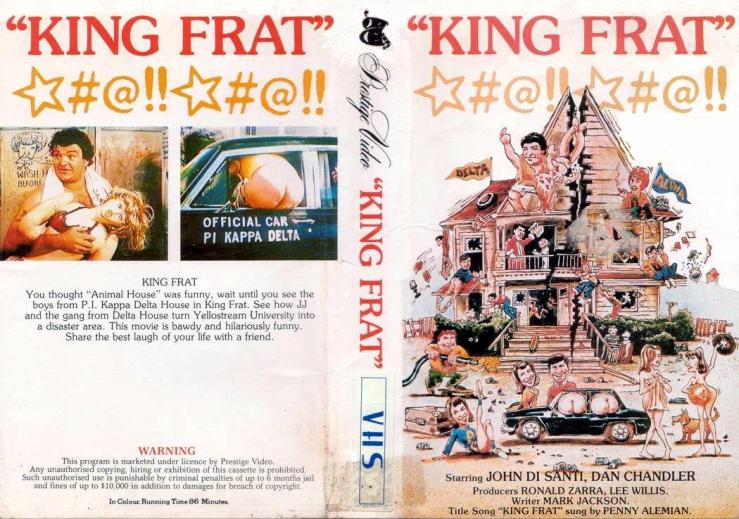
For years I read about King Frat in Cinema Sewer and always debated if I could handle it. And then I came across its entry in Teen Movie Helland realized that as I was planning a week of teen movies to go along with it, that I’d have to battle my way through it. I’m happy to say that I’ve made it. And really, it’s something else.
Before he became the founding editor of The Huffington Post, Roy Sekoff starred in this movie, which was filmed in Miami and Coral Gables as a takeoff of Animal House. The Bluto Blutarsky of this film is J.J. “Gross-Out” Gumbroski, played by John DiSanti, who believe it or not would go on to be in other movies (*batteries not included is one of them).
Set at Yellowstream University, this movie follows the Pi Kappa Delta fraternity, who are only concerned with drinking. A good chunk of the film involves them mooning people, which leads to the death of the dean of the school. Then, a farting contest is announced and everyone battles to have the best farts in a scene that goes on longer than you’d expect, then goes about another seven minutes past that.
I mean, just watch the first ten minutes of this movie, knowing that this same song plays for the entire movie.
King Frat is literally the bottom of the absolute barrel of filmmaking and I love it. If Animal House was too classy for you, if you wondered if they could make a movie where a frat could murder a dean by farting in his face and stealing the body and then have a scene where numerous men and women fart and nearly shit themselves, good news. This is the movie for you.
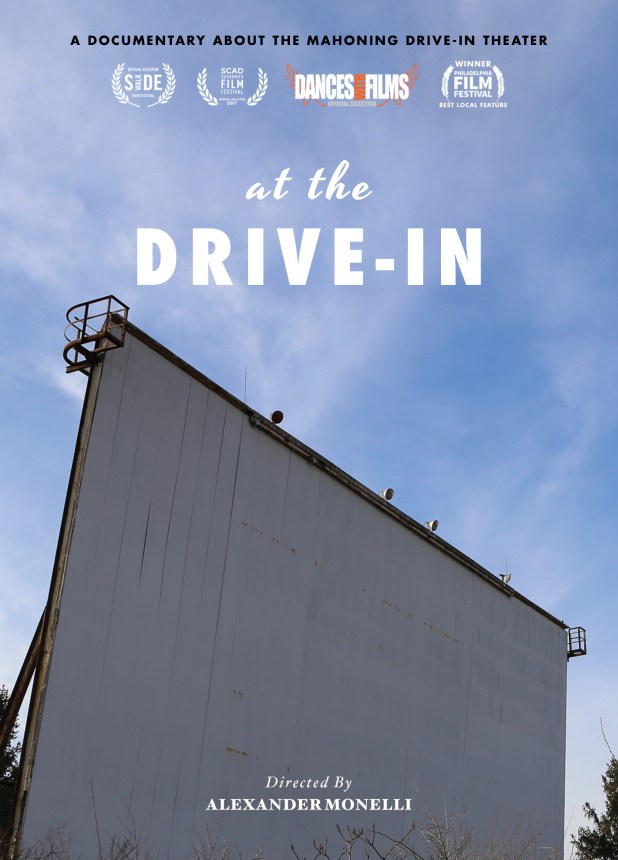
There’s nothing like a drive-in. I feel that it’s the best way to see a movie. The open sky, watching from the car or a chair, hamburgers, hot dogs, a cooler full of beer and perhaps some other substances, pizza, popcorn and staying up way too late. It’s pure magic. We go see drive-in movies as often as we can and know all about the Mahoning Drive-In. This documentary tells even more of the story.
From sleeping in the concession stand to working entirely for free, the volunteers of the Mahoning Drive-In have kept their theater alive, using their vintage projector and 35mm prints. However, when Hollywood announces that all new movies will only be available digitally, it might be the end.
Obviously, the Mahoning is still open. This movie tells you how they stayed that way.
I get really emotional at the drive-in. I well up with emotion at times, remembering how it felt to escape reality as a child and get to go and sit under the stars. Just seeing the big screen with the sun behind it makes me choke up a little. This film made me feel exactly the same way.
To learn more, visit At the Drive-In‘s official site. You can also order the movie here or watch it on demand April 9.
NOTE: This was sent to us by the movie’s PR team but that has no impact on our review.
Between the first Friday the 13th and the Houseseries, Sean S. Cunningham made this teen sex comedy. As my wife Becca reminded me, one of the only differences between this movie and a slasher is that no one gets killed for all the sex and drinking. It’s a remnant of some forgotten time, when people in their late twenties could play college students and bars were named things like Games People Play.
Two nerds share a hotel room at the Breeze and Seas in Fort Lauderdale, Florida with two cooler guys from Florida. There — I’ve established most of the plot for you. Ah — one of the nerds is a rich kid with a politico dad who is tracking him down. And also, some guy wants to shut the hotel down.
1983 was a way different time. A time when hijinks could be kind of homoerotic and perhaps no one noticed. A time when dudes could sleep four to a room and one of them could bring back a girl, who would willingly have sex with all of them present and no one thought this was perhaps a bit creepy. A time when things like me too and drunk driving were just future notions. Indeed, there’s a scene where a girl is driving a convertible and holding a can of Miller Lite the entire time.
At the time this was made, Coke owned Columbia Pictures. So just in case you wonder why there’s an extended sequence where a girl remarks how she’s thirsty before sex and would really like a Coke before a guy goes to a large Coke branded machine to buy her a can, there’s your answer.
My favorite bit of trivia for this film is that Corinne Alphen, the former wife of Wiseguy star Ken Wahl, is in it. A two-time Penthouse Pet of the Month and a Pet of the Year, today she’s a professional Tarot card reader. And hey — keep your eyes open for an early appearance by Curb Your Enthusiasm co-star Jeff Garlin.
Cunningham would follow this movie with a much darker film about teens in Florida — The New Kids. What a double feature!
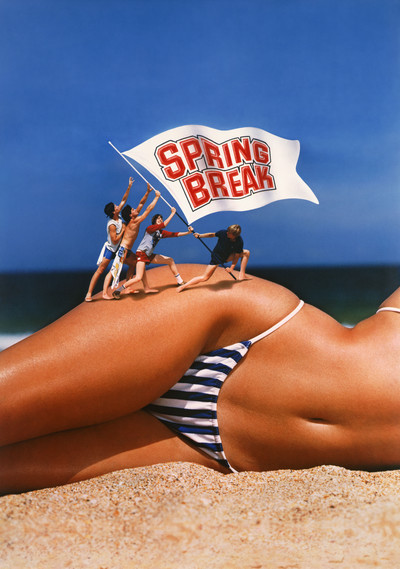
*Update: Mars Callahan, who’s best known for the acclaimed Poohall Junkies starring Chazz Palminteri and Christopher Walken, wrote and directed a failed, never-released remake, Spring Break ’83, which we reviewed as part of our “Box Office Failures Week.”
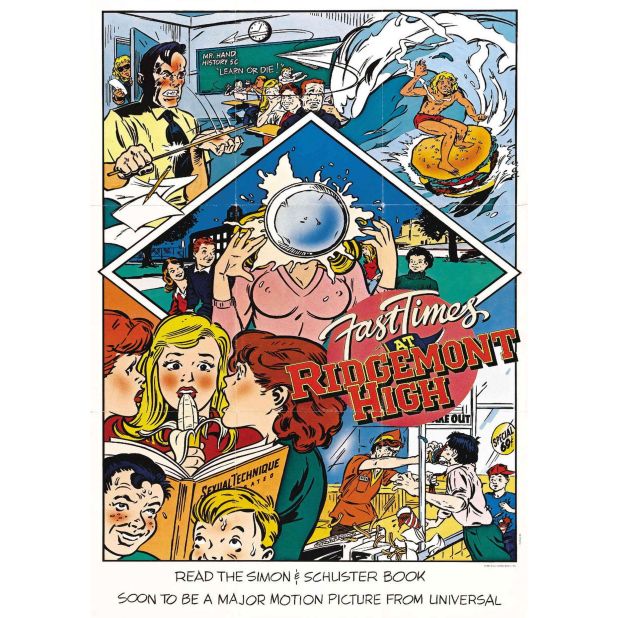
In the interview he did with us this week, Teen Movie Hell author Mike “McBeardo” McPadden said that “All previous teen comedies lead to Fast Times at Ridgemont High, and all subsequent teen comedies have proceeded forth from it.”
In his 1981 book, future director Cameron Crowe went undercover at Clairemont High School in San Diego and wrote about his real-life experiences. Directed by Amy Heckerling (Clueless, the Look Who’s Talking series, Johnny Dangerously and National Lampoon’s European Vacation), this movie follows the book and expands on it.
Interestingly enough, Mark Ratner in this film was modeled on a kid named Andy Rathbone, who claims that he actually did a lot of the Spicoli cool things too. He had become friends with Cameron and didn’t realize he was being lied to and ended up pretty hurt by the experience. But don’t feel too bad for him. He went on to write the For Dummies books, so he ended up doing pretty well for himself.
This is a film made up of characters and the way they intersect from the end of summer, the high school year and into the next summer. That’s really the story arch of the film, which allows the characters to breathe and come into their own.
Brad Hamilton (Judge Reinhold) starts the year as one of the most popular seniors at Ridgemont High School. Next year seems set: he’s a multiple time employee of the month at All-American Burger, he’s breaking up with his girlfriend Lisa (Amanda Wyss) so that he can be eligible all year long and his car is nearly paid off. It all falls apart: he gets fired for yelling at an abusive customer, Lisa breaks up with him before he can, he gets a job at Captain Hook Fish & Chips where he’s forced to wear a humiliating outfit and worst of all, he’s caught masturbating by his sister’s best friend Linda (the bewitching Phoebe Cates).
His sister Stacy (Jennifer Jason Leigh) may have an even rougher year: other than her job at the Perry’s Pizza (Leigh actually did work at a Perry’s Pizza for a month before filming began) at the mall, her biggest job seems to be losing her virginity, which she finally does with stereo salesman Ron Johnson, who she tells that she’s 19 (she’s 15 and he’s 26). Their baseball dugout sex is boring and she tries to find love afterward with Mark Ratner, who works at the movie theater at the mall. However, his best friend Damone the ticket scalper ends up trying to steal her away, getting her pregnant, which nice guy Mark ends up helping her take care of. Damone is a total scumbag, but it’s interesting to me that Cameron put the words of his friend Glen Frey into his mouth when he discusses Stacy not seeing anything in Mark: “If this girl can’t smell your qualifications, then who needs her?”
Jeff Spicoli (Sean Penn) is a surfer who is bold enough to order a pizza to his history class, a fact that does little to endear him to Mr. Hand (Ray Walston). He also ends up wrecking star football player Charles Jefferson’s (Forest Whitaker) Camaro, but his writing racial slurs all over it and blaming the school’s rival Lincoln High ends up leading Jefferson to his best game ever. On the night of prom, Mr. Hand keeps Spicoli in his room, forcing him to pay back the eight hours of class time that he wasted with a one-on-one lesson.
There are tons of little cameos as we amble to the conclusion. This is one of Nicholas Cage’s first films, as he’s one of Spicoli’s stoner buds, as are Eric Stoltz and Anthony Edwards. Pamela Springsteen — Angela Baker herself — shows up, as does Kelli Maroney (Chopping Mall, Night of the Comet), Vincent Schiavelli as teacher Mr. Vargas and Lana Clarkson (Barbarian Queen and future Phil Spector victim) as his beyond hot wife.
Everything ends up pretty good for all concerned: Mark and Stacy are having a passionate love affair (but haven’t gone all the way yet) while he makes up with Damone, who gets arrested for scalping. Brad gets a job at a convenience store and is promoted to manager after he and Spicoli foil a robbery. Speaking of that iconic character, he saves Brooke Shields from drowning and spends the reward getting Van Halen to play his birthday party. Linda moves in with her Abnormal Psychology professor at UC Riverside. And Mr. Hand still thinks everyone is on dope.
If you were 12 in 1984, like I was, the scene where Phoebe Cates appears rising from the pool changed your life. It’s the kind of cultural connection that kids today will never have. Judge Reinhold brought a large dildo to play with for this scene, which Cates didn’t know about until she saw it. That’s why her look of horror is so honest.
The other star of this film is the Sherman Oaks Galleria, the mall that contains much of the action. This is the mall where Moon Unit Zappa would invent the term valley girl for her song with her father, which led to the movie Valley Girl, which was also filmed in this mall. Other movies that use this location include the aforementioned Chopping Mall and Night of the Comet (which means that Kelli Maroney spent plenty of time at the Galleria), as well as Commando, Back to the Future Part II, Terminator 2: Judgment Day, Phantom of the Mall: Eric’s Revengeand Innerspace.
If you haven’t seen this movie, you really need to get off the internet and fix that. It really holds up and also rewards multiple viewings.
Subtitled “A Crucible of Coming-of-Age Comedies from Animal House to Zapped!,” Mike “McBeardo” McPadden’s new book Teen Movie Hell does for teen films what his Heavy Metal Movies did for, well, heavy metal movies. I’ve long been an admirer of Mike’s writing and was super excited when he agreed to do an interview as part of our teen comedy week, which was totally inspired by his book!
B&S ABOUT MOVIES: In the postscript to the book, you wrote that you’ve been working on this off and on for a long time. Did today’s environment play into why you put this out now?
MIKE “MCBEARDO” MCPADDEN: The short answer is no. The longer answer is this book would have come out at any point since I started working on it in 1994 had a publisher agreed to make it happen. That TMH finally emerged now in the era of “cancel culture” et al was just happenstance.
On the surface, it seems like the exact wrong moment, but the challenge of our present culture directed the project into something better than it would have been in the past.
It was kind of like the limitation of haiku. Consideration of potential missteps with language inspired me to come up with clever means of expressing what I wanted to express and, more importantly, to open the book up to contributors who could experience these movies in ways I could simply could not.
B&S: Last year’s Blockers did a fun job of subverting the teen movie cliches. But honestly, is there any way 90% of the movies in your book could be released now?
MCBEARDO: No, but I think that’s true of all movies from the past. I get what you’re asking though, in terms of content and humor that is now deemed not just unacceptable but demanding of punishment. And that answer is very much a “no”—and that’s fine. It’s right even.
Any attempt to make something today as outrageous, say King Frat or Screwballs would come off like those christawful “neo-grindhouse” movies on the order of Machete or Hobo With a Shotgun or, worst of all, Mandy.
Those things are the lowest of the low to me—technically upscale Troma, cutesy shock charades imitating nostalgia for somebody else’s nostalgia, like living, stinking pages of “The Complete Idiot’s Guide to Misappropriating Legitimate Cult Cinema.”
Of course, those neo-grindhouse movies are allowable in the current cultural environment because they focus on violence. No one would dare attempt to translate that to the vintage teen comedies because sex—as it once was and perhaps will forever now again be— stands out as the ultimate “don’t go there” taboo.
B&S: Porky’s is often thought of first when it comes to these films. What would you say — outside of the beach movies of the 60’s — is the real progenitor? And if you had to pick 2-3 of these films for someone that had never seen them to give them an overall flavor of the genre, which would they be?
MCBEARDO: All previous teen comedies lead to Fast Times at Ridgemont High, and all subsequent teen comedies have proceeded forth from it. So there’s that one.
In terms of utter insanity and to choose something off-Hollywood, I’d say Surf II. It’s the best made of the completely off-the-wall examples such King Frat, H.O.T.S., Screwballs, Oddballs, and Hamburger: The Motion Picture. There’s a film festival for you.
A near-legendary film, so to speak…
B&S: One of the most impressive parts of the book was that you had no issue printing a dissenting opinion if someone didn’t agree. The Valley Girl review really stands out. How did that come up?
MCBEARDO: Christina Ward, who hates Valley Girl, is a great writer and she has brilliantly taken over the reigns of Feral House publishing in the wake of founder Adam Parfrey’s death. I’m always interested in reading terrifically constructed words, regardless of whether I agree with the ideas being expressed or not.
On top of that, I’m also a fan of extremely well expressed hothead outbursts. Christina pulled that off, tone-wise, while also eloquently illustrating what she doesn’t like and why she doesn’t like it.
B&S: It’s a pleasant surprise to see a celebrity you don’t expect to show up in a teen sex comedy, like Kurt Vonnegut in Back to School or Charles Bukowski in Supervan. What would people who haven’t read your book be surprised by?
MCBEARDO: Crispin Glover comes to mind. He’s existed in the popular consciousness for a long time as offbeat cinema’s supreme King Weirdo, but he started out as just another young actor eager for gigs. As a result, he plays one of the leads in My Tutor, Teachers, and the 1983 NBC TV-movie High School USA.
Crispin also acts as the sort of host of The Best of Times, a 1981 narrative musical-variety series about “today’s youth” that ABC aired once and which, at age 12, I managed to watch. It’s really jaw-dropping.
In between sketches and dance numbers that are set to, like, “Hit Me With Your Best Shot,” there are dramatic monologues wherein a youthful cast member just addresses the camera. Nicolas Cage delivers a true stunner about being afraid to register for the draft. You can watch it on YouTube. Which means you should be watching it right now.
B&S: I’m always struck by the old Hollywood types that show up in these films. It reminds me of how old comedians and Boris Karloff would show up in beach pictures. Why do you think that happens so much?
MCBEARDO: From the actor’s point of view, a job’s a job. Especially when you’re old. From a studio’s point of view, a famous name is a famous name—and all the better when you can match it to a genre. That’s why John Carradine was still being “featured” in shitty Z-level horror movies into the ’80s and, I’m sure, even after he died.
So if you can get Huntz Hall and Joe E. Ross to do a few hours work in Gas Pump Girls, for example, you get them!
B&S: Who would be your dream teen movie cast?
MCBEARDO: It’s an interesting question, because, outside of the John Hughes casts, these movies really aren’t star driven.
When it comes to a core group of goofy dudes, Michael Zorek is a great party-hearty fat guy in Private School and Hot Moves. Eddie Deezen, of course, is the nerdo-di-tutti-nerdi. Dana Olsen, who plays a fast-talking preppie con man in Making the Grade, should have starred in more movies. He didn’t, opting instead to focus on screenwriting. He went on to write The ‘Burbs.
In terms of actresses, I am an enormous fan of Cheryl “Rainbeaux” Smith, who ruled ’70s teensploitation in The Swinging Cheerleaders, The Pom-Pom Girls, Slumber Party ’57, and Revenge of the Cheerleaders. She first mesmerized me when I was 13 and caught Lemora the Lady Dracula on TV.
When it comes to ’80s, it’s always great when Corinne Bohrer shows up, as she does in Zapped!, Joysticks, Surf II, and Stewardess School.
The best female lead performance in the genre comes from Joyce Hyser in Just One of the Guys. The funniest female performance belongs to Katt Shea in Preppies.
B&S: Seriously, will any single scene change as many lives as Phoebe Cates in Fast Times?
MCBEARDO: No. That kind of shared cultural experience is as much a part of the past as the Beatles on Ed Sullivan. We don’t live that way any more.
The exact moment nearly every American teen in 1982 hit puberty.
B&S: I really liked the overall tone of the book, as it’s not leering but not prudish. You struck a real balance while keeping things fun. Was that a challenge?
MCBEARDO: Obviously—I hope—I’m a free speech advocate and that calls for defending offensive, ugly, and unpopular speech. Still, there can be odd value in imposing censorship on one’s self.
I recall the fearless and flamboyant writer Quentin Crisp once bemoaning the new cinematic freedom of after the 1970s, particularly in regard to sex. Now, bear in mind, Quentin got arrested for being gay in the 1940s and announced in a London courtroom, “I am a self-evident, self-possessed, effeminate homosexual for all the world to see!”
But in terms of sex on screen, Quentin thought the ability to just show it prevented filmmakers from having to use their imaginations and he asked, in effect, “Are movies in general better now because we can see the actors naked?”
I would agree with his implication that, no, after the New Hollywood explosion, movies have only always gotten dumber and duller and worse—which doesn’t mean I haven’t also enjoyed a bunch of nude scenes.
So to turn that back around to the book: I think writing it while thinking about larger implications resulted in a richer, funnier, and more meaningful project than it would have been had I just loaded it up with dick-and-tit jokes.
B&S: At numerous junctures, you call out John Hughes. Is that something you felt in your teen years or something you grew to feel? For me, it’s the scene in Breakfast Club where Ally Sheedy is only seen as attractive once she conforms. I wanted to shut the movie off and I was just in my teens!
MCBEARDO: Sixteen Candles came out the year I turned 16. I reviewed it in my high school newspaper and expressed disgust over the ham-fisted obviousness of underscoring the family running around like idiots at the sisters wedding by playing David Bowie’s “Young Americans” on the soundtrack.
The bitch of that was that when the movie came out on video, they couldn’t get the rights to the song, so it’s no longer there. Anyway, Hughes annoyed me from the get-go.
The Breakfast Club opened while I was still 16 and a high-school fuck-up intimately familiar with detention sessions and I loathed Judd Nelson’s character being portrayed as this “noble savage.” And I let people know.
I always liked Pretty in Pink, though. Harry Dean Stanton as the alcoholic dad, Annie Potts as a glimmer of hip hope for the future, and especially the ending felt true to me.
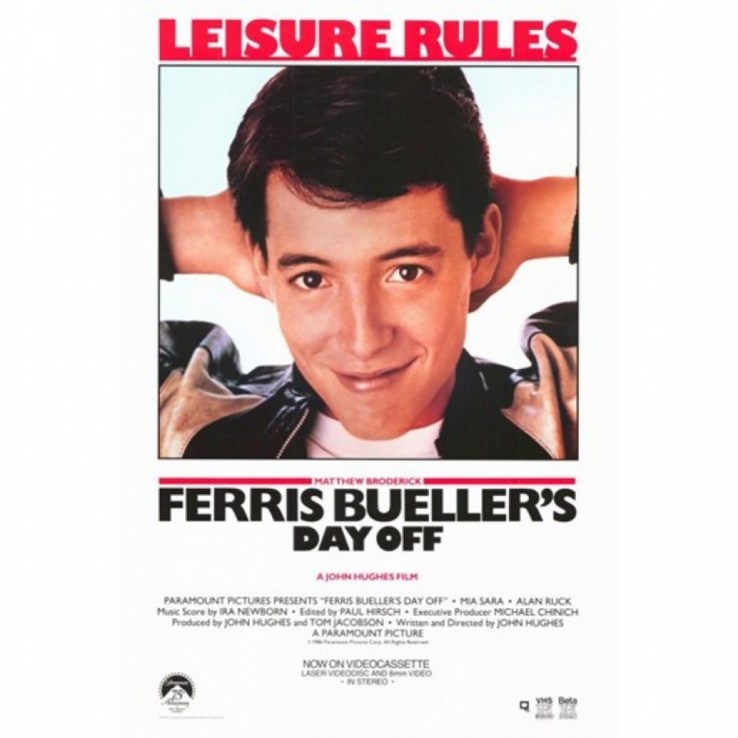
Ferris Bueller gave me a fucking brain aneurysm on immediate contact, though. It was perhaps the only film that legitimately “offended” me.
I write in the book about that experience, but I’ll reiterate here—I was 17 years old. My heroes were Howard Stern, Sam Kinison, Don Rickles, and Johnny Rotten. Musically, I was obsessed with the Butthole Surfers, the Mentors, and S.O.D. I was actively attempting to consume every Nazisploitation and Italian cannibal film ever made. Into that exact milieu arrived Ferris Bueller and I was completely, frothing-at-the-head-holes outraged and infuriated and saddened for all humanity by it and by him.
Naturally, it annoys me now that the rest of the world seems to have “caught up” with me circa June 1986.
Mark Twain nailed a policy I think is proper: “When you find yourself on the side of the majority, it’s time to check your position.” I checked and, to be sure, I remain where I always have regarding Ferris Bueller.
The real enemy.
B&S: Porky’s was another movie that made me feel similarly. Between that and Revenge of the Nerds, why does each oppressed group in those films only reply back with more oppression?
MCBEARDO: Sorry to go all Oprah on you, but, really, “Hurt people hurt people.”
In Porky’s, the jocks who suffered bruised egos literally destroy the livelihood of the guy they blame for it, along with all the people he employs. Today, Porky would taken down via doxxing or SWAT-ing.
In Revenge, the ugly and unloved nerds humiliate women they feel humiliated by simply for existing. In modern parlance, we’d call those guys “incels,” and we’re all too horribly aware of what they’ve been capable of doing.
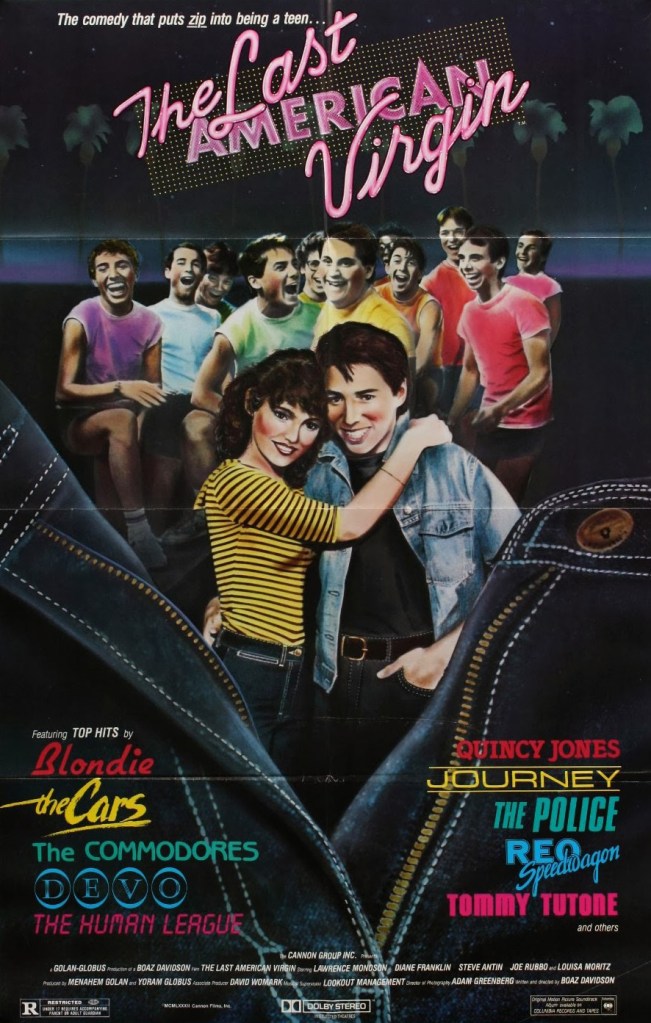
B&S: Finally, it’s awesome that people are talking about The Last American Virgin. Were you warned to the ending or did you get punched in the balls like I did?
MCBEARDO: I saw The Last American Virgin at the Nostrand theater when I was 14 with a big, raucous group of dudes. The one guy among us who was 17 bought all the tickets. We snuck in an entire pizza and hooted and laughed through the whole movie, right up to that sudden pitch-black drop off a cliff.
Afterward, we all walked out in a thick, heavy silence. It was only broken a half-a-block away when that one 17-year-old said with genuine earnestness, “I felt bad for that asshole.” He spoke for all of us.
Don’t be fooled by this happy poster. This film crushes souls.
Thanks Mike for taking the time to do this. Look for our review of Teen Movie Hell later this week, but this is one book that all movie fans should pick up. You can get it now from Bazillion Points.
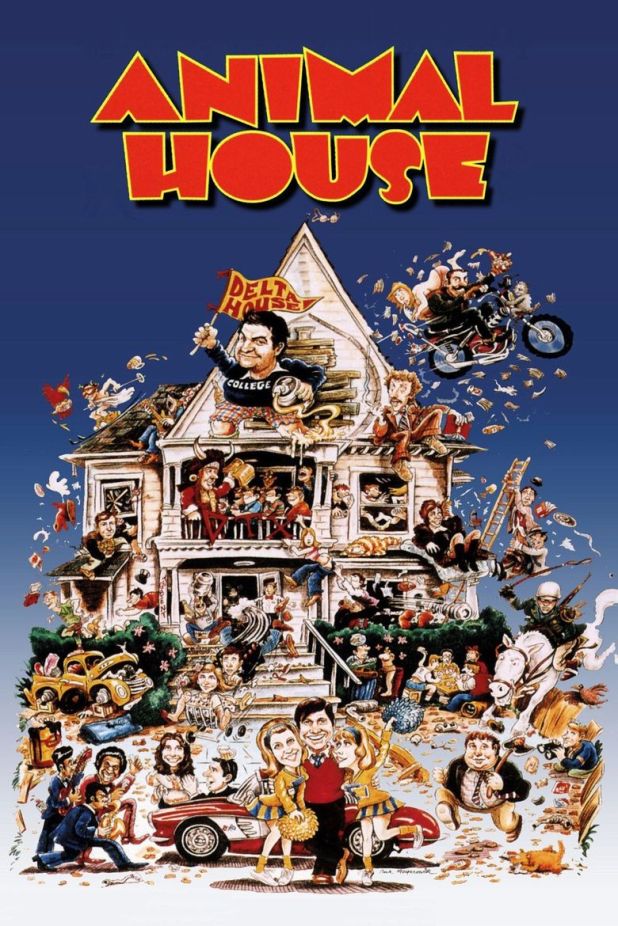
It’s impossible to explain to anyone who wasn’t around when this movie came out what its impact was. It changed comedy.
It came directly from the minds at the National Lampoon. In 1973’s National Lampoon’s High School Yearbook, writer Doug Kenney created the characters of Larry Kroger, Mandy Pepperidge, and Vernon Wormer, who by and large appear exactly the same in this film. Several of the stories of Lampoon writer Chris Miller also inspired this movie.
With an original script that was basically page after page of vomit, director John Landis was selected on the basis of his film The Kentucky Fried Movie. He added the idea that there had to be good guys and bad guys.
Originally, the cast was going to be Chevy Chase as Otter, Bill Murray as Boon, Brian Doyle-Murray as Hoover, Dan Aykroyd as D-Day (which makes sense, as the motorcycle-loving character is pretty much Aykroyd) and John Belushi as Bluto. Only Belushi would end up being in the film. At one point, Jack Webb was going to be Dean Wormer with Kim Novak as his wife, but he backed out.
At the time of filming, Belushi was only a star on Saturday Night Live and the studio wanted another star. Luckily, Landis was friends with Donald Sutherland and often babysat his son Kiefer. Thinking the film wouldn’t be a success, he did it for a day rate versus points, which cost the actor around $14 million dollars.
That said, without Sutherland, the movie wouldn’t have been made.
Much like the best of comedies — you will see this as a thread in most of my explorations of them — this is more of a series of vignettes than an overall narrative. The main story, though, concerns College Dean Vernon Wormer (John Vernon) and his battles against the sloppy and silly Delta Tau Chi fraternity.
My favorite part of this movie is something that was taken and used so many times by so many other lesser films: the final fates of many of the characters are revealed via text before the credits roll. For example, Babs becomes a tour guide at Universal Studios. Many of the films of John Landis have an ad for Universal Studios that ends by saying, “Ask for Babs”. That was a secret joke that for a while would give lucky visitors a discount or even a free ticket.
Sadly, National Lampoon writer and editor P.J. O’Rourke blamed this movie for magazine’s death. After Animal House‘s success, Hollywood came with money in hand, paying the writers more than they’d ever make at the magazine. But then, none of their scripts would be all that great, which hurt their careers and the reputation of the Lampoon.
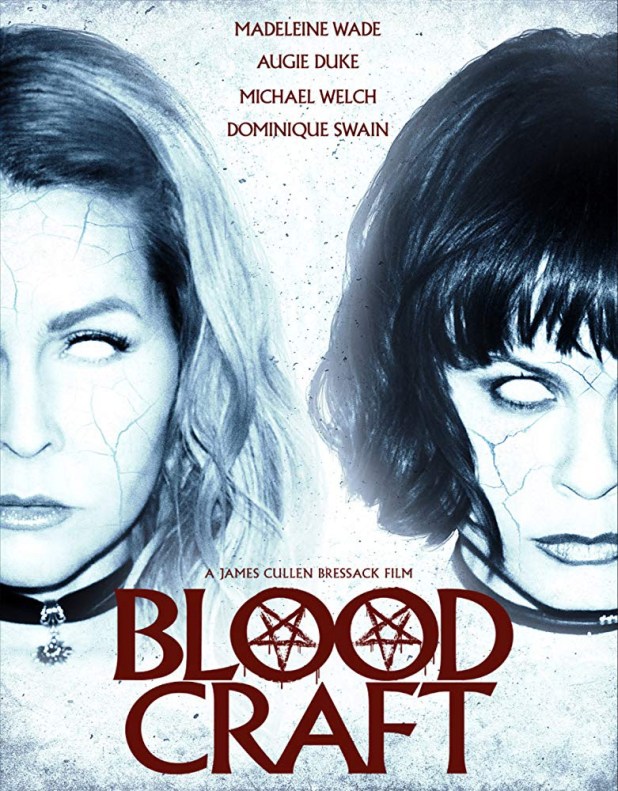
Two sisters — both of whom had suffered abuse at the hands of their sadistic father in their childhood — learn that he’s dead. Seeing as how they can’t get their revenge in any normal way, they decide to use witchcraft to bring his spirit back and finally get their payback. That’s the idea behind this supernatural offering from co-writer/director James Cullen Bressack.
Exotic dancer Grace (co-writer Madeline Wade) learns of her father’s death, which forces her to return home to see her sister Serena. Together, they face the pain of their past, including the painful memories of abuse at the hands of their father, Minister Hall (Dave Sheridan, Scary Movie, Ghost World). Michael Welch (Mike Newton from Twilight) also shows up, as does Mark Rolston (The Shawshank Redemption, Aliens).
Even though Hilde (Dominique Swain, Lolita, Face/Off, The Sixth Friend), their mother, was terminally ill, she taught both girls the basics of witchcraft. That’s what they’ll try to use to escape the scars of childhood and gain their horrible revenge on their father. But first, they have to find a man to torture and use as his host.
This film depends on the abilities of its female leads, who do a good job of moving things forward, as they’re often the only two people on screen for most of the film. The level of their father’s depravity gets fully explored, trust me.
Blood Craft is available digitally on April 9.
Disclaimer: We were sent this movie by its PR team but that doesn’t impact our review.
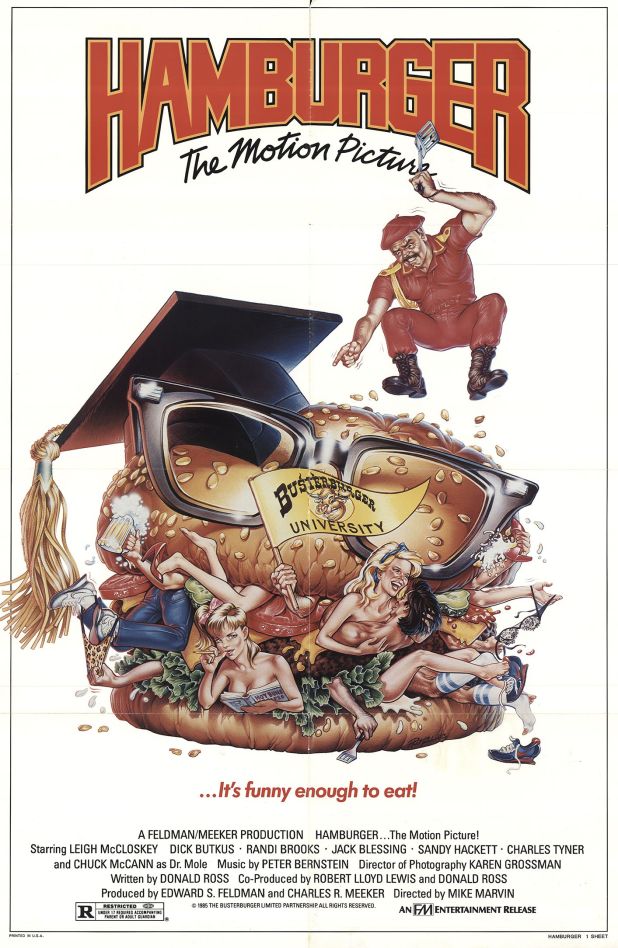
My wife asked me, “Why would anyone watch this movie?” She doesn’t get it. She wasn’t around in the 1980’s, when we had no internet. She wasn’t going through puberty. She’ll never understand staying up until 3:15 AM to catch a movie about a Hamburger University and the joy that it can bring.
Russell Proco (Leigh McCloskey, who improbably is also in Argento’s Inferno) has been kicked out of multiple schools because he can’t stop hooking up. There’s a trust fund waiting for him if he can get a diploma. So he picks the one school he knows he can graduate — Buster Burger University.
You know why the 1980’s were great? Because Dick Butkus could be in a movie and we all knew exactly who his character was. Here, his job is to beat the hell out of the students so they don’t screw up Buster Burger. Everyone has to follow the rules:
Outside consumption of food is prohibited.
All candidates are to stay on the grounds of Buster Burger University until graduation.
Since sex and success make lousy partners, all candidates are not to engage in sex while students.
This is a movie that follows the best formula: just get a bunch of crazy characters together, get them into some insane situations and let the hijinks ensue. Along the way, Russell makes a friend who is obsessed with the CEO’s sexy wife (the pneumatic Randi Brooks, who also is in TerrorVision), a nun who for some reason is going to burger school, a sex-crazed guerilla fighter, a soul singer who was arrested and is at the school on work release and so much more.
Where else other than Buster Burger University can you learn to yell things like “Put those cookies back, motherfucker,” get stuck inside a giant pickle and then have to battle against bikers and cops on your first day of work?
Most amazingly, director Mike Marvin would go on to make a movie that is even less connected to reality, The Wraith.




 B&S About Movies
You must be logged in to post a comment.