Silent Night, Deadly Night 5: The Toy Maker (1991)

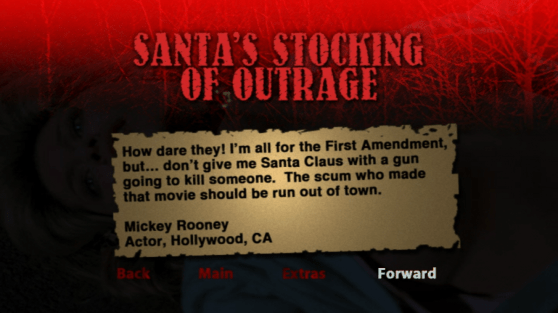
Mickey Rooney famously decried the original Silent Night, Deadly Night. He said that the scum who made it should be run out of town for having sullied the sacredness of Christmas. Yet here he is, starring in the fifth installment. Hollywood is funny that way.
Neith Hunter, Clint Howard and Conan Yuzna — who played Kim, Ricky and Lonnie in Silent Night, Deadly Night 4: Initiation — make cameo appearances, but as far as I know, they aren’t the same characters.

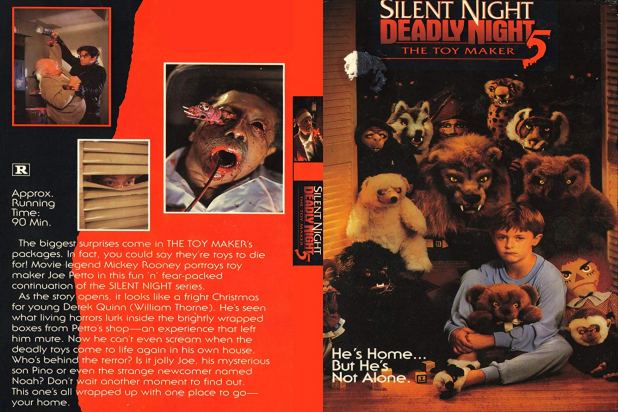
One night in December, Derek Quinn finds a gift on his porch. His father yells at him for being awake so late and opens the gift himself, which has an orb shaped like Santa inside it. Soon, it unleashes some tentacles which strangles dad and makes him fall down on a fireplace poker. His wife Sarah soon finds his body.

Two weeks later, Derek’s mom takes him to the toy store of Joe Petto (Rooney) — get it, JOE PETTO — to pick out a toy. Petto’s son Pino — yes, Pino Petto — is a weird duck who tries to get Derek to pick Larry the Larvae. Derek rejects the toys and Joe begins screaming at Pino, blaming him for the toy store failing. While all that’s going on, Noah Adams has followed the family and taken that worm toy, which he gives to his landlord. Larry the Larvae crawls into that dude’s mouth and out his eyeball, proving that this movie isn’t screwing around when it comes to holiday gore.

The next day, Sarah takes Derek to see Santa, who ends up being Noah. There’s also another gift on the porch and if someone didn’t want a gift any more than this kid, I have no idea who that person is.

So that gift ends up being rocket skates and a kid ends up getting hospitalized by them. And oh yeah — Pino gets beaten into oblivion by his dad. And oh yeah part two — Noah is really Derek’s real dad.

What follows next is a sequence where the babysitter and her boyfriend are accosted by a toy hand and then annihilated by an entire army of toys that basically dissects them. Joe steals Derek and Noah reveals that the old toymaker hurt a whole bunch of kids after his wife died by selling them toys that would hurt them.

As they get to the toy store, Noah is knocked out and Pino reveals that he is a robotic boy created by Joe to replace his dead son, but that he can never live up to being a real boy. Joe beats him to the point that he dies time and time again, but now he wants Sarah to be his mom, so he sexually assaults her. Yep. This movie is taking no prisoners.

The end of this movie is completely out of control. The robotic kid — who has an asexual body like a Ken doll — gets chopped in half and his head stomped on, as he cries for his father. You really have to see it to believe it.

Director Martin Kitrosser has had an interesting career, writing starting as a script supervisor on the first Friday the 13th before eventually writing the third and fifth films in that series. He also wrote Meatballs Part II and has gone on to be a script supervisor for nearly all of Quentin Tarantino’s films, with his credit in Once Upon a Time…In Hollywood listing him as Martin “The Cobra” Kitrosser.

Brian Yuzna, who produced Re-Animator, was also on board for this. The effects, by Screaming Mad George, are incredible, with tons of gore and some really inventive deadly toys. Actually, this whole movie is way better than it has any right being, seeing as how it’s the fifth movie in the series. To be honest, it’s several cuts above the other ones all put together.

You can watch this for free — with commercials — on Vudu.
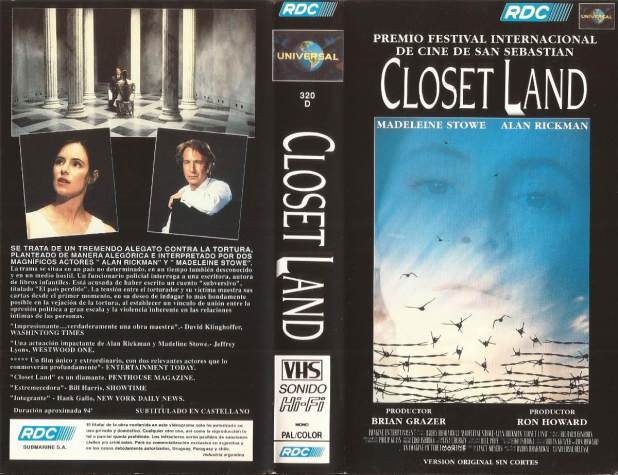
Closet Land (1991)

With Closet Land, Radha Bharadwaj became the first director of Indian descent to have a film released by a major Hollywood studio. This movie was produced by Ron Howard and Brian Grazer and basically only features two actors, Madeleine Stowe as Victim and Alan Rickman as Interrogator.

In an unspecified country and time, Victim is taken from her home in the middle of the night and accused of putting anti-government messages into her children’s book Closet Land, a tale of a badly behaved girl who has been locked in a closet as a punishment. However, the totalitarian and anti-woman government assumes that the book is filled with anarchy.

The Interrogator believes that the author is guilty of propaganda created to stir dissent in the hearts of children, while Victim knows that she wrote it to cope with a childhood assault. Worse, the Interrogator later claims that he was the one who abused her in her chldhood, but it’s never explained if he’s telling the truth or trying to assert his will over her.

By the end, no matter what tools the Interrogator attempts to use to get the truth, Victim refuses to sign a confession and instead goes to her death.

This is a movie that has survived based on word of mouth, as it was only released on VHS in the United States. It’s never come out on DVD or blu ray, which is incredibly surprising.

Alan Rickman said of the film in Empire magazine. “Somewhere in there I made — and have continued to do — films that disappear without a trace. You still care about them…while I was doing that [bigger budget films], I’d also done Closet Land, which I should think almost nobody saw.”

In 2009, Bharadwaj said, “If the film has currency today, it is because of viewers like you. You have kept my film alive. You had the ingenuity to put it up on YouTube. You have engaged in chats and discussions about it. So the fact that the film is alive, and its influence is growing, is very much a testimony to what you can do.” You can read more of her thoughts on the film on her personal website.

Seeing as how this film is impossible to get legally in the U.S. — unless you still have a VCR — I’ve decided to share it. My biggest worry is that this is the future our country is headed toward unless we learn empathy and limit the powers of those who crave it most.

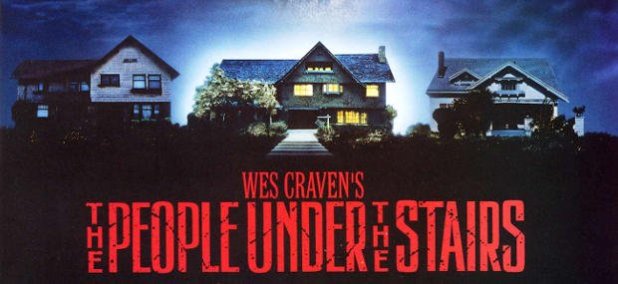
The People Under the Stairs (1991)

Wes Craven was inspired by a news story from the late 1970s, in which two burglars broke into a Los Angeles household, leading the police to discover two African-American children who had been locked away by their parents. There was little studio interference on this $6 million dollar film, which ended up being a modest success.

Craven would say that this movie was closer to The Hills Have Eyes than any film he’d done in a while, telling Fangoria that it was “a raw film with no dreams in it whatsoever. It’s an extraordinary, real situation involving an awful family that shouldn’t exist, but unfortunately, often does.” I mean, that’s kind of poetic, huh?

Poindexter “Fool” Williams (Brandon Adams, The Mighty Ducks and The Sandlot) and his family are about to be evicted by their landlords, known as Mommy and Daddy Robeson. They’re played by Everett McGill and Wendy Robie, who were cast after they played married couple “Big” Ed and Nadine Hurley in Twin Peaks.

Meanwhile, Fool, Leroy (Ving Rhames) and Spencer decide to break in to the Robeson’s home. Bad idea — they find a dead body and an entire room full of pale children that have been locked up inside a dungeon. When they return to the house, the Robesons end up being home and Daddy kills Leroy.

On the run, Fool meets their daughter Alice (A.J. Langer, My So-Called Life), who tells him that the “people under the stairs” are kids who broke Mommy and Daddy’s rules of see no, hear no and speak no evil. Now, they’ve become cannibals and only Alice has escaped the horrible punishments of her parents, punishments like getting your tongue cut out like Roach.

Soon, Alice and Fool are on the run with Prince the dog chasing after them. The gold they find enables his family to escape the ghetto while doing the right thing — exposing the Robesons for the monsters they are.

That’s because Mommy and Daddy are really brother and sister, inbred killers from a long and gnarled family tree that started by running a funeral home before they went into real estate. Now, they must pay and the very house must be destroyed. 

Bill Cobbs, who played Grandpa, was also Dr. Emory Erickson, inventor of the Transporter, on Star Trek: Enterprise. Plus, Kelly Jo Minter (Miracle MileThe Lost BoysPopcorn and A Nightmare on Elm Street 5: The Dream Child) shows up, as does John Hostetter, who is Tuck in Knightriders and was the voice of Bazooka on the G.I. Joe cartoon.

Craven brings back the familiar trope of “Now I Lay Me Down to Sleep” in this film, not just a nod to the A Nightmare on Elm Street films, but a prayer that was also spoken in The Last House on the Left and the title of another Craven film, My Soul to Take.

I usually am not a fan of Craven as much as others, but this is probably one of his best films. It’s devoted to scares and fun, which is really what a night at a horror movie film should be all about.

You can get this movie from Shout! Factory.

The Terror Within 2 (1991)

Andrew Stevens is back after the first film, this time helping the last human colony to survive underground against the mutants who yearn to destroy them. He also falls in love with another survivor long enough for her to be impregnated by a mutant, because that’s what these movies are all about.

You know, I love R. Lee Emery. Sure, he pretty much played the same role in every picture, but you have to respect a man who will give the same effort in a movie directed by Andrew Stevens as he did in one helmed by Stanley Kubrick. He’s also stated in interviews that he only did this movie to pay for his house. As a man struggling to keep up with all of the home improvement goals of my wife, I feel his pain. Here, he plays a doomed base commander, who at least has a love interest in Andrew’s mom, Stella Stevens. Speaking of respect, you gotta love a kid who makes sure his mom still has work.

The only thing I liked better about this sequel is that there’s an entire cult of religious nuts who constantly take peyote and worship the mutants. I wish the movie was about them doing drugs and hanging out with monsters, because that’s a way better movie than this.

You can watch this for free on Tubi and Amazon Prime. You can also get a blu ray of this movie from Ronin Flix.

Neon City (1991)

By 2053, extensive ecological damage has resulted in lawless lands that are controlled by mutants. That’s the world that Harry Stark (Michael Ironside) lives in, working as a bounty hunter after being a cop. One of his bounties, a woman named Reno (Vanity), ends up being the reason he travels to Neon City on a giant truck.

I mean, I’ve seen worse setups for a movie.

Everyone on the trip has some kind of secret. There’s Bulk (a clean-shaven Lyle Alzado), a former friend of Starks who he once arrested. A serial killer who is acting like a doctor. The clown Dickie Divine (Richard Sanders, Les Nessman from WKRP In Cincinnati), a rich girl named Twink (Juliet Landau, Drusilla from Buffy the Vampire Slayer), Stark’s ex-wife Sandy and an old man named Wing.

The train battles through radioactive Xander Clouds, mutant attacks and even visits a diner staffed by mutants. Slowly, Stark and Reno come together while evading the killer on the train and making their way to Neon City.

Television writer Ann Lewis Hamilton wrote this as an update to John Ford’s Stagecoach. As she’d dealt with sexism in her career, she used the male name Buck Finch as her pen name. Unsurprisingly, despite her writing the lead as a woman, producers instead cast the male Ironside as Stark.

This movie looks like a high-end TV movie, because well, it is. I’d recommend it only if you love Vanity, Michael Ironside and post-apocalyptic cinema. Seeing as how I’m cursed by all three of those afflictions, I was caught in its spell against my will.

You can watch this on Tubi.

Omega Cop (1990) and Karate Cop (1991)

The bolo tie-wearing Prescott (Adam West) runs a “Special Police” force in the year 1999 from a one-room set (that he never leaves) via a couple of Commodore 64s and some 60s-era blinking props to protect the post-apocalyptic wastelands of Southern California. Keeping Adam West company in the washed-up actor’s camp are Troy Donahue (the metal epic Shock ‘em Dead) and Stewart Whitman (Guyana: Cult of the Damned, Demonoid, and Bermuda Triangle). Helping out on the stunts and working as one of the “wasteland scavengers” is the always reliable and entertaining Sean P. Donahue (of the awesome Ground Rules).

And how did we get here, you ask? Well you’ll have to listen to West’s voice over narration (that he wrote himself!) at the beginning of the film as he educates you on the ozone layer, the greenhouse effect, the rain forests, and the solar flares that plagued the world (“. . . half the world just didn’t give a shit. . . .”).

Anyway, when West catches wind of an illegal slave auction of women run by some “bad-ass” named Wraith (clad in a predictable Nazi SS uniform), he sends in the resident “Mad Max”: John Travis (Ron Marchini of the 1976 kung-fu classic and popular video rental, Death Machines). During the course of breaking up the slave ring — with his high-tech, multi-barrel shotgun — his team is killed: Travis is the last police officer on the force! So, with his high-tech ‘80s-era jeep, Travis takes the two surviving slave women to a utopia of clean air and water in Montana . . . and kicks some ass along the way. (Travis may have been double-crossed by Adam West, who really ran the slave ring . . . does it really matter?)

If you’re a post-apocalypse completest — or an Adam West fan that needs to slide a copy of Omega Cop next to Zombie Nightmare (with Jon-Mikl Thor!) and One Dark Night on your shelf — then this film is for you.

Say what you will about its production quality and shortcomings in catching some Mad Max-inspired post-apoc love, but Omega Cop isn’t boring and was popular enough on the video store circuit that Ron Marchini and writer Denny Grayson returned with a 1991 sequel: Karate Cop — costarring David Carradine (Future Force, Death Race 2000) in place of Adam West — which has something to do with people forced into gladiator-arenas by street-terrorist gangs. But get this: the director is sexploitation purveyor Alan Roberts of Young Lady Chatterley (1977) and The Happy Hooker Goes to Hollywood (1980). But don’t let his soft-porn presence deter your watch: as with any Marchini flick, Karate Cop is a fun watch.

Director Paul Kyriazi, who made his debut with the aforementioned Death Machines and vanished from the film world after Omega Cop, which served as his fifth and final film, has returned to the writing and director’s chair with the 2018 sci-fi movie, Forbidden Power. You can learn more about Kyriazi’s return and his new film courtesy of a favorable review at HorrorGeekLife.

You can watch the VHS rips of Omega Cop and Karate Cop on You Tube.

About the Author: You can read the music and film reviews of R.D Francis on Medium and learn more about his work on Facebook. He also writes for B&S Movies.

Firehead (1991)

Action International Pictures, also known as West Side Studios, was founded by David Winters, David A. Prior and Peter Yuval in 1986. After Winters was overruled on a casting decision for Thrashin’ — he wanted Johnny Depp and they wanted Josh Brolin — Winters made the professional decision to control all aspects of future projects.

All of this would lead to them producing seventeen movies and distributing forty one more between 1988 and 1994. They often used the same cast and crew in many of the films, such as David Prior and his brother Red, as well as William Zipp as actor, writer, director, producer, and stunt man. They weren’t above getting big stars, either. That is, if you consider Cameron Mitchell a big star, which I completely do.

Some of their films include Island of BloodMiami GolemDeadly PreyZombie Death HousePhoenix the WarriorElvesFuture ForceFuture ZoneNight Trap, and, of course, Space Mutiny. Truly, their work is the bottom of a very tasty barrel.

Today, however, we’re here to discuss Firehead.

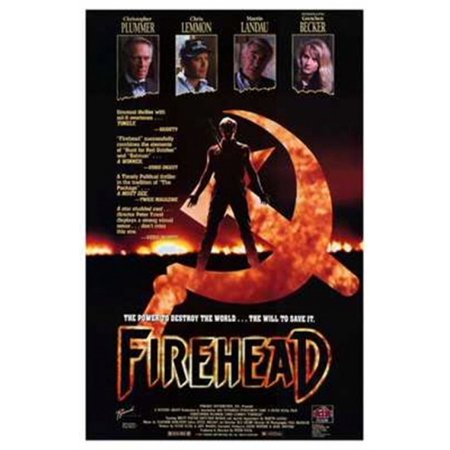
At some point in 1988, a telekinetic Soviet agent known only as Firehead (Brett Porter, Arena) defects to the United States after he refuses to use his abilities against a crowd of protesters. Yet just two years later, he’s blowing up American factories, which brings a chemist (Chris Lemmon, who was on Thunder In Paradise) and an assassin (Gretchen Becker, Maniac Cop 3: Badge of Silence) together to track him down. In the midst of all this, Christopher Plummer shows up as a military man out to use Firehead to take over the world. And Martin Landau? Oh, he should know better. He really should.

If you think you have the gumption to deal with this, well…it’s on Amazon Prime. You’d be better off watching it in RiffTrax form, though.

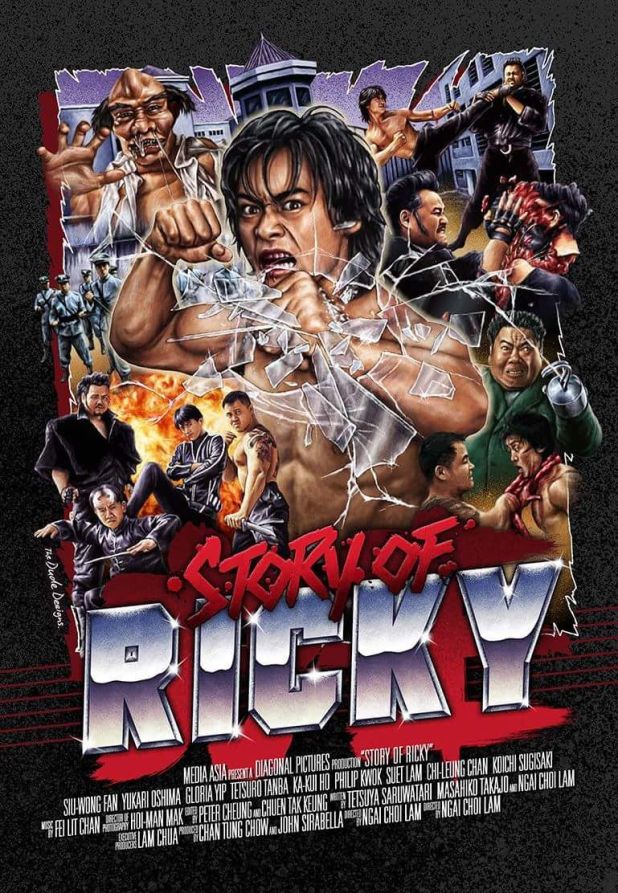
Riki-Oh: The Story of Ricky (1991)

Writer and director Lam Ngai Kai’s films combine comedy, action, adventure and horror, often less concerned with narrative. Despite a long career, starting with films for the Shaw Brothers all the way to several standouts in the 80’s and 90’s such as The Ghost Snatchers and The Cat, he’s best known in the west for this film.

Riki-Oh started as a manga, or Japanese comic book, and ran for three years in the magazine Business Jump. Created by Masahiko Takajo and Tetsuya Saruwatari, it tells the story of a post-apocalyptic world where prisons have become privatized and their populations used for slave labor. One of the prisoners is Riki-Oh, who is there for killing the Yakuza boss who was responsible for the death of his girlfriend. He’s the one man that can’t be broken, as he’s learned Qigong from one of Chiang Kai-shek’s bodyguards. Now, he’s so strong that he can punch holes through literally anything and everyone.

Qigong is “a holistic system of coordinated body posture and movement, breathing and meditation” that is all about cultivating life energy, known as chi. I don’t know if it can be used to punch a man’s head clean off, but who am I to go against Hong Kong cinema by the way of Japan?

Ricky starts the film by earning the ire of the gangs within the jail by stopping Wildcat, the captain of the cells, from abusing an older inmate named Omar. This all leads to Omar killing himself, realizing he’ll never leave the prison, and the gang sending the obese Zorro after our hero, only to be absolutely obliterated. That’s when we learn through flashbacks why Ricky is in jail and how he learned exactly how to become pretty much invincible. Seriously — he still has five bullets inside his heart and he can even restitch the veins in his arm in the midst of combat.

This brings Ricky into conflict with the Gang of Four, the leaders of each of the cells, and Warden Dan, who has one eye. The other has all of his drugs inside it. The first battle between Ricky and Oscar ends up Oscar trying to commit seppuku and slicing into his own stomach before choking Ricky with his intestines. Oh yeah — this is when I should warn you that this movie has absolutely no restrictions. If something can explode in a shower of blood and gore, it will, over and over and over again.

Ricky spends the rest of the film battling the other leaders — Rogan, Brandon and Tarzan — as well as the brutal warden. Everyone that tries to help our hero is killed and he must survive being buried alive and covered in concrete to rise up and finally kill the warden and punch his way through the wall of the prison to discover freedom.

There are so many strange moments and characters in this film that it’s almost impossible to list them all. This is simply a movie that must be experienced, as it’s literally a comic book come to life. It also has a dub so poor that most giallo is a step up in quality.

My favorite character — other than Ricky — is the warden’s spoiled son. He eats candy constantly and his clumsy nature leads to numerous deaths. This is a film in love with slapstick as much as violent death.

Star Fan Siu-Wong would return for Dint King, Inside King, a spiritual sequel of sorts that is set in the distant future. He wears the same camouflage poncho in this film, but has a different name and the film isn’t an official Riki-Oh movie.

There’s also an anime of this story, but what’s amazing is just how much this movie is a real-life cartoon. It’s like Cool Hand Luke mixed with Dead Alive, a film that shows you how Luke could have really done better if he just knocked people’s jaws off instead of eating all of those hard-boiled eggs.

You can watch it for free on Tubi.

Sins of the Mother (1991)

The bizarre relationship between an overbearing mother and her son, a convicted rapist? Sounds like a giallo, but it’s a 1990’s made for TV movie. That said, it’s based on a novel by Jack Olsen and also based on a true story.

Yes, Kevin Coe (Dale Midkiff, Pet Sematary) may be a horrible real estate agent, but he’s good at one thing: assaulting and murdering women. Maybe that’s two things. Regardless, he has to put up with the taunts of his socialite mother (Elizabeth Montgomery, BewitchedThe Legend of Lizzie Borden).

Now, his new girlfriend Ginny Perham is getting too close and she just might unravel all his secrets. Hey — Talia Balsam is in this, which makes me happy, as I always celebrate when her dad shows up in horror films. And Caroline Williams — Stretch from The Texas Chainsaw Massacre 2 — shows up.

Not much else happens, sad to say. Maybe I was hoping for more of a trip into the psychosexual mind — I blame the trailer for Torso for that line — but got nothing.

Hudson Hawk (1991)

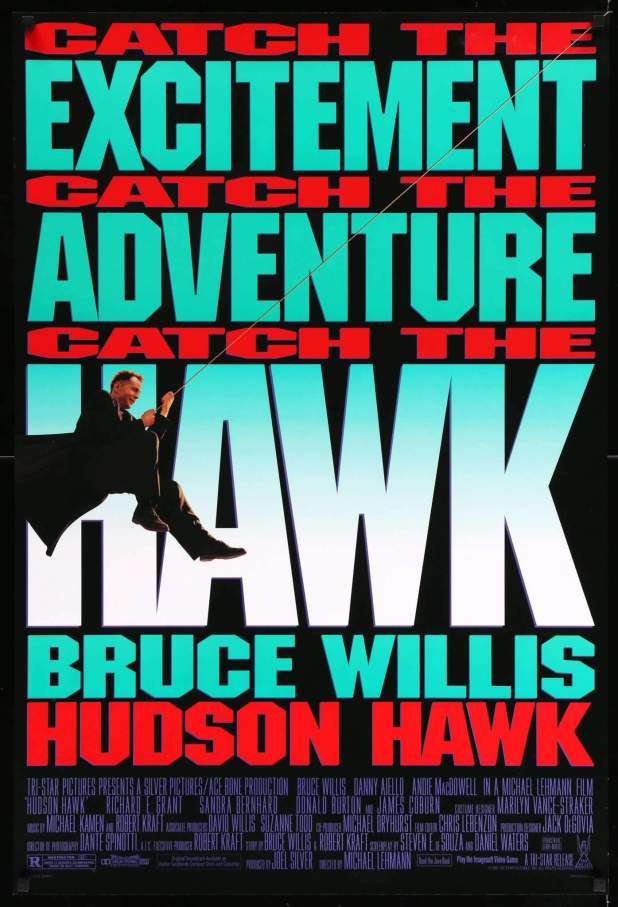
Whatever Hudson Hawk is, it’s not what it started out to be. It’s totally different than the movie Joel Silver wanted to produce and it’s completely different than the script Steven E. de Souza wrote. As Bruce Willis became a bigger and bigger star, he just took over, bringing on screenwriter Daniel Waters to add plenty of strangeness to De Souza’s straightforward adventure tale.

It didn’t even have the same bad guys. Originally, Joss Ackland was going to be the Bond-style bad guy. Then, director Michael Lehmann actually had conversations with Audrey Hepburn before Willis said, “Let’s take the guy from the first draft and the girl from the second and make them a couple.”

Hudson Hawk is really the story of how a small and fun film turned into a $50 million dollar loss for TriStar Pictures. In fact, this was the last movie produced by the company before they merged with the struggling Columbia Pictures. The film lost so much money, Sony had to salvage the companies by purchasing the remaining stock, then reorganizing the company as part of the recently-formed Sony Pictures Entertainment.

Eddie “Hudson Hawk” Hawkins (Willis) just wants to celebrate his first day of parole with a cappuccino, but to get there, he has to deal with his parole officer, the Mario Brothers mafia family and the CIA, all of whom want him to do one more heist.

Finally, he and his partner Tommy “Five-Tone” Messina (Danny Aiello) are forced to comply with Mayflower Industries, which is run by husband and wife Darwin (Richard E. Grant) and Minerva Mayflower (Sandra Bernhard), along with their blade-slinging butler, Alfred (Donald Burton). Their goal is to rebuild da Vincy’s La Macchina dell’Oro, the alchemical machine that converts lead into gold.

There are crystals in da Vinci’s art that will power this machine, as well as a nun named Sister Anna Baragli (Andie MacDowell) who is an operative for the Vatican’s secret intelligence. Also — our heroes use different songs to time out their robberies. Still with us?

That said, It’s hard for me to hate a movie that features James Coburn as George Kaplan, the name of the fake agent from North by Northwest, complete with handcuffs and a phone that emit the same tones as his famous Flint series of films. Or one that has David Caruso as an agent named Kit-Kat (all the CIA guys are named for candy bars).

However, this is a film that proves that there really can be too much of a good thing. The end takes a long time to get there and when it does, you’ll wonder why so much effort went into it.

Hey man — it was the 1990’s and these were the movies people wanted to see. This is the story of ego out of control. Yet the film that gave Willis so much power — he had tested really high with audiences in test screenings of Bonfire of the Vanities — crashed too.

Between the throes of trying to release Meet the Applegates and the way he was treated by Willis on this film, it’s a wonder Michael Lehmann ever directed again. But he stayed with it — he’s been behind several American Horror Story episodes.

BONUS: You can hear Becca tell me how much she hates this movie on our podcast.