Border Radio (1987): John Doe Week

Editor’s Desk: This review originally ran on September 26, 2020, as part of our “Rock ‘n’ Roll Week II.” We’ve brought it back for “John Doe Week.


Was it worth waiting a few years before finding a copy of this poorly-distributed VHS in a cut-out bin at an old Sound Warehouse?

Oh, yeah.

Fans of the cult film existentialism of Easy Rider, Vanishing Point, and Two-Lane Blacktop — or any art film that finds a reissue on the Criterion Collection — will enjoy this grim, black and white film noir homage (shot on Super 16mm) to the French new-wave films of old; to that end, the film employs a disjointed, non-linear narrative. Do you enjoy the films of Jim Jarmusch’s Stranger Than Paradise (1984), Down by Law (1986), and Mystery Train (1989)? Did you enjoy the later Clerks (1994) by Kevin Smith? Do the “mood pieces” of Italian filmmaker Michelangelo Antonioni — such as 1975’s The Passenger — appeal to you?

Then you’ll enjoy Border Radio — although this UCLA student film by Allison Anders and Kurt Voss (Down and Out with the Dolls) doesn’t possess the “slickness” of those films, as you can see from the trailer.

Border Radio is a noirish tale of three southern California punk rockers — two musicians and a roadie (Chris D. and John Doe) — who decided a club stiffed them on a gig, so they rob the club. Chris D. subsequently abandons his rock journalist wife and crosses the border into Mexico with his split of the caper, leaving her holding the bag in repaying the debt of their robbery; she sends John Doe into Mexico to find him.

The caveat of Border Radio: this is not a punk film.

U.S.-issued VHS by Michael Nesmith’s Pacific Arts Video courtesy of 112 Video/Paul Zamarelli of VHS Collector.com.

There are punk rockers cast in the film as actors, but the music and punk aesthetic is void from its frames. The film’s stars, Chris D. of the Flesh Eaters and the Divine Horsemen, and John Doe of X, do not perform any of their music in the film. At the time Allison Anders (1992’s Gas Food Lodging, 1999’s Sugar Town, 2001’s Things Behind the Sun) completed the four-years-shot film begun in 1983, L.A.’s punk scene — with the musicians she cast as actors — was over.

The Flesh Eaters disbanded and the Divine Horsemen (lead singer Julie Christensen stars in the film) were set to release their first recordings; Billy Zoom left X; Phil and Dave Alvin (Dave co-stars in the film) disbanded the Blasters, and Texacala Jones (who also appears in du-Beat-eo) split from Tex and the Horseheads. Green on Red (they appear on stage at the Hong Kong Cafe), who got their start on Slash Records with Gravity Talks (1983) and wrote the soundtrack for Anders’s Gas Food Lodging (1985), also folded up the tents after their three, pre-grunge albums for Mercury: The Killer Inside Me (1987), Here Come the Snakes (1988), and This Time Around (1989) failed to expand beyond college rock airplay and connect with the burgeoning, commercial alternative rock scene. The film’s theme song, “Border Radio,” is performed by The Tonys, aka L.A.’s the Dils, aka Rank n’ File, led by Chip and Tony Kinman; by the time of the film’s release, they formed the synth-based Blackbird project.

You can learn more about the out-of–print Enigma Records soundtrack — never released on compact disc — on Discogs.com. The film is not currently available on PPV and VOD platforms, but DVDs can be purchased direct from Criterion. Here’s the trailer and the full soundtrack to enjoy.

About the Author: You can learn more about the writings of R.D Francis on Facebook. He also writes for B&S About Movies.

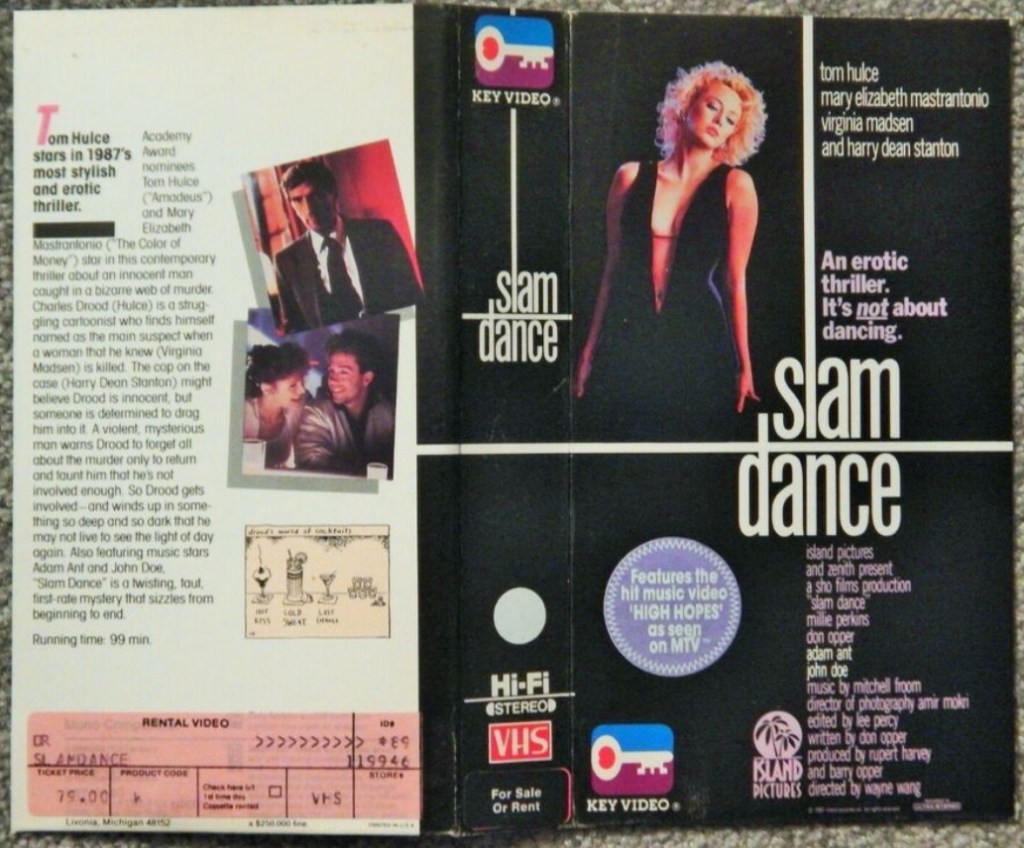
Slam Dance (1987)

John Doe made his first big screen appearances in the 1981 music documentaries The Decline of Western Civilization and Urgh! A Music War. While he made his big screen debut as an actor in Oliver Stone’s Salvador (1986; reviewed this week), he actually made his first foray into acting with Allison Anders’s Border Radio (1987), which began shooting in 1983. After scoring his first mainstream acting gig in Salvador, Doe found himself on another hot ticket, this time with much-ballyhooed Chinese director Wayne Wang.

Ah, the VHS sleeve we remember/courtesy of rtsrarities/eBay via pinterest

Born in British Hong Kong and trained at California College of the Arts, Wang made his debut with the 1972-shot — for $16,000 — and released in 1975 gangster drama A Man, A Woman, and a Killer. The film was poorly reviewed and it wasn’t until his next film, Chan is Missing (1982), that Hollywood stood up and took notice; the film is recognized as the first Asian-American feature film to gain theatrical distribution and acclaim outside of the Asian marketplace place. Gene Siskel and Roger Ebert of PBS-TV’s Sneak Previews loved him. Courtesy of Wang’s choice to shoot in black & white to carry through the film’s mystery-noir narrative, he was hailed as the next “John Cassavetes.” Wang’s next feature, another Asian-centric narrative cast with Asian actors, Dim Sum: A Little Bit of Heart, repeated the box office and critical acclaim of Chan is Missing.

And, with that, Hollywood was ready for Wang to take on an American feature film. Island Pictures, a subsidiary of Island Music, fronted Wang the $4.5 million to shoot the Don Opper-penned (Android and City Limits; rewrites on Critters) film noir Slam Dance. The film was a critical and box office bomb that cleared less than a half million in American box office receipts. Wang himself was so displeased with the end product — which he blamed on producer interference — he tried to have his name removed from the film.

And since it was the first “mainstream movie” for both Opper and Wang, it killed off their mainstream hopes in Hollywood. Opper didn’t write another movie until the Hallmark Channel (!?) disaster film Supernova (2005), an Australian-produced feature film that starred Luke Perry, Peter Fonda, and Tia Carrere. While Wang directed three more indie, low-budget films, he returned to mainstream critical good graces with The Joy Luck Club (1993) and Miramax-distributed Smoke (1995).

Tom Hulce, who was never able to consolidate his Oscar tour de force in Amadeus (1984) into a leading-man career of distinction, stars as C.C. Drood. Drood is a married cartoonist involved noirish intrigue after his lover, Yolanda (a very hot Virginia Madsen), who makes her living as a call girl, is found murdered. In addition to having John Gilbert (John Doe), a corrupt cop looking to pin the murder on Drood, Yolanda’s lesbian lover, Bobby, has hired a hit man (Don Opper) to kill Drood. Of course, Gilbert and Bobby, were in on the murder all along. Another wrench in the noir works is new wave star Adam Ant as Drood’s agent. And the musician connections of the film carries through with keyboardist Mitchell Froom, who got his start with the bands Montrose and Gamma led by Ronnie Montrose, composing the film score.

As for the actor that led to us reviewing this film: John Doe followed up his smaller support role in Salvador with class and style; he should have made a much greater leap into feature films after turning in equally stellar (in larger roles) performances in the much-aired cable cult favorites of Road House (1989) and Great Balls of Fire (1989) (reviews for both this week!). Unfortunately, Doe’s next two films, Liquid Dreams and A Matter of Degrees (both 1991) failed at the box office. Doe fared better with his next work — going thes-for-thesp — as professional gambler Tommy “Behind-the-Deuce” O’Rourke in the Kevin Costner and Dennis Quaid-starring Wyatt Earp (1994; reviewed this week, look for it).

While it’s available as a rental on Vudu, we found a free-with-ads steam on TubiTV — denied! — it’s been pulled. But you can stream it over on Amazon Prime. Oh, and regardless of the pretense of Doe and Ant — and its title — this is not a “punk film.” You’ve been caveated. You can watch the trailer and opening seven minute from the VHS, via You Tube.

About the Author: You can learn more about the writings of R.D Francis on Facebook. He also writes for B&S About Movies.
Devil’s Dynamite (1987)

Look, there’s no such person as Joe Livingstone, the director of this movie. Or William Palmer, its writer. They’re both Godfrey Ho, the Hong Kong Ed Wood who made at least eighty movies from 1980 to 1990 and may have used over forty screen names, making him the Asian Aristide Massaccesi.

Ho is the master of a cut and paste style of filmmaking that challenges the notions of art and copyright clearances — or he’s a hack out to make a quick buck. He’s also famous for dropping footage of ninjas into movies even if the plot doesn’t call for it. I take issue with this: movies always call for more ninjas.

His love of the word ninjas also led to making movies that have titles like The Ninja Force, Ninja The Protector, Full Metal NinjaThe Ninja SquadThunder Ninja Kids: The Hunt for the Devil BoxerNinja Terminator, Zombie vs. Ninja, Thunder Ninja Kids in the Golden AdventureNinja Force of AssassinsNinja Knight Brothers of Blood, Ninja of the Magnificence, Ninja Powerforce, Ninja Strike ForceThe Ninja ShowdownPower of NinjitsuNinja’s Extreme WeaponsNinja’s Demon MassacreCobra vs. NinjaDeath Code: NinjaGolden Ninja InvasionRage of NinjaNinja: The BattalionEmpire of the Spiritual NinjaNinja Operation 7: Royal WarriorsNinja CommandmentsNinja In ActionNinja: American WarriorNinja Operation: Licensed to Terminate, Ninja Operation 6: Champion on Fire, Ninja Phantom Heroes, Bionic NinjaTough Ninja the Shadow WarriorTwinkle Ninja Fantasy (that’s one I gotta track down), The Blazing Ninja and probably ten movie ninja movies. Seriously, those guys are like cockroaches.

He would film footage for one movie, then re-use those shots over and over, which kind of makes him the Asian Roger Corman, but then he’d also find obscure Thai, Filipino and other Asian films, then graft them onto his movies — making him the Asian Bruno Mattei? — and then have several movies made with the budget of one, except no one can even tell where his footage begins and where the other films end.

Ho didn’t stop with stealing footage. He has no idea that music is a copyrightable thing either, so his movies are filled with all manner of sonic thievery, including songs from Miami Vice, Star TrekStar Wars, anime and even music from Wendy Carlos, Chris & Cosey, Tangerine Dream, Clan of Xymox, Vangelis and Pink Floyd.

Other than some rich musicians and the gullible film public, who gets hurt, right? Well, Richard Harrison, for one. He’d worked with Ho in the past at Shaw Brothers and made a deal to be in a few of his films. A few movies ended up being, well, a veritable onslaught of low-level ninjas films with his name above the title, which did damage to his career. Harrison was the unwilling feature actor in almost a dozen different movies, which sent him back to the United States. Yes, a guy who worked for everyone from Alfonso Brescia, Antonio Margheriti and Alberto De Martino to appearing in Bruce Lee ripoffs and Eurospy films had finally had enough.

And then, out of nowhere, Ho was making mainstream movies. Well, as mainstream as a Cynthia Rothrock film would be. After directing her in Honor and Glory and Undefeatable, he also made Laboratory of the Devil, a remake/remix/ripoff/ unauthorized sequel of The Man Behind the Sun. And then, he went back to his old tricks and used all the same footage to make a sequel to that movie, Maruta 3 … Destroy all Evidence. And then…

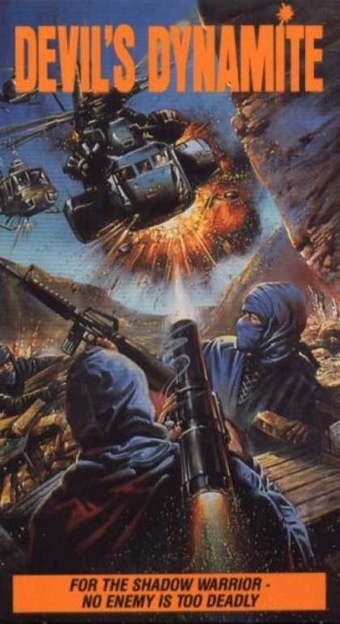
Somehow, this movie is 81 minutes and feels like nine hours. It’s all about Alex, who we also find out is the Shadow Warrior*, and now, he has to fight a smuggling ring who are all vampires, which as we all know, hop in China. No one at all is surprised that vampires exist. It is just matter of fact. There’s also a gambler looking to get even with the mob boss who sent him to jail, in case you get bored.

This is also somehow a sequel to Robo Vampire. Trust me, you have no reason to watch that. Or this. I mean, this movie has a silver lame suited superhero moonwalking against vampires, so really you can do whatever you want. Also, this movie makes so little sense that Robo Vampire could very well be the sequel, for all we know.

The poster is pretty awesome, though. And to be perfectly honest, I love these movies.

If you decide you can handle a director who makes Jess Franco look like Fellini, this is on Tubi.

*Shadow Warrior has the kind of costume that’s so horrible, Rat Fink A Boo Boo are both laughing at him.

Summer Camp Nightmare (1987)

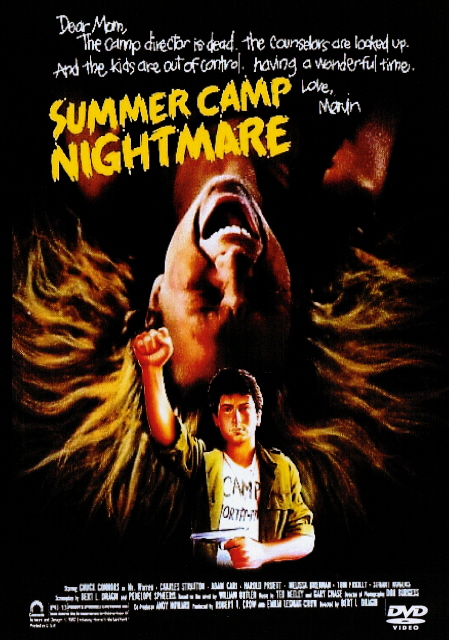
Based on the novel The Butterfly Revolution by William Butler, Summer Camp Massacre is not the slasher that you’d be led to believe it is from the title and poster. It is, however, one of the few movies that’s never even come out on DVD.

Donald Poultry is a sensitive young man given to writing a diary in his tape recorder. A summer at camp is supposed to make him come out of his shell, but the arrival of Mr. Warren (Chuck Connors) means that this summer will not be like any he’s ever had before.

That’s where the story seems to be going until the kids go all Lord of the Flies and take the camp over themselves, getting single digit kids drunk and watching satellite TV all night. Honestly, it sounds like a dream summer, but so does smoking a whole pack of cigarettes until you’re actually forced to do it.

Penelope Spheeris was one of the writers of this and it has themes from her film Suburbia throughout. It was directed by Bert L. Dragin, who also wrote and directed Twice Dead.

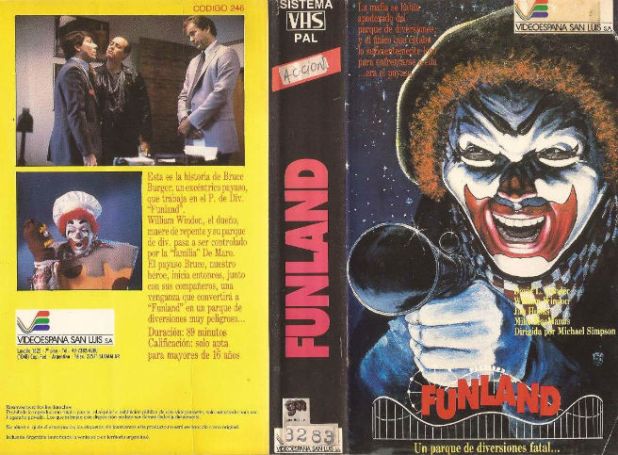
Funland (1987)

Filmed at Six Flags Over Georgia in Austell, Georgia, this is the kind of movie that I can’t really figure out. Who is it for? What is it really all about? Is it a slasher, which it seems like from that poster? Is it a comedy? Is it even funny? It’s a complete mess. But yet, I’ve watched it more than once.

It was written by Bonnie and Terry Turner, who would write for Saturday Night Live for six years before creating 3rd Rock from the Sun and That ’70s Show, as well as the scripts for Coneheads, the two Wayne’s World movies, Tommy Boy and The Brady Bunch Movie. We can forgive them for the Whoopi show, That ’80s Show and this movie, right?

For this, they were joined by Michael A. Simpson. Who? Oh, you know, the guy who made the two Sleepaway Camp sequels, Sleepaway Camp II: Unhappy Campers and Sleepaway Camp 3: Teenage Wasteland.

I mean, this is the kind of movie where the line, “I’m a graduate of State University. I also attended the David Lee Roth University where I studied rear projection,” is the highlight. So just know what you’re getting into.

So what is Funland? Well, it’s a theme park owned by Angus Perry (William Windom, Dr. Seth Hazlitt on Murder, She Wrote) that used to be owned by its clown mascot Bruce Burger, who is really former accountant Niel Stickney (David Lander, Squiggy from Laverne and Shirley). And now that the mob has rubbed out Angus and taken over, Niel has gone completely out to lunch, seeing hallucinations of his dead boss and trying to kill the new owners.

There are a lot of comedy names in this, like Bruce Mahler, Robert Sacchi (yes, the Bogart cop from one of the strangest giallo you’ll see, The French Sex Murders), Clark Brandon from Fast Food and Mr. Merlin, Michael McManus (who, like Mahler, did time in a Police Academy film), Mary Beth McDonough (one of the Waltons) and a very young Jan Hooks, who had worked with the Turners in Atlanta comedy (and got them on to SNL).

If you’re looking for a movie where a demented clown slashes his way through a theme park, well, this is not it. But it’s…something.

You can watch this on Tubi.

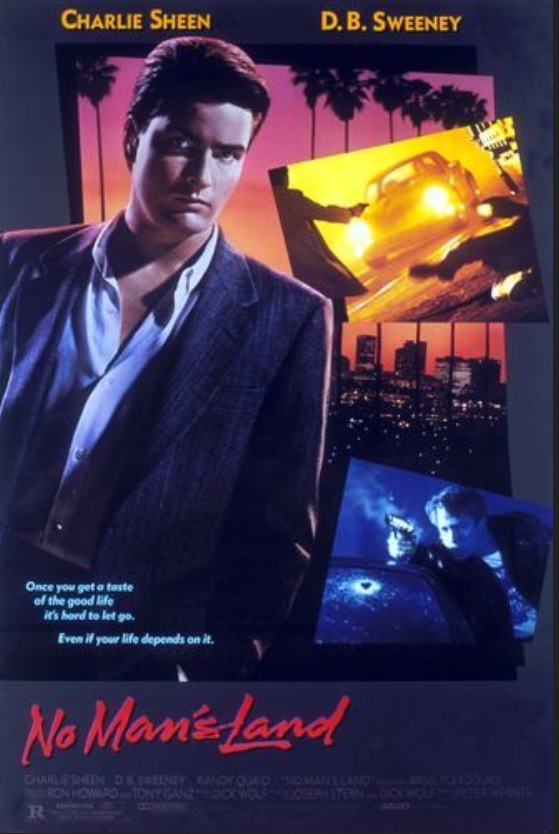
No Man’s Land (1987)

<In a deep “movie trailer” announcer’s voice>: Starring D.B Sweeney as Paul Walker and Charlie Sheen as Vin Diesel in an explosive tale about a cop infiltrating a street-racing car theft ring . . . in No Man’s Land . . . a tale about a rookie patrolman (that “doesn’t act like a cop”) assigned to an undercover job that utilizes his car skills. Also starring Randy Quaid as Ted Levine and Lara Harris as Jordana Brewster. Playing now on HBO and Showtime. Also available at your local mom n’ pop video store.

The Porsche chase!

The best we got for a freebie online stream is a 12-part upload on You Tube, as it was pulled from TubiTV — and it is no longer offered as a free-with-ads stream on Vudu, either. The good news is that MGM has made this readily available as a DVD and VOD across multiple platforms. As they should: this is a classic. Seriously, this is an enjoyable Sheen-starrer from his Wall Street heydays. Watch it and enjoy its King of the Mountain (1981; yep, also reviewed this week week, look for it) vibes.

About the Author: You can learn more about the writings of R.D Francis on Facebook. He also writes for B&S About Movies.
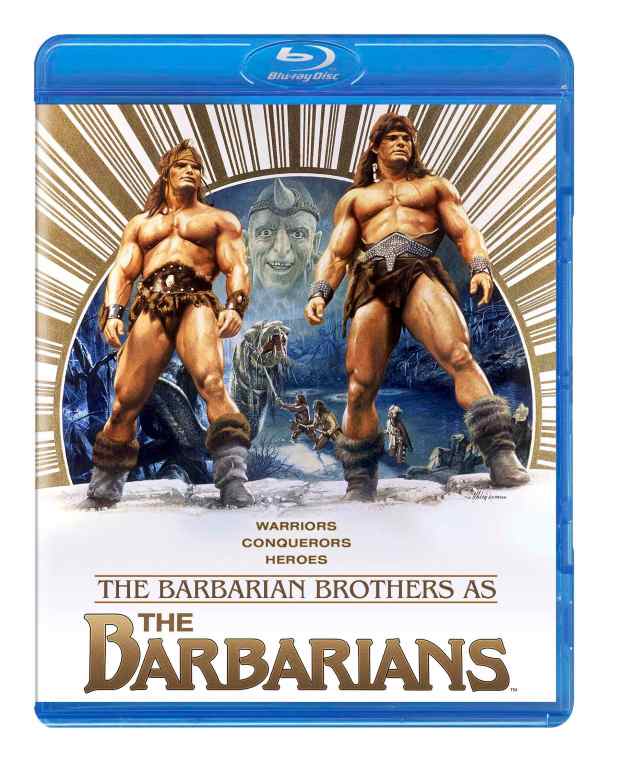
The Barbarians (1987)

EDITOR’S NOTE: We originally wrote about this movie on January 30, 2019. However, with a new blu ray coming from Kino Lorber, we felt it’d be a good idea to bring this movie back to our readers’ attention.

Ruggero Deodato has been celebrated on this site, not just for Cannibal Holocaust, but for movies like Live Like a Cop, Die Like a ManConcorde Affaire ’79House On the End of the ParkRaiders of AtlantisCut and RunBody CountThe Washing Machine and Dial Help. From those movies, you can tell that Deodato has hit nearly every genre. Now, with this one, he returns to his peblum roots — Hercules, Prisoner of Evil was the first movie he directed — and enters the post-Arnold Italian barbarian boom with not one but two American swordsmen who look like living and breathing He-Man toys, David and Peter Paul, better known as The Barbarian Brothers.

I honestly can’t be impartial about this movie, as it’s packed with so much that I love. I mean, just from the voiced over credits, when the names Golan, Globus and Deodato come up, I can’t help but cheer. This is the kind of feel good junk food movie that I love, a film that completely rips off Conan the Barbarian in all the best of ways — times two.

Instead of reciting the script over again — the old review does a decent enough job of that — let me extol the reasons why I love this movie so much.

It’s got an amazing cast. And the Barbarian Brothers. Perhaps realizing that the Brothers may look like a 1983 first wave Masters of the Universe figure but have the acting skills of, well, a 1983 first wave Masters of the Universe figure, Deodato wisely fills the film with all manner of amazing people. There’s Michael Berryman as the Dirtmaster, the henchman tasked with running The Pit, or the place where slaves do manual labor. George Eastman shows up for a few seconds to arm wrestle in a cantina scene. Eva LaRue — who somehow is both of the third installments of RoboCop and Ghoulies — as the long-lost adopted sister of the brothers. And perhaps, most importantly, Richard Lynch, who as always turns in a game performance despite the absolute silliness of the proceedings. I mean, the dude has hair extensions and fake fingers after the young brothers bite his fingers off.

It’s got the Barbarian Brothers. For two guys who look like they should be serious warriors — or barbarians, if the title has anything to say about it — they spend much of the movie making fun of one another. They seem to screw up everything they touch and mostly only escape from situations by being bulls in a proverbial China shop. You have to love that despite the movie being set in what seems to be the distant past — unless Deodato is pulling a Yor Hunter from the Future fakeout on us — they speak as if it were 1987, calling one another bonehead repeatedly.

It’s got a great score. Pino Donaggio has written music for everything from Don’t Look Now and Tourist Trap to Dressed to KillThe Howling and Body Double (and yes, Giallo In Venice and Gor II), so you know that when you hear his music, it’s going to elevate anything it plays behind.

It’s got fun effects and sets. One of the craziest thing about the new blu ray of this is that it’s so crystal clear that you can see the strings moving a dragon’s mouth up and down, which is rather disconcerting. That said, the swamp set — where most of the film takes place — looks awesome otherwise. This is also a movie with magical belly button jewelry, which is a sentence I’ve never written before.

It’s got Mad Max wrapped up in its sword and sorcery. Despite — again — being set in the past, most of Kadar’s warriors look like they should be in the employ of Immorten Joe. Also, Kutchek and Gore — our heroes — live with a band of traveling circus performers who use their skills to throw knives and blow fire at their attackers. It’s like the hard-driving armanda of — again! — Immorten Joe, but only 28 years earlier.

If you ever want to sit down and have me talk over a movie and extol its virtues — of which many would say there are none — then let it be this movie. I even have the great new blu ray from Kino Lorber, so it looks fabulous!

You can get a copy of your own right here. This has my highest recommendation.

Mill Creek Sci-Fi Invasion: ROTOR (1987)

A little Terminator, some Judge Dredd, some RoboCop throw them all together and you get ROTOR, which really means Robotic Officer of the Tactical Operations Research/Reserve Unit. Far from defunind the police, this future cop is the dream of Captain J.B. Coldyron, a scientist who runs the police robotics lab. He also manages a ranch, because, well, I have no idea how he can afford that on a police scientist salary, but here we are in the said future.

Anyways, Earl G. Buglar, Coldyron’s commander in the police department, has been stealing money for the ROTOR project and now has to have something to show to corrupt senator Donald D. Douglas — who sounds like a Stan Lee character name — before election time. Seeing as how all J.B. has to show for himself is a goofball prototype and a ripoff of Johnny 5*.

That’s when ROTOR gets activated and goes on the loose, killing off fiancees and stalking their women. J.B. finds the woman who made the chassis of this killing machine and together, they try to stop him. You know what his weakness is? Loud noises. So how does he fire his gun or use his car’s siren?

This movie pretty much has a Mad Max ripoff poster going for it and not much else. Seriously, even for someone like me that can smile through the worst Italian cinema has to offer can find little joy within this movie, especially when one of the robotic advancements is a TOMY toy made five years before this movie.

*That robot is named Willard and was played by APD2, a robot purchased in 1986 by the police department of Addision, Texas. Other than the IMDB notice that APD2 led the Christmas parade that year, there’s no mention anywhere of him on the web, a curious thing when you think that a police department had an actual robot in its employ and no one talks about it. Also, Texas is the first state to use a bomb carrying robot to kill a criminal. On July 8, 2016, that robot ended a standoff with a heavily armed suspect following the shooting of several Dallas police officers at a protest march.

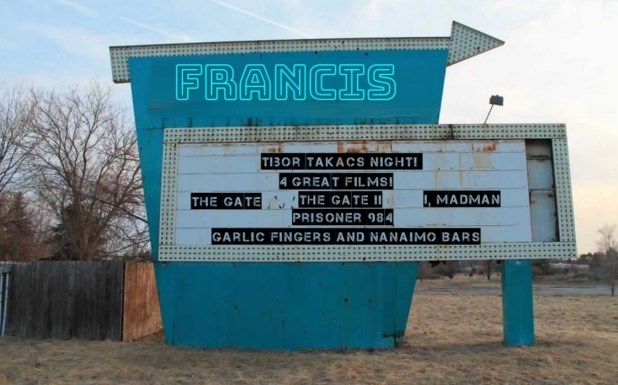
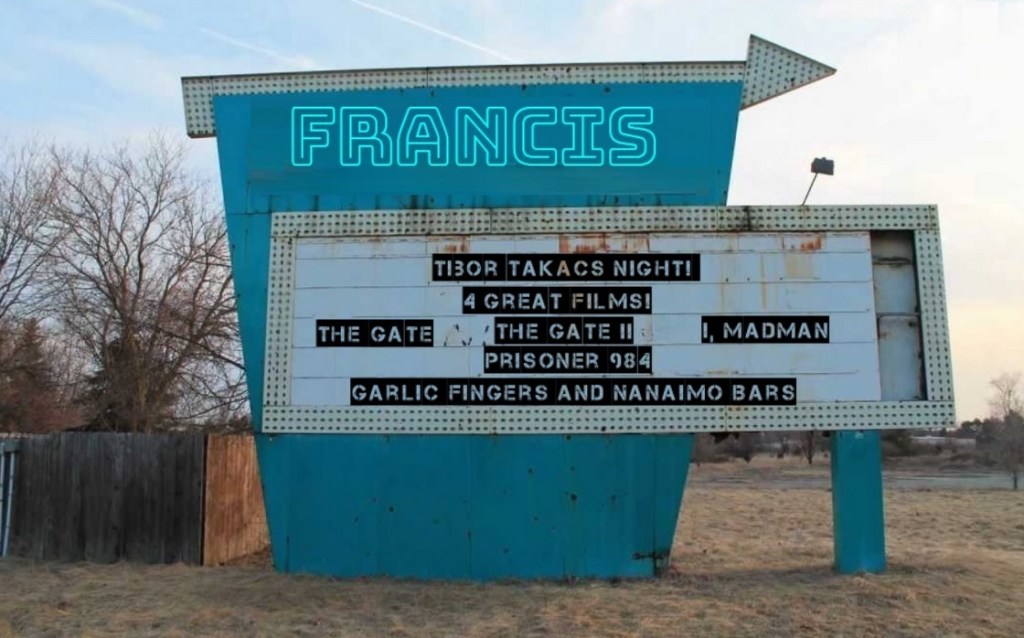
Drive-In Friday: Tibor Takács Night

Primarily known as a talent manager, studio producer and engineer, Hungarian born director Tibor Takács worked behind the boards for the Canadian bands the Viletones and the Cardboard Brains before he became a director. His first feature film project was the self-produced Metal Messiah (1978), a long-form rock opera/video which starred two bands from his stable: Kickback and the Cardboard Brains.

Best known for the internationally-distributed “No False Metal” classic, The Gate (1987), he made his feature film debut with the 1978-shot-and-1982 released CBC-TV movie 984: Prisoner of the Future, which has long since fallen into the public domain and is easily found on a wide variety of bargin-basement sci-fi DVD sets. After the cult VHS and cable status of The Gate, he was poised to direct A Nightmare on Elm Street 4: The Dream Master, but passed on the project . . . and he gave us The Gate 2: The Trespassers and the pilot movie for the original Sabrina the Teenage Witch.

These days, he’s churning out the mockbuster hoards of Ice Spiders, Mega Snake, and Destruction: Los Angeles, as well as other films concerning all manner of meteors, tornadoes, mosquitoes, black holes, and rats for the SyFy Channel . . . and he got into the Hallmark Christmas movie business alongside our equally beloved Fred Olen Ray and David DeCoteau.

Oh, and Hallmark romance flicks.

Did Sam and I watch The Secret Ingredient for its February 2020 premiere — making our significant others cringe in the process — as we chomped on our popcorn and gulped our A&W Root Beers with glee? Damn right, we did. And you know how B&S About Movies is about our Christmas movies . . . so yes, we did binge the Takacs X-Mas oeuvre of Once Upon A Christmas (2000), Twice Upon a Christmas (2001), Rocky Mountain Christmas (2017), It’s Christmas, Eve (2018), Memories of Christmas (2018), and A Christmas Miracle (2019). And when Tibor finishes off his currently-in-production Lifetime damsel-in-distress thriller Roadkill — his 48th directing effort — we’ll watch that one, as well.

But what we really want to know: Tibor, when in the hell are you and Eric Roberts going to do a movie together? It’s de rigueur for guys like you, Olen Ray, and DeCoteau. Make it happen, Tibor! Remember when you wrote and directed Redline, aka Deathline, that bionic-man-out-for-revenge actioner back in 1997 with Rutger Hauer and Mark Dacascos? Or Bad Blood, aka Viper, from 1994 with Lorenzo Lamas as a bad-ass trucker taking down the mob? Something like those flicks . . . just cut Eric Roberts loose to kick mercenary and mobster ass as an “aging action hero” thespin’ his little heart out . . . as a rogue C.I.A black-ops agent, like Mack Dacascos in 1998’s Sanctuary. Make it happen, buddy!

Movie 1: The Gate (1987)

Come on, you know this movie, ye wee metal pup.

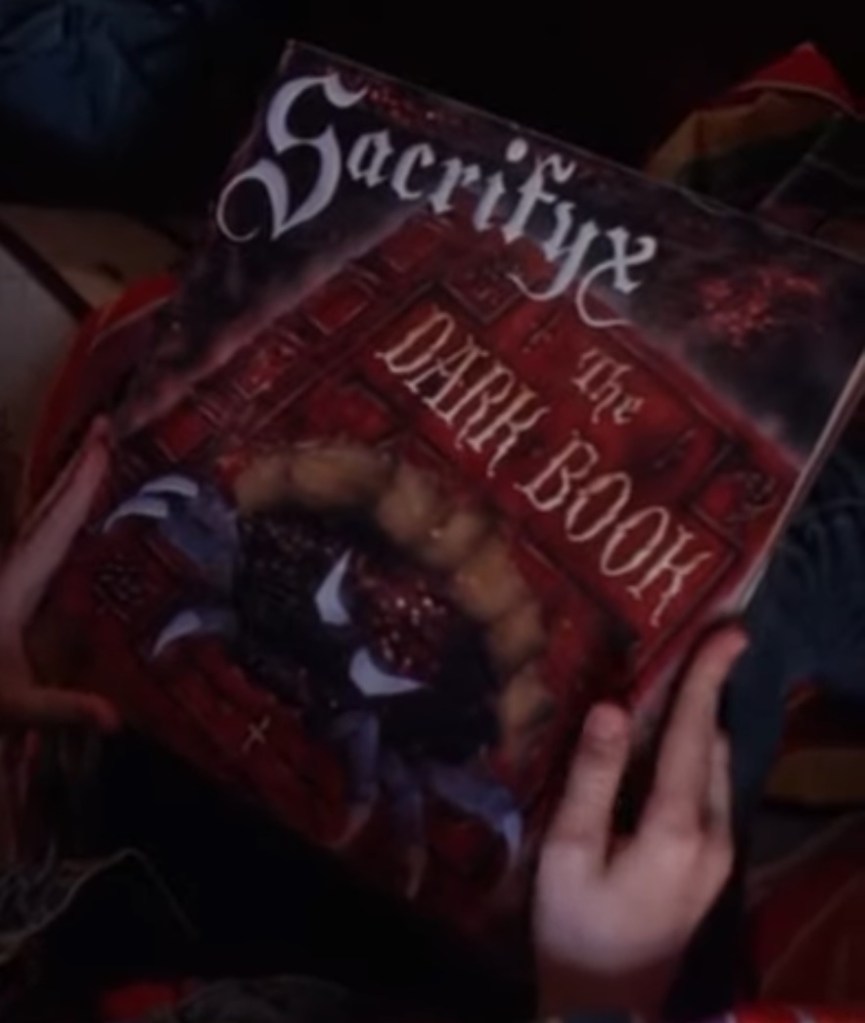
This is — non-CGI, mind you — a tale of an album known as The Dark Book by Sacrifyx — a band who died in a horrific accident after its recording — that serves as “the key” to opening a gate to hell . . . that just so happened to be under the roots of a lightning-stuck tree in the backyard of future Blu Cigs spokesman Stephen Dorff (he was 12 at the time).

How loved is this movie? You can buy Sacrifyx “The Dark Book” T-shirts on esty. Fans have compiled “Top 10” lists about the film. Sacrifyx is noted as one of the best “fake bands” on film. And . . .

There’s a (baffling, but awesome) Sacrifyx website, and . . .

An equally eerie album by a band called Sacrifyx listed on Discogs that recorded an album at Dunwich Analog Studios in Detroit, Michigan, in 1983 — with a song “The Gate.” But wait, the movie didn’t come out until 1987? Shivers. And guess what . . . the album is real. It’s on You Tube.

Which Old God is F’in with us, here? Love this movie, ye must!

Movie 2: The Gate II: Trespassers (1990)

Dude . . . imagine a Tibor-made Freddy Krueger movie? How awesome could that have been? Instead, we got a sequel to The Gate — both written by Michael Nankin, who made his debut with the David Naughton-starring (yes, the Dr. Pepper “Making It” Meatballs werewolf in London guy), Animal House-rip Midnight Madness in 1980.

The upside to this movie: Terry shoots and scores! He bags a babe. So, you see, it pays to worship Satan and dabble in the black arts. Do it! Chant Natas three times and the babes will come crawlin’ out the ground for ya!

Is The Gate II as good as the original? Nope. But it’s a lot of fun with great non-CGI effects, once again, from Randall William Cook, who also handles the SFX for the next feature on this evening’s program.

Intermission! Spin the dark circle, if you dare . . .

Back to the Show!

Movie 3: I, Madman (1989)

Long before meta-fiction became shot-on-iPhone de rigueur for the digital auteur crowd (For Jennifer), Julio Cortázar wrote a short story — La Continuidad de Los Parques (The Continuity of the Parks) — a tale that is three stories; each aware of one another in a universe where fiction collides with meta-fiction.

The much-missed Jenny Wright of Near Dark fame (I recall reading her interview in Shock Cinema Issues #45 that went into detail about the abuses she suffered and caused her exit from the business) is Virginia, a bookish girl obsessed with writer Malcolm Brand’s I, Madman. In the pages of that tale, the deformed Dr. Kessler attempts to win over an actress by killing people and adding their faces to his own. And she comes face to face, literally, with Dr. Kessler as he’s entered the real world.

Should this follow up to The Gate be as revered and remembered as The Gate. Yes. Is it? No. Love this movie, you must. It’s awesomeness and a bag ‘o garlic fingers.

P.S. You need more “film within a film” tomfoolery? Check out Anguish (1987).

Movie 4: 984: Prisoner of the Future (1982)

Tibor’s first commercial film project was this failed Canadian TV series pilot programmer in 1978. Courtesy of the Star Wars-infused sci-fi market, it was shook loose from the analog dustbins onto home video shelves in 1982.

Also circulating on DVD bargain comps as The Tomorrow Man, it’s a surreal psychological drama concerned with the imprisonment of an intelligence agent in an Orwellian future. Don’t let the Dr. Who-esque TV production designs deter you from watching this well-written and acted sci-fi’er — a commendable start to the awesome career of Tibor Takács. We found a trailer upload on You Tube.

About the Author: You can learn more about the writings of R.D Francis on Facebook. He also writes for B&S About Movies and publishes on Medium.

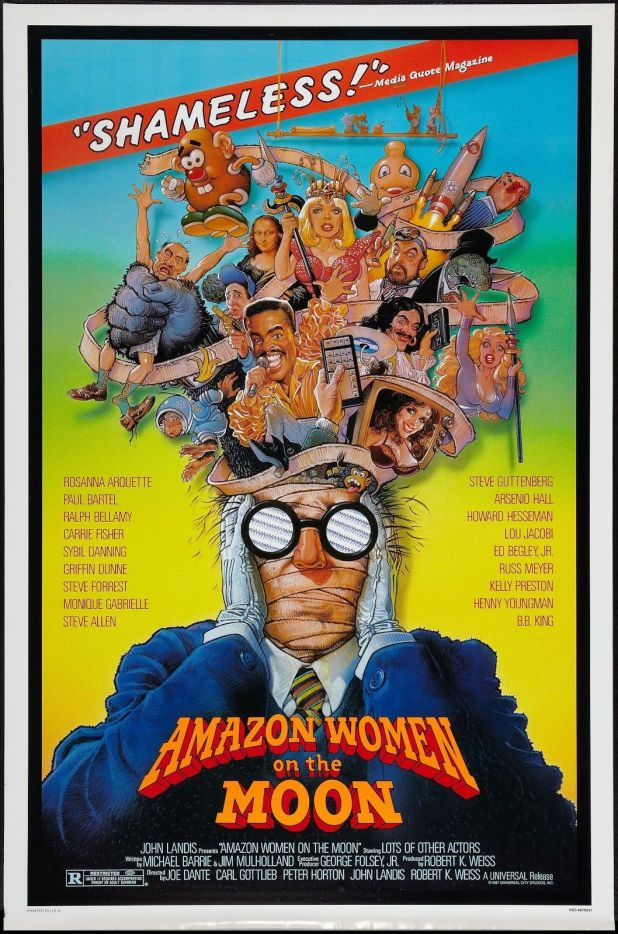
ANOTHER TAKE ON: Amazon Women on the Moon (1987)

We covered this movie on February 23, 2019, but to be perfectly honest, I could watch this movie every single day. Directed by five different people — Joe Dante, Carl Gottlieb, Peter Horton, John Landis and Robert K. Weiss — and starring tons of folks that I love, it’s the most perfect of all cinematic junk food.

Rather than give you a breakdown of everything that airs on WIDB-TV (channel 8) during its broadcasting day, I’ll just touch on the fact that this movie unites so many of my favorite people in one place.

There’s Russ Meyer as, well, Russ Meyer the video store owner, because what other place would have giant movie posters all over it for Supervixens? An assortment of comedians enacting a roast in the place of a funeral, with Charlie Callas, Rip Tayor, Jackie Vernon, Slappy White, Henny Youngman and Steve Allen being upstaged by Joe Dante favorite Belinda Balaski, who goes from sadness to anger to comedic force in one incredible performance. Ed Begley, Jr. as the Invisible Man. William “Blackula” Marshall as the leader of the Video Pirates. Henry Silva appearing in Unsolved Mysteries years before that show was a thing (it debuted in 1987, most of this film was shot in 1985). David Alan Grier as Don “No Soul” Simmons, something that never fails to make me smile. Andrew “Dice” Clay before anyone knew who he was, shooting Ken Wahl’s wife and getting Jimmy Olsen in trouble. And oh yeah — the main segment has Steve Forrest (the star of S.W.A.T. and Mommie Dearest‘s Greg Savitt), John Travolta’s older brother Joey, Lana Clarkson (Barbarian Queen and, sadly, a future Phil Spector victim), Sybil Danning and Forrest J. Ackerman as the President of the United States in a movie that should star Zsa Zsa Gabor. Stick around after the credits or you’ll miss a picture-perfect Kroger Babb riff starring Carrie Fisher and one of my favorite movie people to ever exist, Paul Bartel. Oh! I almost forgot Monique Gabrielle as Taryn Steele!

I have no idea who this movie was for other than for me. It’s a movie that speaks the language of the movie geek long before the internet existed and was doomed to bomb (or play HBO forever and find worshippers).

I’m so happy to have the new Kino Lorber blu ray of this. Beyond featuring a documentary with interviews with nearly everyone involved, it also has the deleted segments Peter Pan Theater, The Unknown Soldier and The French Ventriloquist’s Dummy. Plus, there are outtakes of every single routine from the roast of Harvey Pitnik and audio commentary from Kat Ellinger and Mike McPadden.

You can get the new blu ray from Kino Lorber, who were nice enough to send us a copy. This is one of those movies that I feel that everyone should have in their collection. There is no way that I can be unbiased on this one.