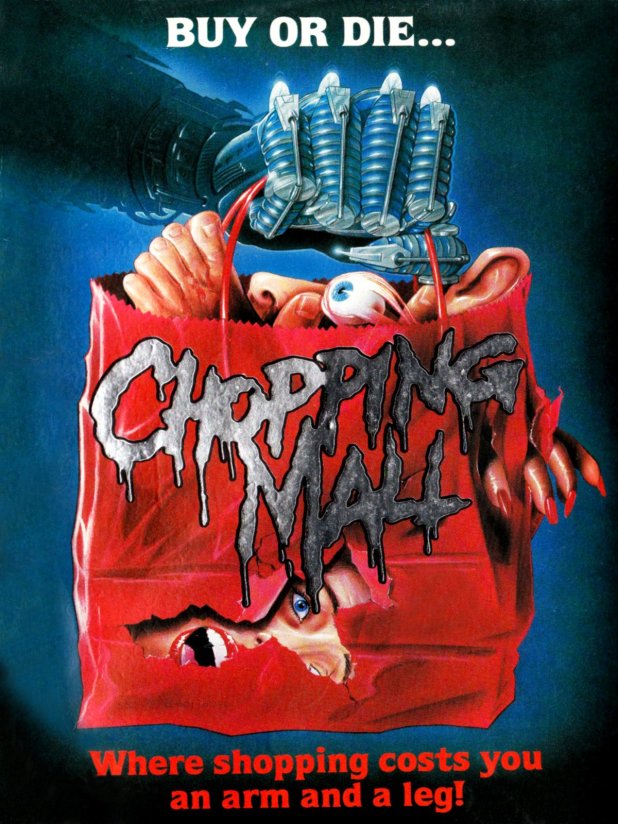
Chopping Mall (1986)

If you’re not from Pittsburgh, let me tell you about Century 3 Mall. At one point, it was the biggest, most modern mall in the area, dug into a former slag heap with 50 plus tons of concrete poured to ensure its three levels would stand. It had everything — Wicks ‘n’ Sticks, a food court, a cutlery store that sold throwing stars, a store called Heaven that had Japanese comic books and punk rock posters — even Richard Simmons showed up to precariously dangle from the third floor of the mall as everyone sweated to the oldies.
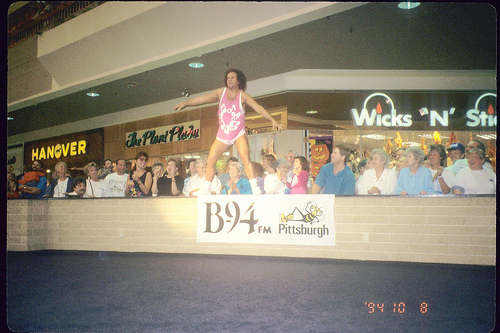
It was a magical time to be alive, but if you go to Century 3 Mall today, all that remains are 30 some odd stores from the heights that the mall had once reached —  five department stores and over 200 stores and services. It’s a sad blight today, with rainwater collecting in buckets all over the place, stained carpets and shuttered storefronts.

A sad Easter Bunny sits in what once was a bustling shopping center.

I tell you all of this to tell you that at one time, before the internet and social media, we went to the mall. My childhood mall was called Beaver Valley Mall and I remember our priest once yelling in a sermon that more kids thought BVM meant the mall than the name of our church — Purification Blessed Virgin Mary. This is also the same priest who told the story of the movie Alive once a month or so, with no meaning at the end, only discussing how they loved God, prayed and had to eat one another. This tale would always begin with, “The story is told…”

But I digress.

Chopping Mall is the second movie Jim Wynorski directed after The Lost Empire. Mentored by Roger Corman, it’s a cheap and quick little picture that still has moments of great entertainment quality. Kind of like a shopping mall.

Park Plaza Mall has had some theft issues, so they install the security team of the future: three robots programmed to take out thieves with tasers and tranquilizers. Of course, nothing could go wrong, right?

Rick (Russell Todd, Friday the 13th Part 2), Linda, Greg, Suzie (Barbara Crampton, We Are Still Here), Mike, Leslie, Ferdy and Allison (Kelli Maroney, Night of the Comet) have all stayed late after work and are partying in one of the furniture stores in the mall. These kids are super comfy with one another, because they’re basically soft swinging as they have sex on beds and couches right next to one another. Only Ferdy and Allison, the geeky kids, refuse to copulate.

Meanwhile, a lightning storm strikes the mall and reprograms the robots, which kill a technician (Gerrit Graham, Phantom of the ParadiseTerrorvision) and a janitor (Dick Miller, playing a character named Walter Paisley, a name he also used in A Bucket of BloodThe HowlingTwilight Zone: The Movie and Shake, Rattle and Rock!). Mike and Leslie are killed almost instantly, with her head blown to bits while the others all arm themselves with weapons to try and kill the robots.

Like Shakespeare, everyone dies…except for Ferdy and Allison. You’ll thrill to robots with treads rolling all over a mall, shooting lasers, beeping and booping and being like mini-RoboCops.

If the mall looks familiar, it’s because Commando and Fast Times at Ridgemont High were also shot at the Sherman Oaks Galleria. It’s even mentioned in the song Valley Girl by Moon Unit Zappa! The exteriors in the movie are the Beverly Central Shopping Centre, where Scenes from a Mall was set (and Eraserhead was shot on the industrial wasteland that existed before the mall was built).
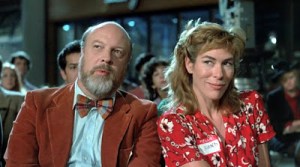
My favorite part of the entire movie is when the Blanks (Paul Bartel and Mary Woronov) show up, reprising their roles from Eating Raoul! It’s totally unexpected and such a weird left turn. It’s not like they’re well-known characters, but any time Bartel and Woronov — two of my favorites — show up in a film, I’m excited.

While this film was originally known as Killbots, that title failed at the box office and the movie was re-released months later with its new title, one suggested by a janitor!

Sadly, malls are just about dead today. You can’t even find a video store in one to buy or rent this movie. You can go to Amazon Prime to stream this movie, though.

UPDATE: You can buy this on blu ray from Vestron Video at Diabolik DVD.
MORE FUCKED UP FUTURES: Hands of Steel (1986)

Francis Turner (John Saxon, who I will opine is my favorite American actor in a foreign genre film ever) has created a cyborg who is 70% robot and 30% human, Paco Queruak (Daniel Greene from Falcon Crest). He programs him to kill a scientist with plans to cure acid rain (that was a big problem back in the 80’s that, much like killer bees, has just gone away). However, his solution runs afoul of the military/industrial complex that Turner works for. So he must die. And guess who programs him? Donald O’Brien, Doctor Butcher, M.D. himself!

However, Paco still has humanity inside and abandons his mission and sets out to discover more of his past in Arizona. There, he finds love with Linda (Janet Agren, City of the Living Dead, Eaten Alive!) in literally ten or twenty seconds of screen time. And he gets into a feud with Paul Morales (George Eastman!), a redneck trucker who don’t take too kindly to strangers around these parts.

Paul is an arm wrestler, too. It’s no coincidence that Hands of Steel was going to come out at the same time as Over the Top (which according to this article, was filming just 50 miles away).

Then it’s back to the military/industrial complex, who sends a whole bunch of killers after our hero. There are bikers, mafia guys and even a ripoff of Pris from Blade Runner that Paco beats by ripping off her head. Then Paul comes back to try and kill Paco, but our hero literally crushes his head with his cyborg grip.

Paco takes down a helicopter and stops Saxon, who has a giant gun, before cops surround the building ala the Rambo: First Blood. Thinking Linda is dead, Paco has gone crazy, but she survives and is able to talk him into surrendering.

Then, we are gifted with this closing image:

Directed by Sergio Martino (The Strange Vice of Mrs. WardhAll the Colors of the Dark2019: After the Fall of New York), this movie sadly shows little of the mastery of the form he showed in his giallo work.

Even worse, there’s a tragedy that happened during the filming, as Claudio Cassinelli (Warriors of the Year 2072, Murder Rock) was killed when the helicopter he was in crashed. The rotor blades struck the underside of the bridge and broke off, sending the helicopter into a canyon, where Cassinelli and the pilot died. It wasn’t Martino’s fault, as the National Transportation Safety Board reported that there were prescription drugs in the pilot’s hotel room that would have impaired his judgment. Because John Saxon was a stickler for Screen Actors Guild rules, he shot all of his scenes in Italy and refused to appear in any of the non-union American shot footage. He believes that the SAG saved his life, as otherwise, he would have been on that helicopter.

At least there’s a score by Claudio Simonetti of Goblin to liven things up.

Hands of Stone is a kind of movie we don’t get much of any longer — a movie that found life on the video shelves, a cyborg movie we could rent when Terminator was out of stock. If there’s one compliment I can give this film, the art that sells it is awesome. You can watch it on Amazon Prime and buy it at Diabolik DVD. There’s free copies on You Tube HERE and HERE.

How “f’d” is this movie? We reviewed two more times: As part of the Mill Creek Sci-Fi Invasion Box Set in November 2020 and as part of our Mill Creek Pure Terror Month Box Set in November 2019.

And don’t let the recycling of video box art fool you: Top Line, starring Franco Nero, and Cy-Warrior, starring Henry Silva, are two completely different movies — about renegade cyborgs, natch. Well, they’re almost not the same movie. See for yourself!

Critters (1986)

We start in an asteroid prison, where the Krites hijack a spaceship and escape to Earth. The warden hires Ug (Terrence Mann) and another shapeshifting bounty hunter to follow them.

As they study Earth transmissions, Ug takes the form of rock star Johnny Steele and the second remains blank. You will hear the song “Power of the Night” so many times in this movie that you’ll be able to sing it yourself.

Meanwhile, in Kansas, the Brown family is enjoying rural Earth life. There’s father Jay (Billy “Green” Bush, Jason Goes to Hell: The Final Friday), mother Helen ( Dee Wallace Stone, The HowlingCujoPopcorn) and their kids April and Brad. As the kids go to school, Jay waits for mechanic Charlie (Don Keith Opper, who is in all four Critters films) to show up. Once a major league prospect, he started getting messages from radios and possibly even UFOs through his fillings and went insane.

That night, the Krites ship crash lands. Thinking it’s a meteorite, Jay and Brad check it out only to catch one of the monsters eating its way through a cow. They cut all the power to the farm, take out a cop and shoot Jay with one of their tranquilizing quills.

While all this is going on, April is horizontally dancing with NYV transplant Steve (Billy Zane!) who gets eaten almost immediately. Her brother saves her with some firecrackers. Just then, the bounty hunters come to town, with one of them continually changing shape to become different townspeople.

Everything works out well, with the Krites being wiped out. The bounty hunters even leave behind a device to call them in case of a sequel as we see eggs that are about to hatch.

There’s a funny scene with a Critter plays with an E.T. doll, a film in which Dee Wallace Stone also starred. And I almost forgot — genre vet Lin Shaye (the Insidious films) shows up too!

The character design of the Critters is probably the best part of the film. The Chiodo Brothers also worked on Ernest Scared StupidTeam America: World Police, Large Marge in Pee Wee’s Big Adventure, the “mousterpieces” in Dinner for Schmucks and, of course, Killer Klowns from Outer Space.

Depending on when you grew up, Critters is either silly fluff or a treasured part of your childhood. I tend to the former while Becca is definitely on the latter choice. Director Stephen Herek also directed plenty of her other favorites like Bill & Ted’s Excellent AdventureDon’t Tell Mom the Babysitter is Dead and The Mighty Ducks.

Watch it for yourself and decide! There’s a really inexpensive compilation DVD that has all four films and it’s available to rent or buy on almost every major streaming service.

WATCH THE SERIES: Friday the 13th part 2

By 1984, Jason wasn’t going anywhere, even if every single sequel promised his final kill or the final chapter or the end of the series. As they say in pro wrestling, red means green. And Jason was bringing in plenty of both. (PS – We have an article on Jason in wrestling right here!)

Friday the 13th: The Final Chapter (1984)

Paramount — and producer Frank Mancuso, Jr. — were both aware that people were growing tired of slashers. In fact, Mancuso, Jr. began to hate the series because no one respected him for making the films, despite how much money they made. So the order was made: let’s kill Jason.

Directed by Joseph Zito, who also made the slasher classic The Prowler (a much bloodier, much more interesting move than this), an interesting attempt was made to get you to actually care about some of the characters. But not all, of course. There’s always going to be cannon fodder in these films.

The evening after the last film, Jason comes back to life and kills a coroner and a nurse before making his way back to Crystal Lake. And, de rigueur, more teenagers show up — Paul, Sara, Sam (Judie Aronson, American Ninja), Jimmy (Crispin Glover!), Doug (Peter Barton, Hell Night and TV’s The Powers of Matthew Star) and Ted. They even pass Pamela Vorhees’ tombstone along the way.

Oh yeah — then there’s Trish (Kimberly Beck, Marnie), Tommy (Corey Feldman!), their mom (Joan Freeman, Panic in the Year Zero!) and their dog Gordon. And there are the skinny dipping teens, Tina and Terri. Oh yeah — and a young drifter named Rob with a secret.

Tommy’s family are the sympathetic characters mentioned earlier, with the kid being a stand-in for the beloved Tom Savini. He shows off his collection of special FX early and often.

Of course, those teenagers all do drugs, have sex and die horribly. We’re used to those things. But the murder of Tommy’s mom has some emotion. And then we learn that Rob is the brother of Sandra from Friday the 13th Part 2 and has been obsessed with finding and killing Jason. Oh, he finds him, and dies like a complete bitch, screaming “He’s killing me!”

The close, where Trish cuts off Jason’s mask to reveal his face and Tommy has to flip out to hack Jason to death, was the stuff of legend in my pre-teen days, oft-discussed at lunches and study halls.

Tom Savini returned here for the chance to kill off Jason, but come on, everyone. We all knew what was coming next.

Friday the 13th: A New Beginning (1985)

Presenting the scummiest, vilest Friday of them all — a film packed with more kills (22!), more nudity and more drugs behind the scenes than several of the other films combined!

Years after killing off Jason, Tommy Jarvis has nightmares that the man he killed has returned. That’s why he’s in Pinehurst Halfway House, where Pam Roberts and Dr. Matt Letter (Richard Young, who gives young Indy his fedora in Indiana Jones and the Last Crusade) are trying to help him to get over his violent past and the death of his mother.

But are there a bunch of teens to get killed? Sure there are. There’s Reggie, Tommy’s roommate whose grandfather George works there as a cook. Plus, we have Robin (Juliette Cummins, Slumber Party Massacre 2), Violet (Tiffany Helm, O.C. & Stiggs, Reform School Girls), Jake, Vic (Suicide from Return of the Living Dead), Joey, Eddie and Tina (Debi Sue Voorhees, no relation). There’s also rich neighbors Ethel Hubbard and Junior, who want the halfway house closed down.

What follows is a bit of a mystery movie, at least for a bit. Is one of the kids the killer, like Vic, or has Jason come back from the dead? Even the end of the movie leaves that up in the air, to be honest. It’s kind of a mess, but along the way there’s a ton of blood and gore.

Danny Steinmann is the director here, perhaps better known for The Unseen and Savage Streets. Well, maybe not by most people, but by me? Of course. He also broke into movies by directing and writing the adult film High Rise and probably would have created more films in the Friday the 13th saga, but a bicycling accident and long recovery meant that this would be the last film that he would direct. The working title for this film was Repetition. 

So what happens after this? Well, what do you think?

Friday the 13th Part VI: Jason Lives (1986)

Directed by Tom McLoughlin, a veteran of plenty of made for TV movies and Sometimes They Come Back, as well as playing the robot S.T.A.R. in The Black Hole and Katahdin in Prophecy, this is the film where Jason became fully supernatural and it’s also one of the few films in the series to get good reviews, probably due to the amount of humor throughout.

The original plan was for Tommy Jarvis to become Jason, but audiences were pretty unhappy with that hint at the end of the last film. So this one begins with Tommy (Thom Matthews, Return of the Living Dead) heading to Jason’s grave to destroy his body so that he can never come back. But of course, as soon as he stabs the murderer with a metal fence post, lighting strikes him and he’s back from the dead — and kills Tommy’s friend Alan (Ron Palillo, Horshack from TV’s Welcome Back, Kotter) right away.

Tommy freaks out and heads to Sheriff Garris’ office and the lawman locks him up, thinking that this is all in his head. The truth is that Jason is back and he is on a rampage, killing camp counselors Darren (Tony Goldwyn, Carl from Ghost) and Lizabeth. A whole new crew of kids go looking for them and despite Tommy’s warnings, they think of Jason as only an urban legend.

This time, Jason is stopped by being chained underwater, but even at the end, his eyes are wide open and he’s obviously ready for more.

Again, this movie was a major big deal in my teenage years, particularly because it had a music video for it! “He’s Back (the Man Behind the Mask)” by Alice Cooper announced that Jason had survived the final chapter.

The working title for this installment was Aladdin Sane. I really enjoyed this installment, which even has a nod to James Bond in the beginning. In our movie hallway, we have several versions of the poster for this one. It’s nearly a comedy in parts, but still has a great plot.

Of course, Jason was ready for more. But were the kids? We’ll be back in a few hours with our next chapter!

HOUSE WEEK: House (1986)

Steve Miner has so many cinematic sins to deal with — Soul ManMy Father the HeroBig Bully (the next to last live action film Rick Moranis would appear in), Halloween H20: 20 Years Later — that you almost forget that he started his career making the second and third installments of Friday the 13th and today’s movie, House.

Roger Cobb (William Katt, Carrie) has some issues. As a Stephen King-ian popular horror writer, he feels fenced in by the horror genre. He has writer’s block. His wife has left him. His son disappeared and no one can find him. And the aunt that raised him just hung herself in the haunted house where he was raised.

Cobb intends his next book to be about what he went through in Vietnam, so he decides to move into the house. His strongest memories involve Big Ben (Richard Moll, fulfilling the contract that either he or Robert Englund appear in every 80’s horror film), a soldier who bullied him back in ‘Nam who was injured and left behind for the enemy to capture.

Everyone’s a fan of Cobb, from his new neighbor Harold (George Wendt from TV’s Cheers) to his real estate agent and the cops that investigate him. He just wants to write. But with all the monsters in his head — and real monsters in the house — that doesn’t seem like it’s going to happen.

Things get worse when his wife visits and turns into a monster, only to be killed by a shotgun blast. At this point, the film flirts with making Cobb the real monster, but it’s a narrative shift that is never followed up on. Then, as he buries his wife, his hot neighbor comes on to him. What he thinks will be a night of hot sex turns out to be him watching her young son, but that goes wrong when little monsters try to steal the kid,

Finally, Cobb falls into his medicine cabinet into an alternate dimension that predates the Upside Down of Stranger Things by several decades. He rescues his son, but not before Big Ben attacks him again. Finally, Cobb realizes that all of his fears are inside his head and he destroys the monster with a grenade before leading the house to find his son and wife, who is magically returned to life.

House was produced by Sean S. Cunningham and featured music by Henry Manfredini, who also worked on the Friday the 13th films. Fred Dekker wrote the original script, but most of the humor is credited to Ethan Wiley.

This is a good example of pre-CGI monster moviemaking. Big Ben looks great, a triumph of practical makeup, as do the creatures that populate the film. And it’s interesting that this movie explores PTSD and the dark side of war years before many were ready to face it.

The look of the film reminds me of late-period Fulci minus the gore. I’m referring to the film stock itself, which doesn’t have much richness, looking more like a TV movie than a theatrical film.

House isn’t a movie that demands that you watch it, but if you’re looking for something in the middle of the night, it always provides a fun distraction. You can’t dislike a film that has a large fish on the wall come to life and try to kill someone. You can watch it on Shudder or grab the original movie from Arrow at Diabolik DVD or the box set of this movie and the sequel.

AMERICAN GIALLO: Manhunter (1986)

Silence of the Lambs is a great movie. But you’re reading my words right now, so I want you to know that Manhunter is a way better movie. In fact, it’s nearly a perfect film, one whose perfect union of light, color, tone and sound nearly moves me to tears.

Dino De Laurentiis was involved in this, changing the title from Red Dragon, and being his usual hamfisted self, but Michael Mann was coming in hot from TV’s Miami Vice (he’d previously directed Thief and The Keep before that show caught fire).

William Petersen (who would go on to star in CSI) is phenomenal as Will Graham, a former FBI profiler who has to come out of retirement to help solve a murder. Working on his character with the Chicago and FBI Violent Crimes Units, he learned that profilers often had to compartmentalize their personal lives, because it was near impossible to turn off the things they’d seen. In fact, at the conclusion of the film, Petersen found it near impossible to shake the character.

Tom Noonan (Frankenstein’s Monster in The Monster Squad) researched serial killers, but found himself sickened by what he learned. Instead, he tried to become a man who saw that he was doing good for his victims instead of harming them. He was doing it out of love. Improvising during his audition, he noticed that he was frightening one of the casting agents, so he pushed hard to frighten her even more. He claims that this is what secured the role for him. 

But the real star of the show is Michael Mann’s eye and his work with director of photography Dante Spinotti. There are color tints throughout the film, ala Bava, with cool blue representing love and green with purple and magenta to denote the violent moments. Petersen has said that Mann wanted a visual aura for the film, so the story could work on an emotional level.

Even the framing of the shots — watch how close Petersen is with other characters in the film, particularly how Dennis Farina (whose acting career began in Mann’s Thief) nearly collapses before coming near him at the end of the film, where once they could sit side by side.

Let’s get into the story: Will Graham (Petersen) is a retired FBI profiler who had a mental breakdown after being attacked by the serial killer Dr. Hannibal Lecktor (yes, that’s the correct spelling and Brian Cox (Zodiac) is commanding in this role). His old boss Jack Crawford (Farina) needs him to come back and enter the mind of the Tooth Fairy (Noonan), a killer who preys on families. Graham and Crawford both promise his family — Molly (Kim Greist, C.H.U.D.) and Kevin — that he will only look at the evidence and not get involved.

What follows is a cat and mouse game of trying to find the Tooth Fairy while Graham must return to confront the man who nearly cost him his life and sanity, Dr. Lecktor. Everything the police try backfires, including using a tabloid journalist to draw out the killer, which puts Graham’s family in direct danger when Lecktor gives the killer their home address.

There’s a great scene here where Graham and his son shop. In what would be a throw away scene in any other film, the true humanity of Mann’s work, in contrast to his meticulous editing and color theory, shine through. You can tell that Kevin has been forced to grow up and become the man of the house while his father was destroyed by Lecktor. And now, his father has to prove that he can protect his family again.

Meanwhile, the Tooth Fairy has found love with Reba (Joan Allen, Room), a blind co-worker. She cannot see his hairlip. She isn’t aware that he’s watching his victims while they enjoy a romantic dinner. His love for her and her acceptance has suppressed his bloodlust. Yet just as Graham’s profile discovers just how important that acceptance is, he sees her go home with another employee. It’s simply a ride home, but the killer goes wild, killing the man and abducting Reba. She calls him by his name and he replies, “Frances is gone. Forever.”

What follows is my favorite scene in the film, where we visually see how Graham’s mind works, as he figures out the connection between the murders where families were killed and their eyes replaced with mirrors. He figures out that all of the films came from the same lab. As he looks out the window, sure that he is right and ready to be confirmed, even when the lab says they have different labels, he confidently looks out the window and asks them to peel the label back. His hand against the window, the moon bright, he is proved correct and the chase is on.

As they determine the Tooth Fairy’s identity on the plane, leaving police cars barely enough time to meet them as they land, you know that Graham will not wait for backup. He is back, in his element, no longer a beaten man. As they make their way to the Kansas City riverfront (a bravura scene with a house that was made just for the film), Graham and Crawford race through the woods as the Tooth Fairy begins shotgunning cops.

During the final encounter, Mann shot multiple speeds, so that cameras were recording the same scene at 24, 36, 72 and 90 frames per second. This gives the shootout a feel that Spinotti said was off tempo and staccato. I found it disconcerting, the violence, not Hollywood glamour but messy real life.

Even more intriguing is that the climax was shot after principal photography and when the union crew had run out of hours. There wasn’t even an effects crew on hand,  so the skeleton crew that remained blew ketchup across the set through hoses to simulate blood spray. 

The home of the Tooth Fairy is an otherworldly place, blasting Iron Butterfly’s “In-A-Gadda-Da-Via,” lunar landscapes blocking rooms, before Graham busts through the window, breaking the Tooth Fairy’s carefully created world. Despite this act of heroism, the killer simply drops him to the floor and continues killing cops. yet Graham rises and defeats the man and confronts his victim. When he asks him who he is, he replies, “Graham. Will Graham.” He has left the other demons in his mind behind. He is himself again, ready to leave this world behind and return to his family.

So how is this film a giallo? Simple. Where it has no connection to the fashion and female protagonist that are hallmarks of the genre, the color choices, driven hero and psychosexual motives of the killer are pure giallo. So is the devotion to symmetry in the shots, echoing the work of Argento. However, this is a film stripped of the camp that is at the heart of so much giallo. Yet there it is, inside the DNA of this film.

FULCI WEEK: The Devil’s Honey (1986)

Also known as Dangerous Obsession, this movie was intended to be Lucio Fulci’s comeback after more than a year of dealing with hepatitis. It’s a return to the giallo (or at least sexually related drama) that he was creating in the early 70’s instead of the gore that he’d become infamous for throughout the 80’s, but when you’re dealing with Fulci, you know you’re going to get something certifiably insane and also something that doesn’t fit into any set category.

The film opens on Johnny playing that tender, tender saxophone that the ladies love so much. And no one loves it more than Jessica, his woman, who runs into the booth to lick the spit off his lips rather than let him wipe it himself. Johnny responds by fondling her in front of the engineers and his band, who are all like, “Brah, you gotta get outta here with that noise.” Instead, Johnny kicks everyone out and he takes her right in the middle of the studio, against her protests, telling her that he is her master and that everything he loves is in her. She argues that he doesn’t want her, only a piece of her, and Johnny responds by playing sax music directly into her woman parts. Honestly, I don’t even know if this is physically possible, but it’s one of the funniest scenes I’ve ever seen in a movie. It’s like Fulci was upset he couldn’t just cut out someone’s eyeball, so he decided to do the most ridiculous sex scene possible.

You know how you get jaded and say, “I’ve seen everything?” Well, I’m here to tell you that you haven’t until you watch The Devil’s Honey.

Unbeknownst to our lovers, everyone was in the booth watching. They blame Jessica for distracting Johnny, so she leaves for the bar.

We cut to a Dr. Wendell Simpson (Brett Halsey, Return of the FlyDemonia) being stripped of his scrubs after a successful surgery. He calls to tell Carol (Corinne Clery, who of course is Kala from Yor, Hunter from the Future), his wife, that he will be late. And why is he late? Because he’s visiting Anna, a prostitute, a fact that his wife knows only too well. He’s obsessed with work and finds it hard to concentrate on anything. Well, that is until she tries to fix a run in her stockings with red nail polish — something no human being has ever done before in the history of human civilization. The doctor responds by rubbing that red nail polish all over her face before taking her violently and quickly, then he pays her to leave, as she calls him a fucking monster.

Honestly, Fulci stages a sex scene like he stages a spider eating off someone’s face.

Carol catches the doctor leaving the prostitute’s apartment, just as we move back to Johnny and Jessica on a rollercoaster. They’re fighting, because there’s a thin line between love and hate. They lick faces as the coaster goes up and down the hills, which is intercut with Caol lying in bed, unfulfilled as the doctor sleeps.

Just when you think Fulci is going to back off on the insanity, we have Johnny and Jessica on a motorcycle, where he forces her to fondle him while he races the bike faster and faster until they nearly hit a car.

Ladies — if you’re into dudes wearing Cosby sweaters, tight jeans and brown leather, Johnny is the man for you.

They head back to their house, where they make love while Dickie from The Beyond barks outside their door. Afterward, Jessica sits outside, angry. Seriously, her mood swings seem like a red flag, but I’m 45 and not a famous saxophone player. I can see these things a little better.

She’s upset that Johnny treats her like a piece of meat. He starts stalking her with his bike while she screams at him to go away. He falls and smacks his head on a rock, but seems OK. The engineer tells him that they need to finish and he keeps playing until he collapses. Jessica goes nuts, pounding the glass, and this is just after she confessed to the engineer that she is pregnant and he tells her to get an abortion.

If you think this is gonna bring Jessica and Dr. Simpson together, well, you’re right.

The call comes in to Dr. Simpson to save Johnny, but Carol starts arguing with him. She tells him that he only performs for strangers and that she isn’t one of his whores. He points her to a cab stand and tells her to fuck off as she yells that she is filing for a divorce.

As the surgery starts, the doctor is distracted by what his wife told him, as all he can hear is her voice as the operation gets rougher and rougher. Johnny dies, a fact that Jessica instantly feels. She chases the doctor from the hospital, screaming that he is the killer of her boyfriend.

Jessica is obsessed, watching old videos of Johnny, staring at his photos, hearing his jazz theme over and over in her head.

That said — Johnny is a creep even in these videos, violently forcing her to make love, which makes her cry all over again. Instead of realizing that she is probably better off, she holds his sweater and cries.

Dr. Simpson and Carol make a date for old time’s sake, but he keeps getting threatening notes and calls. And despite all the things that Simpson has done wrong, if he just takes Carol to bed and satisfies her, she’ll take him back. She tells him that she’s no different than his whores and that she demands to be treated like one of them. They begin making out when the phone begins to ring and ring and, well, ring. He can’t forsake his duty for his wife, so she leaves him for good. As he answers the phone, he hears Jessica’s voice, asking “Why did you let him die?”

Meanwhile, Jessica is going even crazier, wearing Johnny’s sweaters and watching his videos over and over again before walking in the rain all night long.

The next day, she pulls a gun on the doctor and kidnaps him, taking him back to her house. She chloroforms him — a practice that exists only in professional wrestling and movies — and ties him up inches away from Dickie (I know it’s not the same dog, but I’d like to believe that Fulci has some kind of shared universe going on here). Jessica? Oh, she’s outside smashing his car with an axe. She hums a song, then announces that she is going to kill him, but not until she’s ready, at which point Dr. Simpson pisses his pants.

Jessica has a flashback — the first of many — of how Johnny treated her, as he gives her a baby doll at the beach and how he never wanted a child.

That pregnancy is causing Jessica nothing but pain, but she tells him that women are stronger than men and that she’ll be around long after the doctor is dead. She strikes him in the face, covering his face with blood, blood that she rubs all over her stomach, forcing him to lick it off while some rocking Italian synth plays.

She then drags him to the ocean, trying to drown him. She screams that Johnny had courage while the doctor has none. At gunpoint, she pushes him face first into the beach, but at the moment where it seems like he’ll die, she has second thoughts. She gives him mouth to mouth, which turns into her licking his face, the same way she did Johnny. But then she says, “I hate you. And I’m going to kill you.”

Speaking of Johnny, those flashbacks keep coming, as does the pain of her pregnancy. We see Johnny shooting a Richard Kern type video with a gun. As Jessica remembers, she debates killing herself, but stops.

The doctor tells her that she is, “An amazing girl.” She tells him that that won’t stop her from killing him. “But you’re still beautiful,” he answers before being forced to eat dog food.

As he is humiliated, Simpson recites a poem to her: “”When you have spent your life like a fortune that never seemed to end, a second chance will come like a long lost friend. Great joy will fill you and flush you hot. No more will you ever be cool, for she is the devil’s honey pot. And you’ll drown in her, you fool.” He claims that he never understood it until now. She finally shows him mercy by covering his naked, tied up body with a blanket as he kisses her knees, then slowly works up her body. That said — she is still cold and filled with hatred.

So, of course, she dumps a candle on him. “My name is fear. You can call me Jessica,” she says, as she reminds us all that we’re watching a Lucio Fulci movie. I’m surprised that she didn’t rip out his eyeball and throw it at the camera.

The dog dies — why, who knows — and Jennifer buries him with Johnny’s sweater. She buries the dog at the beach while remembering more and more how cruel Johnny was to her, how he only wanted her to be obedient and how he would grow more upset the more she loved him.

Awhile ago, Johnny bought Jessica a mystical bracelet that would keep love alive no matter what, unless thrown away. That bracelet is sold by Lucio Fulci, so I’d beware whatever that crazy old man in a hat has to sell — chances are it will make you puke your intestines out.

Jessica has one final memory — a romantic night at the movies turned into a nightmare when Johnny and his bandmate, Nicky, into made love to her at the same time, against her will. Jessica throws the bracelet into the sea, freeing herself.

She unties the doctor and puts the gun to her head again. The doctor saves her by coming to her bed and making love to her. He recites the poem to her one more time and the film ends.

Much like any Fulci movie, this isn’t going to be what you expect. It’s sexy at times, but never enough that it’s a movie you can enjoy for those aspects. It’s too rough, too crazy, too emotional, too dark to be seen that way. It’s about loss and finding someone, even when that makes no sense at all. It’s about power and why it means nothing. And it’s about a mystical bracelet, I guess.

There’s a great uncut version finally available of this film from Severin, with multiple covers and plenty of extras. Watch it and decide for yourself, but beware the devil’s honey pot.

Never Too Young to Die (1986)

I grew up on James Bond. More than that, at a young age, I was obsessed with Bond. One magical Christmas, the only gifts I got were the James Bond role playing game from Victory Games and all of the expansions. I saw every single one one of the movies, even the original Casino Royale and Never Say Never Again, the bootleg Sean Connery film that came out of Kevin McClory’s legal battles with Eon Productions, the Fleming estate and United Artists. I’ve seen every Bond ripoff, from Flint to Matt Helm to Dr. Goldfoot and the Girl Bombs (it helps that Mario Bava directed that one). Post Timothy Dalton, I grew bored with the more realistic Bond and never came back. I grew up with the ridiculous world of Roger Moore.

I get the feeling that plenty of other folks have had similar experiences, thanks to comics like Jimmy’s Bastards and Kingsmen (also a series of movies). And this movie — Never Too Young to Die guest stars the Bond from my favorite of the series, the only appearance of George Lazenby, On Her Majesty’s Secret Service as Drew Stargrove, but we can just pretend he’s James Bond.

Stargrove has a son, Lance. He has a theme song. And he has a mission, to stop psychopathic hermaphroditic gang leader Velvet Von Ragner (Gene Simmons, sure he’s in KISS, but let’s celebrate his ridiculous IMDB page, where he’s either played himself or been in some amazingly insane films, like Trick or Treat and Runaway). But his luck has finally run out. He’s dead and his somewhat estranged son must leave behind his gymnastic days at college to take over his role as the best secret agent in the world.

Lance is played by John Stamos, mostly known for TV’s Full House. This is his star turn, all fresh faced and ready to break hearts. He’s joined on his mission by Vanity, who may have had a short and sweet film career, but got to be in some incredible stuff, like The Last DragonAction JacksonTanya’s Island52 Pick-Up and Terror Train.

Your ability to enjoy this film depends completely on your ability to enjoy ridiculousness. And facts like this — the nightclub outfit that costume Gene Simmons wears in the nightclub scene is the same one that Lynda Carter wore for her 1980 ENCORE! special, where she sang KISS’ “I Was Made for Loving You.”

Writer Steven Paul also created the Baby Geniuses series and had uncredited help from Lorenzo Semple, Jr. (TV’s BatmanFlash Gordon), which shows. Paul also wrote 1992’s The Double 0 Kid, where Corey Haim dreams of being a secret agent.

Director Gil Bettman produced and directed tons of 80’s TV, like The Fall GuyKnight Rider and Automan, a one season wonder that combined police drama with Tron. I may be the only human being to have watched the entire season. His other major movie in 1986 was Crystal Heart, where Tawny Kitaen plays a rock star who falls in love with a boy who lives inside a crystal room because he has an auto-immune deficiency.

This film has an incredibly uneven tone. At times, it’s a family movie. Other scenes, Road Warrior clones are tearing off Vanity’s clothes and threatening to rape her. Sometimes, everything is treated with wacky humor. And then, you see people fall to their deaths and smack into the ground. It’s also a much better movie the more mind enhancing substances you consume, I figure, as I watched it cold sober and it kind of dragged (no pun intended).

Oh yeah — Lance’s roommate, Cliff, is played by Peter Kwong, who was Rain in Big Trouble in Little China. And because this movie was made in the 1980’s, Robert Englund contractually has to be in it.

STEPHEN KING WEEK: Maximum Overdrive (1986)

After seeing other people direct his work, Stephen King was probably pretty unsatisfied with the results. He famously disagreed with the direction that Stanley Kubrick took The Shining, after all. In 1986, thanks to Dino De Laurentiis, he got to direct this ode to insanity, based on his short story Trucks (which has also been made into a SyFy movie).

That’s the copy that starts this film, which begins with a cameo from King and his wife, as an unresponsive ATM machine calls him an asshole. That ATM machine must have had to sit through this film — I kid, in all honesty, before we even get into this movie…I loved this. It’s pure stupid junk food. You feel sick afterward, but it’s pure sugar. And sugar tastes great.

The comet that passes our planet makes machines (and not every single machine, which means there are plot holes wider than King’s nostrils during this era) go crazy and kill humans. Literally, that’s all you need to know. There’s no need to worry about subtext or character development. Just watch machines kill people and people kill machines and enjoy 96 minutes of your life without the need to make decisions.

This is a film that does not give two shits about offending anyone. People are killed at will, including a Little League team (a bad squib that went off too early gives the effect that a kid’s head has exploded in this scene, a point that went moot as King loved it and wanted it in the film; if you’re gonna run a kid over with a steamroller, go for it I always say. Censors disagreed.), a coach who is killed by a soda machine (after a wacky shot to the nuts), lawnmowers rolling over people, arcade machines electrifying people, electronic knives trying to slice up waitresses…this film has it all. If you have a bucket list that includes the phrase, “I want to see human beings cut down at will by the very tools that they created,” King is ready to check that one for you.

The survivors are few, like Deke Keller, who escapes on his bike, escaping a trail of blood and death (and some sinister lawn sprinklers). There’s Bill Robinson (Emilio Estevez), who figures out that things are going wrong when a toy truck with a Greek Goblin mask on the front runs down Deke’s dad in the parking lot. There’s Bubba Hendershot, the owner of the Dixie Boy truck stops where everyone hides, who can’t wait to use his bazooka. Here comes tough hitchhiker Brett Graham, who will, of course, fall for Bill. There’s Connie (Yeardley Smith, the voice of Lisa Simpson!) and Curtis, a married couple. There are also plenty of other folks, but please, don’t get too attached to any of them.

There’s something for everyone in this film, like waitresses flipping out and screaming at bulldozers before being shot (“We made you! We made you!”), plenty of AC/DC, including the song Who Made Who that was written for the film (King wanted the band to be in the film and even won them over by singing “Ain’t No Fun” in its entirety to them), an ice cream truck that tries to kill the survivors (the dolly grip had to pull the cameraman to safety), the machines demanding gasoline via Morse code, the small kid shooting a drive-in menu board to get revenge for his dad…seriously, this is a film chock full of moments. Crazy moments.

Even this last title that spells out what happens next is ridiculous. I laughed out loud when it went across the screen.

King contends that this is a moron movie and that he was coked out of his mind making this film. I’d have to say that he’s 100% on target here, as this trailer attests.

The filming of this movie was so chaotic that people were left scarred for life. A radio-controlled lawnmower went out of control, hit a camera support and cost director of photography Armando Nannuzzi (Jesus of NazarethThe Damned) his eye. He asked for $18 million dollars in damages and the case was settled out of court.

There’s a great article by Blake Harris that interviewed many of the principals involved. Amazingly, Blue Velvet was being filmed in the same town at the same time! And Milton Subotsky, formerly of Amicus, was going to produce!

Maybe it’s the law of diminishing returns, but I enjoyed Maximum Overdrive more than any new film I’ve seen this year. Watch it half awake, with someone you love, and yell at the screen. You’ll feel so much better.

UPDATE: You can get this on blu ray — finally — from Vestron Video at Diabolik DVD.
TOBE HOOPER WEEK: The Texas Chainsaw Massacre 2 (1986)

In my Fangoria reading youth, there were two constants: The Texas Chainsaw Massacre was the scariest movie ever and Tom Savini was the master of gore. If you put that chocolate into that bloody peanut butter, what would you get? And in a world where Freddy, Jason and soon, Michael Meyers would all get sequel after sequel, why not Leatherface?

Two failed films into his Cannon Pictures deal, one would assume that Tobe Hooper felt the same way. And even though Chainsaw 2 would double its slim $4 million dollar budget, it wasn’t considered a success by audiences and critics for years — similar to how Halloween fans just could not see Halloween 3 as a great film until the last few years.

Whereas Chainsaw seems to be a nuanced film based on dread, mood and cinema vérité, the sequel is in your face, replete with tons of gore, overwhelming screams and saw noises and near-slapstick moments. Maybe it’s because Tobe Hooper, unlike nearly every other human being on the face of the Earth, saw the first film as a black comedy and this was just the next logical progression. For me, I saw Chainsaw 2 as a middle finger, a fuck you to the expectation that the film needed to be just more of the same. Ironically, Rob Zombie seems to have fallen in love with this film so much that he’s filmed variations of it several times and even used some of the cast.

Tobe Hooper wasn’t the only person in need of some redemption here.

Dennis Hopper’s Hollywood career –actually, his entire life — had gone off the rails. That said, Hopper’s career should have ended numerous times. After appearing in two films with James Dean, Rebel Without a Cause and Giant, Dean’s passing impacted Hopper so greatly that he had a blowup on the set of From Hell to Texas where he forced director Henry Hathaway to do over eighty takes, leading to Hathaway claiming that Hopper would never work again. After leaving for New York to study with Lee Strasberg at the Actor’s Studio, he would star in Night Tide (alongside Marjorie Cameron, the Whore of Babylon as prophesied in the Book of Revelations, no shit).

Yet for years, Hopper could find no work in Hollywood. Because he was the son-in-law of Margaret Sullivan, John Wayne gave him a break and talked director Hathaway into using him in 1965’s The Sons of Katie Elder. He also appears alongside Wayne in 1969’s True Grit — a film on which the two actors became friends. In both of these films, he dies and says his final words to the venerable screen icon.

Within months, Hopper was in two blockbusters in a summer (and had appeared in Cool Hand Luke the year before) — the aforementioned True Grit and Easy Rider, the film that made his name to so many. Stepping into the director’s chair, Hopper won kudos for his improv style and innovative editing (the truth is, he nearly had to be physically removed from the editing bay), but the film arose out of chaos — Fonda and Hopper had creative differences, Hopper was in the midst of a divorce and drugs, drugs and more drugs. Hopper even pulled a knife on actor Rip Torn during casting, a story that he told on The Tonight Show but placed the knife in Torn’s hands — a storyline switch that cost him nearly a million dollars.

The problems of Easy Rider would continue — minus the success — on his infamous next effort, The Last Movie. Hopper would say — when speaking of Easy Rider— that “the cocaine problem in the United States in really because of me.” With a $1 million budget ($6.4 million in today’s money) and free reign, Hopper went to Peru to make a movie that had been his pet project since the early 60’s — a meditation on fact versus fiction and how cinema struggles to be real. It’s also a batshit crazy film, not helped by the aforementioned drug usage (Hopper had film cans full of coke and women at the ready while editing), a little longer than a week marriage to co-star Michelle Phillips and a year plus of editing inside Hopper’s home studio in New Mexico. This entire process was documented in The American Dreamer, a documentary by Lawrence Schiller and L.M. Kit Carson (who perhaps not so coincidentally wrote Texas Chainsaw Massacre 2, the movie that we should really start talking about soon). Hopper finally created a straightforward cut of the film that was much more conventional before showing it to Alejandro Jodorowsky, who told him it was a piece of shit and urged him to break new ground. Hopper destroyed that edit and the resulting film made him persona non grata in Hollywood for another decade.

Hopper went to Europe, where his drug intake increased, but he appeared in roles in films like Mad Dog Morgan before 1979’s Apocalypse Now brought him back to the mainstream. He also stepped in to direct and act in 1980’s acclaimed Out of the Blue, but his old habits came back hard. His behavior on the set of Human Highway delayed the film and Hopper was up to 3 grams of coke a day, plus 30 beers, weed and assorted other substances.

So what did he do next? He staged a suicide attempt by blowing himself up in a coffin with 17 sticks of dynamite at an art happening, then later disappearing into the Mexican desert. Oh yeah — he also went to rehab in 1983.

But the successful mainstream comeback — and this time, he would stay — that happened after David Lynch’s Blue Velvet (Hopper begged for the role, telling Lynch that he was Frank Booth) was far away when Dennis Hopper would step into the cowboy boots of Chainsaw 2‘s Lieutenant Boude “Lefty” Enright. The uncle of Chainsaw’s Sally and Franklin Hardesty, he’s spent the last 13 years searching for the Sawyer clan, hoping to bring them to justice.

There’s finally a lead — thanks to two dumb jocks on the way to the OU vs. Texas Cotton Bowl game. They call DJ Vanita “Stretch” Brock’s (Caroline Williams, who Rob Zombie would later cast in his remake of Halloween 2radio show and won’t hang up. She keeps them on the air long enough to hear them get attacked by a passing pickup truck. Leatherface appears, the old side of Texas coming roaring back to decimate the new Texas, cutting off part of the driver’s head in a horrific spray of gore and crashing their car, killing both of the boys.

However, Stretch made a tape of the attack and Lefty asks her to play it. He’s old Texas, too. A lawman who has been on a quest for over a decade, one that’s cost him so much (originally, Lefty was intended to be Stretch’s absent father).

This leads to Leatherface and his family attacking the radio station, with Chop Top (Bill Moseley, who Hooper found in a satire of his film called The Texas Chainsaw Manicure. Hooper’s son William would also feature this character in his unreleased film All-American Massacre. You can also see Moseley as the Deadite Captain in Army of Darkness, the 1988 remake of The Blob and in every Rob Zombie movie, just about) leading the charge. A Vietnam vet (which explains his absence from the first film), Chop Top got his massive head wound from a machete, leaving him with a metal plate in his head. He also tends to heat up a wire hanger and burn the skin at the edge of the plate to eat. He’s used his government disability checks to purchase Texas Battle Land, a decrepit theme park that his family now lives in.

Leatherface corners Stretch and slides his chainsaw between her thighs, sawing his way closer to her as her screams become moans in a really discomforting scene. Unable to take the sexual tension, Leatherface runs, telling the rest of the clan that he killed her. They take her co-worker L.G. back to their amusement park home, which has been decorated with skulls, bones and dead bodies — it’s a stunning achievement in art direction for the budget.

Lefty soon arrives and gets himself ready for battle with his own chainsaws. He goes shithouse on the place until finding Franklin’s dead body.

Stretch is discovered by the besotted Leatherface, who gives her her own mask — that of L.G.’s face. He ties her up and leaves, but miraculously, L.G. has enough life in him to help her escape…until she’s found by Drayton Sawyer (who played the same role in the original), the cook. Seems that Drayton has set up a big business, winning chili cookoffs with his special recipe. The family brings her to dinner — Chop Top treats Leatherface as one would bully a little brother — before Lefty saves her. A huge battle ensues, chainsaw versus chainsaw, before a grenade that was pinned to the corpse of Chop Top’s Hitchhiker twin brother goes off, probably (but hey, I was ready for a sequel) killing everyone.

Chop Top and Stretch survive, battling up a rock tower. I mentioned this scene a few weeks ago in my tribute to Hooper. It’s amazing — both a reference and a reversal of the ending of the first film.

Chop Top and Stretch survive, battling up a rock tower. I mentioned this scene a few weeks ago in my tribute to Hooper. It’s amazing — both a reference and a reversal of the ending of the first film.

Hooper didn’t even want to direct this film. He originally intended to produce it. Then, there was the idea that the movie (to be written with original writer Kim Henkel) would be about an entire town of cannibals — playing off Motel Hell, itself a satire of Chainsaw — with the crazy title of Beyond the Valley of the Texas Chainsaw Massacre. Cannon hired new writers for the massive changes they envisioned and with the budget hacked (sawed?) down, Hooper got back in the director’s chair.

Dennis Hopper would go on to achieve more mainstream fame after this film than the counterculture fame that got him there, appearing in films such as SpeedWaterworld and Super Mario Brothers. He said at the time that Chainsaw 2 was the worst film he’d ever been in, but one would have to assume that he said that before those films.

If you’re thinking — hey, this is a comedy — be prepared. The film never was released in England, was banned in West Germany and Australia, and was rated X before being released unrated in the U.S. Tom Savini was at the top of his game here (and there are even more gory scenes that didn’t make the…err…cut (there it is again), like the clan decimating football fans).

This is a film filled with excess that comments on excess. It’s filled with ridiculousness to combat the banal nature of 80’s ridiculousness. It’s also a popcorn film that could make most folks puke up said popcorn.

It’s a shame that this is the last Hooper movie to see a true cinematic release. When this played at the Drive-In Monster Rama earlier this year, I was struck by how well it holds up, as well as the supreme level of onscreen gore. It’s a film that does that rare trick — it’s humorous while being horrific, never descending into banal parody like Scream or a Troma movie. It’s the closest movie have come — other than Creepshow — to getting the aesthetics of E.C. Comics on to the silver screen.