CANNON MONTH 2: Strange Invaders (1983)

EDITOR’S NOTE: This was originally on the site on May 17, 2022Cannon did not produce Strange Invaders, but they did release it on video in Germany on the Cannon Screen Entertainment label. Cannon did, however, produce the similar 50s science fiction style Invaders from Mars

Directed and co-written — with Bill Condon and Walter Halsey Davis — by Michael Laughlin, Strange Invaders was to be the second part of a trilogy that started with Strange Behavior AKA Dead Kids. The third film was going to be The Adventures of Philip Strange, a World War II spy adventure mixed with science fiction.

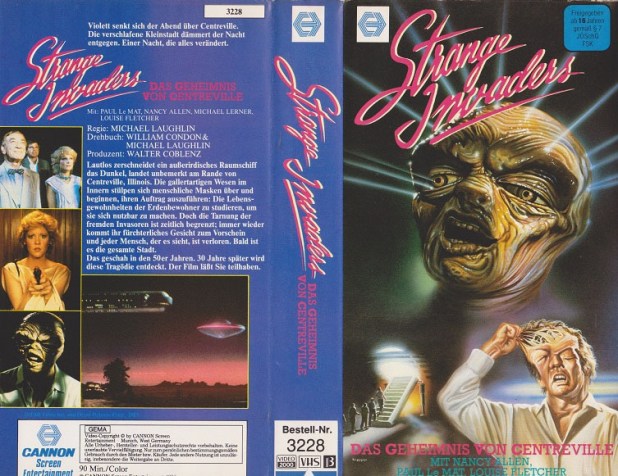
1958: Centerville, Illinois (shot on location!) is invaded by aliens, transforming humans into blue orbs and taking over their bodies.

1983: College lecturer Charles Bigelow (Paul Le Mat) learns that his ex-wife Margaret Newman (Diana Scarwid, Mommie Dearest) has disappeared after last being seen in Centerfield. Along with journalist Betty Walker (Nancy Allen), he heads to the town to find her and protect their daughter Betty Walker (Lulu Sybert, who was the daughter of production designer Richard Sylbert and writer Susanna Moore, who left Sybert for Laughlin), a half-human, half-alien being that the aliens want to bring back home.

Along with June Lockhart and Mark Goddard from Lost in Space and Kenneth Tobey from the original The ThingStrange Invaders also has Louise Fletcher (Nurse Ratched from One Flew Over the Cuckoo’s Nest), Wallace Shawn, Fiona Lewis (who was also in Strange Behavior ), Bobby “Borris” Pickett (the maker of “Monster Mash”) and Dey Young (Kate Rambeau from Rock ‘n Roll High School).

Strange Invaders is a movie that tries to remind audiences of the Cold War science fiction of the 1950s. Audiences weren’t really all that into it — I mean, even The Thing struggled — but it remains a movie I watch every few months and always enjoy.

CANNON MONTH 2: The Dead Zone (1983)

EDITOR’S NOTE: The Dead Zone was not produced by Cannon but was released on video in the UK by Cannon / Warner Home Video.

After Stephen King’s novel The Dead Zone was released in 1979, Lorimar Film Entertainment began developing a movie version with screenwriter Jeffrey Boam (InnerspaceThe Lost BoysIndiana Jones and the Last Crusade). Lorimar lost the rights and that’s where producer Dino De Laurentiis comes in.

He disliked Boam’s screenplay and asked King himself to write a script that he found way too involved and complicated — did he ever read a King book? — and brought on David Cronenberg to direct. He originally worked with Andrzej Żuławski before bringing back Boam. Meanwhile, De Laurentiis hired producer Debra Hill to work with Cronenberg and Boam to get the movie ready to film.

Cronenberg had a vision: “King’s book is longer than it needed to be. The novel sprawls and it’s episodic. What I did was use that episodic quality, because I saw The Dead Zone as a triptych.” Those three parts would be Johnny Smith having his car accident and awakening from a coma, how he helped catch the Castle Rock Killer and the conclusion as he searches for Stillson, a politician who he believes will end the world. King is said to have said that Cronenberg and Boam improved and intensified the power of the original story.

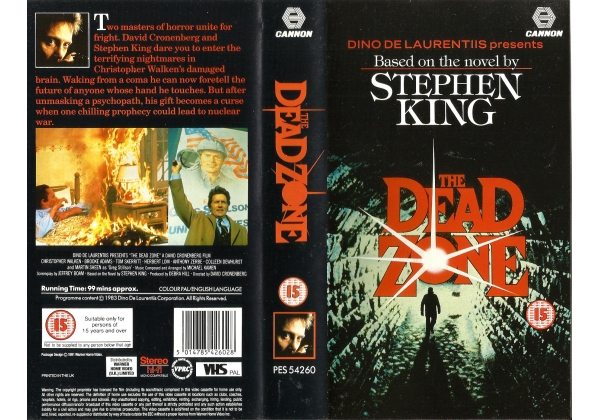
As Johnny Smith (Christopher Walken) drives home through a storm, he has a car accident that puts him in a coma for five years. As time passed, Sarah (Brooke Adams) married and had a child. As he undergoes therapy with neurologist Dr. Sam Weizak (Herbert Lom), he discovers that physical contact can allow him to see into someone’s life. For example, he learns that Weizak’s mother is still alive and that a nurse’s child is in danger.

Sheriff George Bannerman (Tom Skeritt) asks Johnny to help him solve the case of the Castle Rock Killer, which leads him to a member of the police force — Deputy Frank Dodd (Nicholas Campbell) — being the real killer and Dodd’s mother (Colleen Dewhurst) shooting him, leaving him with a limp and pushing him to stay away from humanity.

After saving a child he is tutoring — the son of Roger Stewart (Anthony Zerbe) — Johnny discovers the Dead Zone,  a place where he can change the future. After meeting a politician named Greg Stillson (Martin Sheen) who Sarah and her husband volunteer for, he learns with a handshake that the future President will launch nukes that will destroy the world.

Johnny decides to kill Stillson before he can do so and as he shoots at the man, the politician uses Sarah’s son as a human shield. Johnny is killed by a bodyguard, but before he dies, he learns that Sarah still loves him and that he has changed the future.

The Dead Zone is — perhaps outside of Carrie — the best adaption of a King novel. Cujo is a spiritual sequel — at least the book is — as it’s set in Castle Rock and the spirit of Frank Dodd has gone into the dog and made it evil. Sheriff Bannerman is also in that story, but was played by Sandy Ward in the film. Other Castle Rock stories include Stand By MeThe Dark Half and Needful Things.

CANNON MONTH 2: The Throne of Fire (1983)

EDITOR’S NOTE: This was on the site for the first time on February 2, 2019. The Throne of Fire was not produced by Cannon but was released on video by Cannon / MGM/UA Home Video.

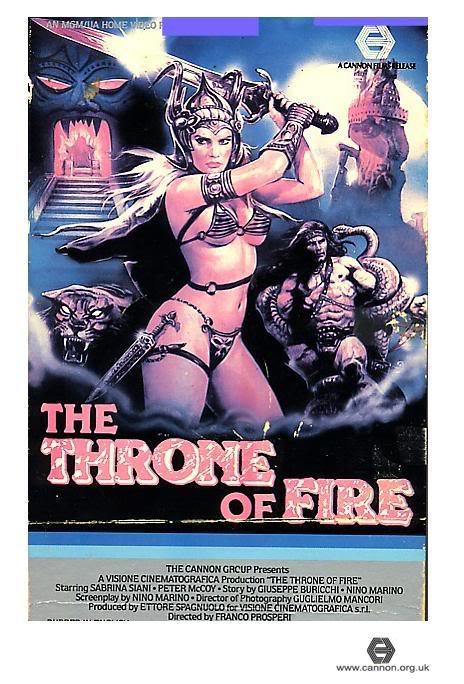
We’re barely five minutes into The Throne of Fire when one of the main characters promises his mother that he will live up to being Satan’s son by massacring women and children. Yep. I’m sold. Let’s do this — a rare sword and sorcery film with a female central character, in this case, Princess Valkari who is played by Sabrina Siani. Ms. Siani may be best known to maniacs like me for playing Oncron in Lucio Fulci’s fog-drenched barbarian saga, Conquest

Director Franco Prosperi probably made this at the same time as Gunan, King of the Barbarians, as he recycled much of the cast, including Pietro Torrisi who plays Sebastian here.

Everyone is battling Mora,  the son of the devil’s messenger Belial, who wants to sit on the throne of evil on the day of the night in the day. Modern people would refer to this an eclipse. But if he doesn’t marry the princess first, he’ll die.

Luckily, Sebastian has similar powers and can also turn invisible, so he’s on hand to help the princess. There’s also a Well of Madness and lots of people get to sit on the Throne of Fire, which makes them go up in flames. Perhaps you’d not want to sit on said chair.

Will you like this movie? Well, that depends. How well do you do with Italian barbarian movies? Are you a red blooded heterosexual man who would like to watch Sabrina Siani? Are you a red blooded homosexual man who wants to watch men go bare chested? Do you want to watch lots of people get immolated? Then hurry on down to The Throne of Fire!

You can get this from Revok and VHSPS.

CANNON MONTH 2: The Ballad of Narayama (1983)

EDITOR’S NOTE: This was first on the site on January 6, 2021The Ballad of Narayama was not produced by Cannon but was theatrically distributed by Cannon Film Distributors (UK) Ltd.

The Ballad of Narayama came late in the career of director Shôhei Imamura who claimed that a viewing of Kurosawa’s Rashomon inspired him to imagine that a new freedom of expression was possible in post-war Japan. Starting as an assistant to Yasujirō Ozu, he soon was dissatisfied, as he wanted to show a different take on how he saw Japan.

He left Shochiku for a better salary at Nikkatsu and became the assistant director to Yuzo Kawashima, who was known for his tragic satire. From his first film as a director, Nusumareta Yokujō (Stolen Desire), he courted controversy, unafraid to show the lower caste of Japan and frank sexuality.

Imamura saw himself as more of a cultural anthropologist than a filmmaker and was all about being an iconoclast, even starting his own studio and pushing for projects that would fail, having to make small films for most of the late 70’s and early 80’s due to Kamigami no Fukaki Yokubō (Profound Desires of the Gods), a deeply personal film that took a year and a half to make and wasn’t seen as a success at the time.

By the 1980’s, Imamura was able to mount larger-scale movies, including this one, a remake of Keisuke Kinoshita’s 1958 The Ballad of Narayama.

A key member of the Japanese New Wave, Imamura is one of the few directors to keep making films through the 21st century and the only director from Japan to win two Palme d’Or awards (for this movie and The Eel).

My grandmother died last month. I’m not telling you that out of a need for sympathy, but to tell you where my head was while watching this movie. It’s about ubasute, which is translated as abandoning an old woman, which was the ancient Japanese practice of carrying an infirm or elderly relative to a mountain or other desolate place and leaving them to die.

You may think that this is a barbaric practice. But in our world of modern medicine that keeps people alive well beyond the time that they should be deceased, I wonder sometimes that we keep people with us for so long that it becomes torture. I don’t have the answers but I’ve tried to keep an open mind as I watched this movie, sometimes overflowing with emotion.

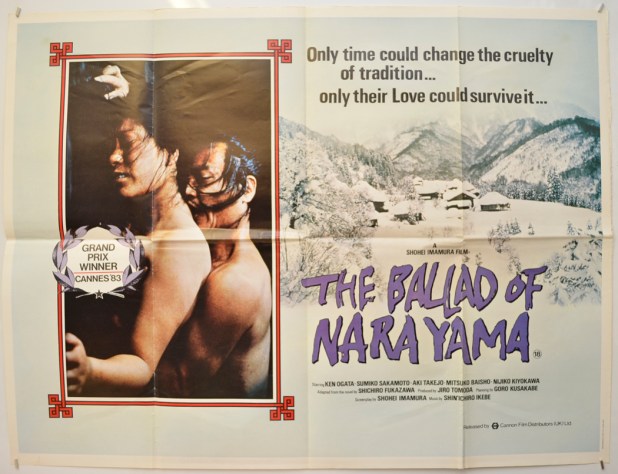
In a small Japanese village in the 19th century, Orin (Sumiko Sakamoto, who Imamura cast in two other of his movies, The Pornographers and Warm Water Under a Red Bridge; she won the Japanese Best Actress from Nihon Academy for her performance in this film, as well as a kiss from Orson Welles) realize that at the age of 69, she is but months from having to go up the mountain to die. She’s of sound mind and body, but doesn’t want to be like the old men who fight every step of the way, screaming that they want to stay alive.

Over the next year, we see her life, whether it’s the negative of young people referring to her as an old witch or the positive, where we see her fix the problems of the village, help her son Tatsuheito (Ken Ogata) to find a wife and set things right before stoically going on to her death in the snow.

As we see the lives of the villagers, we also see nature intrude, whether that’s through the birds in the trees or the snake that is always near, even in moments of incredible joy.

How strongly did Sakamoto believe in this role? She extracted four of her teeth just to play the scene where Orin smashes out all of her teeth to convince her family that she must die.

Beyond Sakamoto’s awards, this movie also won best film at the Japanese Academy Awards numerous best actor awards for Ogata, who played Sakamoto’s son, a best supporting actress award for Mitsuko Baisho, best sound and an excellence in cinematography award.

This is a film of juxtaposition, of the lowest and most base of humanity in contrast with ones that will sacrifice everything. Moments of sheer beauty stand hand in hand with scenes of violence and pain. It’s a heartbreaking film yet one that reaffirmed my belief in life, in the cyclical nature of death and rebirth. And it is by no means an easy watch.

You can find The Ballad of Narayama on the new Survivor Ballads: Three Films By Shohei Imamura set from Arrow Films. This is a must-buy, as each film demands to be part of any film lover’s collection. You can get yours from MVD.

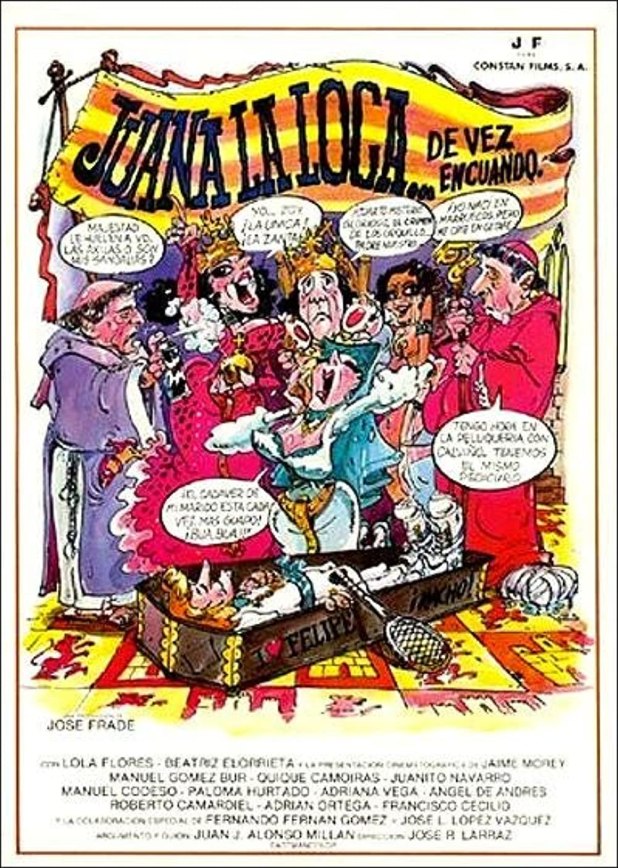
Juana la Loca… de vez en cuando (1983)

The second time that director Jose Ramon Larraz would work with writer Juan Jose Alonso Millan — The National Mummy is their other work together — this movie is a parody of the life of Juana I of Castile, the woman who will one day become the Queen of Spain.

The Catholic monarchs in charge are worried about the brutal Torquemada’s obsessive need to prosecute and torture everyone. It’s within this world that Larraz and Millan attempt to tell a comedic tale.

Based on The Madness of Love by Manuel Tamayo Y Baus, this tells how Juana went from a passionate young woman to Joanna the Mad, a woman who was both the Queen of Castile and Aragon yet kept confined.

She was married by arrangement to Philip the Handsome, Archduke of Austria of the House of Habsburg, and gained power as every member of her family died, other than King Ferdinand II of Aragon, who proclaimed himself Governor and Administrator of Castile, then King after Phillip died in 1506.

Despite being the ruling queen, Joanna was declared insane and confined in the Royal Convent of Santa Clara in Tordesillas by order of her father, who ruled for a decade and then her son took over as she remained hidden from the world.

Was her insanity because she discovered that the love of her life, Phillip, was cheating on her. She may have had melancholia or inherited schizophrenia. Or perhaps this highly intelligent woman was used by her husband and father.

Anyways, somehow Larraz was picked to direct this and well, he is used to making sex comedies by this point in his career. I’m not one to understand the intricacies of Spanish history and the humor that arises from it. I prefer when Larraz makes movies with haunted women confronting the evil within themselves.

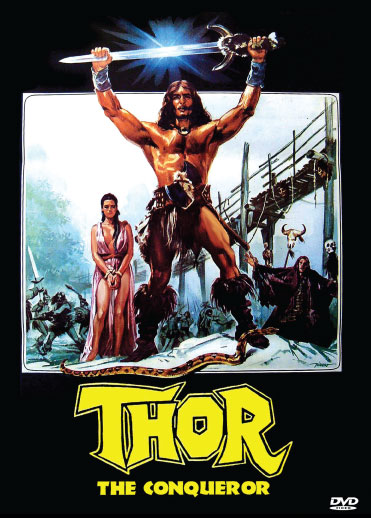
Thor the Conqueror (1983)

The craze of making barbarian movies post-Conan the Barbarian had to feel like going back home for director Tonino Ricci, as he worked on the second unit on Thor and the Amazon Women all the way back in 1963, as well as other peblum movies such as Sword of the ConquererErik the Conqueror and Taur, il re della forza bruta. You may also know him for the films he directed, like Kid il monello del westUn omicidio perfetto a termine di legge, RushPanic and Encounters In the Deep.

Writer Tito Carpi wrote plenty of movies I’ve yelled with joy during, such as MartaTentaclesWarriors of the Wasteland and Sinbad of the Seven Seas.

Kind of taking a page out of the aforementioned Arnold movie — but not really — this starts with the death of Thor’s parents. Sure, we see Gant The Annihilator (Angelo Ragusa) speaking with the owl wizard Etna (Christopher Holm) as Thor’s mom squats him out behind a tree, but it’s only minutes before the army of Gnut (Raf Falcone) kill everyone but the wizard and the baby as Gant’s sword turns into a snake.

Thor grows up to be Bruno Minniti, who will grow up to be Rage and Rush. He has to find that sword to become the greatest chief of all time and to get there, he must become the most misogynist hero you’ve ever seen, repeatedly sleeping with women while his ghost owl magician adoptive father watches and yells stuff out and man, Italian movies.

One of those women, a virgin warrior named Sheeba (Maria Romano, Violence in a Women’s Prison) ends up becoming his slave and then his wife after saving him and then bears Thor a child, so sometimes getting caveman dragged into lovemaking can be a meet cute, if we believe a 1983 Italian exploitation movie and we never should.

There’s also Ina (Malisa Longo, who is also in Gunan, King of the Barbarians and was Helga, She Wolf of Stilberg), another virgin warrior that our hero who isn’t a hero must battle.

In the final battle, Etna sends Thor an animal to help him and says, “In days to come, they will call this a horse” and I laughed so hard that even thinking about it now makes me laugh even more.

You can watch this on YouTube.

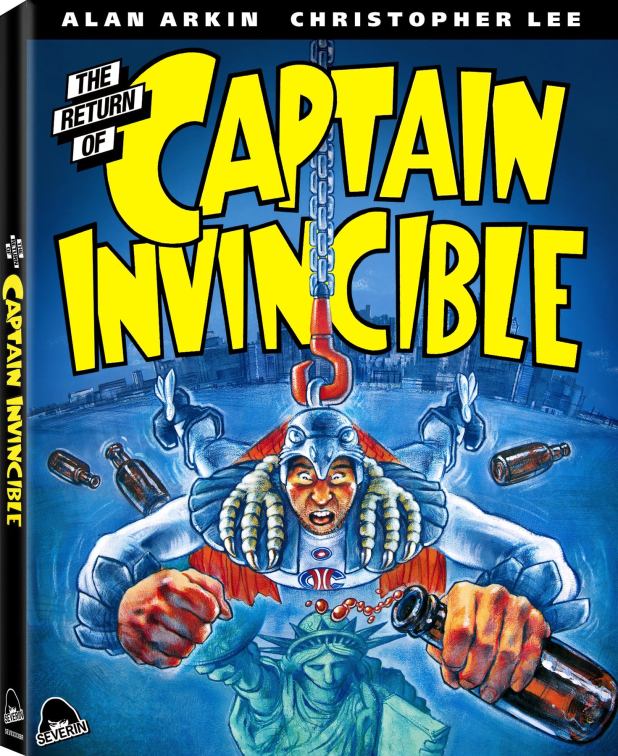
SEVERIN BLU RAY RELEASE: The Return of Captain Invincible (1983)

Captain Invincible helped win World War 2 but couldn’t survive the McCarthy hearings. Angry that his country turned its back on him, he moved to Australia and became a drunk. Thirty years later, Mr. Midnight, his greatest villain, comes back and steals the hypno ray. The U.S. government now needs the Captain back. But is he even interested?

Directed by Philippe Mora (Mad Dog Morgan, The Beast WithinHowling II: Your Sister is a Werewolf), this Australian superhero comedy musical is a lost film. It never played in U.S. theaters due to Jensen Farley Pictures (who also distributed Chained HeatCurtainsThe Boogens and more) going out of business, but it was released on video. It also bombed really badly in Australia, so it’s not a film that anyone thinks about.

It’s a strange bird, a mix of pathos at times (the idea of superheroes being forced to retire because of the McCarthy hearings was first done in 1979’s JSA stories in Adventure Comics and 1985’s America vs. the Justice Society) and musical scenes, featuring three songs from The Rocky Horror Picture Show team of Richard O’Brien and Richard Hartley,

Starring Alan Arkin as the Captain and Christopher Lee as Mr. Midnight, the film really explores how a superhero would have to relearn his powers after decades of alcohol abuse, as well as how a supervillain would really operate in the modern world. It was written by Andrew Gaty, Peter Smalley (Dead End Drive-In) and Steven de Souza (CommandoBad DreamsDie HardHudson Hawk48 Hours and many more).

The black and white sequences were my favorite parts of the film, showing how Captain Invincible gave up being a hero and how he got his powers. The music is pretty interesting, particularly Lee’s explanation of how there was evil before there was humanity. Also, I love Mr. Midnight’s sidekick, Julius, who looks like a naked human horse person.

Also of note, there’s a scene where vacuum cleaners attack our hero. The scene made so little sense, the original pick for Captain Invincible, James Coburn (Derek Flint from In Like Flint and Our Man Flint) dropped out of the movie!

Severin has re-released this movie in a special set that has both the theatrical and director’s cut, as well as soundtrack CD. Plus, you also get interviews with producer Andrew Gaty, cinematographer Mike Molloy, actors Kate Fitzpatrick and Chris Haywood, Christopher Lee performing “Name Your Poison” On German TV, an alternate title opening, a trailer, commentary from Mora And Not Quite Hollywood director Mark Hartley, a discussion between Morra and Steven E. de Souza, and Morra speaking with Marc Edward Heuck.

You can order the blu ray from Severin.

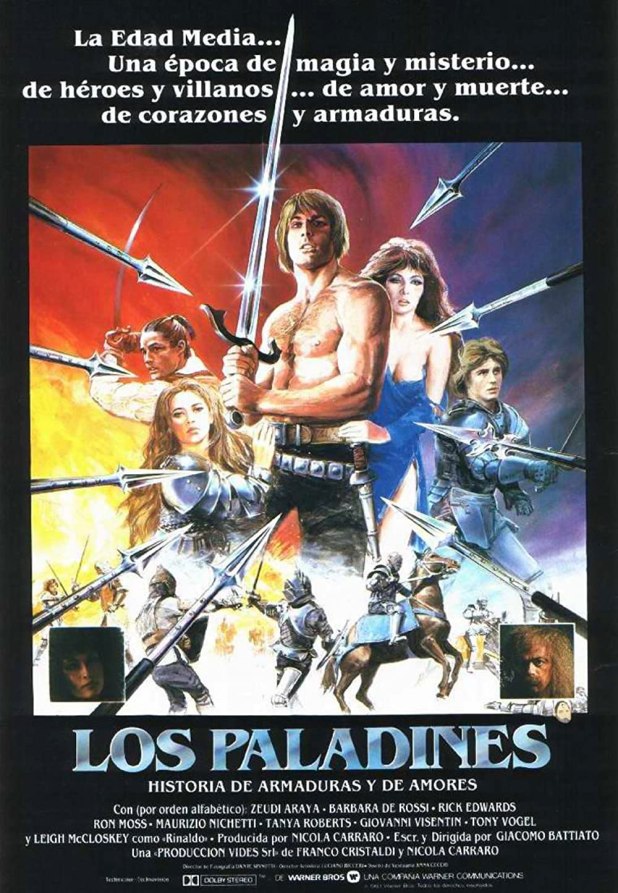
Junesploitation 2022: I paladini – Storia d’armi e d’amori (1983)

June 29: Junesploitation’s topic of the day — as suggested by F This Movie— is sword and sorcery! We’re excited to tackle a different genre every day, so check back and see what’s next.

Loosely based on the stories of the Paladins — the twelve fictional knights of legend who were the foremost members of Charlemagne’s court in the 8th century — especially the epic poem Orlando Furioso by Ludovico Ariosto, Paladins is less Conan than most Italian sword and sorcery movies.

Like Yor Hunter from the Future, this was an Italian TV miniseries edited down into a movie for U.S. audiences and by that, I mean people like me staying up at 3 AM and watching HBO.

Bradamante (Barbara De Rossi) is a woman with an invincible suit of armor that comes to save her — like literally, it rides in, a haunted suit of armor, after she’s nearly assaulted in a waterfall which proves that yes, this is an Italian movie.

She gets caught between the Christians like Orlando (Rick Edwards) and the Moors, which include Isabella (Tonya Roberts), Ruggero (Ronn Moss, Rowdy Abilene from Hard Ticket to Hawaii) and Ferrau (Tony Vogel).

Now, Moors are supposed to be the Muslim inhabitants of the Maghreb, the Iberian Peninsula, Sicily and Malta. Let me tell you, in no way does the Bronx-born Roberts seem like she fits in. Moss is also as blonde as it gets, so…yeah.

How else do you know this is Italian? Just look at the supporting cast: Bobby Rhodes as a mercenary. Leigh McCloskey from Inferno. Al Cliver. Hal Yamanouchi as a samurai. Famous Zombi zombie Ottaviano Dell’Acqua listed in the credits as rapist.

Yes, it sure is an Italian movie.

Director Giacomo Battiato usually stayed away from the kind of movies I watch, so this is the first time I’ve encountered his work. I am frankly shocked that this wasn’t a Cannon movie, because this feels like something they’d pick up.

There are some great costumes in this, like Ferrau’s bird-themed armor. It’s pretty much less hearts and more swords, non-stop combat as if it wanted to be Excalibur instead of Ator. It also looks like a big movie thanks to Dante Spinotti, who would leave Italian exploitation behind and make Hollywood magic in films like ManhunterThe Quick and the Dead and L.A. Confidential.

Trigger warning: this has five attempted rapes, including one by a wizard, one by an invisible man and the other avoided by Ferrau’s bird-shaped codpiece is too rusty to come off.

As far as I know, this has never come out in the U.S. on disk. You can find it on YouTube but if you’re the kind of viewer that needs a perfect print, I got really bad news for you.


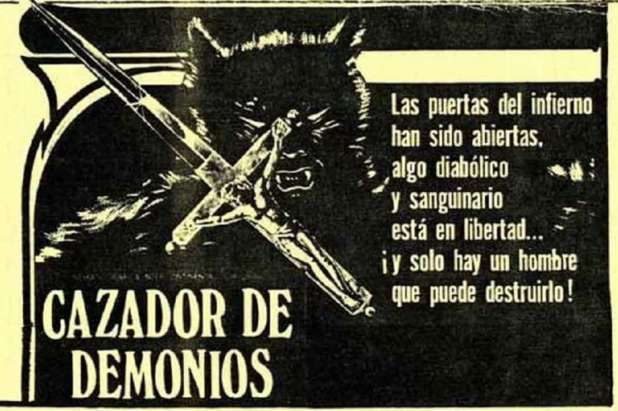
Cazador de demonios (1983)

Horrific murders are happening every night in a small rural Mexican village — heads are ripped off their necks, arms are ripped off and bodies are destroyed — and may be the work of an ancient legend known as the Nahual. Sheriff Aguilar (Roberto Montiel) and Dr. José Luis (Rafael Sánchez Navarro) hope to keep their town safe, but as Mexican Dr. Loomis might say, “¡La muerte ha llegado a tu pueblito!

The moral of the story? Never murder a shaman. I mean, the guy was slicing a chicken in half and dripping its blood all over a farmer’s pregnant wife like he was in that Danzig video for “Mother” that MTV only played once and Bob Larson lost his mind over. And when his wife’s baby is stillborn, I guess you can see why the guy went nuts.

Extra points to Padre Martin (Tito Junco), who takes all of the church’s silver and gets it turned into ammunition. Someone has to do something, right? He also has this amazing blast of dialogue:

Dr. José Luis: Who’s that?

Padre Martín: Asmodeus. Leviathan. Beelzebub. Call him as you like.

Dr. José Luis: Satan?

Padre Martín: Lord of darkness, prince of shadows, king of hell and of the black side of the Universe.

José Luis: You talk about him as if you had a lot of respect for him.

Padre Martín: Satan has to be respected, son. He’s a very powerful being, and infinitely cruel.

There’s also that moment that happens in all Mexican Satanic movies where God has had enough of this and decides that all the antics have to come to a stop. It happens here when a throwing knife has a crucifix of light appear on it before it flies toward the demon. You’ve had your fun, Satan. Now let’s wrap this up.

Tales from the Dark Side episode 2: “I’ll Give You a Million”

Duncan Williams (Keenan Wynn) and Jack Blaine (George Petrie) are both businessmen who have destroyed lives to get where they are. As they grow older, they rely on one another to have someone to argue with. Their latest issue? Duncan has offered one million dollars for the soul of Jack.

Oh what a contract! Within 24 hours of death, all rights to Jack’s soul go to Duncan. If Duncan dies before taking the soul, the contract is null and void. The only exception? If Duncan dies of foul play, the million has to be paid back with interest because Jack may have previously been involved with killing someone.

Seeing as how Jack is an atheist, he takes the wager, but when he learns that he has a short time to live, he tries to cancel the contract. Except that Jack learns that his liver is giving out and that he’ll soon die, so in a panic, he buys his soul back and Duncan makes a million dollars on the deal.

The next day, Duncan learns that Jack died and his telegram was not sent until after he died, which fulfills Jack’s end of the contract. Because 24 hours have passed, Duncan is now the official owner of Jack’s soul and unable to profit on the deal. But what if someone who is an expert on signing away souls wants them both?

Director John Harrison, who also directed the movie for the series, also wrote the story, which was turned into a screenplay by David Spiel and Mark Durand.

This may be a humorous story, but it uses the time well and doesn’t seem like it ever gets slow.  There’s nothing like rich and evil people getting destroyed by their own schemes.