Ellen Hailey (Barbara Bain) is going through a divorce, so she takes her daughter Ruth (Kay Lenz) to a summer lodge sort of like Dirty Dancing, except they both want to get horizontal with the handyman (Michael Moriarty) who has a bad leg that keeps him out of the war. Man, divorce and world wars and Michael Moriarty pounding it out with a mother and daughter? Loving it.
You know, sometimes I just let these TV movies roll all day and pretend that it’s the early 80s and I’m home sick from school and that I’m allowed to watch as many TV movies as I want which I do believe is the perfect day.
Then I have to do some work because life isn’t as good anymore.
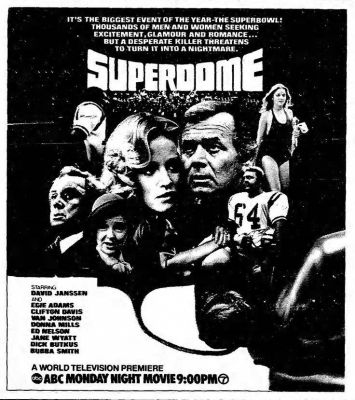
Director William A. Graham, who worked with Elvis Presley on Change of Habit (1969) — and too many TV series to mention (but we’ll mention Trapped Beneath the Sea (1974) and Beyond the Bermuda Triangle (1975) and the excellent, 1977 Frank Sinatra-starrer, Contract on Cherry Street) knocks it out of the park . . . er, sky, as it were . . . with a stellar debut script by Robert Boris (who nailed it with his second script, 1973’s Electra Glide in Blue) in a tale about a troubled, ex-war helicopter pilot who fights his person demons by stopping a bank robbery.
Overseas theatrical for the 1976 release/courtesy Worthpoint.
The always likable and reliable and David Janssen (Moon of the Wolf, the must-see submarine romp Fer-de-lance) stars as Harry “Smiling Jack” Walker: a highly regarded pilot and traffic reporter for Salt Lake City, Utah’s KBEX Radio. As part of his celebrity, Walker will display his fully restored P-40 Warhawk — the same plane he flew during WW II as a member of the Flying Tigers — to promote his station’s “throwback weekend” of playing WW II era big band standards of the 1940s. (Janssen, a skilled pilot in his own right, did most of his own flying, which only adds to the film thrilling realism.)
As the film opens, we see Walker’s “war flashback” (courtesy of the 1942 war film, The Flying Tigers) as he tows the plane — causing his own, ironic traffic jam — to the station. Courtesy of a smart script by Robert Boris (who also gave us the 1982 Richard Pryor entry Some Kind of Hero and the 1983 Dan Aykroyd vehicle, Doctor Detroit), the plane serves as a metaphor: Walker is as outdated as his plane. To that end, his old war pilot buddy, Jim McAndrew (the always on-point Ralph Meeker), now himself an outdated and desked cop, urges Walker to quit the bitching about the “glory days” and live in the now.
The “Dirty Harry” catalyst (if not made by CBS-TV, this would have made for a great Clint Eastwood theatrical vehicle) for Walker to get off his duff is a daylight bank robbery by two ex-Vietnam Marines using weapons stolen from Salt Lake City’s National Guard Armory. Warning the highway denizens below of the police pursuit, Walker takes it upon himself to begin an aerial pursuit of the robbers, communicating with McAndrew the details about the car — and their female teller hostage.
Now, you’d think a helicopter following a car would be boring . . . think again. Thanks to Walker’s ex-war piloting skills, our ersatz Harry Callahan pilots the chopper just over the getaway car’s roof, ripping between buildings, down city streets and under underpasses.
Now, just when you think the helicopter chasing the car gets boring . . . the robbers have their own “getaway” helicopter perched on top of a parking garage. Now, the chase takes to the skies over the Utah deserts and mountain ranges. And Walker’s running out of gas . . . living life by the seat of his flying pants, as he recaptures his “glory days” one last time.
A rating winner when it aired on January 30, 1973, CBS-TV, in conjunction with Warner Bros. (Clint’s old studio; so why didn’t Eastwood do this?), successfully marketed the $400,000 film throughout Europe and the Pacific Rim to box office gold. Of course, when the home video era arrived, Prism Entertainment released it in 1985, while VCI Entertainment picked it up for its 2007 DVD release.
Go VHS retro. Get the DVD. Stream it. However you do it: Watch this movie. Team it up with the car-on-car chase flick Vanishing Point (1971) for a great double feature. Want to go for a triple (or a TV movie double): check out another Vietnam war ex-chopper pilot who’s called into action to safe the day with Bernard Kowalski’s Terror in the Sky (1971).
Sure, David Janssen was no Clint Eastwood or Charlton Heston (I watched Chuck in Two Minute Warning (1976) this week; Janssen would have been great in that film, as Chuck, here) meant for leading man roles U.S. big screens, but when it came to carrying films on the small screen, no one did it better than David Janssen. Nobody. There’s no better Dirty Harry TV movie knockoff than Birds of Prey.
Be sure to check out our last “TV Week” of reviews concerned with action and terror in the skies with our “Airline Disasters TV Movie Round-Up” featurette.
Another great, David Janssen TV movie knockoff of popular films, in this case: Charlton Heston’s Two-Minute Warning crossed with the Bruce Dern-fronted Black Sunday.
About the Author: You can read the music and film reviews of R.D Francis on Medium and learn more about his work on Facebook. He also writes for B&S About Movies (links to a truncated teaser-listing of his reviews).
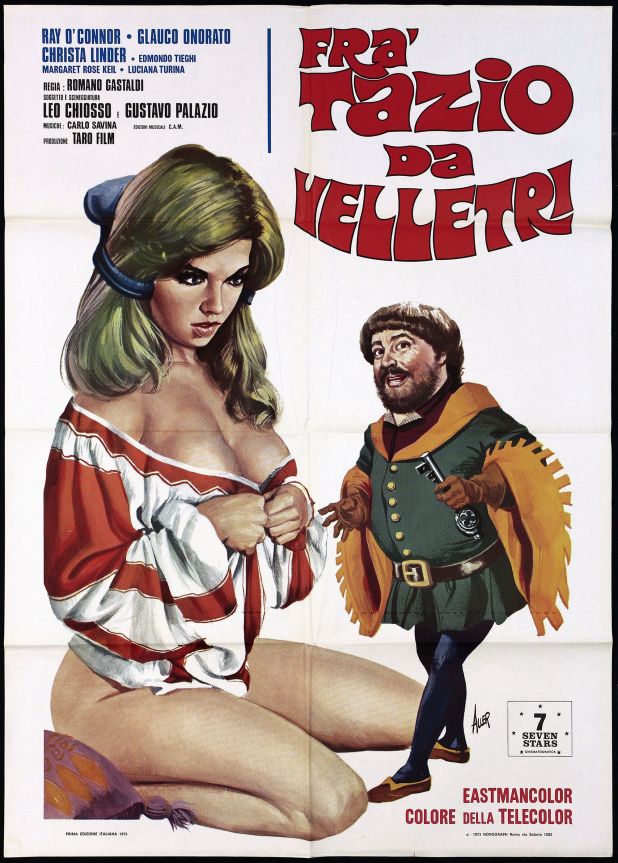
Friar Tazio da Velletri desires Lisa (Christa Linder, whose career takes her from appearing with Blue Demon in Invasion of the Dead and in Boris Karloff’s last movie The Incredible Invasionto showing up in the Westen Day of Anger, the Carlos Enrique Taboad quasi-giallo Vagabundo en la Lluvia, the Eurospy movies Kill Me Gently and Countdown to Doomsday, Harry Reems’ last adult film Bel Ami (she had a body double), Fulci’s Dracula in the Provinces before a move to America and being in Hooper and an episode of Trapper John M.D.; talk about an eclectic resume!) but she’s married and you know, he’s a priest.
He spreads the rumor that he’s a famous priest able to drive the lust out of women, which brings plenty of lusty women his way, and you know the rest, right?
Joe D’Amato was also worked on Sollazzevoli storie di mogli gaudenti e mariti penitenti – decameron № 69 at the same time as this movie and after a right with the producers, he left the film to be finished by Romano Scandariato.
Giovanni Boccaccio is considered the greatest European prose writer of his time (1313-1375, in case you’re interested) and he’s best known for The Decameron, a series of short stories that pretty much define much of the Italian literary tradition.
Six hundred years later, the cinema was referring back to Boccaccio with a series of films which are a subgenre of a subgenre, i.e. the decamerotici movies of the commedia sexy all’italiana, which get their start with Pier Paolo Pasolini’s Trilogy of Life of The Decameron, Canterbury Tales and Arabian Nights. Those films take the stories people knew, added sex and nudity, and there were around fifty ripoffs that followed.
Joe D’Amato made two of them, this movie and More Sexy Canterbury Tales, which he directed, wrote and even acted in under the names Romano Gastaldi in the Italian version and Ralph Zucker in the English cut. He was worried that other directors wouldn’t use him as a cinematographer if it got out that he was directing. That’s why he is listed as the cinematographer of More Sexy as his birth name, Aristide Massaccesi. It’s also the first time that D’Amato would show the idea of self-castration which is reflected at the end of his film Sesso Nero (Black Sex) AKA Sexy Erotic Love AKA Exotic Malice.
In this story, Boccaccio is led by demons into hell and learns of the reasons why his fellow pilgrims are there, including two couples who swap partners, a friar who ignores his vows to take a young parishioner, a merchant whose wife deflowered his nephew, a homosexual merchant (merchants obviously are all going to Hell) whose lover must sleep with his wife, Nero, a music teacher who instructs his students in the art of tickling more than just the keys and Dante Alighieri, the Italian poet who invented more of what we know about Hell than the Bible itself.
When this was first presented to the Italian censorship board, the title pretty much put every one of Pasolini’s three films together: Le mille e una notte di Boccaccio a Canterbury (The Thousand and One Tales of Boccaccio in Canterbury). Between full frontal female nudity and a priest in a pile of excrement, it failed and needed reshot, with Return of the Exorcist director Luca Damiano director filling in as D’Amato was in America shooting Alberto de Martino’s Il consigliori.
Nearly every long-time Italian genre director made comedies. There are several more from D’Amato, but this one takes advantage of his love and talent when it comes to making gorgeous women like Gabriella Giorgelli (Seven Blood-Stained Orchids, Wax Mask) look even more beautiful.
EDITOR’S NOTE: Kinski and D’Amato? Sometimes life just gets too wild. We originally wrote about this on March 31, 2018 and now it’s back with new information. Enjoy!
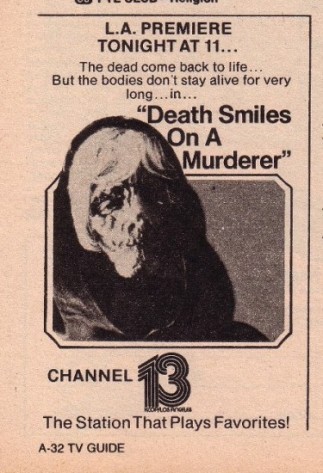
Once you watch this film, you’ll wonder — just how did this play on TV? It was part of the 13 titles included in Avco Embassy’s Nightmare Theater package syndicated in 1975 (the others were Marta, Maniac Mansion, Night of the Sorcerers, Fury of the Wolfman, Hatchet for the Honeymoon, Horror Rises from the Tomb, Dear Dead Delilah, Doomwatch, Bell from Hell, Witches Mountain, Mummy’s Revenge and The Witch) and several of these films aired intact on regular television! I can’t imagine — nor will you once you read this — what people thought! I even found a mention that the scene where Klaus Kinski inserts a pin into a girl’s eye aired uncut on Pittsburgh’s beloved Chiller Theater (indeed, it played on July 7, 1979 and December 26, 1981, thanks to the amazing listing on the Chiller Theater fan site).
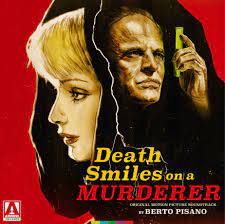
1906. Austria. Greta von Holstein (Ewa Aulin, Candy from Candy as well as Death Laid an Egg) has been used and abused by all of the men in her life, including Dr. von Ravensbrück, a rich cad who knocks her up and leaves her to die in childbirth.
Three years later. Her hunchback brother Franz, besotten with incestual love, brings her back to life with a magic medallion inscribed with the secret of life over death. He tries to get back into her pants, so she throws a black cat at his face. It eats his eyeballs, because, well, this is a Joe D’Amato movie. She then escapes into the world where she seeks revenge on the von Ravensbrück’s family.
Walter, the son of the doctor who done her wrong, and Eve, his wife, take her in after an accident outside their home. They both fall in love with her, which gives D’Amato license to shoot long lovemaking scenes. You may know him on one hand for his horror films, likeBeyond the Darkness, Frankenstein 2000,Absurdand Antropophagus. But you may also know him for his adult films like Porno Holocaust and the Rocco Siffredi vehicle Tarzan X – Shame of Jane. Here, he combines his love of the female form with his eye for murder and insanity.
Eva is becoming jealous of Greta. But what he doesn’t know is that her new lover is wiping out people left and right, just for fun. The butler in the gallery with a razor. The maid in the woods with a shotgun. A lab assistant in the lab with a metal club. Even the family doctor (Klaus Kinski, do I need to say more or tell you he was in Schizoid, Crawlspace, Marquis de Sade: Justine and more? Or that he was also maniac who was drafted to the German army, spent time as a POW and drank his own urine to get sick and get home earlier? This is not the craziest Kinski story, by the way…) is strangled right after he learned how to use her amulet to bring back the dead that he had been experimenting on (as you do).
Eva’s jealousy wins out, so she walls her up alive in the rooms beneath the castle, killing her. But Greta isn’t done yet. She shows up as a ghost at a party and lures Eva toward falling off the roof. That night, Greta’s ghost gives Walter a fatal heart attack in bed. And all of this was just to lure her old lover, Dr. von Ravensbrück, to the funeral, where she leads him to a vault and suffocates him.
A police inspector wonders if he’ll ever add up the case, as he finds the corpse of Greta’s brother near her empty grave. She’s gone and he wonders whatever happened to her. The person he has been telling the story to? Greta.
I was really struck by Berto Pisano’s music in this. He also contributed the strange soundtrack to Burial Ground. Here, his music is jazzy and then atonal, with sharp stings to call out the action.
I feel like I need to take a long shower after watching this movie. Which isn’t a bad thing, really. It’s an effective mix of giallo and gothic romance, with plenty of sleaze and gore for those seeking those thrills.
In the book Spaghetti Nightmares, Massaccesi said that he used his real name on this film because he was “encouraged by the budget…and by the presence of two important actors like Ewa Aulin and Kalus Kinski, who were appearing at the time in several Italian films, and whose presence was opposed on me by production and distribution. Kinski, in spite of everything, is an excellent professional actor.”
When asked how he felt about the movie, he wasn’t kind to himself: “Not many fond memories there. I’m afraid it’s a very imperfect film, pandering and mechanical, but this is due to the fact that I wrote the script on my own. When you don’t work with someone else who challenges your ideas, stimulates them and corrects you where necessary, helping you to make what you write credible, it’s much harder to come up with a good product.”
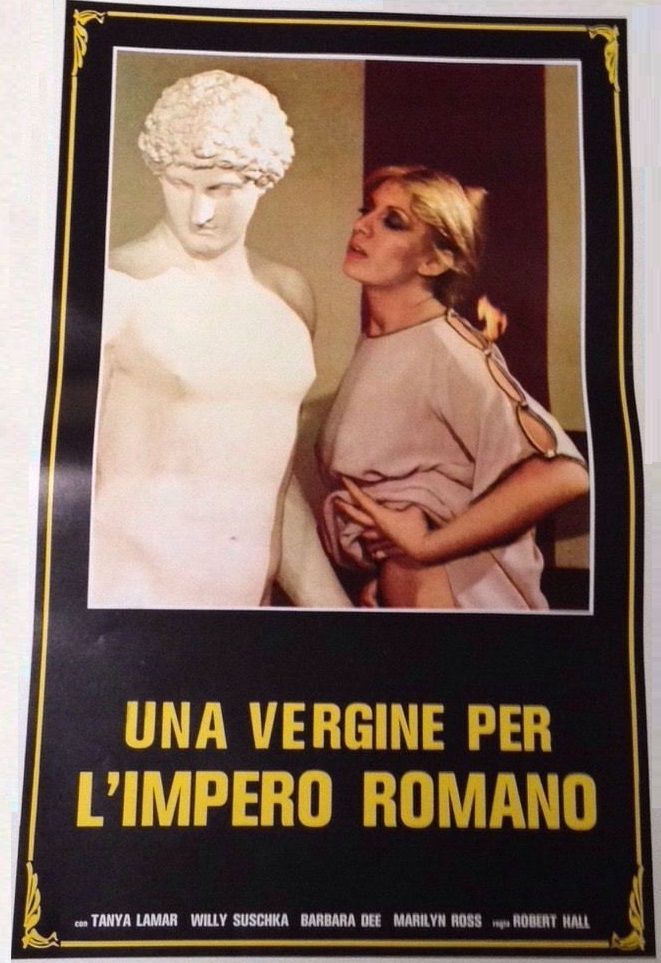
Using the name Jim Black and Robert Hall — as well as Dirk Frey — Joe D’Amato really went all out to get as many names as possible into this movie.
Nadine Roussial plays Livia the Arena Queen, a virgin who must win one more battle inside the arena to get her freedom. It’s an adult movie — hey there’s Mark Shannon in a cameo — and was probably made on sets from another at the same time D’Amato movie like The Emperor Caligula: The Untold Story or Messalina… orgasmo imperiale which saw Joe use the name OJ Clarke.Nadine Roussial is in the latter, so it makes a little too much sense. Look — when you have a set, use it.
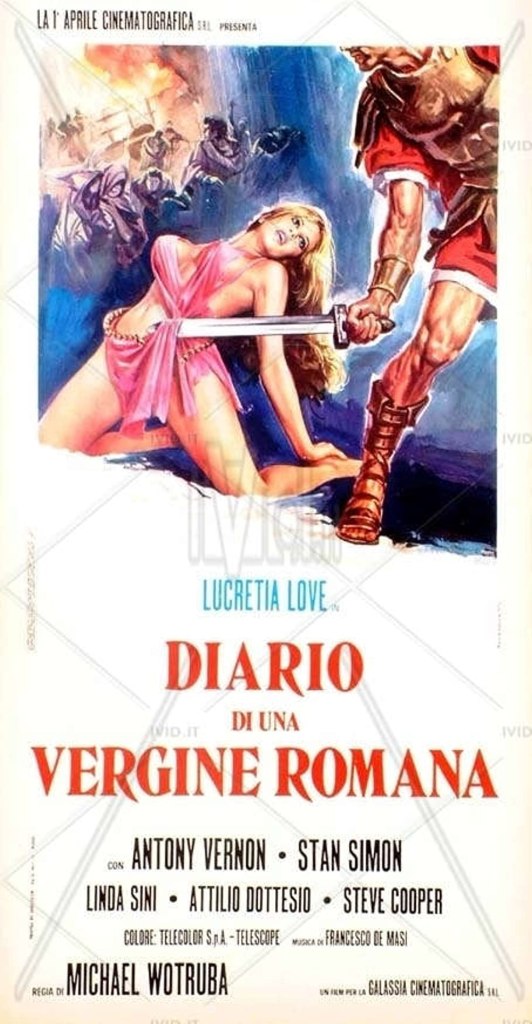
Diary of a Roman Virgin used the D’Amato named Michael Wotruba name here. It’s the story of Livia (Lucretia Love, who may have been born in Texas but made her way to Italy to be in everything from The Killer Reserved Nine Seatsto Enter the Devil) who has made her way from a tragedy involving stock footage from The Last Days of Pompeii and who rise in power.
This also has scenes from Triumph of the Ten Gladiators and The Arena in it, because why let stuff go to waste, right?
These films are at the opposite sides of D’Amato making Roman epics. Of course, after the 80s, the sex would go even further in his films, as he’d make Sodoma e Gomorra, Caligola follia del potere and Antonio e Cleopatra as adult movies.
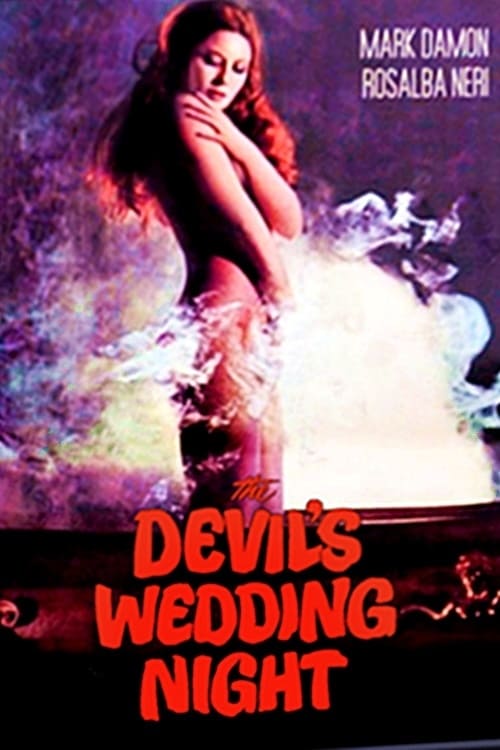
Supposedly, The Devil’s Wedding Night (AKA Full Moon of the Virgins) was all Mark Damon’s idea. After being in House of Usher, Damon had moved to Italy and appeared in movies like Black Sabbath and Johnny Yuma.
Perhaps this idea was the start of his producing career, which was more successful than his acting job. Damon was planning on selling the movie an American production company. Luigi Batzella (Nude for Satan, The Beast In Heat) was picked to direct, but most people believe that Joe D’Amato stepped in and finished the film.
I’m a firm believer in this theory because there’s a moment near the end of this movie where an otherworldly Countess Dolingen De Vries rises from a bathtub of blood and fog and writhes near nude on the screen and somehow going beyond the confines of the screen to destroy my mind. I generally try my best not to turn reviews of movies with atrractive women into male gaze spectacles, but Rosalba Neri is absoutely iconic in this moment, a perfect scene that is never discussed nearly enough.
There’s also a magic vampire ring of the Nibelungen, which is gigantic costume jewelery and therefore better than any Hollywood baubles, village girls with sacred amulets of Pazuzu (yes, really), five virgins getting sacrificed all at once in an express line of bloodletting magic, three different twist endings in a row, tripped out Dr. Who looking tunnel moments, D’Amato billing himself as Michael Holloway and going absolutely wlld capturing every inch of womanly curves and an incredible setting, the Castello Piccolomini Balsorano, the same place Lady Frankenstein, Bloody Pit of Horror, Crypt of the Vampire, The Lickerish Quartet, The Blade Master, Sister Emanuelle, The Bloodsucker Leads the Dance, The Reincarnation of Isabel, Farfallon, Pensiero d’amore, Lady Barbara, 7 Golden Women Against Two 07: Treasure Hunt, C’è un fantasma nel mio letto, Baby Love and Put Your Devil Into My Hell were all shot at.
Plus, Xiro Papas, the monster of Frankenstein 80, plays a vampiric giant.
If you’re a fan of the harder side of Hammer, then allow this female vampire to obsess you as well.
We had this faith-based film from Johnny Cash on our long list for our most recent “Rock ‘n’ Roll Week” (which is actually musically diverse), then our Christian Cinema, aka Christploitation Week, came together, so here we are.
By the time Johnny had the clout to make the movie he always wanted to make — a film that professed his faith — he was already a seasoned film veteran, making his first transition from behind the microphone to the silver screen with a guest-starring role on TV’s Wagon Train (1959) and Shogun Slade (1959). After two more bit roles on The Rebel (1960) and The Deputy (1961), Cash made his feature film debut in Five Minutes to Live, aka Door to Door Maniac (1961). He soon followed with the lead role in the TV movie The Night Rider (1962) and held his own alongside Kirk Douglas in A Gunfight (1971) directed by Lamont Johnson (The Last American Hero).
At the time, “Jesus Rock” was big business, which lead to the film adaptations of the Broadway “Rock Operas” Godspell (via Columbia Pictures) and Jesus Christ Superstar (via Universal Pictures), and Neil Diamond taking the music reins on the film adaptation of the international best-selling novella Jonathan Livingston Seagull(via Paramount Pictures) — all of which were issued in 1973. So, when Johnny Cash pitched his version of the Gospel of Christ set to his original tunes, 20th Century Fox got on board the gospel train. The studio, however, only distributed the film: the production was fully financed by Cash and his wife (who plays Mary Magdalene).
To direct his version on the story on the life of Jesus, his death and resurrection on location in Israel, Cash, the producer, chose noted cinematographer and documentarian Robert Elfstrom, who directed Cash’s 1969 documentary Johnny Cash! The Man, His World, His Music.
As inspired Cash’s idea is — of his black-clad self narrating the story via an acoustic guitar performing original tunes composed by himself, his wife June Carter, and Kris Kristofferson — critics outright hated the movie (Michael Medved even gave it an entry in one of his Golden Turkeys books). Sure, the theology is skewed, the narrative is sappy, and the acting is rough in spots. But there’s a lot of heart (that Medved missed, big surprise) in the frames, and none of the negatives my production-critical eye sees today, as I revisit The Gospel Road all these years later, doesn’t detract from the fact that this was a big deal when it debuted in 1973. I have found memories of going to the theater and watching it as a family. I enjoyed it then, and still, today.
What makes it work is that Jesus (played by Robert Elfstrom) isn’t the pious, serious washcloth-wimp we’ve seen in other depictions. Johnny’s Jesus is a jovial messiah who takes to playing with children on the beaches of the Sea of Galilee. Beautiful stuff, indeed.
In addition to the film, the music in the film also served as Johnny’s fourth gospel album and 45th album overall, a double album issued in 1973. The music is, of course, absolutely fantastic.
Am I blinded by my Johnny Cash fandom? Probably. And this movie may not convert you, but it will certainly move you. Oh, yes. It will move you. Johnny has that way about him. And you can stream it for free on Godtube. You can watch the trailer on You Tube.
About the Author: You can learn more about the writings of R.D Francis on Facebook.He also writes for B&S About Movies.
Editor’s Note: Sam Panico previously reviewed this Christian-leaning extensional film as part of our February 2020 “Box Office Failures” theme week of reviews. As we fill out our ever-expanding database of reviews of “Christian Cinema” films from the ’70s that we’ve missed, we brought this film back for another look.
Sam and I are split on this film. But he hasn’t outcast me, as was Jonathan, from the B&S flock. For we are still united in our love of Godfrey Ho and Bruno Mattei films.And there will always be The Astrologer, right Sam?
And what does this all have to do with the “Jesus Rock” movement of the late ’60s and early ’70s? Read on, brother.
The September 17, 1981, cover of Rolling Stone #352, with a picture of Jim Morrison emblazoned on the cover, proclaimed: He’s Hot, He’s Sexy and Dead. In the early ’70s, the same could be said about Jesus Christ, for the Son of God ruled the airwaves and theater screens.
To set up the “why” of this tale of existential seagulls (as well as the “hippie Jesus” romps Godspell and Jesus Christ Superstar), we need to look back to the positive message of the “Jesus Rock” movement born out of the disillusioned “Summer of Love” of the late ’60s.
At the time, as Sam Pacino pointed out in his review of the Christian apoc-documentary The Late Great Planet Earth*, the hippie occult generation’s dreams flamed out at Altamont and was annihilated on Cielo Drive. I have to add that, the hippies, whether they accepted it or not, were long since assimilated by Madison Avenue. There was still money to be made at the expense of the “Summer of Love,” for it was no longer an ideal, but a marketing campaign.
Enter Brother J. to breath new life into a down-the-tubes advertising crusade.
The short-lived “Jesus Rock” genre (for a contemporary context: think of the 36-month run of the Nirvana-driven Grunge era) hit its peak in 1972 when the Doobie Brothers scored a Top 40 hit with “Jesus Is Just Alright.” Other bands topping the Billboard charts were the Stephen Stills-led “supergroup” Manassass (with Chris Hillman of the Byrds) and “Jesus Gave Love Away For Free” (1972) (remembering the Byrds started the genre with their 1969-version of the Doobies’ later hit), the folk-rocking “Now Be Thankful” by Fairport Convention (1970), “Jesus is a Soul Man” by Lawrence Reynolds (1970), Norman Greenbaum’s “Spirit in the the Sky” (1970), Charlie Allen and his band Pacific Gas & Electric with “Are You Ready” (1971), Sweathog with “Hallelujah,” “Put Your Hand in the Hand” (1971) by the Canadian band Ocean, “Joy to the World” (1971) by Three Dog Night, and “If You Wanna Get to Heaven” by Ozark Mountain Daredevils (1974). Pop music fans forget that Top 40-meister Tommy James of the Shondells followed up his early, playful hits of “Hanky Panky,” “I Think We’re Alone Now,” and “Mony, Mony” with an album that professed his faith, his second album, Christian of the World (1971); that “Jesus Rock” entry scored two U.S. Top 40 hits with the songs “Draggin’ the Line” and “I’m Coming Home.” (No, the prior song isn’t about cocaine use (“doing lines”), but about the futility of man’s efforts under God.)
Myrrh Records, a leading Christian music label, had their catalog distributed via A&M Records, which brought Petra (a Southern/Country Rock concern) to a national stage. Ohio’s Glass Harp (friends with the Eagles’ Joe Walsh, then of the James Gang), signed with Decca, and the Resurrection Band broke new ground with their Zeppelin/Sabbath “heavy blues” take on the genre. The smash hit, Broadway “Rock Operas” Jesus Christ Superstar and Godspell were adapted into films; their respective cast albums and soundtracks topped the charts, with singles from each becoming Top 40 hits for Murray Head, Yvonne Elliman, Helen Ready, and even Deep Purple’s Ian Gillan.
So, with Columbia and Universal releasing their competing films versions of Godspell and Jesus Christ Superstar in 1973 (in March and August, respectively), the odd-studio out, Paramount, wasn’t missing the “Jesus Rock” boat. So they optioned writer Richard Bach’s 1970 best-selling novella, Jonathan Livingston Seagull. And since the book — as did the two stage-to-films that inspired its production — didn’t come with a soundtrack, Paramount, through Columbia Records (his label), contracted Neil Diamond to write a companion piece to the book/film. Yes, Neil Diamond, the bane of many’s musical existence (not me), made a “Jesus Rock” album — and topped the album and singles charts.
Jonathan (aka Jesus Christ, voiced by James Francisus) tires of the boring life in his sea-gull clan. So he experiments with new, always more daring flying techniques (putting way the flesh and finding his spiritual side). Since his spiritual quest goes against the communal grains, the flock’s elders (Hal Holbrook) expel him from the clan (as was, if you know your Bible, Jesus). So Jonathan sets out upon the Earth to discover wisdom, find disciples, and a higher reason for being.
Needless to say, the general public had a hard enough time comprehending spiritually conflicted, sentient computers and alien interpretations of heaven as an all white-luxury hotel suite, as an astronaut traveled his “inner space” in 2001: A Space Odyssey. So, most — film critic Roger Ebert infamously walked out of the film — weren’t going for intelligent seagulls backed by a Neil Diamond soundtrack.
The seagulls, of course, do not actually talk; you’re hearing their “thoughts,” as it were, courtesy of a voice cast rounded out by Juliet Mills and Richard Crenna. You have to give Hall Bartlett credit, who, without the benefits of CGI or animation, somehow managed to film seagulls and frame it with dialog to give us an impression the gulls, in fact, talk.
If Roma Downey and her husband/producing cohort Mark Burnett (who found great success with their The Bible miniseries and 2014’s Son of God) remade this, courtesy of technology, the gulls — as do all of the animals in today’s films and television commercials, would actually, “talk.”
But let’s let this one be.
If you enjoyed the book — which many (criminally) dismissed as metaphysical drivel and thus, hated the movie — you’ll love the movie, a movie that is of its time and place: a time when seagulls could talk and Jesus was, in fact, “hot, sexy and dead.”
You can enjoy the soundtrack, in its entirety, on You Tube. The film is easily found on multiple PPV streaming platforms.
ABOUT THE AUTHOR: Andre Couture writes about film on his blog Celluloid Consommé and on Letterboxd. You can hear his voice talk about monsters on Humanoids From the Deep Dive from time to time and read his Twitter rambles by following him at @demonidisco.
There’s something infatuating about how weird 70s science fiction can get. It’s hard to encounter those stories that haven’t been filled in with the jargon of the time, injecting it with a time capsule-like quality while further embellishing whichever angle the sci-fi narrative is presenting, usually a sociopolitical one.
Invasion of the Bee Girls feels like the polar opposite of something like The Stepford Wives — in effect an act of revenge against men for all they take for granted and continually and casually oppress. It’s just so fitting that it takes the form of mutated women seducing men to death, literally.
The film opens on Neil Agar (played by William Smith, Captain Devlin and Count Sodom from Hell Comes to Frogtown) who is sent to California to investigate the mysterious death of a bacteriologist at Brandt Research, a government facility. It’s when he talks with some of the other lead scientists that he notices a lot of them are quite the players, living extravagant sex lives on the side. More bodies pile up that fit the same cause of death: congestive heart failure caused by sexual exhaustion. What a way to go! If anything, death by sex might be too good for these people.
In an early scene the local sheriff holds a meeting for the townspeople that feels ripped straight out of a Jaws ripoff. In some ways this one kind of is, too. But what this scene has going for it is wonderful and breathes some much-needed air into the movie. It includes an amusingly dated V.D. joke that even gets the town chuckling about the murders. I mean, if you’re going to make a sci-fi picture about women experimentally mutating bee DNA to kill male playboys with sex, you might as well have a sense of humor about it.
We loosely follow Dr. Susan Harris (Anitra Ford from Messiah of Evil) during her bee escapades while she wears large gaudy black sunglasses which at first seem to just be her own weird fashion choice that she’s latched onto (or Ford’s insistence on wearing them during her scenes as if she were recovering from a hangover while filming, something Cameron Mitchell fans can identify with). But as we see more and more Bee Girls they all don the same style. I’d say it works for some more than others, and while you’d think it’s not really that creepy just think how a crowd of them staring at you would feel like.
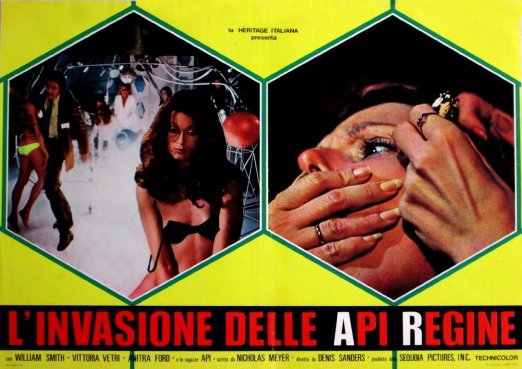
There’s one thing inarguably chilling in this and that’s the transformation sequence in the film where we see the entire process of what it takes to transform someone into the titular Bee Girl and its equal parts intense and frightening. In a completely dialogue-free sequence, a hypnotic drone sounds with a heavy dose of blue light blasting onto the subject. Various assisting worker Bee Girls cover the subject with a weird white substance that looks a little too much like Fluffernutter, then seal them into a chamber where bees swarm and cover every inch of their body. Daniel Robitaille, eat your heart out. They then emerge and the white stuff is peeled away, exposing the newly mutated lady inside. Truly creepy shit, and all achieved visually with no need for dialogue. If nothing else this is what you came to see.
Invasion of the Bee Girls is director Denis Sanders’ last feature film and Nicholas Meyer’s first film writing gig — he actually almost removed his name from the film after rewrites but was convinced to keep it. Got to take those credits when you can, I guess.




 B&S About Movies
You must be logged in to post a comment.