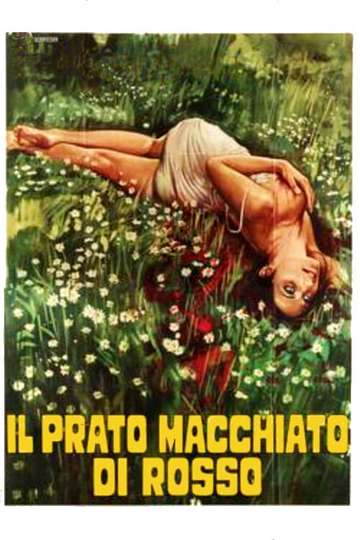
Il prato macchiato di rosso (1973)

The Red-Stained Lawn or The Bloodstained Lawn was originally called Vampiro 2000 and infuses science fiction, Gothic horror and giallo all in one wacky package with a bloodsucking robotic cherry on top.

The film takes place in Emilia-Romagna, Italy. There, a United Nations Educational, Scientific and Cultural Organization agent find a bottle of wine with blood in it. How could this happen to such a well-known vintage from Michelino Croci? What if the winery is a front for a blood smuggling scheme? And how would blood stay good in bottles? So many mysteries!

Dr. Antonio Genovese (Enzo Tarascio), his wife Nina (Marina Malfatti, All the Colors of the Dark, The Red Queen Kills Seven Times, Seven Blood-Stained Orchids) and her brother Alfiero (Claudio Biava) look for people with no ties — hippies, drifters, prostitutes and literally gypsies, tramps and thieves — to lure to an all expenses paid getaway at their castle. Folks like freewheeling musician Max (George Willing, Who Saw Her Die?) and his lover (Daniela Caroli), who have accepted an invitation to spend some time in the Genovese estate, along with the alcoholic tramp (Lucio Dalla, who would become a major singing star in the 80s), a gypsy (Barbara Marzano, The Bloodsucker Leads the Dance) and a sex worker (Dominique Boschero, Argoman the Fantastic Superman).

The bloodsucking machine is literally right out in the open, treated like a piece of pop art. You have to admire that level of out in the open when it comes to an Italian film killer. You also have to love that the killers have a shower that sprays wine and this doesn’t bother Max nor his never named girlfriend, nor does the hall of mirrors bedroom seem strange to anyone else. There’s also a curtain between rooms that totally looks like female anatomy and even more so a scene taking right out of The Laughing Woman.

Director and writer Riccardo Ghione only made four movies: this one, a documentary called Il Limbo, the hippy drama A cuore freddo and La rivoluzione sessuale, a movie in which 7 men and 7 women perform an experiment inspired by the sexual orgone energy theories of Wilhelm Reich. If that was crazy enough, it was co-written by Dario Argento. He would go on to write several other films, including the Joe D’Amato film Delizia.

I love that this movie stands on the line between arthouse and grindhouse with every decision it makes leaning away from the artistic and toward the prurient and bloody. Sure, there’s a message about how the rich subjugate the lower classes, but it’s also a film where Malfatti gives speeches about Wagner and how meaningless her victims are, all while a gigantic cartoony machine literally sucks young blood.

Circle of Fear episode 18: “Legion of Demons”

Directed by Paul Stanley, who had more than 110 directing credits, and written by Anthony Lawrence (who created The Phoenix and The Sixth Sense) and Richard Matheson, is all about Betty (Shirley Knight, Paul Blart’s mom), whose friend Janet (Kathryn Hays, As the World Turns)  has invited to leave small town life behind and enjoy the big city.

Except the big city is filled with devil worshippers.

Janet disappears and the office where she worked suggests that Betty take her place. But as she works more and more around these drones, she wonders if they have lost their souls.

Because they have.

Starring Jon Cypher (Man-At-Arms from Masters of the Universe), John Ventantonio (George Atwood in Private Parts), Neva Patterson, Paul Karr, James Luisi and Bridget Hanley, this episode may take a fair amount from Rosemary’s Baby, but when William Castle is your producer, you can do that.

This is one of the better episodes, filled with inventive camera angles, arresting dream sequences and plenty of Satanic imagery. Consider this my recommendation.

You can watch this on YouTube.

Tetsujin Tiger Seven (1973)

Iron Man Tiger Seven was a Japanese tokusatsu series that aired from October 6, 1973 to March 30, 1974 with a total of 26 episodes. It’s pretty much trying to be Kamen Rider without being Kamen Rider and has a hero born of tragedy, as several Mu monsters — yes, the same Mu that sung under the ocean and is also the home of the KLF — attack a dig that our hero’s human alter ego — Takigawa Go — is part of with his father, who is leading it. He’s stabbed in the heart and his father gives him an ancient heart that he has found in the ruins and a magic pendant that activates his powers when he says, “Tiger Spark.”

I say tragic because moments later, everyone but Takigawa Go gets killed and then a few episodes later, his girlfriend gets killed to, giving him the trademark scarf he wears when in Iron Man Tiger Seven mode.

Then again, he does get a somewhat intelligent motorcycle with rocket boosters and transformative powers that comes to his aid when he roars.

The bad guys in this are astounding with each monster of the week being called “something” Genjin, so we have Kappa Genjin, Merman Genjin, Flying Dragon Genjin, Rat Genjin and the incredible Wolf Genjin, who is a white wolf riding a motorcycle.

The same company that made this also created Kaiketsu Lion Maru, which has three kids in the samurai era who can transform into a human/lion hybrid.

You can watch the first episode on YouTube. There are also episodes with English subtitles on the Internet Archive.

Circle of Fear episode 17 “Doorway to Death”

Directed by Daryl Duke and written by Richard Matheson and Jimmy Sangster, this episode is all about a family moving into a new apartment in San Francisco. When young Robert (Leif Garrett) starts to explore, he finds an empty apartment with a door into the woods inside. He also meets a man inside those woods who asks to meet his sisters Jane (Garrett’s sister Dawn Lyn, Walking Tall) and Peggy (Susan Dey). Yet when the girls visit the room themselves, they only find a closet.

And then she learns that the ghost — the man in the woods killed his wife with an axe and then was executed — wants her for his next wife.

“Doorway to Death” may not be the best episode of the show, but the scene where Peggy wakes up to find wet footprints around her bed, as if someone was walking her room and watching her all night? That’s the kind of weird I keep watching this show for.

You can watch this on YouTube.

Circle of Fear episode 16 “Earth, Air, Fire and Water”

When you have D.C. Fontana, Harlan Ellison and Richard Matheson working on a story, you know it’s going to be good. This episode of Circle of Fear has a community of six artists who discover six colorful glass containers within a storefront that has rent and location that’s too good to be true.

Ellen Parrish (Joan Blackman, Macon County LineShiversBlue HawaiiPets), Sam Richards (Frank Converse), Jake Freeman (Tim McIntire,  the voice of Blood in A Boy and His Dog), Tyne Daly (Cagney and Lacey), Brooke Bundy (Elaine in two Elm Street movies) and Paul Cepeda (Scott Marlowe) are the artists who soon find that the containers are starting to take their souls and destroy them.

Director Alexander Singer had a career that stretched from making an episode of Dr. Kildare in 1961 all the way to Star Trek: Voyager in 1998.

This is a strange episode that I’ve noticed that plenty of folks disliked. I have no idea what episode they watched, because I loved it. It’s perfect for 1973 and the end of the era of artist collectives and free love. Watch it and let me know what you think.

You can watch this on YouTube.

APRIL MOVIE THON DAY 21: Nihon Chinbotsu (1973)

The highest grossing film in Japan in 1973 and 1974, Submersion of Japan or Japan Sinks! was also a big deal in the U.S. Roger Corman bought the rights as part of New World Pictures and made a remix where he cut out lots of footage, added new sequences directed by Andrew Meyer (Night of the Cobra Woman) and added Lorne Greene as an ambassador at the United Nations as well as appearances by Rhonda Leigh Hopkins (Summer School Teachers), John Fujioka (Shinyuki from American Ninja), Marvin Miller (anarratorr in several movies), Susan Sennett (Candy from The Candy Snatchers), Ralph James (Sixpack Annie), Phil Roth, Cliff Pellow and Joe Dante.

Now called Tidal Wave, it came out in May of 1975, while New World also released an uncut subtitled version called Submersion of Japan in America.

If you remember when we discussed Nosutoradamusu no daiyogen, Japan was in disaster mania, predicting the end of the world at every turn. This movie was inspired by Nippon chinbotsu by Sakyô Komatsu, the same author of Virus: The EndBye Bye JupiterDisappearance of the Capital and Time of the Apes. Of all his work, Komatsu’s sinking story was so popular that it became a TV series in 1974 and was remade in 2006 as Doomsday: The Sinking of Japan, then remade again as the 2020 TV mini-series Japan Sinks 2020, which was so big that it played theaters and spun off another series, Japan Sinks: People of Hope.

There was even a 2006 parody, Nihon igai zenbu chinbotsu, which means The World Sinks Except Japan.

This was no cheap picture. Director Shirô Moritani has been second unit on Yojimbo while writer Shinobu Hashimoto was behind RashomonSeven SamuraiThe Hidden Fortress and Throne of Blood amongst many other movies, as well as the director of Lake of Illusions, Minami no kaze to nami and I Want to Be a Shellfish.

Two hundred million years ago, what we know as the Earth was a single continent which split up over the years. At one point, Japan was part of the continent of Asia. But now? If you read the title, spoiler, Japan is going to sink. The first people to find out are geophysicist Dr. Tadokoro (Keiju Kobayashi, whose roles in comedies defined what post-war Japan saw as the ideal salaryman) and Onodera Toshio (Hiroshi Fujioka, the original Kamen Rider) take their submarine Wadatsumi-1 to the Ogasawara Islands. How bad is it? Well, the land mass that makes up the islands of Japan itself are about to collapse into a trench.

While Onodera is falling for Abe Reiko (Ayumi Ishida), volcanos start to erupt and earthquakes break out with more frequency. A rich businessman named Mr. Watari (Shōgo Shimada) pays for a series of expeditions to discover if Japan can be saved. But just like our climate, it’s already too late. Unlike our crisis, Japan has three choices: form a new country, seek a home in other countries or accept the end of the country and die.

They only have ten months to decide and as many countries offer to help, I’m reminded that as much as I love Japan, it’s an incredibly racist country. Even in a fictional story, South Korea, China and Taiwan refuse to help them. By the end, as the country sinks into the sea, more than half the population remains to go down with the ship. And our hero and heroine? They’re seperated a world away from one another.

You know who is in this? Turkish born actor Andrew Hughes, a businessman based in Tokyo as an import-export businessman who shows up in so many Japanese films from the late 1950s to the mid-1980s, usually in minor roles but even playing Hitler in The Crazy Adventure. The Japanese prime minister is played by Nobuo Nakamura, who was in Kurosawa’s films, but the really interesting actor is the man playing the driver of the Japanese leader. He’s played by Haruo Nakajima, who played Godzilla from 1954’s original film to 1972’s Godzilla vs. Gigan. After this role, he went to work in Toho’s bowling alley. I wish I was making that up.

This movie has some amazing alternate titles, such as Panic Over Tokyo (West Germany and I’m shocked that Frankenstein was not involved, as his name was on every Toho Godzilla movie releasd there), The Fall of Japan (Belgium), Death in the Rising Sun (Portugal knows how to name a movie), The Sun Does Not Rise Over the Island (Czechoslovakia), Planet Earth Year Zero (Italy), S.O.S. The Earth Is Sinking (Sweden) and The End of the World (Turkey).

Roger Ebert nominated this movie for The 50 Worst Films of All Time–and How They Got That Way by Harry Medved and Randy Dreyfuss. He said, “The movie never ends, but if you wait long enough it gets to a point where it’s over.”

As for the Japanese version of the film — which lends its special effects to the aforementioned Toho Nostradamus movie — I really liked that unlike so many disaster films, the actual socioeconomic problems that the world would face get explained and shown. There’s no shortage of waves crushing everything in their way, but at least we learn something.

You can watch the original Japanese version of this movie at the Internet Archive.

Circle of Fear episode 15: “Dark Vengeance”

EDITOR’S NOTE: This is the first episode of Circle of Fear that I ever watched, as I was trying to find a movie with an evil horse for this year’s Scarecrow Challenge. I’m so glad that I found this as it led to me watching the entire series. This originally was posted on October 22, 2021.

This is an episode of the show Ghost Story, which changed its name to Circle of Fear midway through its one season. Executive produced by William Castle, the original idea for the show was to have Sebastian Cabot play Winston Essex, the owner of a mysterious hotel called Mansfield House, which was really San Diego’s Hotel del Coronado where Wicked Wicked was filmed.

By episode 14 of 22, the show was retitled and Cabot was out and the show still suffered poor ratings, despite featuring writers like Robert Bloch, Harlan Ellison, D.C. Fontana and Jimmy Sangster.

Episode 15 was Dark Vengeance, which was written by Peter Dixon (whose career was all over the place in TV, working on everything from the Superman 1950s TV series to the Masters of the Universe cartoon) and directed by Herschel Daugherty (The Victim).

While working at a construction site, Frank (an incredibly, near impossible young Martin Sheen) finds a box that can;t be opened. He becomes obsessed with it and finally is able to break into it, revealing only a broken mirror and a toy horse that upsets his wife Cindy (KIm Darby, queen of the TV movie supernatural heroines) to increasing mania.

Of course Cindy would have a past with the horse. But how do you get it back in the box or even destroy it when it can even survive being set ablaze?

There’s no way a goofy wooden horse should be so damned frightening, but everyone is beyond committed to making this happen. Man, after seeing this episode, now I have an entire series to devour. This show suffered comparisons to Night Gallery, but after all, shouldn’t every anthology show made ever after Serling’s masterwork suffer that fate?

You can watch this on YouTube.

APRIL MOVIE THON DAY 14: Black Magic Rites (1973)

I mean, if you made a movie just for me, this would be it.

This had to be sent to the Italian censorship board twice, as they said that the film “consists of a rambling series of sadistic sequences, meant to urge, through extreme cruelty mixed with degenerate eroticism, the lowest sexual instincts.”

Also called Riti, magie nere e segrete orge nel Trecento…(Rites, Black Magic and Secret Orgies in the Fourteenth Century…) and The Reincarnation of Isabel, this was written and directed by Renato Polselli, who also made Delirio CaldoThe Vampire and the Ballerina and Revelations of a Psychiatrist on the World of Sexual Perversion.

Hundreds of years ago, Isabella (Rita Calderoni, Nude for Satan) was tortured and burned for being a witch as her lover swore revenge. Then we meet Jack Nelson (Mickey Hargitay, making some wild movies as always) and his stepdaughter Laureen (also Calderoni) who are celebrating her engagement in a castle without knowing that the cellar is host to the black magic rites of the title. And if they get seven sets of eyes and the blood of virgins, they can bring back Isabella.

Any time this movie feels like it’s getting boring or starting to make sense, it cuts to either sex scenes or murder or Satanic rituals and you know, more movies could learn from what it was all about. I can only imagine the kind of parties that Polselli used to host.

There are also vampires, because this movie is also known as The Ghastly Orgies of Count Dracula.

You know, I never dated many girls who wore makeup before my wife. But there was one that was taking her time putting on makeup and she was putting on false eyelashes and I was trying to say that she didn’t need all that makeup and lashes and she said, “I’m doing it for me. And you. So let me get hot for you.” I wish I had seen this movie before I dated her, because man, the fake eyelashes in this are doing something to me.

JESS FRANCO MONTH: Les ébranlées (1973)

Dolls for Sale is another Al Pereira (Howard Vernon) movie and this time, the detective is hired by a woman who simply wants him to break into a location and take an envelope. Of course, this leads to a murder and Al going deeper and deeper into a sleazy world that no one ever escapes.

That downward spiral takes Al so low that he stabs Lina Gordon (Glenda Allen), the woman who used him, who has just killed another woman (Anne Libert). But the reason why is that Al has learned that she was born a man and for some reason, his mental state just can’t deal with that, knowing that someone so seductive could be masculine under her feminine mask.

There’s a roughness that feels lived in, a sleaziness that feels authentic and a sexuality that feels brazen, thanks to Kali Hansa as Leona. I’m shocked that Al Pereira emerged from this story to appear in several more Franco films, but I often wonder if the Franco Cinematic Universe is a multiverse, where there are multiple Al Pereira, Red Lips, Dr. Orloff and Cathy/Lina aspects all living different lives, slightly off and all struggling to escape with their sanity intact and never their innocence.

JESS FRANCO MONTH: Le journal intime d’une nymphomane (1973)

Linda Vargas (Montserrat Prous) works a showgirl number with Maria Toledano (Kali Hansa, The Night of the Sorcerers) before picking up Ortiz (Manuel Pereiro), seducing him, calling the cops and killing herself by slicing her own throat, which implicates him in her murder.

His wife, Rosa (Jacqueline Laurent) attempts to learn the truth and discovers from Countess Anna de Monterey (Anne Libert, The DemonsA Virgin Among the Living Dead) that her husband assaulted Linda when she was just a young girl, going from drugs to, well, the title is Sinner: The Secret Diary of a Nymphomaniac, so you can guess the rest.

Made after the death of Soledad Miranda and before Franco would fall for Lina Romay, this comes from the more serious side of Jess Franco, feeling like it was inspired by the structure of Citizen Kane, which makes sense more than the absolutely formless movies he’d make later in his career.

The worst thing is that Jacqueline Laurent was fired from her position as a drama teacher at a private high school because of this film. Her students learned that she had appeared nude in this film — made 39 years before — and the school’s administration claimed that this and other erotic thrillers made in the sixties and seventies posed a distraction.